tow FIAT IDEA 2010 1.G Owner's Manual
[x] Cancel search | Manufacturer: FIAT, Model Year: 2010, Model line: IDEA, Model: FIAT IDEA 2010 1.GPages: 210, PDF Size: 4.4 MB
Page 126 of 210
125
STARTING
AND DRIVING
IN AN
EMERGENCY
MAINTENANCE
AND CARE
TECHNICAL
SPECIFICATIONS
ALPHABETICAL
INDEX
DASHBOARD
AND
CONTROLS
SAFETY
WARNING
LIGHTS AND
MESSAGES
If when turning the key to
MAR the warning light ¬does not turn on or stays on whilst
driving (together with the message in
the multifunctional display, where
provided), a failure may have oc-
curred in the restraint systems. In this
case the air bags or pretensioners
may not be deployed after an impact
or, in a minor number of cases, they
may be deployed accidentally. Con-
tact Fiat Dealership immediately to
have the system checked before dri-
ving off.
WARNING
The failure of the warning
light ¬is indicated by inter-
mittent blinking of the warning light
“that signals front passenger airbag
deactivated. The airbag system will
automatically deactivate the passen-
ger airbag (front and side, where pro-
vided). In this case, the warning light
¬may not indicate a fault in the sys-
tem. Contact the Fiat Dealership im-
mediately to have the system checked
before driving off.
WARNING
HOT ENGINE
COOLANT (red)
When the ignition key is
moved to MAR, the warning light
turns on and should go off after a few sec-
onds.
The warning light turns on when the en-
gine is overheated.
If the warning light comes on, proceed as
follows:
❒during normal travel: stop the car,
stop the engine and check that the wa-
ter level in the vessel is not under the
MINline. In this case, wait for a few
minutes for the engine to cool down
when slowly and carefully open the
cap, top-up with coolant and check
that the level is between the MINand
MAXreferences on the vessel itself.
Also check for leaks. Should the warn-
ing light turn on again at the next start-
up, contact Fiat Dealership.
u
❒If the vehicle is used under severe
conditions(e.g. towing of trailers up-
hill or fully loaded vehicle): slow down
and stop the car if the warning light
stays on. Stop for 2 or 3 minutes with
the engine running and slightly accel-
erated to assist better coolant circu-
lation. Then switch the engine off.
Check correct fluid level as described
above.
IMPORTANT Under severe use of the
car, keep the engine on and slightly accel-
erated for few minutes before switching it
off.
The display will show the dedicated mes-
sage.
LOW BATTERY
CHARGE (red)
When the ignition key is
moved to MAR, the warning light
turns on and should go out as soon as the
engine is started (with the engine running
at idle speed a brief delay in going out is
allowed). Go to a Lancia Dealership im-
mediately if the warning light stays on.w
123-132 LUM IDEA GB 2 ed.qxd 14-01-2010 13:47 Pagina 125
Page 134 of 210
133
STARTING
AND DRIVING
MAINTENANCE
AND CARE
TECHNICAL
SPECIFICATIONS
ALPHABETICAL
INDEX
DASHBOARD
AND
CONTROLS
SAFETY
WARNING
LIGHTS AND
MESSAGES
IN AN
EMERGENCY
OPENING/CLOSING THE DOORS................................ 134
STARTING THE ENGINE ................................................. 134
FIX & GO AUTOMATIC
(QUICK TYRE REPAIR KIT) ............................................. 136
REPLACING A WHEEL ..................................................... 140
WHEN NEEDING TO CHANGE A BULB .................. 144
REPLACING EXTERIOR BULBS ...................................... 147
REPLACING AN INTERIOR BULB ................................. 152
REPLACING FUSES ............................................................. 153
IF THE BATTERY IS FLAT ................................................. 158
LIFTING THE CAR ............................................................. 158
TOWING THE CAR .......................................................... 159
I I
N N
A A
N N
E E
M M
E E
R R
G G
E E
N N
C C
Y Y
In an emergency we recommend that you call the toll-free number found on the
Warranty Booklet. You will go to our web site at www.fiat.com
to find the Fiat Dealership nearest to you.
133-160 LUM IDEA GB 2 ed.qxd 14-01-2010 13:50 Pagina 133
Page 136 of 210
135
STARTING
AND DRIVING
MAINTENANCE
AND CARE
TECHNICAL
SPECIFICATIONS
ALPHABETICAL
INDEX
DASHBOARD
AND
CONTROLS
SAFETY
WARNING
LIGHTS AND
MESSAGES
IN AN
EMERGENCY
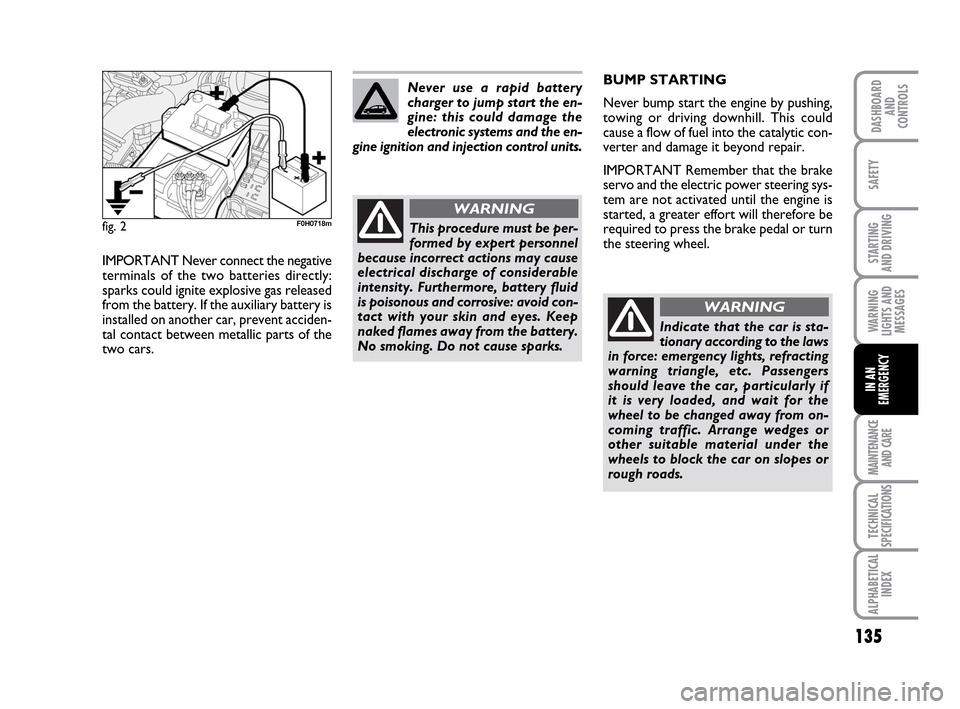
fig. 2F0H0718m
IMPORTANT Never connect the negative
terminals of the two batteries directly:
sparks could ignite explosive gas released
from the battery. If the auxiliary battery is
installed on another car, prevent acciden-
tal contact between metallic parts of the
two cars.
This procedure must be per-
formed by expert personnel
because incorrect actions may cause
electrical discharge of considerable
intensity. Furthermore, battery fluid
is poisonous and corrosive: avoid con-
tact with your skin and eyes. Keep
naked flames away from the battery.
No smoking. Do not cause sparks.
WARNING
Never use a rapid battery
charger to jump start the en-
gine: this could damage the
electronic systems and the en-
gine ignition and injection control units.BUMP STARTING
Never bump start the engine by pushing,
towing or driving downhill. This could
cause a flow of fuel into the catalytic con-
verter and damage it beyond repair.
IMPORTANT Remember that the brake
servo and the electric power steering sys-
tem are not activated until the engine is
started, a greater effort will therefore be
required to press the brake pedal or turn
the steering wheel.
Indicate that the car is sta-
tionary according to the laws
in force: emergency lights, refracting
warning triangle, etc. Passengers
should leave the car, particularly if
it is very loaded, and wait for the
wheel to be changed away from on-
coming traffic. Arrange wedges or
other suitable material under the
wheels to block the car on slopes or
rough roads.
WARNING
133-160 LUM IDEA GB 2 ed.qxd 14-01-2010 13:50 Pagina 135
Page 137 of 210
136
STARTING
AND DRIVING
MAINTENANCE
AND CARE
TECHNICAL
SPECIFICATIONS
ALPHABETICAL
INDEX
DASHBOARD
AND
CONTROLS
SAFETY
WARNING
LIGHTS AND
MESSAGES
IN AN
EMERGENCY
FIX & GO AUTOMATIC
(QUICK TYRE REPAIR
KIT) (where provided)
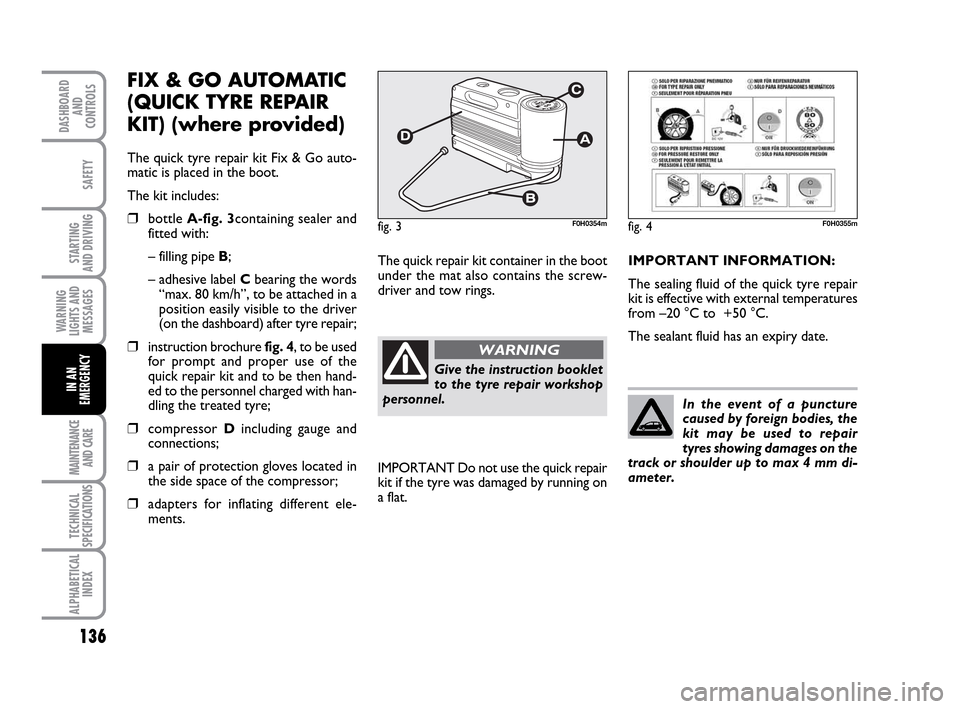
The quick tyre repair kit Fix & Go auto-
matic is placed in the boot.
The kit includes:
❒bottle A-fig. 3containing sealer and
fitted with:
– filling pipe B;
– adhesive label Cbearing the words
“max. 80 km/h”, to be attached in a
position easily visible to the driver
(on the dashboard) after tyre repair;
❒instruction brochure fig. 4, to be used
for prompt and proper use of the
quick repair kit and to be then hand-
ed to the personnel charged with han-
dling the treated tyre;
❒compressor Dincluding gauge and
connections;
❒a pair of protection gloves located in
the side space of the compressor;
❒adapters for inflating different ele-
ments.The quick repair kit container in the boot
under the mat also contains the screw-
driver and tow rings.
fig. 3F0H0354mfig. 4F0H0355m
Give the instruction booklet
to the tyre repair workshop
personnel.
WARNING
IMPORTANT Do not use the quick repair
kit if the tyre was damaged by running on
a flat.IMPORTANT INFORMATION:
The sealing fluid of the quick tyre repair
kit is effective with external temperatures
from –20 °C to +50 °C.
The sealant fluid has an expiry date.
In the event of a puncture
caused by foreign bodies, the
kit may be used to repair
tyres showing damages on the
track or shoulder up to max 4 mm di-
ameter.
133-160 LUM IDEA GB 2 ed.qxd 14-01-2010 13:50 Pagina 136
Page 145 of 210

144
STARTING
AND DRIVING
MAINTENANCE
AND CARE
TECHNICAL
SPECIFICATIONS
ALPHABETICAL
INDEX
DASHBOARD
AND
CONTROLS
SAFETY
WARNING
LIGHTS AND
MESSAGES
IN AN
EMERGENCY
WHEN NEEDING TO
CHANGE A BULB
GENERAL INSTRUCTIONS
❒When a bulb is not working, check
that the corresponding fuse is intact
before replacing it: refer to the “If a
fuse blows” paragraph in this chapter
for fuse location.
❒before changing a bulb check the con-
tacts for oxidation;
❒Burnt bulbs must be replaced by oth-
ers of the same type and power.
❒Always check the height of the head-
light beam after changing a bulb. Versions with alloy rims
❒Check that the hub contact surfaces
are clean;
❒fit the normal wheel centring it on the
pins, lead in the fastening screws and
tighten them using the wrench pro-
vided;
❒lower the car and remove the jack;
❒using the wrench provided, fully tight-
en the bolts in the sequence shown
in fig. 16.
❒snap fit the wheel cup on the hub.
When you have finished
❒stow the spare wheel C-fig. 11 in the
space provided in the boot;
❒Fit the jack partially open in its box B-
fig. 11forcing it lightly to prevent it
from vibrating when travelling;
❒put the tools back into their places in
the container;
❒arrange the container and tools in the
spare wheel and secure the fastening
device A-fig. 11;
❒rearrange the preformed boot cover
correctly.
Modifications or repairs to
the electrical system (elec-
tronic control units) that are not car-
ried out properly or do not take the
technical specifications of the system
into account can cause malfunctions
leading to the risk of fire.
WARNING
Halogen bulbs contain pres-
surised gas which may cause
small fragments of glass to be pro-
jected outwards if the bulb is broken.
WARNING
Halogen lamps must be han-
dled holding the metallic part
only. Touching the transpar-
ent part of the bulb with your
fingers may reduce the intensity of the
emitted light and even compromise du-
ration of the lamp itself. In the case of
accidental contact, rub the lamp with
a cloth and spirit and leave to dry.IMPORTANT When the weather is cold
or damp or after hard rain or after wash-
ing, the area of headlamps or rear lights,
may steam up and/or form drops of con-
densation on the inside. This is a natural
phenomenon due to the difference in tem-
perature and humidity between the inside
and the outside of the glass which does
not indicate a fault and does not compro-
mise the normal operation of lighting de-
vices. The mist disappears quickly turn-
ing the lights on, starting from the centre
of the diffuser, extending progressively to-
wards the edges.
133-160 LUM IDEA GB 2 ed.qxd 14-01-2010 13:50 Pagina 144
Page 160 of 210
159
STARTING
AND DRIVING
MAINTENANCE
AND CARE
TECHNICAL
SPECIFICATIONS
ALPHABETICAL
INDEX
DASHBOARD
AND
CONTROLS
SAFETY
WARNING
LIGHTS AND
MESSAGES
IN AN
EMERGENCY
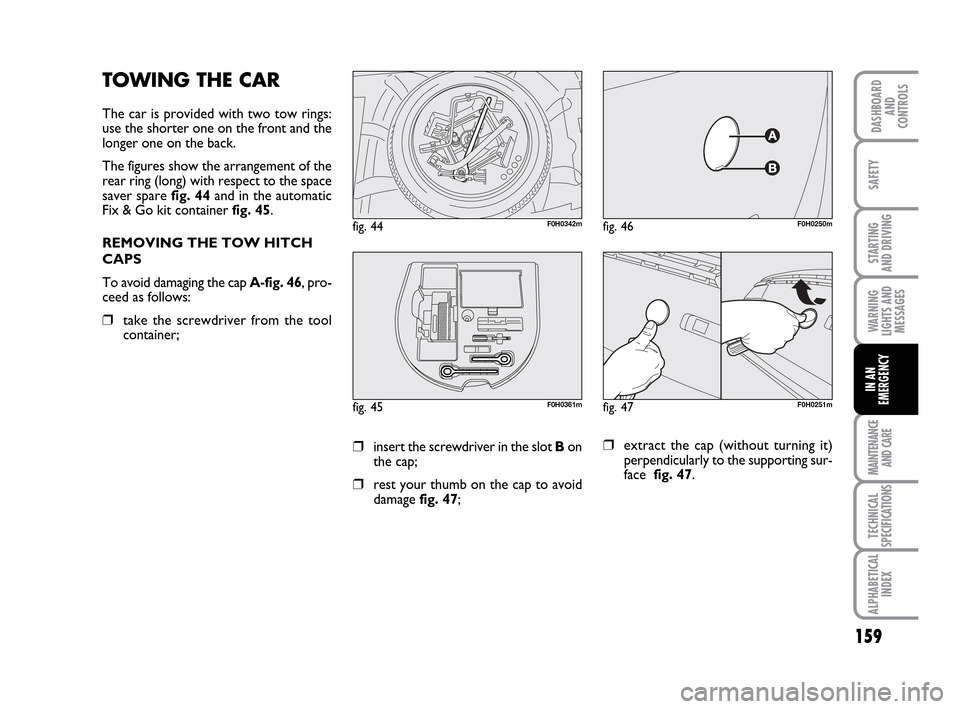
TOWING THE CAR
The car is provided with two tow rings:
use the shorter one on the front and the
longer one on the back.
The figures show the arrangement of the
rear ring (long) with respect to the space
saver spare fig. 44and in the automatic
Fix & Go kit container fig. 45.
REMOVING THE TOW HITCH
CAPS
To avoid damaging the cap A-fig. 46, pro-
ceed as follows:
❒take the screwdriver from the tool
container;
fig. 46F0H0250m
fig. 47F0H0251m
❒insert the screwdriver in the slot Bon
the cap;
❒rest your thumb on the cap to avoid
damage fig. 47;
fig. 44F0H0342m
fig. 45F0H0361m
❒extract the cap (without turning it)
perpendicularly to the supporting sur-
face fig. 47.
133-160 LUM IDEA GB 2 ed.qxd 14-01-2010 13:50 Pagina 159
Page 161 of 210
160
STARTING
AND DRIVING
MAINTENANCE
AND CARE
TECHNICAL
SPECIFICATIONS
ALPHABETICAL
INDEX
DASHBOARD
AND
CONTROLS
SAFETY
WARNING
LIGHTS AND
MESSAGES
IN AN
EMERGENCY
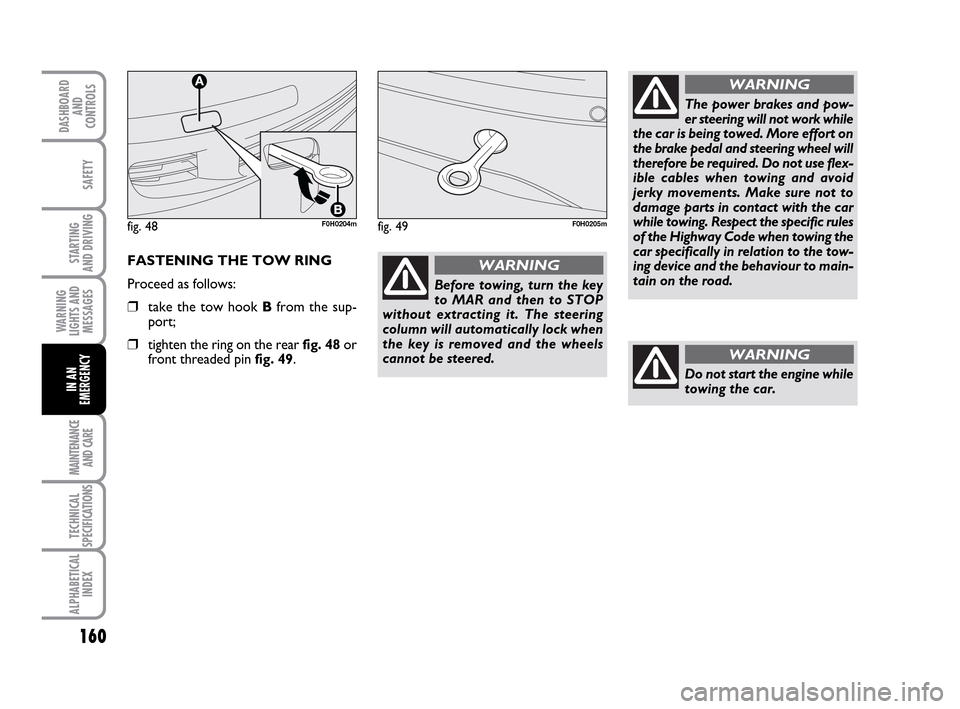
FASTENING THE TOW RING
Proceed as follows:
❒take the tow hook Bfrom the sup-
port;
❒tighten the ring on the rear fig. 48 or
front threaded pin fig. 49.
fig. 48F0H0204mfig. 49F0H0205m
Before towing, turn the key
to MAR and then to STOP
without extracting it. The steering
column will automatically lock when
the key is removed and the wheels
cannot be steered.
WARNING
The power brakes and pow-
er steering will not work while
the car is being towed. More effort on
the brake pedal and steering wheel will
therefore be required. Do not use flex-
ible cables when towing and avoid
jerky movements. Make sure not to
damage parts in contact with the car
while towing. Respect the specific rules
of the Highway Code when towing the
car specifically in relation to the tow-
ing device and the behaviour to main-
tain on the road.
WARNING
Do not start the engine while
towing the car.
WARNING
133-160 LUM IDEA GB 2 ed.qxd 14-01-2010 13:50 Pagina 160
Page 163 of 210
162
STARTING
AND DRIVING
IN AN
EMERGENCY
TECHNICAL
SPECIFICATIONS
ALPHABETICAL
INDEX
DASHBOARD
AND
CONTROLS
SAFETY
WARNING
LIGHTS AND
MESSAGES
MAINTENANCE
AND CARE
SCHEDULED SERVICING
Correct maintenance is essential for en-
suring long car life under the best condi-
tions.
This is why Fiat has planned a series of
checks and maintenance operations every
20,000 km.
Scheduled servicing will not however ful-
ly cover all of the need of your car: It is
however important to remember that
scheduled servicing does not completely
cover all the car’s requirements: also in
the initial period before 20.000 km service
coupon and later, between one coupon
and another, ordinary care is still required
such as for example routine check and
topping up the level of fluids, tyre pressure
check, etc.IMPORTANT Scheduled service coupons
are required by the manufacturer. Failure
to carry them out may invalidate the war-
ranty.
Scheduled Servicing is performed by all Fi-
at Dealerships at pre-established times.
If during each operation, in addition to the
ones programmed, the need arises for fur-
ther replacements or repairs, these may
only be carried out with the explicit agree-
ment of the Customer.IMPORTANT You are advised to contact
the Fiat Dealership in the event of any mi-
nor operating faults, without waiting for
the next service coupon.
If your car is used frequently for towing,
the interval between one service coupon
and the other must be reduced.
161-180 LUM IDEA GB 2 ed.qxd 14-01-2010 13:52 Pagina 162
Page 165 of 210
164
STARTING
AND DRIVING
IN AN
EMERGENCY
TECHNICAL
SPECIFICATIONS
ALPHABETICAL
INDEX
DASHBOARD
AND
CONTROLS
SAFETY
WARNING
LIGHTS AND
MESSAGES
MAINTENANCE
AND CARE
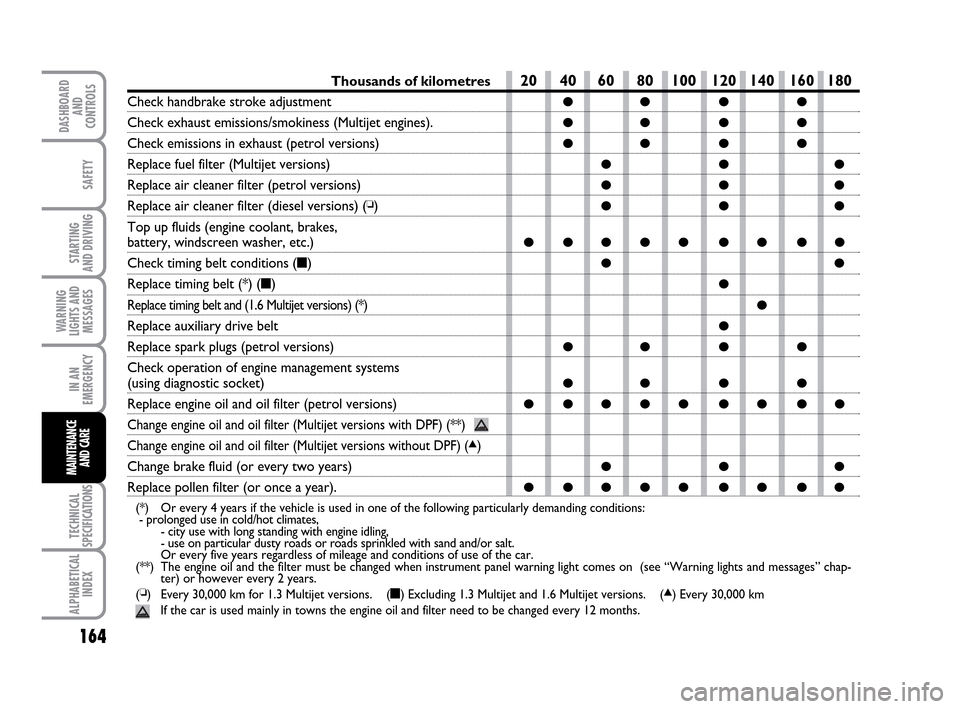
Thousands of kilometres
Check handbrake stroke adjustment
Check exhaust emissions/smokiness (Multijet engines).
Check emissions in exhaust (petrol versions)
Replace fuel filter (Multijet versions)
Replace air cleaner filter (petrol versions)
Replace air cleaner filter (diesel versions) (❏)
Top up fluids (engine coolant, brakes,
battery, windscreen washer, etc.)
Check timing belt conditions (■)
Replace timing belt (*) (■)
Replace timing belt and (1.6 Multijet versions) (*)
Replace auxiliary drive belt
Replace spark plugs (petrol versions)
Check operation of engine management systems
(using diagnostic socket)
Replace engine oil and oil filter (petrol versions)
Change engine oil and oil filter (Multijet versions with DPF) (**)
Change engine oil and oil filter (Multijet versions without DPF) (▲)
Change brake fluid (or every two years)
Replace pollen filter (or once a year).
(*) Or every 4 years if the vehicle is used in one of the following particularly demanding conditions:
- prolonged use in cold/hot climates,
- city use with long standing with engine idling,
- use on particular dusty roads or roads sprinkled with sand and/or salt.
Or every five years regardless of mileage and conditions of use of the car.
(**) The engine oil and the filter must be changed when instrument panel warning light comes on (see “Warning lights and messages” chap-
ter) or however every 2 years.
(
❏) Every 30,000 km for 1.3 Multijet versions. (■) Excluding 1.3 Multijet and 1.6 Multijet versions. (▲) Every 30,000 km
If the car is used mainly in towns the engine oil and filter need to be changed every 12 months.
20 40 60 80 100 120 140 160 180
●● ● ●
●● ● ●
●● ● ●
●●●
●●●
●●●
●●●●● ●●●●
●●
●
●
●
●● ● ●
●● ● ●
●●●●● ●●●●
●●●
●●●●● ●●●●
161-180 LUM IDEA GB 2 ed.qxd 14-01-2010 13:52 Pagina 164
Page 167 of 210
166
STARTING
AND DRIVING
IN AN
EMERGENCY
TECHNICAL
SPECIFICATIONS
ALPHABETICAL
INDEX
DASHBOARD
AND
CONTROLS
SAFETY
WARNING
LIGHTS AND
MESSAGES
MAINTENANCE
AND CARE
IMPORTANT - Engine oil
Should prevailing use of the car be under
one of the following specially heavy con-
ditions:
❒trailer or caravan towing;
❒dusty roads;
❒short repeated distances (less than 7-
8 km) and with external temperatures
below zero;
❒frequently idling engines or long dis-
tance low speed driving (e.g. taxis or
door-to-door deliveries) or in case of
a long term inactivity;
change engine oil more frequently than
shown on the “Service Schedule”.
IMPORTANT - Air cleaner
When the car is used on dusty roads,
change the air cleaner more frequently
than shown on the “Service Schedule”.
Call a Fiat Dealership for doubts regard-
ing engine oil and air cleaner replacement.IMPORTANT - Pollen filter
It is advisable to replace the filtering ele-
ment more frequently if the car is used in
dusty or very polluted places. Specifical-
ly, replace if a lower air flow into the pas-
senger compartment is found.
IMPORTANT - Diesel filter
Using diesel not complying with European
Specification EN590 may lead to the need
to replace the diesel fuel filter more fre-
quently than shown in the “Service Sched-
ule”.IMPORTANT - Battery
Check the battery charge once a year,
preferably before the beginning to winter,
to prevent freezing of the electrolyte.
Perform this inspection more frequently
if the car is mainly used for short distances
or if electrical devices running with the key
off are installed, particularly after-market.
Check the battery level (electrolyte) more
frequently than shown on the “Service
Schedule” if the car is used in hot climates
or in particularly demanding conditions.
Take the car to a Fiat Deal-
ership for servicing. Make
sure you have the right equip-
ment, genuine Fiat spare
parts and consumables for ordinary,
minor interventions. Do not attempt
the operations if you lack the experi-
ence.
161-180 LUM IDEA GB 2 ed.qxd 14-01-2010 13:52 Pagina 166