brake FIAT IDEA 2010 1.G Owner's Guide
[x] Cancel search | Manufacturer: FIAT, Model Year: 2010, Model line: IDEA, Model: FIAT IDEA 2010 1.GPages: 210, PDF Size: 4.4 MB
Page 165 of 210
164
STARTING
AND DRIVING
IN AN
EMERGENCY
TECHNICAL
SPECIFICATIONS
ALPHABETICAL
INDEX
DASHBOARD
AND
CONTROLS
SAFETY
WARNING
LIGHTS AND
MESSAGES
MAINTENANCE
AND CARE
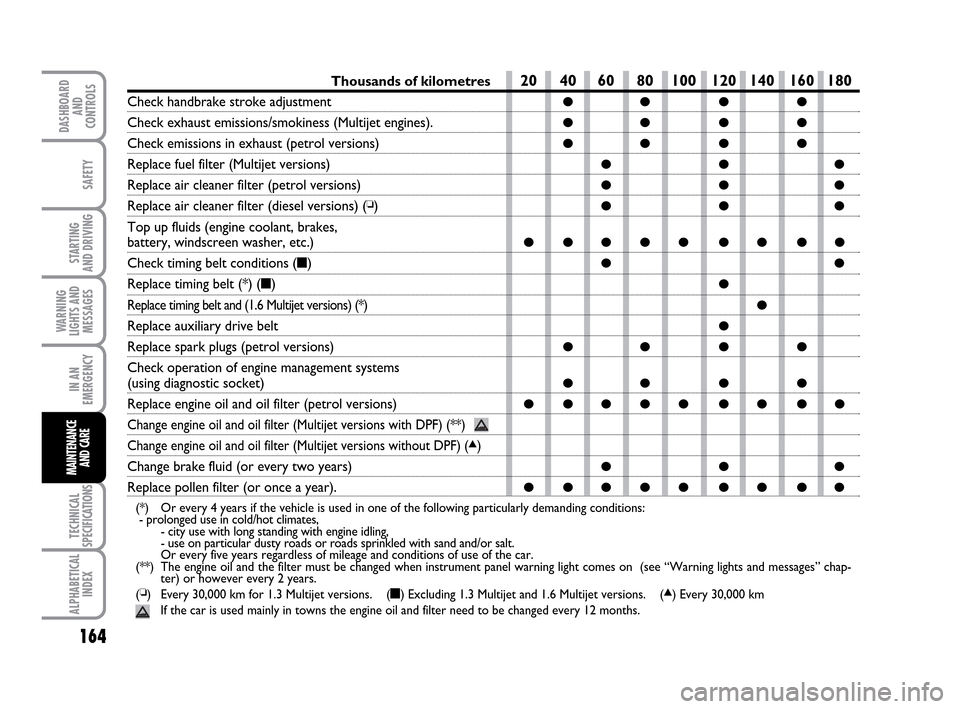
Thousands of kilometres
Check handbrake stroke adjustment
Check exhaust emissions/smokiness (Multijet engines).
Check emissions in exhaust (petrol versions)
Replace fuel filter (Multijet versions)
Replace air cleaner filter (petrol versions)
Replace air cleaner filter (diesel versions) (❏)
Top up fluids (engine coolant, brakes,
battery, windscreen washer, etc.)
Check timing belt conditions (■)
Replace timing belt (*) (■)
Replace timing belt and (1.6 Multijet versions) (*)
Replace auxiliary drive belt
Replace spark plugs (petrol versions)
Check operation of engine management systems
(using diagnostic socket)
Replace engine oil and oil filter (petrol versions)
Change engine oil and oil filter (Multijet versions with DPF) (**)
Change engine oil and oil filter (Multijet versions without DPF) (▲)
Change brake fluid (or every two years)
Replace pollen filter (or once a year).
(*) Or every 4 years if the vehicle is used in one of the following particularly demanding conditions:
- prolonged use in cold/hot climates,
- city use with long standing with engine idling,
- use on particular dusty roads or roads sprinkled with sand and/or salt.
Or every five years regardless of mileage and conditions of use of the car.
(**) The engine oil and the filter must be changed when instrument panel warning light comes on (see “Warning lights and messages” chap-
ter) or however every 2 years.
(
❏) Every 30,000 km for 1.3 Multijet versions. (■) Excluding 1.3 Multijet and 1.6 Multijet versions. (▲) Every 30,000 km
If the car is used mainly in towns the engine oil and filter need to be changed every 12 months.
20 40 60 80 100 120 140 160 180
●● ● ●
●● ● ●
●● ● ●
●●●
●●●
●●●
●●●●● ●●●●
●●
●
●
●
●● ● ●
●● ● ●
●●●●● ●●●●
●●●
●●●●● ●●●●
161-180 LUM IDEA GB 2 ed.qxd 14-01-2010 13:52 Pagina 164
Page 166 of 210
165
STARTING
AND DRIVING
IN AN
EMERGENCY
TECHNICAL
SPECIFICATIONS
ALPHABETICAL
INDEX
DASHBOARD
AND
CONTROLS
SAFETY
WARNING
LIGHTS AND
MESSAGES
MAINTENANCE
AND CARE
YEARLY INSPECTION
PLAN
The following yearly inspection plan is rec-
ommended for cars clocking less than
20,000 km a year (e.g. approximately
15.000 km):
❒check tyre conditions/wear and pres-
sure (included spare wheel)
❒check lighting system operation (head-
lights, direction indicators, hazard
lights, boot, passenger compartment,
instrument panel warning lights, etc.)
❒check windscreen wiper/washer
(nozzle direction and blade wear)
❒check front disk brake pad conditions
and wear;
❒visually inspect the conditions of: en-
gine, gearbox, flexible and stiff piping
(exhaust, fuel feed, brakes), rubber
parts (boots, sleeves, bushings, etc.)
❒check cleanness of locks, bonnet and
boot and lever cleanness and lubrica-
tion
❒check battery charge;
❒visually check the various drive belt
conditions;
❒check and top up liquids if required
(engine coolant, brakes, windscreen
washer, battery, etc.)
❒change engine oil;
❒change engine oil filter;
❒change pollen filter (where provided).
ADDITIONAL
INTERVENTIONS
Every 1,000 km or before long journeys,
check and, if necessary, top up:
❒engine coolant fluid level;
❒brake fluid level;
❒windscreen washer fluid level;
❒tyre pressure and conditions.
Every 3,000 km check and, if necessary,
top up: engine oil level.
You are recommended to use
PETRONAS LUBRICANTS products, de-
signed and produced specifically for Fiat
cars (see table “Capacities” in section
“Technical specifications”).
161-180 LUM IDEA GB 2 ed.qxd 14-01-2010 13:52 Pagina 165
Page 168 of 210
167
STARTING
AND DRIVING
IN AN
EMERGENCY
TECHNICAL
SPECIFICATIONS
ALPHABETICAL
INDEX
DASHBOARD
AND
CONTROLS
SAFETY
WARNING
LIGHTS AND
MESSAGES
MAINTENANCE
AND CARE
LEVELS CHECK
IMPORTANT Be careful not to confuse
the various types of fluids while topping
up: they are all reciprocally incompatible
and may severely damage your car.
IMPORTANT Never smoke while work-
ing in the engine compartment. Flamma-
ble gases may be present. Risk of fire.
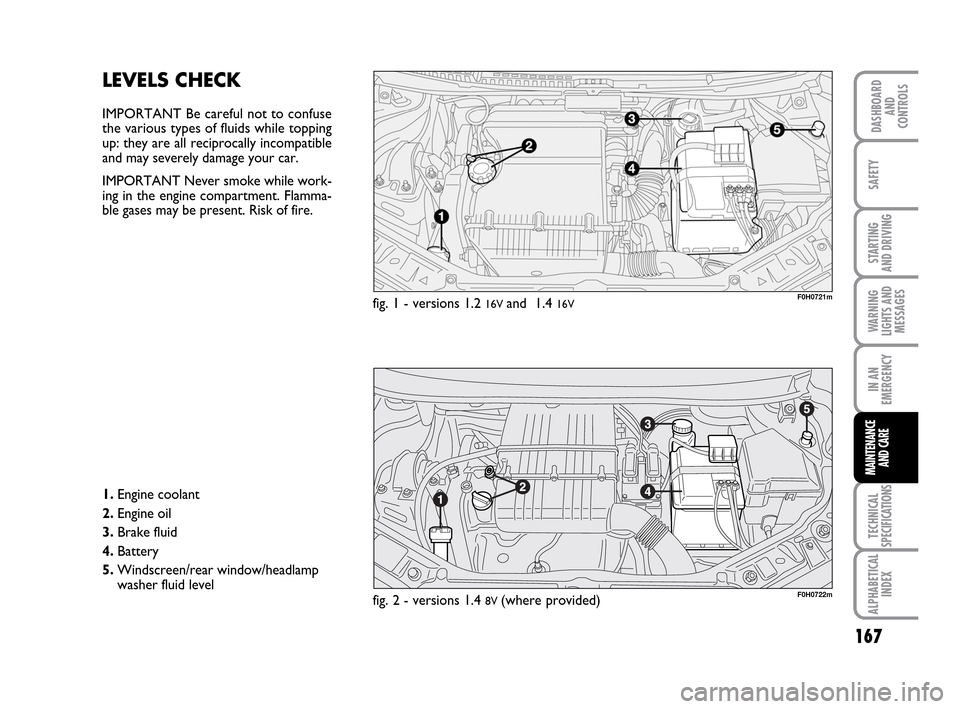
F0H0721mfig. 1 - versions 1.2 16V and 1.4 16V
F0H0722mfig. 2 - versions 1.4 8V (where provided) 1. Engine coolant
2. Engine oil
3. Brake fluid
4. Battery
5.Windscreen/rear window/headlamp
washer fluid level
161-180 LUM IDEA GB 2 ed.qxd 14-01-2010 13:52 Pagina 167
Page 169 of 210
168
STARTING
AND DRIVING
IN AN
EMERGENCY
TECHNICAL
SPECIFICATIONS
ALPHABETICAL
INDEX
DASHBOARD
AND
CONTROLS
SAFETY
WARNING
LIGHTS AND
MESSAGES
MAINTENANCE
AND CARE
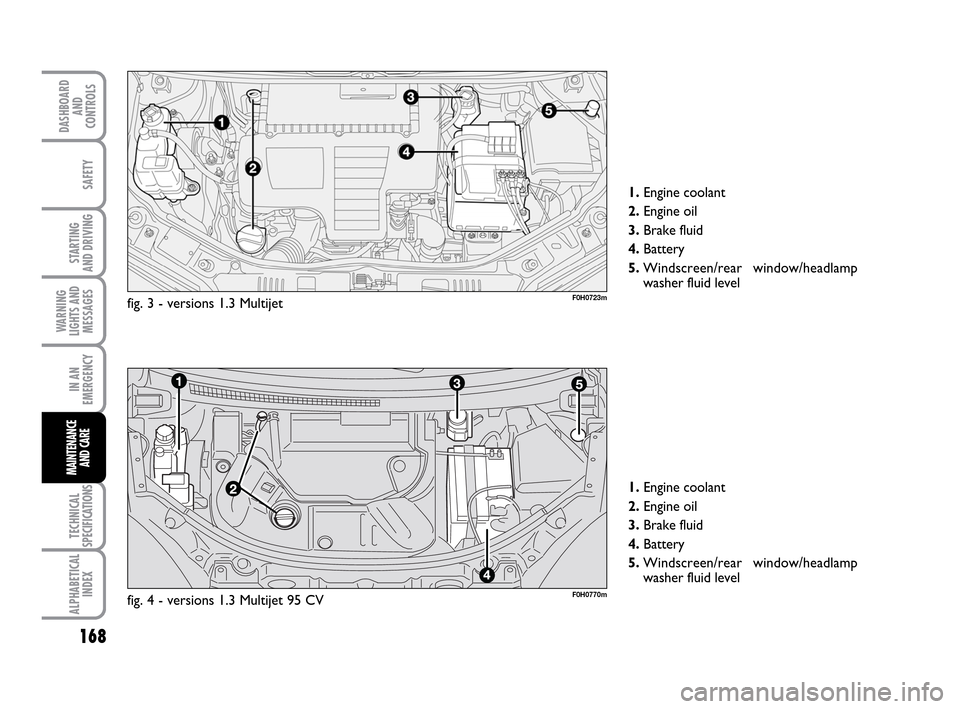
F0H0723mfig. 3 - versions 1.3 Multijet 1. Engine coolant
2. Engine oil
3. Brake fluid
4. Battery
5.Windscreen/rear window/headlamp
washer fluid level
F0H0770mfig. 4 - versions 1.3 Multijet 95 CV 1. Engine coolant
2.Engine oil
3. Brake fluid
4. Battery
5.Windscreen/rear window/headlamp
washer fluid level
161-180 LUM IDEA GB 2 ed.qxd 14-01-2010 13:52 Pagina 168
Page 170 of 210
169
STARTING
AND DRIVING
IN AN
EMERGENCY
TECHNICAL
SPECIFICATIONS
ALPHABETICAL
INDEX
DASHBOARD
AND
CONTROLS
SAFETY
WARNING
LIGHTS AND
MESSAGES
MAINTENANCE
AND CARE
3
12
45
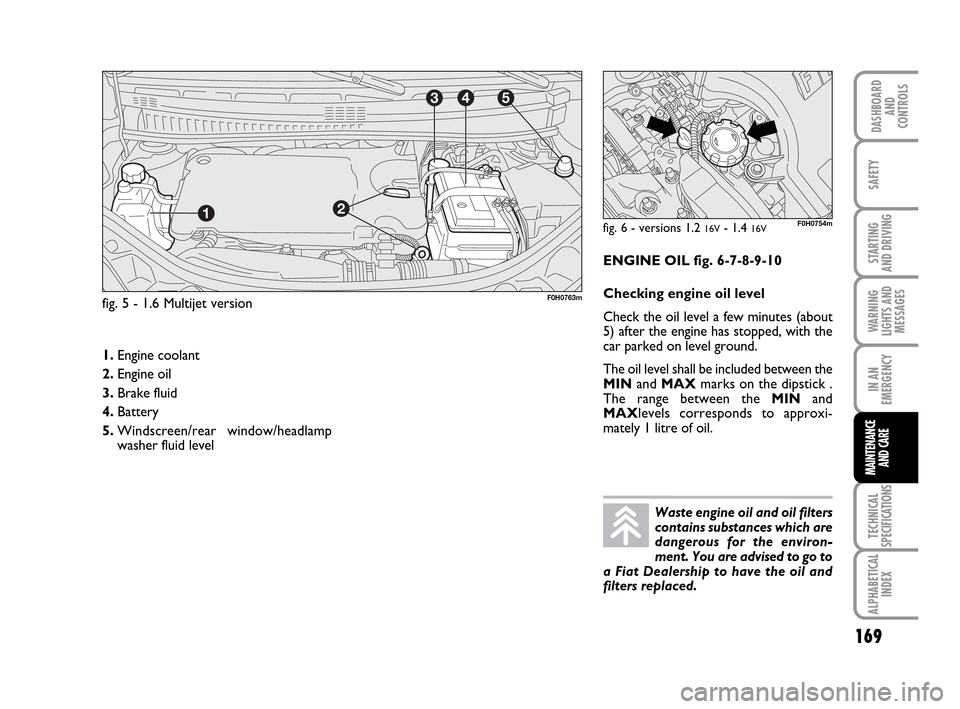
F0H0763mfig. 5 - 1.6 Multijet version
1. Engine coolant
2. Engine oil
3. Brake fluid
4. Battery
5.Windscreen/rear window/headlamp
washer fluid levelENGINE OIL fig. 6-7-8-9-10
Checking engine oil level
Check the oil level a few minutes (about
5) after the engine has stopped, with the
car parked on level ground.
The oil level shall be included between the
MINand MAXmarks on the dipstick .
The range between the MINand
MAXlevels corresponds to approxi-
mately 1 litre of oil.
fig. 6 - versions 1.2 16V- 1.4 16VF0H0754m
Waste engine oil and oil filters
contains substances which are
dangerous for the environ-
ment. You are advised to go to
a Fiat Dealership to have the oil and
filters replaced.
161-180 LUM IDEA GB 2 ed.qxd 14-01-2010 13:52 Pagina 169
Page 173 of 210
172
STARTING
AND DRIVING
IN AN
EMERGENCY
TECHNICAL
SPECIFICATIONS
ALPHABETICAL
INDEX
DASHBOARD
AND
CONTROLS
SAFETY
WARNING
LIGHTS AND
MESSAGES
MAINTENANCE
AND CARE
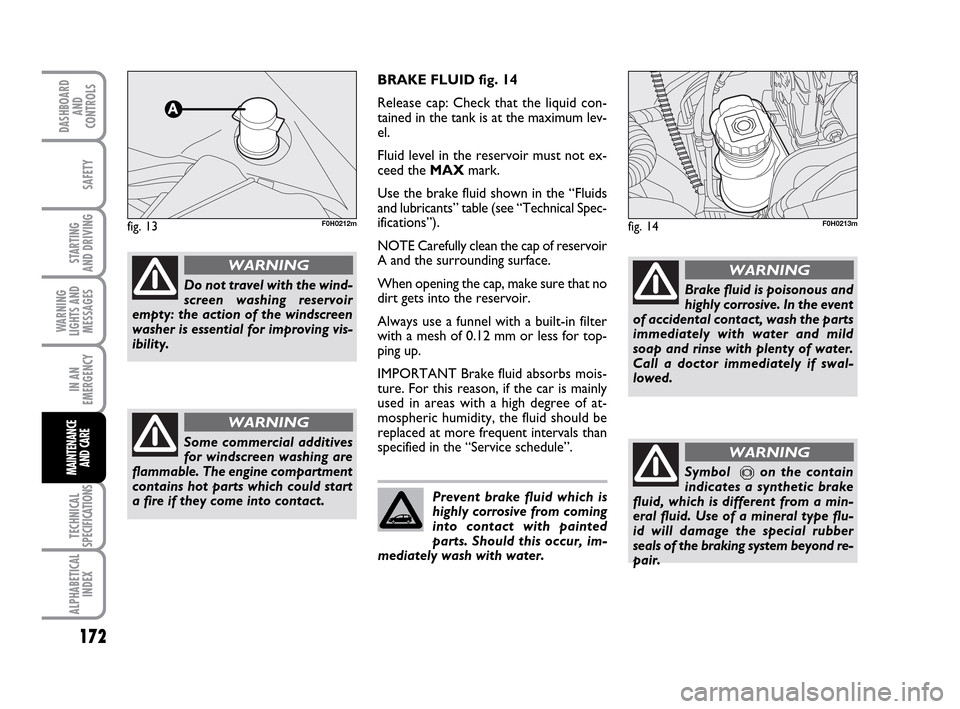
BRAKE FLUID fig. 14
Release cap: Check that the liquid con-
tained in the tank is at the maximum lev-
el.
Fluid level in the reservoir must not ex-
ceed the MAXmark.
Use the brake fluid shown in the “Fluids
and lubricants” table (see “Technical Spec-
ifications”).
NOTE Carefully clean the cap of reservoir
A and the surrounding surface.
When opening the cap, make sure that no
dirt gets into the reservoir.
Always use a funnel with a built-in filter
with a mesh of 0.12 mm or less for top-
ping up.
IMPORTANT Brake fluid absorbs mois-
ture. For this reason, if the car is mainly
used in areas with a high degree of at-
mospheric humidity, the fluid should be
replaced at more frequent intervals than
specified in the “Service schedule”.
fig. 14F0H0213m
Brake fluid is poisonous and
highly corrosive. In the event
of accidental contact, wash the parts
immediately with water and mild
soap and rinse with plenty of water.
Call a doctor immediately if swal-
lowed.
WARNING
Symbol πon the contain
indicates a synthetic brake
fluid, which is different from a min-
eral fluid. Use of a mineral type flu-
id will damage the special rubber
seals of the braking system beyond re-
pair.
WARNING
Prevent brake fluid which is
highly corrosive from coming
into contact with painted
parts. Should this occur, im-
mediately wash with water.
Do not travel with the wind-
screen washing reservoir
empty: the action of the windscreen
washer is essential for improving vis-
ibility.
WARNING
Some commercial additives
for windscreen washing are
flammable. The engine compartment
contains hot parts which could start
a fire if they come into contact.
WARNING
fig. 13F0H0212m
161-180 LUM IDEA GB 2 ed.qxd 14-01-2010 13:52 Pagina 172
Page 177 of 210
176
STARTING
AND DRIVING
IN AN
EMERGENCY
TECHNICAL
SPECIFICATIONS
ALPHABETICAL
INDEX
DASHBOARD
AND
CONTROLS
SAFETY
WARNING
LIGHTS AND
MESSAGES
MAINTENANCE
AND CARE
RUBBER HOSES
Carefully follow the information contained
in the “Service schedule” in this section
for maintenance of brake system and fuel
feed rubber hoses.
Ozone, high temperatures and prolonged
lack of fluid in the system may cause hard-
ening and cracking of the hoses, with pos-
sible leaks. Careful inspections are there-
fore necessary.
WINDSCREEN/REAR
WINDOW
WIPER/WASHER
BLADES
Periodically clean the rubber part using
special products; TUTELA PROFES-
SIONAL SC 35is recommended.
Replace the blades if the rubber edge is
deformed or worn. In all cases, it is ad-
visable to replace them approximately
once a year.
A few simple precautions can reduce the
possibility of damage to the blades:
❒make sure that the rubber part is not
stuck to the windscreen at sub-zero
temperatures. Use an antifreeze prod-
uct to release it if required;
❒remove the snow from the window:
this will avoid overstressing the elec-
trical motor and causing it to overheat
in addition to protecting the blades;
❒do not operate the windscreen and
rear window wipers on dry glass.
Driving with worn wiper
blades is a serious hazard,
because visibility is reduced in bad
weather.
WARNING
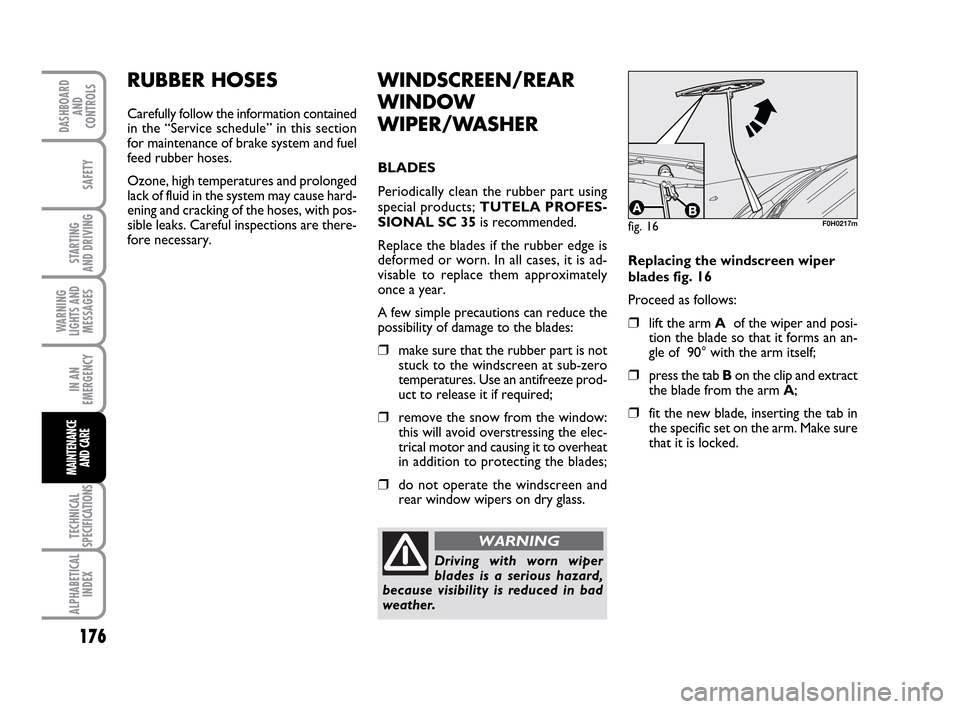
Replacing the windscreen wiper
blades fig. 16
Proceed as follows:
❒lift the arm Aof the wiper and posi-
tion the blade so that it forms an an-
gle of 90° with the arm itself;
❒press the tab Bon the clip and extract
the blade from the arm A;
❒fit the new blade, inserting the tab in
the specific set on the arm. Make sure
that it is locked.
fig. 16F0H0217m
161-180 LUM IDEA GB 2 ed.qxd 14-01-2010 13:53 Pagina 176
Page 182 of 210
181
STARTING
AND DRIVING
IN AN
EMERGENCY
MAINTENANCE
AND CARE
ALPHABETICAL
INDEX
DASHBOARD
AND
CONTROLS
SAFETY
WARNING
LIGHTS AND
MESSAGES
TECHNICAL
SPECIFICATIONS
IDENTIFICATION DATA ................................................. 182
ENGINE CODES - BODYWORK VERSIONS ............. 184
ENGINE ................................................................................. 185
FUEL FEED/IGNITION ....................................................... 187
TRANSMISSION UNIT ...................................................... 187
BRAKES .................................................................................. 188
SUSPENSIONS ..................................................................... 188
STEERING SYSTEM ............................................................. 188
WHEELS ................................................................................. 189
DIMENSIONS ....................................................................... 193
PERFORMANCE .................................................................. 193
WEIGHTS .............................................................................. 194
CAPACITIES ......................................................................... 195
FLUIDS AND LUBRICANTS ............................................ 196
FUEL CONSUMPTION ...................................................... 198
CO
2EMISSIONS .................................................................. 199
T T
E E
C C
H H
N N
I I
C C
A A
L L
S S
P P
E E
C C
I I
F F
I I
C C
A A
T T
I I
O O
N N
S S
181-199 LUM IDEA GB 2 ed.qxd 14-01-2010 13:56 Pagina 181
Page 189 of 210
188
STARTING
AND DRIVING
IN AN
EMERGENCY
MAINTENANCE
AND CARE
ALPHABETICAL
INDEX
DASHBOARD
AND
CONTROLS
SAFETY
WARNING
LIGHTS AND
MESSAGES
TECHNICAL
SPECIFICATIONS
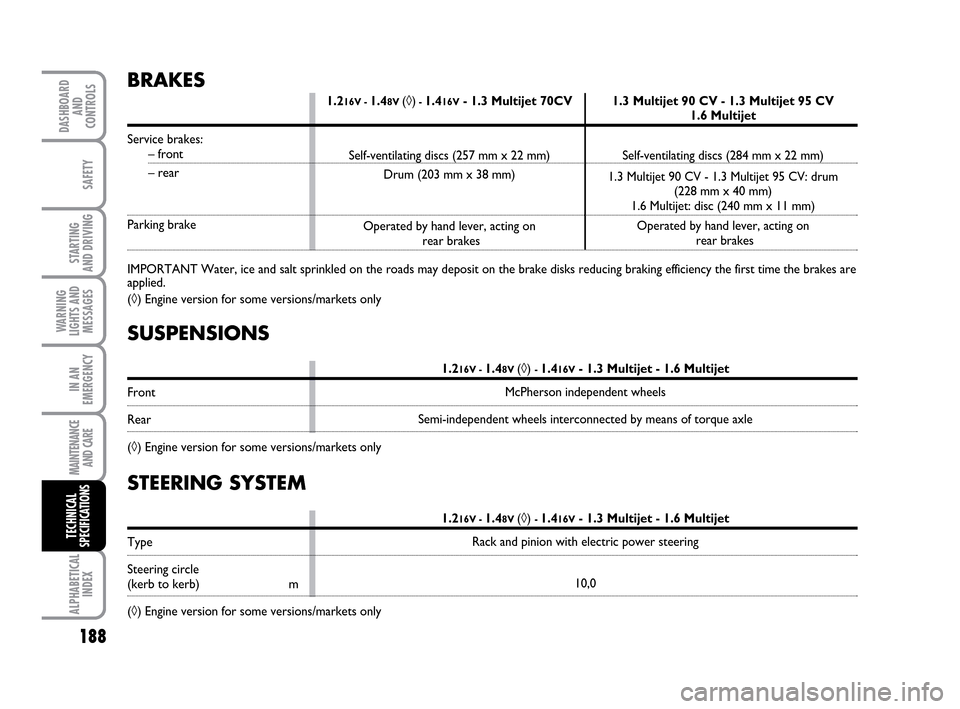
SUSPENSIONS
Front
Rear
(◊) Engine version for some versions/markets only1.2
16V - 1.48V (◊) - 1.416V- 1.3 Multijet - 1.6 Multijet
McPherson independent wheels
Semi-independent wheels interconnected by means of torque axle
STEERING SYSTEM
Type
Steering circle
(kerb to kerb) m
(◊) Engine version for some versions/markets only1.2
16V - 1.48V (◊) - 1.416V- 1.3 Multijet - 1.6 Multijet
Rack and pinion with electric power steering
10,0
BRAKES
Service brakes:– front
– rear
Parking brake
IMPORTANT Water, ice and salt sprinkled on the roads may deposit on the brake disks reducing braking efficiency the first time the brakes are
applied.
(◊) Engine version for some versions/markets only1.2
16V - 1.48V (◊)- 1.416V- 1.3 Multijet 70CV
Self-ventilating discs (257 mm x 22 mm)
Drum (203 mm x 38 mm)
Operated by hand lever, acting on
rear brakes1.3 Multijet 90 CV - 1.3 Multijet 95 CV
1.6 Multijet
Self-ventilating discs (284 mm x 22 mm)
1.3 Multijet 90 CV - 1.3 Multijet 95 CV: drum
(228 mm x 40 mm)
1.6 Multijet: disc (240 mm x 11 mm)
Operated by hand lever, acting on
rear brakes
181-199 LUM IDEA GB 2 ed.qxd 14-01-2010 13:56 Pagina 188
Page 195 of 210
194
STARTING
AND DRIVING
IN AN
EMERGENCY
MAINTENANCE
AND CARE
ALPHABETICAL
INDEX
DASHBOARD
AND
CONTROLS
SAFETY
WARNING
LIGHTS AND
MESSAGES
TECHNICAL
SPECIFICATIONS
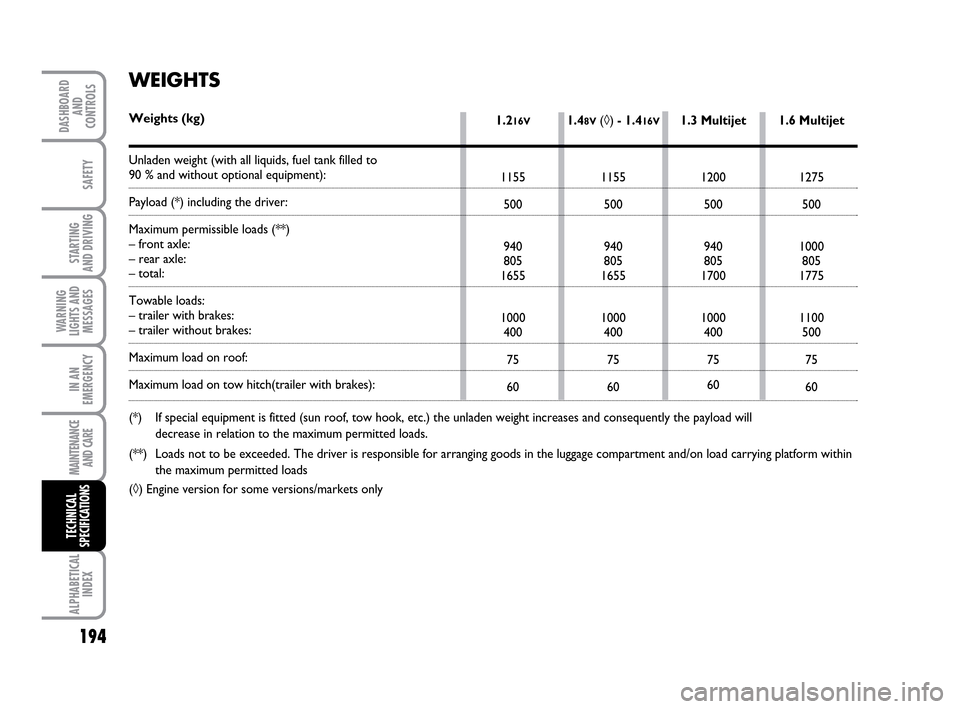
WEIGHTS
Weights (kg)
Unladen weight (with all liquids, fuel tank filled to 90 % and without optional equipment):
Payload (*) including the driver:
Maximum permissible loads (**)
– front axle:
– rear axle:
– total:
Towable loads:
– trailer with brakes:
– trailer without brakes:
Maximum load on roof:
Maximum load on tow hitch(trailer with brakes):
(*) If special equipment is fitted (sun roof, tow hook, etc.) the unladen weight increases and consequently the payload will
decrease in relation to the maximum permitted loads.
(**) Loads not to be exceeded. The driver is responsible for arranging goods in the luggage compartment and/on load carrying platform within
the maximum permitted loads
(◊) Engine version for some versions/markets only1.2
16V
1155
500
940
805
1655
1000
400
75
601.4
8V(◊) - 1.416V
1155
500
940
805
1655
1000
400
75
601.3 Multijet
1200
500
940
805
1700
1000
400
75
601.6 Multijet
1275
500
1000
805
1775
1100
500
75
60
181-199 LUM IDEA GB 2 ed.qxd 14-01-2010 13:56 Pagina 194