oil change FIAT IDEA 2010 1.G Owners Manual
[x] Cancel search | Manufacturer: FIAT, Model Year: 2010, Model line: IDEA, Model: FIAT IDEA 2010 1.GPages: 210, PDF Size: 4.4 MB
Page 87 of 210
86
SAFETY
STARTING
AND DRIVING
WARNING
LIGHTS AND
MESSAGES
IN AN
EMERGENCY
MAINTENANCE
AND CARE
TECHNICAL
SPECIFICATIONS
ALPHABETICAL
INDEX
DASHBOARD
AND CONTROLS
ACCESSORIES
PURCHASED BY THE
OWNER
If after buying the car, you decide to install
electrical accessories that require a per-
manent electric supply (alarm, satellite an-
titheft system, etc.) or accessories that in
any case burden the electric supply, con-
tact Fiat Dealership, whose qualified per-
sonnel, besides suggesting the most suit-
able devices belonging to Lineaccessori Fi-
at, will also evaluate the overall electric
consumption, checking whether the car’s
electric system is able to withstand the
load required, or whether it needs to be
integrated with a more powerful battery.
INSTALLING
ELECTRICAL/ELECTRONIC
DEVICES
Electrical and electronic devices installed
after buying the car by after-market ser-
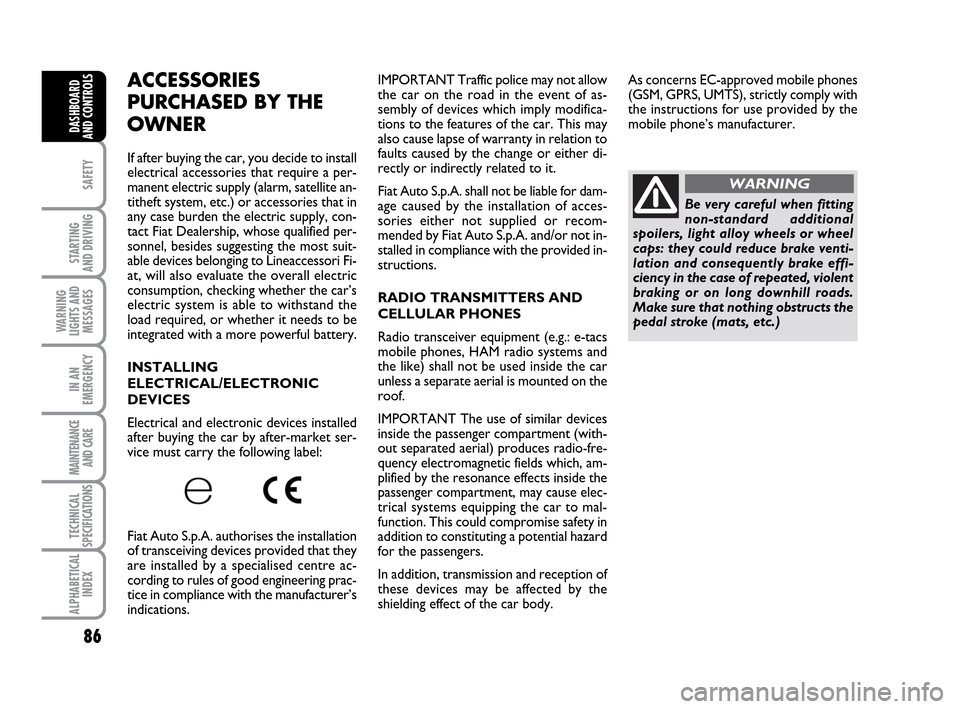
vice must carry the following label:
Fiat Auto S.p.A. authorises the installation
of transceiving devices provided that they
are installed by a specialised centre ac-
cording to rules of good engineering prac-
tice in compliance with the manufacturer’s
indications.IMPORTANT Traffic police may not allow
the car on the road in the event of as-
sembly of devices which imply modifica-
tions to the features of the car. This may
also cause lapse of warranty in relation to
faults caused by the change or either di-
rectly or indirectly related to it.
Fiat Auto S.p.A. shall not be liable for dam-
age caused by the installation of acces-
sories either not supplied or recom-
mended by Fiat Auto S.p.A. and/or not in-
stalled in compliance with the provided in-
structions.
RADIO TRANSMITTERS AND
CELLULAR PHONES
Radio transceiver equipment (e.g.: e-tacs
mobile phones, HAM radio systems and
the like) shall not be used inside the car
unless a separate aerial is mounted on the
roof.
IMPORTANT The use of similar devices
inside the passenger compartment (with-
out separated aerial) produces radio-fre-
quency electromagnetic fields which, am-
plified by the resonance effects inside the
passenger compartment, may cause elec-
trical systems equipping the car to mal-
function. This could compromise safety in
addition to constituting a potential hazard
for the passengers.
In addition, transmission and reception of
these devices may be affected by the
shielding effect of the car body.As concerns EC-approved mobile phones
(GSM, GPRS, UMTS), strictly comply with
the instructions for use provided by the
mobile phone’s manufacturer.
Be very careful when fitting
non-standard additional
spoilers, light alloy wheels or wheel
caps: they could reduce brake venti-
lation and consequently brake effi-
ciency in the case of repeated, violent
braking or on long downhill roads.
Make sure that nothing obstructs the
pedal stroke (mats, etc.)
WARNING
036-092 LUM IDEA GB 2 ed.qxd 14-01-2010 12:15 Pagina 86
Page 127 of 210
126
STARTING
AND DRIVING
IN AN
EMERGENCY
MAINTENANCE
AND CARE
TECHNICAL
SPECIFICATIONS
ALPHABETICAL
INDEX
DASHBOARD
AND
CONTROLS
SAFETY
WARNING
LIGHTS AND
MESSAGES
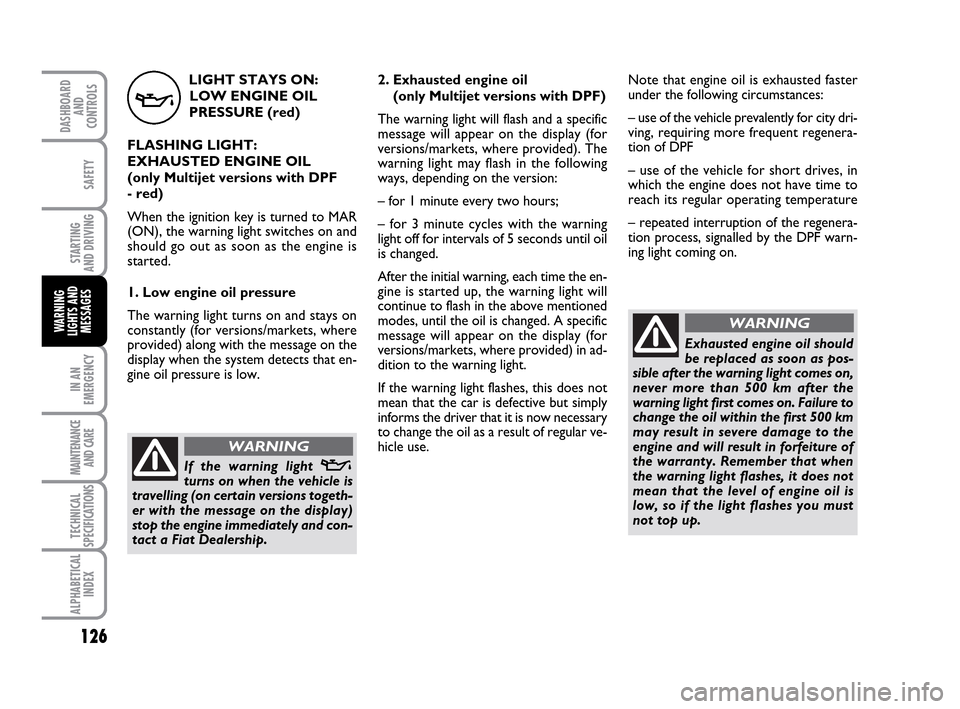
LIGHT STAYS ON:
LOW ENGINE OIL
PRESSURE (red)
FLASHING LIGHT:
EXHAUSTED ENGINE OIL
(only Multijet versions with DPF
- red)
When the ignition key is turned to MAR
(ON), the warning light switches on and
should go out as soon as the engine is
started.
1. Low engine oil pressure
The warning light turns on and stays on
constantly (for versions/markets, where
provided) along with the message on the
display when the system detects that en-
gine oil pressure is low.
v
2. Exhausted engine oil
(only Multijet versions with DPF)
The warning light will flash and a specific
message will appear on the display (for
versions/markets, where provided). The
warning light may flash in the following
ways, depending on the version:
– for 1 minute every two hours;
– for 3 minute cycles with the warning
light off for intervals of 5 seconds until oil
is changed.
After the initial warning, each time the en-
gine is started up, the warning light will
continue to flash in the above mentioned
modes, until the oil is changed. A specific
message will appear on the display (for
versions/markets, where provided) in ad-
dition to the warning light.
If the warning light flashes, this does not
mean that the car is defective but simply
informs the driver that it is now necessary
to change the oil as a result of regular ve-
hicle use.
If the warning light v
turns on when the vehicle is
travelling (on certain versions togeth-
er with the message on the display)
stop the engine immediately and con-
tact a Fiat Dealership.
WARNING
Note that engine oil is exhausted faster
under the following circumstances:
– use of the vehicle prevalently for city dri-
ving, requiring more frequent regenera-
tion of DPF
– use of the vehicle for short drives, in
which the engine does not have time to
reach its regular operating temperature
– repeated interruption of the regenera-
tion process, signalled by the DPF warn-
ing light coming on.
WARNING
Exhausted engine oil should
be replaced as soon as pos-
sible after the warning light comes on,
never more than 500 km after the
warning light first comes on. Failure to
change the oil within the first 500 km
may result in severe damage to the
engine and will result in forfeiture of
the warranty. Remember that when
the warning light flashes, it does not
mean that the level of engine oil is
low, so if the light flashes you must
not top up.
123-132 LUM IDEA GB 2 ed.qxd 14-01-2010 13:47 Pagina 126
Page 131 of 210
130
STARTING
AND DRIVING
IN AN
EMERGENCY
MAINTENANCE
AND CARE
TECHNICAL
SPECIFICATIONS
ALPHABETICAL
INDEX
DASHBOARD
AND
CONTROLS
SAFETY
WARNING
LIGHTS AND
MESSAGES
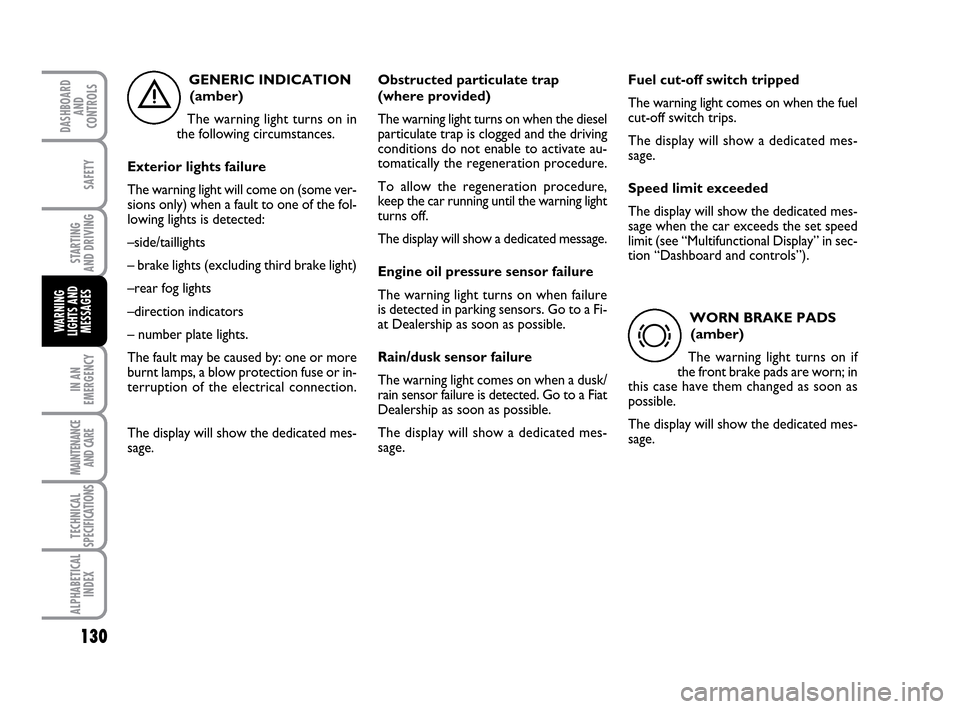
GENERIC INDICATION
(amber)
The warning light turns on in
the following circumstances.
Exterior lights failure
The warning light will come on (some ver-
sions only) when a fault to one of the fol-
lowing lights is detected:
–side/taillights
– brake lights (excluding third brake light)
–rear fog lights
–direction indicators
– number plate lights.
The fault may be caused by: one or more
burnt lamps, a blow protection fuse or in-
terruption of the electrical connection.
The display will show the dedicated mes-
sage.
è
Obstructed particulate trap
(where provided)
The warning light turns on when the diesel
particulate trap is clogged and the driving
conditions do not enable to activate au-
tomatically the regeneration procedure.
To allow the regeneration procedure,
keep the car running until the warning light
turns off.
The display will show a dedicated message.
Engine oil pressure sensor failure
The warning light turns on when failure
is detected in parking sensors. Go to a Fi-
at Dealership as soon as possible.
Rain/dusk sensor failure
The warning light comes on when a dusk/
rain sensor failure is detected. Go to a Fiat
Dealership as soon as possible.
The display will show a dedicated mes-
sage.Fuel cut-off switch tripped
The warning light comes on when the fuel
cut-off switch trips.
The display will show a dedicated mes-
sage.
Speed limit exceeded
The display will show the dedicated mes-
sage when the car exceeds the set speed
limit (see “Multifunctional Display” in sec-
tion “Dashboard and controls”).
WORN BRAKE PADS
(amber)
The warning light turns on if
the front brake pads are worn; in
this case have them changed as soon as
possible.
The display will show the dedicated mes-
sage.
d
123-132 LUM IDEA GB 2 ed.qxd 14-01-2010 13:47 Pagina 130
Page 165 of 210
164
STARTING
AND DRIVING
IN AN
EMERGENCY
TECHNICAL
SPECIFICATIONS
ALPHABETICAL
INDEX
DASHBOARD
AND
CONTROLS
SAFETY
WARNING
LIGHTS AND
MESSAGES
MAINTENANCE
AND CARE
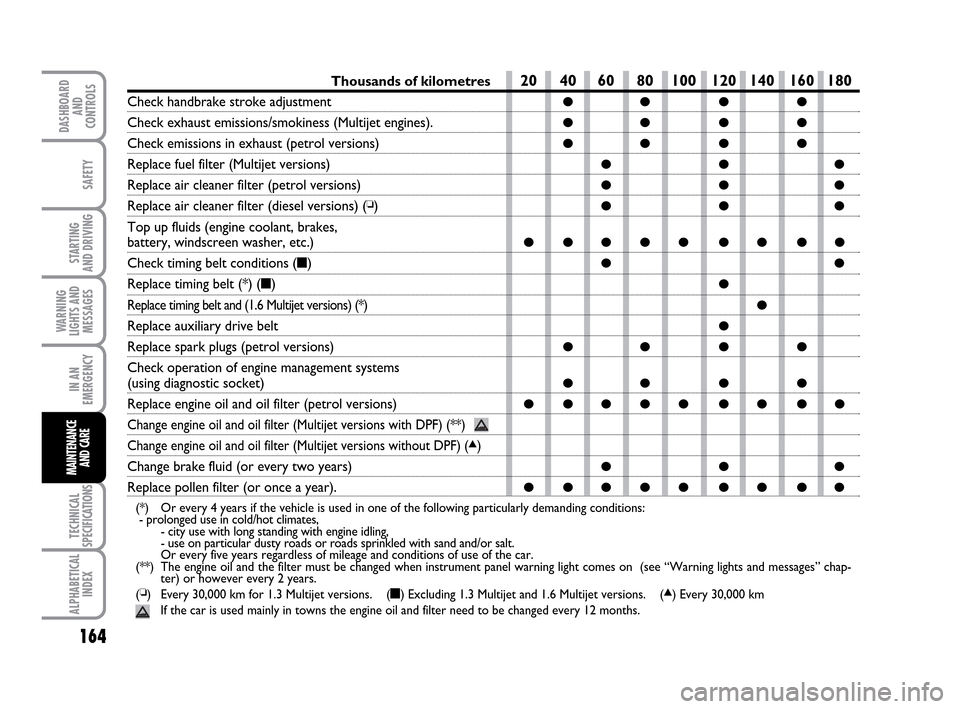
Thousands of kilometres
Check handbrake stroke adjustment
Check exhaust emissions/smokiness (Multijet engines).
Check emissions in exhaust (petrol versions)
Replace fuel filter (Multijet versions)
Replace air cleaner filter (petrol versions)
Replace air cleaner filter (diesel versions) (❏)
Top up fluids (engine coolant, brakes,
battery, windscreen washer, etc.)
Check timing belt conditions (■)
Replace timing belt (*) (■)
Replace timing belt and (1.6 Multijet versions) (*)
Replace auxiliary drive belt
Replace spark plugs (petrol versions)
Check operation of engine management systems
(using diagnostic socket)
Replace engine oil and oil filter (petrol versions)
Change engine oil and oil filter (Multijet versions with DPF) (**)
Change engine oil and oil filter (Multijet versions without DPF) (▲)
Change brake fluid (or every two years)
Replace pollen filter (or once a year).
(*) Or every 4 years if the vehicle is used in one of the following particularly demanding conditions:
- prolonged use in cold/hot climates,
- city use with long standing with engine idling,
- use on particular dusty roads or roads sprinkled with sand and/or salt.
Or every five years regardless of mileage and conditions of use of the car.
(**) The engine oil and the filter must be changed when instrument panel warning light comes on (see “Warning lights and messages” chap-
ter) or however every 2 years.
(
❏) Every 30,000 km for 1.3 Multijet versions. (■) Excluding 1.3 Multijet and 1.6 Multijet versions. (▲) Every 30,000 km
If the car is used mainly in towns the engine oil and filter need to be changed every 12 months.
20 40 60 80 100 120 140 160 180
●● ● ●
●● ● ●
●● ● ●
●●●
●●●
●●●
●●●●● ●●●●
●●
●
●
●
●● ● ●
●● ● ●
●●●●● ●●●●
●●●
●●●●● ●●●●
161-180 LUM IDEA GB 2 ed.qxd 14-01-2010 13:52 Pagina 164
Page 166 of 210
165
STARTING
AND DRIVING
IN AN
EMERGENCY
TECHNICAL
SPECIFICATIONS
ALPHABETICAL
INDEX
DASHBOARD
AND
CONTROLS
SAFETY
WARNING
LIGHTS AND
MESSAGES
MAINTENANCE
AND CARE
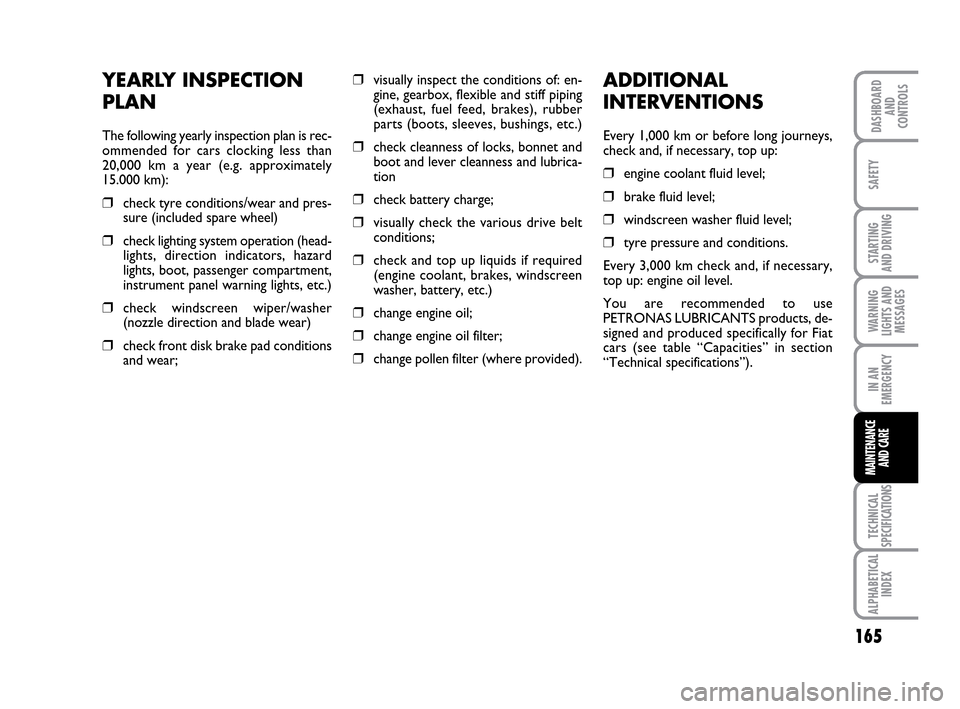
YEARLY INSPECTION
PLAN
The following yearly inspection plan is rec-
ommended for cars clocking less than
20,000 km a year (e.g. approximately
15.000 km):
❒check tyre conditions/wear and pres-
sure (included spare wheel)
❒check lighting system operation (head-
lights, direction indicators, hazard
lights, boot, passenger compartment,
instrument panel warning lights, etc.)
❒check windscreen wiper/washer
(nozzle direction and blade wear)
❒check front disk brake pad conditions
and wear;
❒visually inspect the conditions of: en-
gine, gearbox, flexible and stiff piping
(exhaust, fuel feed, brakes), rubber
parts (boots, sleeves, bushings, etc.)
❒check cleanness of locks, bonnet and
boot and lever cleanness and lubrica-
tion
❒check battery charge;
❒visually check the various drive belt
conditions;
❒check and top up liquids if required
(engine coolant, brakes, windscreen
washer, battery, etc.)
❒change engine oil;
❒change engine oil filter;
❒change pollen filter (where provided).
ADDITIONAL
INTERVENTIONS
Every 1,000 km or before long journeys,
check and, if necessary, top up:
❒engine coolant fluid level;
❒brake fluid level;
❒windscreen washer fluid level;
❒tyre pressure and conditions.
Every 3,000 km check and, if necessary,
top up: engine oil level.
You are recommended to use
PETRONAS LUBRICANTS products, de-
signed and produced specifically for Fiat
cars (see table “Capacities” in section
“Technical specifications”).
161-180 LUM IDEA GB 2 ed.qxd 14-01-2010 13:52 Pagina 165
Page 167 of 210
166
STARTING
AND DRIVING
IN AN
EMERGENCY
TECHNICAL
SPECIFICATIONS
ALPHABETICAL
INDEX
DASHBOARD
AND
CONTROLS
SAFETY
WARNING
LIGHTS AND
MESSAGES
MAINTENANCE
AND CARE
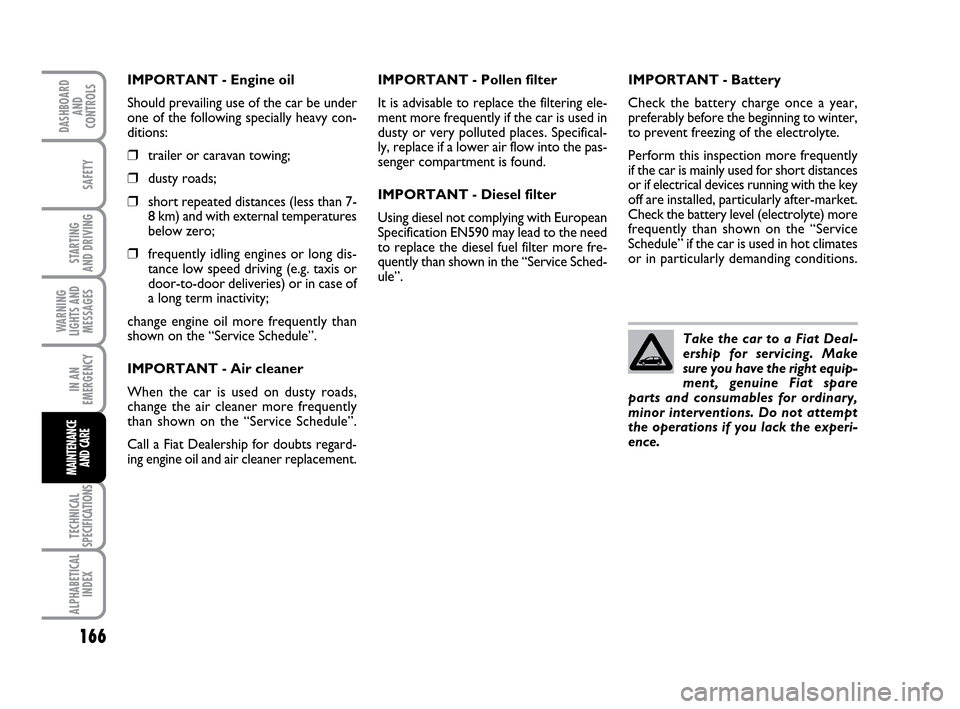
IMPORTANT - Engine oil
Should prevailing use of the car be under
one of the following specially heavy con-
ditions:
❒trailer or caravan towing;
❒dusty roads;
❒short repeated distances (less than 7-
8 km) and with external temperatures
below zero;
❒frequently idling engines or long dis-
tance low speed driving (e.g. taxis or
door-to-door deliveries) or in case of
a long term inactivity;
change engine oil more frequently than
shown on the “Service Schedule”.
IMPORTANT - Air cleaner
When the car is used on dusty roads,
change the air cleaner more frequently
than shown on the “Service Schedule”.
Call a Fiat Dealership for doubts regard-
ing engine oil and air cleaner replacement.IMPORTANT - Pollen filter
It is advisable to replace the filtering ele-
ment more frequently if the car is used in
dusty or very polluted places. Specifical-
ly, replace if a lower air flow into the pas-
senger compartment is found.
IMPORTANT - Diesel filter
Using diesel not complying with European
Specification EN590 may lead to the need
to replace the diesel fuel filter more fre-
quently than shown in the “Service Sched-
ule”.IMPORTANT - Battery
Check the battery charge once a year,
preferably before the beginning to winter,
to prevent freezing of the electrolyte.
Perform this inspection more frequently
if the car is mainly used for short distances
or if electrical devices running with the key
off are installed, particularly after-market.
Check the battery level (electrolyte) more
frequently than shown on the “Service
Schedule” if the car is used in hot climates
or in particularly demanding conditions.
Take the car to a Fiat Deal-
ership for servicing. Make
sure you have the right equip-
ment, genuine Fiat spare
parts and consumables for ordinary,
minor interventions. Do not attempt
the operations if you lack the experi-
ence.
161-180 LUM IDEA GB 2 ed.qxd 14-01-2010 13:52 Pagina 166
Page 209 of 210
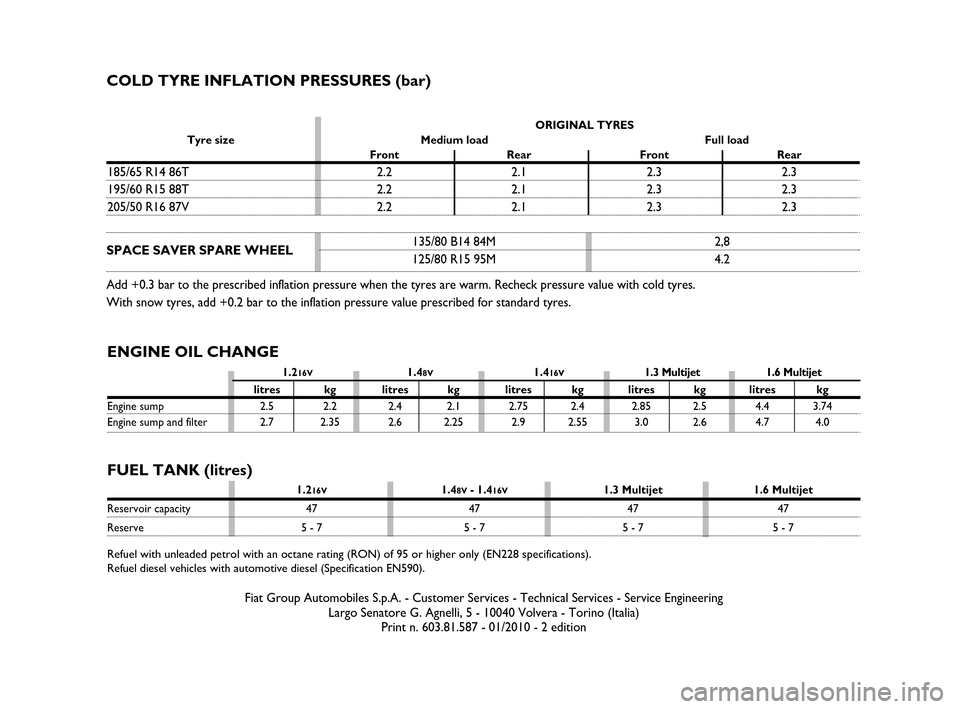
FUEL TANK (litres)
ENGINE OIL CHANGE
Fiat Group Automobiles S.p.A. - Customer Services - Technical Services - Service Engineering
Largo Senatore G. Agnelli, 5 - 10040 Volvera - Torino (Italia)
Print n. 603.81.587 - 01/2010 - 2 edition
COLD TYRE INFLATION PRESSURES (bar)
1.216V1.48V- 1.416V1.3 Multijet 1.6 Multijet
Reservoir capacity 47 47 47 47
Reserve 5 - 7 5 - 7 5 - 7 5 - 7
Refuel with unleaded petrol with an octane rating (RON) of 95 or higher only (EN228 specifications).
Refuel diesel vehicles with automotive diesel (Specification EN590).
1.216V1.48V1.416V1.3 Multijet 1.6 Multijet
litres kg litres kg litres kg litres kg litres kg
Engine sump 2.5 2.2 2.4 2.1 2.75 2.4 2.85 2.5 4.4 3.74
Engine sump and filter 2.7 2.35 2.6 2.25 2.9 2.55 3.0 2.6 4.7 4.0ORIGINAL TYRES
Tyre size Medium load Full load
Front Rear Front Rear
185/65 R14 86T 2.2 2.1 2.3 2.3
195/60 R15 88T 2.2 2.1 2.3 2.3
205/50 R16 87V 2.2 2.1 2.3 2.3
SPACE SAVER SPARE WHEEL135/80 B14 84M 2,8125/80 R15 95M 4.2
Add +0.3 bar to the prescribed inflation pressure when the tyres are warm. Recheck pressure value with cold tyres.
With snow tyres, add +0.2 bar to the inflation pressure value prescribed for standard tyres.
200-208 LUM IDEA GB 2 ed.qxd 14-01-2010 13:59 Pagina 208