ABS FIAT IDEA 2012 1.G User Guide
[x] Cancel search | Manufacturer: FIAT, Model Year: 2012, Model line: IDEA, Model: FIAT IDEA 2012 1.GPages: 210, PDF Size: 3.65 MB
Page 114 of 210
113
WARNING
LIGHTS AND
MESSAGES
IN AN
EMERGENCY
CAR
MAINTENANCE
TECHNICAL
SPECIFICATIONS
INDEX
DASHBOARD
AND CONTROLS
SAFETY
DEVICES
CORRECT USE
OF THE CAR
❒Turn the ignition key to AVVas soon
as warning light m goes out. If you wait
too long you will lose the benefit of
the work done by the glow plugs. Re-
lease the key as soon as the engine
starts.
IMPORTANT With cold engine, the ac-
celerator pedal shall be completely re-
leased while turning the ignition key to
AVV.
If the engine does not start at the first at-
tempt, return the ignition key to STOP
before repeating starting.
If, when the ignition key is on MAR, warn-
ing light
Yremains lit, turn the key to
STOPand then back to MAR; if the
warning light remains on, try with the oth-
er keys provided with the car.
If you still cannot start the engine, contact
Fiat Dealership.
IMPORTANT Never leave the ignition key
at MARwhen the engine is off.The warning light
mwill
flash for 60 seconds at start-
up or during prolonged crank-
ing to signal a fault in the
glow plug heating system. You can use
the car as usual if the engine starts but
you should contact a Fiat Dealership
as soon as possible.
HOW TO WARM UP
THE ENGINE AFTER
IT HAS JUST STARTED
(petrol and Multijet versions)
Proceed as follows:
❒Drive off slowly, letting the engine turn
at medium revs. Do not accelerate
abruptly;
❒Do not drive at full performance for
the initial kilometres. Wait until the
coolant temperature gauge starts
moving.
STOPPING THE ENGINE
Turn the ignition to STOPwhile the en-
gine is idling.
IMPORTANT After a taxing drive, you
should allow the engine to “catch its
breath” before turning it off by letting it
idle to allow the temperature in the en-
gine compartment to fall.Never bump start the engine
by pushing, towing or coast-
ing downhill. This could cause
fuel to flow into the catalyt-
ic exhaust system and damage it be-
yond repair.
A quick burst on the acceler-
ator before turning off the en-
gine serves absolutely no
practical purpose, it wastes
fuel and is damaging especially to tur-
bocharged engines.
Remember that the servo-
brake and power steering
are not operational until the engine
has been started, therefore much ef-
fort than usual is required on the
brake pedal and steering wheel.
WARNING
111-122 idea GB 1 ed 10-07-2008 8:29 Pagina 113
Page 119 of 210
118
WARNING
LIGHTS AND
MESSAGES
IN AN
EMERGENCY
CAR
MAINTENANCE
TECHNICAL
SPECIFICATIONS
INDEX
DASHBOARD
AND CONTROLS
SAFETY
DEVICES
CORRECT USE
OF THE CAR
Do not exceed the speed limits of the
country you are driving in. In any case do
not exceed 100 km/h.
The ABS system with which
the car may be fitted does
not control the trailer braking system.
Great care should therefore be taken
when driving on slippery road sur-
faces.
Under no circumstances
should the vehicle brake sys-
tem be altered to control the trailer
brake. The trailer braking system
must be fully independent of the ve-
hicle’s hydraulic system.
WARNING
WARNING
INSTALLING THE TOW HOOK
The towing device should be fastened to
the body by specialised personnel ac-
cording to any additional and/or integra-
tive information supplied by the Manufac-
turer of the device.
The towing device must meet current reg-
ulations with reference to 94/20/EC Di-
rective and subsequent amendments.
For any version the towing device used
must match the towable weight of the ve-
hicle on which it is to be installed.
For the electric connection a unified con-
nector should be used which is generally
placed on a special bracket normally fas-
tened to the towing device, and a special
ECU for external trailer light control shall
be installed on the car. For the electrical connection 7 or 13 pins
12VDC connection is to be used (CU-
NA/UNI and ISO/DIN Standards). Follow
the instructions provided by the car man-
ufacturer and/or the tow hitch manufac-
turer.
An electric brake should be supplied di-
rectly by the battery through a cable with
a cross section of no less than 2.5 mm
2.
IMPORTANT Electric brake or other de-
vice shall be used with running engine.
In addition to the electrical branches, the
car’s electric system can only be con-
nected to the supply cable for an electric
brake and to the cable for an internal light,
though not above 15W.
For connections use a preset control unit
with battery cable no less than 2.5 mm
2.
111-122 idea GB 1 ed 10-07-2008 8:29 Pagina 118
Page 124 of 210
123
IN AN
EMERGENCY
CAR
MAINTENANCE
TECHNICAL
SPECIFICATIONS
INDEX
DASHBOARD
AND CONTROLS
SAFETY
DEVICES
CORRECT USE
OF THE CAR
WARNING
LIGHTS AND
MESSAGES
GENERAL WARNINGS ...................................................... 124
LOW BRAKE FLUID LEVEL .............................................. 124
HANDBRAKE ON ............................................................... 124
AIRBAG FAILURE ................................................................. 124
HOT ENGINE COOLANT ................................................ 125
LOW BATTERY CHARGE................................................. 125
LOW ENGINE OIL PRESSURE ......................................... 126
EXHAUSTED OIL ................................................................. 126
“DUALDRIVE” ELECTRIC POWER
STEERING FAILURE............................................................. 126
INCOMPLETE DOOR LOCKING ................................... 126
SEAT BELTS NOT FASTENED ......................................... 126
EBD FAILURE......................................................................... 127
INJECTION SYSTEM FAILURE ......................................... 127
EOBD ENGINE CONTROL SYSTEM FAILURE ........... 127
FRONT PASSENGER AIRBAG DISABLED .................... 128
ABS SYSTEM FAILURE ........................................................ 128
FUEL RESERVE....................................................................... 128
GLOW PLUG HEATING.................................................... 129
GLOW PLUG HEATING FAILURE.................................. 129
WATER IN DIESEL FUEL FILTER ..................................... 129
CAR PROTECTION SYSTEM FAULT - FIAT CODE .. 129
REAR FOG LIGHTS ............................................................. 129
GENERAL FAILURE INDICATION ................................. 130
WW W
A A
R R
N N
I I
N N
G G
L L
I I
G G
H H
T T
S S
A A
N N
D D
M M
E E
S S
S S
A A
G G
E E E
S S
BRAKE PAD WEAR ............................................................. 131
PARTICULATE FILTER CLOGGED................................. 131
SIDE/TAIL LIGHTS AND LOW BEAMS ......................... 131
FOLLOW ME HOME ......................................................... 131
FRONT FOG LIGHTS ......................................................... 131
LEFT-HAND DIRECTION INDICATOR ....................... 132
RIGHT-HAND DIRECTION INDICATOR ................... 132
“DUALDRIVE” ELECTRIC POWER STEERING
ACTIVATION ........................................................................ 132
CRUISE CONTROL SYSTEM ............................................ 132
MAIN BEAMS ......................................................................... 132
POSSIBLE ICE ON ROAD.................................................. 132
LIMITED RANGE .................................................................. 132
123-132 idea GB 1 ed 10-07-2008 8:29 Pagina 123
Page 129 of 210
128
IN AN
EMERGENCY
CAR
MAINTENANCE
TECHNICAL
SPECIFICATIONS
INDEX
DASHBOARD
AND CONTROLS
SAFETY
DEVICES
CORRECT USE
OF THE CAR
WARNING
LIGHTS AND
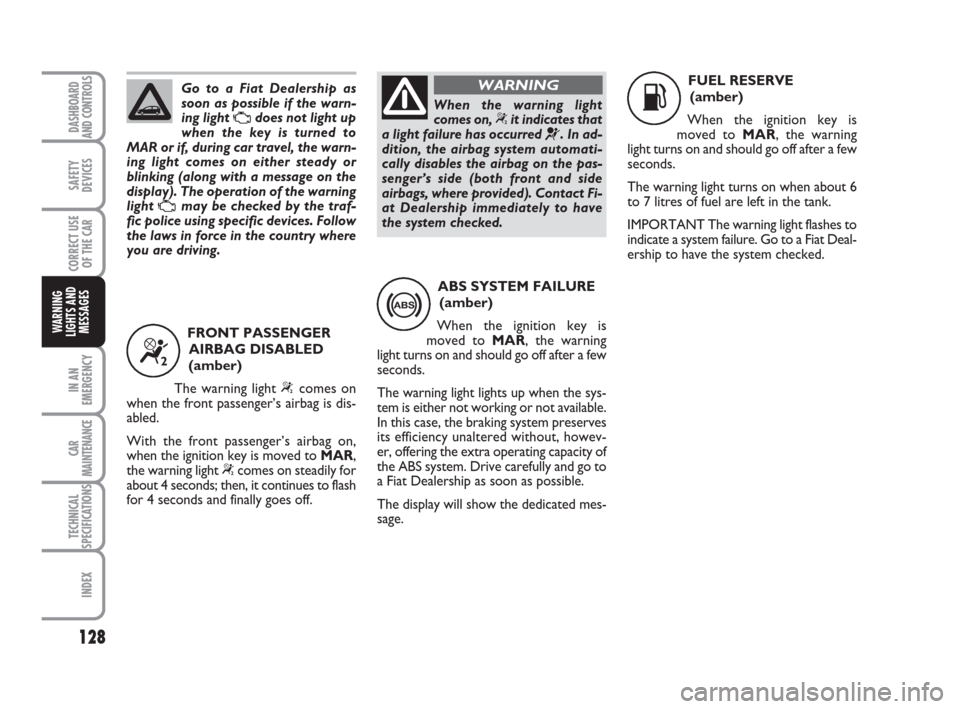
MESSAGESFRONT PASSENGER
AIRBAG DISABLED
(amber)
The warning light
“comes on
when the front passenger’s airbag is dis-
abled.
With the front passenger’s airbag on,
when the ignition key is moved to MAR,
the warning light
“comes on steadily for
about 4 seconds; then, it continues to flash
for 4 seconds and finally goes off.
“
ABS SYSTEM FAILURE
(amber)
When the ignition key is
moved to MAR, the warning
light turns on and should go off after a few
seconds.
The warning light lights up when the sys-
tem is either not working or not available.
In this case, the braking system preserves
its efficiency unaltered without, howev-
er, offering the extra operating capacity of
the ABS system. Drive carefully and go to
a Fiat Dealership as soon as possible.
The display will show the dedicated mes-
sage.
>
FUEL RESERVE
(amber)
When the ignition key is
moved to MAR, the warning
light turns on and should go off after a few
seconds.
The warning light turns on when about 6
to 7 litres of fuel are left in the tank.
IMPORTANT The warning light flashes to
indicate a system failure. Go to a Fiat Deal-
ership to have the system checked.
KWhen the warning light
comes on, “it indicates that
a light failure has occurred
¬. In ad-
dition, the airbag system automati-
cally disables the airbag on the pas-
senger’s side (both front and side
airbags, where provided). Contact Fi-
at Dealership immediately to have
the system checked.
WARNINGGo to a Fiat Dealership as
soon as possible if the warn-
ing light
Udoes not light up
when the key is turned to
MAR or if, during car travel, the warn-
ing light comes on either steady or
blinking (along with a message on the
display). The operation of the warning
light
Umay be checked by the traf-
fic police using specific devices. Follow
the laws in force in the country where
you are driving.
123-132 idea GB 1 ed 10-07-2008 8:29 Pagina 128
Page 149 of 210
148
CAR
MAINTENANCE
TECHNICAL
SPECIFICATIONS
INDEX
DASHBOARD
AND CONTROLS
SAFETY
DEVICES
CORRECT USE
OF THE CAR
WARNING
LIGHTS AND
MESSAGES
IN AN
EMERGENCY
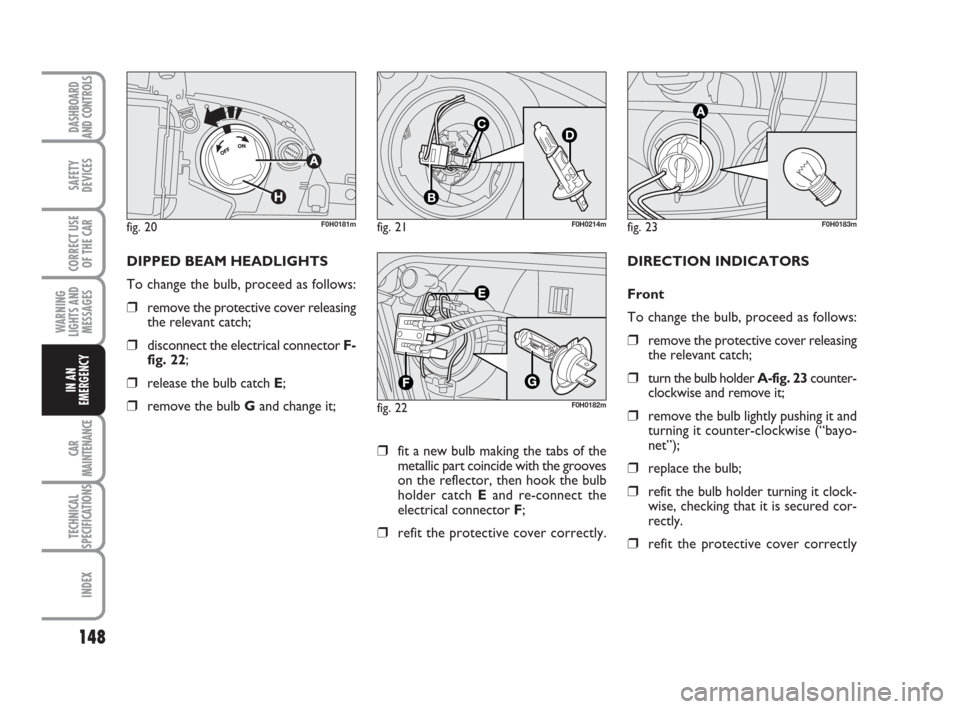
fig. 20F0H0181mfig. 21
C
B
D
F0H0214m
fig. 22F0H0182m
DIPPED BEAM HEADLIGHTS
To change the bulb, proceed as follows:
❒remove the protective cover releasing
the relevant catch;
❒disconnect the electrical connector F-
fig. 22;
❒release the bulb catch E;
❒remove the bulb Gand change it;
fig. 23F0H0183m
DIRECTION INDICATORS
Front
To change the bulb, proceed as follows:
❒remove the protective cover releasing
the relevant catch;
❒turn the bulb holder A-fig. 23counter-
clockwise and remove it;
❒remove the bulb lightly pushing it and
turning it counter-clockwise (“bayo-
net”);
❒replace the bulb;
❒refit the bulb holder turning it clock-
wise, checking that it is secured cor-
rectly.
❒refit the protective cover correctly
❒fit a new bulb making the tabs of the
metallic part coincide with the grooves
on the reflector, then hook the bulb
holder catch Eand re-connect the
electrical connector F;
❒refit the protective cover correctly.
133-160 idea GB 1 ed 10-07-2008 8:30 Pagina 148
Page 151 of 210
150
CAR
MAINTENANCE
TECHNICAL
SPECIFICATIONS
INDEX
DASHBOARD
AND CONTROLS
SAFETY
DEVICES
CORRECT USE
OF THE CAR
WARNING
LIGHTS AND
MESSAGES
IN AN
EMERGENCY
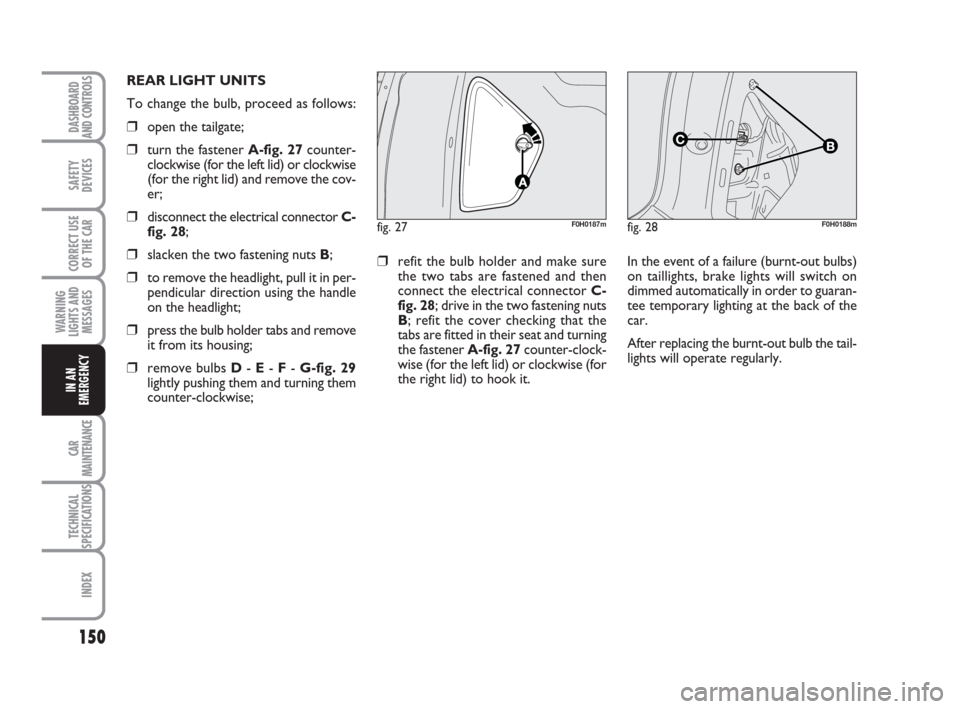
fig. 27F0H0187mfig. 28F0H0188m
REAR LIGHT UNITS
To change the bulb, proceed as follows:
❒open the tailgate;
❒turn the fastener A-fig. 27counter-
clockwise (for the left lid) or clockwise
(for the right lid) and remove the cov-
er;
❒disconnect the electrical connector C-
fig. 28;
❒slacken the two fastening nuts B;
❒to remove the headlight, pull it in per-
pendicular direction using the handle
on the headlight;
❒press the bulb holder tabs and remove
it from its housing;
❒remove bulbs D- E- F- G-fig. 29
lightly pushing them and turning them
counter-clockwise;
❒refit the bulb holder and make sure
the two tabs are fastened and then
connect the electrical connector C-
fig. 28; drive in the two fastening nuts
B; refit the cover checking that the
tabs are fitted in their seat and turning
the fastener A-fig. 27counter-clock-
wise (for the left lid) or clockwise (for
the right lid) to hook it. In the event of a failure (burnt-out bulbs)
on taillights, brake lights will switch on
dimmed automatically in order to guaran-
tee temporary lighting at the back of the
car.
After replacing the burnt-out bulb the tail-
lights will operate regularly.
133-160 idea GB 1 ed 10-07-2008 8:30 Pagina 150
Page 157 of 210
156
CAR
MAINTENANCE
TECHNICAL
SPECIFICATIONS
INDEX
DASHBOARD
AND CONTROLS
SAFETY
DEVICES
CORRECT USE
OF THE CAR
WARNING
LIGHTS AND
MESSAGES
IN AN
EMERGENCY
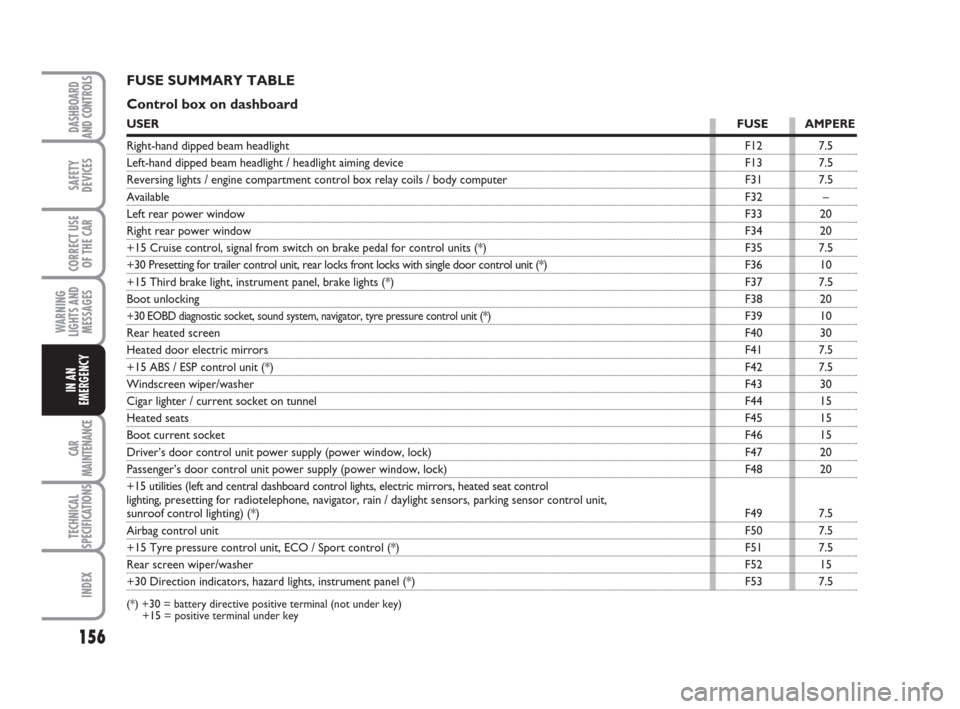
FUSE SUMMARY TABLE
Control box on dashboard
USERFUSE AMPERE
Right-hand dipped beam headlightF12 7.5
Left-hand dipped beam headlight / headlight aiming device F13 7.5
Reversing lights / engine compartment control box relay coils / body computer F31 7.5
AvailableF32 –
Left rear power windowF33 20
Right rear power windowF34 20
+15 Cruise control, signal from switch on brake pedal for control units (*) F35 7.5
+30 Presetting for trailer control unit, rear locks front locks with single door control unit (*) F36 10
+15 Third brake light, instrument panel, brake lights (*) F37 7.5
Boot unlockingF38 20
+30 EOBD diagnostic socket, sound system, navigator, tyre pressure control unit (*)F39 10
Rear heated screenF40 30
Heated door electric mirrorsF41 7.5
+15 ABS / ESP control unit (*)F42 7.5
Windscreen wiper/washerF43 30
Cigar lighter / current socket on tunnelF44 15
Heated seatsF45 15
Boot current socketF46 15
Driver’s door control unit power supply (power window, lock) F47 20
Passenger’s door control unit power supply (power window, lock) F48 20
+15 utilities (left and central dashboard control lights, electric mirrors, heated seat control
lighting,presetting for radiotelephone, navigator, rain / daylight sensors, parking sensor control unit,
sunroof control lighting) (*)F49 7.5
Airbag control unitF50 7.5
+15 Tyre pressure control unit, ECO / Sport control (*) F51 7.5
Rear screen wiper/washerF52 15
+30 Direction indicators, hazard lights, instrument panel (*) F53 7.5
(*) +30 = battery directive positive terminal (not under key)
+15 = positive terminal under key
133-160 idea GB 1 ed 10-07-2008 8:30 Pagina 156
Page 167 of 210
166
TECHNICAL
SPECIFICATIONS
INDEX
DASHBOARD
AND CONTROLS
SAFETY
DEVICES
CORRECT USE
OF THE CAR
WARNING
LIGHTS AND
MESSAGES
IN AN
EMERGENCY
CAR
MAINTENANCE
IMPORTANT - Engine oil
Should prevailing use of the car be under
one of the following specially heavy con-
ditions:
❒trailer or caravan towing;
❒dusty roads;
❒short distances (less than 7-8 km) re-
peated and with external tempera-
tures below zero;
❒frequently idling engines or long dis-
tance low speed driving (e.g. taxis or
door-to-door deliveries) or in case of
a long term inactivity;
replace engine oil more frequently than
required on “Service schedule”.
IMPORTANT - Air cleaner
If the car is used on dusty roads change
the air cleaner more frequently than the
indications in the “Service schedule”.
If in doubt as to how often the engine oil
and air cleaner should be changed ac-
cording to how you use the car, contact
a Fiat Dealership.IMPORTANT - Pollen filter
If the vehicle is used frequently in dusty or
heavily polluted environments it is advis-
able to replace the filtering element more
frequently; in particular it should be re-
placed if a reduction of the amount of air
admitted to the passenger compartment
is noted.
IMPORTANT - Diesel filter
The possibility of topping up with diesel
fuel not complying with EN590 European
Norm might make it necessary to replace
the filter more frequently than indicated
in the “Service schedule”.IMPORTANT - Battery
The charge in the battery should be
checked at the start of winter to limit the
risk of electrolyte freezing.
This check should be carried out more
frequently if the car is used mainly for
short trips, or if it is fitted with accessories
that permanently absorb electricity even
with the ignition key removed, especially
in the case of after market accessories. If
the car is used in hot climates or particu-
larly harsh conditions it is wise to check
the level of the battery fluid (electrolyte)
more frequently than specified in the “Ser-
vice schedule” in this section.
Car maintenance should be
entrusted to Fiat Dealership.
For routine and minor main-
tenance operations you wish
to carry out yourself, always make sure
you have the proper equipment, gen-
uine Fiat spare parts and the necessary
fluids; do not however carry out these
operations if you have no experience.
161-180 idea GB 1 ed 10-07-2008 8:30 Pagina 166
Page 173 of 210
172
TECHNICAL
SPECIFICATIONS
INDEX
DASHBOARD
AND CONTROLS
SAFETY
DEVICES
CORRECT USE
OF THE CAR
WARNING
LIGHTS AND
MESSAGES
IN AN
EMERGENCY
CAR
MAINTENANCE
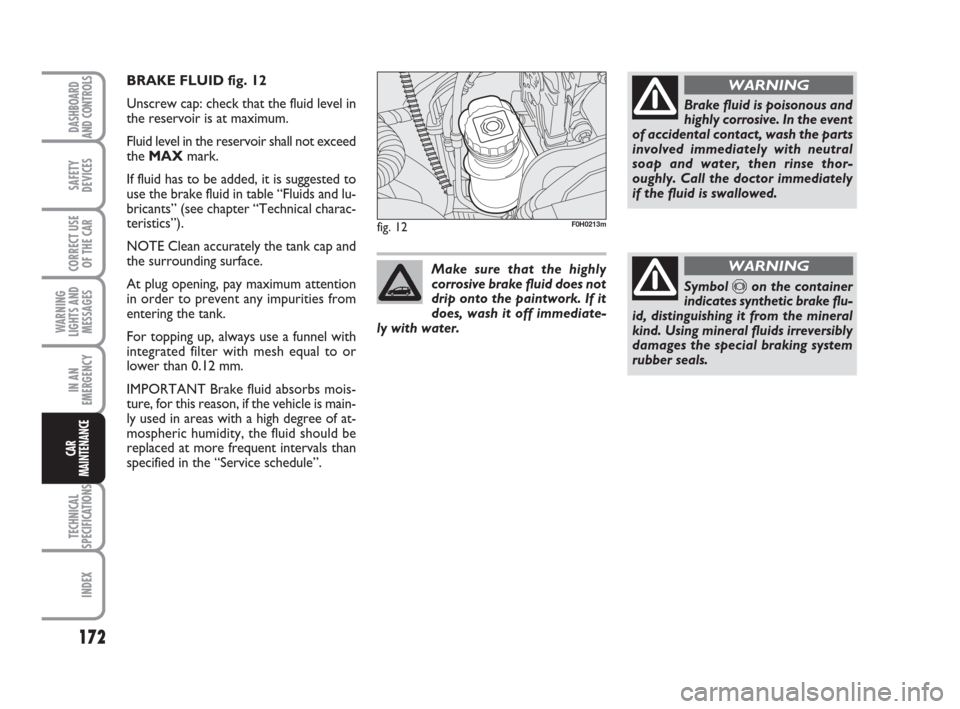
BRAKE FLUID fig. 12
Unscrew cap: check that the fluid level in
the reservoir is at maximum.
Fluid level in the reservoir shall not exceed
the MAXmark.
If fluid has to be added, it is suggested to
use the brake fluid in table “Fluids and lu-
bricants” (see chapter “Technical charac-
teristics”).
NOTE Clean accurately the tank cap and
the surrounding surface.
At plug opening, pay maximum attention
in order to prevent any impurities from
entering the tank.
For topping up, always use a funnel with
integrated filter with mesh equal to or
lower than 0.12 mm.
IMPORTANT Brake fluid absorbs mois-
ture, for this reason, if the vehicle is main-
ly used in areas with a high degree of at-
mospheric humidity, the fluid should be
replaced at more frequent intervals than
specified in the “Service schedule”.
fig. 12F0H0213m
Brake fluid is poisonous and
highly corrosive. In the event
of accidental contact, wash the parts
involved immediately with neutral
soap and water, then rinse thor-
oughly. Call the doctor immediately
if the fluid is swallowed.
WARNING
Symbol πon the container
indicates synthetic brake flu-
id, distinguishing it from the mineral
kind. Using mineral fluids irreversibly
damages the special braking system
rubber seals.
WARNINGMake sure that the highly
corrosive brake fluid does not
drip onto the paintwork. If it
does, wash it off immediate-
ly with water.
161-180 idea GB 1 ed 10-07-2008 8:30 Pagina 172
Page 175 of 210
174
TECHNICAL
SPECIFICATIONS
INDEX
DASHBOARD
AND CONTROLS
SAFETY
DEVICES
CORRECT USE
OF THE CAR
WARNING
LIGHTS AND
MESSAGES
IN AN
EMERGENCY
CAR
MAINTENANCE
IMPORTANT If the charge level remains
for a long time under 50%, the battery is
damaged by sulphation, reducing its ca-
pacity and starting attitude.
The battery will also be more at risk of
freezing (e.g. already at –10°C).
Refer to the paragraph “Car inactivity” in
“Starting and driving” if the car is left
parked for a long time.
If after buying the car, you want to install
electric accessories which require per-
manent electric supply (alarm, etc.) con-
tact the Fiat Dealership whose qualified
personnel, in addition to suggesting the
most suitable devices beloning to the Fi-
at Lineaccessori line, will evaluate the
overall electric absorption, checking
whether the car’s electric system is capa-
ble of withstanding the load required, or
whether it should be integrated with a
more powerful battery.
Since these devices continue absorbing en-
ergy even when the ignition key is off, they
gradually run down the battery. USEFUL ADVICE FOR
LENGTHENING THE LIFE OF
YOUR BATTERY
To avoid draining your battery and to
lengthen its life, observe the following in-
dications:
❒when you park your car, ensure that
doors, bonnet and flaps are well
closed in order to ensure that no lights
remain on inside the passenger com-
partment;
❒switch off all lights inside the car: the
car is however equipped with a system
which switches all internal lights off au-
tomatically;
❒when the engine is off, do not keep de-
vices running for long periods (e.g.
sound system, hazard lights etc.);
❒before performing any operation on
the electrical system, disconnect the
battery negative terminal cable;
❒screw the terminals of the battery
down hard.Batteries contain substances
that can be very dangerous for
the environment. t is advisable
to have the battery changed
by a Fiat Dealership where it will be
disposed of according to the law.
If the vehicle must remain
unused for a long time at
very low temperatures, remove the
battery and carry it to a warm place,
to avoid freezing.
WARNING
When performing any oper-
ations on the battery or near
it, always protect your eyes with the
special goggles.
WARNING
161-180 idea GB 1 ed 10-07-2008 8:30 Pagina 174