roof FIAT IDEA 2012 1.G User Guide
[x] Cancel search | Manufacturer: FIAT, Model Year: 2012, Model line: IDEA, Model: FIAT IDEA 2012 1.GPages: 210, PDF Size: 3.65 MB
Page 87 of 210
86
SAFETY
DEVICES
CORRECT USE
OF THE CAR
WARNING
LIGHTS AND
MESSAGES
IN AN
EMERGENCY
CAR
MAINTENANCE
TECHNICAL
SPECIFICATIONS
INDEX
DASHBOARD
AND CONTROLS
ACCESSORIES
PURCHASED
BY THE OWNER
If, after buying the car, you decide to in-
stall electrical accessories that require a
permanent electric supply (alarm, satellite
antitheft system, etc.) or accessories that
in any case burden the electric supply,
contact Fiat Dealership, whose qualified
personnel, besides suggesting the most
suitable devices belonging to Lineaccessori
Fiat, will also evaluate the overall electric
absorption, checking whether the vehicle
electric system is able to withstand the
load required, or whether it needs to be
integrated with a more powerful battery.
INSTALLATION OF ELECTRIC/
ELECTRONIC DEVICES
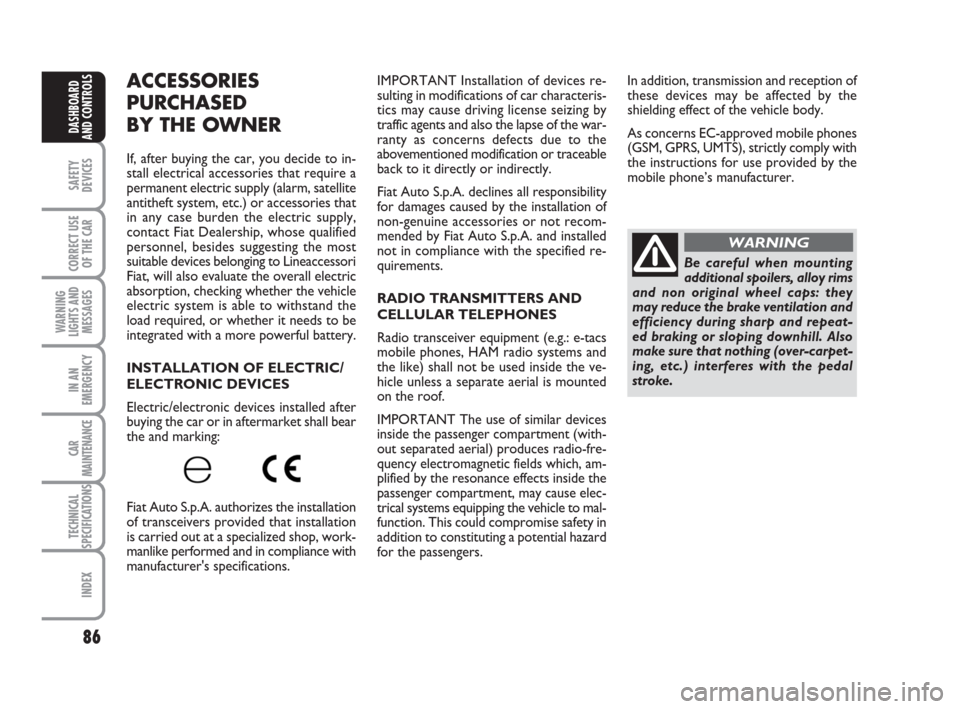
Electric/electronic devices installed after
buying the car or in aftermarket shall bear
the and marking:
Fiat Auto S.p.A. authorizes the installation
of transceivers provided that installation
is carried out at a specialized shop, work-
manlike performed and in compliance with
manufacturer's specifications.IMPORTANT Installation of devices re-
sulting in modifications of car characteris-
tics may cause driving license seizing by
traffic agents and also the lapse of the war-
ranty as concerns defects due to the
abovementioned modification or traceable
back to it directly or indirectly.
Fiat Auto S.p.A. declines all responsibility
for damages caused by the installation of
non-genuine accessories or not recom-
mended by Fiat Auto S.p.A. and installed
not in compliance with the specified re-
quirements.
RADIO TRANSMITTERS AND
CELLULAR TELEPHONES
Radio transceiver equipment (e.g.: e-tacs
mobile phones, HAM radio systems and
the like) shall not be used inside the ve-
hicle unless a separate aerial is mounted
on the roof.
IMPORTANT The use of similar devices
inside the passenger compartment (with-
out separated aerial) produces radio-fre-
quency electromagnetic fields which, am-
plified by the resonance effects inside the
passenger compartment, may cause elec-
trical systems equipping the vehicle to mal-
function. This could compromise safety in
addition to constituting a potential hazard
for the passengers.In addition, transmission and reception of
these devices may be affected by the
shielding effect of the vehicle body.
As concerns EC-approved mobile phones
(GSM, GPRS, UMTS), strictly comply with
the instructions for use provided by the
mobile phone’s manufacturer.
Be careful when mounting
additional spoilers, alloy rims
and non original wheel caps: they
may reduce the brake ventilation and
efficiency during sharp and repeat-
ed braking or sloping downhill. Also
make sure that nothing (over-carpet-
ing, etc.) interferes with the pedal
stroke.
WARNING
036-092 idea GB 1 ed 10-07-2008 16:12 Pagina 86
Page 109 of 210
108
CORRECT USE
OF THE CAR
WARNING
LIGHTS AND
MESSAGES
IN AN
EMERGENCY
CAR
MAINTENANCE
TECHNICAL
SPECIFICATIONS
INDEX
DASHBOARD
AND CONTROL
SAFETY
DEVICES
To manually deactivate the
passenger’s front airbag and
the Side Bag (where provided), refer
to paragraph “Multifunctional re-
configurable display” in section
“Dashboard and controls”.
WARNING
MANUAL DEACTIVATION OF
FRONT AIRBAG AND SIDE
BAGON PASSENGER’S SIDE
(where provided)
Whenever a child needs to be carried on
the front seat, the passenger’s front airbag
and the Side Bag (where provided) must
be deactivated.
The warning light
“on the instrument
panel stays on steadily until the passenger’s
front airbag and the Side Bag (where pro-
vided) are re-activated.
SIDE AIR BAGS
(where fitted)
(Side bag - Window
bag)
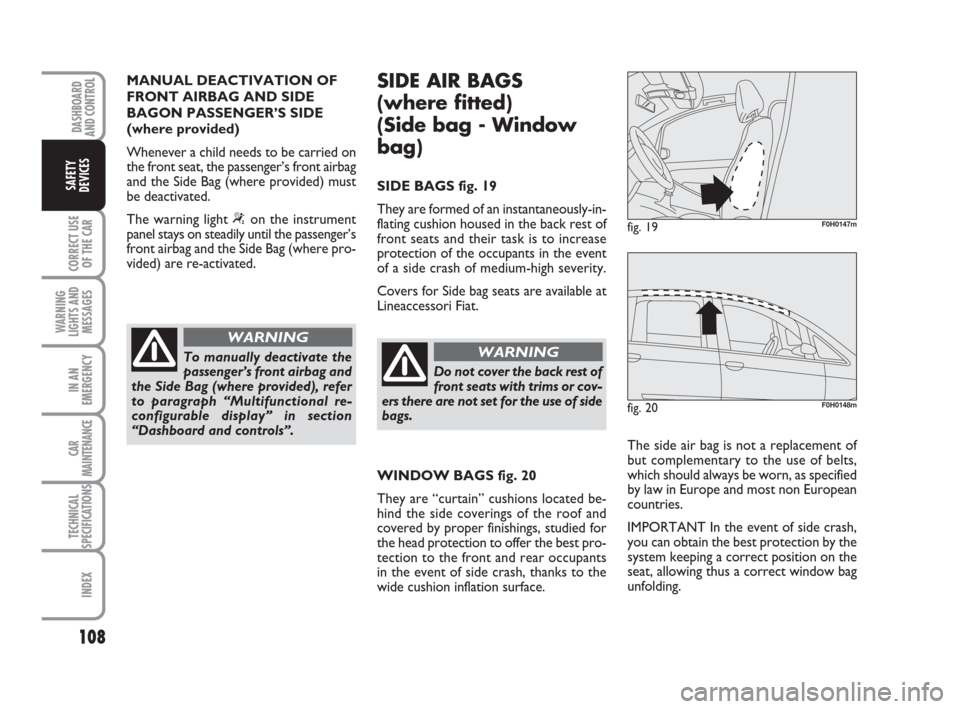
SIDE BAGS fig. 19
They are formed of an instantaneously-in-
flating cushion housed in the back rest of
front seats and their task is to increase
protection of the occupants in the event
of a side crash of medium-high severity.
Covers for Side bag seats are available at
Lineaccessori Fiat.
The side air bag is not a replacement of
but complementary to the use of belts,
which should always be worn, as specified
by law in Europe and most non European
countries.
IMPORTANT In the event of side crash,
you can obtain the best protection by the
system keeping a correct position on the
seat, allowing thus a correct window bag
unfolding.
Do not cover the back rest of
front seats with trims or cov-
ers there are not set for the use of side
bags.
WARNING
WINDOW BAGS fig. 20
They are “curtain” cushions located be-
hind the side coverings of the roof and
covered by proper finishings, studied for
the head protection to offer the best pro-
tection to the front and rear occupants
in the event of side crash, thanks to the
wide cushion inflation surface.
fig. 19F0H0147m
fig. 20F0H0148m
093-110 idea GB 1 ed 10-07-2008 8:28 Pagina 108
Page 117 of 210
116
WARNING
LIGHTS AND
MESSAGES
IN AN
EMERGENCY
CAR
MAINTENANCE
TECHNICAL
SPECIFICATIONS
INDEX
DASHBOARD
AND CONTROLS
SAFETY
DEVICES
CORRECT USE
OF THE CAR
CONTAINING
RUNNING COSTS
Here are some suggestions which may
help you to keep the running costs of your
car down and lower the amount of toxic
emissions released into the atmosphere.
GENERAL CONSIDERATIONS
Car maintenance
Have checks and adjustments carried out
in accordance with the “Service schedule”.
Tyres
Check the pressure of the tyres routine-
ly at an interval of no more than 4 weeks:
if the pressure is too low, consumption
levels increase as resistance to rolling is
higher.
Unnecessary loads
Do not travel with too much luggage
stowed in the boot. The weight of the car
(especially when driving in town) and its
trim greatly affects consumption and sta-
bility.Roof rack/ski rack
Remove the roof rack or the ski rack from
the roof as soon as they are no longer
used. These accessories lower air pene-
tration and adversely affect consumption
levels. When needing to carry particular-
ly voluminous objects, preferably use a
trailer.
Electric devices
Use electric devices only for the amount
of time needed. Rear heated window, ad-
ditional headlights, windscreen wipers and
heater fan need a considerable amount of
energy, therefore increasing the require-
ment of current increases fuel consump-
tion (up to +25% in the urban cycle).
Climate control
The air conditioner is an additional load
which greatly affects the engine leading to
higher consumption (on average up to
+20%). When the temperature outside
the vehicle permits it, use the air vents
where possible.
Spoilers
The use of non-certified aerodynamic
items may adversely affect air drag and
consumption levels.DRIVING STYLE
Starting
Do not warm the engine with the car at
a standstill or at idle or high speed: under
these conditions the engine warms up
much more slowly, increasing electrical
consumption and emissions. It is therefore
advisable to move off immediately, slow-
ly, avoiding high speeds. This way the en-
gine will warm faster.
Unnecessary actions
Avoid accelerating when waiting at traffic
lights or before switching off the engine.
This and also double declutching is ab-
solutely pointless on modern cars and al-
so increase consumption and pollution.
Gear selection
As soon as the conditions of the traffic and
road allow, use a higher gear. Using a low
gear to obtain brilliant performance in-
creases consumption.
In the same way improper use of a high
gear increases consumption, emissions an
engine wear.
111-122 idea GB 1 ed 10-07-2008 8:29 Pagina 116
Page 147 of 210
146
CAR
MAINTENANCE
TECHNICAL
SPECIFICATIONS
INDEX
DASHBOARD
AND CONTROLS
SAFETY
DEVICES
CORRECT USE
OF THE CAR
WARNING
LIGHTS AND
MESSAGES
IN AN
EMERGENCY
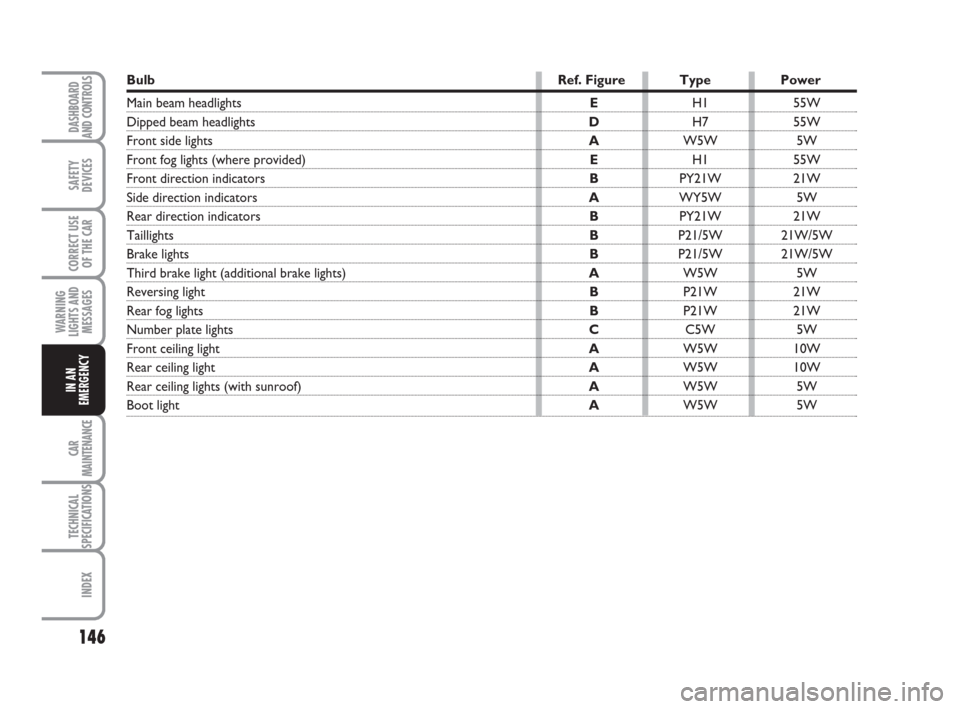
Bulb Ref. Figure Type Power
Main beam headlightsEH1 55W
Dipped beam headlights DH7 55W
Front side lights AW5W 5W
Front fog lights (where provided)EH1 55W
Front direction indicators BPY21W 21W
Side direction indicators AWY5W 5W
Rear direction indicators BPY21W 21W
Taillights BP21/5W 21W/5W
Brake lights BP21/5W 21W/5W
Third brake light (additional brake lights) AW5W 5W
Reversing light BP21W 21W
Rear fog lights BP21W 21W
Number plate lights CC5W 5W
Front ceiling lightAW5W 10W
Rear ceiling lightAW5W 10W
Rear ceiling lights (with sunroof)AW5W 5W
Boot light AW5W 5W
133-160 idea GB 1 ed 10-07-2008 8:30 Pagina 146
Page 157 of 210
156
CAR
MAINTENANCE
TECHNICAL
SPECIFICATIONS
INDEX
DASHBOARD
AND CONTROLS
SAFETY
DEVICES
CORRECT USE
OF THE CAR
WARNING
LIGHTS AND
MESSAGES
IN AN
EMERGENCY
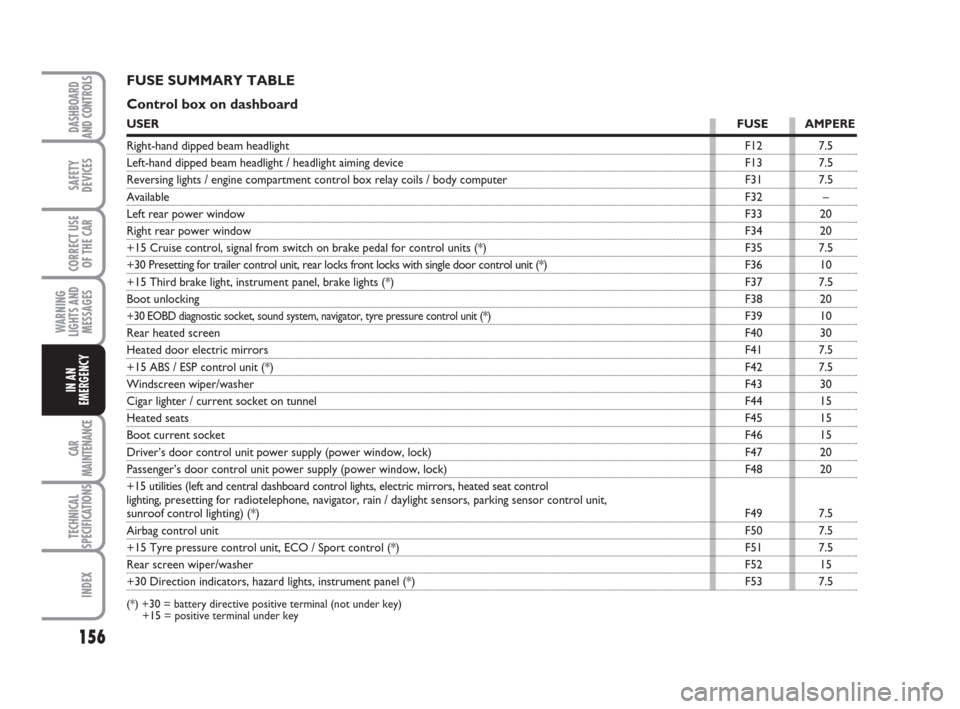
FUSE SUMMARY TABLE
Control box on dashboard
USERFUSE AMPERE
Right-hand dipped beam headlightF12 7.5
Left-hand dipped beam headlight / headlight aiming device F13 7.5
Reversing lights / engine compartment control box relay coils / body computer F31 7.5
AvailableF32 –
Left rear power windowF33 20
Right rear power windowF34 20
+15 Cruise control, signal from switch on brake pedal for control units (*) F35 7.5
+30 Presetting for trailer control unit, rear locks front locks with single door control unit (*) F36 10
+15 Third brake light, instrument panel, brake lights (*) F37 7.5
Boot unlockingF38 20
+30 EOBD diagnostic socket, sound system, navigator, tyre pressure control unit (*)F39 10
Rear heated screenF40 30
Heated door electric mirrorsF41 7.5
+15 ABS / ESP control unit (*)F42 7.5
Windscreen wiper/washerF43 30
Cigar lighter / current socket on tunnelF44 15
Heated seatsF45 15
Boot current socketF46 15
Driver’s door control unit power supply (power window, lock) F47 20
Passenger’s door control unit power supply (power window, lock) F48 20
+15 utilities (left and central dashboard control lights, electric mirrors, heated seat control
lighting,presetting for radiotelephone, navigator, rain / daylight sensors, parking sensor control unit,
sunroof control lighting) (*)F49 7.5
Airbag control unitF50 7.5
+15 Tyre pressure control unit, ECO / Sport control (*) F51 7.5
Rear screen wiper/washerF52 15
+30 Direction indicators, hazard lights, instrument panel (*) F53 7.5
(*) +30 = battery directive positive terminal (not under key)
+15 = positive terminal under key
133-160 idea GB 1 ed 10-07-2008 8:30 Pagina 156
Page 158 of 210
157
CAR
MAINTENANCE
TECHNICAL
SPECIFICATIONS
INDEX
DASHBOARD
AND CONTROLS
SAFETY
DEVICES
CORRECT USE
OF THE CAR
WARNING
LIGHTS AND
MESSAGES
IN AN
EMERGENCY
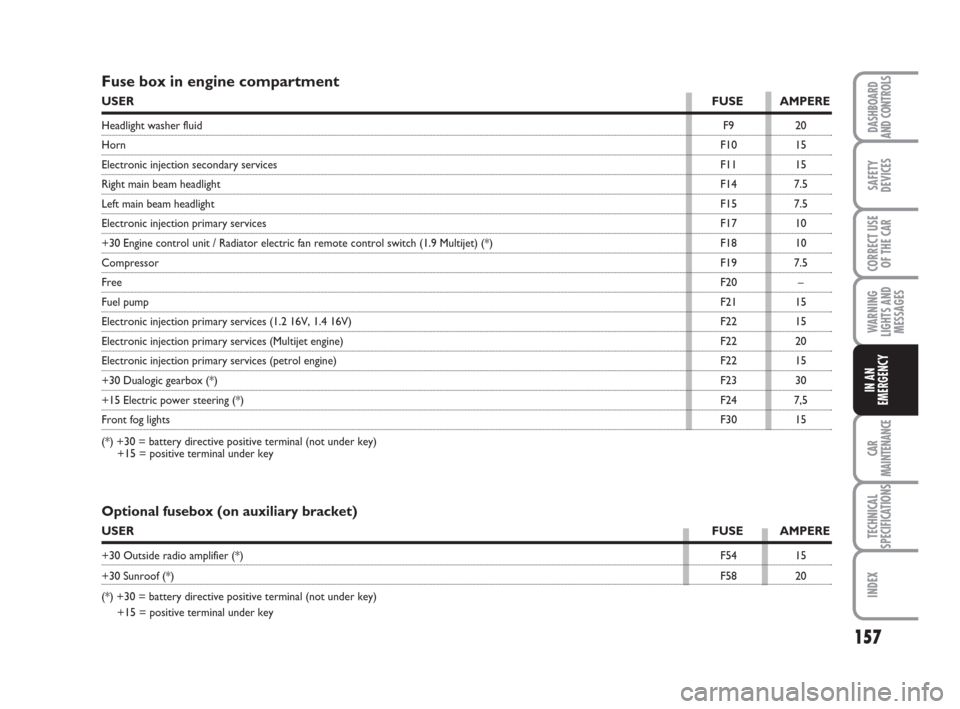
Fuse box in engine compartment
USERFUSE AMPERE
Headlight washer fluidF9 20
HornF10 15
Electronic injection secondary servicesF11 15
Right main beam headlightF14 7.5
Left main beam headlightF15 7.5
Electronic injection primary servicesF17 10
+30 Engine control unit / Radiator electric fan remote control switch (1.9 Multijet) (*) F18 10
CompressorF19 7.5
FreeF20 –
Fuel pumpF21 15
Electronic injection primary services (1.2 16V, 1.4 16V)F22 15
Electronic injection primary services (Multijet engine)F22 20
Electronic injection primary services (petrol engine)F22 15
+30 Dualogic gearbox (*)F23 30
+15 Electric power steering (*)F24 7,5
Front fog lightsF30 15
(*) +30 = battery directive positive terminal (not under key)
+15 = positive terminal under key
Optional fusebox (on auxiliary bracket)
USERFUSE AMPERE
+30 Outside radio amplifier (*)F54 15
+30 Sunroof (*)F58 20
(*) +30 = battery directive positive terminal (not under key)
+15 = positive terminal under key
133-160 idea GB 1 ed 10-07-2008 8:30 Pagina 157
Page 179 of 210
178
TECHNICAL
SPECIFICATIONS
INDEX
DASHBOARD
AND CONTROLS
SAFETY
DEVICES
CORRECT USE
OF THE CAR
WARNING
LIGHTS AND
MESSAGES
IN AN
EMERGENCY
CAR
MAINTENANCE
BODYWORK
PROTECTION FROM
ATMOSPHERIC AGENTS
The main causes of corrosion are the fol-
lowing:
❒atmospheric pollution;
❒salty air and humidity (coastal areas,
or hot humid climates);
❒seasonal environment conditions.
Not to be underestimated is also the abra-
sive action of wind-borne atmospheric
dust and sand and mud and gravel raised
by other vehicles.
On your Fiat Idea, Fiat implemented the
best manufacturing technologies to effec-
tively protect the bodywork against cor-
rosion.
These include:
❒Painting products and systems which
give the car particular resistance to
corrosion and abrasion;
❒Use of galvanised (or pretreated) steel
sheets, with high resistance to corro-
sion;
❒Spraying of plastic parts, with a pro-
tective function, in the more exposed
points: underdoor, inner fender parts,
edges, etc.;
❒Use of “open” boxed sections to pre-
vent condensation and pockets of
moisture from triggering rust inside.
BODY AND UNDERBODY
WARRANTY
Your Fiat Idea is covered by warranty
against perforation due to rust of any orig-
inal element of the structure or body. For
the general terms of this warranty, refer
to “FIAT WARRANTY” booklet.
ADVICE FOR PRESERVING THE
BODYWORK
Paint
Paintwork does not only serve an aesteth-
ic purpose, but also protects the under-
lying sheet metal.
In the case of deep scrapes or scores, you
are advised to have the necessary touch-
ing up carried out immediately to avoid
the formation of rust. Use only original
paint products for touching up (see “Body-
work paint identification plate” in section
“Technical specification”).
Normal paint maintenance consists in
washing at intervals depending on the con-
ditions and environment of use. For ex-
ample, in highly polluted areas, or if the
roads are sprayed with salt, it is wise to
wash the car more frequently.To correctly wash the car:
❒remove the aerial from the roof to
prevent damage to it if the car is
washed in an automatic system;
❒wash the body using a low pressure jet
of water;
❒wipe a sponge with a slightly soapy so-
lution over the bodywork, frequently
rinsing with the sponge;
❒rinse well with water and dry with a
jet of air or a chamois leather.
When drying, take particular care with the
less visible parts like door surrounds, bon-
net and around the headlights where wa-
ter may stagnate. The car should not be
taken to a closed area immediately, but left
in the open so that residual water can
evaporate.
Do not wash the car after it has been left
in the sun or with the bonnet hot: this may
alter the shine of the paintwork.
Exterior plastic parts must be cleaned in
the same way as the rest of the vehicle.
Where possible, do not park under trees;
the resinous substance many species re-
lease give the paint a dull appearance and
increase the possibility of triggering rust
processes.
161-180 idea GB 1 ed 10-07-2008 8:30 Pagina 178
Page 195 of 210
194
INDEX
DASHBOARD
AND CONTROLS
SAFETY
DEVICES
CORRECT USE
OF THE CAR
WARNING
LIGHTS AND
MESSAGES
IN AN
EMERGENCY
CAR
MAINTENANCE
TECHNICAL
SPECIFICATIONS
1.216V
1155
500
940
805
1655
1000
400
75
601.4
8V(◊) - 1.416V
1155
500
940
805
1655
1000
400
75
601.3 Multijet
1200
500
940
805
1700
1000
400
75
60
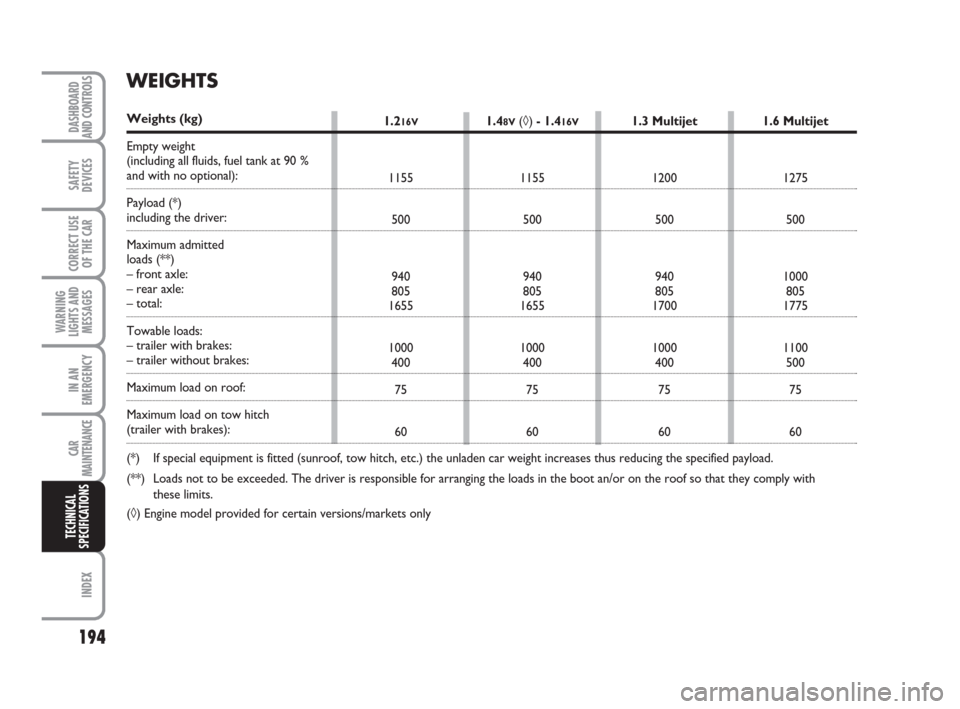
WEIGHTS
Weights (kg)
Empty weight
(including all fluids, fuel tank at 90 %
and with no optional):
Payload (*)
including the driver:
Maximum admitted
loads (**)
– front axle:
– rear axle:
– total:
Towable loads:
– trailer with brakes:
– trailer without brakes:
Maximum load on roof:
Maximum load on tow hitch
(trailer with brakes):
(*) If special equipment is fitted (sunroof, tow hitch, etc.) the unladen car weight increases thus reducing the specified payload.
(**) Loads not to be exceeded. The driver is responsible for arranging the loads in the boot an/or on the roof so that they comply with
these limits.
(◊) Engine model provided for certain versions/markets only1.6 Multijet
1275
500
1000
805
1775
1100
500
75
60
181-199 idea GB 1 ed 10-07-2008 8:31 Pagina 194
Page 199 of 210
198
INDEX
DASHBOARD
AND CONTROLS
SAFETY
DEVICES
CORRECT USE
OF THE CAR
WARNING
LIGHTS AND
MESSAGES
IN AN
EMERGENCY
CAR
MAINTENANCE
TECHNICAL
SPECIFICATIONS
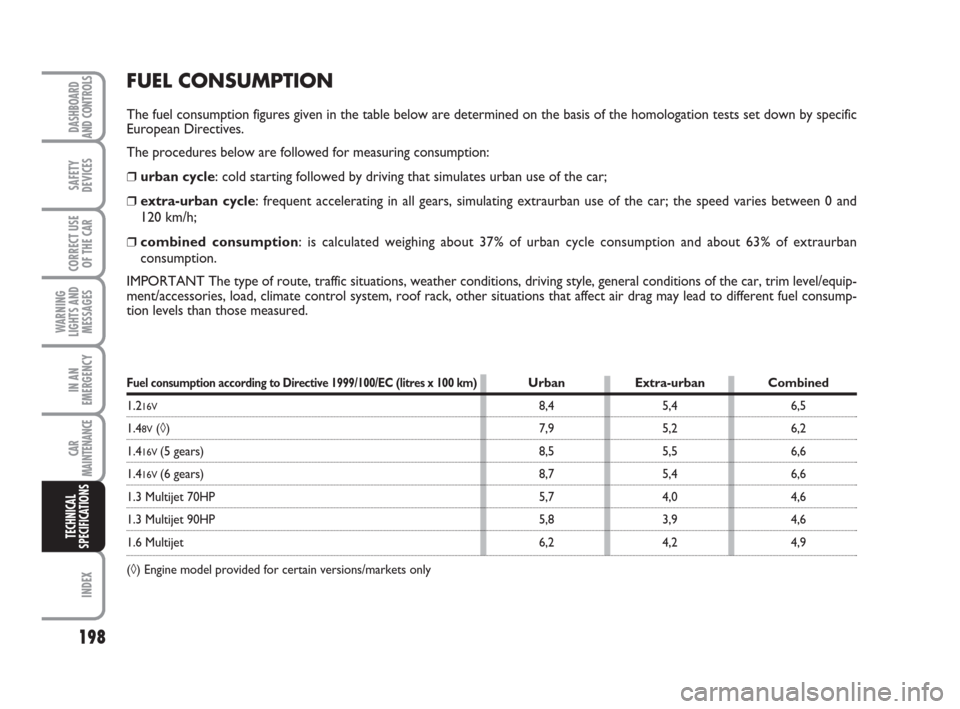
FUEL CONSUMPTION
The fuel consumption figures given in the table below are determined on the basis of the homologation tests set down by specific
European Directives.
The procedures below are followed for measuring consumption:
❒urban cycle: cold starting followed by driving that simulates urban use of the car;
❒extra-urban cycle: frequent accelerating in all gears, simulating extraurban use of the car; the speed varies between 0 and
120 km/h;
❒combined consumption: is calculated weighing about 37% of urban cycle consumption and about 63% of extraurban
consumption.
IMPORTANT The type of route, traffic situations, weather conditions, driving style, general conditions of the car, trim level/equip-
ment/accessories, load, climate control system, roof rack, other situations that affect air drag may lead to different fuel consump-
tion levels than those measured.
Fuel consumption according to Directive 1999/100/EC (litres x 100 km)Urban Extra-urban Combined
1.216V8,4 5,4 6,5
1.48V(◊) 7,9 5,2 6,2
1.416V (5 gears) 8,5 5,5 6,6
1.416V (6 gears) 8,7 5,4 6,6
1.3 Multijet 70HP 5,7 4,0 4,6
1.3 Multijet 90HP 5,8 3,9 4,6
1.6 Multijet 6,2 4,2 4,9
(◊) Engine model provided for certain versions/markets only
181-199 idea GB 1 ed 10-07-2008 8:31 Pagina 198
Page 203 of 210
202
SAFETY
DEVICES
CORRECT USE
OF THE CAR
WARNING
LIGHTS AND
MESSAGES
IN AN
EMERGENCY
CAR
MAINTENANCE
TECHNICAL
SPECIFICATIONS
DASHBOARD
AND CONTROLS
INDEX
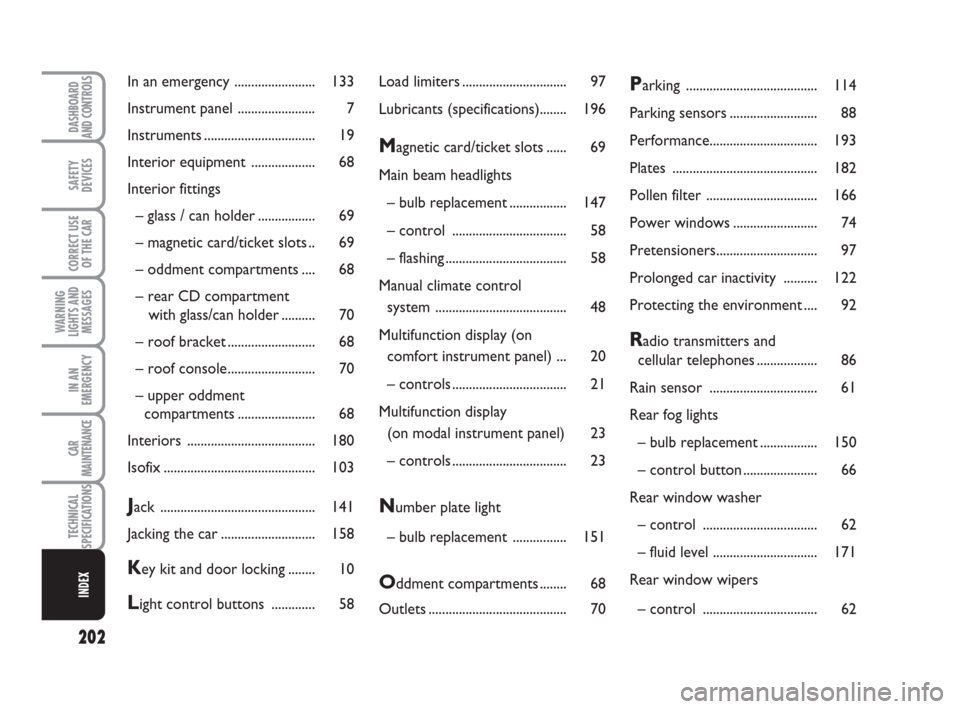
In an emergency ........................ 133
Instrument panel ....................... 7
Instruments ................................. 19
Interior equipment ................... 68
Interior fittings
– glass / can holder ................. 69
– magnetic card/ticket slots .. 69
– oddment compartments .... 68
– rear CD compartment
with glass/can holder .......... 70
– roof bracket .......................... 68
– roof console.......................... 70
– upper oddment
compartments ....................... 68
Interiors ...................................... 180
Isofix ............................................. 103
Jack .............................................. 141
Jacking the car ............................ 158
Key kit and door locking ........ 10
Light control buttons ............. 58Load limiters ............................... 97
Lubricants (specifications)........ 196
Magnetic card/ticket slots ...... 69
Main beam headlights
– bulb replacement ................. 147
– control .................................. 58
– flashing .................................... 58
Manual climate control
system ....................................... 48
Multifunction display (on
comfort instrument panel) ... 20
– controls .................................. 21
Multifunction display
(on modal instrument panel) 23
– controls .................................. 23
Number plate light
– bulb replacement ................ 151
Oddment compartments ........ 68
Outlets ......................................... 70
Parking ....................................... 114
Parking sensors .......................... 88
Performance................................ 193
Plates ........................................... 182
Pollen filter ................................. 166
Power windows ......................... 74
Pretensioners.............................. 97
Prolonged car inactivity .......... 122
Protecting the environment .... 92
Radio transmitters and
cellular telephones .................. 86
Rain sensor ................................ 61
Rear fog lights
– bulb replacement ................. 150
– control button ...................... 66
Rear window washer
– control .................................. 62
– fluid level ............................... 171
Rear window wipers
– control .................................. 62
200-208 idea GB 1 ed 10-07-2008 10:58 Pagina 202