battery FIAT IDEA 2012 1.G Owner's Manual
[x] Cancel search | Manufacturer: FIAT, Model Year: 2012, Model line: IDEA, Model: FIAT IDEA 2012 1.GPages: 210, PDF Size: 3.65 MB
Page 156 of 210
155
CAR
MAINTENANCE
TECHNICAL
SPECIFICATIONS
INDEX
DASHBOARD
AND CONTROLS
SAFETY
DEVICES
CORRECT USE
OF THE CAR
WARNING
LIGHTS AND
MESSAGES
IN AN
EMERGENCY
F0H0720mfig. 42 fig. 41
F0H0201m
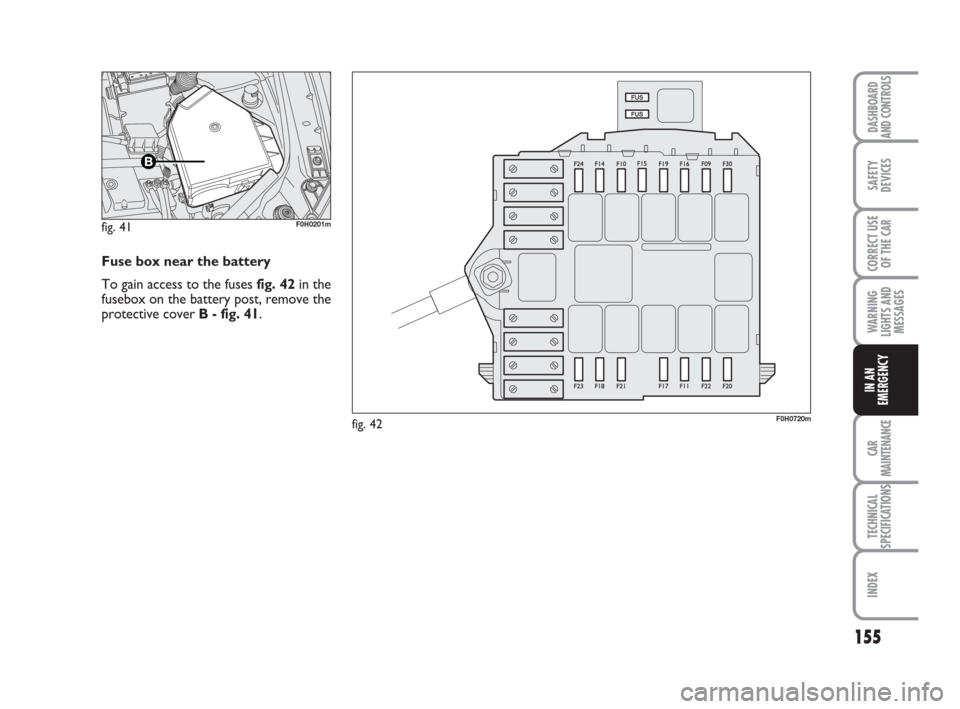
Fuse box near the battery
To gain access to the fuses fig. 42in the
fusebox on the battery post, remove the
protective cover B - fig. 41.
133-160 idea GB 1 ed 10-07-2008 8:30 Pagina 155
Page 157 of 210
156
CAR
MAINTENANCE
TECHNICAL
SPECIFICATIONS
INDEX
DASHBOARD
AND CONTROLS
SAFETY
DEVICES
CORRECT USE
OF THE CAR
WARNING
LIGHTS AND
MESSAGES
IN AN
EMERGENCY
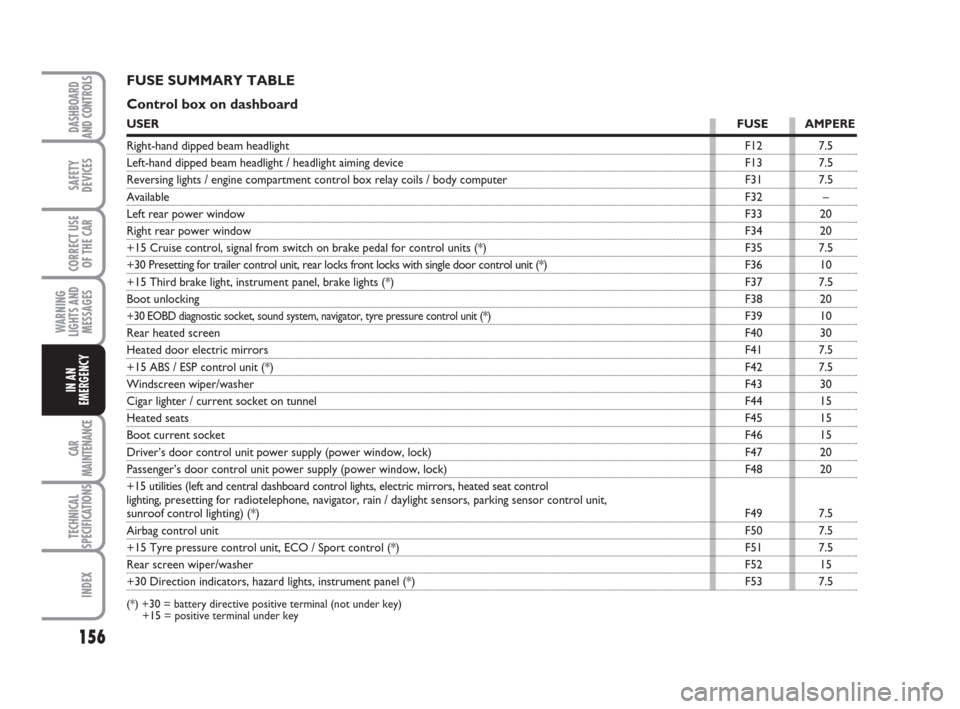
FUSE SUMMARY TABLE
Control box on dashboard
USERFUSE AMPERE
Right-hand dipped beam headlightF12 7.5
Left-hand dipped beam headlight / headlight aiming device F13 7.5
Reversing lights / engine compartment control box relay coils / body computer F31 7.5
AvailableF32 –
Left rear power windowF33 20
Right rear power windowF34 20
+15 Cruise control, signal from switch on brake pedal for control units (*) F35 7.5
+30 Presetting for trailer control unit, rear locks front locks with single door control unit (*) F36 10
+15 Third brake light, instrument panel, brake lights (*) F37 7.5
Boot unlockingF38 20
+30 EOBD diagnostic socket, sound system, navigator, tyre pressure control unit (*)F39 10
Rear heated screenF40 30
Heated door electric mirrorsF41 7.5
+15 ABS / ESP control unit (*)F42 7.5
Windscreen wiper/washerF43 30
Cigar lighter / current socket on tunnelF44 15
Heated seatsF45 15
Boot current socketF46 15
Driver’s door control unit power supply (power window, lock) F47 20
Passenger’s door control unit power supply (power window, lock) F48 20
+15 utilities (left and central dashboard control lights, electric mirrors, heated seat control
lighting,presetting for radiotelephone, navigator, rain / daylight sensors, parking sensor control unit,
sunroof control lighting) (*)F49 7.5
Airbag control unitF50 7.5
+15 Tyre pressure control unit, ECO / Sport control (*) F51 7.5
Rear screen wiper/washerF52 15
+30 Direction indicators, hazard lights, instrument panel (*) F53 7.5
(*) +30 = battery directive positive terminal (not under key)
+15 = positive terminal under key
133-160 idea GB 1 ed 10-07-2008 8:30 Pagina 156
Page 158 of 210
157
CAR
MAINTENANCE
TECHNICAL
SPECIFICATIONS
INDEX
DASHBOARD
AND CONTROLS
SAFETY
DEVICES
CORRECT USE
OF THE CAR
WARNING
LIGHTS AND
MESSAGES
IN AN
EMERGENCY
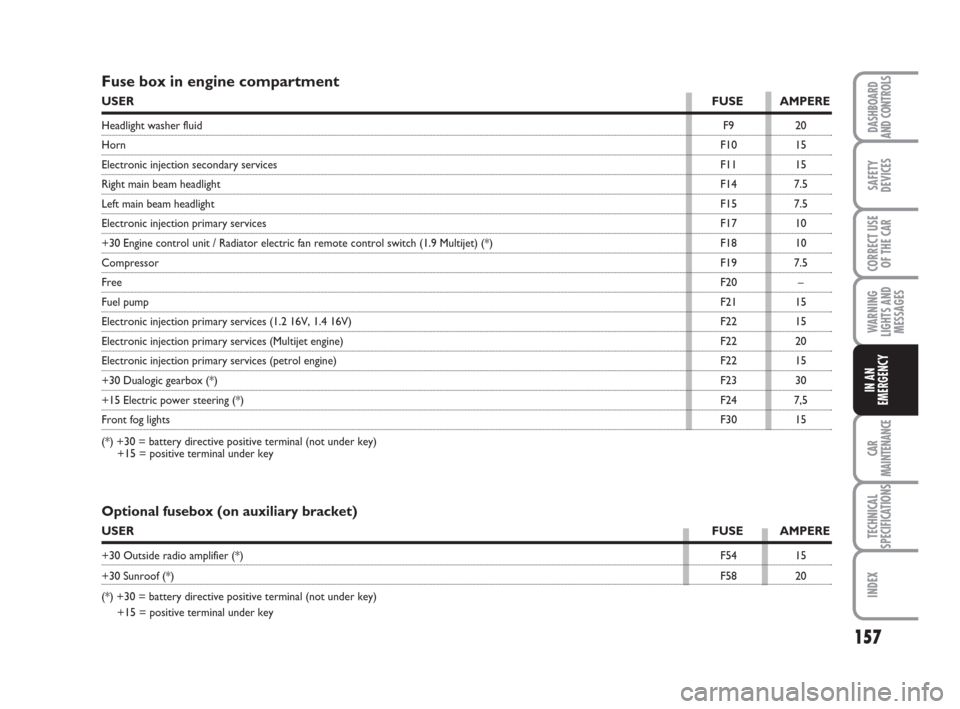
Fuse box in engine compartment
USERFUSE AMPERE
Headlight washer fluidF9 20
HornF10 15
Electronic injection secondary servicesF11 15
Right main beam headlightF14 7.5
Left main beam headlightF15 7.5
Electronic injection primary servicesF17 10
+30 Engine control unit / Radiator electric fan remote control switch (1.9 Multijet) (*) F18 10
CompressorF19 7.5
FreeF20 –
Fuel pumpF21 15
Electronic injection primary services (1.2 16V, 1.4 16V)F22 15
Electronic injection primary services (Multijet engine)F22 20
Electronic injection primary services (petrol engine)F22 15
+30 Dualogic gearbox (*)F23 30
+15 Electric power steering (*)F24 7,5
Front fog lightsF30 15
(*) +30 = battery directive positive terminal (not under key)
+15 = positive terminal under key
Optional fusebox (on auxiliary bracket)
USERFUSE AMPERE
+30 Outside radio amplifier (*)F54 15
+30 Sunroof (*)F58 20
(*) +30 = battery directive positive terminal (not under key)
+15 = positive terminal under key
133-160 idea GB 1 ed 10-07-2008 8:30 Pagina 157
Page 159 of 210
158
CAR
MAINTENANCE
TECHNICAL
SPECIFICATIONS
INDEX
DASHBOARD
AND CONTROLS
SAFETY
DEVICES
CORRECT USE
OF THE CAR
WARNING
LIGHTS AND
MESSAGES
IN AN
EMERGENCY
IF THE BATTERY IS FLAT
WARNING The battery charging proce-
dure is described only for information pur-
poses. This operation should be carried
out by Fiat Dealership.
Charging should be slow at low amp rat-
ing for 24 hours. Charging for a longer
time may damage the battery.
Charge the battery as follows:
❒disconnect battery negative terminal;
❒connect the charger cables to the bat-
tery terminals, observing the poles;
❒turn on the charger;
❒when you have finished, turn the
charger off before disconnecting the
battery;
❒reconnect battery negative terminal.
WARNING If the vehicle is fitted with
alarm system, turn it off with the remote
control (see “Alarm” in the “Dashboard
and controls” chapter).
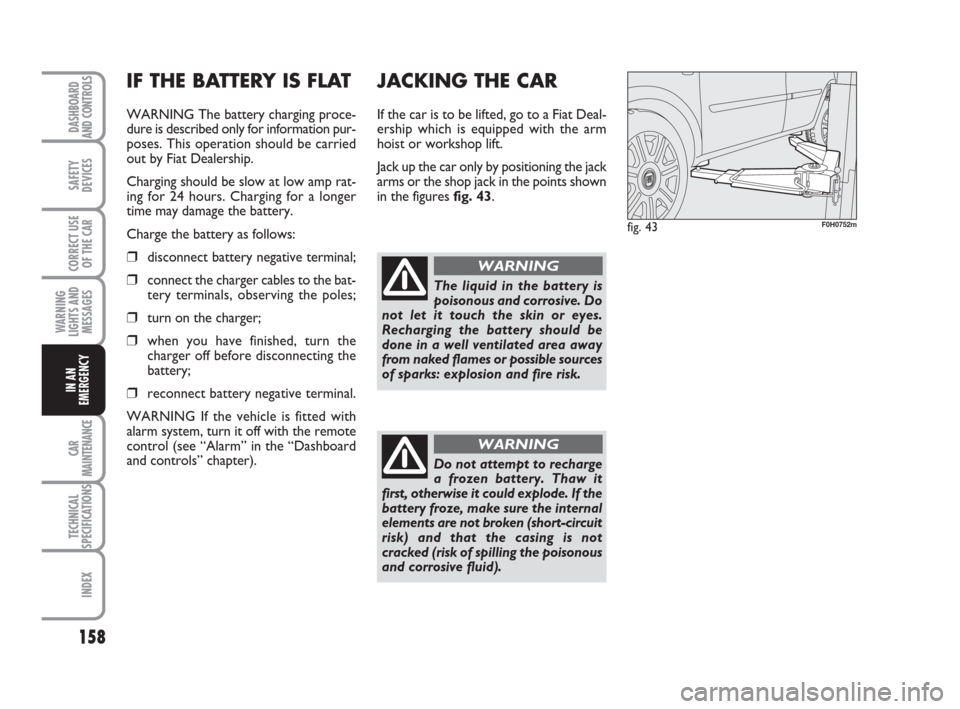
JACKING THE CAR
If the car is to be lifted, go to a Fiat Deal-
ership which is equipped with the arm
hoist or workshop lift.
Jack up the car only by positioning the jack
arms or the shop jack in the points shown
in the figures fig. 43.
The liquid in the battery is
poisonous and corrosive. Do
not let it touch the skin or eyes.
Recharging the battery should be
done in a well ventilated area away
from naked flames or possible sources
of sparks: explosion and fire risk.
WARNING
Do not attempt to recharge
a frozen battery. Thaw it
first, otherwise it could explode. If the
battery froze, make sure the internal
elements are not broken (short-circuit
risk) and that the casing is not
cracked (risk of spilling the poisonous
and corrosive fluid).
WARNING
fig. 43F0H0752m
133-160 idea GB 1 ed 10-07-2008 8:30 Pagina 158
Page 162 of 210
161
TECHNICAL
SPECIFICATIONS
INDEX
DASHBOARD
AND CONTROLS
SAFETY
DEVICES
CORRECT USE
OF THE CAR
WARNING
LIGHTS AND
MESSAGES
IN AN
EMERGENCY
CAR
MAINTENANCE
SCHEDULED SERVICING .................................................. 162
SERVICE SCHEDULE ........................................................... 163
ANNUAL INSPECTION SCHEDULE .............................. 165
ADDITIONAL CHECKS ..................................................... 165
CHECKING FLUID LEVELS ............................................... 167
DIESEL FUEL FILTER (green filter) ................................... 173
BATTERY ................................................................................ 173
WHEELS AND TYRES ......................................................... 175
RUBBER HOSES .................................................................... 176
WINDSCREEN/REAR WINDOW WIPERS .................. 176
BODYWORK ........................................................................ 178
INTERIORS............................................................................. 180
CC C
A A
R R
M M
A A
I I
N N
T T
E E
N N
A A
N N
C C
E E
161-180 idea GB 1 ed 10-07-2008 8:30 Pagina 161
Page 165 of 210
164
TECHNICAL
SPECIFICATIONS
INDEX
DASHBOARD
AND CONTROLS
SAFETY
DEVICES
CORRECT USE
OF THE CAR
WARNING
LIGHTS AND
MESSAGES
IN AN
EMERGENCY
CAR
MAINTENANCE
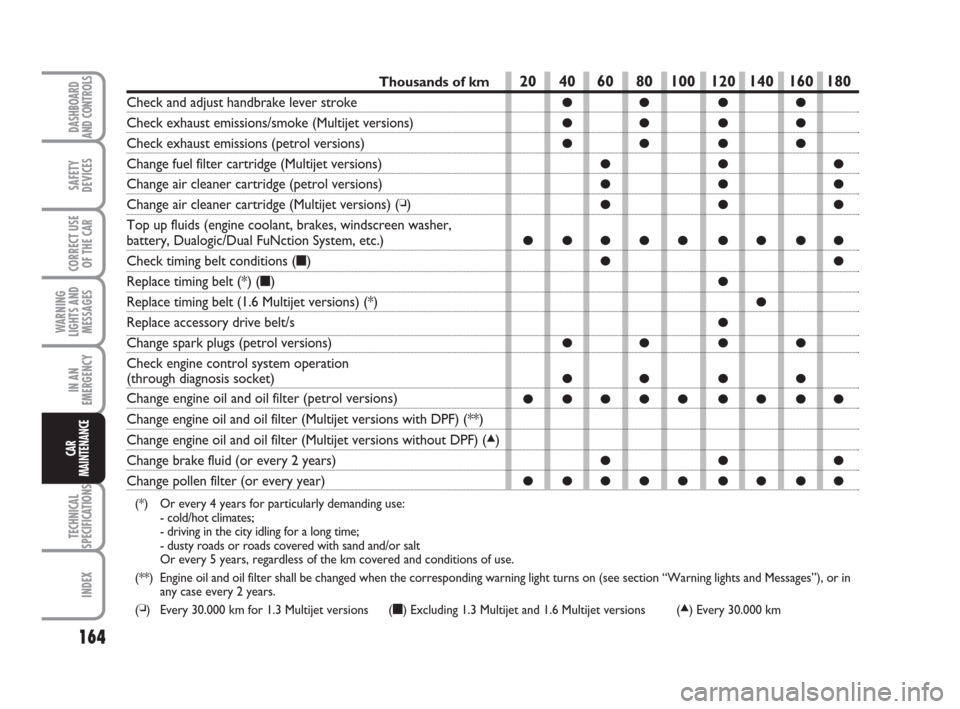
Thousands of km
Check and adjust handbrake lever stroke
Check exhaust emissions/smoke (Multijet versions)
Check exhaust emissions (petrol versions)
Change fuel filter cartridge (Multijet versions)
Change air cleaner cartridge (petrol versions)
Change air cleaner cartridge (Multijet versions) (❏)
Top up fluids (engine coolant, brakes, windscreen washer,
battery, Dualogic/Dual FuNction System, etc.)
Check timing belt conditions (■)
Replace timing belt (*) (■)
Replace timing belt (1.6 Multijet versions) (*)
Replace accessory drive belt/s
Change spark plugs (petrol versions)
Check engine control system operation
(through diagnosis socket)
Change engine oil and oil filter (petrol versions)
Change engine oil and oil filter (Multijet versions with DPF) (**)
Change engine oil and oil filter (Multijet versions without DPF) (▲)
Change brake fluid (or every 2 years)
Change pollen filter (or every year)
(*) Or every 4 years for particularly demanding use:
- cold/hot climates;
- driving in the city idling for a long time;
- dusty roads or roads covered with sand and/or salt
Or every 5 years, regardless of the km covered and conditions of use.
(**) Engine oil and oil filter shall be changed when the corresponding warning light turns on (see section “Warning lights and Messages”), or in
any case every 2 years.
(
❏) Every 30.000 km for 1.3 Multijet versions (■) Excluding 1.3 Multijet and 1.6 Multijet versions (▲) Every 30.000 km
20 40 60 80 100 120 140 160 180
●● ● ●
●● ● ●
●● ● ●
●●●
●●●
●●●
●●●●● ●●●●
●●
●
●
●
●● ● ●
●● ● ●
●●●●● ●●●●
●●●
●●●●● ●●●●
161-180 idea GB 1 ed 10-07-2008 8:30 Pagina 164
Page 166 of 210
165
TECHNICAL
SPECIFICATIONS
INDEX
DASHBOARD
AND CONTROLS
SAFETY
DEVICES
CORRECT USE
OF THE CAR
WARNING
LIGHTS AND
MESSAGES
IN AN
EMERGENCY
CAR
MAINTENANCE
ANNUAL INSPECTION
SCHEDULE
For cars with an annual mileage of below
20,000 km (for example about 15,000 km)
the following yearly inspection programme
is provided:
❒check tyre conditions/wear and adjust
pressure if required (including the
spare wheel);
❒check lighting system operation (head-
lights, direction indicators, hazard
lights, boot lights, passenger compart-
ment lights, warning lights, etc.);
❒check windscreen/washer (nozzles/
and blade position regulation)
❒check front disk brake pad conditions
and wear;
❒sight inspect the conditions of: engine,
gearbox, transmission, pipes and hoses
(exhaust - fuel - brakes), rubber parts
(boots, sleeves, bushes, etc;
❒check for bonnet and boot lock clean-
ness, lever cleanness and lubrication;
❒check battery charge;
❒visual check on various drive belt con-
ditions;
❒top up fluid levels (engine coolant,
brakes, windscreen washer, battery,
etc.);
❒change engine oil;
❒change engine oil filter;
❒replace pollen filter (where provided).
ADDITIONAL CHECKS
Every 1,000 km or before long journeys,
check and top up if required:
❒engine coolant fluid level;
❒brake fluid level;
❒windscreen washer fluid level;
❒tyre pressure and conditions.
Every 3,000 km check and top up if re-
quired: engine oil level.
You are recommended to use FL Selenia
products, designed and produced specifi-
cally for Fiat cars (see table “Capacities”
in section “Technical specifications”).
161-180 idea GB 1 ed 10-07-2008 8:30 Pagina 165
Page 167 of 210
166
TECHNICAL
SPECIFICATIONS
INDEX
DASHBOARD
AND CONTROLS
SAFETY
DEVICES
CORRECT USE
OF THE CAR
WARNING
LIGHTS AND
MESSAGES
IN AN
EMERGENCY
CAR
MAINTENANCE
IMPORTANT - Engine oil
Should prevailing use of the car be under
one of the following specially heavy con-
ditions:
❒trailer or caravan towing;
❒dusty roads;
❒short distances (less than 7-8 km) re-
peated and with external tempera-
tures below zero;
❒frequently idling engines or long dis-
tance low speed driving (e.g. taxis or
door-to-door deliveries) or in case of
a long term inactivity;
replace engine oil more frequently than
required on “Service schedule”.
IMPORTANT - Air cleaner
If the car is used on dusty roads change
the air cleaner more frequently than the
indications in the “Service schedule”.
If in doubt as to how often the engine oil
and air cleaner should be changed ac-
cording to how you use the car, contact
a Fiat Dealership.IMPORTANT - Pollen filter
If the vehicle is used frequently in dusty or
heavily polluted environments it is advis-
able to replace the filtering element more
frequently; in particular it should be re-
placed if a reduction of the amount of air
admitted to the passenger compartment
is noted.
IMPORTANT - Diesel filter
The possibility of topping up with diesel
fuel not complying with EN590 European
Norm might make it necessary to replace
the filter more frequently than indicated
in the “Service schedule”.IMPORTANT - Battery
The charge in the battery should be
checked at the start of winter to limit the
risk of electrolyte freezing.
This check should be carried out more
frequently if the car is used mainly for
short trips, or if it is fitted with accessories
that permanently absorb electricity even
with the ignition key removed, especially
in the case of after market accessories. If
the car is used in hot climates or particu-
larly harsh conditions it is wise to check
the level of the battery fluid (electrolyte)
more frequently than specified in the “Ser-
vice schedule” in this section.
Car maintenance should be
entrusted to Fiat Dealership.
For routine and minor main-
tenance operations you wish
to carry out yourself, always make sure
you have the proper equipment, gen-
uine Fiat spare parts and the necessary
fluids; do not however carry out these
operations if you have no experience.
161-180 idea GB 1 ed 10-07-2008 8:30 Pagina 166
Page 168 of 210
167
TECHNICAL
SPECIFICATIONS
INDEX
DASHBOARD
AND CONTROLS
SAFETY
DEVICES
CORRECT USE
OF THE CAR
WARNING
LIGHTS AND
MESSAGES
IN AN
EMERGENCY
CAR
MAINTENANCE
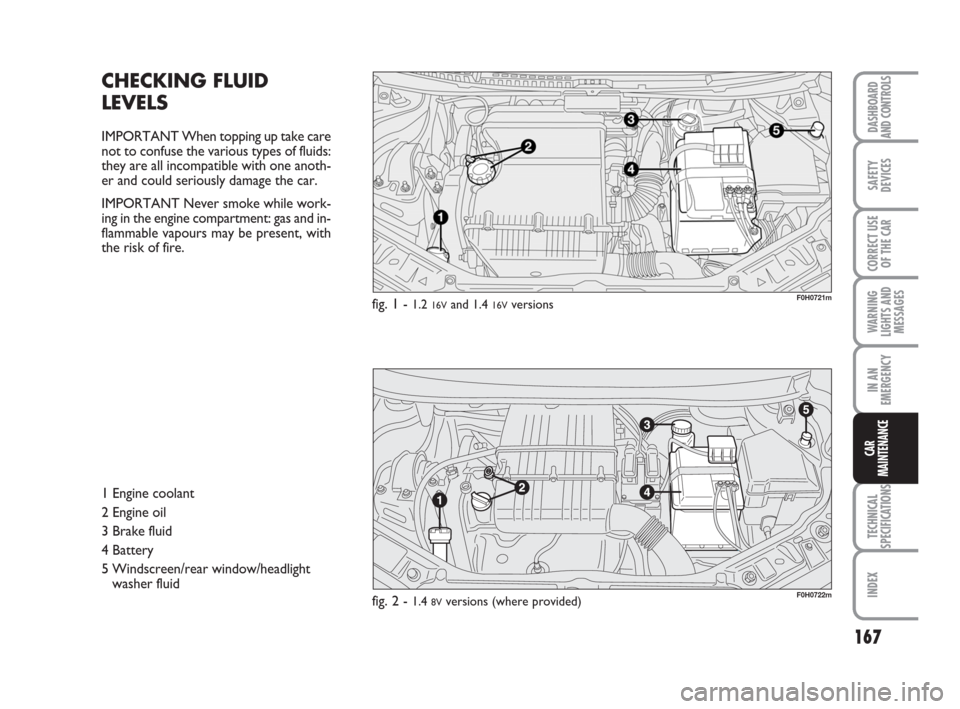
CHECKING FLUID
LEVELS
IMPORTANT When topping up take care
not to confuse the various types of fluids:
they are all incompatible with one anoth-
er and could seriously damage the car.
IMPORTANT Never smoke while work-
ing in the engine compartment: gas and in-
flammable vapours may be present, with
the risk of fire.
F0H0721mfig. 1 - 1.2 16Vand 1.4 16Vversions
F0H0722mfig. 2 - 1.4 8Vversions (where provided)
1 Engine coolant
2 Engine oil
3 Brake fluid
4 Battery
5 Windscreen/rear window/headlight
washer fluid
161-180 idea GB 1 ed 10-07-2008 8:30 Pagina 167
Page 169 of 210
168
TECHNICAL
SPECIFICATIONS
INDEX
DASHBOARD
AND CONTROLS
SAFETY
DEVICES
CORRECT USE
OF THE CAR
WARNING
LIGHTS AND
MESSAGES
IN AN
EMERGENCY
CAR
MAINTENANCE
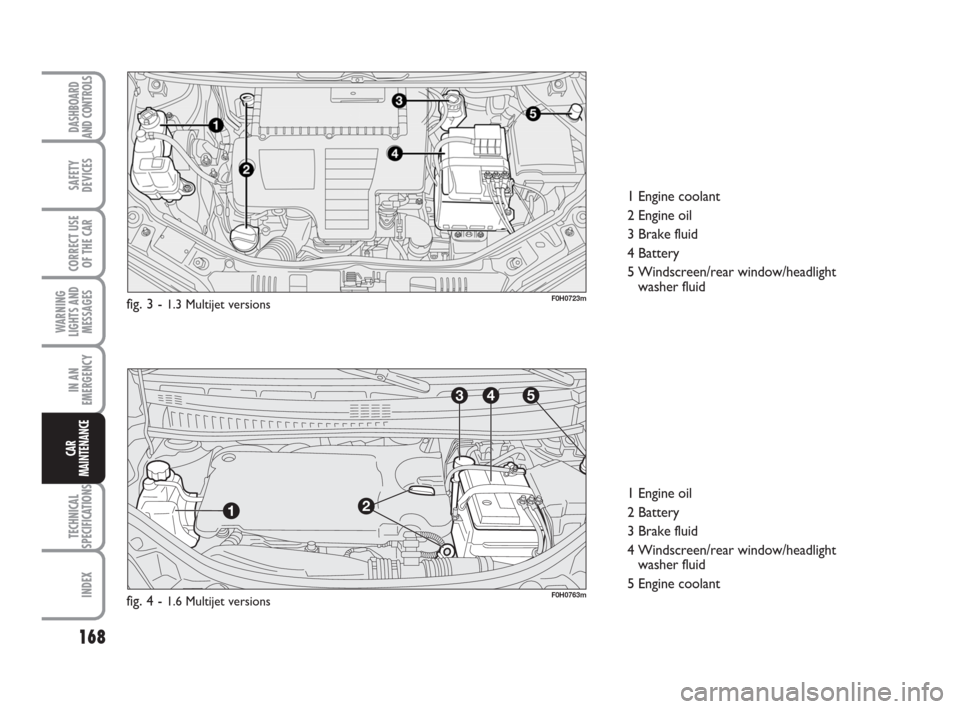
F0H0723mfig. 3 - 1.3 Multijet versions
3
12
45
F0H0763mfig. 4 - 1.6 Multijet versions
1 Engine coolant
2 Engine oil
3 Brake fluid
4 Battery
5 Windscreen/rear window/headlight
washer fluid
1 Engine oil
2 Battery
3 Brake fluid
4 Windscreen/rear window/headlight
washer fluid
5 Engine coolant
161-180 idea GB 1 ed 10-07-2008 8:30 Pagina 168