air condition FIAT LINEA 2007 1.G User Guide
[x] Cancel search | Manufacturer: FIAT, Model Year: 2007, Model line: LINEA, Model: FIAT LINEA 2007 1.GPages: 230, PDF Size: 3.31 MB
Page 66 of 230
65
SAFETY
DEVICES
CORRECT USE
OF THE
CAR
WARNING
LIGHTS AND
MESSAGES
IN AN
EMERGENCY
CAR
MAINTENANCE
TECHNICAL
SPECIFICATIONS
INDEX
DASHBOARD
AND CONTROLS
IMPORTANT The quick demisting/de-
frosting function will stay on for approxi-
mately 3 minutes after the engine coolant
temperature is warm enough to ensure
rapid window demisting.
When the function is on, the LED on the
rear window demister button will light up
and the message FULL AUTOwill go
out on the display.
You may only adjust the fan speed and
switch the rear window demister off man-
ually when this function is running.
To restore running operations before this
function was activated, press either but-
ton B, air recirculation button G, com-
pressor button For button AUTO A.Switching the system off (E)
Press Eto switch the climate control sys-
tem off. The display will go out as a con-
sequence.
The following climate control conditions
will be established when the system is off:
❒display off;
❒temperature not shown;
❒air recirculation on, passenger com-
partment isolated from the outside
(recirculation LED on);
❒climate control compressor off;
❒fan off.Press AUTOto switch the automatic cli-
mate control system back on.
Page 128 of 230
127
WARNING
LIGHTS AND
MESSAGES
IN AN
EMERGENCY
CAR
MAINTENANCE
TECHNICAL
SPECIFICATIONS
INDEX
DASHBOARD
AND CONTROLS
SAFETY
DEVICES
CORRECT USE
OF THE CAR
Roof rack/ski rack
Remove the roof rack or the ski rack from
the roof after use. These accessories de-
crease aerodynamic penetration of the car
and have a negative effect on consumption.
It is better to use a trailer to transport
particularly bulky objects.
Electric devices
Use electric devices only for the amount
of time needed. Rear heated window, ad-
ditional headlights, windscreen wipers and
heater fan need a considerable amount of
energy, therefore increasing the require-
ment of current increases fuel consump-
tion (up to +25% in the urban cycle).
Climate control
The climate control system requires high-
er fuel consumption (up to +20% in av-
erage): use the air vents when the exter-
nal temperature allows to.
Spoilers
The use of non-certified aerodynamic
items may adversely affect air drag and
consumption levels.DRIVING STYLE
Starting
Do not warm the engine up with the car
standing: the engine warms up very slow-
ly in these conditions, increasing con-
sumption and emissions. It is advisable to
start off immediately and slowly keeping
the engine speed down: the engine will
warm up much faster this way.
Unnecessary actions
Avoid revving up when starting at traffic
lights or before stopping the engine. The
latter action, like doubling the clutch, is un-
necessary and causes increase of con-
sumption and pollution.
Gear selection
Use a higher gear as soon as traffic and
road conditions allow. Using a low gear
for faster acceleration will increase con-
sumption.
In the same way improper use of a high
gear increases consumption, emissions an
engine wear.CONTAINING
RUNNING COSTS
Here are some suggestions which may
help you to keep the running costs of your
car down and lower the amount of toxic
emissions released into the atmosphere.
GENERAL CONSIDERATIONS
Car maintenance
Have checks and adjustments carried out
in accordance with the “Service schedule”.
Tyres
Check tyre pressure regularly at least
once every four weeks: excessively low
pressure will increase consumption be-
cause rolling resistance will be higher.
Unnecessary loads
Do not travel with too much luggage
stowed in the boot. The weight of the car
(especially when driving in town) and its
trim greatly affects consumption and sta-
bility.
Page 140 of 230
139
IN AN
EMERGENCY
CAR
MAINTENANCE
TECHNICAL
SPECIFICATIONS
INDEX
DASHBOARD
AND CONTROLS
SAFETY
DEVICES
CORRECT USE
OF THE
CAR
WARNING
LIGHTS AND
MESSAGES
K
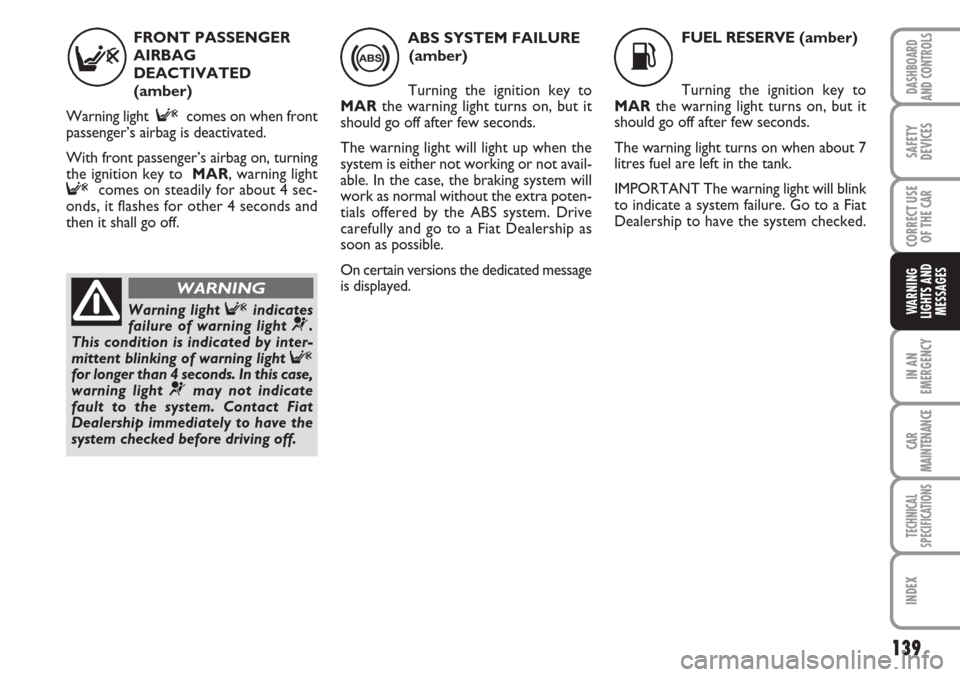
FUEL RESERVE(amber)
Turning the ignition key to
MARthe warning light turns on, but it
should go off after few seconds.
The warning light turns on when about 7
litres fuel are left in the tank.
IMPORTANT The warning light will blink
to indicate a system failure. Go to a Fiat
Dealership to have the system checked. ABS SYSTEM FAILURE
(amber)
Turning the ignition key to
MARthe warning light turns on, but it
should go off after few seconds.
The warning light will light up when the
system is either not working or not avail-
able. In the case, the braking system will
work as normal without the extra poten-
tials offered by the ABS system. Drive
carefully and go to a Fiat Dealership as
soon as possible.
On certain versions the dedicated message
is displayed.
>F
FRONT PASSENGER
AIRBAG
DEACTIVATED
(amber)
Warning light
Fcomes on when front
passenger’s airbag is deactivated.
With front passenger’s airbag on, turning
the ignition key to MAR, warning light
Fcomes on steadily for about 4 sec-
onds, it flashes for other 4 seconds and
then it shall go off.
Warning light
Findicates
failure of warning light ¬.
This condition is indicated by inter-
mittent blinking of warning light
Ffor longer than 4 seconds. In this case,
warning light ¬may not indicate
fault to the system. Contact Fiat
Dealership immediately to have the
system checked before driving off.
WARNING
Page 181 of 230
180
WARNING
LIGHTS AND
MESSAGES
TECHNICAL
SPECIFICATIONS
INDEX
DASHBOARD
AND CONTROLS
SAFETY
DEVICES
CORRECT USE
OF THE CAR
IN AN
EMERGENCY
CAR
MAINTENANCE
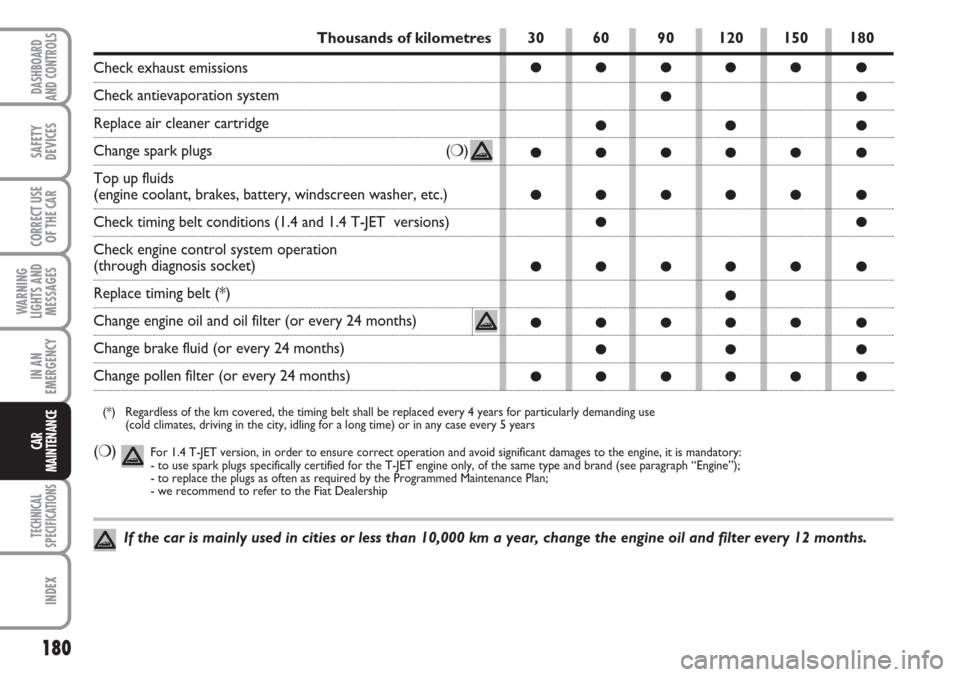
If the car is mainly used in cities or less than 10,000 km a year, change the engine oil and filter every 12 months.30 60 90 120 150 180
●●●●● ●
●●
●● ●
●●●●● ●
●●●●● ●
●●
●●●●● ●
●
●●●●● ●
●● ●
●●●●● ●
Thousands of kilometres
Check exhaust emissions
Check antievaporation system
Replace air cleaner cartridge
Change spark plugs (❍)
Top up fluids
(engine coolant, brakes, battery, windscreen washer, etc.)
Check timing belt conditions (1.4 and 1.4 T-JET versions)
Check engine control system operation
(through diagnosis socket)
Replace timing belt (*)
Change engine oil and oil filter (or every 24 months)
Change brake fluid (or every 24 months)
Change pollen filter (or every 24 months)
(*) Regardless of the km covered, the timing belt shall be replaced every 4 years for particularly demanding use
(cold climates, driving in the city, idling for a long time) or in any case every 5 years
(❍)For 1.4 T-JET version, in order to ensure correct operation and avoid significant damages to the engine, it is mandatory:
- to use spark plugs specifically certified for the T-JET engine only, of the same type and brand (see paragraph “Engine”);
- to replace the plugs as often as required by the Programmed Maintenance Plan;
- we recommend to refer to the Fiat Dealership
Page 184 of 230
183
WARNING
LIGHTS AND
MESSAGES
TECHNICAL
SPECIFICATIONS
INDEX
DASHBOARD
AND CONTROLS
SAFETY
DEVICES
CORRECT USE
OF THE CAR
IN AN
EMERGENCY
CAR
MAINTENANCE
DEMANDING USE
OF THE CAR
Should prevailing use of the car be under
one of the following specially heavy con-
ditions:
❒trailer or caravan towing;
❒dusty roads;
❒short distances (less than 7-8 km) re-
peated and with external temperatures
below zero;
❒frequently idling engines or long dis-
tance low speed driving (e.g. taxis or
door-to-door deliveries) or in case of
a long term inactivity;
❒in cities;
perform the following inspections more
frequently than shown on the Service
Schedule:
❒check front disk brake pad conditions
and wear;
❒check cleanness of locks, bonnet and
boot and lever cleanness and lubrica-
tion;
❒visually inspect the conditions of: en-
gine, gearbox, transmission, pipes and
hoses (exhaust - fuel - brakes), rubber
parts (boots, sleeves, bushes, etc.);
❒check battery charge and liquid level
(electrolyte) (see paragraph “Charge
level check” in chapter “Maintenance
and care”);
❒visually inspect the accessory drive belt
conditions;
❒check pollen filter and replace, if re-
quired;
❒check air cleaner and replace, if re-
quired.
REGULAR
INSPECTIONS
Every 1,000 km or before long journeys,
check and top up if required:
❒engine coolant fluid level;
❒brake fluid level;
❒brake fluid level;
❒tyre pressure and conditions.
❒operation of lights (headlights, direction
indicators, hazard lights, etc.);
❒operation of the windscreen wiper/
washer system, position and wear of
the windscreen and rear window wiper
blades;
Every 3,000 km check the following and
top-up, if required:engine oil level.
You are recommended to use FL
Seleniaproducts, designed and produced
specifically for Fiat cars (see table “Ca-
pacities” in section “Technical specifica-
tions”).
Page 190 of 230
189
WARNING
LIGHTS AND
MESSAGES
TECHNICAL
SPECIFICATIONS
INDEX
DASHBOARD
AND CONTROLS
SAFETY
DEVICES
CORRECT USE
OF THE CAR
IN AN
EMERGENCY
CAR
MAINTENANCEOil consumption is extremely
low; if another top-up should
be required after only a short
period of time, have the system checked
for leakage at a Fiat Dealership.
BATTERY
The car fits a low-maintenance battery: no
top-ups with distilled water are needed in
normal conditions of use.
CHECKING THE CHARGE fig. 9
Use the gauge A (where provided) on the
battery lid positioned as shown in fig. 9and
take action according to the colour it as-
sumes.
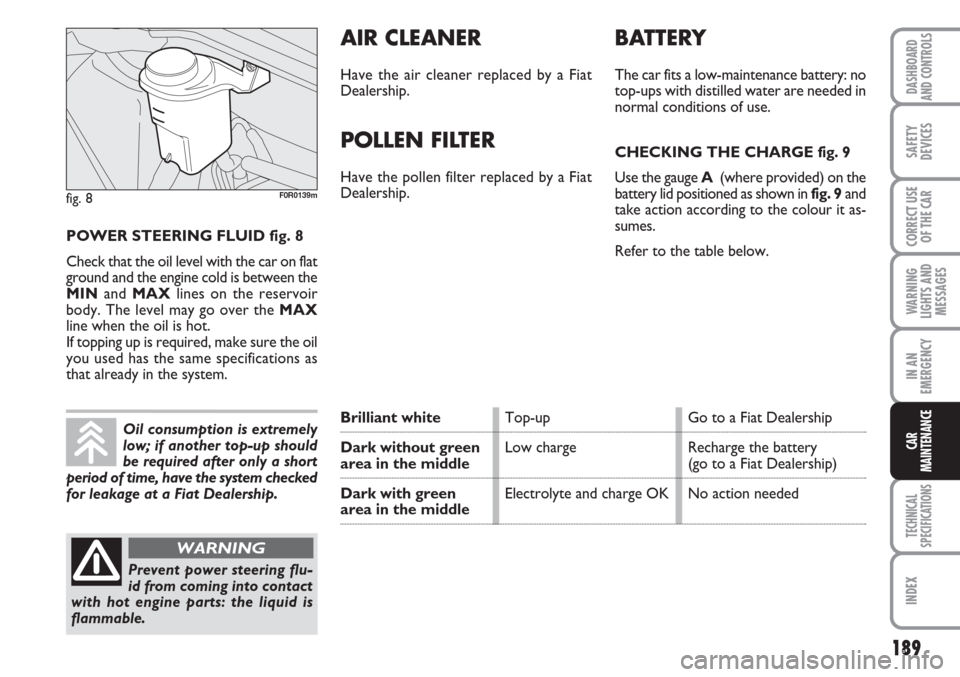
Refer to the table below. POWER STEERING FLUID fig. 8
Check that the oil level with the car on flat
ground and the engine cold is between the
MINand MAXlines on the reservoir
body. The level may go over the MAX
line when the oil is hot.
If topping up is required, make sure the oil
you used has the same specifications as
that already in the system.
AIR CLEANER
Have the air cleaner replaced by a Fiat
Dealership.
POLLEN FILTER
Have the pollen filter replaced by a Fiat
Dealership.
Prevent power steering flu-
id from coming into contact
with hot engine parts: the liquid is
flammable.
WARNING
fig. 8F0R0139m
Brilliant whiteTop-up Go to a Fiat Dealership
Dark without greenLow charge Recharge the battery
area in the middle(go to a Fiat Dealership)
Dark with green Electrolyte and charge OK No action needed
area in the middle
Page 196 of 230
195
WARNING
LIGHTS AND
MESSAGES
TECHNICAL
SPECIFICATIONS
INDEX
DASHBOARD
AND CONTROLS
SAFETY
DEVICES
CORRECT USE
OF THE CAR
IN AN
EMERGENCY
CAR
MAINTENANCE
BODY AND UNDERBODY
WARRANTY
Your car is covered by warranty against
perforation due to rust of any original el-
ement of the structure or body.
For the general terms of this warranty, re-
fer to Fiat Warranty Booklet.
ADVICE FOR PRESERVING
THE BODYWORK
Paint
Paintwork does not only serve an aes-
thetic purpose, but also protects the un-
derlying sheet metal.
Touch up abrasions and scratches immedi-
ately to prevent the formation of rust. On-
ly use genuine spare paint products for
touch-ups (see “Bodywork paint identifi-
cation plate” in the “Technical Specifica-
tions” section).BODYWORK
PROTECTION FROM
ATMOSPHERIC AGENTS
The main causes of corrosion are the fol-
lowing:
❒atmospheric pollution;
❒salty air and humidity (coastal areas, or
hot humid climates);
❒seasonal environment conditions.
Not to be underestimated is also the abra-
sive action of wind-borne atmospheric
dust and sand and mud and gravel raised
by other cars.
On your car, Fiat implemented the best
manufacturing technologies to effectively
protect the bodywork against corrosion.These are the most important:
❒paint products and systems which give
the car particular resistance to corro-
sion and abrasion;
❒use of galvanised (or pre-treated) steel
sheets, with high resistance to corro-
sion;
❒spraying the underbody, engine com-
partment, wheelhouse internal parts
and other parts with highly protective
wax products;
❒spraying of plastic materials for pro-
tective purposes in the most exposed
points: under the doors, inside the
mudguard, along the edges, etc.
❒use of “open” boxed sections to pre-
vent condensation and pockets of mois-
ture from triggering rust inside.
Page 197 of 230
196
WARNING
LIGHTS AND
MESSAGES
TECHNICAL
SPECIFICATIONS
INDEX
DASHBOARD
AND CONTROLS
SAFETY
DEVICES
CORRECT USE
OF THE CAR
IN AN
EMERGENCY
CAR
MAINTENANCE
Normal maintenance of paintwork consists
in washing the car: the frequency depends
on the conditions and environment where
the car is used. For example, it is advisable
to wash the car more often in areas with
a high environmental pollution or on roads
sprinkled with salt.
To correctly wash the car:
❒remove the aerial from the roof to pre-
vent damage to it if the car is washed in
an automatic system;
❒wash the body using a low pressure jet
of water;
❒wipe a sponge with a slightly soapy so-
lution over the bodywork, frequently
rinsing with the sponge;
❒rinse well with water and dry with a jet
of air or a chamois leather.
Dry the parts less in sight particularly care-
fully, such as the door frames and the
headlight frames, where water may stag-
nate more easily. It is a good idea to leave
the car in the open for a while after wash-
ing it to give time for the water to evap-
orate.Do not wash the car after it has been
parked in the sun or when the engine is
bonnet is hot: this could take the shine off
the paint.
Exterior plastic parts must be cleaned in
the same way as the rest of the car.
Where possible, do not park under trees;
the resinous substance many species re-
lease give the paint a dull appearance and
increase the possibility of triggering rust
processes.
IMPORTANT Bird droppings must be
washed off immediately and thoroughly as
the acid they contain is particularly ag-
gressive.
Detergents cause water pollu-
tion. The car should be washed
in areas equipped for collect-
ing and purifying the liquid
used in the washing process.
Windows
Use specific window cleaner products.
Use also clean cloths to avoid scratching
the glass or damaging the transparency.
IMPORTANT The inside of the rear win-
dow should be wiped gently with a cloth
in the direction of the filaments to avoid
damaging the heating device.
Engine compartment
Wash the engine compartment carefully
after the end of the winter. Be careful not
to direct the jet of water onto electronic
control units. Adequately protect the up-
per air vents to prevent damage to the
windscreen wiper motor. Have this op-
eration performed at a specialised work-
shop.
IMPORTANT Perform this operation on
a cold engine and with the key at STOP.
After the washing operation, make sure
that the various protections (e.g. rubber
caps and guards) have not removed or
damaged.
Front headlights
IMPORTANT Never use aromatic sub-
stances (e.g.: petrol) or ketenes (e.g.: ace-
tone) for cleaning front headlight plastic
lens.
Page 217 of 230
216
WARNING
LIGHTS AND
MESSAGES
INDEX
DASHBOARD
AND CONTROLS
SAFETY
DEVICES
CORRECT USE
OF THE
CAR
IN AN
EMERGENCY
CAR
MAINTENANCE
TECHNICAL
SPECIFICATIONS
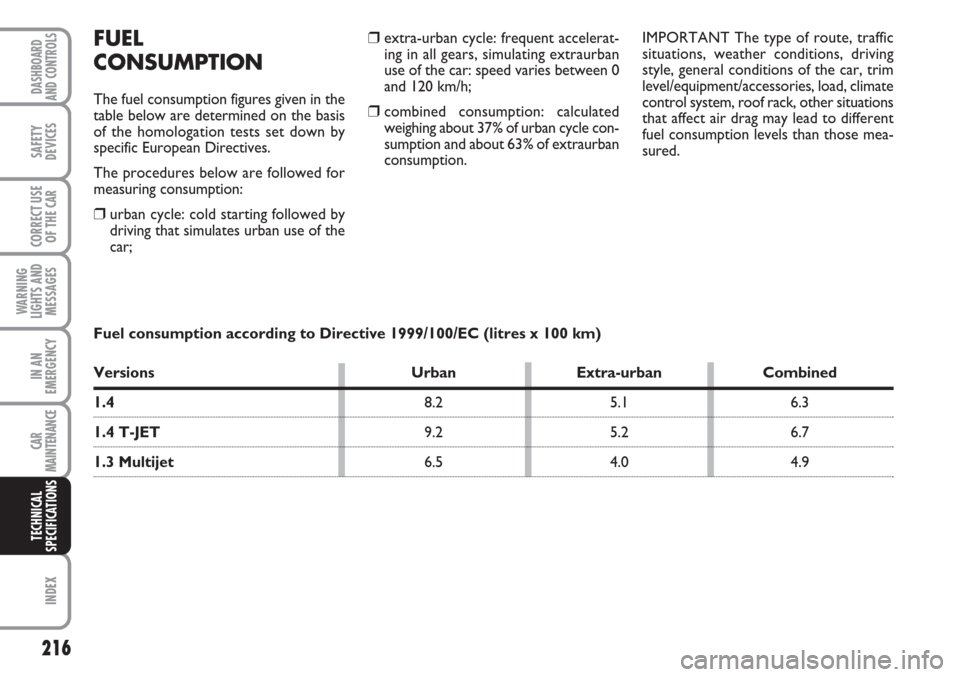
❒extra-urban cycle: frequent accelerat-
ing in all gears, simulating extraurban
use of the car: speed varies between 0
and 120 km/h;
❒combined consumption: calculated
weighing about 37% of urban cycle con-
sumption and about 63% of extraurban
consumption.
FUEL
CONSUMPTION
The fuel consumption figures given in the
table below are determined on the basis
of the homologation tests set down by
specific European Directives.
The procedures below are followed for
measuring consumption:
❒urban cycle: cold starting followed by
driving that simulates urban use of the
car;IMPORTANT The type of route, traffic
situations, weather conditions, driving
style, general conditions of the car, trim
level/equipment/accessories, load, climate
control system, roof rack, other situations
that affect air drag may lead to different
fuel consumption levels than those mea-
sured.
Fuel consumption according to Directive 1999/100/EC (litres x 100 km)
Versions Urban Extra-urban Combined
1.4 8.2 5.1 6.3
1.4 T-JET9.2 5.2 6.7
1.3 Multijet6.5 4.0 4.9
Page 219 of 230
218
WARNING
LIGHTS AND
MESSAGES
DASHBOARD
AND CONTROLS
SAFETY
DEVICES
CORRECT USE
OF THE
CAR
IN AN
EMERGENCY
CAR
MAINTENANCE
TECHNICAL
SPECIFICATIONS
INDEX
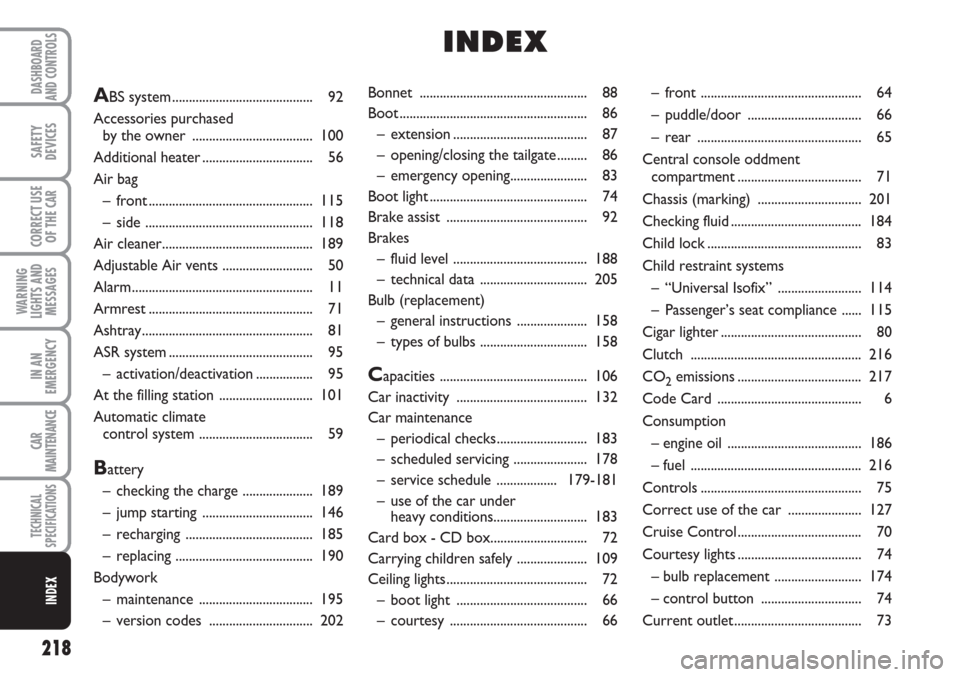
Bonnet .................................................. 88
Boot ........................................................ 86
– extension........................................ 87
– opening/closing the tailgate ......... 86
– emergency opening....................... 83
Boot light............................................... 74
Brake assist .......................................... 92
Brakes
– fluid level ........................................ 188
– technical data ................................ 205
Bulb (replacement)
– general instructions ..................... 158
– types of bulbs ................................ 158
Capacities ............................................ 106
Car inactivity ....................................... 132
Car maintenance
– periodical checks........................... 183
– scheduled servicing ...................... 178
– service schedule ..................179-181
– use of the car under
heavy conditions............................ 183
Card box - CD box............................. 72
Carrying children safely ..................... 109
Ceiling lights.......................................... 72
– boot light ....................................... 66
– courtesy ......................................... 66– front ................................................ 64
– puddle/door .................................. 66
– rear ................................................. 65
Central console oddment
compartment..................................... 71
Chassis (marking) ............................... 201
Checking fluid....................................... 184
Child lock.............................................. 83
Child restraint systems
– “Universal Isofix” ......................... 114
– Passenger’s seat compliance ...... 115
Cigar lighter.......................................... 80
Clutch ................................................... 216
CO2emissions..................................... 217
Code Card ........................................... 6
Consumption
– engine oil ........................................ 186
– fuel ................................................... 216
Controls................................................ 75
Correct use of the car ...................... 127
Cruise Control..................................... 70
Courtesy lights ..................................... 74
– bulb replacement .......................... 174
– control button .............................. 74
Current outlet...................................... 73
ABS system.......................................... 92
Accessories purchased
by the owner .................................... 100
Additional heater................................. 56
Air bag
– front................................................. 115
– side .................................................. 118
Air cleaner............................................. 189
Adjustable Air vents ........................... 50
Alarm...................................................... 11
Armrest................................................. 71
Ashtray................................................... 81
ASR system........................................... 95
– activation/deactivation................. 95
At the filling station ............................ 101
Automatic climate
control system .................................. 59
Battery
– checking the charge ..................... 189
– jump starting ................................. 146
– recharging ...................................... 185
– replacing ......................................... 190
Bodywork
– maintenance .................................. 195
– version codes ............................... 202
II I
N N
D D
E E
X X