fuel FIAT LINEA 2007 1.G User Guide
[x] Cancel search | Manufacturer: FIAT, Model Year: 2007, Model line: LINEA, Model: FIAT LINEA 2007 1.GPages: 230, PDF Size: 3.31 MB
Page 40 of 230
39
SAFETY
DEVICES
CORRECT USE
OF THE
CAR
WARNING
LIGHTS AND
MESSAGES
IN AN
EMERGENCY
CAR
MAINTENANCE
TECHNICAL
SPECIFICATIONS
INDEX
DASHBOARD
AND CONTROLS
If the distance unit set is “mi” the fuel con-
sumption unit will be displayed in “mpg”.
– press button +or –for setting;
– when accessing the “Temperature” sub-
menu: briefly press MENU ESC: either
“°C” or “°F” will appear on the display ac-
cording to the previous setting;
– press button +or –for setting;
When you have made the required set-
tings, briefly press button MENU ESCto
go back to the menu screen or press the
button for long to go back to the standard
screen without storing settings.
– hold MENU ESCpressed to go back
to the standard screen or main menu ac-
cording to the points of the menu where
you are at.Language (Selecting the language)
The messages may be displayed in the fol-
lowing languages: Italian, German,
English, Spanish, French, Portuguese,
Dutch.
To set the required language proceed as
follows:
– briefly press button MENU ESC: the
previously set “language” “ will flash on the
display;
– press button +or –for setting;
– briefly press button MENU ESCto go
back to the menu screen or press the but-
ton for long to go back to the standard
screen without storing settings.Buzzer volume (Adjusting the
failure/warning buzzer volume)
With this function the volume of the
buzzer accompanying any failure/warning
indication can be adjusted according to 8
levels.
To adjust the volume proceed as follows:
– briefly press button MENU ESC: the
previously set volume “level” will flash on
the display;
– press button +or –for setting;
– briefly press button MENU ESCto go
back to the menu screen or press the but-
ton for long to go back to the standard
screen without storing settings.
Page 43 of 230
42
SAFETY
DEVICES
CORRECT USE
OF THE
CAR
WARNING
LIGHTS AND
MESSAGES
IN AN
EMERGENCY
CAR
MAINTENANCE
TECHNICAL
SPECIFICATIONS
INDEX
DASHBOARD
AND CONTROLS
TRIP COMPUTER
General features
The “Trip computer” is used to display in-
formation on car operation when the key
is turned to MAR. This function allows to
define two separate trips called “Trip A”
and “Trip B” for monitoring the car’s
“complete mission” in a reciprocally in-
dependent manner.
Both functions are resettable (reset - start
of new mission).
“Trip A” may be used to display the fig-
ures relating to:
– Range
– Distance travelled
– Average consumption
– Instant consumption
– Average speed
– Travel time (driving time).“Trip B”, available on multifunctional dis-
play only, shall be used to display the fig-
ures relating to:
– Trip distance B
– Average consumption B
– Average speed B
– Travel time B (driving time).
Note“Trip B” functions may be exclud-
ed (see “Trip B on”). “Range” and “In-
stantaneous consumption” cannot be re-
set.Values displayed
Range
This indicates the distance which may be
travelled with the fuel in the tank
assuming that driving conditions will not
change. The message “——” will appear
on the display in the following cases:
– range shorter than 50 km (or 30 mi)
– car left parked with engine running for
long.
Distance travelled
This indicates the distance covered from
the start of the new mission.
Page 44 of 230
43
SAFETY
DEVICES
CORRECT USE
OF THE
CAR
WARNING
LIGHTS AND
MESSAGES
IN AN
EMERGENCY
CAR
MAINTENANCE
TECHNICAL
SPECIFICATIONS
INDEX
DASHBOARD
AND CONTROLS
Average consumption
This indicates the average consumption
from the start of the new mission.
Instant consumption
This indicates the fuel consumption. The
value is constantly updated. The message
“----” will appear on the display
if the car is parked with the engine run-
ning.
Average speed
This shows the car average speed as a
function of the overall time elapsed since
the start of the new mission.
Travel time
This value shows the time elapsed since
the start of the new mission.
IMPORTANT If information is not avail-
able, the message “----” will appear instead
of the Trip Computer values. Displaying
of the values will be resumed when nor-
mal operation is restored without reset-
ting the values displayed before the prob-
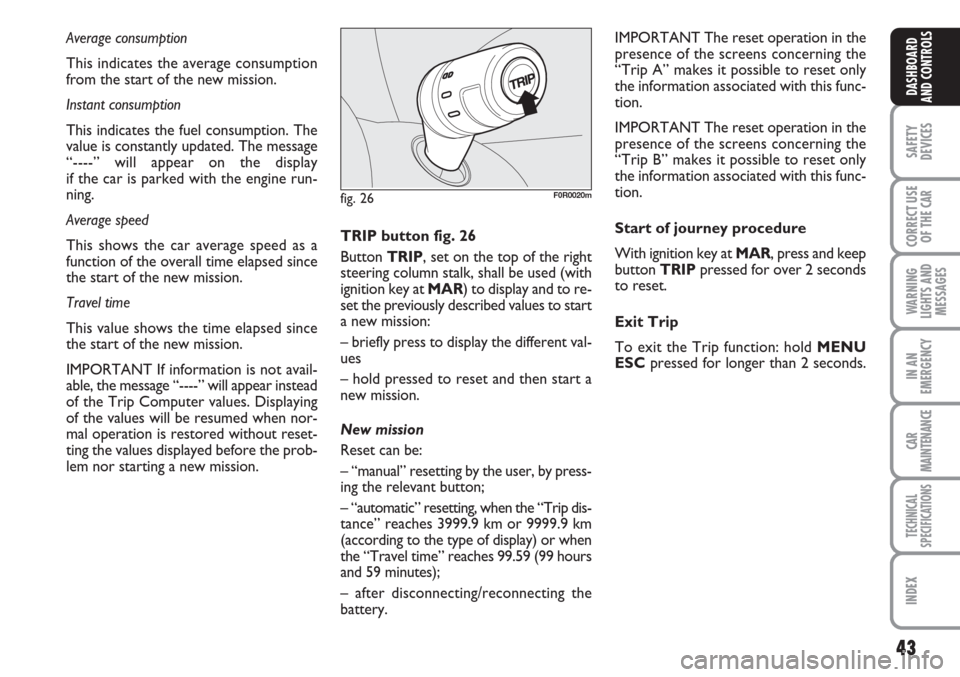
lem nor starting a new mission. TRIP button fig. 26
Button TRIP, set on the top of the right
steering column stalk, shall be used (with
ignition key at MAR) to display and to re-
set the previously described values to start
a new mission:
– briefly press to display the different val-
ues
– hold pressed to reset and then start a
new mission.
New mission
Reset can be:
– “manual” resetting by the user, by press-
ing the relevant button;
– “automatic” resetting, when the “Trip dis-
tance” reaches 3999.9 km or 9999.9 km
(according to the type of display) or when
the “Travel time” reaches 99.59 (99 hours
and 59 minutes);
– after disconnecting/reconnecting the
battery.IMPORTANT The reset operation in the
presence of the screens concerning the
“Trip A” makes it possible to reset only
the information associated with this func-
tion.
IMPORTANT The reset operation in the
presence of the screens concerning the
“Trip B” makes it possible to reset only
the information associated with this func-
tion.
Start of journey procedure
With ignition key at MAR, press and keep
button TRIPpressed for over 2 seconds
to reset.
Exit Trip
To exit the Trip function: hold MENU
ESCpressed for longer than 2 seconds.
fig. 26F0R0020m
Page 78 of 230
77
SAFETY
DEVICES
CORRECT USE
OF THE
CAR
WARNING
LIGHTS AND
MESSAGES
IN AN
EMERGENCY
CAR
MAINTENANCE
TECHNICAL
SPECIFICATIONS
INDEX
DASHBOARD
AND CONTROLS
Door unlocking in the event
of a crash
If the fuel cut-off switch trips following an
accident, the doors will be automatically
unlocked to let you leave the car and the
ceiling lights will be switched on at the
same time. The doors can always be
opened from the inside of the car by
means of the specific levers.
Proceed as follows if no fuel leakage is
found and and the car is in condition to be
driven to rearm the fuel cut-off switch.FUEL CUT-OFF SWITCH
The car is fitted with a safety switch that
in the event of a crash comes into opera-
tion by cutting off fuel and turning off the
engine as a consequence.
This device therefore prevents fuel leaks
due to fuel piping breaking.
IMPORTANT After the accident, re-
member to remove the electronic key
from the ignition device to prevent drain-
ing the battery.The message “FPS on” will appear on the
digital display when the switch trips. The
message “Inertia switch tripped. See hand-
book” will appear on the multifunctional
display.
If, after a crash, you smell fu-
el or see leaks from the fuel
system, do not reset the switch to
avoid fine risk.
WARNING
If the centralised door lock-
ing system was operated
from inside the car and the fuel cut-
off switch did not manage to auto-
matically release the doors, it will not
be possible to access the passenger
compartment from the outside after
an accident. The possibility of open-
ing the doors from the outside de-
pends on the conditions of the doors
themselves after the accident: if may
not be possible to open a damaged
door. In this case, try to open the oth-
er doors of the car.
WARNING
Page 79 of 230
78
SAFETY
DEVICES
CORRECT USE
OF THE
CAR
WARNING
LIGHTS AND
MESSAGES
IN AN
EMERGENCY
CAR
MAINTENANCE
TECHNICAL
SPECIFICATIONS
INDEX
DASHBOARD
AND CONTROLS
fig. 61F0R0077m
fig. 60F0R0104m
fig. 62F0R0078m
INTERIOR FITTINGS
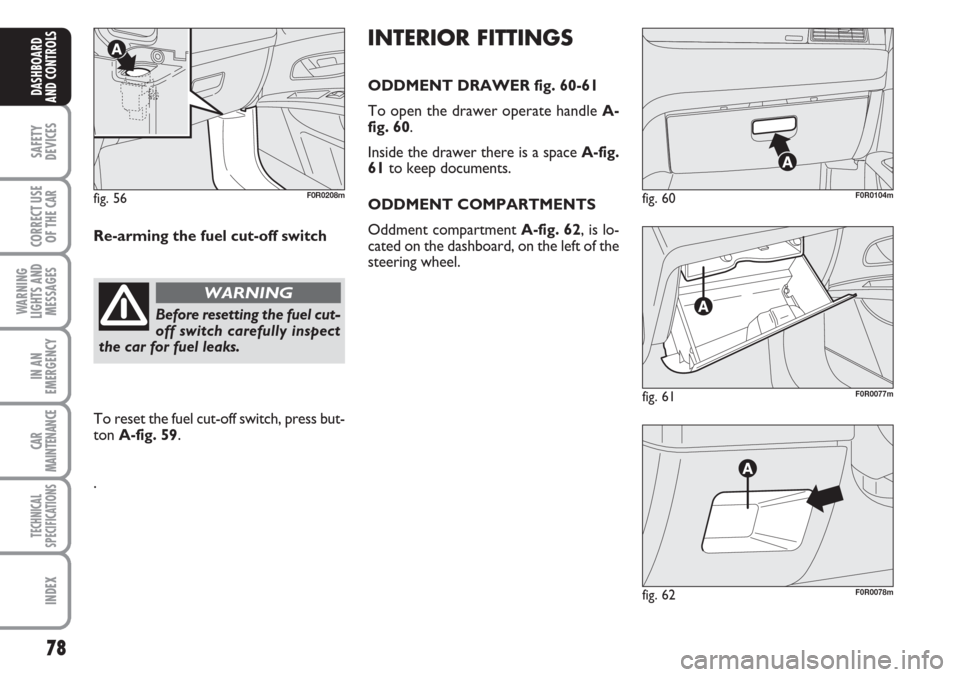
ODDMENT DRAWER fig. 60-61
To open the drawer operate handle A-
fig. 60.
Inside the drawer there is a space A-fig.
61to keep documents.
ODDMENT COMPARTMENTS
Oddment compartment A-fig. 62, is lo-
cated on the dashboard, on the left of the
steering wheel. Re-arming the fuel cut-off switch
Before resetting the fuel cut-
off switch carefully inspect
the car for fuel leaks.
WARNING
To reset the fuel cut-off switch, press but-
ton A-fig. 59.
.
fig. 56F0R0208m
Page 102 of 230
101
SAFETY
DEVICES
CORRECT USE
OF THE
CAR
WARNING
LIGHTS AND
MESSAGES
IN AN
EMERGENCY
CAR
MAINTENANCE
TECHNICAL
SPECIFICATIONS
INDEX
DASHBOARD
AND CONTROLS
AT THE FILLING
STATION
PETROL ENGINES
Use only unleaded petrol.
To avoid mistakes, the diameter of the fu-
el filler is too small to introduce the beak
of a leaded petrol pump. The petrol oc-
tane rating (RON) must not be lower
than 95.
IMPORTANT An inefficient catalyst leads
to harmful exhaust emissions, thus con-
tributing to air pollution.
IMPORTANT Never use leaded petrol,
even in small amount or in an emergency,
as this would damage the catalyst beyond
repair.DIESEL ENGINES
If the outside temperature is very low, the
diesel thickens due to the formation of
paraffin clots and could clog the diesel fu-
el filter.
In order to avoid these problems, differ-
ent types of diesel are distributed ac-
cording to the season: summer type, win-
ter type and arctic type (cold, mountain
areas).
If refuelling with diesel fuel whose features
are not suitable to the temperature of use,
it is advisable to mix TUTELA DIESEL ART
additive in the proportions shown on the
container with the fuel. Pour the additive
into the tank before the fuel.
When using or parking the car for a long
time in the mountains or cold areas, it is
advisable to refuel using locally available
fuel.
In this case, it is also advisable to keep the
tank over 50% full.For diesel engines, use diesel
fuel for motor vehicles com-
pliant with EN590 European
specifications only. The use of
other products or mixtures may dam-
age the engine beyond repair and con-
sequently cause lapse of warranty in
relation to the damage caused. If you
accidentally introduce other types of
fuel in the tank, do not start the engine
and empty the tank. If the engine has
run also for a very short time, you will
need to have the entire fuel feed sys-
tem emptied in addition to the tank.
Filling the tank
To fill the tank completely, top-up twice
after the pump switches off. Further top-
ups could cause faults in the fuel feeding
system.
Page 103 of 230
102
SAFETY
DEVICES
CORRECT USE
OF THE
CAR
WARNING
LIGHTS AND
MESSAGES
IN AN
EMERGENCY
CAR
MAINTENANCE
TECHNICAL
SPECIFICATIONS
INDEX
DASHBOARD
AND CONTROLS
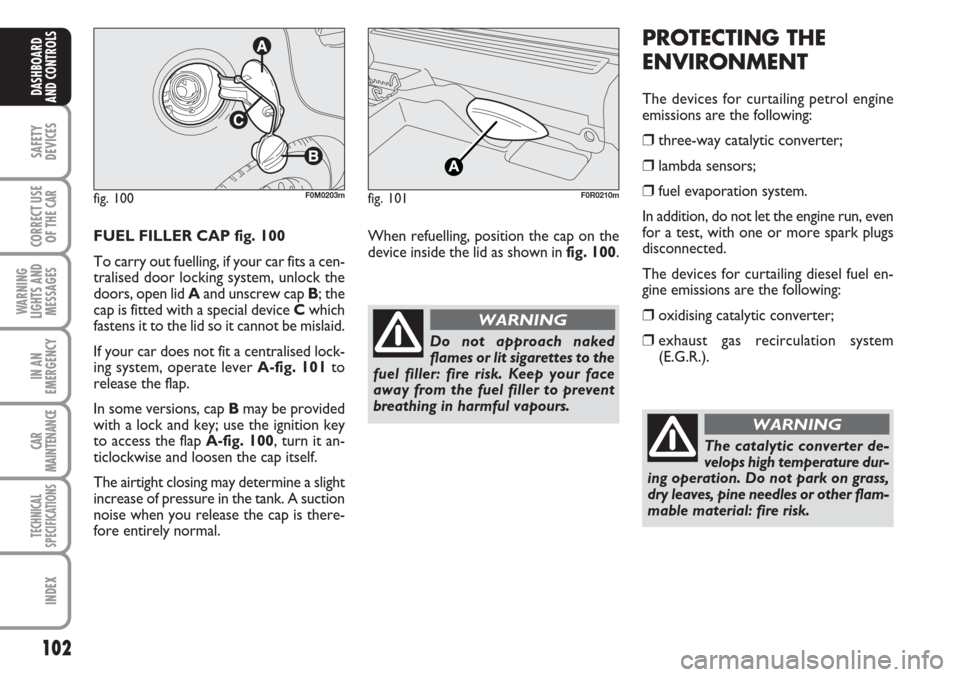
FUEL FILLER CAP fig. 100
To carry out fuelling, if your car fits a cen-
tralised door locking system, unlock the
doors, open lid Aand unscrew cap B; the
cap is fitted with a special device Cwhich
fastens it to the lid so it cannot be mislaid.
If your car does not fit a centralised lock-
ing system, operate lever A-fig. 101to
release the flap.
In some versions, cap Bmay be provided
with a lock and key; use the ignition key
to access the flap A-fig. 100, turn it an-
ticlockwise and loosen the cap itself.
The airtight closing may determine a slight
increase of pressure in the tank. A suction
noise when you release the cap is there-
fore entirely normal.
PROTECTING THE
ENVIRONMENT
The devices for curtailing petrol engine
emissions are the following:
❒three-way catalytic converter;
❒lambda sensors;
❒fuel evaporation system.
In addition, do not let the engine run, even
for a test, with one or more spark plugs
disconnected.
The devices for curtailing diesel fuel en-
gine emissions are the following:
❒oxidising catalytic converter;
❒exhaust gas recirculation system
(E.G.R.).
fig. 100F0M0203m
Do not approach naked
flames or lit sigarettes to the
fuel filler: fire risk. Keep your face
away from the fuel filler to prevent
breathing in harmful vapours.
WARNING
fig. 101F0R0210m
When refuelling, position the cap on the
device inside the lid as shown in fig. 100.
The catalytic converter de-
velops high temperature dur-
ing operation. Do not park on grass,
dry leaves, pine needles or other flam-
mable material: fire risk.
WARNING
Page 125 of 230
124
WARNING
LIGHTS AND
MESSAGES
IN AN
EMERGENCY
CAR
MAINTENANCE
TECHNICAL
SPECIFICATIONS
INDEX
DASHBOARD
AND CONTROLS
SAFETY
DEVICES
CORRECT USE
OF THE CAR
STOPPING THE ENGINE
Turn the ignition to STOPwhile the en-
gine is idling.
IMPORTANT After a taxing drive, you
should allow the engine to “catch its
breath” before turning it off by letting it
idle to allow the temperature in the en-
gine compartment to fall.
A quick burst on the acceler-
ator before turning off the en-
gine serves absolutely no
practical purpose, it wastes
fuel and is damaging especially to tur-
bocharged engines.HOW TO WARM UP THE
ENGINE AFTER IT HAS JUST
STARTED
(petrol and diesel engines)
Proceed as follows:
❒drive off slowly, letting the engine turn
at medium revs. Do not accelerate
abruptly;
❒do not demand to performance for the
first few kilometres. Wait until the en-
gine coolant gauge starts moving.
Remember that the brake
booster and power steering
are not operational until the
engine has been started,
therefore much effort than usual is re-
quired on the brake pedal and steering
wheel.
Never jump start the engine
by pushing, towing or driving
downhill. This could cause a
flow of fuel into the catalyt-
ic converter and damage it beyond re-
pair.
Page 128 of 230
127
WARNING
LIGHTS AND
MESSAGES
IN AN
EMERGENCY
CAR
MAINTENANCE
TECHNICAL
SPECIFICATIONS
INDEX
DASHBOARD
AND CONTROLS
SAFETY
DEVICES
CORRECT USE
OF THE CAR
Roof rack/ski rack
Remove the roof rack or the ski rack from
the roof after use. These accessories de-
crease aerodynamic penetration of the car
and have a negative effect on consumption.
It is better to use a trailer to transport
particularly bulky objects.
Electric devices
Use electric devices only for the amount
of time needed. Rear heated window, ad-
ditional headlights, windscreen wipers and
heater fan need a considerable amount of
energy, therefore increasing the require-
ment of current increases fuel consump-
tion (up to +25% in the urban cycle).
Climate control
The climate control system requires high-
er fuel consumption (up to +20% in av-
erage): use the air vents when the exter-
nal temperature allows to.
Spoilers
The use of non-certified aerodynamic
items may adversely affect air drag and
consumption levels.DRIVING STYLE
Starting
Do not warm the engine up with the car
standing: the engine warms up very slow-
ly in these conditions, increasing con-
sumption and emissions. It is advisable to
start off immediately and slowly keeping
the engine speed down: the engine will
warm up much faster this way.
Unnecessary actions
Avoid revving up when starting at traffic
lights or before stopping the engine. The
latter action, like doubling the clutch, is un-
necessary and causes increase of con-
sumption and pollution.
Gear selection
Use a higher gear as soon as traffic and
road conditions allow. Using a low gear
for faster acceleration will increase con-
sumption.
In the same way improper use of a high
gear increases consumption, emissions an
engine wear.CONTAINING
RUNNING COSTS
Here are some suggestions which may
help you to keep the running costs of your
car down and lower the amount of toxic
emissions released into the atmosphere.
GENERAL CONSIDERATIONS
Car maintenance
Have checks and adjustments carried out
in accordance with the “Service schedule”.
Tyres
Check tyre pressure regularly at least
once every four weeks: excessively low
pressure will increase consumption be-
cause rolling resistance will be higher.
Unnecessary loads
Do not travel with too much luggage
stowed in the boot. The weight of the car
(especially when driving in town) and its
trim greatly affects consumption and sta-
bility.
Page 129 of 230
128
WARNING
LIGHTS AND
MESSAGES
IN AN
EMERGENCY
CAR
MAINTENANCE
TECHNICAL
SPECIFICATIONS
INDEX
DASHBOARD
AND CONTROLS
SAFETY
DEVICES
CORRECT USE
OF THE CAR
CONDITIONS OF USE
Cold starting
Short distances and frequent cold start-ups
will prevent the engine from reaching op-
timal running temperature. Consequently,
both consumption (from +15 to +30% on
urban cycle ) and emissions will increase.
Traffic and
road conditions
Rather high consumption is caused by
heavy traffic, for instance when travelling
in a queue with frequent use of low gears
or in cities with many traffic lights. Moun-
tain and rough roads also have a negative
effect on consumption.
Traffic hold-ups
During prolonged hold-ups (level crossings)
the engine should be switched off.TOWING TRAILERS
IMPORTANT NOTES
The car must be provided with a type-ap-
proved tow hitch and adequate electrical
system to tow caravans or trailers. Instal-
lation must be performed by specialised
personnel who will issue the required pa-
pers for travelling on roads.
Install any specific and/or additional rear-
view mirrors as specified by law.
Remember that when towing a trailer,
steep hills are harder to climb, the brak-
ing spaces increase and overtaking takes
longer depending on the overall weight.
Engage a low gear when driving downhill,
rather than constantly using the brake.
The weight of the trailer on the car’s tow
hitch will reduce the loading capacity of
the car by the same amount. Consider the
weight of the car at full load, including ac-
cessories and luggage to make sure you do
not exceed the maximum towable weight
(shown on the log book). Top speed
Fuel consumption considerably increases
as speed increases. Keep your speed as
even as possible, avoiding unnecessary
braking and acceleration which cause ex-
cessive fuel consumption and increase
emissions.
Acceleration
Sudden acceleration has a very negative
effect on consumptions and emissions: ac-
celerate gradually and do not go over the
maximum torque ratio.