steering wheel FIAT LINEA 2007 1.G User Guide
[x] Cancel search | Manufacturer: FIAT, Model Year: 2007, Model line: LINEA, Model: FIAT LINEA 2007 1.GPages: 230, PDF Size: 3.31 MB
Page 117 of 230
116
CORRECT USE
OF THE
CAR
WARNING
LIGHTS AND
MESSAGES
IN AN
EMERGENCY
CAR
MAINTENANCE
TECHNICAL
SPECIFICATIONS
IINDEX
DASHBOARD
AND CONTROLS
SAFETY
DEVICES
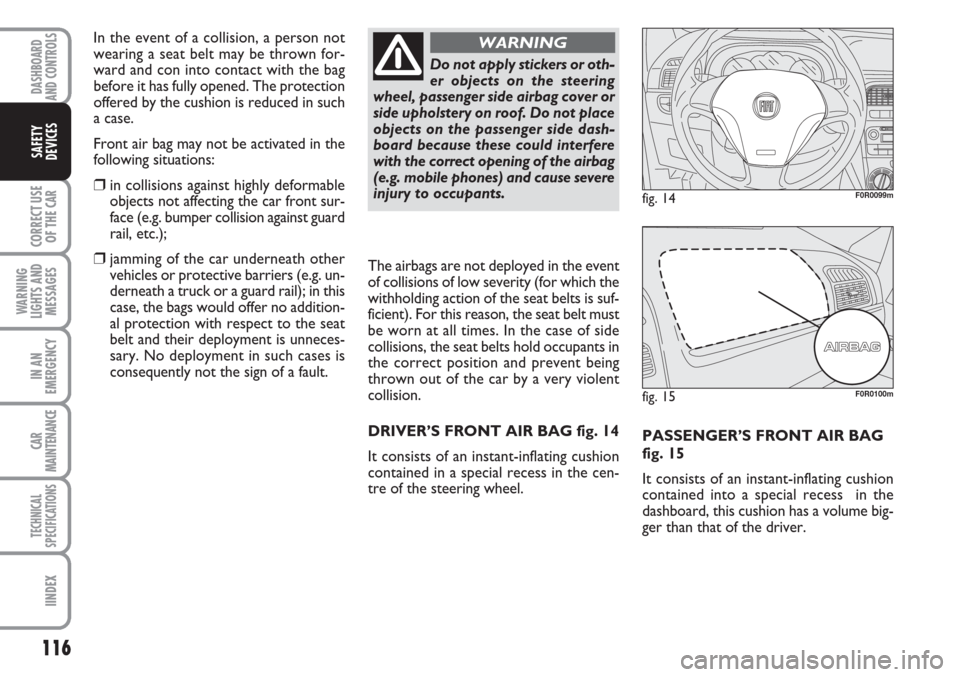
PASSENGER’S FRONT AIR BAG
fig. 15
It consists of an instant-inflating cushion
contained into a special recess in the
dashboard, this cushion has a volume big-
ger than that of the driver.
fig. 14F0R0099m
fig. 15F0R0100m
The airbags are not deployed in the event
of collisions of low severity (for which the
withholding action of the seat belts is suf-
ficient). For this reason, the seat belt must
be worn at all times. In the case of side
collisions, the seat belts hold occupants in
the correct position and prevent being
thrown out of the car by a very violent
collision.
DRIVER’S FRONT AIR BAG fig. 14
It consists of an instant-inflating cushion
contained in a special recess in the cen-
tre of the steering wheel.
Do not apply stickers or oth-
er objects on the steering
wheel, passenger side airbag cover or
side upholstery on roof. Do not place
objects on the passenger side dash-
board because these could interfere
with the correct opening of the airbag
(e.g. mobile phones) and cause severe
injury to occupants.
WARNINGIn the event of a collision, a person not
wearing a seat belt may be thrown for-
ward and con into contact with the bag
before it has fully opened. The protection
offered by the cushion is reduced in such
a case.
Front air bag may not be activated in the
following situations:
❒in collisions against highly deformable
objects not affecting the car front sur-
face (e.g. bumper collision against guard
rail, etc.);
❒jamming of the car underneath other
vehicles or protective barriers (e.g. un-
derneath a truck or a guard rail); in this
case, the bags would offer no addition-
al protection with respect to the seat
belt and their deployment is unneces-
sary. No deployment in such cases is
consequently not the sign of a fault.
Page 121 of 230
120
CORRECT USE
OF THE
CAR
WARNING
LIGHTS AND
MESSAGES
IN AN
EMERGENCY
CAR
MAINTENANCE
TECHNICAL
SPECIFICATIONS
IINDEX
DASHBOARD
AND CONTROLS
SAFETY
DEVICES
Always drive holding your
hands on the steering wheel
rim so that the airbag can inflate
freely in the case of need. Do not dri-
ve with your body bent forward. Keep
your back straight against the back
rest.
WARNING
Airbags may be deployed if
another vehicle crashes if the
key is inserted and at MAR also if the
engine is not running and the car is
stationary. For this reason, children
must never sit on the front seat, even
if the car is not moving. On the oth-
er hand, if the key is inserted and at
STOP, none of the safety devices
(airbag or pretensioners) will be de-
ployed in a collision. Non deployment
of the devices in this case does not in-
dicate a system fault.
WARNING
Do not wash the seats with
pressurised water or steam
(by hand or in automatic seat wash-
ing stations).
WARNING
The airbag deployment
threshold is higher than that
of the pretensioners. For collisions in
the range between the two thresh-
olds, it is normal for only the preten-
sioners to be activated.
WARNING
Do not hook rigid objects to
the coat hooks and to the
support handles.
WARNING
Airbags do not replace seat
belts but increase their effi-
ciency. Furthermore, since front
airbags are not deployed in low speed
collisions, side collisions, rear-end
shunts or roll-overs, the occupants are
only protected by the seat belts which
must be fastened at all times.
WARNING
When the key is turned to
MAR warning light F(with
passenger front airbag activate) will
blink for a few seconds to remind you
that the airbag will be deployed in the
event of a collision after which it
should go out.
WARNING
Have the airbag system
checked by a Fiat Dealership
if the car was stolen, if theft was at-
tempted, or if the car was subjected
to vandalism or flooding.
WARNING
Page 123 of 230
122
WARNING
LIGHTS AND
MESSAGES
IN AN
EMERGENCY
CAR
MAINTENANCE
TECHNICAL
SPECIFICATIONS
INDEX
DASHBOARD
AND CONTROLS
SAFETY
DEVICES
CORRECT USE
OF THE CAR
ENGINE STARTING
The car is provided with an electronic en-
gine lock device: refer to “The Fiat CODE
system” paragraph in “Dashboard and
controls” if you cannot start the engine.
The engine may be noisier during the first
seconds of operation, particularly after a
long period of inactivity. This is charac-
teristic of hydraulic tappets, the timing sys-
tem chosen to reduce the number of ser-
vicing interventions and does effects nei-
ther functionality nor reliability.
It is advisable not to demand
maximum performance from
your car (e.g. excessive accel-
erations, long distances at top
rpm, excessive intense braking, etc.) as
soon as the engine is started.
Do not leave the key in the ig-
nition switch with the engine
off to avoid unnecessary con-
sumption of electricity which
could drain the battery. It is dangerous
to run the engine in closed environ-
ments.
Running the engine in con-
fined areas is extremely dan-
gerous. The engine consumes oxygen
and produces carbon monoxide
which is a highly toxic and lethal gas.
WARNING
Remember that the brake
booster and power steering
are not operational until the engine
has been started, therefore much ef-
fort than usual is required on the
brake pedal and steering wheel.
WARNING
STARTING PROCEDURE FOR
PETROL VERSIONS
Proceed as follows:
❒ensure that the handbrake is up;
❒put the gear lever into neutral;
❒press the clutch pedal down to the
floor without touching the accelerator;
❒turn the ignition key to AVVand let
it go the moment the engine starts.
If the engine does not start at the first at-
tempt, return the ignition key to STOP
before repeating starting.
Page 125 of 230
124
WARNING
LIGHTS AND
MESSAGES
IN AN
EMERGENCY
CAR
MAINTENANCE
TECHNICAL
SPECIFICATIONS
INDEX
DASHBOARD
AND CONTROLS
SAFETY
DEVICES
CORRECT USE
OF THE CAR
STOPPING THE ENGINE
Turn the ignition to STOPwhile the en-
gine is idling.
IMPORTANT After a taxing drive, you
should allow the engine to “catch its
breath” before turning it off by letting it
idle to allow the temperature in the en-
gine compartment to fall.
A quick burst on the acceler-
ator before turning off the en-
gine serves absolutely no
practical purpose, it wastes
fuel and is damaging especially to tur-
bocharged engines.HOW TO WARM UP THE
ENGINE AFTER IT HAS JUST
STARTED
(petrol and diesel engines)
Proceed as follows:
❒drive off slowly, letting the engine turn
at medium revs. Do not accelerate
abruptly;
❒do not demand to performance for the
first few kilometres. Wait until the en-
gine coolant gauge starts moving.
Remember that the brake
booster and power steering
are not operational until the
engine has been started,
therefore much effort than usual is re-
quired on the brake pedal and steering
wheel.
Never jump start the engine
by pushing, towing or driving
downhill. This could cause a
flow of fuel into the catalyt-
ic converter and damage it beyond re-
pair.
Page 148 of 230
147
WARNING
LIGHTS AND
MESSAGES
CAR
MAINTENANCE
TECHNICAL
SPECIFICATIONS
INDEX
DASHBOARD
AND CONTROLS
SAFETY
DEVICES
CORRECT USE
OF THE
CAR
IN AN
EMERGENCY
IMPORTANT Never connect the negative
terminals of the two batteries directly:
sparks could ignite explosive gas released
from the battery. If the auxiliary battery is
installed on another car, prevent acciden-
tal contact between metallic parts of the
two cars.BUMP STARTING
Never jump start the engine by pushing,
towing or driving downhill. This could
cause a flow of fuel into the catalytic con-
verter and damage it beyond repair.
IMPORTANT Remember that the brake
booster and the power steering system
are not operating until the engine is start-
ed, a greater effort will therefore be re-
quired to press the brake pedal or turn
the steering wheel.REPLACING A WHEEL
GENERAL INSTRUCTIONS
Wheel changing and correct use of the
jack and spare wheel call for some pre-
cautions as listed below.
Indicate that the car is sta-
tionary according to the laws
in force: hazard lights, triangle, etc.
Passengers should leave the car, par-
ticularly if it is very loaded and wait
for the wheel to be changed away
from on-coming traffic. Apply the
handbrake.
WARNING
Page 172 of 230
171
WARNING
LIGHTS AND
MESSAGES
CAR
MAINTENANCE
TECHNICAL
SPECIFICATIONS
INDEX
DASHBOARD
AND CONTROLS
SAFETY
DEVICES
CORRECT USE
OF THE
CAR
IN AN
EMERGENCY
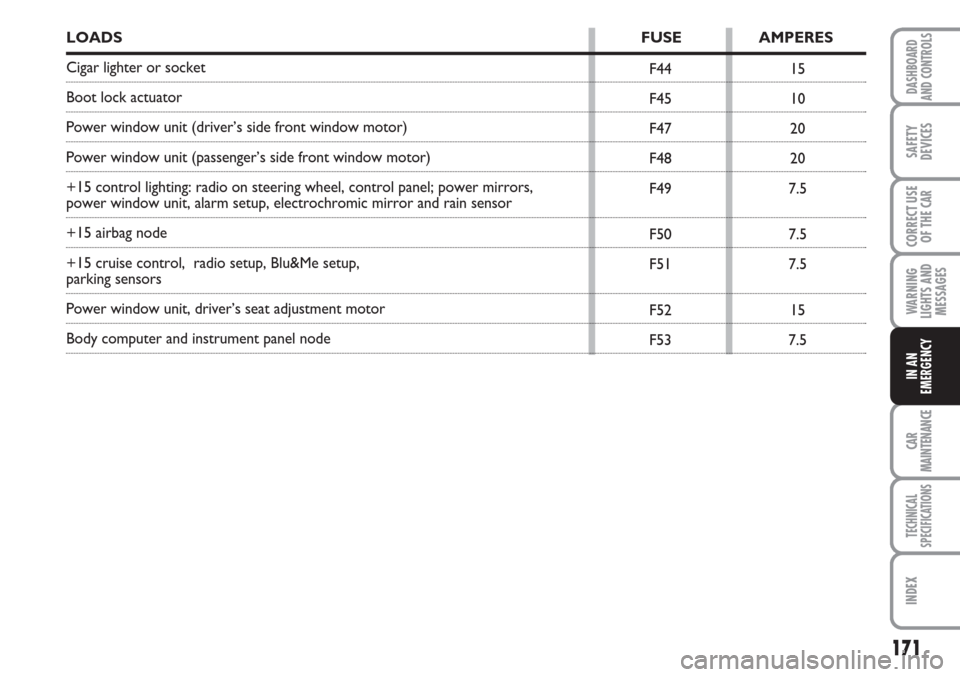
LOADS FUSE AMPERES
Cigar lighter or socket
Boot lock actuator
Power window unit (driver’s side front window motor)
Power window unit (passenger’s side front window motor)
+15 control lighting: radio on steering wheel, control panel; power mirrors,
power window unit, alarm setup, electrochromic mirror and rain sensor
+15 airbag node
+15 cruise control, radio setup, Blu&Me setup,
parking sensors
Power window unit, driver’s seat adjustment motor
Body computer and instrument panel node F44
F45
F47
F48
F49
F50
F51
F52
F5315
10
20
20
7.5
7.5
7.5
15
7.5
Page 177 of 230
176
WARNING
LIGHTS AND
MESSAGES
CAR
MAINTENANCE
TECHNICAL
SPECIFICATIONS
IINDEX
DASHBOARD
AND CONTROLS
SAFETY
DEVICES
CORRECT USE
OF THE
CAR
IN AN
EMERGENCY
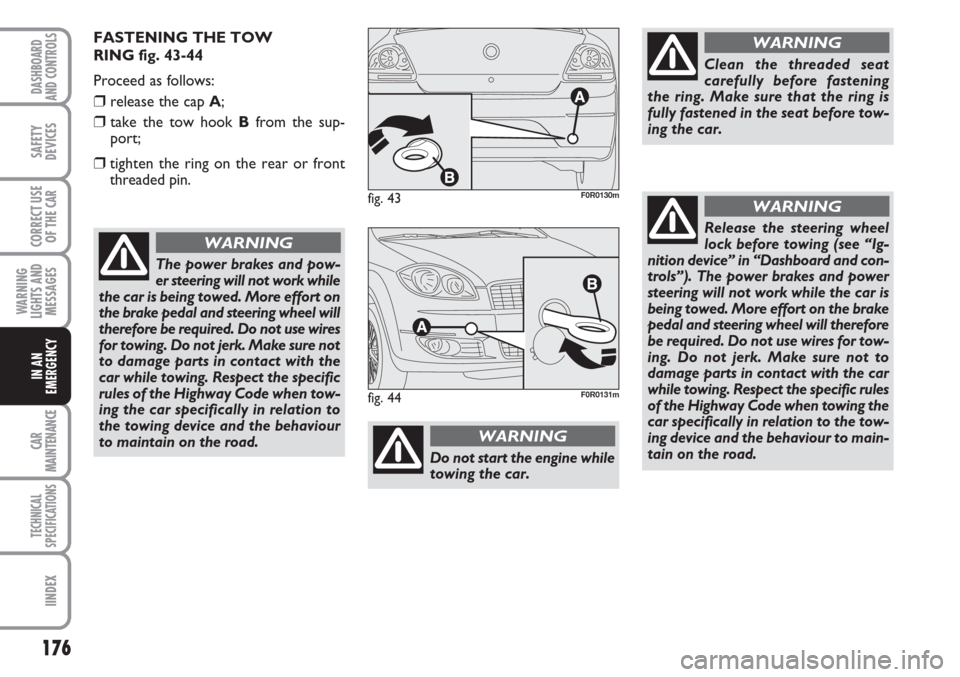
FASTENING THE TOW
RING fig. 43-44
Proceed as follows:
❒release the cap A;
❒take the tow hook Bfrom the sup-
port;
❒tighten the ring on the rear or front
threaded pin.
The power brakes and pow-
er steering will not work while
the car is being towed. More effort on
the brake pedal and steering wheel will
therefore be required. Do not use wires
for towing. Do not jerk. Make sure not
to damage parts in contact with the
car while towing. Respect the specific
rules of the Highway Code when tow-
ing the car specifically in relation to
the towing device and the behaviour
to maintain on the road.
WARNING
fig. 43F0R0130m
fig. 44F0R0131m
Do not start the engine while
towing the car.
WARNING
Clean the threaded seat
carefully before fastening
the ring. Make sure that the ring is
fully fastened in the seat before tow-
ing the car.
WARNING
Release the steering wheel
lock before towing (see “Ig-
nition device” in “Dashboard and con-
trols”). The power brakes and power
steering will not work while the car is
being towed. More effort on the brake
pedal and steering wheel will therefore
be required. Do not use wires for tow-
ing. Do not jerk. Make sure not to
damage parts in contact with the car
while towing. Respect the specific rules
of the Highway Code when towing the
car specifically in relation to the tow-
ing device and the behaviour to main-
tain on the road.
WARNING
Page 193 of 230
192
WARNING
LIGHTS AND
MESSAGES
TECHNICAL
SPECIFICATIONS
INDEX
DASHBOARD
AND CONTROLS
SAFETY
DEVICES
CORRECT USE
OF THE CAR
IN AN
EMERGENCY
CAR
MAINTENANCE
WHEELS AND TYRES
Check the pressure of each type, includ-
ing the spare, approximately once every
two weeks and before starting a long jour-
ney: this check must be performed with
the tyre rested and cold.
It is normal for pressure to increase when
the car is used. For the correct tyre in-
flation pressure, see “Wheels” in “Tech-
nical specifications” section.
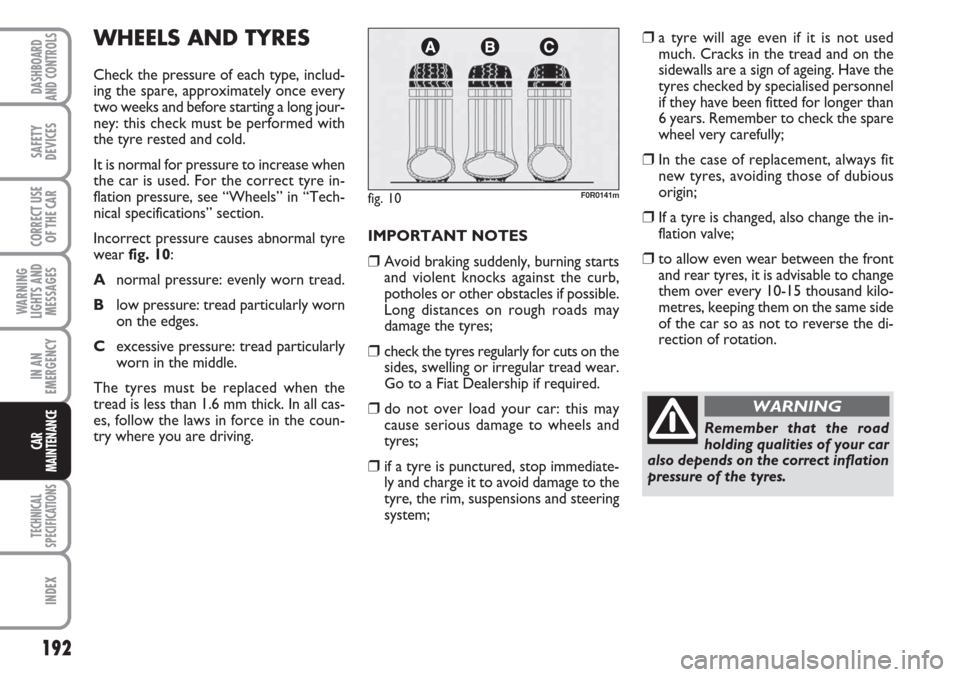
Incorrect pressure causes abnormal tyre
wearfig. 10:
Anormal pressure: evenly worn tread.
Blow pressure: tread particularly worn
on the edges.
Cexcessive pressure: tread particularly
worn in the middle.
The tyres must be replaced when the
tread is less than 1.6 mm thick. In all cas-
es, follow the laws in force in the coun-
try where you are driving.
fig. 10F0R0141m
IMPORTANT NOTES
❒Avoid braking suddenly, burning starts
and violent knocks against the curb,
potholes or other obstacles if possible.
Long distances on rough roads may
damage the tyres;
❒check the tyres regularly for cuts on the
sides, swelling or irregular tread wear.
Go to a Fiat Dealership if required.
❒do not over load your car: this may
cause serious damage to wheels and
tyres;
❒if a tyre is punctured, stop immediate-
ly and charge it to avoid damage to the
tyre, the rim, suspensions and steering
system;
❒a tyre will age even if it is not used
much. Cracks in the tread and on the
sidewalls are a sign of ageing. Have the
tyres checked by specialised personnel
if they have been fitted for longer than
6 years. Remember to check the spare
wheel very carefully;
❒In the case of replacement, always fit
new tyres, avoiding those of dubious
origin;
❒If a tyre is changed, also change the in-
flation valve;
❒to allow even wear between the front
and rear tyres, it is advisable to change
them over every 10-15 thousand kilo-
metres, keeping them on the same side
of the car so as not to reverse the di-
rection of rotation.
Remember that the road
holding qualities of your car
also depends on the correct inflation
pressure of the tyres.
WARNING
Page 199 of 230
198
WARNING
LIGHTS AND
MESSAGES
TECHNICAL
SPECIFICATIONS
INDEX
DASHBOARD
AND CONTROLS
SAFETY
DEVICES
CORRECT USE
OF THE CAR
IN AN
EMERGENCY
CAR
MAINTENANCE
GENUINE LEATHER STEERING
WHEEL/GEAR LEVER KNOB
These components must be cleaned with
mild soap and water only.
Never use spirit and/or alcohol based
products.
Before using off-the-shelves products de-
signed for cleaning car interiors, make sure
that they do not contain spirit and/or al-
cohol based substances before using them.
If window cleaner accidentally drips onto
the steering wheel or gear lever knob,
wipe away immediately and then wash the
concerned area with mild soap and water. IMPORTANT Be carefully when arranging
a steering wheel lock device, where applic-
able, to prevent damaging the leather up-
holstery by rubbing. INTERIOR PLASTIC PARTS
It is advisable to clean interior parts with a
moist cloth and a solution of water and mild
soap. Use specific products for cleaning plas-
tic, without solvents and specifically de-
signed to prevent damage to the appearance
and colour of the treated parts to remove
grease and tough stains.
IMPORTANT Never use spirit or petro-
leum to clean the instrument panel.
Page 200 of 230
199
WARNING
LIGHTS AND
MESSAGES
INDEX
DASHBOARD
AND CONTROLS
SAFETY
DEVICES
CORRECT USE
OF THE
CAR
IN AN
EMERGENCY
CAR
MAINTENANCE
TECHNICAL
SPECIFICATIONS
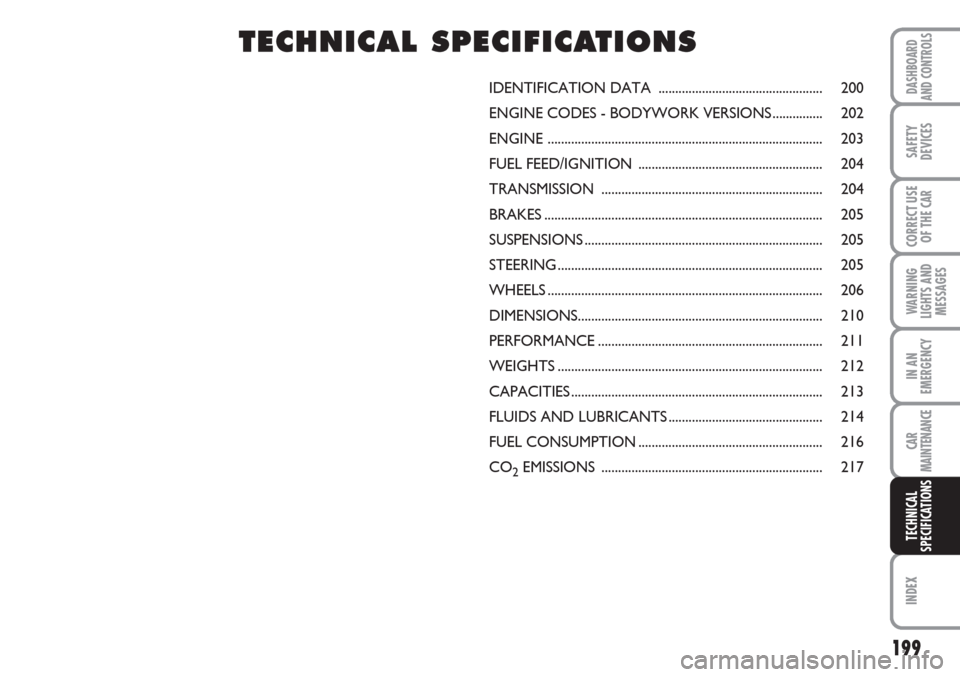
IDENTIFICATION DATA ................................................. 200
ENGINE CODES - BODYWORK VERSIONS............... 202
ENGINE .................................................................................. 203
FUEL FEED/IGNITION ....................................................... 204
TRANSMISSION .................................................................. 204
BRAKES................................................................................... 205
SUSPENSIONS....................................................................... 205
STEERING............................................................................... 205
WHEELS.................................................................................. 206
DIMENSIONS......................................................................... 210
PERFORMANCE................................................................... 211
WEIGHTS............................................................................... 212
CAPACITIES........................................................................... 213
FLUIDS AND LUBRICANTS.............................................. 214
FUEL CONSUMPTION....................................................... 216
CO
2EMISSIONS .................................................................. 217
TT T
E E
C C
H H
N N
I I
C C
A A
L L
S S
P P
E E
C C
I I
F F
I I
C C
A A
T T
I I
O O
N N
S S