battery FIAT LINEA 2007 1.G Owner's Manual
[x] Cancel search | Manufacturer: FIAT, Model Year: 2007, Model line: LINEA, Model: FIAT LINEA 2007 1.GPages: 230, PDF Size: 3.31 MB
Page 169 of 230
168
WARNING
LIGHTS AND
MESSAGES
CAR
MAINTENANCE
TECHNICAL
SPECIFICATIONS
IINDEX
DASHBOARD
AND CONTROLS
SAFETY
DEVICES
CORRECT USE
OF THE
CAR
IN AN
EMERGENCY
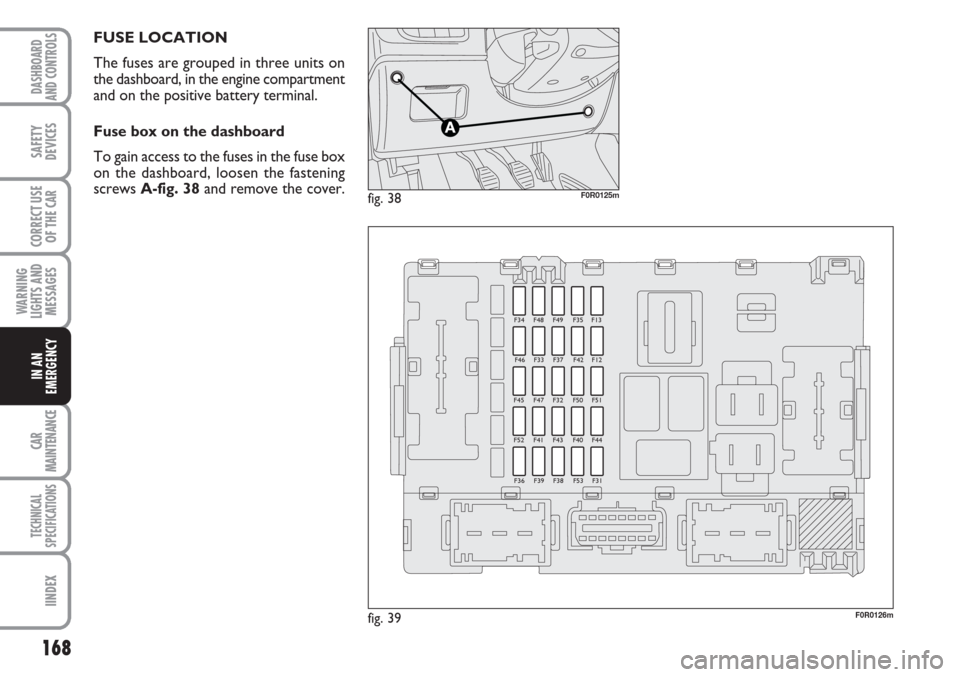
FUSE LOCATION
The fuses are grouped in three units on
the dashboard, in the engine compartment
and on the positive battery terminal.
Fuse box on the dashboard
To gain access to the fuses in the fuse box
on the dashboard, loosen the fastening
screws A-fig. 38and remove the cover.
fig. 39F0R0126m
F34 F48 F49 F35 F13
F46 F33 F37 F42 F12
F45 F47 F32 F50 F51
F52 F41 F43 F40 F44
F36 F39 F38 F53 F31
fig. 38F0R0125m
Page 170 of 230
169
WARNING
LIGHTS AND
MESSAGES
CAR
MAINTENANCE
TECHNICAL
SPECIFICATIONS
INDEX
DASHBOARD
AND CONTROLS
SAFETY
DEVICES
CORRECT USE
OF THE
CAR
IN AN
EMERGENCY
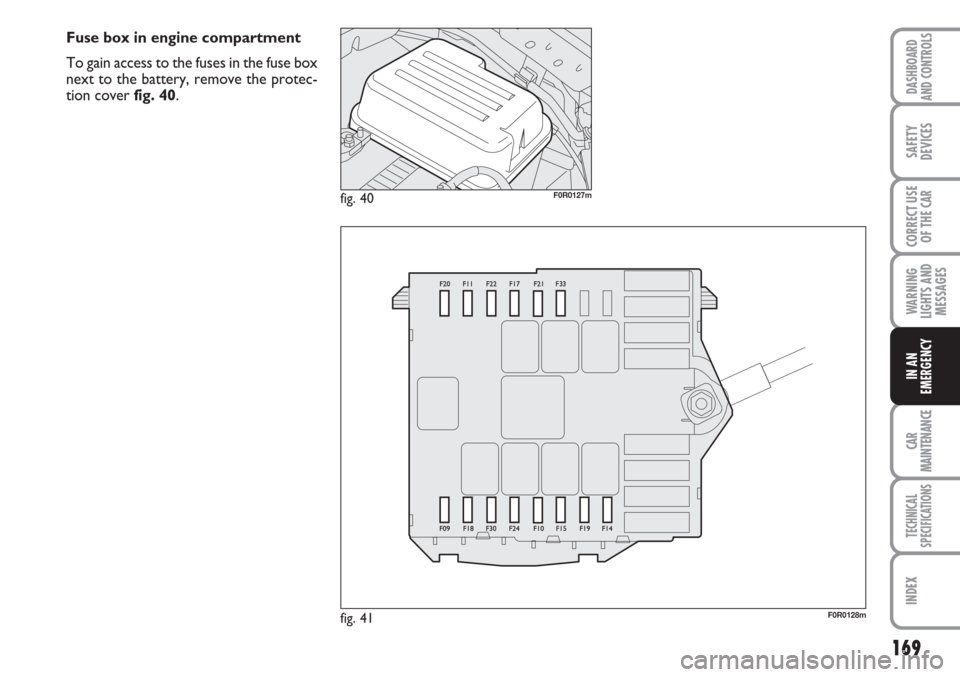
Fuse box in engine compartment
To gain access to the fuses in the fuse box
next to the battery, remove the protec-
tion cover fig. 40.
fig. 40F0R0127m
fig. 41F0R0128m
Page 175 of 230
174
WARNING
LIGHTS AND
MESSAGES
CAR
MAINTENANCE
TECHNICAL
SPECIFICATIONS
IINDEX
DASHBOARD
AND CONTROLS
SAFETY
DEVICES
CORRECT USE
OF THE
CAR
IN AN
EMERGENCY
IF THE BATTERY IS FLAT
IMPORTANT The battery recharging pro-
cedure is provided as an example only.
You are recommended to go to a Fiat
Dealership to have this operation per-
formed.
Low amperage slow recharging for ap-
proximately 24 hour is advised. Rapid bat-
tery charging with high currents could
damage the battery.
Charge the battery as follows:
❒disconnect battery negative terminal;
❒connect the charger cables to the bat-
tery terminals, observing the poles;
❒turn on the charger;
❒when you have finished, turn the charg-
er off before disconnecting the battery;
❒reconnect battery negative terminal.
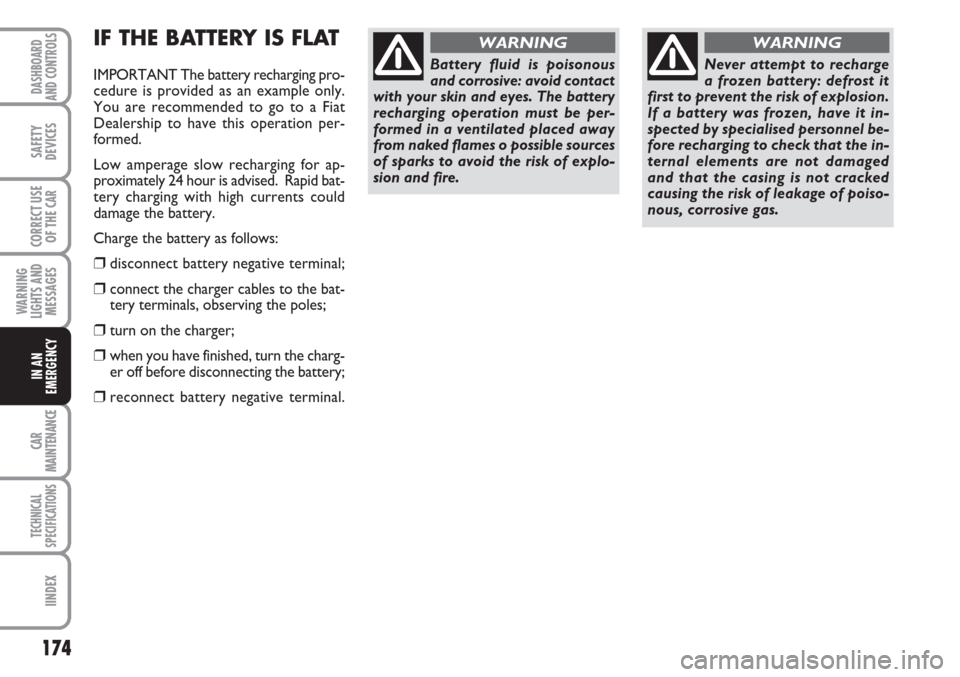
Battery fluid is poisonous
and corrosive: avoid contact
with your skin and eyes. The battery
recharging operation must be per-
formed in a ventilated placed away
from naked flames o possible sources
of sparks to avoid the risk of explo-
sion and fire.
WARNING
Never attempt to recharge
a frozen battery: defrost it
first to prevent the risk of explosion.
If a battery was frozen, have it in-
spected by specialised personnel be-
fore recharging to check that the in-
ternal elements are not damaged
and that the casing is not cracked
causing the risk of leakage of poiso-
nous, corrosive gas.
WARNING
Page 178 of 230
177
WARNING
LIGHTS AND
MESSAGES
TECHNICAL
SPECIFICATIONS
INDEX
DASHBOARD
AND CONTROLS
SAFETY
DEVICES
CORRECT USE
OF THE CAR
IN AN
EMERGENCY
CAR
MAINTENANCE
SCHEDULED SERVICING ................................................ 178
SERVICE SCHEDULE
PETROL VERSIONS............................................................. 179
SERVICE SCHEDULE
DIESEL VERSIONS ............................................................... 181
REGULAR INSPECTIONS ................................................. 183
DEMANDING USE OF THE CAR ................................... 183
CHECKING FLUID LEVELS................................................ 184
AIR CLEANER ...................................................................... 189
POLLEN FILTER ................................................................... 189
BATTERY................................................................................ 189
WHEELS AND TYRES......................................................... 192
RUBBER HOSES .................................................................... 193
WINDSCREEN WIPERS...................................................... 193
BODYWORK........................................................................ 195
INTERIORS ............................................................................ 197
CC C
A A
R R
M M
A A
I I
N N
T T
E E
N N
A A
N N
C C
E E
Page 181 of 230
180
WARNING
LIGHTS AND
MESSAGES
TECHNICAL
SPECIFICATIONS
INDEX
DASHBOARD
AND CONTROLS
SAFETY
DEVICES
CORRECT USE
OF THE CAR
IN AN
EMERGENCY
CAR
MAINTENANCE
If the car is mainly used in cities or less than 10,000 km a year, change the engine oil and filter every 12 months.30 60 90 120 150 180
●●●●● ●
●●
●● ●
●●●●● ●
●●●●● ●
●●
●●●●● ●
●
●●●●● ●
●● ●
●●●●● ●
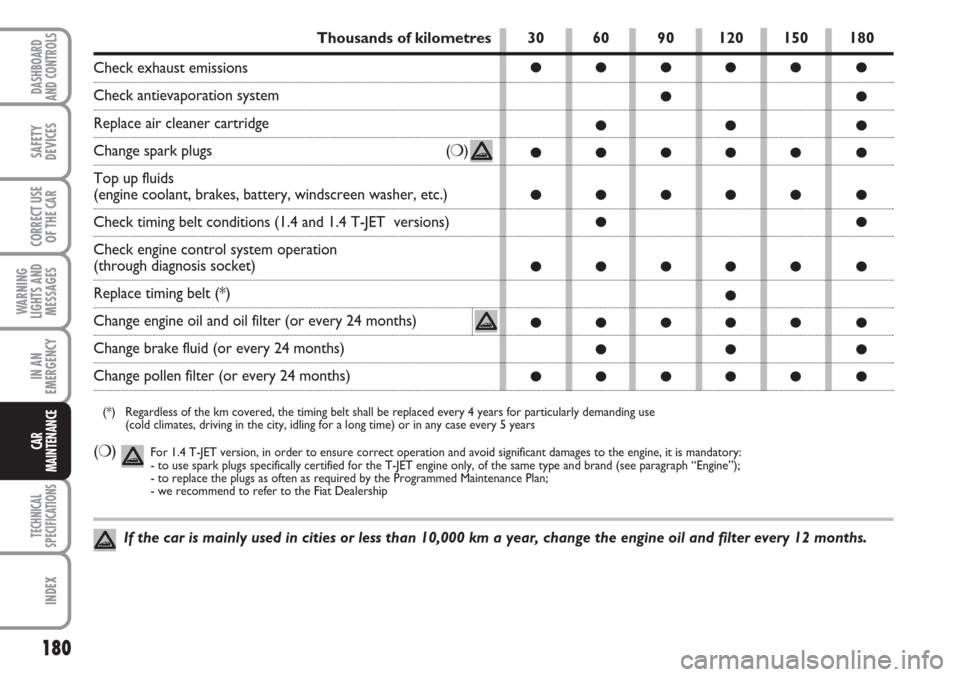
Thousands of kilometres
Check exhaust emissions
Check antievaporation system
Replace air cleaner cartridge
Change spark plugs (❍)
Top up fluids
(engine coolant, brakes, battery, windscreen washer, etc.)
Check timing belt conditions (1.4 and 1.4 T-JET versions)
Check engine control system operation
(through diagnosis socket)
Replace timing belt (*)
Change engine oil and oil filter (or every 24 months)
Change brake fluid (or every 24 months)
Change pollen filter (or every 24 months)
(*) Regardless of the km covered, the timing belt shall be replaced every 4 years for particularly demanding use
(cold climates, driving in the city, idling for a long time) or in any case every 5 years
(❍)For 1.4 T-JET version, in order to ensure correct operation and avoid significant damages to the engine, it is mandatory:
- to use spark plugs specifically certified for the T-JET engine only, of the same type and brand (see paragraph “Engine”);
- to replace the plugs as often as required by the Programmed Maintenance Plan;
- we recommend to refer to the Fiat Dealership
Page 183 of 230
182
WARNING
LIGHTS AND
MESSAGES
TECHNICAL
SPECIFICATIONS
INDEX
DASHBOARD
AND CONTROLS
SAFETY
DEVICES
CORRECT USE
OF THE CAR
IN AN
EMERGENCY
CAR
MAINTENANCE
30 60 90 120 150 180
●●●●● ●
●● ●
●● ●
●●●●● ●
●●●●● ●
●●●●● ●
●● ●
●●●●● ●
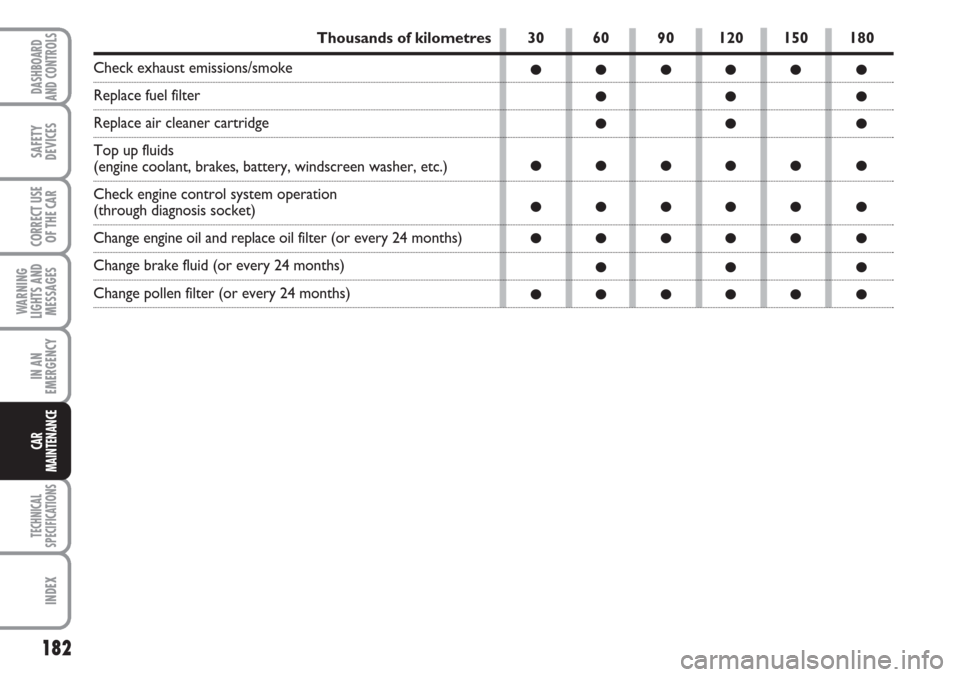
Thousands of kilometres
Check exhaust emissions/smoke
Replace fuel filter
Replace air cleaner cartridge
Top up fluids
(engine coolant, brakes, battery, windscreen washer, etc.)
Check engine control system operation
(through diagnosis socket)
Change engine oil and replace oil filter (or every 24 months)
Change brake fluid (or every 24 months)
Change pollen filter (or every 24 months)
Page 184 of 230
183
WARNING
LIGHTS AND
MESSAGES
TECHNICAL
SPECIFICATIONS
INDEX
DASHBOARD
AND CONTROLS
SAFETY
DEVICES
CORRECT USE
OF THE CAR
IN AN
EMERGENCY
CAR
MAINTENANCE
DEMANDING USE
OF THE CAR
Should prevailing use of the car be under
one of the following specially heavy con-
ditions:
❒trailer or caravan towing;
❒dusty roads;
❒short distances (less than 7-8 km) re-
peated and with external temperatures
below zero;
❒frequently idling engines or long dis-
tance low speed driving (e.g. taxis or
door-to-door deliveries) or in case of
a long term inactivity;
❒in cities;
perform the following inspections more
frequently than shown on the Service
Schedule:
❒check front disk brake pad conditions
and wear;
❒check cleanness of locks, bonnet and
boot and lever cleanness and lubrica-
tion;
❒visually inspect the conditions of: en-
gine, gearbox, transmission, pipes and
hoses (exhaust - fuel - brakes), rubber
parts (boots, sleeves, bushes, etc.);
❒check battery charge and liquid level
(electrolyte) (see paragraph “Charge
level check” in chapter “Maintenance
and care”);
❒visually inspect the accessory drive belt
conditions;
❒check pollen filter and replace, if re-
quired;
❒check air cleaner and replace, if re-
quired.
REGULAR
INSPECTIONS
Every 1,000 km or before long journeys,
check and top up if required:
❒engine coolant fluid level;
❒brake fluid level;
❒brake fluid level;
❒tyre pressure and conditions.
❒operation of lights (headlights, direction
indicators, hazard lights, etc.);
❒operation of the windscreen wiper/
washer system, position and wear of
the windscreen and rear window wiper
blades;
Every 3,000 km check the following and
top-up, if required:engine oil level.
You are recommended to use FL
Seleniaproducts, designed and produced
specifically for Fiat cars (see table “Ca-
pacities” in section “Technical specifica-
tions”).
Page 185 of 230
184
WARNING
LIGHTS AND
MESSAGES
TECHNICAL
SPECIFICATIONS
INDEX
DASHBOARD
AND CONTROLS
SAFETY
DEVICES
CORRECT USE
OF THE CAR
IN AN
EMERGENCY
CAR
MAINTENANCE
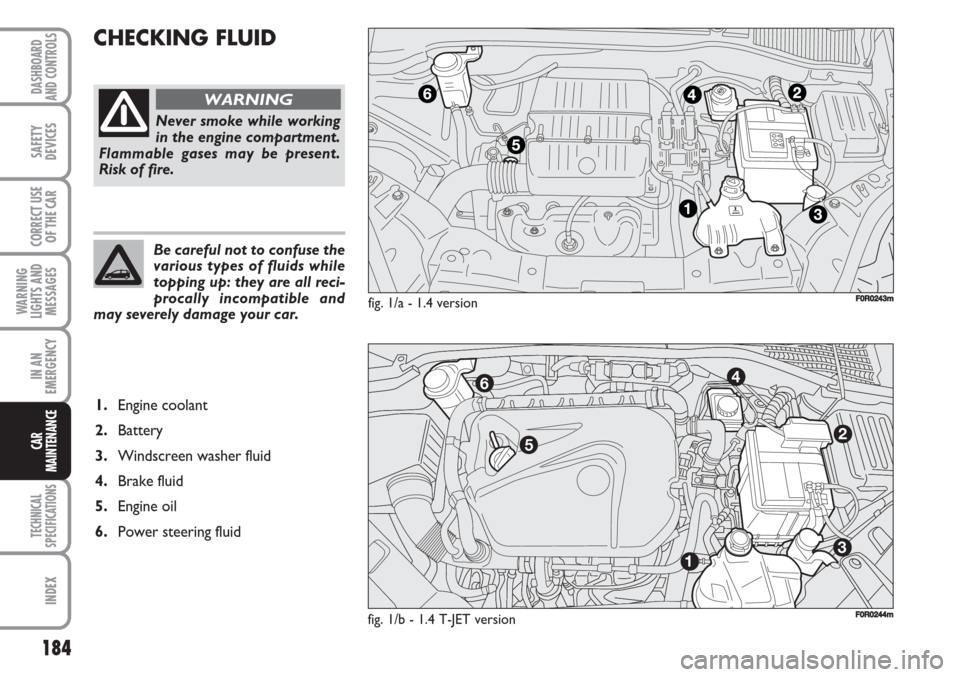
CHECKING FLUID
fig. 1/a - 1.4 version
Never smoke while working
in the engine compartment.
Flammable gases may be present.
Risk of fire.
WARNING
Be careful not to confuse the
various types of fluids while
topping up: they are all reci-
procally incompatible and
may severely damage your car.
F0R0243m
1.Engine coolant
2.Battery
3.Windscreen washer fluid
4.Brake fluid
5.Engine oil
6.Power steering fluid
fig. 1/b - 1.4 T-JET version
2
64
5
13
2
64
5
13
2
64
5
13
F0R0244m
Page 186 of 230
185
WARNING
LIGHTS AND
MESSAGES
TECHNICAL
SPECIFICATIONS
INDEX
DASHBOARD
AND CONTROLS
SAFETY
DEVICES
CORRECT USE
OF THE CAR
IN AN
EMERGENCY
CAR
MAINTENANCE
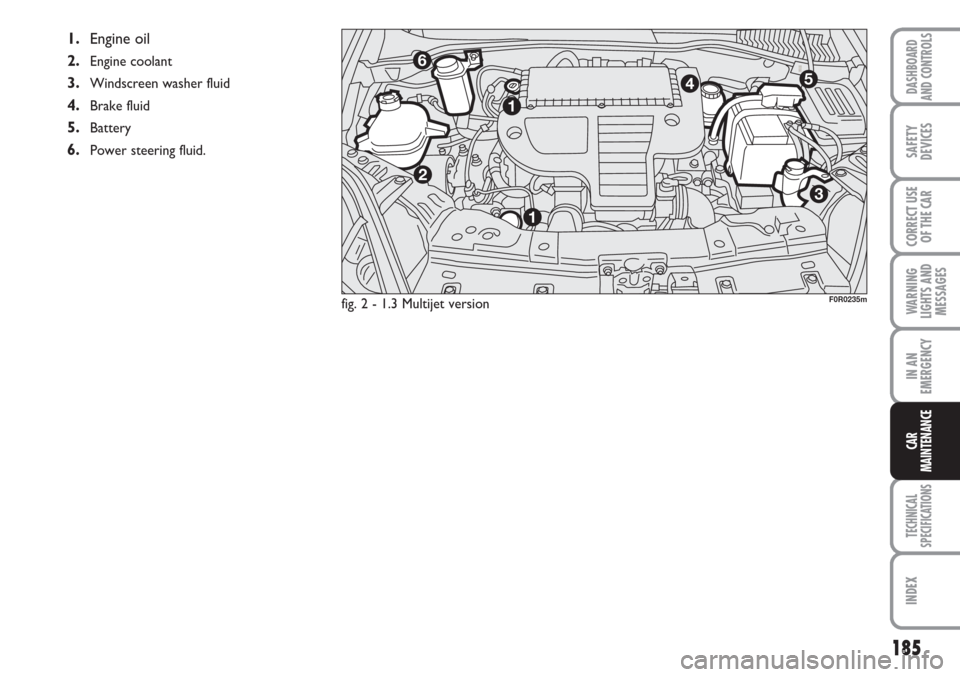
fig. 2 - 1.3 Multijet version
1
1
6
2
45
3
F0R0235m
1.Engine oil
2.
Engine coolant
3.Windscreen washer fluid
4.Brake fluid
5.Battery
6.Power steering fluid.
Page 190 of 230
189
WARNING
LIGHTS AND
MESSAGES
TECHNICAL
SPECIFICATIONS
INDEX
DASHBOARD
AND CONTROLS
SAFETY
DEVICES
CORRECT USE
OF THE CAR
IN AN
EMERGENCY
CAR
MAINTENANCEOil consumption is extremely
low; if another top-up should
be required after only a short
period of time, have the system checked
for leakage at a Fiat Dealership.
BATTERY
The car fits a low-maintenance battery: no
top-ups with distilled water are needed in
normal conditions of use.
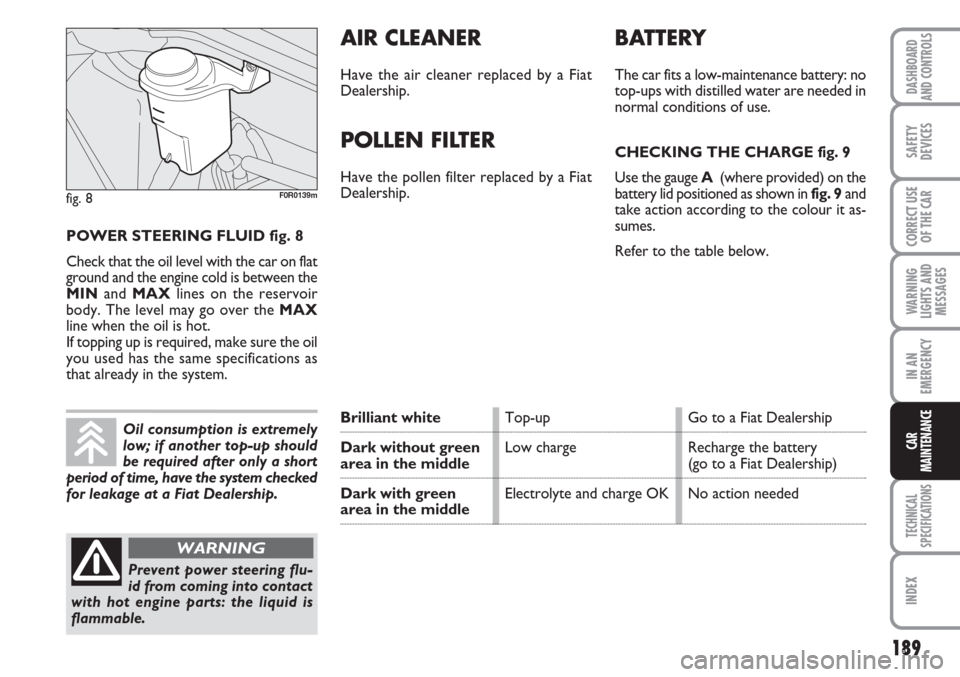
CHECKING THE CHARGE fig. 9
Use the gauge A (where provided) on the
battery lid positioned as shown in fig. 9and
take action according to the colour it as-
sumes.
Refer to the table below. POWER STEERING FLUID fig. 8
Check that the oil level with the car on flat
ground and the engine cold is between the
MINand MAXlines on the reservoir
body. The level may go over the MAX
line when the oil is hot.
If topping up is required, make sure the oil
you used has the same specifications as
that already in the system.
AIR CLEANER
Have the air cleaner replaced by a Fiat
Dealership.
POLLEN FILTER
Have the pollen filter replaced by a Fiat
Dealership.
Prevent power steering flu-
id from coming into contact
with hot engine parts: the liquid is
flammable.
WARNING
fig. 8F0R0139m
Brilliant whiteTop-up Go to a Fiat Dealership
Dark without greenLow charge Recharge the battery
area in the middle(go to a Fiat Dealership)
Dark with green Electrolyte and charge OK No action needed
area in the middle