lock FIAT LINEA 2007 1.G Owner's Manual
[x] Cancel search | Manufacturer: FIAT, Model Year: 2007, Model line: LINEA, Model: FIAT LINEA 2007 1.GPages: 230, PDF Size: 3.31 MB
Page 48 of 230
47
SAFETY
DEVICES
CORRECT USE
OF THE
CAR
WARNING
LIGHTS AND
MESSAGES
IN AN
EMERGENCY
CAR
MAINTENANCE
TECHNICAL
SPECIFICATIONS
INDEX
DASHBOARD
AND CONTROLS
REARVIEW MIRRORS
DRIVING MIRROR fig. 32
The mirror is fitted with a safety device
that causes it to be released in the event
of a violent crash.
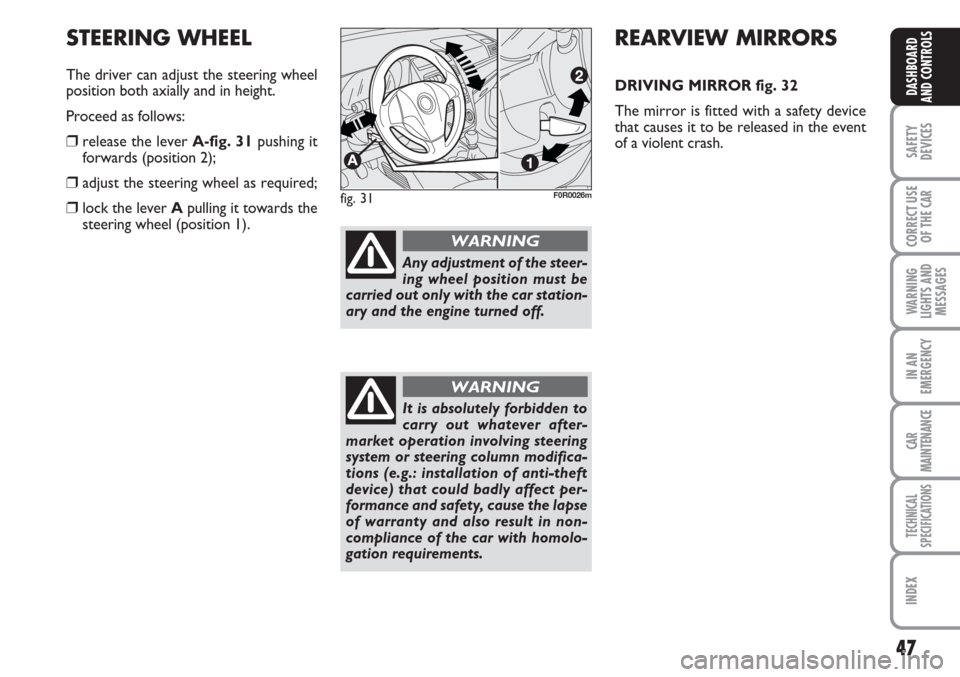
STEERING WHEEL
The driver can adjust the steering wheel
position both axially and in height.
Proceed as follows:
❒release the lever A-fig. 31pushing it
forwards (position 2);
❒adjust the steering wheel as required;
❒lock the lever Apulling it towards the
steering wheel (position 1).fig. 31F0R0026m
Any adjustment of the steer-
ing wheel position must be
carried out only with the car station-
ary and the engine turned off.
WARNING
It is absolutely forbidden to
carry out whatever after-
market operation involving steering
system or steering column modifica-
tions (e.g.: installation of anti-theft
device) that could badly affect per-
formance and safety, cause the lapse
of warranty and also result in non-
compliance of the car with homolo-
gation requirements.
WARNING
Page 62 of 230
61
SAFETY
DEVICES
CORRECT USE
OF THE
CAR
WARNING
LIGHTS AND
MESSAGES
IN AN
EMERGENCY
CAR
MAINTENANCE
TECHNICAL
SPECIFICATIONS
INDEX
DASHBOARD
AND CONTROLS
USING THE CLIMATE
CONTROL SYSTEM
The system can be started in different
ways, but it is advisable to start by press-
ing the AUTObutton and then turning
the knobs to set the temperature required
on the display.
The system will start running automatically
in this way and the set comfortable tem-
perature will be reached as quickly as pos-
sible. The system will adjust the temper-
ature, the quantity and the distribution of
the air introduced into the passenger com-
partment and will manage the recircula-
tion function and the compressor.
Manual intervention is only required for
the following functions during fully auto-
matic operation.
❒Tair recirculation, to keep the
function always either on or off;
❒Zto speed up demisting/defrosting of
windscreen, rear window and exter-
nal rearview mirrors;During completely automatic system op-
eration, you can vary the set temperature,
the air distribution and the fan speed us-
ing the corresponding buttons or knobs
at any time: the system will automatically
change settings to adapt to the new re-
quest.
During fully automatic operation (FULL
AUTO), the word FULLwill disappear
if the air distribution, air speed, compres-
sor and/or recirculation settings are
changed. In this way, the functions will
switch from automatic to manual control
until AUTOis pressed again. With on or
more manually set functions, the intro-
duced air temperature is still managed au-
tomatically by the system, except for when
the compressor is off: in the case, the air
introduced into the passenger compart-
ment cannot be cooler than the outside
air.Air temperature adjustment
knob (I)
Turn the knob either clockwise or anti-
clockwise to increase or lower the re-
quested temperature in the passenger
compartment. The set temperature is
shown on the display.
Turn the knob either all to the right or
all to the left to the extreme HIor LO
position to use the maximum heating or
maximum cooling functions:
❒HI function (maximum heating):
select by turning the temperature knob
clockwise over the maximum value
(32 °C).
This function may be used to heat up the
passenger compartment exploiting the
system potential to the maximum. In this
condition, the system stop controlling
temperature automatically and sets air
mixing to maximum heating. The air speed
and distribution are fixed.
Specifically, if the heating fluid is not suffi-
ciently warm, the fan will not start up at
the maximum speed immediately to limit
introducing excessively cool air into the
passenger compartment.
All manual settings will be allowed when
this function is on.
Page 63 of 230
62
SAFETY
DEVICES
CORRECT USE
OF THE
CAR
WARNING
LIGHTS AND
MESSAGES
IN AN
EMERGENCY
CAR
MAINTENANCE
TECHNICAL
SPECIFICATIONS
INDEX
DASHBOARD
AND CONTROLS
To switch the function off, simply turn the
temperature knob anticlockwise and set
the required temperature.
❒LOfunction (maximum cooling):
select by turning the temperature knob
anticlockwise under the minimum value
(16 °C).
This function may be used to cool down
the passenger compartment exploiting the
system potential to the maximum. In this
condition, the system stop controlling
temperature automatically and sets air
mixing to maximum cooling. The air speed
and distribution are fixed. All manual set-
tings will be allowed when this function
is on.
To switch the function off, simply turn the
temperature knob anticlockwise and set
the required temperature.Air distribution buttons (B)
Press these buttons to manually set one
of the seven air distribution settings:▲Air flow to the windscreen and front
side window vents to demist or de-
frost them.
˙Air flow at central and side dashboard
vents to ventilate the chest and the
face during the hot season.
▼Air flow to the front and rear foot well
vents. Thanks to the natural tenden-
cy of hot air to spread upwards, this
distribution pattern allows to warm
the passenger compartment up as
quickly as possible, providing an im-
mediate feeling of warmth.
˙
▼Air flow distributed between foot well
vents (hotter air) and central and side
dashboard vents (cooler air). This dis-
tribution is particularly useful in spring
and autumn on a sunny day.
▲
▼Air flow distributed between foot well
vents and windscreen and front side
window defrosting/demisting vents.
This allows an adequate warming of
the passenger compartment and pre-
vents the windows from misting up.
▲
˙Air flow distributed between wind-
screen and front side window de-
froster/demister and central and side
dashboard vents. This distribution al-
lows to maintain good levels of com-
fort and the passenger compartment
adequately cool (summer).
▲
˙
▼Air flow distributed between wind-
screen and front side window de-
froster/demister and central and side
dashboard vents. This distribution al-
lows adequate air diffusion and main-
tains a good level of comfort both in
summer and winter.
The set distribution is shown by the cor-
responding LEDs on the selected buttons.
To restore automatic air distribution con-
trol after a manual adjustment, press but-
ton AUTO.
Page 74 of 230
73
SAFETY
DEVICES
CORRECT USE
OF THE
CAR
WARNING
LIGHTS AND
MESSAGES
IN AN
EMERGENCY
CAR
MAINTENANCE
TECHNICAL
SPECIFICATIONS
INDEX
DASHBOARD
AND CONTROLS
Ceiling light timing
On certain versions to facilitate getting
in/out of the car at night or with poor
lighting, 2 different timed switching on
modes have been provided.LIGHT TIMING WHEN GETTING INTO THE CAR
Lights will turn on as follows:
❒for about 10 seconds when opening
front doors;
❒for about 3 minutes when opening one
of the side doors;
❒for about 10 seconds when closing the
doors.
Timing will stop when turning the ignition
key to MAR.
LIGHT TIMING WHEN GETTING OUT
OF THE CAR
After removing the key from the ignition
switch, the ceiling lights will turn on as fol-
lows:
❒within 2 minutes from turning the en-
gine off for about 10 seconds;
❒when opening one of the side doors for
about 3 minutes;
❒when closing one of the doors for
about 10 seconds.
Timing will stop automatically when lock-
ing the doors.
Page 77 of 230
76
SAFETY
DEVICES
CORRECT USE
OF THE
CAR
WARNING
LIGHTS AND
MESSAGES
IN AN
EMERGENCY
CAR
MAINTENANCE
TECHNICAL
SPECIFICATIONS
INDEX
DASHBOARD
AND CONTROLS
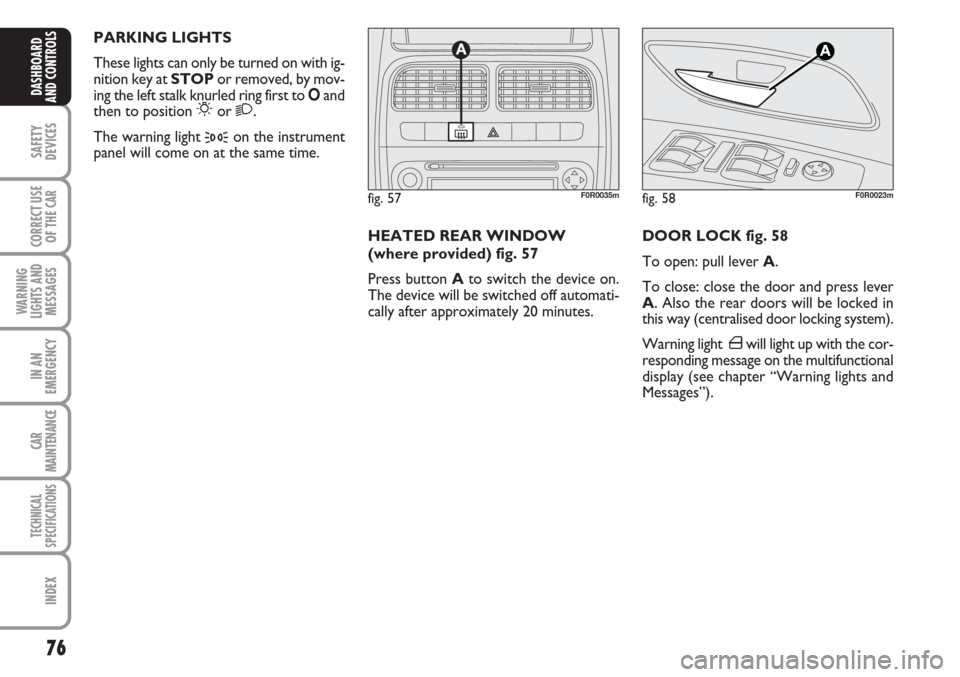
DOOR LOCK fig. 58
To open: pull lever A.
To close: close the door and press lever
A. Also the rear doors will be locked in
this way (centralised door locking system).
Warning light ´will light up with the cor-
responding message on the multifunctional
display (see chapter “Warning lights and
Messages”).
fig. 57F0R0035m
HEATED REAR WINDOW
(where provided) fig. 57
Press button Ato switch the device on.
The device will be switched off automati-
cally after approximately 20 minutes. PARKING LIGHTS
These lights can only be turned on with ig-
nition key at STOPor removed, by mov-
ing the left stalk knurled ring first to Oand
then to position
6or 2.
The warning light
3on the instrument
panel will come on at the same time.
fig. 58F0R0023m
Page 78 of 230
77
SAFETY
DEVICES
CORRECT USE
OF THE
CAR
WARNING
LIGHTS AND
MESSAGES
IN AN
EMERGENCY
CAR
MAINTENANCE
TECHNICAL
SPECIFICATIONS
INDEX
DASHBOARD
AND CONTROLS
Door unlocking in the event
of a crash
If the fuel cut-off switch trips following an
accident, the doors will be automatically
unlocked to let you leave the car and the
ceiling lights will be switched on at the
same time. The doors can always be
opened from the inside of the car by
means of the specific levers.
Proceed as follows if no fuel leakage is
found and and the car is in condition to be
driven to rearm the fuel cut-off switch.FUEL CUT-OFF SWITCH
The car is fitted with a safety switch that
in the event of a crash comes into opera-
tion by cutting off fuel and turning off the
engine as a consequence.
This device therefore prevents fuel leaks
due to fuel piping breaking.
IMPORTANT After the accident, re-
member to remove the electronic key
from the ignition device to prevent drain-
ing the battery.The message “FPS on” will appear on the
digital display when the switch trips. The
message “Inertia switch tripped. See hand-
book” will appear on the multifunctional
display.
If, after a crash, you smell fu-
el or see leaks from the fuel
system, do not reset the switch to
avoid fine risk.
WARNING
If the centralised door lock-
ing system was operated
from inside the car and the fuel cut-
off switch did not manage to auto-
matically release the doors, it will not
be possible to access the passenger
compartment from the outside after
an accident. The possibility of open-
ing the doors from the outside de-
pends on the conditions of the doors
themselves after the accident: if may
not be possible to open a damaged
door. In this case, try to open the oth-
er doors of the car.
WARNING
Page 83 of 230
82
SAFETY
DEVICES
CORRECT USE
OF THE
CAR
WARNING
LIGHTS AND
MESSAGES
IN AN
EMERGENCY
CAR
MAINTENANCE
TECHNICAL
SPECIFICATIONS
INDEX
DASHBOARD
AND CONTROLS
DOORS
CENTRAL DOOR
LOCKING/UNLOCKING SYSTEM
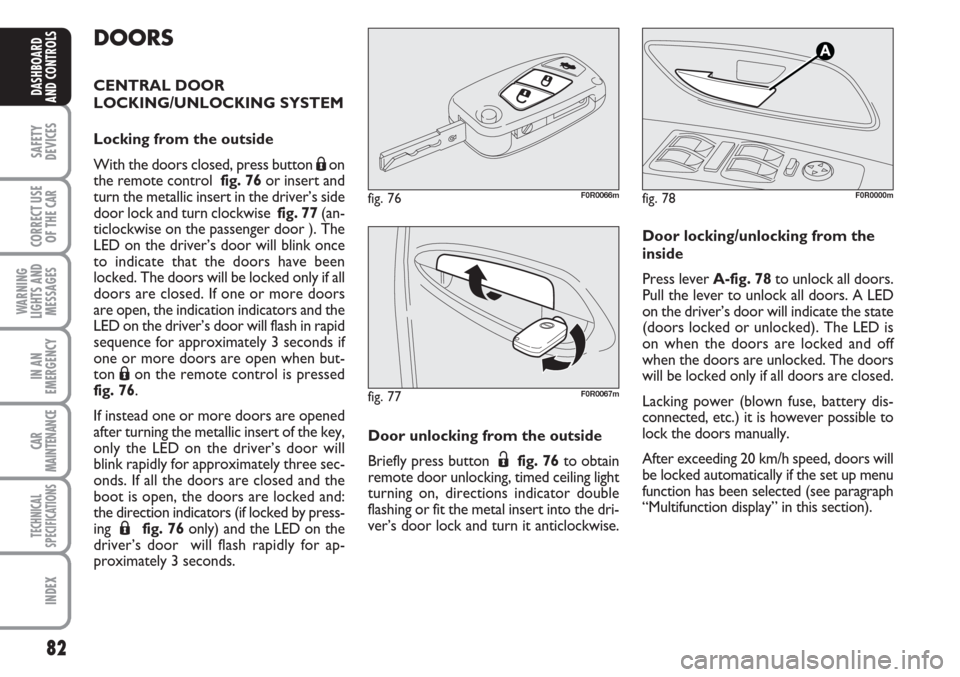
Locking from the outside
With the doors closed, press button
Áon
the remote control fig. 76or insert and
turn the metallic insert in the driver’s side
door lock and turn clockwise fig. 77(an-
ticlockwise on the passenger door ). The
LED on the driver’s door will blink once
to indicate that the doors have been
locked. The doors will be locked only if all
doors are closed. If one or more doors
are open, the indication indicators and the
LED on the driver’s door will flash in rapid
sequence for approximately 3 seconds if
one or more doors are open when but-
ton
Áon the remote control is pressed
fig. 76.
If instead one or more doors are opened
after turning the metallic insert of the key,
only the LED on the driver’s door will
blink rapidly for approximately three sec-
onds. If all the doors are closed and the
boot is open, the doors are locked and:
the direction indicators (if locked by press-
ing
Áfig. 76only) and the LED on the
driver’s door will flash rapidly for ap-
proximately 3 seconds.Door unlocking from the outside
Briefly press button
Ëfig. 76to obtain
remote door unlocking, timed ceiling light
turning on, directions indicator double
flashing or fit the metal insert into the dri-
ver’s door lock and turn it anticlockwise.
fig. 77F0R0067m
fig. 78F0R0000m
Door locking/unlocking from the
inside
Press lever A-fig. 78to unlock all doors.
Pull the lever to unlock all doors. A LED
on the driver’s door will indicate the state
(doors locked or unlocked). The LED is
on when the doors are locked and off
when the doors are unlocked. The doors
will be locked only if all doors are closed.
Lacking power (blown fuse, battery dis-
connected, etc.) it is however possible to
lock the doors manually.
After exceeding 20 km/h speed, doors will
be locked automatically if the set up menu
function has been selected (see paragraph
“Multifunction display” in this section).
fig. 76F0R0066m
Page 84 of 230
83
SAFETY
DEVICES
CORRECT USE
OF THE
CAR
WARNING
LIGHTS AND
MESSAGES
IN AN
EMERGENCY
CAR
MAINTENANCE
TECHNICAL
SPECIFICATIONS
INDEX
DASHBOARD
AND CONTROLS
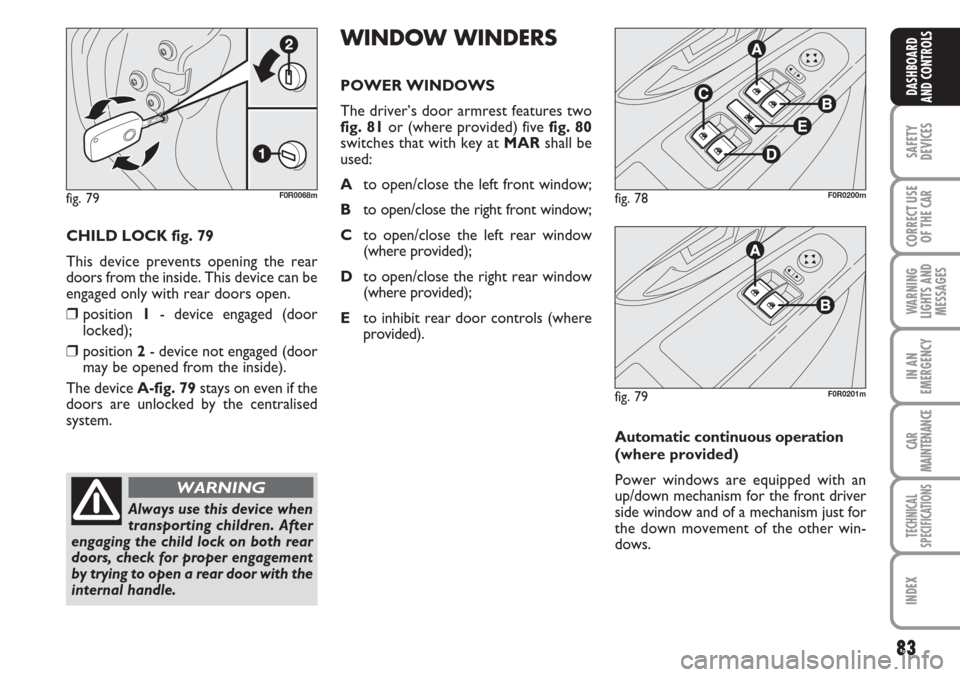
CHILD LOCK fig. 79
This device prevents opening the rear
doors from the inside. This device can be
engaged only with rear doors open.
❒position 1- device engaged (door
locked);
❒position 2- device not engaged (door
may be opened from the inside).
The device A-fig. 79stays on even if the
doors are unlocked by the centralised
system.
fig. 79F0R0068m
Always use this device when
transporting children. After
engaging the child lock on both rear
doors, check for proper engagement
by trying to open a rear door with the
internal handle.
WARNING
WINDOW WINDERS
POWER WINDOWS
The driver’s door armrest features two
fig. 81or (where provided) five fig. 80
switches that with key at MARshall be
used:
Ato open/close the left front window;
Bto open/close the right front window;
Cto open/close the left rear window
(where provided);
Dto open/close the right rear window
(where provided);
Eto inhibit rear door controls (where
provided).
fig. 78F0R0200m
fig. 79F0R0201m
Automatic continuous operation
(where provided)
Power windows are equipped with an
up/down mechanism for the front driver
side window and of a mechanism just for
the down movement of the other win-
dows.
Page 87 of 230
86
SAFETY
DEVICES
CORRECT USE
OF THE
CAR
WARNING
LIGHTS AND
MESSAGES
IN AN
EMERGENCY
CAR
MAINTENANCE
TECHNICAL
SPECIFICATIONS
INDEX
DASHBOARD
AND CONTROLS
BOOT
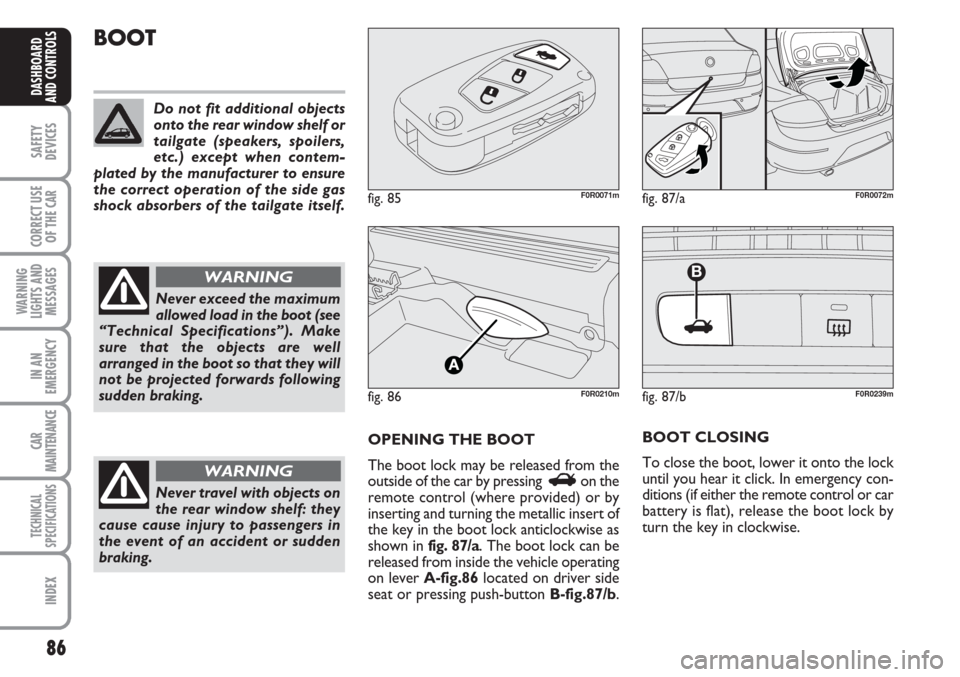
OPENING THE BOOT
The boot lock may be released from the
outside of the car by pressing
Ron the
remote control (where provided) or by
inserting and turning the metallic insert of
the key in the boot lock anticlockwise as
shown in fig. 87/a. The boot lock can be
released from inside the vehicle operating
on lever A-fig.86 located on driver side
seat or pressing push-button B-fig.87/b.BOOT CLOSING
To close the boot, lower it onto the lock
until you hear it click. In emergency con-
ditions (if either the remote control or car
battery is flat), release the boot lock by
turn the key in clockwise.
fig. 85F0R0071m
fig. 86F0R0210m
fig. 87/aF0R0072m
Do not fit additional objects
onto the rear window shelf or
tailgate (speakers, spoilers,
etc.) except when contem-
plated by the manufacturer to ensure
the correct operation of the side gas
shock absorbers of the tailgate itself.
Never exceed the maximum
allowed load in the boot (see
“Technical Specifications”). Make
sure that the objects are well
arranged in the boot so that they will
not be projected forwards following
sudden braking.
WARNING
Never travel with objects on
the rear window shelf: they
cause cause injury to passengers in
the event of an accident or sudden
braking.
WARNING
fig. 87/b
B
F0R0239m
Page 88 of 230
87
SAFETY
DEVICES
CORRECT USE
OF THE
CAR
WARNING
LIGHTS AND
MESSAGES
IN AN
EMERGENCY
CAR
MAINTENANCE
TECHNICAL
SPECIFICATIONS
INDEX
DASHBOARD
AND CONTROLS
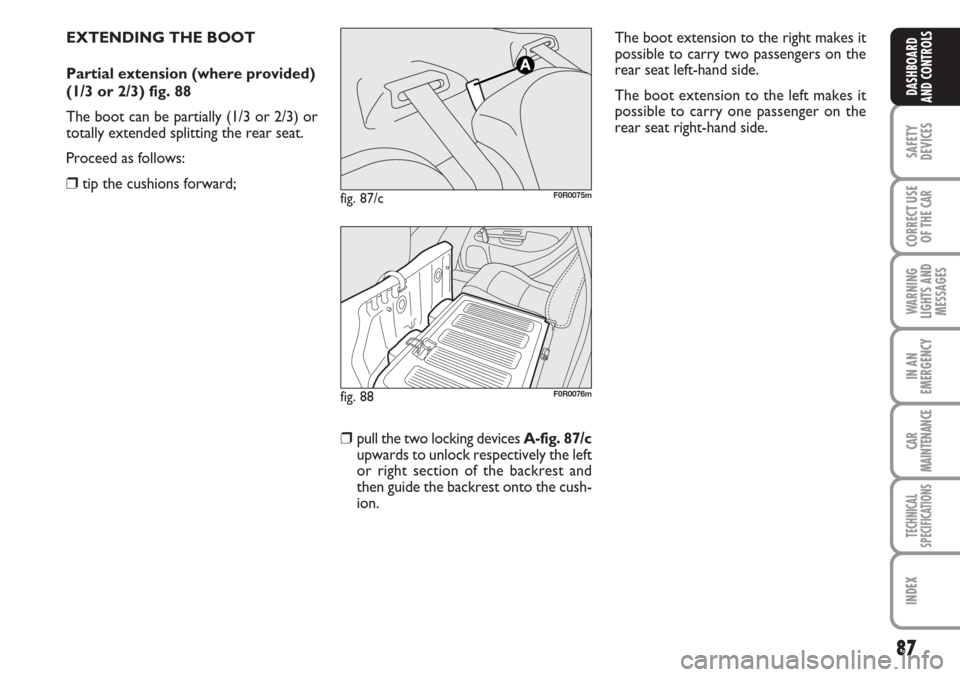
EXTENDING THE BOOT
Partial extension (where provided)
(1/3 or 2/3) fig. 88
The boot can be partially (1/3 or 2/3) or
totally extended splitting the rear seat.
Proceed as follows:
❒tip the cushions forward;fig. 87/cF0R0075m
fig. 88F0R0076m
❒pull the two locking devices A-fig. 87/c
upwards to unlock respectively the left
or right section of the backrest and
then guide the backrest onto the cush-
ion.The boot extension to the right makes it
possible to carry two passengers on the
rear seat left-hand side.
The boot extension to the left makes it
possible to carry one passenger on the
rear seat right-hand side.