brake FIAT LINEA 2007 1.G Owner's Guide
[x] Cancel search | Manufacturer: FIAT, Model Year: 2007, Model line: LINEA, Model: FIAT LINEA 2007 1.GPages: 230, PDF Size: 3.31 MB
Page 177 of 230
176
WARNING
LIGHTS AND
MESSAGES
CAR
MAINTENANCE
TECHNICAL
SPECIFICATIONS
IINDEX
DASHBOARD
AND CONTROLS
SAFETY
DEVICES
CORRECT USE
OF THE
CAR
IN AN
EMERGENCY
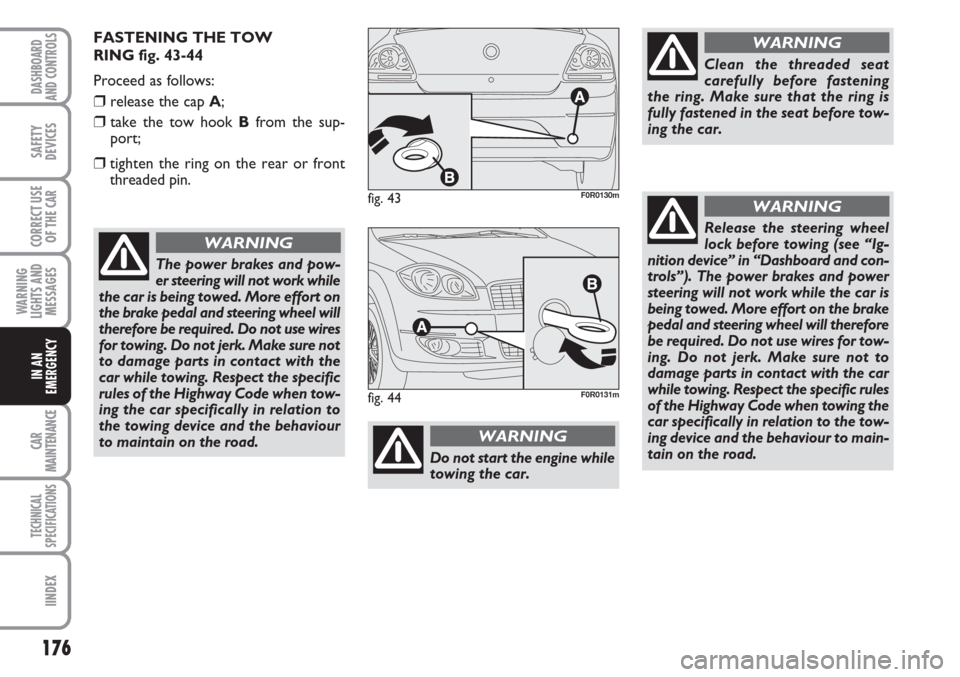
FASTENING THE TOW
RING fig. 43-44
Proceed as follows:
❒release the cap A;
❒take the tow hook Bfrom the sup-
port;
❒tighten the ring on the rear or front
threaded pin.
The power brakes and pow-
er steering will not work while
the car is being towed. More effort on
the brake pedal and steering wheel will
therefore be required. Do not use wires
for towing. Do not jerk. Make sure not
to damage parts in contact with the
car while towing. Respect the specific
rules of the Highway Code when tow-
ing the car specifically in relation to
the towing device and the behaviour
to maintain on the road.
WARNING
fig. 43F0R0130m
fig. 44F0R0131m
Do not start the engine while
towing the car.
WARNING
Clean the threaded seat
carefully before fastening
the ring. Make sure that the ring is
fully fastened in the seat before tow-
ing the car.
WARNING
Release the steering wheel
lock before towing (see “Ig-
nition device” in “Dashboard and con-
trols”). The power brakes and power
steering will not work while the car is
being towed. More effort on the brake
pedal and steering wheel will therefore
be required. Do not use wires for tow-
ing. Do not jerk. Make sure not to
damage parts in contact with the car
while towing. Respect the specific rules
of the Highway Code when towing the
car specifically in relation to the tow-
ing device and the behaviour to main-
tain on the road.
WARNING
Page 180 of 230
179
WARNING
LIGHTS AND
MESSAGES
TECHNICAL
SPECIFICATIONS
INDEX
DASHBOARD
AND CONTROLS
SAFETY
DEVICES
CORRECT USE
OF THE CAR
IN AN
EMERGENCY
CAR
MAINTENANCE
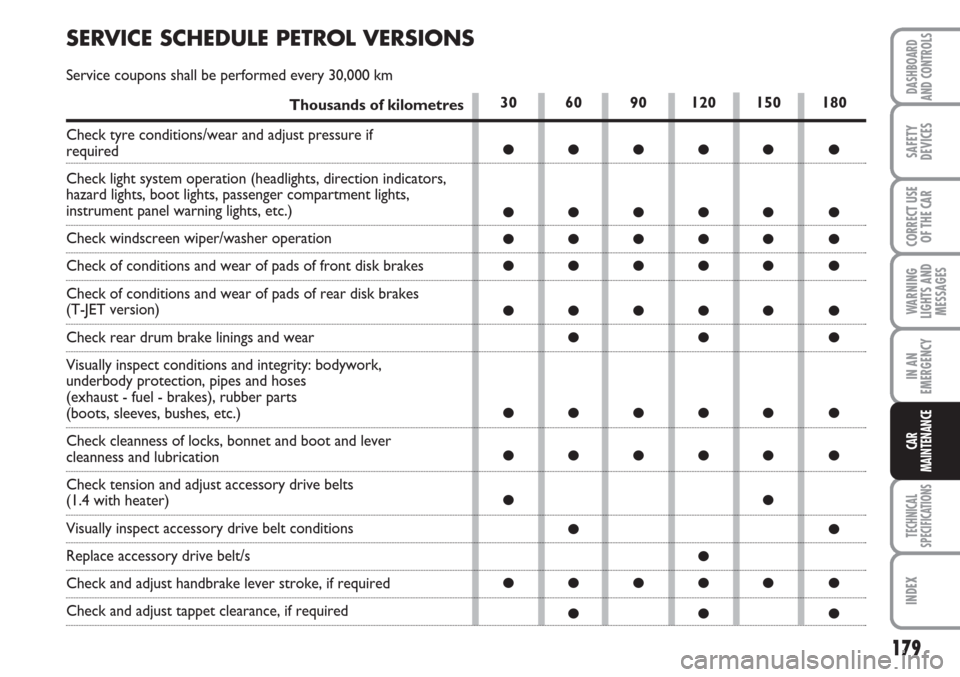
30 60 90 120 150 180
●●●●● ●
●●●●● ●
●●●●● ●
●●●●● ●
●●●●● ●
●● ●
●●●●● ●
●●●●● ●
●●
●●
●
●●●●● ●
●● ●
SERVICE SCHEDULE PETROL VERSIONS
Service coupons shall be performed every 30,000 km
Thousands of kilometres
Check tyre conditions/wear and adjust pressure if
required
Check light system operation (headlights, direction indicators,
hazard lights, boot lights, passenger compartment lights,
instrument panel warning lights, etc.)
Check windscreen wiper/washer operation
Check of conditions and wear of pads of front disk brakes
Check of conditions and wear of pads of rear disk brakes
(T-JET version)
Check rear drum brake linings and wear
Visually inspect conditions and integrity: bodywork,
underbody protection, pipes and hoses
(exhaust - fuel - brakes), rubber parts
(boots, sleeves, bushes, etc.)
Check cleanness of locks, bonnet and boot and lever
cleanness and lubrication
Check tension and adjust accessory drive belts
(1.4 with heater)
Visually inspect accessory drive belt conditions
Replace accessory drive belt/s
Check and adjust handbrake lever stroke, if required
Check and adjust tappet clearance, if required
Page 181 of 230
180
WARNING
LIGHTS AND
MESSAGES
TECHNICAL
SPECIFICATIONS
INDEX
DASHBOARD
AND CONTROLS
SAFETY
DEVICES
CORRECT USE
OF THE CAR
IN AN
EMERGENCY
CAR
MAINTENANCE
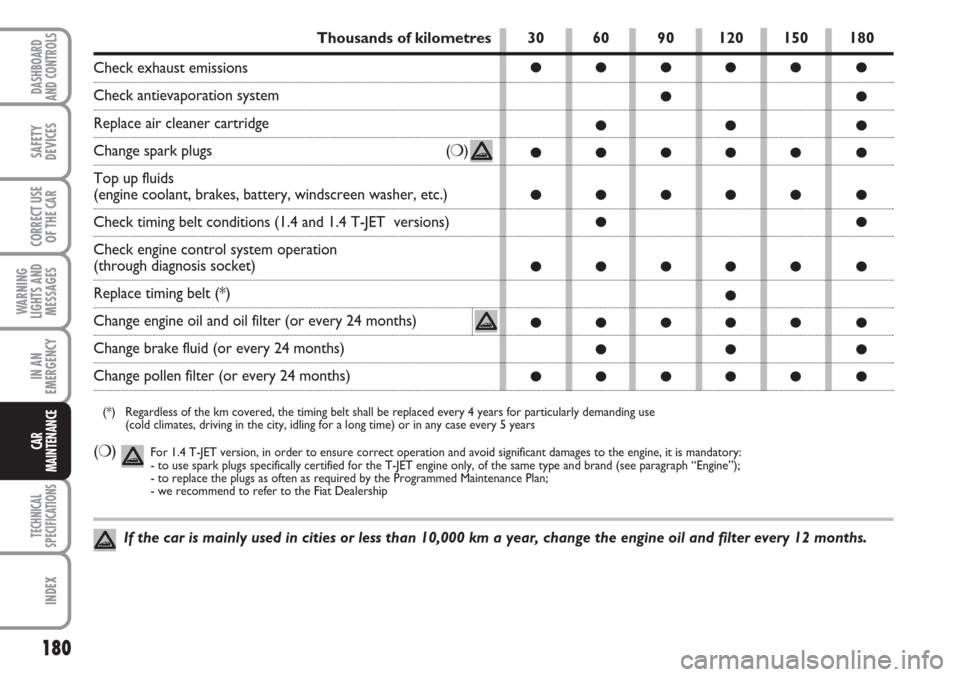
If the car is mainly used in cities or less than 10,000 km a year, change the engine oil and filter every 12 months.30 60 90 120 150 180
●●●●● ●
●●
●● ●
●●●●● ●
●●●●● ●
●●
●●●●● ●
●
●●●●● ●
●● ●
●●●●● ●
Thousands of kilometres
Check exhaust emissions
Check antievaporation system
Replace air cleaner cartridge
Change spark plugs (❍)
Top up fluids
(engine coolant, brakes, battery, windscreen washer, etc.)
Check timing belt conditions (1.4 and 1.4 T-JET versions)
Check engine control system operation
(through diagnosis socket)
Replace timing belt (*)
Change engine oil and oil filter (or every 24 months)
Change brake fluid (or every 24 months)
Change pollen filter (or every 24 months)
(*) Regardless of the km covered, the timing belt shall be replaced every 4 years for particularly demanding use
(cold climates, driving in the city, idling for a long time) or in any case every 5 years
(❍)For 1.4 T-JET version, in order to ensure correct operation and avoid significant damages to the engine, it is mandatory:
- to use spark plugs specifically certified for the T-JET engine only, of the same type and brand (see paragraph “Engine”);
- to replace the plugs as often as required by the Programmed Maintenance Plan;
- we recommend to refer to the Fiat Dealership
Page 182 of 230
181
WARNING
LIGHTS AND
MESSAGES
TECHNICAL
SPECIFICATIONS
INDEX
DASHBOARD
AND CONTROLS
SAFETY
DEVICES
CORRECT USE
OF THE CAR
IN AN
EMERGENCY
CAR
MAINTENANCE
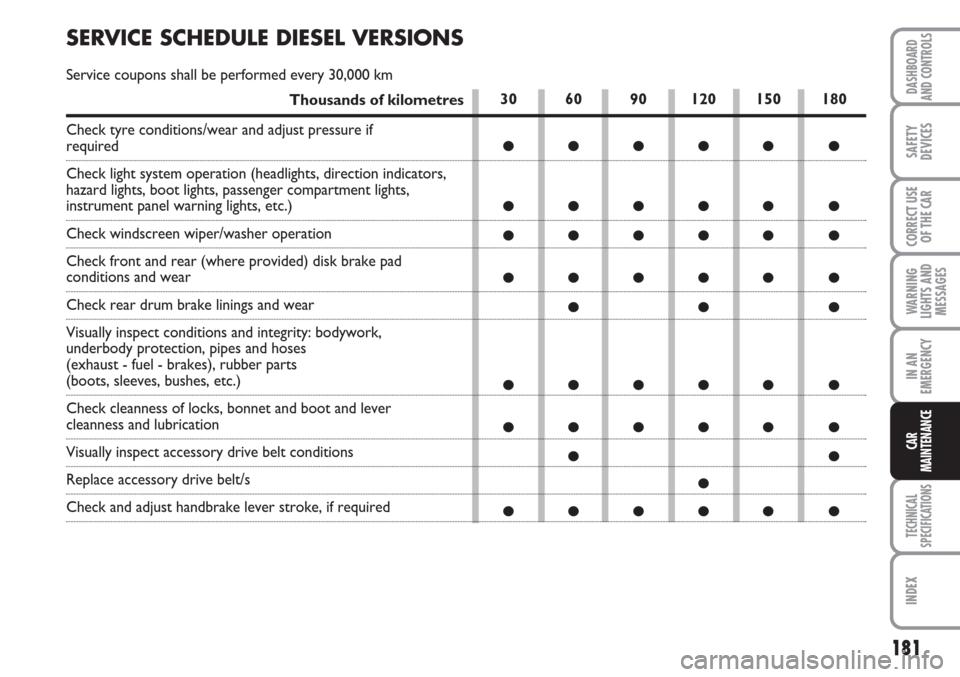
30 60 90 120 150 180
●●●●● ●
●●●●● ●
●●●●● ●
●●●●● ●
●● ●
●●●●● ●
●●●●● ●
●●
●
●●●●● ●
SERVICE SCHEDULE DIESEL VERSIONS
Service coupons shall be performed every 30,000 km
Thousands of kilometres
Check tyre conditions/wear and adjust pressure if
required
Check light system operation (headlights, direction indicators,
hazard lights, boot lights, passenger compartment lights,
instrument panel warning lights, etc.)
Check windscreen wiper/washer operation
Check front and rear (where provided) disk brake pad
conditions and wear
Check rear drum brake linings and wear
Visually inspect conditions and integrity: bodywork,
underbody protection, pipes and hoses
(exhaust - fuel - brakes), rubber parts
(boots, sleeves, bushes, etc.)
Check cleanness of locks, bonnet and boot and lever
cleanness and lubrication
Visually inspect accessory drive belt conditions
Replace accessory drive belt/s
Check and adjust handbrake lever stroke, if required
Page 183 of 230
182
WARNING
LIGHTS AND
MESSAGES
TECHNICAL
SPECIFICATIONS
INDEX
DASHBOARD
AND CONTROLS
SAFETY
DEVICES
CORRECT USE
OF THE CAR
IN AN
EMERGENCY
CAR
MAINTENANCE
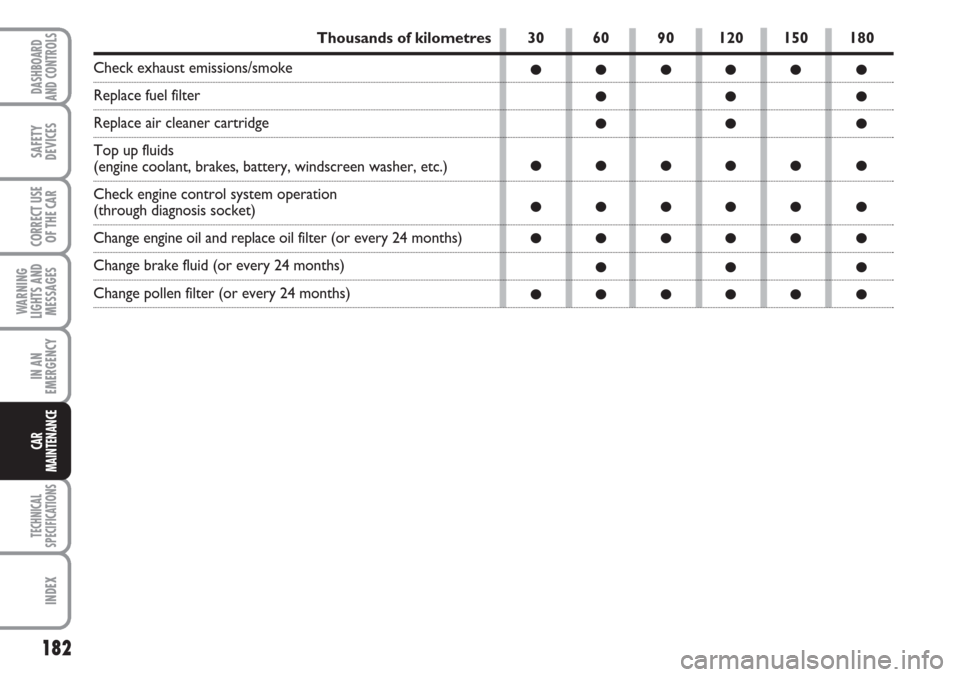
30 60 90 120 150 180
●●●●● ●
●● ●
●● ●
●●●●● ●
●●●●● ●
●●●●● ●
●● ●
●●●●● ●
Thousands of kilometres
Check exhaust emissions/smoke
Replace fuel filter
Replace air cleaner cartridge
Top up fluids
(engine coolant, brakes, battery, windscreen washer, etc.)
Check engine control system operation
(through diagnosis socket)
Change engine oil and replace oil filter (or every 24 months)
Change brake fluid (or every 24 months)
Change pollen filter (or every 24 months)
Page 184 of 230
183
WARNING
LIGHTS AND
MESSAGES
TECHNICAL
SPECIFICATIONS
INDEX
DASHBOARD
AND CONTROLS
SAFETY
DEVICES
CORRECT USE
OF THE CAR
IN AN
EMERGENCY
CAR
MAINTENANCE
DEMANDING USE
OF THE CAR
Should prevailing use of the car be under
one of the following specially heavy con-
ditions:
❒trailer or caravan towing;
❒dusty roads;
❒short distances (less than 7-8 km) re-
peated and with external temperatures
below zero;
❒frequently idling engines or long dis-
tance low speed driving (e.g. taxis or
door-to-door deliveries) or in case of
a long term inactivity;
❒in cities;
perform the following inspections more
frequently than shown on the Service
Schedule:
❒check front disk brake pad conditions
and wear;
❒check cleanness of locks, bonnet and
boot and lever cleanness and lubrica-
tion;
❒visually inspect the conditions of: en-
gine, gearbox, transmission, pipes and
hoses (exhaust - fuel - brakes), rubber
parts (boots, sleeves, bushes, etc.);
❒check battery charge and liquid level
(electrolyte) (see paragraph “Charge
level check” in chapter “Maintenance
and care”);
❒visually inspect the accessory drive belt
conditions;
❒check pollen filter and replace, if re-
quired;
❒check air cleaner and replace, if re-
quired.
REGULAR
INSPECTIONS
Every 1,000 km or before long journeys,
check and top up if required:
❒engine coolant fluid level;
❒brake fluid level;
❒brake fluid level;
❒tyre pressure and conditions.
❒operation of lights (headlights, direction
indicators, hazard lights, etc.);
❒operation of the windscreen wiper/
washer system, position and wear of
the windscreen and rear window wiper
blades;
Every 3,000 km check the following and
top-up, if required:engine oil level.
You are recommended to use FL
Seleniaproducts, designed and produced
specifically for Fiat cars (see table “Ca-
pacities” in section “Technical specifica-
tions”).
Page 185 of 230
184
WARNING
LIGHTS AND
MESSAGES
TECHNICAL
SPECIFICATIONS
INDEX
DASHBOARD
AND CONTROLS
SAFETY
DEVICES
CORRECT USE
OF THE CAR
IN AN
EMERGENCY
CAR
MAINTENANCE
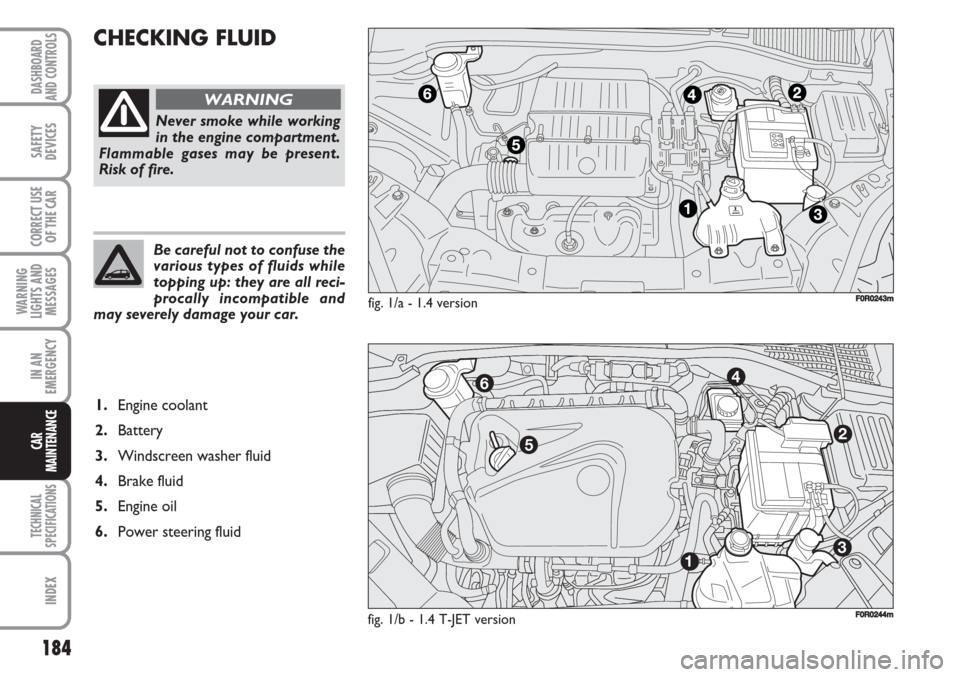
CHECKING FLUID
fig. 1/a - 1.4 version
Never smoke while working
in the engine compartment.
Flammable gases may be present.
Risk of fire.
WARNING
Be careful not to confuse the
various types of fluids while
topping up: they are all reci-
procally incompatible and
may severely damage your car.
F0R0243m
1.Engine coolant
2.Battery
3.Windscreen washer fluid
4.Brake fluid
5.Engine oil
6.Power steering fluid
fig. 1/b - 1.4 T-JET version
2
64
5
13
2
64
5
13
2
64
5
13
F0R0244m
Page 186 of 230
185
WARNING
LIGHTS AND
MESSAGES
TECHNICAL
SPECIFICATIONS
INDEX
DASHBOARD
AND CONTROLS
SAFETY
DEVICES
CORRECT USE
OF THE CAR
IN AN
EMERGENCY
CAR
MAINTENANCE
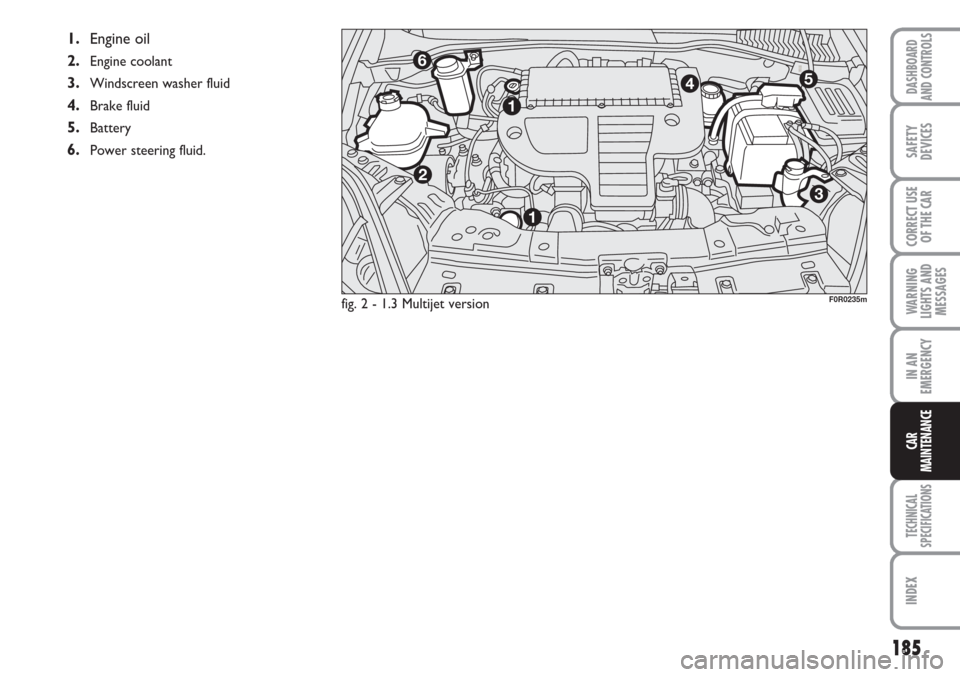
fig. 2 - 1.3 Multijet version
1
1
6
2
45
3
F0R0235m
1.Engine oil
2.
Engine coolant
3.Windscreen washer fluid
4.Brake fluid
5.Battery
6.Power steering fluid.
Page 189 of 230
188
WARNING
LIGHTS AND
MESSAGES
TECHNICAL
SPECIFICATIONS
INDEX
DASHBOARD
AND CONTROLS
SAFETY
DEVICES
CORRECT USE
OF THE CAR
IN AN
EMERGENCY
CAR
MAINTENANCE
NOTE Carefully clean the cap of reservoir
Aand the surrounding surface.
When opening the cap, make sure that no
dirt gets into the reservoir.
For topping up always use a funnel with
built in filter (mesh smaller than or equal
to 0.12 mm).
IMPORTANT Brake fluid absorbs mois-
ture. For this reason, if the car is mainly
used in areas with a high degree of at-
mospheric humidity, the fluid should be
replaced at more frequent intervals than
specified in the “Service schedule”. Check level through the reservoir.
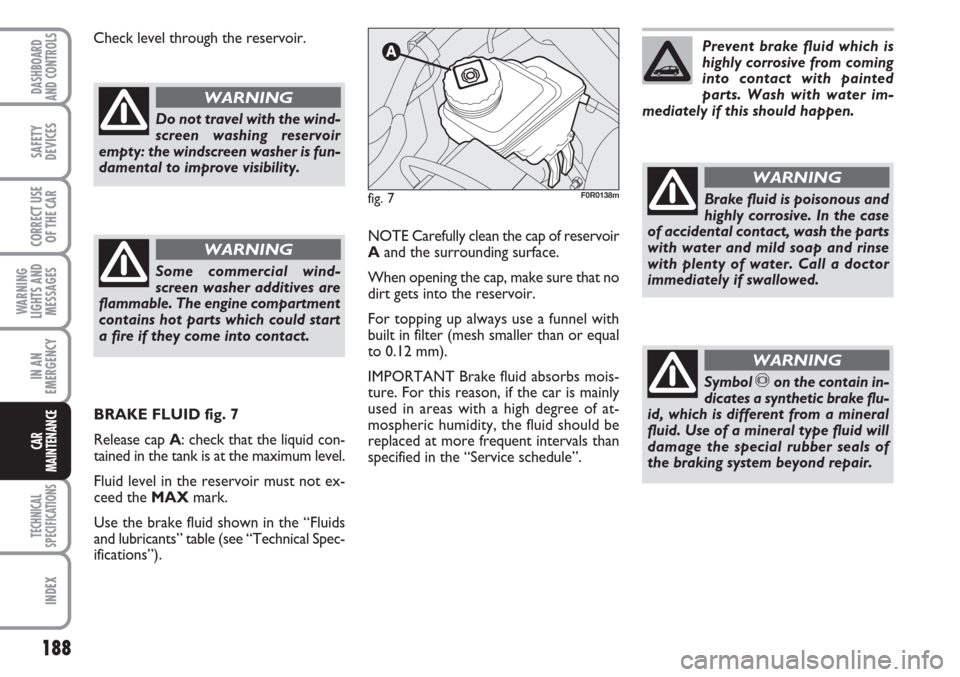
fig. 7F0R0138m
Do not travel with the wind-
screen washing reservoir
empty: the windscreen washer is fun-
damental to improve visibility.
WARNING
Some commercial wind-
screen washer additives are
flammable. The engine compartment
contains hot parts which could start
a fire if they come into contact.
WARNING
Prevent brake fluid which is
highly corrosive from coming
into contact with painted
parts. Wash with water im-
mediately if this should happen.
Brake fluid is poisonous and
highly corrosive. In the case
of accidental contact, wash the parts
with water and mild soap and rinse
with plenty of water. Call a doctor
immediately if swallowed.
WARNING
Symbol πon the contain in-
dicates a synthetic brake flu-
id, which is different from a mineral
fluid. Use of a mineral type fluid will
damage the special rubber seals of
the braking system beyond repair.
WARNING
BRAKE FLUID fig. 7
Release cap A: check that the liquid con-
tained in the tank is at the maximum level.
Fluid level in the reservoir must not ex-
ceed the MAXmark.
Use the brake fluid shown in the “Fluids
and lubricants” table (see “Technical Spec-
ifications”).
Page 194 of 230
193
WARNING
LIGHTS AND
MESSAGES
TECHNICAL
SPECIFICATIONS
INDEX
DASHBOARD
AND CONTROLS
SAFETY
DEVICES
CORRECT USE
OF THE CAR
IN AN
EMERGENCY
CAR
MAINTENANCE
WINDSCREEN WIPER
BLADES
Periodically clean the rubber part using
special products; TUTELA PROFES-
SIONAL SC 35is recommended.
Replace the blades if the rubber edge is
deformed or worn. In all cases, it is ad-
visable to replace them approximately
once a year.
A few simple precautions can reduce the
possibility of damage to the blades:
❒make sure that the rubber part is not
stuck to the windscreen at sub-zero
temperatures. Use an antifreeze prod-
uct to release it if required.
❒remove the snow from the window:
this will avoid overstressing the elec-
trical motor in addition to protecting
the blades;
❒do not operate the windscreen wipers
on dry glass.
Driving with worn wiper
blades is a serious hazard,
because visibility is reduced in bad
weather.
WARNING
RUBBER HOSES
Carefully follow the information contained
in the “Service schedule” in this section
for maintenance of brake system and fuel
feed rubber hoses.
Ozone, high temperatures and prolonged
lack of fluid in the system may cause hard-
ening and cracking of the hoses, with pos-
sible leaks. Careful inspections are there-
fore necessary.Excessively low pressure will
cause overheating of the
tyre and may cause severe tyre dam-
age.
WARNING
Do not exchange the tyres
from the left to the right of
the car and vice versa.
WARNING
Do not repaint alloy wheel
rims at temperatures higher
than 150°C. The mechanical features
of the wheels could be compromised.
WARNING