power steering FIAT LINEA 2007 1.G Owners Manual
[x] Cancel search | Manufacturer: FIAT, Model Year: 2007, Model line: LINEA, Model: FIAT LINEA 2007 1.GPages: 230, PDF Size: 3.31 MB
Page 5 of 230
4
SAFETY
DEVICES
CORRECT USE
OF THE
CAR
WARNING
LIGHTS AND
MESSAGES
IN AN
EMERGENCY
CAR
MAINTENANCE
TECHNICAL
SPECIFICATIONS
INDEX
DASHBOARD
AND CONTROLSDASHBOARD........................................................................ 5
SYMBOLS ............................................................................... 6
THE FIAT CODE SYSTEM.................................................. 6
THE KEYS .............................................................................. 8
ALARM ................................................................................... 11
IGNITION DEVICE.............................................................. 13
INSTRUMENT PANEL ........................................................ 14
INSTRUMENTS..................................................................... 16
DIGITAL DISPLAY ............................................................... 18
MULTIFUNCTION DISPLAY ............................................ 23
RECONFIGURABLE MULTIFUNCTION DISPLAY ....... 32
TRIP COMPUTER ................................................................ 42
FRONT SEATS ..................................................................... 44
REAR SEATS .......................................................................... 45
HEAD RESTRAINTS............................................................. 45
STEERING WHEEL .............................................................. 47
REARVIEW MIRRORS......................................................... 47
HEATING AND VENTILATION...................................... 49
MANUAL CLIMATE CONTROL SYSTEM .................... 53
AUTOMATIC CLIMATE CONTROL SYSTEM ............ 59EXTERNAL LIGHTS ............................................................ 66
WINDOW WASHING....................................................... 68
CRUISE CONTROL ............................................................ 70
CEILING LIGHTS.................................................................. 72
CONTROLS........................................................................... 75
FUEL CUT-OFF SWITCH .................................................. 77
INTERIOR FITTINGS........................................................... 78
DOORS .................................................................................. 82
POWER WINDOWS........................................................... 83
BOOT ...................................................................................... 86
BONNET................................................................................. 88
ROOF RACK/SKI RACK .................................................... 90
HEADLIGHTS........................................................................ 91
ABS SYSTEM ......................................................................... 92
ESP SYSTEM .......................................................................... 93
EOBD SYSTEM ..................................................................... 96
PARKING SENSORS ........................................................... 97
SOUND SYSTEM.................................................................. 99
ACCESSORIES PURCHASED BY THE OWNER .......... 100
AT THE FILLING STATION ............................................. 101
PROTECTING THE ENVIRONMENT............................. 102
DD D
A A
S S
H H
B B
O O
A A
R R
D D
A A
N N
D D
C C
O O
N N
T T
R R
O O
L L
S S
Page 123 of 230
122
WARNING
LIGHTS AND
MESSAGES
IN AN
EMERGENCY
CAR
MAINTENANCE
TECHNICAL
SPECIFICATIONS
INDEX
DASHBOARD
AND CONTROLS
SAFETY
DEVICES
CORRECT USE
OF THE CAR
ENGINE STARTING
The car is provided with an electronic en-
gine lock device: refer to “The Fiat CODE
system” paragraph in “Dashboard and
controls” if you cannot start the engine.
The engine may be noisier during the first
seconds of operation, particularly after a
long period of inactivity. This is charac-
teristic of hydraulic tappets, the timing sys-
tem chosen to reduce the number of ser-
vicing interventions and does effects nei-
ther functionality nor reliability.
It is advisable not to demand
maximum performance from
your car (e.g. excessive accel-
erations, long distances at top
rpm, excessive intense braking, etc.) as
soon as the engine is started.
Do not leave the key in the ig-
nition switch with the engine
off to avoid unnecessary con-
sumption of electricity which
could drain the battery. It is dangerous
to run the engine in closed environ-
ments.
Running the engine in con-
fined areas is extremely dan-
gerous. The engine consumes oxygen
and produces carbon monoxide
which is a highly toxic and lethal gas.
WARNING
Remember that the brake
booster and power steering
are not operational until the engine
has been started, therefore much ef-
fort than usual is required on the
brake pedal and steering wheel.
WARNING
STARTING PROCEDURE FOR
PETROL VERSIONS
Proceed as follows:
❒ensure that the handbrake is up;
❒put the gear lever into neutral;
❒press the clutch pedal down to the
floor without touching the accelerator;
❒turn the ignition key to AVVand let
it go the moment the engine starts.
If the engine does not start at the first at-
tempt, return the ignition key to STOP
before repeating starting.
Page 125 of 230
124
WARNING
LIGHTS AND
MESSAGES
IN AN
EMERGENCY
CAR
MAINTENANCE
TECHNICAL
SPECIFICATIONS
INDEX
DASHBOARD
AND CONTROLS
SAFETY
DEVICES
CORRECT USE
OF THE CAR
STOPPING THE ENGINE
Turn the ignition to STOPwhile the en-
gine is idling.
IMPORTANT After a taxing drive, you
should allow the engine to “catch its
breath” before turning it off by letting it
idle to allow the temperature in the en-
gine compartment to fall.
A quick burst on the acceler-
ator before turning off the en-
gine serves absolutely no
practical purpose, it wastes
fuel and is damaging especially to tur-
bocharged engines.HOW TO WARM UP THE
ENGINE AFTER IT HAS JUST
STARTED
(petrol and diesel engines)
Proceed as follows:
❒drive off slowly, letting the engine turn
at medium revs. Do not accelerate
abruptly;
❒do not demand to performance for the
first few kilometres. Wait until the en-
gine coolant gauge starts moving.
Remember that the brake
booster and power steering
are not operational until the
engine has been started,
therefore much effort than usual is re-
quired on the brake pedal and steering
wheel.
Never jump start the engine
by pushing, towing or driving
downhill. This could cause a
flow of fuel into the catalyt-
ic converter and damage it beyond re-
pair.
Page 148 of 230
147
WARNING
LIGHTS AND
MESSAGES
CAR
MAINTENANCE
TECHNICAL
SPECIFICATIONS
INDEX
DASHBOARD
AND CONTROLS
SAFETY
DEVICES
CORRECT USE
OF THE
CAR
IN AN
EMERGENCY
IMPORTANT Never connect the negative
terminals of the two batteries directly:
sparks could ignite explosive gas released
from the battery. If the auxiliary battery is
installed on another car, prevent acciden-
tal contact between metallic parts of the
two cars.BUMP STARTING
Never jump start the engine by pushing,
towing or driving downhill. This could
cause a flow of fuel into the catalytic con-
verter and damage it beyond repair.
IMPORTANT Remember that the brake
booster and the power steering system
are not operating until the engine is start-
ed, a greater effort will therefore be re-
quired to press the brake pedal or turn
the steering wheel.REPLACING A WHEEL
GENERAL INSTRUCTIONS
Wheel changing and correct use of the
jack and spare wheel call for some pre-
cautions as listed below.
Indicate that the car is sta-
tionary according to the laws
in force: hazard lights, triangle, etc.
Passengers should leave the car, par-
ticularly if it is very loaded and wait
for the wheel to be changed away
from on-coming traffic. Apply the
handbrake.
WARNING
Page 172 of 230
171
WARNING
LIGHTS AND
MESSAGES
CAR
MAINTENANCE
TECHNICAL
SPECIFICATIONS
INDEX
DASHBOARD
AND CONTROLS
SAFETY
DEVICES
CORRECT USE
OF THE
CAR
IN AN
EMERGENCY
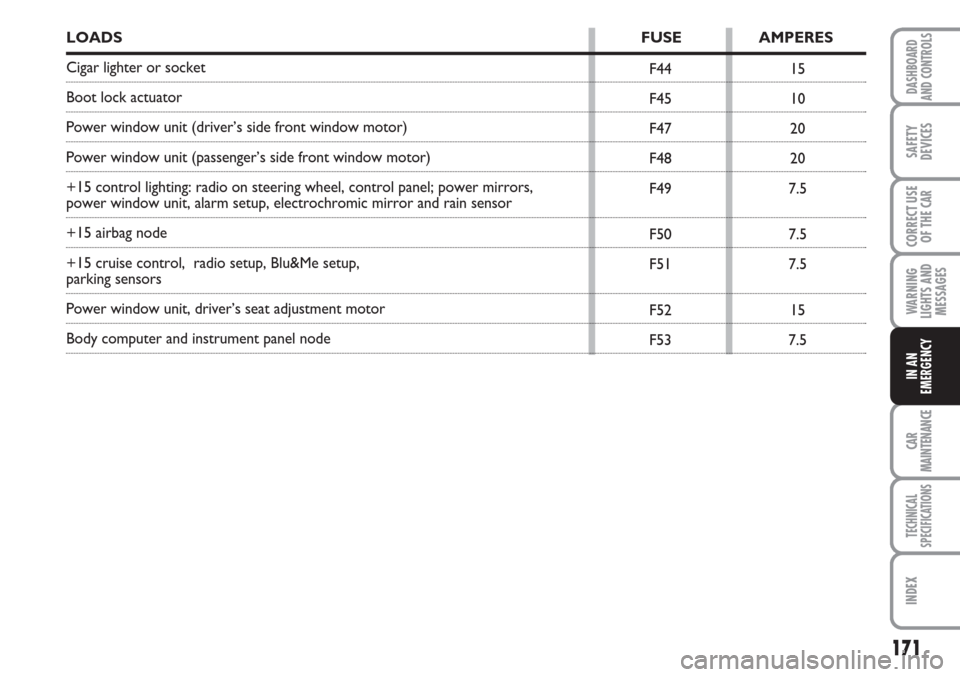
LOADS FUSE AMPERES
Cigar lighter or socket
Boot lock actuator
Power window unit (driver’s side front window motor)
Power window unit (passenger’s side front window motor)
+15 control lighting: radio on steering wheel, control panel; power mirrors,
power window unit, alarm setup, electrochromic mirror and rain sensor
+15 airbag node
+15 cruise control, radio setup, Blu&Me setup,
parking sensors
Power window unit, driver’s seat adjustment motor
Body computer and instrument panel node F44
F45
F47
F48
F49
F50
F51
F52
F5315
10
20
20
7.5
7.5
7.5
15
7.5
Page 177 of 230
176
WARNING
LIGHTS AND
MESSAGES
CAR
MAINTENANCE
TECHNICAL
SPECIFICATIONS
IINDEX
DASHBOARD
AND CONTROLS
SAFETY
DEVICES
CORRECT USE
OF THE
CAR
IN AN
EMERGENCY
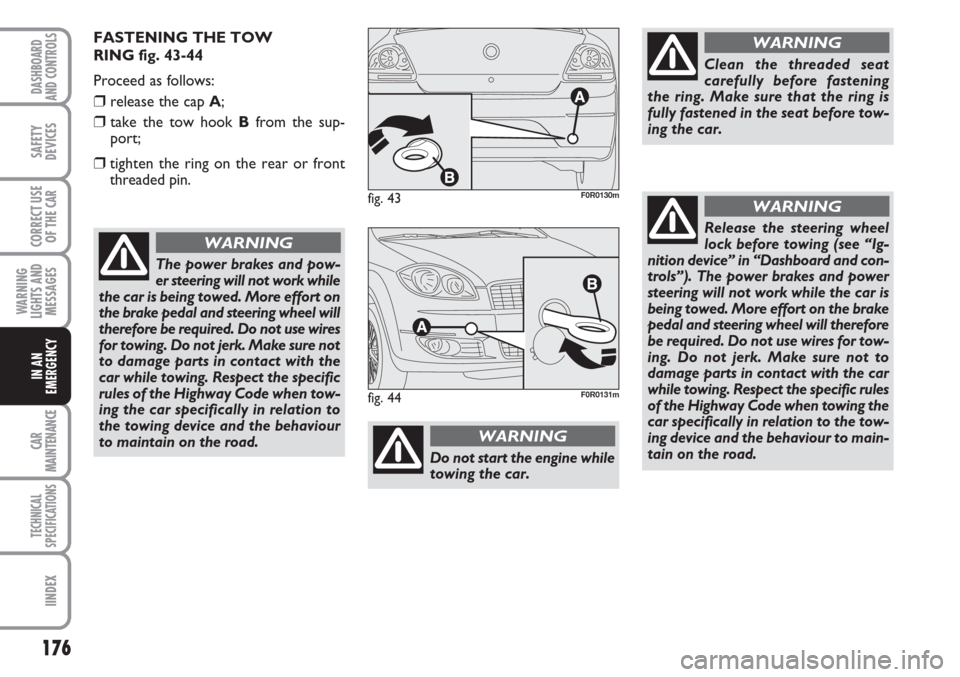
FASTENING THE TOW
RING fig. 43-44
Proceed as follows:
❒release the cap A;
❒take the tow hook Bfrom the sup-
port;
❒tighten the ring on the rear or front
threaded pin.
The power brakes and pow-
er steering will not work while
the car is being towed. More effort on
the brake pedal and steering wheel will
therefore be required. Do not use wires
for towing. Do not jerk. Make sure not
to damage parts in contact with the
car while towing. Respect the specific
rules of the Highway Code when tow-
ing the car specifically in relation to
the towing device and the behaviour
to maintain on the road.
WARNING
fig. 43F0R0130m
fig. 44F0R0131m
Do not start the engine while
towing the car.
WARNING
Clean the threaded seat
carefully before fastening
the ring. Make sure that the ring is
fully fastened in the seat before tow-
ing the car.
WARNING
Release the steering wheel
lock before towing (see “Ig-
nition device” in “Dashboard and con-
trols”). The power brakes and power
steering will not work while the car is
being towed. More effort on the brake
pedal and steering wheel will therefore
be required. Do not use wires for tow-
ing. Do not jerk. Make sure not to
damage parts in contact with the car
while towing. Respect the specific rules
of the Highway Code when towing the
car specifically in relation to the tow-
ing device and the behaviour to main-
tain on the road.
WARNING
Page 185 of 230
184
WARNING
LIGHTS AND
MESSAGES
TECHNICAL
SPECIFICATIONS
INDEX
DASHBOARD
AND CONTROLS
SAFETY
DEVICES
CORRECT USE
OF THE CAR
IN AN
EMERGENCY
CAR
MAINTENANCE
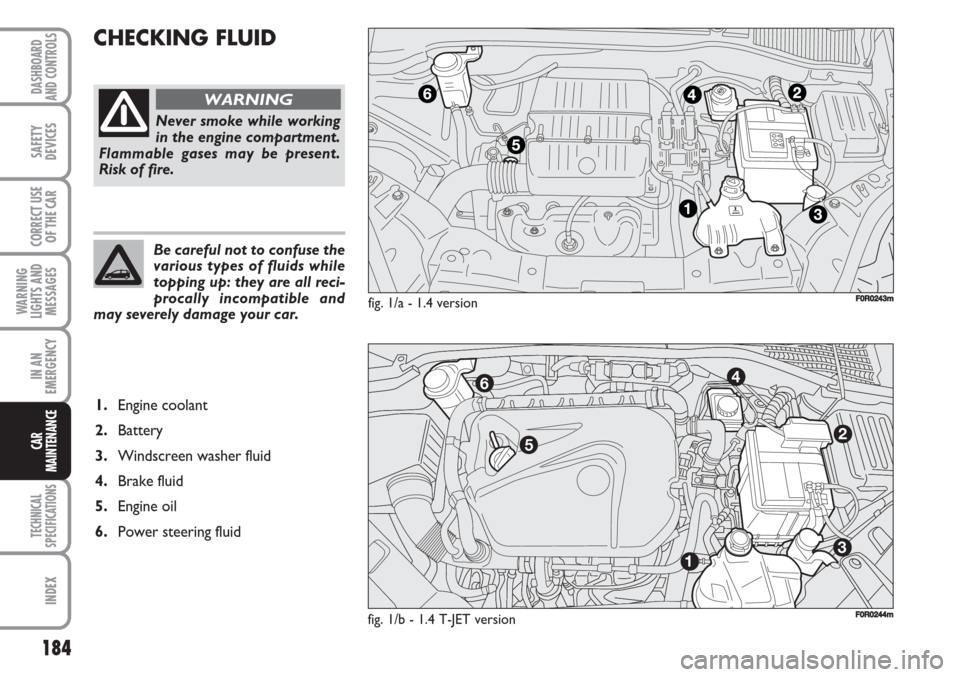
CHECKING FLUID
fig. 1/a - 1.4 version
Never smoke while working
in the engine compartment.
Flammable gases may be present.
Risk of fire.
WARNING
Be careful not to confuse the
various types of fluids while
topping up: they are all reci-
procally incompatible and
may severely damage your car.
F0R0243m
1.Engine coolant
2.Battery
3.Windscreen washer fluid
4.Brake fluid
5.Engine oil
6.Power steering fluid
fig. 1/b - 1.4 T-JET version
2
64
5
13
2
64
5
13
2
64
5
13
F0R0244m
Page 186 of 230
185
WARNING
LIGHTS AND
MESSAGES
TECHNICAL
SPECIFICATIONS
INDEX
DASHBOARD
AND CONTROLS
SAFETY
DEVICES
CORRECT USE
OF THE CAR
IN AN
EMERGENCY
CAR
MAINTENANCE
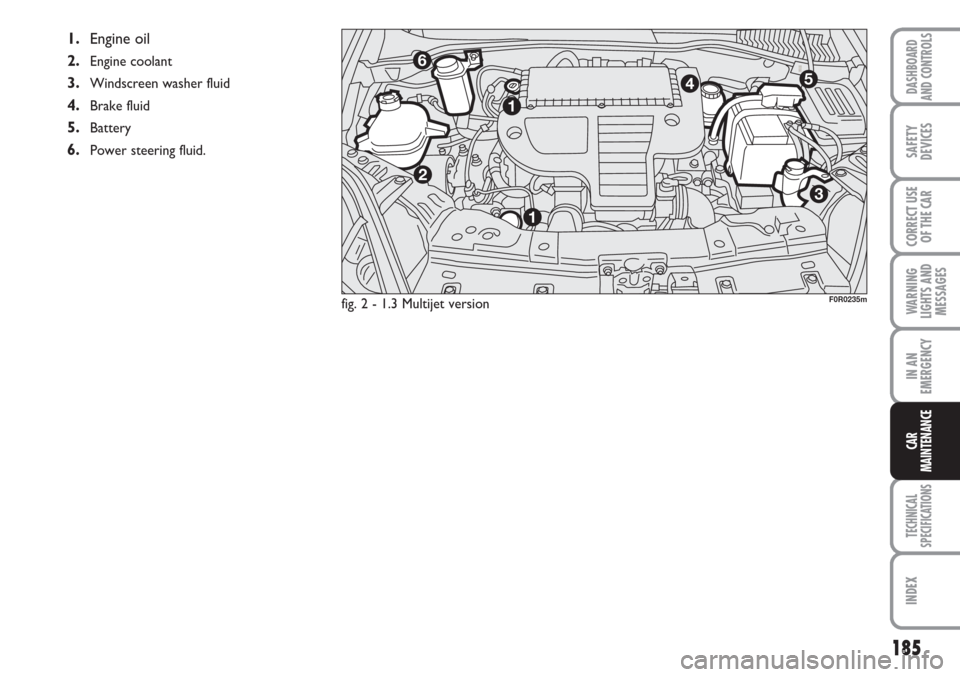
fig. 2 - 1.3 Multijet version
1
1
6
2
45
3
F0R0235m
1.Engine oil
2.
Engine coolant
3.Windscreen washer fluid
4.Brake fluid
5.Battery
6.Power steering fluid.
Page 190 of 230
189
WARNING
LIGHTS AND
MESSAGES
TECHNICAL
SPECIFICATIONS
INDEX
DASHBOARD
AND CONTROLS
SAFETY
DEVICES
CORRECT USE
OF THE CAR
IN AN
EMERGENCY
CAR
MAINTENANCEOil consumption is extremely
low; if another top-up should
be required after only a short
period of time, have the system checked
for leakage at a Fiat Dealership.
BATTERY
The car fits a low-maintenance battery: no
top-ups with distilled water are needed in
normal conditions of use.
CHECKING THE CHARGE fig. 9
Use the gauge A (where provided) on the
battery lid positioned as shown in fig. 9and
take action according to the colour it as-
sumes.
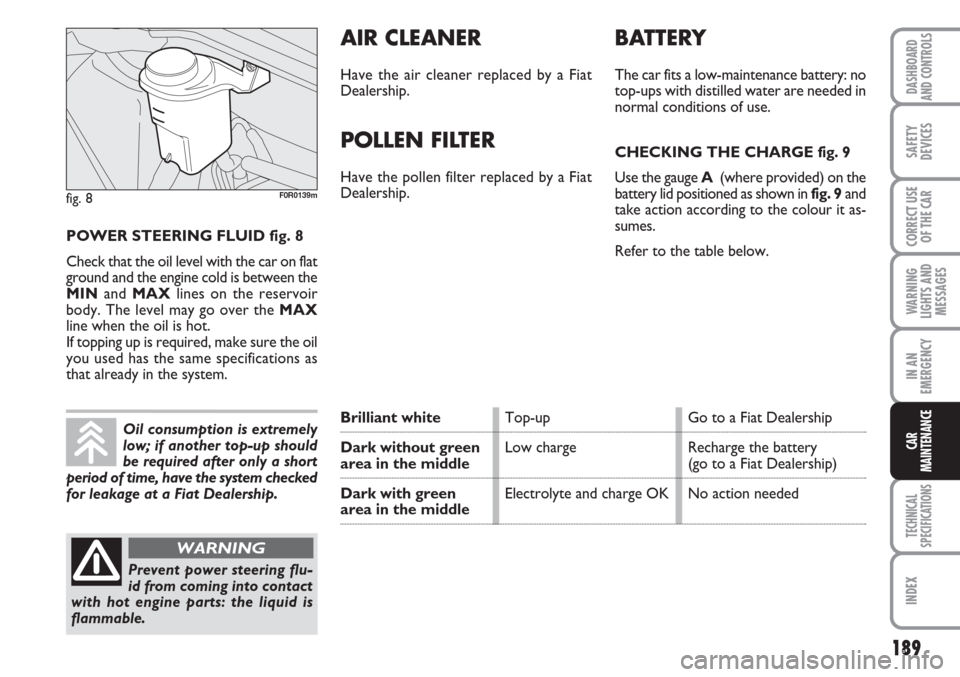
Refer to the table below. POWER STEERING FLUID fig. 8
Check that the oil level with the car on flat
ground and the engine cold is between the
MINand MAXlines on the reservoir
body. The level may go over the MAX
line when the oil is hot.
If topping up is required, make sure the oil
you used has the same specifications as
that already in the system.
AIR CLEANER
Have the air cleaner replaced by a Fiat
Dealership.
POLLEN FILTER
Have the pollen filter replaced by a Fiat
Dealership.
Prevent power steering flu-
id from coming into contact
with hot engine parts: the liquid is
flammable.
WARNING
fig. 8F0R0139m
Brilliant whiteTop-up Go to a Fiat Dealership
Dark without greenLow charge Recharge the battery
area in the middle(go to a Fiat Dealership)
Dark with green Electrolyte and charge OK No action needed
area in the middle
Page 206 of 230
205
WARNING
LIGHTS AND
MESSAGES
INDEX
DASHBOARD
AND CONTROLS
SAFETY
DEVICES
CORRECT USE
OF THE
CAR
IN AN
EMERGENCY
CAR
MAINTENANCE
TECHNICAL
SPECIFICATIONS
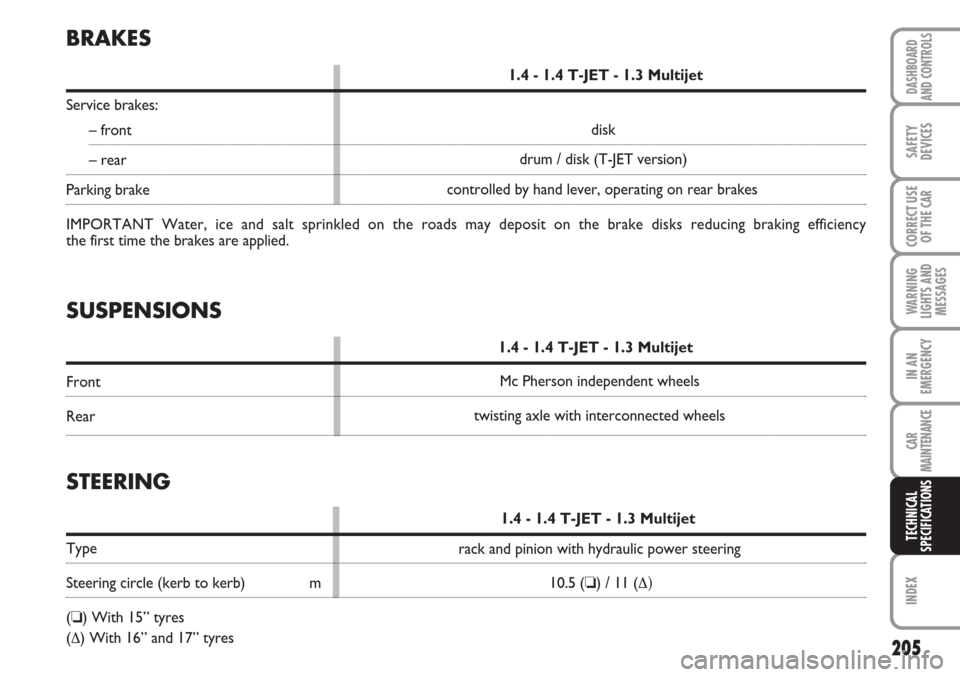
SUSPENSIONS
1.4 - 1.4 T-JET - 1.3 Multijet
Front
Rear
BRAKES
1.4 - 1.4 T-JET - 1.3 Multijet
Service brakes:
– front
– rear
Parking brake
IMPORTANT Water, ice and salt sprinkled on the roads may deposit on the brake disks reducing braking efficiency
the first time the brakes are applied.
Mc Pherson independent wheels
twisting axle with interconnected wheels controlled by hand lever, operating on rear brakesdrum / disk (T-JET version) disk
STEERING
1.4 - 1.4 T-JET - 1.3 Multijet
Type
Steering circle (kerb to kerb) m 10.5 (❏) / 11 (6)
(❏) With 15” tyres
(6) With 16” and 17” tyresrack and pinion with hydraulic power steering