ABS FIAT LINEA 2008 1.G User Guide
[x] Cancel search | Manufacturer: FIAT, Model Year: 2008, Model line: LINEA, Model: FIAT LINEA 2008 1.GPages: 234, PDF Size: 3.41 MB
Page 110 of 234
109
CORRECT USE
OF THE
CAR
WARNING
LIGHTS AND
MESSAGES
IN AN
EMERGENCY
CAR
MAINTENANCE
TECHNICAL
SPECIFICATIONS
INDEX
DASHBOARD
AND CONTROLS
SAFETY
DEVICES
HOW TO KEEP THE SEAT
BELTS ALWAYS IN EFFICIENT
CONDITIONS
Observe the following:
❒always use the belt with the tap taut and
never twisted; make sure that it is free
to run without impediments;
❒replace the belt after an accident of a
certain severity even if it does not ap-
pear damaged. Always replace the belt
if the pretensioners where deployed.
❒to clean the belt, wash by hand with wa-
ter and mild soap, rinse and leave to dry
in the shade. Do not use strong deter-
gents, bleach, paints or any other sub-
stance which could damage the belt fi-
bres;
❒keep the reels dry: correct operation
may only be ensured if the reels are dry;
❒replace the seat belt when showing sig-
nificant wear or cut signs.For optimal protection in the event of a
crash, all passengers must be seated and
wearing adequate restraint systems.
This is even more important for children.
This prescription is compulsory in all EC
countries according to EC Directive
2003/20/EC.
A child’s head is larger and heavier in pro-
portion to its body and the child’s muscu-
lar and bone structures are not fully de-
veloped. For this reason, they require re-
straint systems which are different from
those used by adults to protect them in the
event of an accident. The research results
in relation to the best protection for chil-
dren is illustrated in European Regulation
EEC-R44 which divides the restraint sys-
tems into five groups in addition to mak-
ing their use compulsory:Group 0 0-10 kg in weight
Group 0+ 0-13 kg in weight
Group 1 9-18 kg in weight
Group 2 15-25 kg in weight
Group 3 22-36 kg in weight
As it may be noted, the groups overlap
partly and in fact, in commerce it is pos-
sible to find devices that cover more than
one weight group.
All restraint devices must bear the certi-
fication data, together with the control
brand, on a solidly fixed label which must
absolutely never be removed.
CARRYING CHILDREN SAFELY
103-120 LINEA 1ed GB 3-09-2008 17:30 Pagina 109
Page 118 of 234
117
CORRECT USE
OF THE
CAR
WARNING
LIGHTS AND
MESSAGES
IN AN
EMERGENCY
CAR
MAINTENANCE
TECHNICAL
SPECIFICATIONS
INDEX
DASHBOARD
AND CONTROLS
SAFETY
DEVICES
MANUAL DEACTIVATION OF
PASSENGER’S FRONT AIR BAG
AND SIDE BAG (where provided)
Should it be absolutely necessary to car-
ry a child on the front seat, the passenger’s
front air bag and the Side Bag (where pro-
vided) can be deactivated.
The instrument panel warning light
Fwill stay on glowing steadily until reacti-
vating the passenger’s front air bag and the
Side Bag (where provided).
SEVERE DANGER: Do not
arranged cradle child re-
straints facing backwards if
the passenger’s airbag is on.
Deployment of the airbag in
an accident could cause fa-
tal injuries to the baby. Always deac-
tivate the passenger’s airbag when
placing a child seat on the front seat.
Move the passenger’s seat as far back
as possible to avoid contact between
the cradle and the dashboard. Al-
though this is not mandatory by law,
the airbag should be immediately re-
activated when children are no longer
carried to ensure better protection to
adults.
WARNING
To deactivate the passen-
ger’s front air bag and the
Side Bag (where provided), refer to
paragraphs “Digital display” and
“Multifunctional display” in section
“Dashboard and controls”.
WARNING
103-120 LINEA 1ed GB 3-09-2008 17:30 Pagina 117
Page 125 of 234
124
WARNING
LIGHTS AND
MESSAGES
IN AN
EMERGENCY
CAR
MAINTENANCE
TECHNICAL
SPECIFICATIONS
INDEX
DASHBOARD
AND CONTROLS
SAFETY
DEVICES
CORRECT USE
OF THE CAR
STOPPING THE ENGINE
Turn the ignition to STOPwhile the en-
gine is idling.
IMPORTANT After a taxing drive, you
should allow the engine to “catch its
breath” before turning it off by letting it
idle to allow the temperature in the en-
gine compartment to fall.
A quick burst on the acceler-
ator before turning off the en-
gine serves absolutely no
practical purpose, it wastes
fuel and is damaging especially to tur-
bocharged engines.HOW TO WARM UP THE
ENGINE AFTER IT HAS JUST
STARTED
(petrol and diesel engines)
Proceed as follows:
❒drive off slowly, letting the engine turn
at medium revs. Do not accelerate
abruptly;
❒do not demand to performance for the
first few kilometres. Wait until the en-
gine coolant gauge starts moving.
Remember that the brake
booster and power steering
are not operational until the
engine has been started,
therefore much effort than usual is re-
quired on the brake pedal and steering
wheel.
Never jump start the engine
by pushing, towing or driving
downhill. This could cause a
flow of fuel into the catalyt-
ic converter and damage it beyond re-
pair.
121-132 LINEA 1ed GB 3-09-2008 17:30 Pagina 124
Page 130 of 234
129
WARNING
LIGHTS AND
MESSAGES
IN AN
EMERGENCY
CAR
MAINTENANCE
TECHNICAL
SPECIFICATIONS
INDEX
DASHBOARD
AND CONTROLS
SAFETY
DEVICES
CORRECT USE
OF THE CAR
INSTALLING THE TOW
HOOK
The towing device should be fastened to
the body by specialised personnel accord-
ing to any additional and/or integrative in-
formation supplied by the Manufacturer of
the device.
The towing device must meet current reg-
ulations with reference to 94/20/EEC
Directive and subsequent amendments.
For any version the towing device used
must match the towable weight of the car
on which it is to be installed.
For the electric connection a unified con-
nector should be used which is generally
placed on a special bracket normally fas-
tened to the towing device, and a special
ECU for external trailer light control shall
be installed on the car.
For the electrical connection, 7 or 13 pin
12VDC connection is to be used (CU-
NA/UNI and ISO/DIN Standards). Follow
the instructions provided by the car man-
ufacturer and/or the tow hitch manufac-
turer.An electric brake should be supplied di-
rectly by the battery through a cable with
a cross section of no less than 2.5 mm
2.
IMPORTANT Electric brake or other de-
vice shall be used with running engine.
In addition to the electrical branches, the
car’s electric system can only be con-
nected to the supply cable for an electric
brake and to the cable for an internal light,
though not above 15W.
For connections use the preset control
unit with battery cable no less than 2.5
mm
2. Respect the speed limits specific for each
country for vehicles towing trailers. In all
cases, the top speed must not exceed 100
km/h.
Fit a suitable towing stabilizer to the trail-
er to be towed.
The ABS with which the car
may be equipped will not
control the braking system of the
trailer. Particular caution is required
on slippery roads.
WARNING
Never modify the braking
system of the car to control
the trailer brake. The trailer braking
system must be fully independent
from the hydraulic system of the car.
WARNING
121-132 LINEA 1ed GB 3-09-2008 17:30 Pagina 129
Page 134 of 234
133
IN AN
EMERGENCY
CAR
MAINTENANCE
TECHNICAL
SPECIFICATIONS
INDEX
DASHBOARD
AND CONTROLS
SAFETY
DEVICES
CORRECT USE
OF THE
CAR
WARNING
LIGHTS AND
MESSAGES
GENERAL WARNINGS ..................................................... 134
LOW BRAKE FLUID............................................................ 134
HANDBRAKE ON................................................................ 134
AIR BAG FAILURE................................................................ 135
HOT
ENGINE COOLANT........................................................... 135
LOW BATTERY CHARGE................................................. 136
LOW ENGINE OIL PRESSURE.......................................... 136
INCOMPLETE DOOR LOCKING.................................... 137
SEAT BELTS NOT FASTENED.......................................... 137
EBD SYSTEM FAILURE........................................................ 137
INJECTION SYSTEM FAILURE
(DIESEL VERSIONS) ............................................................ 138
EOBD SYSTEM FAILURE (PETROL VERSIONS) .........138
FRONT PASSENGER AIRBAG DEACTIVATED........... 139
ABS SYSTEM FAILURE......................................................... 139
FUEL RESERVE....................................................................... 139
GLOW PLUG WARMING ................................................ 140
GLOW PLUG WARMING FAILURE............................... 140
WATER IN DIESEL FUEL FILTER..................................... 140FIAT CODE PROTECTION
SYSTEM FAILURE.................................................................. 140
EXTERNAL LIGHTS FAILURE........................................... 141
REAR FOG LIGHTS.............................................................. 141
GENERIC FAILURE INDICATION ................................. 141
ESP SYSTEM FAILURE ........................................................ 142
BRAKE PAD WEAR ............................................................ 142
PARKING SENSOR FAILURE............................................ 143
SIDELIGHTS AND LOW BEAMS..................................... 143
FOLLOW ME HOME........................................................... 143
FRONT FOG LIGHTS ........................................................ 143
LEFT-HAND DIRECTION INDICATOR........................ 143
RIGHT-HAND DIRECTION INDICATOR.................... 143
CRUISE CONTROL ............................................................ 143
MAIN BEAM HEADLIGHTS............................................... 143
POSSIBLE PRESENCE OF ICE ON THE ROAD ........... 144
LIMITED RANGE ................................................................. 144
ASR SYSTEM ......................................................................... 144
WW W
A A
R R
N N
I I
N N
G G
L L
I I
G G
H H
T T
S S
A A
N N
D D
M M
E E
S S
S S
A A
G G
E E
S S
133-144 LINEA 1ed GB 3-09-2008 17:31 Pagina 133
Page 140 of 234
139
IN AN
EMERGENCY
CAR
MAINTENANCE
TECHNICAL
SPECIFICATIONS
INDEX
DASHBOARD
AND CONTROLS
SAFETY
DEVICES
CORRECT USE
OF THE
CAR
WARNING
LIGHTS AND
MESSAGES
K
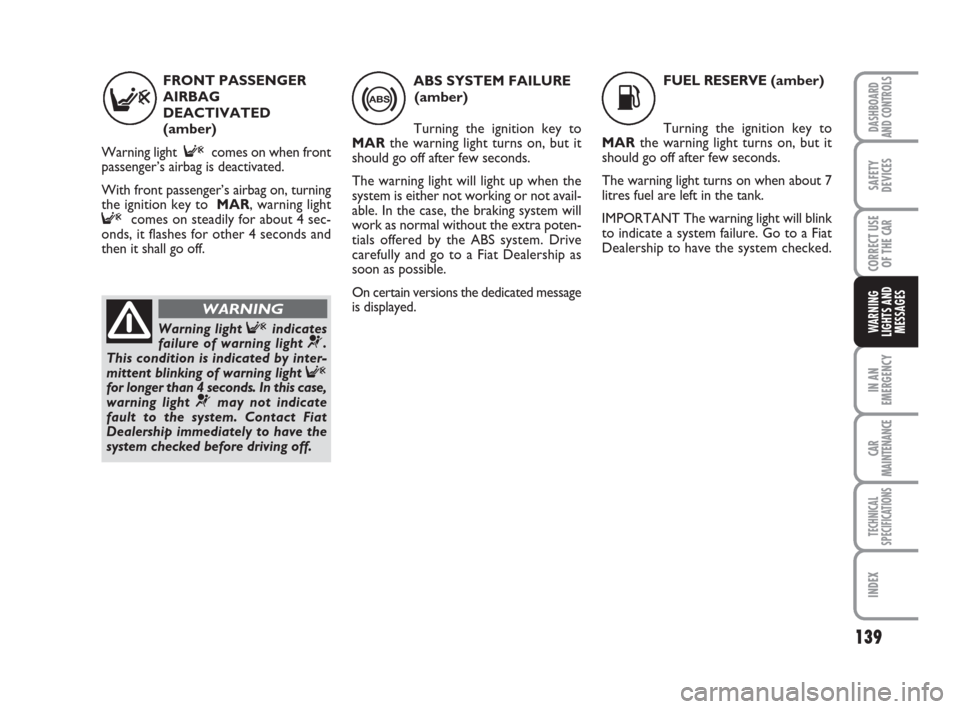
FUEL RESERVE(amber)
Turning the ignition key to
MARthe warning light turns on, but it
should go off after few seconds.
The warning light turns on when about 7
litres fuel are left in the tank.
IMPORTANT The warning light will blink
to indicate a system failure. Go to a Fiat
Dealership to have the system checked. ABS SYSTEM FAILURE
(amber)
Turning the ignition key to
MARthe warning light turns on, but it
should go off after few seconds.
The warning light will light up when the
system is either not working or not avail-
able. In the case, the braking system will
work as normal without the extra poten-
tials offered by the ABS system. Drive
carefully and go to a Fiat Dealership as
soon as possible.
On certain versions the dedicated message
is displayed.
>F
FRONT PASSENGER
AIRBAG
DEACTIVATED
(amber)
Warning light
Fcomes on when front
passenger’s airbag is deactivated.
With front passenger’s airbag on, turning
the ignition key to MAR, warning light
Fcomes on steadily for about 4 sec-
onds, it flashes for other 4 seconds and
then it shall go off.
Warning light
Findicates
failure of warning light ¬.
This condition is indicated by inter-
mittent blinking of warning light
Ffor longer than 4 seconds. In this case,
warning light ¬may not indicate
fault to the system. Contact Fiat
Dealership immediately to have the
system checked before driving off.
WARNING
133-144 LINEA 1ed GB 3-09-2008 17:31 Pagina 139
Page 161 of 234
160
WARNING
LIGHTS AND
MESSAGES
CAR
MAINTENANCE
TECHNICAL
SPECIFICATIONS
IINDEX
DASHBOARD
AND CONTROLS
SAFETY
DEVICES
CORRECT USE
OF THE
CAR
IN AN
EMERGENCY
IF AN EXTERIOR LIGHT
BURNS OUT
For the type of bulb and power rating, see
“When needing to change a bulb”.
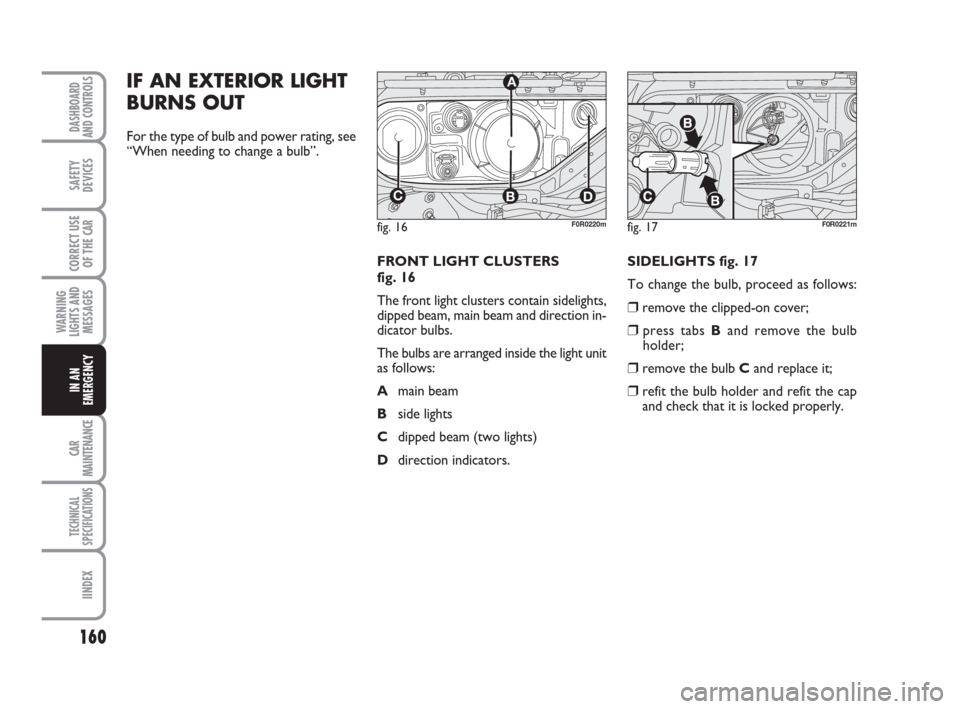
FRONT LIGHT CLUSTERS
fig. 16
The front light clusters contain sidelights,
dipped beam, main beam and direction in-
dicator bulbs.
The bulbs are arranged inside the light unit
as follows:
Amain beam
Bside lights
Cdipped beam (two lights)
Ddirection indicators. SIDELIGHTS fig. 17
To change the bulb, proceed as follows:
❒remove the clipped-on cover;
❒press tabs Band remove the bulb
holder;
❒remove the bulb Cand replace it;
❒refit the bulb holder and refit the cap
and check that it is locked properly.
fig. 16
CBD
A
F0R0220mfig. 17F0R0221m
145-176 LINEA 1ed GB 5-09-2008 9:22 Pagina 160
Page 189 of 234
188
WARNING
LIGHTS AND
MESSAGES
TECHNICAL
SPECIFICATIONS
INDEX
DASHBOARD
AND CONTROLS
SAFETY
DEVICES
CORRECT USE
OF THE CAR
IN AN
EMERGENCY
CAR
MAINTENANCE
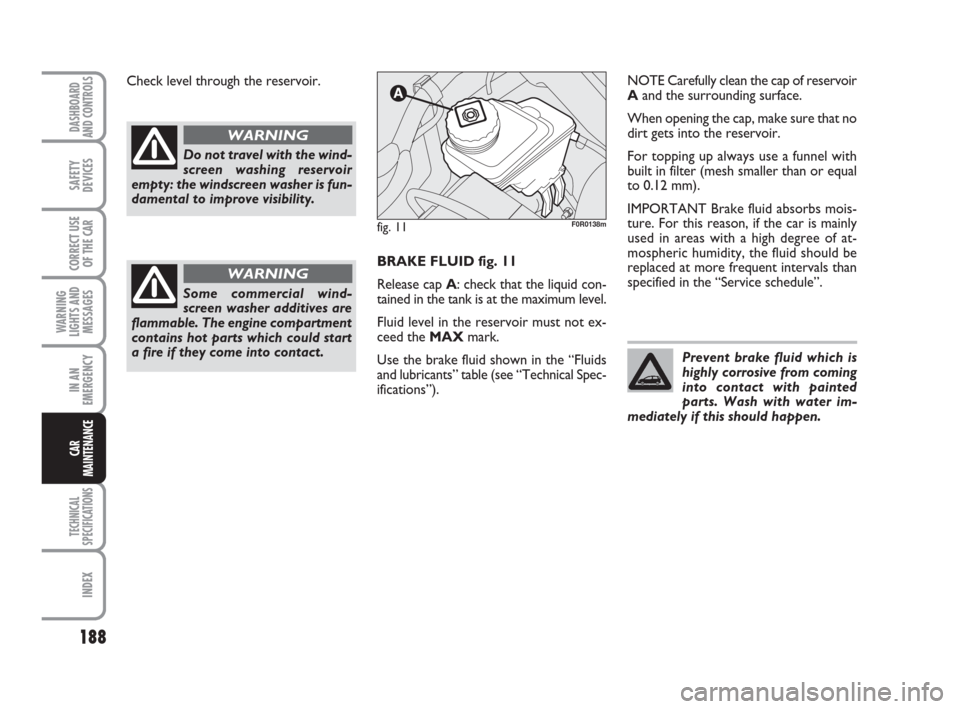
NOTE Carefully clean the cap of reservoir
Aand the surrounding surface.
When opening the cap, make sure that no
dirt gets into the reservoir.
For topping up always use a funnel with
built in filter (mesh smaller than or equal
to 0.12 mm).
IMPORTANT Brake fluid absorbs mois-
ture. For this reason, if the car is mainly
used in areas with a high degree of at-
mospheric humidity, the fluid should be
replaced at more frequent intervals than
specified in the “Service schedule”. Check level through the reservoir.
fig. 11F0R0138m
Do not travel with the wind-
screen washing reservoir
empty: the windscreen washer is fun-
damental to improve visibility.
WARNING
Some commercial wind-
screen washer additives are
flammable. The engine compartment
contains hot parts which could start
a fire if they come into contact.
WARNING
Prevent brake fluid which is
highly corrosive from coming
into contact with painted
parts. Wash with water im-
mediately if this should happen.
BRAKE FLUID fig. 11
Release cap A: check that the liquid con-
tained in the tank is at the maximum level.
Fluid level in the reservoir must not ex-
ceed the MAXmark.
Use the brake fluid shown in the “Fluids
and lubricants” table (see “Technical Spec-
ifications”).
177-200 LINEA 1ed GB 3-09-2008 17:31 Pagina 188
Page 193 of 234
192
WARNING
LIGHTS AND
MESSAGES
TECHNICAL
SPECIFICATIONS
INDEX
DASHBOARD
AND CONTROLS
SAFETY
DEVICES
CORRECT USE
OF THE CAR
IN AN
EMERGENCY
CAR
MAINTENANCE
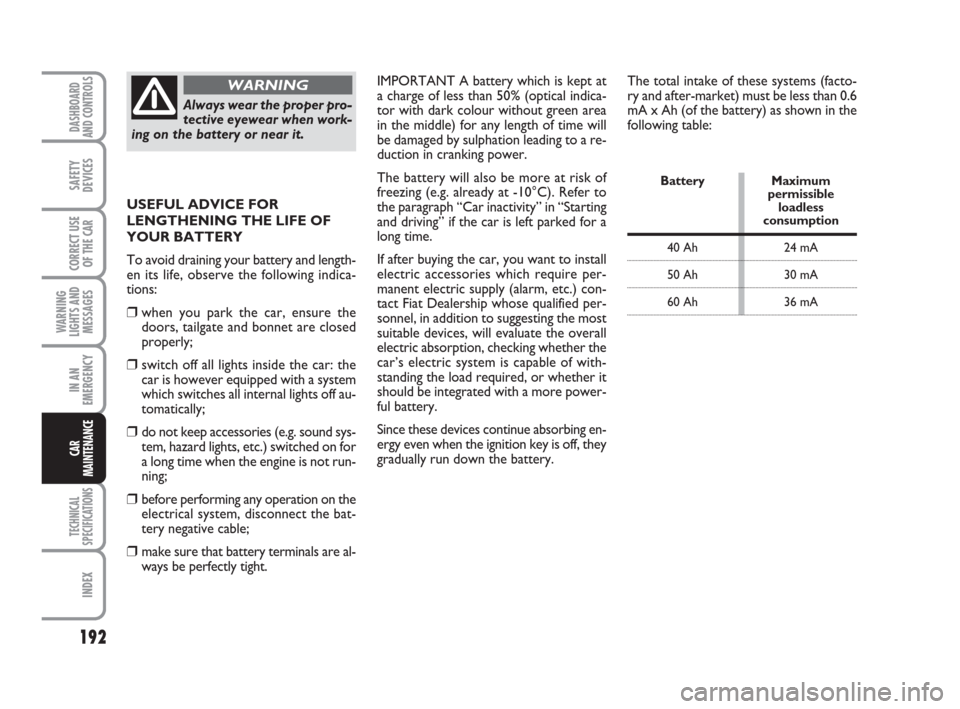
The total intake of these systems (facto-
ry and after-market) must be less than 0.6
mA x Ah (of the battery) as shown in the
following table:
Battery Maximum
permissible
loadless
consumption
40 Ah 24 mA
50 Ah 30 mA
60 Ah 36 mA
IMPORTANT A battery which is kept at
a charge of less than 50% (optical indica-
tor with dark colour without green area
in the middle) for any length of time will
be damaged by sulphation leading to a re-
duction in cranking power.
The battery will also be more at risk of
freezing (e.g. already at -10°C). Refer to
the paragraph “Car inactivity” in “Starting
and driving” if the car is left parked for a
long time.
If after buying the car, you want to install
electric accessories which require per-
manent electric supply (alarm, etc.) con-
tact Fiat Dealership whose qualified per-
sonnel, in addition to suggesting the most
suitable devices, will evaluate the overall
electric absorption, checking whether the
car’s electric system is capable of with-
standing the load required, or whether it
should be integrated with a more power-
ful battery.
Since these devices continue absorbing en-
ergy even when the ignition key is off, they
gradually run down the battery. USEFUL ADVICE FOR
LENGTHENING THE LIFE OF
YOUR BATTERY
To avoid draining your battery and length-
en its life, observe the following indica-
tions:
❒when you park the car, ensure the
doors, tailgate and bonnet are closed
properly;
❒switch off all lights inside the car: the
car is however equipped with a system
which switches all internal lights off au-
tomatically;
❒do not keep accessories (e.g. sound sys-
tem, hazard lights, etc.) switched on for
a long time when the engine is not run-
ning;
❒before performing any operation on the
electrical system, disconnect the bat-
tery negative cable;
❒make sure that battery terminals are al-
ways be perfectly tight.
Always wear the proper pro-
tective eyewear when work-
ing on the battery or near it.
WARNING
177-200 LINEA 1ed GB 3-09-2008 17:31 Pagina 192
Page 196 of 234
195
WARNING
LIGHTS AND
MESSAGES
TECHNICAL
SPECIFICATIONS
INDEX
DASHBOARD
AND CONTROLS
SAFETY
DEVICES
CORRECT USE
OF THE CAR
IN AN
EMERGENCY
CAR
MAINTENANCE
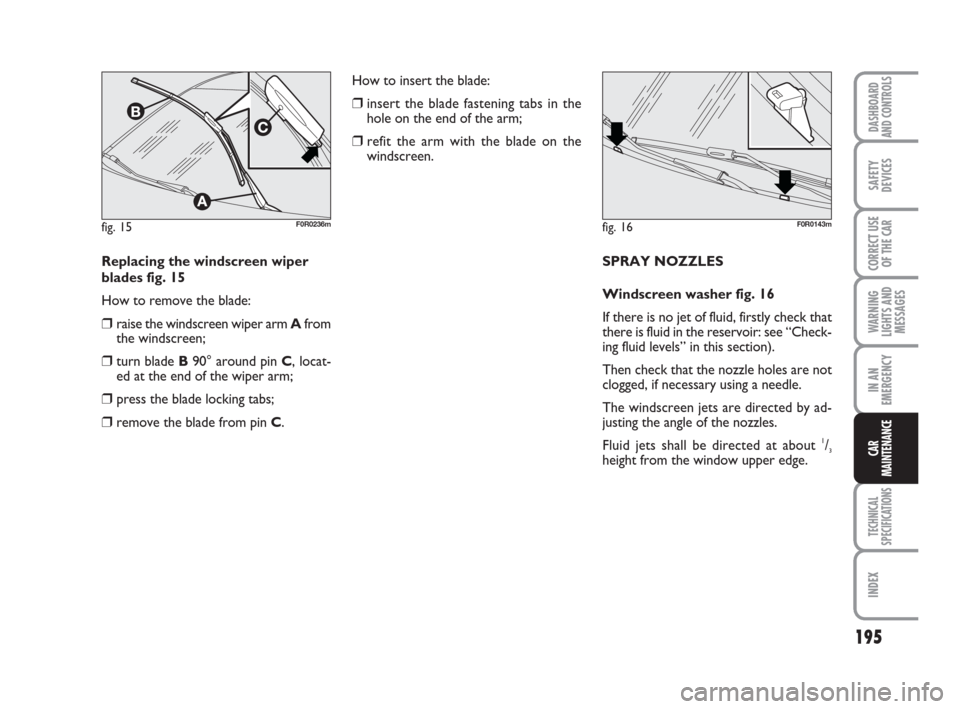
Replacing the windscreen wiper
blades fig. 15
How to remove the blade:
❒raise the windscreen wiper arm Afrom
the windscreen;
❒turn blade B90° around pin C, locat-
ed at the end of the wiper arm;
❒press the blade locking tabs;
❒remove the blade from pin C.
fig. 15F0R0236m
SPRAY NOZZLES
Windscreen washer fig. 16
If there is no jet of fluid, firstly check that
there is fluid in the reservoir: see “Check-
ing fluid levels” in this section).
Then check that the nozzle holes are not
clogged, if necessary using a needle.
The windscreen jets are directed by ad-
justing the angle of the nozzles.
Fluid jets shall be directed at about
1/3height from the window upper edge.
fig. 16F0R0143m
How to insert the blade:
❒insert the blade fastening tabs in the
hole on the end of the arm;
❒refit the arm with the blade on the
windscreen.
177-200 LINEA 1ed GB 3-09-2008 17:31 Pagina 195