climate control FIAT LINEA 2008 1.G User Guide
[x] Cancel search | Manufacturer: FIAT, Model Year: 2008, Model line: LINEA, Model: FIAT LINEA 2008 1.GPages: 234, PDF Size: 3.41 MB
Page 62 of 234
61
SAFETY
DEVICES
CORRECT USE
OF THE
CAR
WARNING
LIGHTS AND
MESSAGES
IN AN
EMERGENCY
CAR
MAINTENANCE
TECHNICAL
SPECIFICATIONS
INDEX
DASHBOARD
AND CONTROLS
USING THE CLIMATE
CONTROL SYSTEM
The system can be started in different
ways, but it is advisable to start by press-
ing the AUTObutton and then turning
the knobs to set the temperature required
on the display.
The system will start running automatically
in this way and the set comfortable tem-
perature will be reached as quickly as pos-
sible. The system will adjust the temper-
ature, the quantity and the distribution of
the air introduced into the passenger com-
partment and will manage the recircula-
tion function and the compressor.
Manual intervention is only required for
the following functions during fully auto-
matic operation.
❒Tair recirculation, to keep the
function always either on or off;
❒Zto speed up demisting/defrosting of
windscreen, rear window and exter-
nal rearview mirrors;During completely automatic system op-
eration, you can vary the set temperature,
the air distribution and the fan speed us-
ing the corresponding buttons or knobs
at any time: the system will automatically
change settings to adapt to the new re-
quest.
During fully automatic operation (FULL
AUTO), the word FULLwill disappear
if the air distribution, air speed, compres-
sor and/or recirculation settings are
changed. In this way, the functions will
switch from automatic to manual control
until AUTOis pressed again. With on or
more manually set functions, the intro-
duced air temperature is still managed au-
tomatically by the system, except for when
the compressor is off: in the case, the air
introduced into the passenger compart-
ment cannot be cooler than the outside
air.Air temperature adjustment
knob (I)
Turn the knob either clockwise or anti-
clockwise to increase or lower the re-
quested temperature in the passenger
compartment. The set temperature is
shown on the display.
Turn the knob either all to the right or
all to the left to the extreme HIor LO
position to use the maximum heating or
maximum cooling functions:
❒HI function (maximum heating):
select by turning the temperature knob
clockwise over the maximum value
(32 °C).
This function may be used to heat up the
passenger compartment exploiting the
system potential to the maximum. In this
condition, the system stop controlling
temperature automatically and sets air
mixing to maximum heating. The air speed
and distribution are fixed.
Specifically, if the heating fluid is not suffi-
ciently warm, the fan will not start up at
the maximum speed immediately to limit
introducing excessively cool air into the
passenger compartment.
All manual settings will be allowed when
this function is on.
044-090 LINEA 1ed GB 3-09-2008 17:29 Pagina 61
Page 64 of 234
63
SAFETY
DEVICES
CORRECT USE
OF THE
CAR
WARNING
LIGHTS AND
MESSAGES
IN AN
EMERGENCY
CAR
MAINTENANCE
TECHNICAL
SPECIFICATIONS
INDEX
DASHBOARD
AND CONTROLS
Fan speed adjusting buttons (H)
Press button Hto increase or to decrease
the fan speed and therefore the amount
of air admitted into the passenger com-
partment, although keeping the required
temperature set.
The fan speed is shown by the lit bars on
the display:
❒max fan speed = all bars lit;
❒min fan speed = one bar lit.
The fan can be cut off only if the climate
control compressor has been switched
off pressing button F-fig. 40.
IMPORTANT To restore automatic fan
speed control after a manual adjustment,
press button AUTO.
IMPORTANT At high speeds, the dynamic
effect may increase the flow of air into the
passenger compartment which in this case
will not directly correspond to the fan
speed bar display.AUTO (A) (automatic operation)
Press AUTO to make the system auto-
matically adjust the quantity and distribu-
tion of the air introduced into the pas-
senger compartment. All previous manu-
al settings will be cancelled.
The message FULL AUTOwill appear
on the front display in this condition.
By manually intervening on at least of the
functions automatically managed by the
system (air recirculation, fan speed or
compressor on/off), the word FULL will
disappear from the display indicating that
the system is no longer automatically con-
trolling all the functions (the temperature
will still be controlled automatically by the
system).
IMPORTANT Should the system (after
manual settings) be no longer able to
guarantee the required temperature set
in the passenger compartment, the set
temperature value will start flashing to in-
dicate this condition, after one minute the
AUTOmessage will turn off.
To restore system automatic control at
any time, after one or more manual ad-
justments, press button AUTO.Air recirculation on/off button (G)
Air recirculation works according to the
following operating logics:
❒override on (inside air recirculation
always on), indicated by the the LED
on button Gand symbol Ton
the display;
❒override off (air recirculation always
off and introduction of external air),
indicated by the fact that the LED on
the button is off êis on the display.
These operating conditions are obtained
by pressing Gin sequence.
IMPORTANT The inside air recircula-
tion system makes it possible to reach
the required heating or cooling condi-
tions faster.
It is however inadvisable to use it on
rainy/cold days as it would considerably
increase the possibility of the windows
misting inside, especially if the climate
control compressor is off.
Recirculation is forced off (i.e. air is
introduced from the outside) when the
the outside temperature is cold to pre-
vent misting up.
It is advisable not to use the air recircu-
lation function when the outside tem-
perature is low to prevent the windows
from rapidly misting up.
044-090 LINEA 1ed GB 3-09-2008 17:29 Pagina 63
Page 65 of 234
64
SAFETY
DEVICES
CORRECT USE
OF THE
CAR
WARNING
LIGHTS AND
MESSAGES
IN AN
EMERGENCY
CAR
MAINTENANCE
TECHNICAL
SPECIFICATIONS
INDEX
DASHBOARD
AND CONTROLS
Climate control compressor
enabling button (F)
Press √to switch the climate control
compressor off (if on). The icon on the
display will go out.
Press the button when the LED is off to
restore automatically system control
and use of the compressor. The icon
will light up on the display in this case.
The system will switch recirculation off
when the compressor is switched off to
prevent misting up. Although the system
is capable of maintaining the required tem-
perature, the word FULLwill disappear
from the display. If on the other hand the
system cannot maintain the required tem-
perature, the digits will blink and the word
AUTOwill disappear.IMPORTANT With the compressor off,
it is not possible to introduced air cooler
than ambient temperature into the pas-
senger compartment. Furthermore, in
certain conditions, the windows could
mist up rapidly because the air is not de-
humidified.The switching off of the climate
control compressor remains in storage
even when the engine has been stopped.
To restore automatic compressor control,
press √again (in this case, the system will
only work as a heater) or press AUTO.
With climate control compressor off, the
fan speed can be set to zero manually (no
bar shown).
With the compressor enabled and the en-
gine started, the fan speed may be reduced
to the minimum setting (only one bar
shown).Fast window demisting/defrosting
button (D)
Press this button: the climate control sys-
tem will automatically switch on all the
functions required for fast windscreen and
front side window demisting/defrosting,
that is:
❒switches on climate control compres-
sor when climatic conditions are suit-
able;
❒air recirculation off;
❒maximum air temperature HI on both
areas;
❒operates proper fan speed according
to engine coolant temperature to lim-
it the flow into the passenger com-
partment of air not warm enough to
demist the windows;
❒directs air flow to windscreen and
front side windows vents;
❒heated rear window on.
044-090 LINEA 1ed GB 3-09-2008 17:29 Pagina 64
Page 66 of 234
65
SAFETY
DEVICES
CORRECT USE
OF THE
CAR
WARNING
LIGHTS AND
MESSAGES
IN AN
EMERGENCY
CAR
MAINTENANCE
TECHNICAL
SPECIFICATIONS
INDEX
DASHBOARD
AND CONTROLS
IMPORTANT The quick demisting/de-
frosting function will stay on for approxi-
mately 3 minutes after the engine coolant
temperature is warm enough to ensure
rapid window demisting.
When the function is on, the LED on the
rear window demister button will light up
and the message FULL AUTOwill go
out on the display.
You may only adjust the fan speed and
switch the rear window demister off man-
ually when this function is running.
To restore running operations before this
function was activated, press either but-
ton B, air recirculation button G, com-
pressor button For button AUTO A.Switching the system off (E)
Press Eto switch the climate control sys-
tem off. The display will go out as a con-
sequence.
The following climate control conditions
will be established when the system is off:
❒display off;
❒temperature not shown;
❒air recirculation on, passenger com-
partment isolated from the outside
(recirculation LED on);
❒climate control compressor off;
❒fan off.Press AUTOto switch the automatic cli-
mate control system back on.
044-090 LINEA 1ed GB 3-09-2008 17:29 Pagina 65
Page 128 of 234
127
WARNING
LIGHTS AND
MESSAGES
IN AN
EMERGENCY
CAR
MAINTENANCE
TECHNICAL
SPECIFICATIONS
INDEX
DASHBOARD
AND CONTROLS
SAFETY
DEVICES
CORRECT USE
OF THE CAR
Roof rack/ski rack
Remove the roof rack or the ski rack from
the roof after use. These accessories de-
crease aerodynamic penetration of the car
and have a negative effect on consumption.
It is better to use a trailer to transport
particularly bulky objects.
Electric devices
Use electric devices only for the amount
of time needed. Rear heated window, ad-
ditional headlights, windscreen wipers and
heater fan need a considerable amount of
energy, therefore increasing the require-
ment of current increases fuel consump-
tion (up to +25% in the urban cycle).
Climate control
The climate control system requires high-
er fuel consumption (up to +20% in av-
erage): use the air vents when the exter-
nal temperature allows to.
Spoilers
The use of non-certified aerodynamic
items may adversely affect air drag and
consumption levels.DRIVING STYLE
Starting
Do not warm the engine up with the car
standing: the engine warms up very slow-
ly in these conditions, increasing con-
sumption and emissions. It is advisable to
start off immediately and slowly keeping
the engine speed down: the engine will
warm up much faster this way.
Unnecessary actions
Avoid revving up when starting at traffic
lights or before stopping the engine. The
latter action, like doubling the clutch, is un-
necessary and causes increase of con-
sumption and pollution.
Gear selection
Use a higher gear as soon as traffic and
road conditions allow. Using a low gear
for faster acceleration will increase con-
sumption.
In the same way improper use of a high
gear increases consumption, emissions an
engine wear.CONTAINING
RUNNING COSTS
Here are some suggestions which may
help you to keep the running costs of your
car down and lower the amount of toxic
emissions released into the atmosphere.
GENERAL CONSIDERATIONS
Car maintenance
Have checks and adjustments carried out
in accordance with the “Service schedule”.
Tyres
Check tyre pressure regularly at least
once every four weeks: excessively low
pressure will increase consumption be-
cause rolling resistance will be higher.
Unnecessary loads
Do not travel with too much luggage
stowed in the boot. The weight of the car
(especially when driving in town) and its
trim greatly affects consumption and sta-
bility.
121-132 LINEA 1ed GB 3-09-2008 17:30 Pagina 127
Page 172 of 234
171
WARNING
LIGHTS AND
MESSAGES
CAR
MAINTENANCE
TECHNICAL
SPECIFICATIONS
INDEX
DASHBOARD
AND CONTROLS
SAFETY
DEVICES
CORRECT USE
OF THE
CAR
IN AN
EMERGENCY
7.5
7.5
7.5
15
20
20
7.5
7.5
7.5
20
10
30
7.5
7.5
20 F12
F13
F31
F32
F33
F34
F35
F36
F37
F38
F39
F40
F41
F42
F43
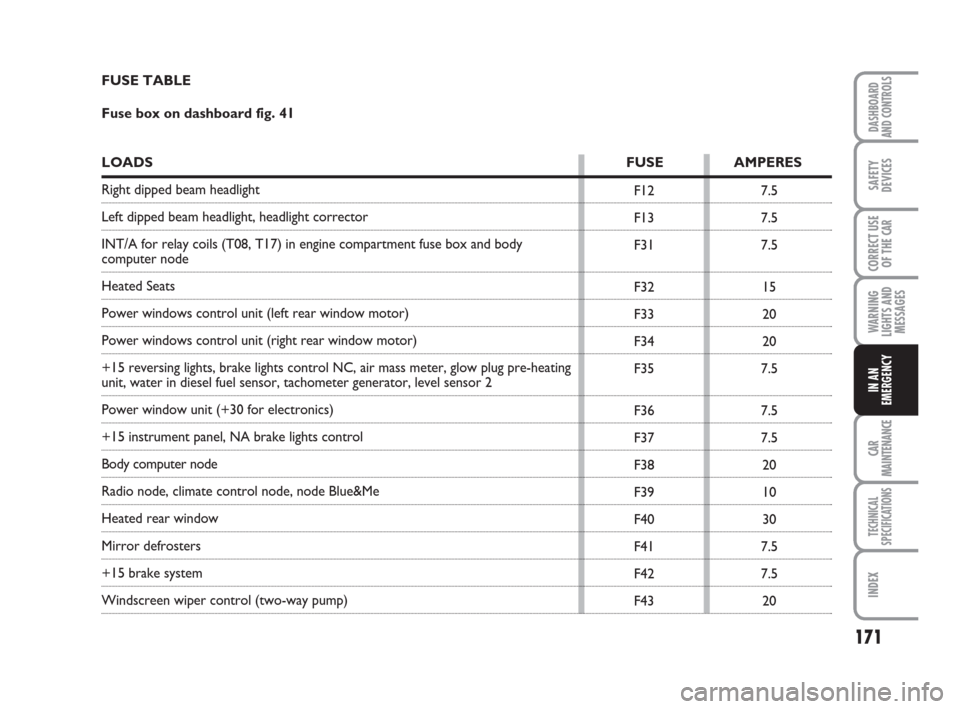
FUSE TABLE
Fuse box on dashboard fig. 41
LOADS FUSE AMPERES
Right dipped beam headlight
Left dipped beam headlight, headlight corrector
INT/A for relay coils (T08, T17) in engine compartment fuse box and body
computer node
Heated Seats
Power windows control unit (left rear window motor)
Power windows control unit (right rear window motor)
+15 reversing lights, brake lights control NC, air mass meter, glow plug pre-heating
unit, water in diesel fuel sensor, tachometer generator, level sensor 2
Power window unit (+30 for electronics)
+15 instrument panel, NA brake lights control
Body computer node
Radio node, climate control node, node Blue&Me
Heated rear window
Mirror defrosters
+15 brake system
Windscreen wiper control (two-way pump)
145-176 LINEA 1ed GB 5-09-2008 9:22 Pagina 171
Page 173 of 234
172
WARNING
LIGHTS AND
MESSAGES
CAR
MAINTENANCE
TECHNICAL
SPECIFICATIONS
IINDEX
DASHBOARD
AND CONTROLS
SAFETY
DEVICES
CORRECT USE
OF THE
CAR
IN AN
EMERGENCY
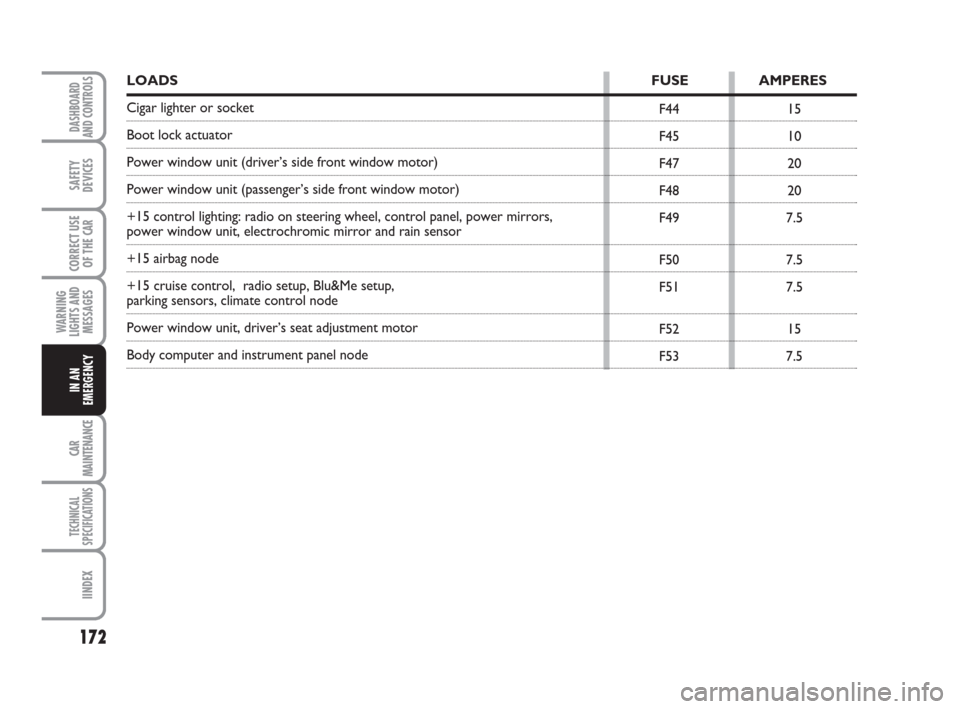
LOADS FUSE AMPERES
Cigar lighter or socket
Boot lock actuator
Power window unit (driver’s side front window motor)
Power window unit (passenger’s side front window motor)
+15 control lighting: radio on steering wheel, control panel, power mirrors,
power window unit, electrochromic mirror and rain sensor
+15 airbag node
+15 cruise control, radio setup, Blu&Me setup,
parking sensors, climate control node
Power window unit, driver’s seat adjustment motor
Body computer and instrument panel node F44
F45
F47
F48
F49
F50
F51
F52
F5315
10
20
20
7.5
7.5
7.5
15
7.5
145-176 LINEA 1ed GB 5-09-2008 9:22 Pagina 172
Page 181 of 234
180
WARNING
LIGHTS AND
MESSAGES
TECHNICAL
SPECIFICATIONS
INDEX
DASHBOARD
AND CONTROLS
SAFETY
DEVICES
CORRECT USE
OF THE CAR
IN AN
EMERGENCY
CAR
MAINTENANCE
30 60 90 120 150 180
●●●●● ●
●● ●
●●●●● ●
●●●●● ●
●●
●●●●● ●
●
●●●●● ●
●● ●
●●●●● ●
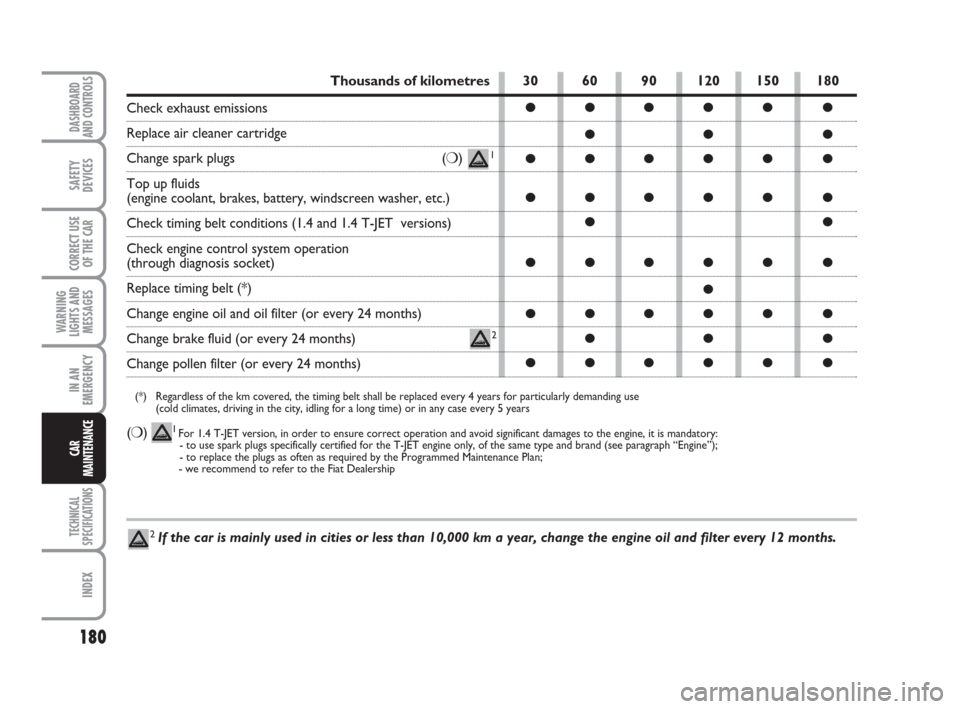
Thousands of kilometres
Check exhaust emissions
Replace air cleaner cartridge
Change spark plugs (❍) 1
Top up fluids (engine coolant, brakes, battery, windscreen washer, etc.)
Check timing belt conditions (1.4 and 1.4 T-JET versions)
Check engine control system operation
(through diagnosis socket)
Replace timing belt (*)
Change engine oil and oil filter (or every 24 months)
Change brake fluid (or every 24 months)2
Change pollen filter (or every 24 months)
(*) Regardless of the km covered, the timing belt shall be replaced every 4 years for particularly demanding use
(cold climates, driving in the city, idling for a long time) or in any case every 5 years
(❍) 1For 1.4 T-JET version, in order to ensure correct operation and avoid significant damages to the engine, it is mandatory:
- to use spark plugs specifically certified for the T-JET engine only, of the same type and brand (see paragraph “Engine”);
- to replace the plugs as often as required by the Programmed Maintenance Plan;
- we recommend to refer to the Fiat Dealership
2If the car is mainly used in cities or less than 10,000 km a year, change the engine oil and filter every 12 months.
177-200 LINEA 1ed GB 3-09-2008 17:31 Pagina 180
Page 183 of 234
182
WARNING
LIGHTS AND
MESSAGES
TECHNICAL
SPECIFICATIONS
INDEX
DASHBOARD
AND CONTROLS
SAFETY
DEVICES
CORRECT USE
OF THE CAR
IN AN
EMERGENCY
CAR
MAINTENANCE
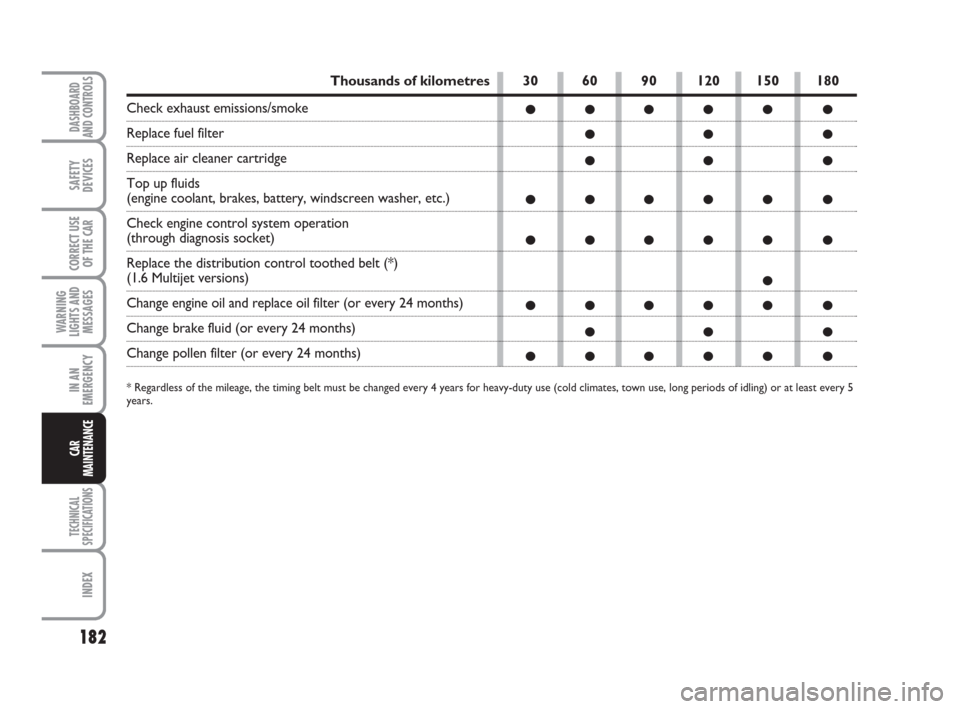
30 60 90 120 150 180
●●●●● ●
●● ●
●● ●
●●●●● ●
●●●●● ●
●
●●●●● ●
●● ●
●●●●● ●
Thousands of kilometres
Check exhaust emissions/smoke
Replace fuel filter
Replace air cleaner cartridge
Top up fluids
(engine coolant, brakes, battery, windscreen washer, etc.)
Check engine control system operation
(through diagnosis socket)
Replace the distribution control toothed belt (*)
(1.6 Multijet versions)
Change engine oil and replace oil filter (or every 24 months)
Change brake fluid (or every 24 months)
Change pollen filter (or every 24 months)
* Regardless of the mileage, the timing belt must be changed every 4 years for heavy-duty use (cold climates, town use, long periods of idling) or at least every 5
years.
177-200 LINEA 1ed GB 3-09-2008 17:31 Pagina 182
Page 188 of 234
187
WARNING
LIGHTS AND
MESSAGES
TECHNICAL
SPECIFICATIONS
INDEX
DASHBOARD
AND CONTROLS
SAFETY
DEVICES
CORRECT USE
OF THE CAR
IN AN
EMERGENCY
CAR
MAINTENANCE
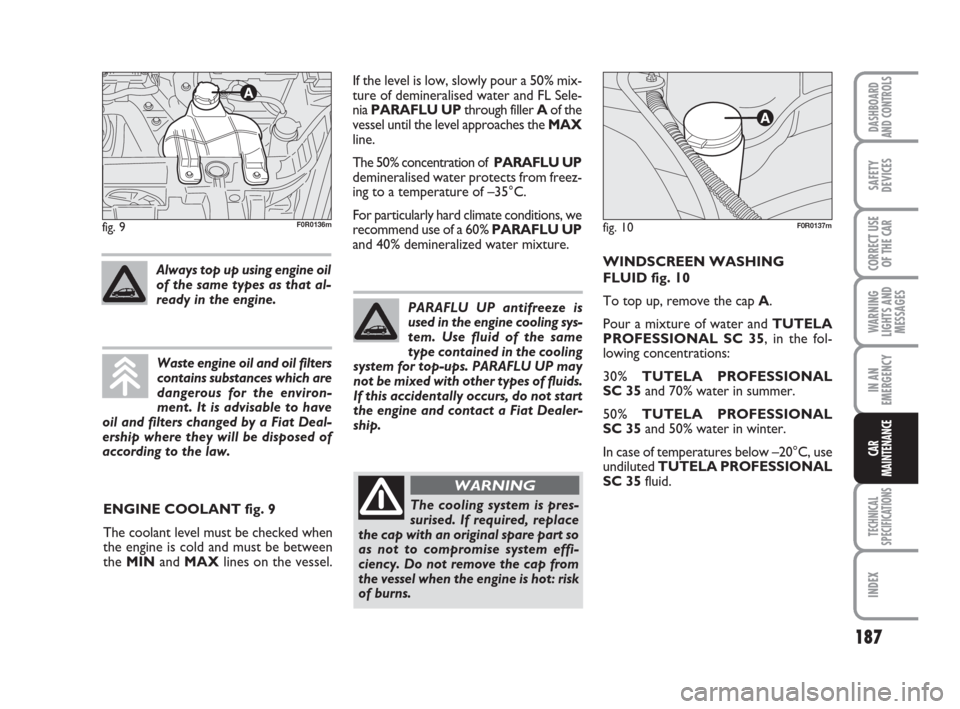
WINDSCREEN WASHING
FLUID fig. 10
To top up, remove the cap A.
Pour a mixture of water and TUTELA
PROFESSIONAL SC 35, in the fol-
lowing concentrations:
30% TUTELA PROFESSIONAL
SC 35and 70% water in summer.
50% TUTELA PROFESSIONAL
SC 35and 50% water in winter.
In case of temperatures below –20°C, use
undiluted TUTELA PROFESSIONAL
SC 35fluid.
ENGINE COOLANT fig. 9
The coolant level must be checked when
the engine is cold and must be between
the MINand MAXlines on the vessel.
fig. 9F0R0136mfig. 10
PARAFLU UP antifreeze is
used in the engine cooling sys-
tem. Use fluid of the same
type contained in the cooling
system for top-ups. PARAFLU UP may
not be mixed with other types of fluids.
If this accidentally occurs, do not start
the engine and contact a Fiat Dealer-
ship.
The cooling system is pres-
surised. If required, replace
the cap with an original spare part so
as not to compromise system effi-
ciency. Do not remove the cap from
the vessel when the engine is hot: risk
of burns.
WARNING
If the level is low, slowly pour a 50% mix-
ture of demineralised water and FL Sele-
nia PARAFLU UPthrough filler Aof the
vessel until the level approaches the MAX
line.
The 50% concentration of PARAFLU UP
demineralised water protects from freez-
ing to a temperature of –35°C.
For particularly hard climate conditions, we
recommend use of a 60% PARAFLU UP
and 40% demineralized water mixture.
Waste engine oil and oil filters
contains substances which are
dangerous for the environ-
ment. It is advisable to have
oil and filters changed by a Fiat Deal-
ership where they will be disposed of
according to the law.
Always top up using engine oil
of the same types as that al-
ready in the engine.
F0R0137m
177-200 LINEA 1ed GB 3-09-2008 17:31 Pagina 187