oil press FIAT MAREA 2000 1.G Workshop Manual
[x] Cancel search | Manufacturer: FIAT, Model Year: 2000, Model line: MAREA, Model: FIAT MAREA 2000 1.GPages: 330
Page 31 of 330
Technical Data
Engine: lubrication
OO.io
Marea- Marea Weekend
2000 range ©
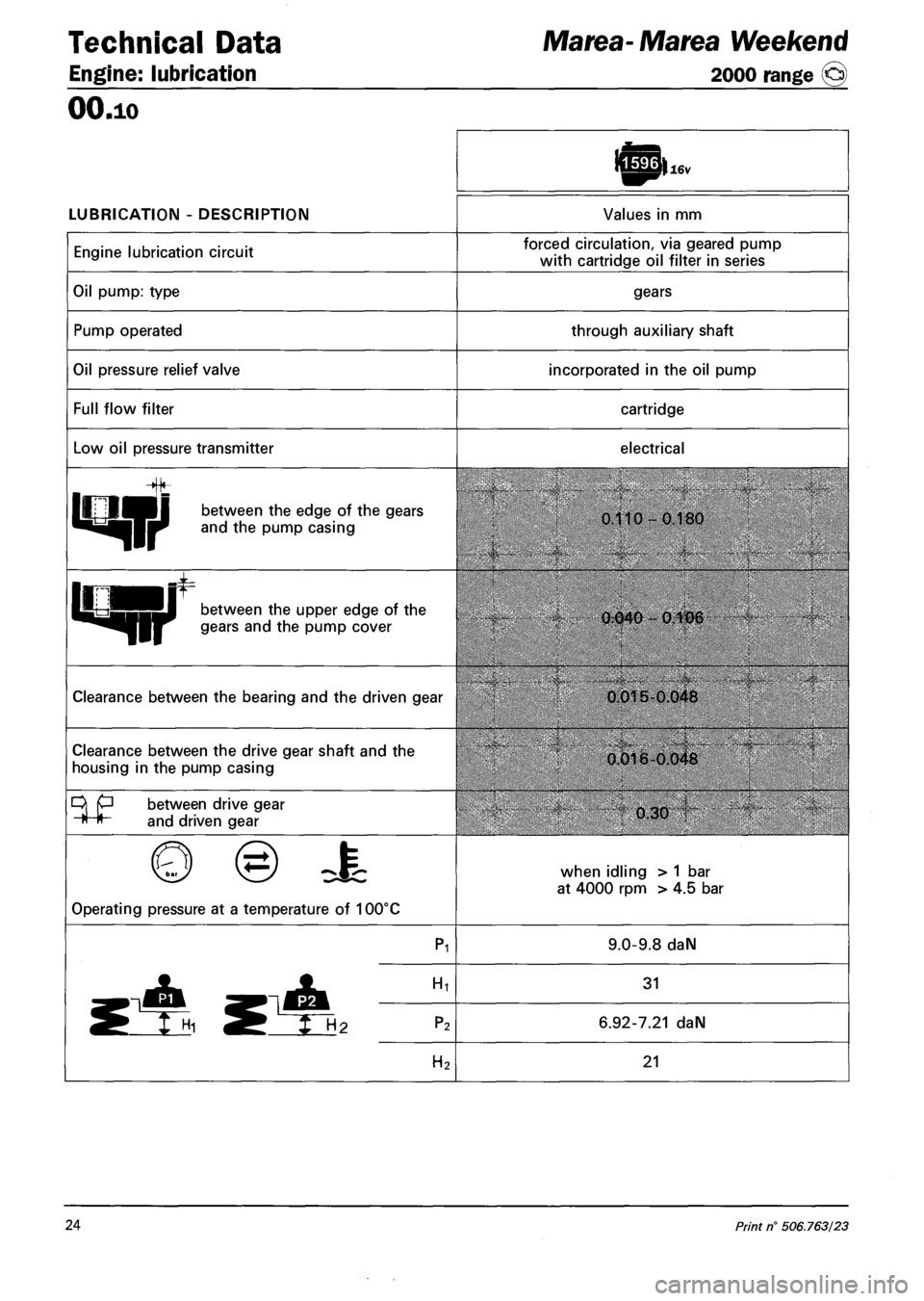
LUBRICATION - DESCRIPTION LUBRICATION - DESCRIPTION Values in mm
Engine lubrication circuit forced circulation, via geared pump
with cartridge oil filter in series
Oil pump: type gears
Pump operated through auxiliary shaft
Oil pressure relief valve incorporated in the oil pump
Full flow filter cartridge
Low oil pressure transmitter electrical
IlimBi between the edge of the gears
^^^•••F and the pump casing
JjOj^^^U between the upper edge of the
^^*^^B§ gears and the pump cover
Clearance between the bearing and the driven gear
Clearance between the drive gear shaft and the
housing in the pump casing
Oi p between drive gear
* * and driven gear
0 © J±
Operating pressure at a temperature of 100°C
when idling > 1 bar
at 4000 rpm > 4.5 bar
Pi 9.0-9.8 daN
31
9 1 Hi I H? P2 6.92-7.21 daN
H2 21
24 Print n° 506.763/23
Page 32 of 330
Marea-Marea Weekend
2000 range ©
Technical Data
Engine: lubrication
OO.io
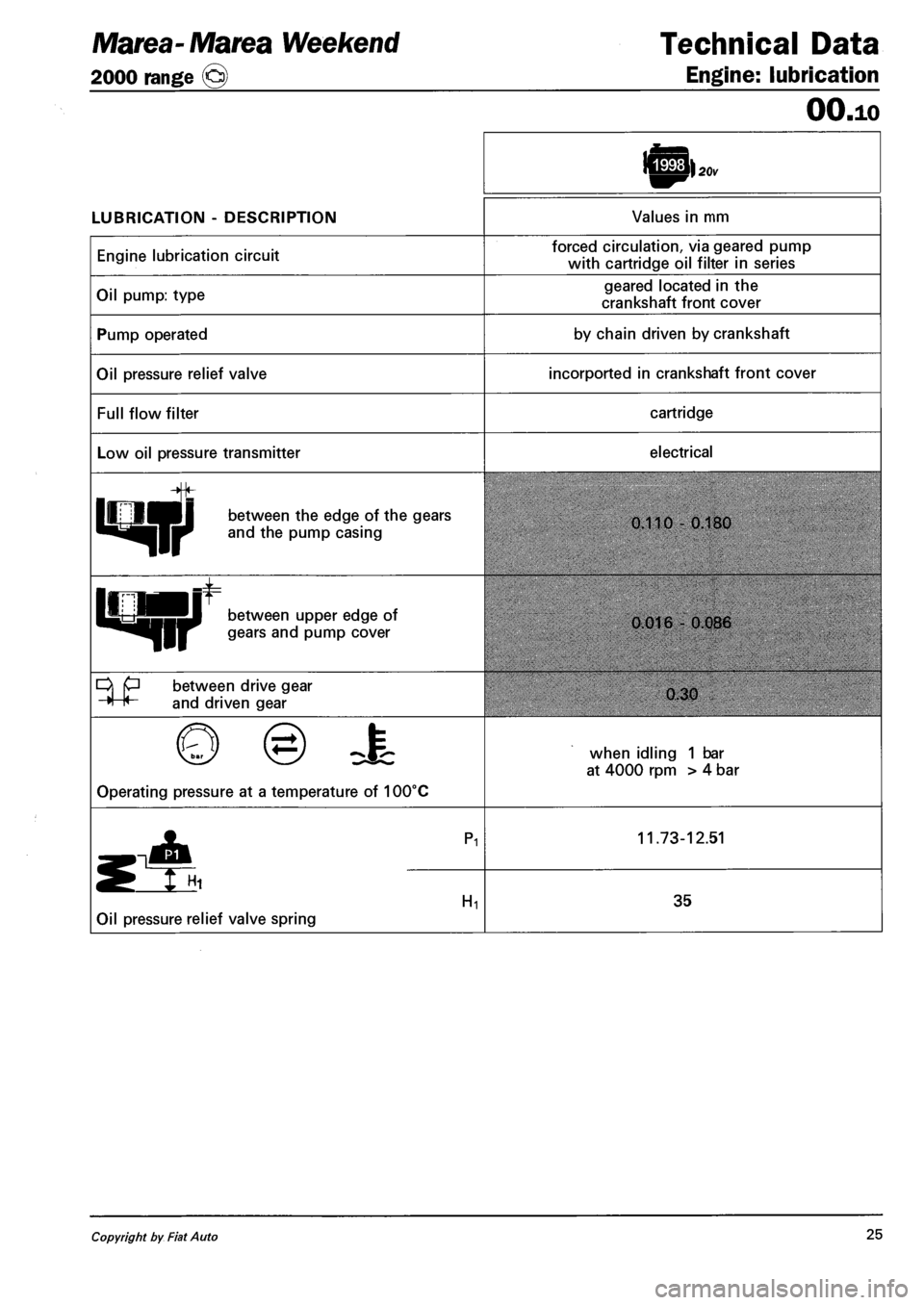
LUBRICATION - DESCRIPTION Values in mm
Engine lubrication circuit forced circulation, via geared pump
with cartridge oil filter in series
Oil pump: type geared located in the
crankshaft front cover
Pump operated by chain driven by crankshaft
Oil pressure relief valve incorported in crankshaft front cover
Full flow filter cartridge
Low oil pressure transmitter electrical
llOmH between the edge of the gears
^^^•••F and the pump casing
(EQi^^^U between upper edge of
^^^^BBf gears and pump cover
Oi 0 between drive gear
-*r-H- and driven gear
© © J:
Operating pressure at a temperature of 100°C
when idling 1 bar
at 4000 rpm > 4 bar
11.73-12.51
2 J*
Hi
Oil pressure relief valve spring
35
Copyright by Fiat Auto 25
Page 34 of 330
Marea-Marea Weekend Technical Data
2000 range (j§) Engine: fuel system - special tools
OO.io
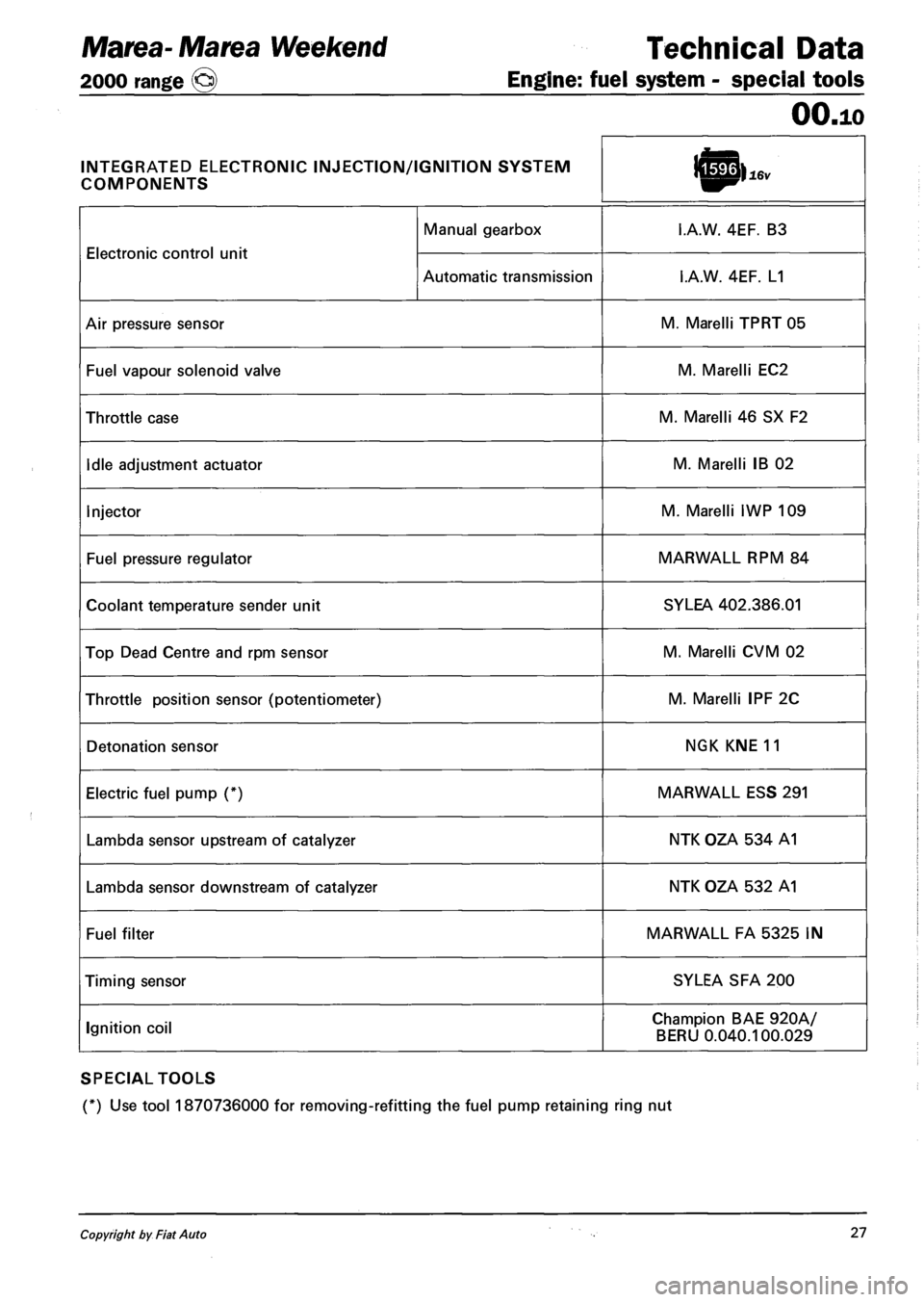
INTEGRATED ELECTRONIC INJECTION/IGNITION SYSTEM
COMPONENTS
Electronic control unit
Manual gearbox I.A.W. 4EF. B3
Electronic control unit
Automatic transmission I.A.W. 4EF. L1
Air pressure sensor M. Marelli TPRT 05
Fuel vapour solenoid valve M. Marelli EC2
Throttle case M. Marelli 46 SX F2
Idle adjustment actuator M. Marelli IB 02
Injector M. Marelli IWP 109
Fuel pressure regulator MARWALL RPM 84
Coolant temperature sender unit SYLEA 402.386.01
Top Dead Centre and rpm sensor M. Marelli CVM 02
Throttle position sensor (potentiometer) M. Marelli IPF 2C
Detonation sensor NGK KNE 11
Electric fuel pump (*) MARWALL ESS 291
Lambda sensor upstream of catalyzer NTK OZA 534 A1
Lambda sensor downstream of catalyzer NTK OZA 532 A1
Fuel filter MARWALL FA 5325 IN
Timing sensor SYLEA SFA 200
Ignition coil Champion BAE 920A/
BERU 0.040.100.029
SPECIAL TOOLS
(*) Use tool 1870736000 for removing-refitting the fuel pump retaining ring nut
Copyright by Fiat Auto 27
Page 38 of 330
Marea- Marea Weekend Technical Data
2000 range (§) Engine: supercharging
OO.io
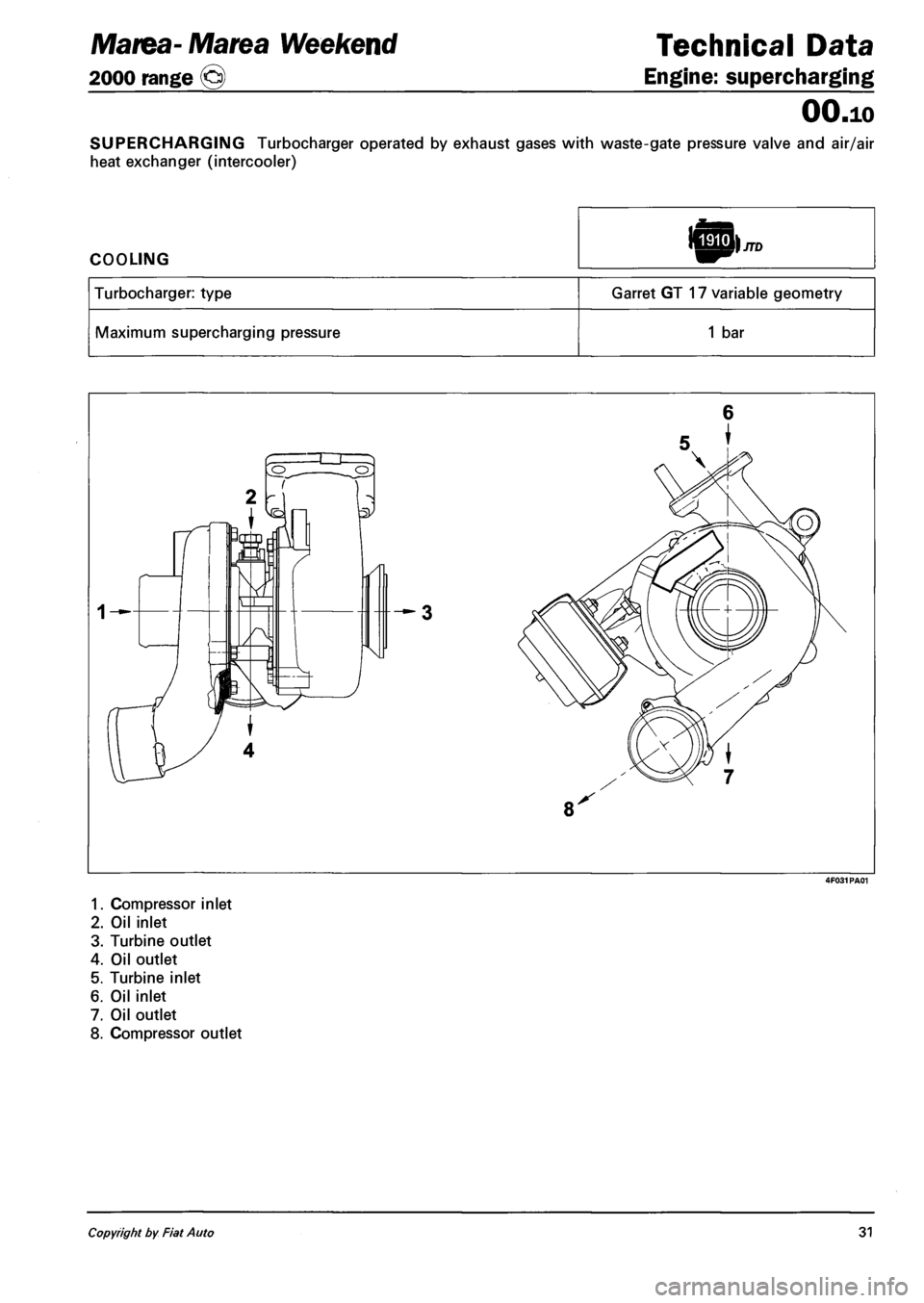
SUPERCHARGING Turbocharger operated by exhaust gases with waste-gate pressure valve and air/air
heat exchanger (intercooler)
COOLING
Turbocharger: type Garret GT 17 variable geometry
Maximum supercharging pressure 1 bar
6
5
1. Compressor inlet
2. Oil inlet
3. Turbine outlet
4. Oil outlet
5. Turbine inlet
6. Oil inlet
7. Oil outlet
8. Compressor outlet
Copyright by Fiat Auto 31
Page 71 of 330
Marea- Marea Weekend 9* Engine
2000 range (Q) Fuel feed system
10.
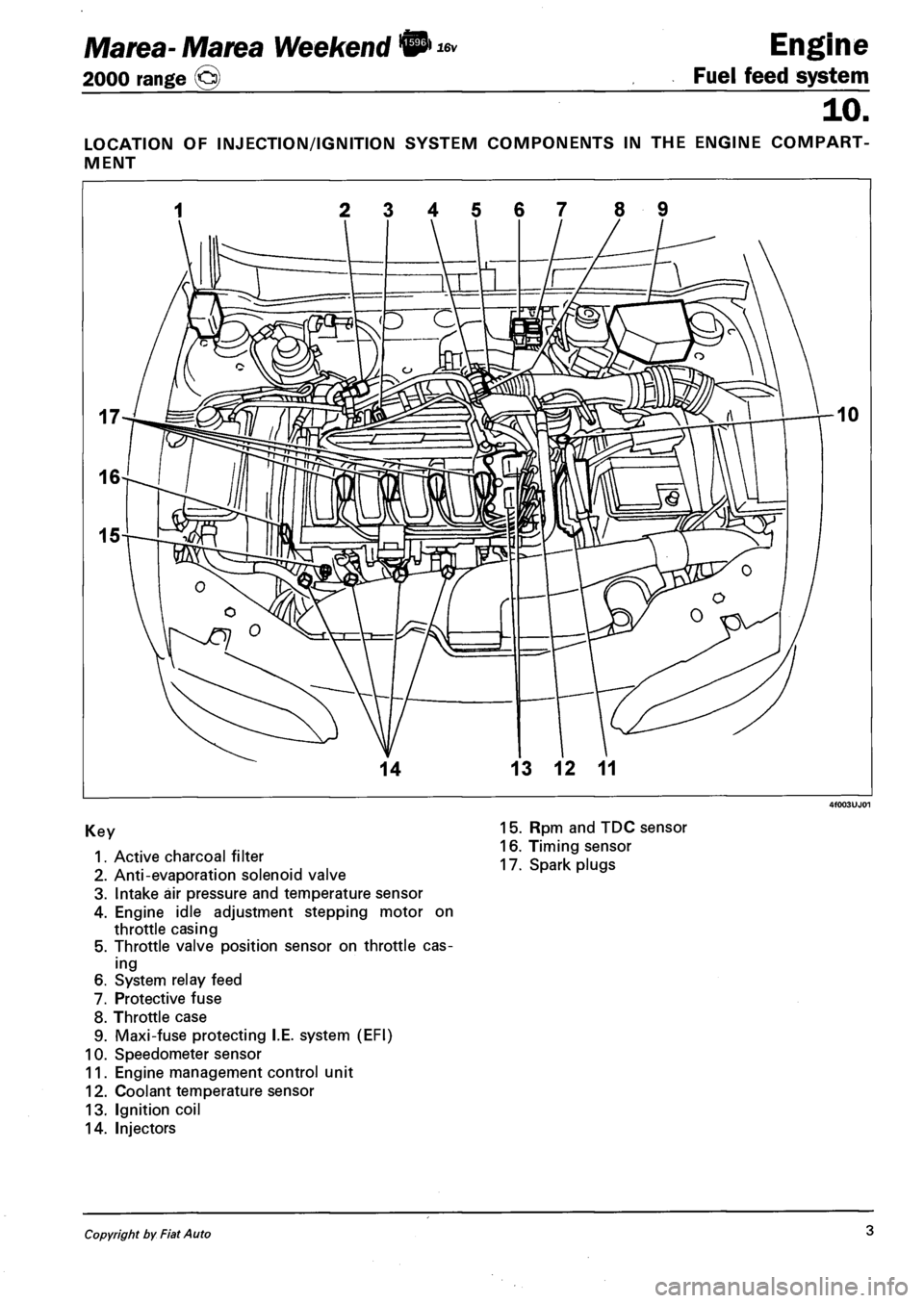
LOCATION OF INJECTION/IGNITION SYSTEM COMPONENTS IN THE ENGINE COMPART
MENT
1 2345678 9
Key
1. Active charcoal filter
2. Anti-evaporation solenoid valve
3. Intake air pressure and temperature sensor
4. Engine idle adjustment stepping motor on
throttle casing
5. Throttle valve position sensor on throttle cas
ing
6. System relay feed
7. Protective fuse
8. Throttle case
9. Maxi-fuse protecting I.E. system (EFI)
10. Speedometer sensor
11. Engine management control unit
12. Coolant temperature sensor
13. Ignition coil
14. Injectors
15. Rpm and TDC sensor
16. Timing sensor
17. Spark plugs
Copyright by Fiat Auto 3
Page 99 of 330
Marea- Marea Weekend 9"°
2000 range ©
Engine
Fuel feed system
10.
TIMING SENSOR
The Hall effect sensor is fitted to the cylinder head and faces the camshaft pulley.
An opening on the pulley allows the timing sensor to detect the engine timing position and indicate it to
the injection control unit.
The injection control unit uses the timing sensor signal to detect TDC at the end of compression.
Operation
A semi-condulator layer, through which a current passes, immersed in a magnetic field (lines of force per
pendicular to the direction of the current), produces a difference in power, known as Hall voltage.
If the intensity of the current remains constant, the voltage produced only depends on the intensity of the
magnetic field. The intensity of the field can simply be altered periodically to produce a modulated electri
cal signal. Signal frequency is proportional to the speed with which the magnetic field changes.
To achieve this change, the sensor is crossed by a metal ring (inner part of the pulley) with an opening.
When it moves, the metal part of the ring covers the sensor to magnetic field and the output signal is
therefore low; Conversely, the sensor generates a high signal at the opening when the magnetic field is
present.
This signal, together with the rpm and TDC signals, allows the injection control unit to identify piston po
sition and determine injection point.
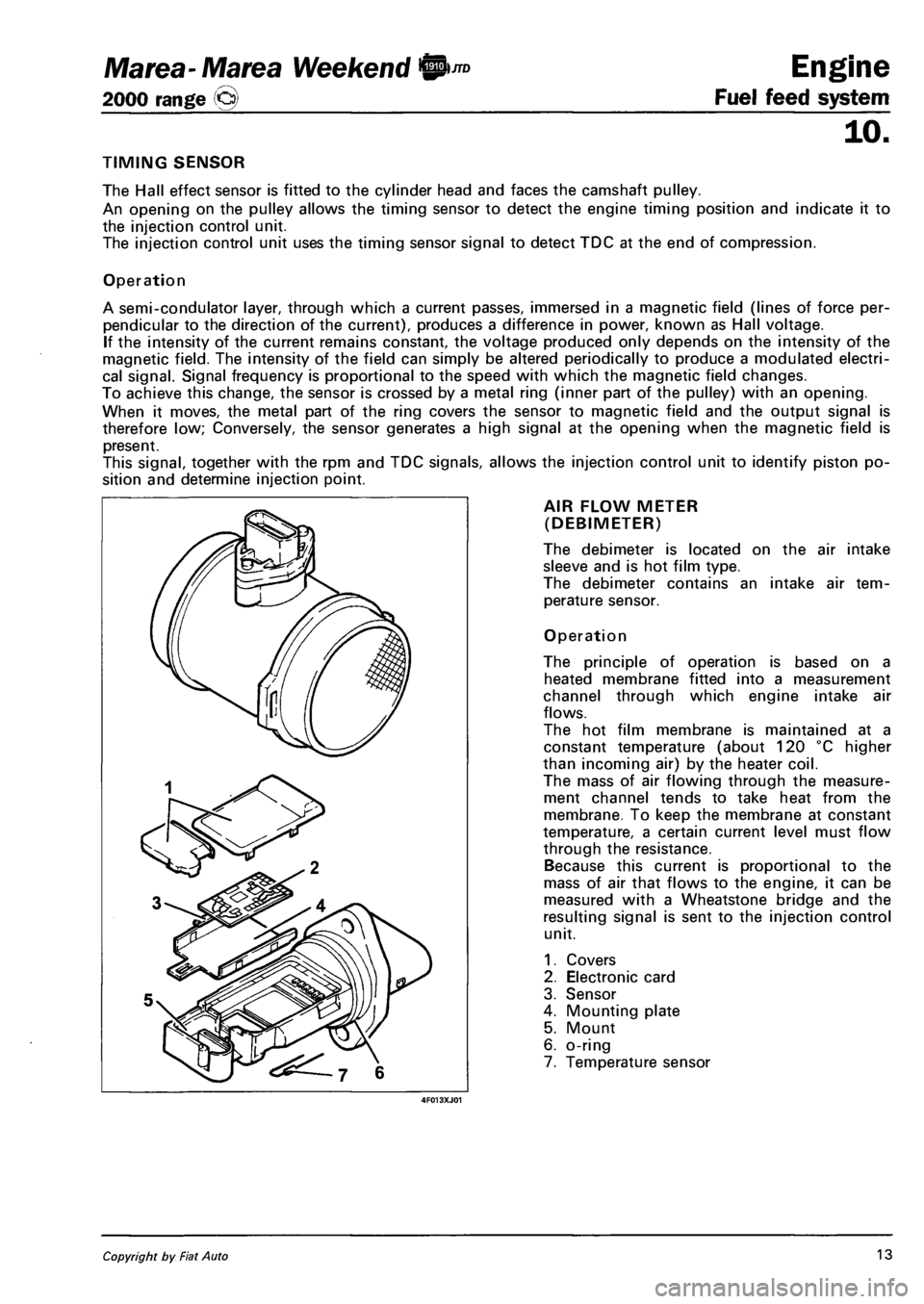
AIR FLOW METER
(DEBIMETER)
The debimeter is located on the air intake
sleeve and is hot film type.
The debimeter contains an intake air tem
perature sensor.
Operation
The principle of operation is based on a
heated membrane fitted into a measurement
channel through which engine intake air
flows.
The hot film membrane is maintained at a
constant temperature (about 120 °C higher
than incoming air) by the heater coil.
The mass of air flowing through the measure
ment channel tends to take heat from the
membrane. To keep the membrane at constant
temperature, a certain current level must flow
through the resistance.
Because this current is proportional to the
mass of air that flows to the engine, it can be
measured with a Wheatstone bridge and the
resulting signal is sent to the injection control
unit.
1. Covers
2. Electronic card
3. Sensor
4. Mounting plate
5. Mount
6. o-ring
7. Temperature sensor
Copyright by Fiat Auto 13
Page 100 of 330
Engine
Fuel feed system
10.
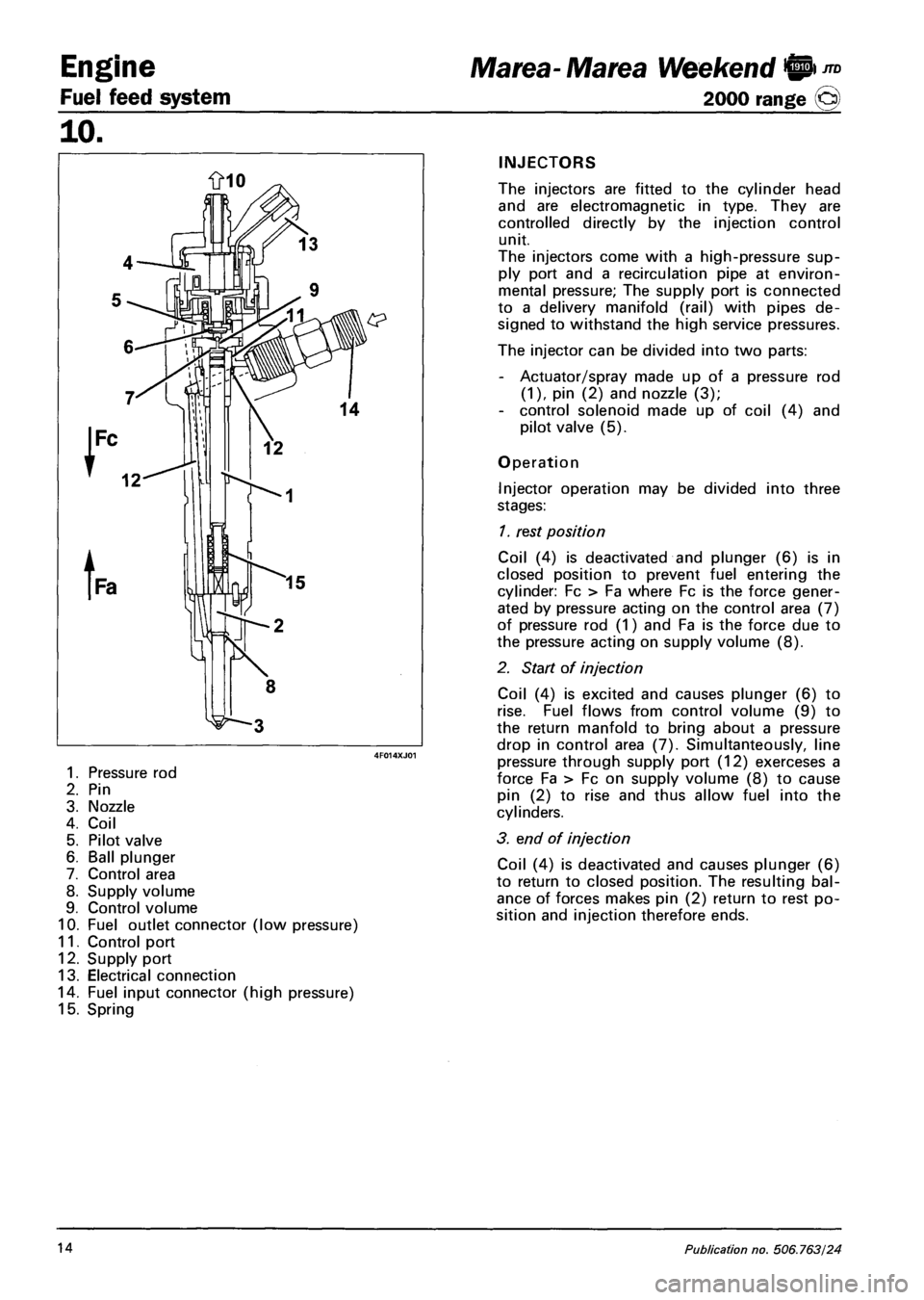
1. Pressure rod
2. Pin
3. Nozzle
4. Coil
5. Pilot valve
6. Ball plunger
7. Control area
8. Supply volume
9. Control volume
10. Fuel outlet connector (low pressure)
11. Control port
12. Supply port
13. Electrical connection
14. Fuel input connector (high pressure)
15. Spring
Marea- Marea Weekend 9 ™
2000 range (Q)
INJECTORS
The injectors are fitted to the cylinder head
and are electromagnetic in type. They are
controlled directly by the injection control
unit.
The injectors come with a high-pressure sup
ply port and a recirculation pipe at environ
mental pressure; The supply port is connected
to a delivery manifold (rail) with pipes de
signed to withstand the high service pressures.
The injector can be divided into two parts:
- Actuator/spray made up of a pressure rod
(1), pin (2) and nozzle (3);
- control solenoid made up of coil (4) and
pilot valve (5).
Operation
Injector operation may be divided into three
stages:
1. rest position
Coil (4) is deactivated and plunger (6) is in
closed position to prevent fuel entering the
cylinder: Fc > Fa where Fc is the force gener
ated by pressure acting on the control area (7)
of pressure rod (1) and Fa is the force due to
the pressure acting on supply volume (8).
2. Start of injection
Coil (4) is excited and causes plunger (6) to
rise. Fuel flows from control volume (9) to
the return manfold to bring about a pressure
drop in control area (7). Simultanteously, line
pressure through supply port (12) exerceses a
force Fa > Fc on supply volume (8) to cause
pin (2) to rise and thus allow fuel into the
cylinders.
3. end of injection
Coil (4) is deactivated and causes plunger (6)
to return to closed position. The resulting bal
ance of forces makes pin (2) return to rest po
sition and injection therefore ends.
14 Publication no. 506.763/24
Page 102 of 330
![FIAT MAREA 2000 1.G Workshop Manual Engine
Fuel feed system
JTD Marea-Marea Weekend ©
2000 range ©
10.
iH
ft
B I 0 ] I D
[ 0 0 1 1
D
0 1 <fi=2 1 1 15J
GLOW PLUG PREHEATING CONTROL
UNIT
The glow plugs are controlled by mea](/img/10/4653/w960_4653-101.png "FIAT MAREA 2000 1.G Workshop Manual Engine
Fuel feed system
JTD Marea-Marea Weekend ©
2000 range ©
10.
iH
ft
B I 0 ] I D
[ 0 0 1 1
D
0 1 <fi=2 1 1 15J
GLOW PLUG PREHEATING CONTROL
UNIT
The glow plugs are controlled by mea")
Engine
Fuel feed system
JTD Marea-Marea Weekend ©
2000 range ©
10.
iH
ft
B I 0 ] I D
[ 0 0 1 1
D
0 1
UNIT
The glow plugs are controlled by means of a
preheating control unit under the direct con
trol of the injection control unit.
The preheating control unit contains a smart
relay that sends a return response (feedback)
to the injection control unit, which is thus in
formed of faults in the preheating control unit
or glow plug short-circuits to earth.
The figure shows the connectors on the base
of the preheating control unit and the pin-out
1. Earth
2. Injection control unit (pin 22)
3. Power supply from main injection relay
4. Not connected
5. Injection control unit (pin 62)
8. Positive from battery (+30)
G. Glow plugs (only four outputs are used)
ACCELERATOR
PEDAL POTENTIOMETER
Accelerator pedal position is converted to an
electrical voltage signal and send to the injec
tion control unit by a potentiometer connected
to the accelerator pedal.
Accelerator pedal position is processed to
gether with rpm information to provide injec
tion times and pressure.
The sensor consists of a case (1) secured to
the pedal by a flange, which contains an axi-
ally-positioned shaft (2) connected to two
potentiometers (3): main and safety potenti
ometers.
A coil spring on the shaft ensures the correct
resistance to pressure while a second spring
ensures return upon release.
16 Publication no. 506.763/24
Page 106 of 330
Engine
Fuel feed system
JTD Marea-Marea Weekend @
2000 range ©
10.
7^ £3
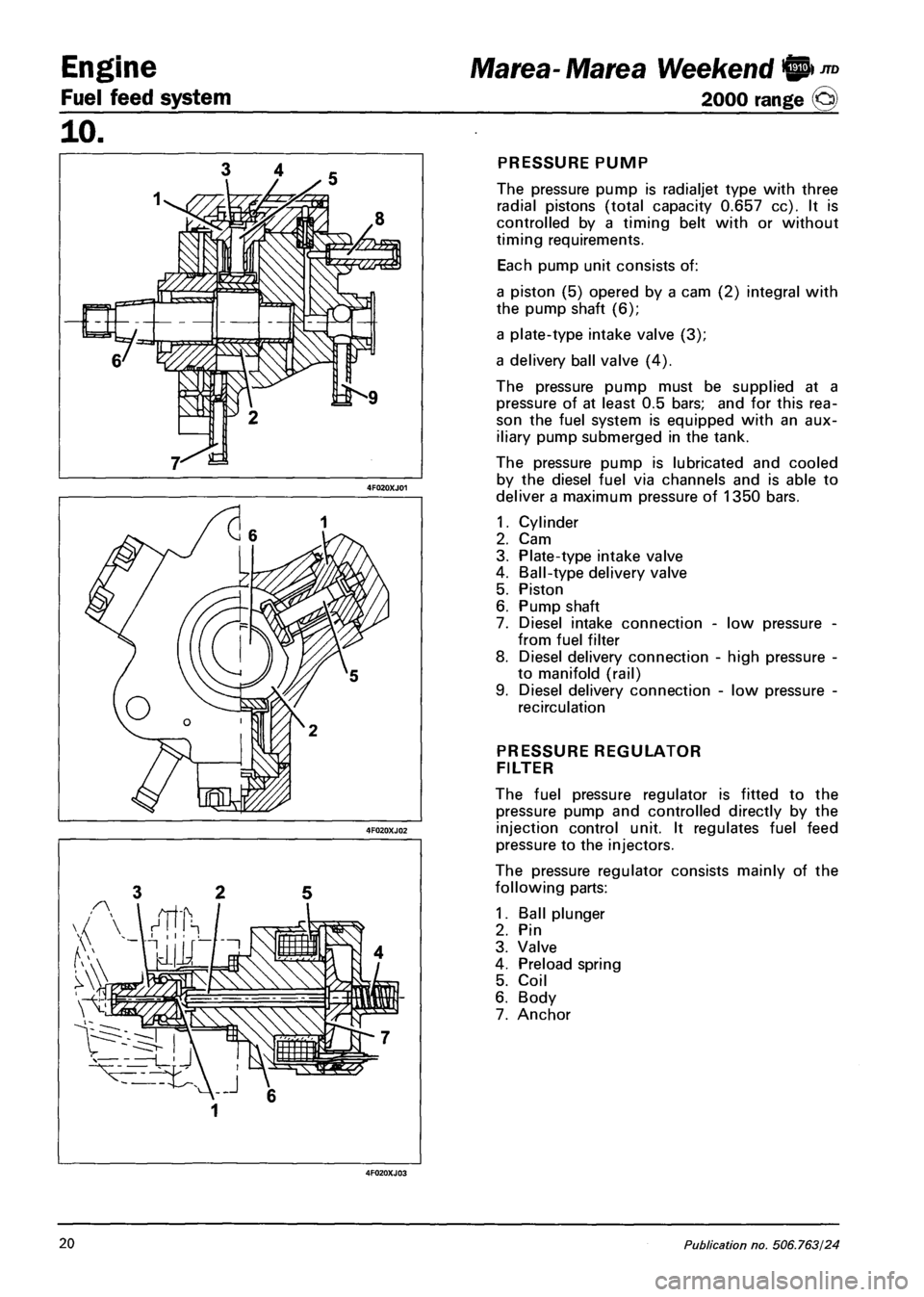
PRESSURE PUMP
The pressure pump is radialjet type with three
radial pistons (total capacity 0.657 cc). It is
controlled by a timing belt with or without
timing requirements.
Each pump unit consists of:
a piston (5) opered by a cam (2) integral with
the pump shaft (6);
a plate-type intake valve (3);
a delivery ball valve (4).
The pressure pump must be supplied at a
pressure of at least 0.5 bars; and for this rea
son the fuel system is equipped with an aux
iliary pump submerged in the tank.
The pressure pump is lubricated and cooled
by the diesel fuel via channels and is able to
deliver a maximum pressure of 1350 bars.
1.
2.
3.
4.
5.
6.
7.
8.
Cylinder
Cam
Plate-type intake valve
Ball-type delivery valve
Piston
Pump shaft
Diesel intake connection -
from fuel filter
Diesel delivery connection
to manifold (rail)
Diesel delivery connection
recirculation
low pressure
high pressure
low pressure
PRESSURE REGULATOR
FILTER
The fuel pressure regulator is fitted to the
pressure pump and controlled directly by the
injection control unit. It regulates fuel feed
pressure to the injectors.
The pressure regulator consists mainly of the
following parts:
1. Ball plunger
2. Pin
3. Valve
4. Preload spring
5. Coil
6. Body
7. Anchor
20 Publication no. 506.763/24
Page 112 of 330
Engine
Fuel feed system
JTD Marea- Marea Weekend 9
2000 range @
10.
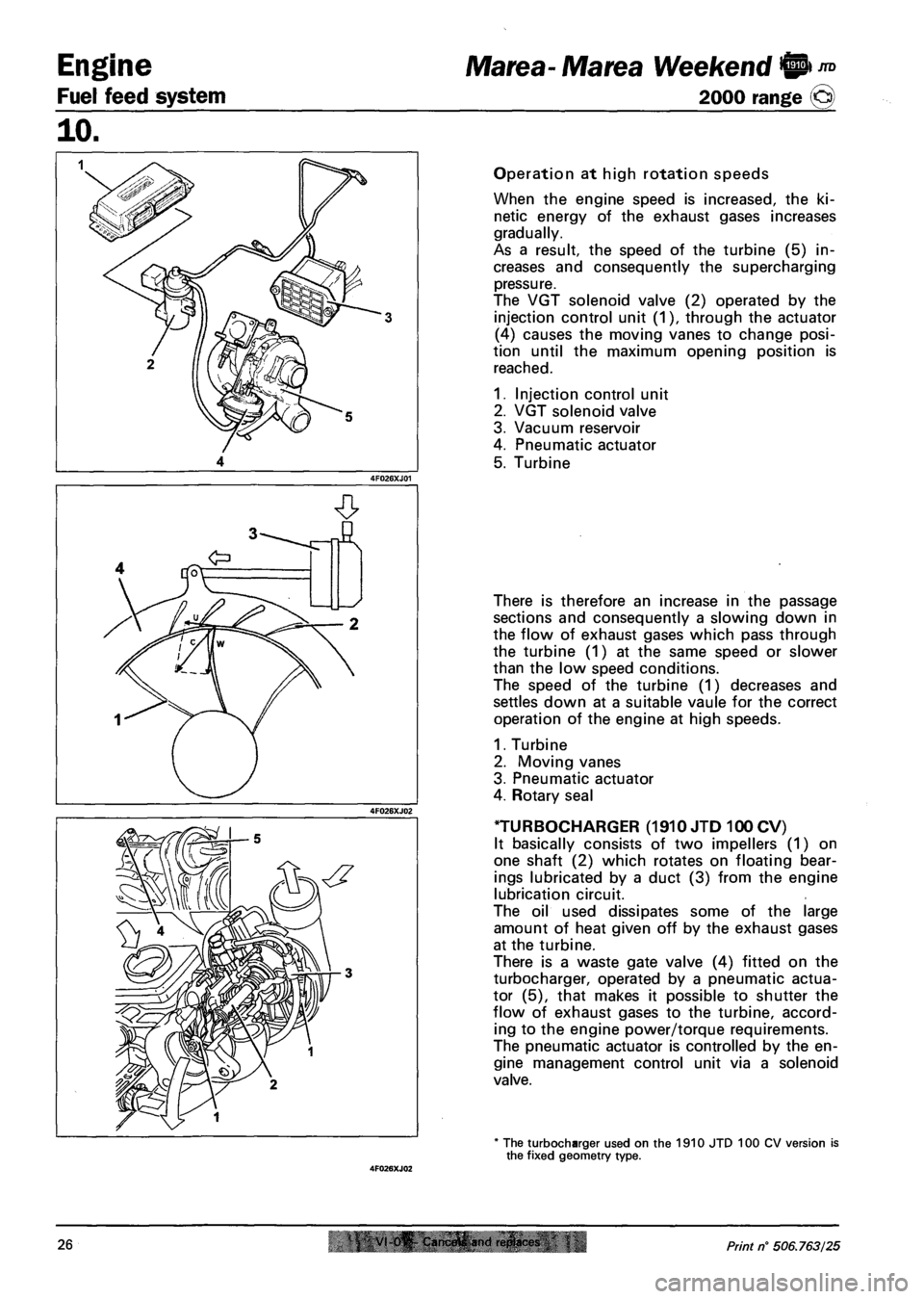
Operation at high rotation speeds
When the engine speed is increased, the ki
netic energy of the exhaust gases increases
gradually.
As a result, the speed of the turbine (5) in
creases and consequently the supercharging
pressure.
The VGT solenoid valve (2) operated by the
injection control unit (1), through the actuator
(4) causes the moving vanes to change posi
tion until the maximum opening position is
reached.
1. Injection control unit
2. VGT solenoid valve
3. Vacuum reservoir
4. Pneumatic actuator
5. Turbine
There is therefore an increase in the passage
sections and consequently a slowing down in
the flow of exhaust gases which pass through
the turbine (1) at the same speed or slower
than the low speed conditions.
The speed of the turbine (1) decreases and
settles down at a suitable vaule for the correct
operation of the engine at high speeds.
1. Turbine
2. Moving vanes
3. Pneumatic actuator
4. Rotary seal
TURBOCHARGER (1910 JTD 100 CV)
It basically consists of two impellers (1) on
one shaft (2) which rotates on floating bear
ings lubricated by a duct (3) from the engine
lubrication circuit.
The oil used dissipates some of the large
amount of heat given off by the exhaust gases
at the turbine.
There is a waste gate valve (4) fitted on the
turbocharger, operated by a pneumatic actua
tor (5), that makes it possible to shutter the
flow of exhaust gases to the turbine, accord
ing to the engine power/torque requirements.
The pneumatic actuator is controlled by the en
gine management control unit via a solenoid
valve.
* The turbocharger used on the 1910 JTD 100 CV version is the fixed geometry type.
26 VI 0^ Cam.frtfi and ri!plact<& Print n° 506.763/25