boot FIAT PALIO 2003 178 / 1.G India Version User Guide
[x] Cancel search | Manufacturer: FIAT, Model Year: 2003, Model line: PALIO, Model: FIAT PALIO 2003 178 / 1.GPages: 156, PDF Size: 6.27 MB
Page 84 of 156
83
1. STOP THE CAR
– Stop the car in a position that is not
dangerous for oncoming traffic where
you can change the wheel safely. The
ground should be flat and adequately
firm. If you have to change the wheel
at night, choose a lit area if possible.
– Turn the engine off and pull up the
handbrake.
– Engage first or reverse gear.
– Alert other drivers that the car is
stationary in compliance with local
regulations: hazard warning lights,
warning triangle etc.
Any passenger should get out and
wait as far away as possible from the
dangers of traffic.
If the road is sloping or bumpy, place
wedges or other suitable material un-
der the wheels to prevent the car from
moving.
2. TAKE OUT THE TOOLS,
JACK AND SPARE WHEEL
They are in the boot.
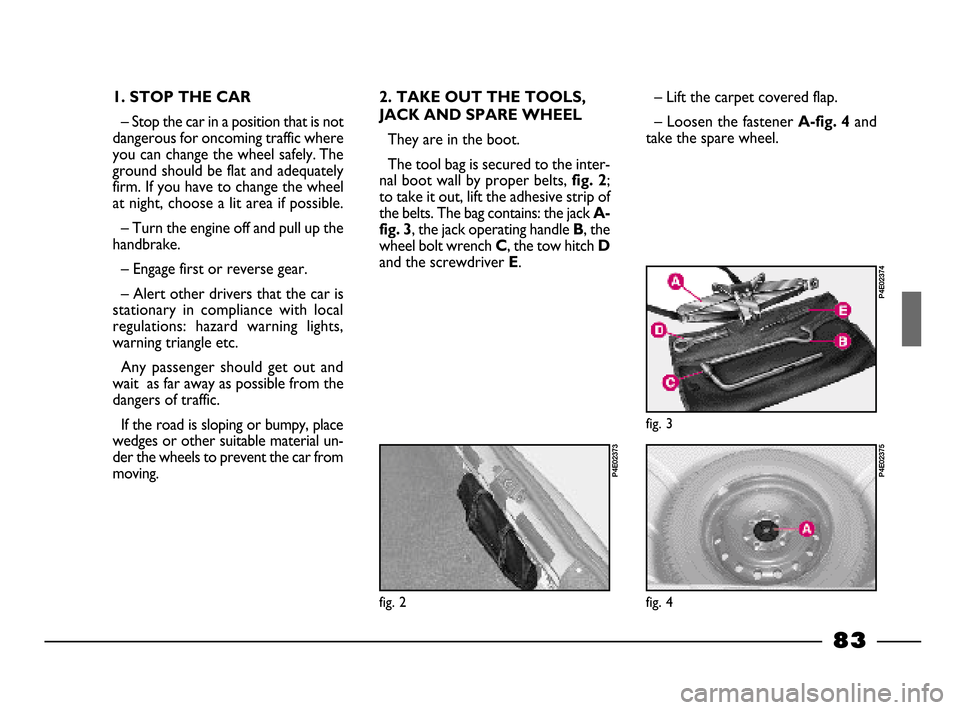
The tool bag is secured to the inter-
nal boot wall by proper belts,
fig. 2;
to take it out, lift the adhesive strip of
the belts. The bag contains: the jack
A-
fig. 3
, the jack operating handle B, the
wheel bolt wrench
C, the tow hitch D
and the screwdriver E.
fig. 2
P4E02373
fig. 4
P4E02375
fig. 3
P4E02374
– Lift the carpet covered flap.
– Loosen the fastener
A-fig. 4and
take the spare wheel.
80-103 03/03/2003 06:49 PM Page 83
Page 86 of 156
85
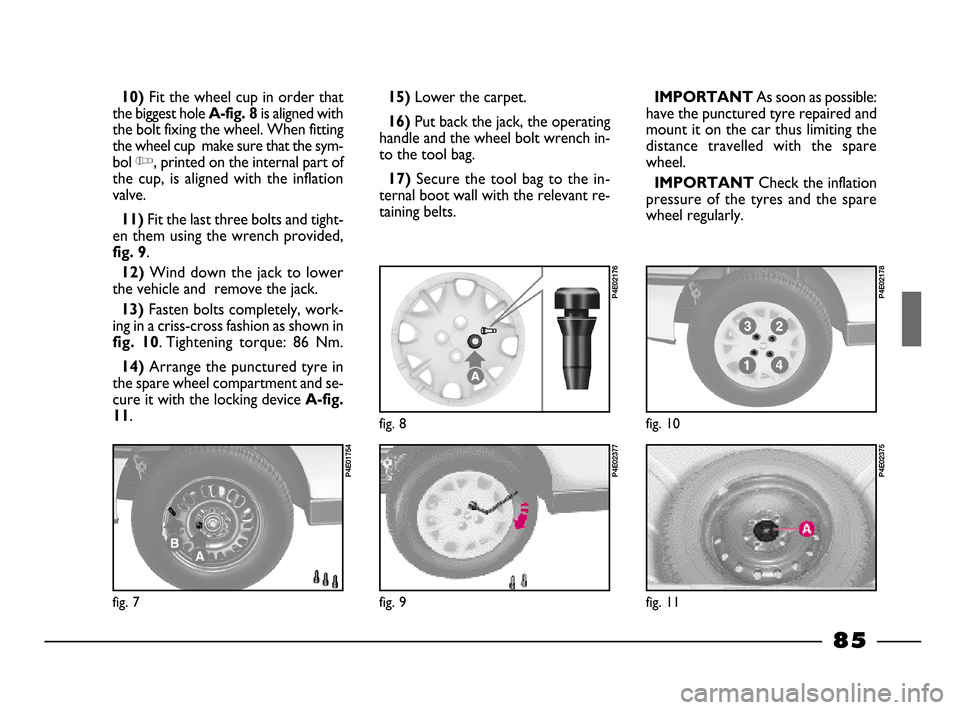
10)Fit the wheel cup in order that
the biggest hole
A-fig. 8is aligned with
the bolt fixing the wheel. When fitting
the wheel cup make sure that the sym-
bol
Y, printed on the internal part of
the cup, is aligned with the inflation
valve.
11)Fit the last three bolts and tight-
en them using the wrench provided,
fig. 9.
12)Wind down the jack to lower
the vehicle and remove the jack.
13)Fasten bolts completely, work-
ing in a criss-cross fashion as shown in
fig. 10. Tightening torque: 86 Nm.
14)Arrange the punctured tyre in
the spare wheel compartment and se-
cure it with the locking device
A-fig.
11
.
fig. 7
P4E01754
15)Lower the carpet.
16)Put back the jack, the operating
handle and the wheel bolt wrench in-
to the tool bag.
17)Secure the tool bag to the in-
ternal boot wall with the relevant re-
taining belts.
fig. 8
P4E02176
fig. 9
P4E02377
IMPORTANT As soon as possible:
have the punctured tyre repaired and
mount it on the car thus limiting the
distance travelled with the spare
wheel.
IMPORTANT Check the inflation
pressure of the tyres and the spare
wheel regularly.
fig. 10
P4E02178
fig. 11
P4E02375
80-103 03/03/2003 06:49 PM Page 85
Page 91 of 156
90
FRONT FOGLIGHTS
To replace the halogen bulb (type
H3, 12V-55W).
1) Turn the wheels to the left to re-
place the right-hand light and vice-ver-
sa.
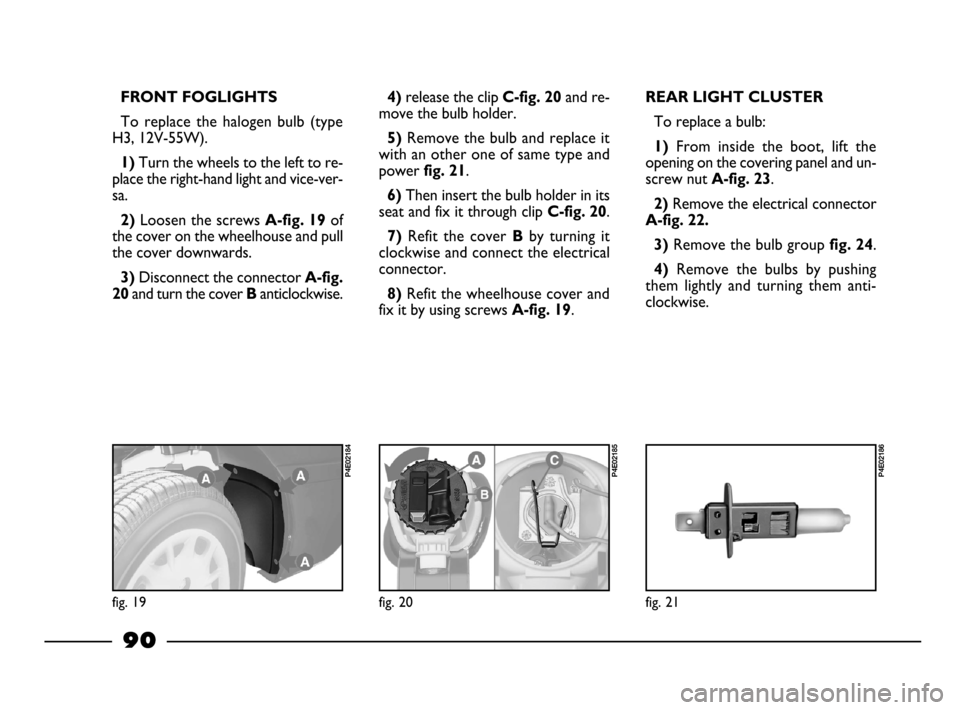
2) Loosen the screws A-fig. 19of
the cover on the wheelhouse and pull
the cover downwards.
3) Disconnect the connectorA-fig.
20
and turn the cover B anticlockwise.
4)release the clip C-fig. 20and re-
move the bulb holder.
5)Remove the bulb and replace it
with an other one of same type and
power
fig. 21.
6)Then insert the bulb holder in its
seat and fix it through clip
C-fig. 20.
7)Refit the cover Bby turning it
clockwise and connect the electrical
connector.
8)Refit the wheelhouse cover and
fix it by using screws
A-fig. 19.
REAR LIGHT CLUSTER
To replace a bulb:
1) From inside the boot, lift the
opening on the covering panel and un-
screw nut
A-fig. 23.
2) Remove the electrical connector
A-fig. 22.
3)
Remove the bulb group fig. 24.
4)Remove the bulbs by pushing
them lightly and turning them anti-
clockwise.
fig. 20
P4E02185
fig. 21
P4E02186
fig. 19
P4E02184
80-103 03/03/2003 06:49 PM Page 90
Page 92 of 156
91
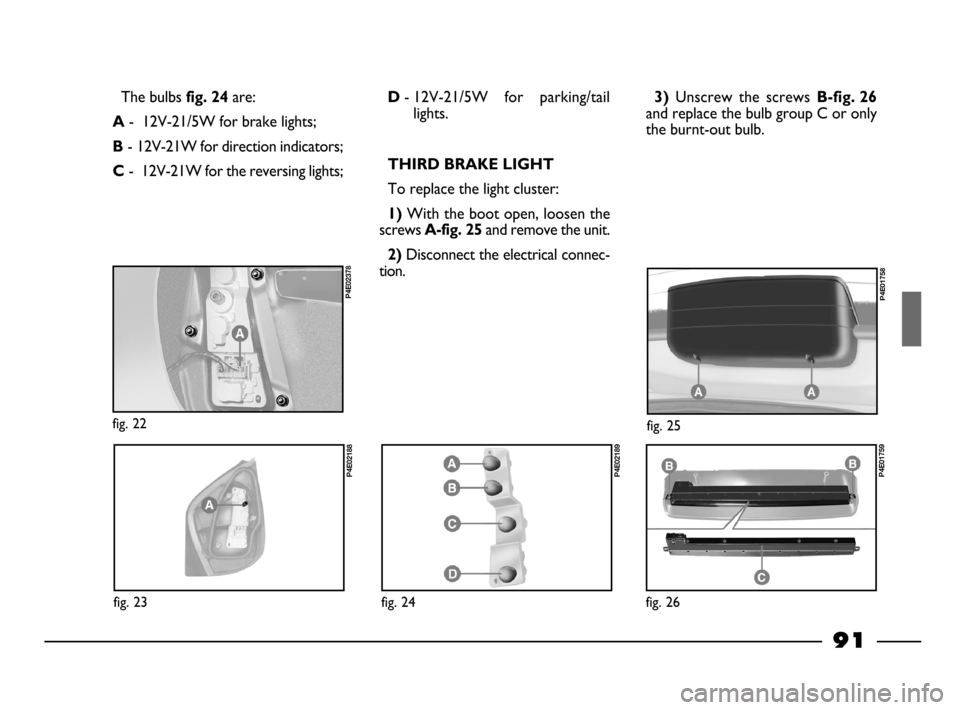
The bulbs fig. 24are:
A- 12V-21/5W for brake lights;
B- 12V-21W for direction indicators;
C- 12V-21W for the reversing lights;
3)Unscrew the screws B-fig. 26
and replace the bulb group C or only
the burnt-out bulb.
D- 12V-21/5W for parking/tail
lights.
THIRD BRAKE LIGHT
To replace the light cluster:
1) With the boot open, loosen the
screws
A-fig. 25 and remove the unit.
2) Disconnect the electrical connec-
tion.
fig. 25
P4E01758
fig. 22
P4E02378
fig. 23
P4E02188
fig. 24
P4E02189
fig. 26
P4E01759
80-103 03/03/2003 06:49 PM Page 91
Page 94 of 156
93
BOOT LIGHT
To replace the 12V-5W cylindrical
bulb, remove the transparent element
A-fig. 29by levering with a screw dri-
ver in point indicated by the arrow.
Remove the plastic guard
Band re-
place the bulb.
fig. 31
P4E01428
IF A FUSE BLOWS
REPLACING THE FUSES
If an electrical device is not working,
check whether the respective fuse is
blown
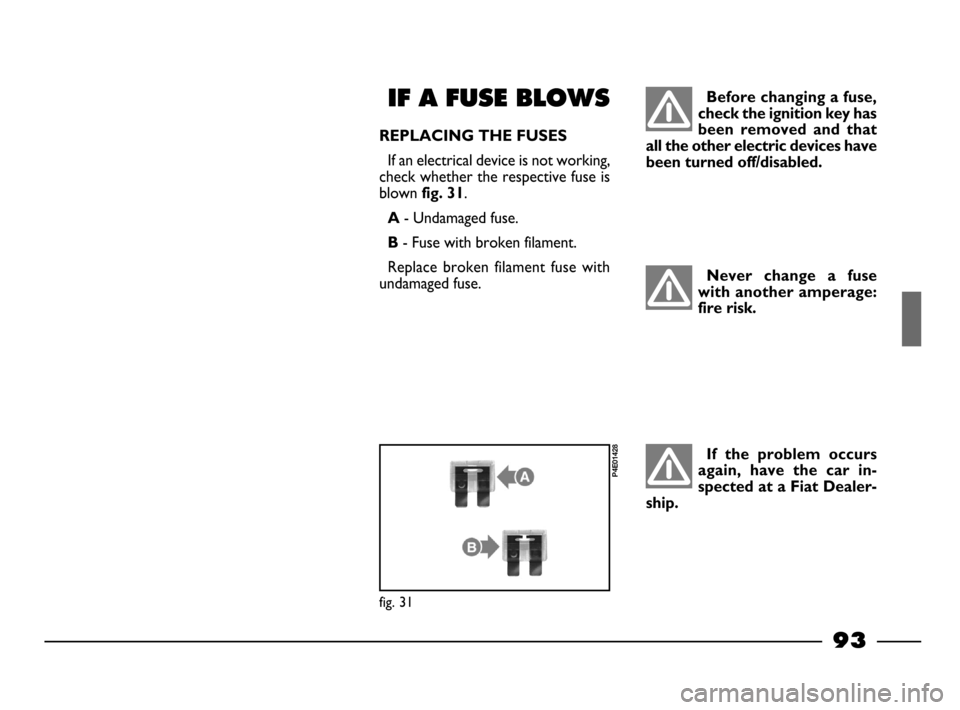
fig. 31.
A- Undamaged fuse.
B- Fuse with broken filament.
Replace broken filament fuse with
undamaged fuse.
Before changing a fuse,
check the ignition key has
been removed and that
all the other electric devices have
been turned off/disabled.
Never change a fuse
with another amperage:
fire risk.
If the problem occurs
again, have the car in-
spected at a Fiat Dealer-
ship.
80-103 03/03/2003 06:49 PM Page 93
Page 119 of 156
118
The total intake of these systems
(factory and after-market) must be less
than 0,6 mA x Ah (of the battery), as
shown in the following table:
Battery Maximum permissiblestand-by intake
50Ah 30 mA
Furthermore, remember that high in-
take electric devices (such as baby bot-
tle warmer, vacuum cleaners, cellular
phones, mini-fridges, etc.) powered
when the engine is off can deploy the
battery.
IMPORTANTIf you need to fit ad-
ditional systems in the car, remember
that improper wiring connections, in
particular if they affect safety devices,
are dangerous.
USEFUL ADVICE
FOR LENGTHENING
THE LIFE
OF YOUR BATTERY
When you park the car, ensure the
doors, boot and bonnet are closed
properly. The courtesy light must be
off.
Do not keep accessories (e.g. sound
system, hazard lights, etc.) switched on
for a long time when the engine is not
running.
IMPORTANTA battery which is
kept at a charge of less than 50% for
any length of time will be damaged by
sulphation leading to a reduction in
cranking power and a higher risk of
the battery electrolyte freezing (this
may even occur at - 10°C).
If the car is inactive for a long peri-
od of time, refer to “Long inactivity of
the car”, in the “Correct use of the
car” chapter.If you want to add electrical acces-
sories after buying the car which need
permanent electric supply(alarm,
free hand phone kit, radio navigator
with satellite antitheft system etc.) vis-
it a
Fiat Dealership. They can sug-
gest the most suitable accessories to
get and check whether the electric
system can support the required load
or whether a larger capacity battery
is required.
These devices will, in fact, run off the
battery even when the key is not in-
serted (car parked, engine stopped)
and can destroy the battery.
104-127 03/03/2003 06:53 PM Page 118
Page 128 of 156
127
Detergents pollute wa-
ter. The car must there-
fore be washed in an area
equipped for the collection and
purification of the liquids used
while washing.
IMPORTANT
The engine com-
partment should be washed while the
engine is cold and with the ignition key
at
STOP. After washing make sure
that the various protections (e.g. rub-
ber boots and various guards) have
not been removed or damaged.
IMPORTANTTo prevent damage
to the electric heater element, wipe the
inside of the heated rear window gen-
tly in the same direction as the ele-
ments.
Engine compartment
At the end of each winter season,
carefully clean the engine compart-
ment. Have this done at a garage.
INTERIORS
Periodically check that water has not
collected under the mats (from dip-
ping shoes, umbrellas etc.) which could
cause the steel to rust
CLEANING SEATS AND
FABRIC COMPONENTS
– Remove dust with a soft brush or
vacuum cleaner.
– Brush the seats with a damp
sponge with water and a neutral soap.
Never use flammable
products (petroleum
ether or petrol) to clean
the inside of the car. Electro-
static charges generated by rub-
bing while cleaning could cause
fires.
Do not keep aerosol
cans in the car. There is
the risk they might ex-
plode. Aerosol cans must never
be exposed to a temperature
above 50°C; when the weather
starts to get hot the temperature
inside the car might go well be-
yond that figure.
PLASTIC PARTS INSIDE THE
CAR
Use special products designed not to
alter the appearance of the compo-
nents.
IMPORTANTDo not use alcohol
or petrol to clean the glass of the in-
strument panel.
104-127 03/03/2003 06:53 PM Page 127
Page 140 of 156
139
P4E02266
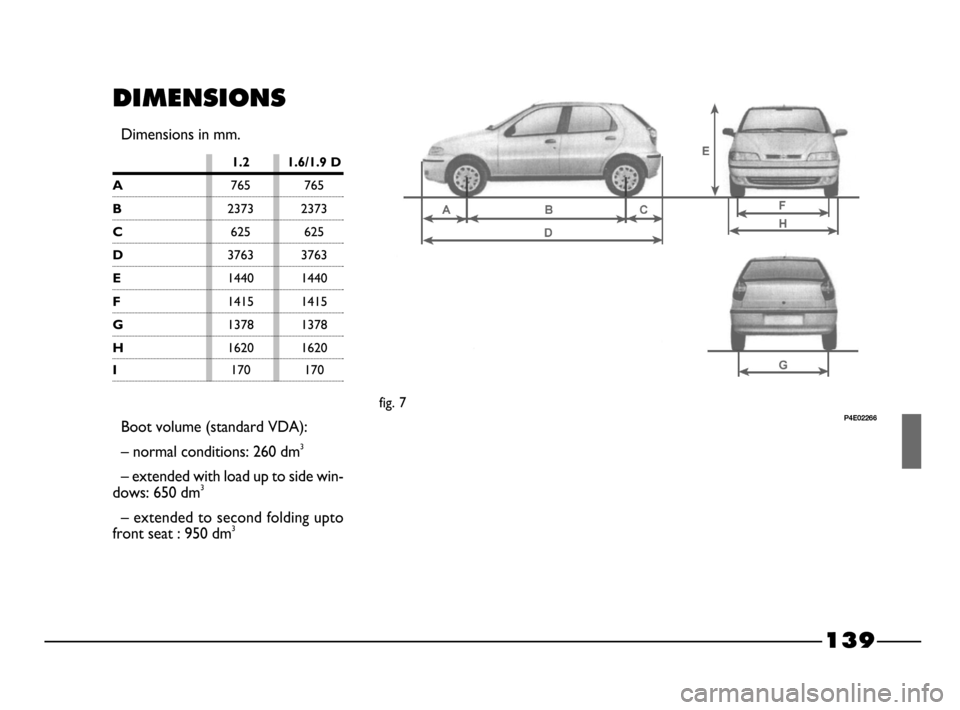
DIMENSIONS
Dimensions in mm.
1.2 1.6/1.9 D
A765 765
B2373 2373
C625 625
D3763 3763
E1440 1440
F1415 1415
G1378 1378
H1620 1620
Boot volume (standard VDA):
– normal conditions: 260 dm
3
– extended with load up to side win-
dows: 650 dm3
– extended to second folding upto
front seat : 950 dm3
fig. 7
I170 170
128-143 03/03/2003 07:39 PM Page 139
Page 141 of 156
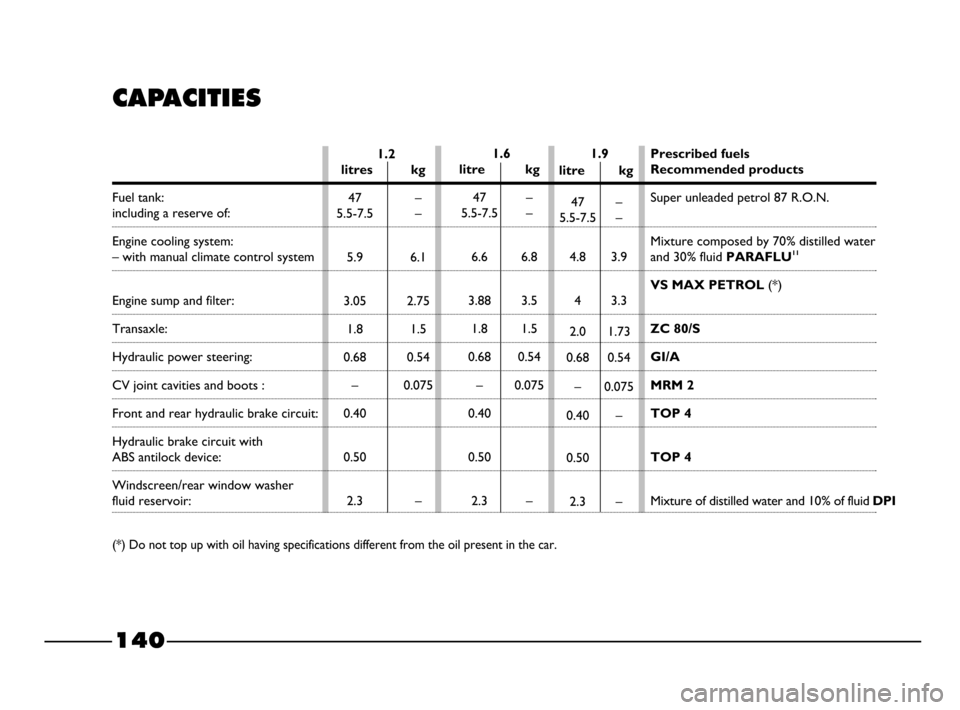
1.2
litres kg
47 –
5.5-7.5 –
5.9 6.1
3.05 2.75
1.8 1.5
0.68 0.54
– 0.075
0.40
0.50
2.3 –
1.6
litre kg
47 –
5.5-7.5 –
6.6 6.8
3.88 3.5
1.8 1.5
0.68 0.54
– 0.075
0.40
0.50
2.3 –
140
Prescribed fuels
Recommended products
Super unleaded petrol 87 R.O.N.
Mixture composed by 70% distilled water
and 30% fluid
PARAFLU11
VS MAX PETROL(*)
ZC 80/S
GI/A
MRM 2
TOP 4
TOP 4
Mixture of distilled water and 10% of fluid DPI
CAPACITIES
(*) Do not top up with oil having specifications different from the oil present in the car.
47 –
5.5-7.5 –
4.8 3.9
43.3
2.0 1.73
0.68 0.54
– 0.075
0.40 –
0.50
2.3 –
1.9
litre kg
Fuel tank:
including a reserve of:
Engine cooling system:
– with manual climate control system
ngine sump:
Engine sump and filter:
Transaxle:
Hydraulic power steering:
CV joint cavities and boots :
Front and rear hydraulic brake circuit:
Hydraulic brake circuit with
ABS antilock device:
Windscreen/rear window washer
fluid reservoir:
128-143 03/03/2003 07:39 PM Page 140
Page 145 of 156
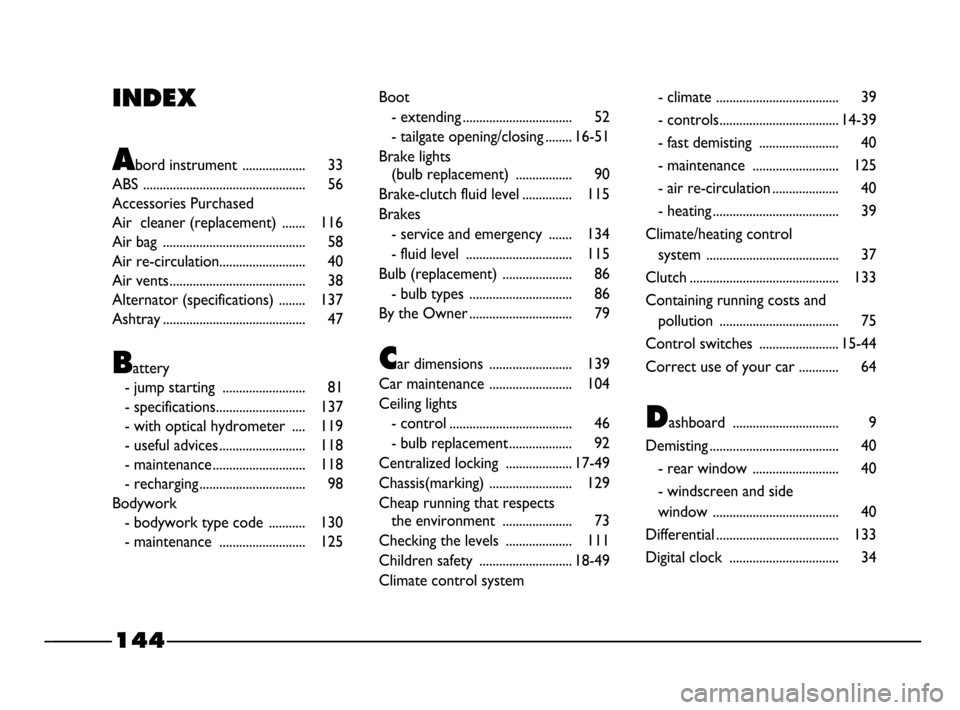
Abord instrument ................... 33
ABS ................................................. 56
Accessories Purchased
Air cleaner (replacement) ....... 116
Air bag ........................................... 58
Air re-circulation.......................... 40
Air vents......................................... 38
Alternator (specifications) ........ 137
Ashtray ........................................... 47
Battery
- jump starting ......................... 81
- specifications........................... 137
- with optical hydrometer .... 119
- useful advices .......................... 118
- maintenance ............................ 118
- recharging ................................ 98
Bodywork
- bodywork type code ........... 130
- maintenance .......................... 125Boot
- extending ................................. 52
- tailgate opening/closing ........ 16-51
Brake lights
(bulb replacement) ................. 90
Brake-clutch fluid level ............... 115
Brakes
- service and emergency ....... 134
- fluid level ................................ 115
Bulb (replacement) ..................... 86
- bulb types ............................... 86
By the Owner ............................... 79Car dimensions ......................... 139
Car maintenance ......................... 104
Ceiling lights
- control ..................................... 46
- bulb replacement ................... 92
Centralized locking .................... 17-49
Chassis(marking) ......................... 129
Cheap running that respects
the environment ..................... 73
Checking the levels .................... 111
Children safety ............................ 18-49
Climate control system- climate ..................................... 39
- controls.................................... 14-39
- fast demisting ........................ 40
- maintenance .......................... 125
- air re-circulation .................... 40
- heating ...................................... 39
Climate/heating control
system ........................................ 37
Clutch ............................................. 133
Containing running costs and
pollution .................................... 75
Control switches ........................ 15-44
Correct use of your car ............ 64
Dashboard ................................ 9
Demisting ....................................... 40
- rear window .......................... 40
- windscreen and side
window ...................................... 40
Differential ..................................... 133
Digital clock ................................. 34
INDEX
144
144-152 03/03/2003 07:30 PM Page 144