battery FIAT PANDA 2013 319 / 3.G User Guide
[x] Cancel search | Manufacturer: FIAT, Model Year: 2013, Model line: PANDA, Model: FIAT PANDA 2013 319 / 3.GPages: 284, PDF Size: 11.33 MB
Page 84 of 284
❒driver's door not shut;
❒driver's seat belt not fastened;
❒reverse gear engaged (for example, for parking
manoeuvres);
❒for versions equipped with automatic climate
control (for versions/markets, where provided), if
an adequate level of thermal comfort has not
been reached or with MAX-DEF activation;
❒during the first period of use for a new car, to
initialise the system.
If climate comfort is to be favoured, the
Star t&Stop system can be disabled, for
continuous operation of the climate
control system and avoidance of, for example, the
windows misting up.
ENGINE RESTARTING CONDITIONS
For reasons of comfort, limiting harmful emissions
and safety purposes, the power unit can restart
automatically without any action on behalf of the
driver if certain conditions are met, including:
❒battery not sufficiently charged;
❒reduced braking system vacuum (e.g. if the brake
pedal is pressed repeatedly);
❒car moving (e.g. when driving on roads with a
gradient);❒engine stopping by Start&Stop system for over 3
minutes;
❒for versions equipped with automatic climate
control (for versions/markets where provided), to
enable suitable thermal comfort or with MAX-DEF
activation.
If a gear in engaged during stopping with Start&Stop,
the automatic restarting of the engine is only
permitted by fully depressing the clutch pedal.
The driver is informed by a message on the display
and - for versions/markets, where provided - by
the flashing of the
symbol.
If the clutch is not pressed, about 3 minutes after the
engine stops, the engine can be restarted only using
the ignition key.
In cases of undesired engine stops, due for example
to the clutch pedal being released abruptly with a
gear engaged, if the Start&Stop system is activated,
the engine can be restarted by fully depressing
the clutch pedal.
SAFETY FUNCTIONS
When the engine is stopped by the Start&Stop
system, if the driver releases his/her seat belt and
opens the driver's or passenger's door, the engine
can be restarted only using the ignition key.
The driver is informed by a buzzer and by the
flashing of the symbol
on the display; on some
versions, a message is displayed as well.
80GETTING TO
KNOW YOUR CAR
SAFETY
STARTING AND
DRIVING
WARNING LIGHTS
AND MESSAGES
IN AN EMERGENCY
SERVICING AND
MAINTENANCE
TECHNICAL
SPECIFICATIONS
INDEX
Page 85 of 284
"ENERGY SAVING" FUNCTION
(for versions/markets, where provided)
If, after automatic engine restarting, the driver does
not carry out any action on the car for an extended
period (about 3 minutes), the Start&Stop system
stops the engine definitively, to prevent fuel
consumption. In these cases, the engine can only be
restarted using the ignition key.
NoteIn any case, it is possible to keep the engine
running by deactivating the Start&Stop system.
IRREGULAR OPERATION
In the event of malfunction, the Start&Stop system is
deactivated. The driver is informed about the fault
through the flashing of the
symbol on the display
(for some versions together with the display of a
message). In this case, contact a Fiat Dealership.
CAR INACTIVITY
In the event of car inactivity, special attention must
be paid to the disconnection of the battery power
supply.
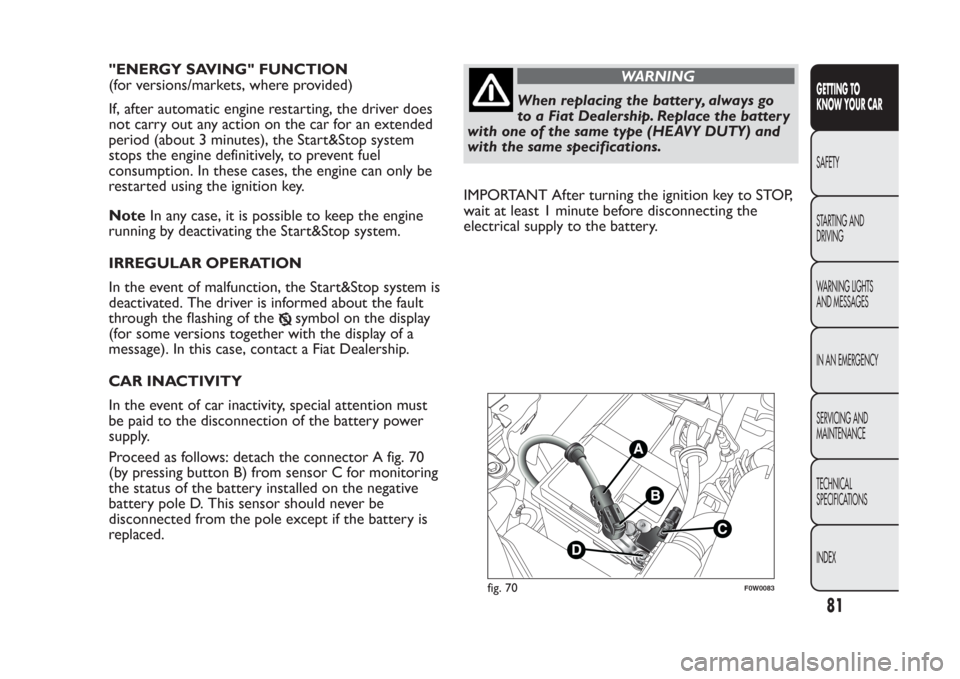
Proceed as follows: detach the connector A fig. 70
(by pressing button B) from sensor C for monitoring
the status of the battery installed on the negative
battery pole D. This sensor should never be
disconnected from the pole except if the battery is
replaced.
WARNING
When replacing the batter y, always go
to a Fiat Dealership. Replace the battery
with one of the same type (HEAVY DUTY) and
with the same specifications.
IMPORTANT After turning the ignition key to STOP,
wait at least 1 minute before disconnecting the
electrical supply to the battery.
fig. 70
F0W0083
81GETTING TO
KNOW YOUR CARSAFETY
STARTING AND
DRIVING
WARNING LIGHTS
AND MESSAGES
IN AN EMERGENCY
SERVICING AND
MAINTENANCE
TECHNICAL
SPECIFICATIONS
INDEX
Page 86 of 284
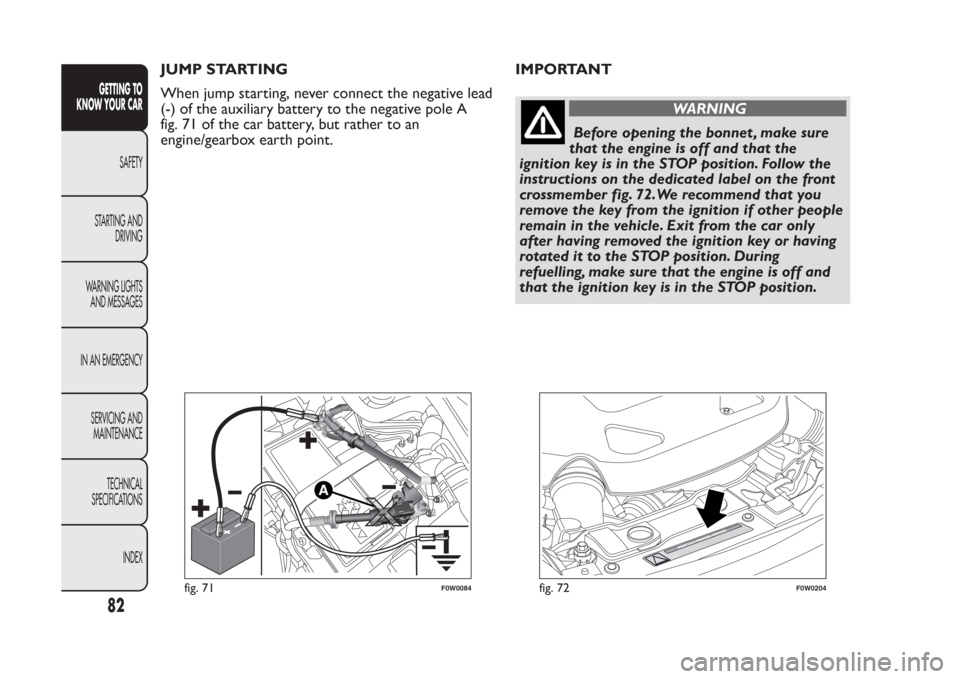
JUMP STARTING
When jump starting, never connect the negative lead
(-) of the auxiliary battery to the negative pole A
fig. 71 of the car battery, but rather to an
engine/gearbox earth point.IMPORTANT
WARNING
Before opening the bonnet , make sure
thattheengineisoffandthatthe
ignition key is in the STOP position. Follow the
instructions on the dedicated label on the front
crossmember fig. 72.We recommend that you
remove the key from the ignition if other people
remain in the vehicle. Exit from the car only
after having removed the ignition key or having
rotated it to the STOP position. During
refuelling, make sure that the engine is off and
that the ignition key is in the STOP position.
fig. 71
F0W0084
fig. 72
F0W0204
82GETTING TO
KNOW YOUR CAR
SAFETY
STARTING AND
DRIVING
WARNING LIGHTS
AND MESSAGES
IN AN EMERGENCY
SERVICING AND
MAINTENANCE
TECHNICAL
SPECIFICATIONS
INDEX
Page 127 of 284
When the engine is switched off never
leave the key turned to MAR-ON to
prevent useless current absorption from
draining the battery.Never jump start the engine by pushing,
towing or coasting downhill.This could
cause fuel to flow into the catalytic
conver ter and damage it beyond repair.
WARMING UP THE ENGINE JUST AFTER IT
HAS STARTED
Proceed as follows:
❒drive off slowly, letting the engine turn at medium
revs. Do not accelerate abruptly;
❒do not demand full performance at first. Wait until
the second bar on the engine coolant temperature
gauge switches on.STOPPING THE ENGINE
Turn the ignition key to STOP while the engine is
idling.
IMPORTANT After a demanding drive, before
turning the engine off you should allow it to idle to
allow the temperature in the engine compartment to
decrease.
A quick burst on the accelerator before
turning off the engine serves absolutely no
practical purpose, it wastes fuel and is
especially damaging to turbocharged engines.
123GETTING TO KNOW
YOUR CAR
SAFETYSTARTING AND
DRIVINGWARNING LIGHTS
AND MESSAGES
IN AN EMERGENCY
SERVICING AND
MAINTENANCE
TECHNICAL
SPECIFICATIONS
INDEX
Page 132 of 284
TOWING TRAILERSIMPORTANT NOTES
For towing caravans or trailers the car must be fitted
with a type-approved tow hook and an adequate
electrical system. Installation must be carried out by
a specialist.
Fit any specific and/or additional rear view mirrors as
specified by the Highway Code.
Remember that when towing a trailer, steep hills are
harder to climb, braking distances increase and
overtaking takes longer depending on the overall
weight of the trail.
Engage a low gear when driving downhill, rather than
constantly using the brake.
The weight of the trailer on the car's tow hook will
reduce the load capacity of the car by the same
amount. To make sure that the maximum towable
weight is not exceeded (given in the car registration
document) account should be taken of the fully
laden trailer, including accessories and luggage.
Respect the speed limits specific to each country for
vehicles towing trailers. In any case, the maximum
speed must not exceed 100 km/h.
An electric brake or winch must be powered directly
by the battery through a cable with a cross-section
of no less than 2.5 mm
2.In addition to the electrical branches, the vehicle's
electrical system can be connected only to the supply
cable for an electric brake and to the cable for an
internal trailer light, though not more than 15 W. For
connections, use the preset control unit with a
battery cable with section no less than 2.5 mm
2.
IMPORTANT The use of auxiliary loads other than
external lights (electric brake, winch, etc.) must
be used with engine running.
IMPORTANT To install a tow hook contact a Fiat
Dealership.
WARNING
The ABS with which the car may be
equipped will not control the braking
system of the trailer. Particular caution is
required on slippery roads.
WARNING
Never modify the braking system of the
car to control the trailer brake.The
trailer braking system must be fully
independent of the car ’s hydraulic system.
128
GETTING TO KNOW
YOUR CAR
SAFETYSTARTING AND
DRIVINGWARNING LIGHTS
AND MESSAGES
IN AN EMERGENCY
SERVICING AND
MAINTENANCE
TECHNICAL
SPECIFICATIONS
INDEX
Page 135 of 284
STORING THE CARIf the car is to be left inactive for longer than a
month, the following precautions should be taken:
❒park the car in covered, dry and if possible
well-ventilated premises and slightly open
the windows;
❒engage a gear and check that the handbrake is not
engaged;
❒disconnect the negative battery terminal (for
versions with Start&Stop system refer to the
paragraph "Start&Stop system" in the chapter
"Knowing your car"); If the battery is not
disconnected from the electrical system, check its
charge every thirty days;
❒clean and protect the painted parts using
protective wax;
❒clean and protect the shiny metal parts using
special compounds available commercially;❒sprinkle talcum powder on the windscreen and
rear window wiper rubber blades and lift them
off the glass;
❒cover the car with a cloth or perforated plastic
sheet. Do not use sheets of non-perforated plastic
as they do not allow moisture on the car body
to evaporate;
❒inflate tyres to +0.5 bar above the standard
specified pressure and check it at intervals;
❒do not drain the engine cooling system.
131GETTING TO KNOW
YOUR CAR
SAFETYSTARTING AND
DRIVINGWARNING LIGHTS
AND MESSAGES
IN AN EMERGENCY
SERVICING AND
MAINTENANCE
TECHNICAL
SPECIFICATIONS
INDEX
Page 139 of 284
LOW BATTERY CHARGE (red)
(for versions/markets, where provided)
When the ignition key is turned to MAR, the warning
light switches on but should switch off as soon as
the engine is started (with the engine idling, a brief
delay is acceptable).
If the warning light (or, on some versions, a message
and a symbol on the display) remains on constantly
or flashing, contact a Fiat Dealership.ON CONSTANTLY: LOW ENGINE
OIL PRESSURE (red)
ON FLASHING: ENGINE OIL
DETERIORATED
(only Diesel versions with DPF - red)
When the ignition key is turned to MAR, the warning
light switches on but should switch off as soon as
the engine is started.
1. Low engine oil pressure
The warning light switches on constantly together
(for versions/markets, where provided) with a
message on the display when the system detects that
the engine oil pressure is too low.
WARNING
If the
warning light switches on
when driving (on certain versions
together with the message on the display) stop
the engine immediately and contact a Fiat
Dealership.
2. Engine oil deteriorated
(only Diesel versions with DPF)
The warning light will flash and a specific message will
appear on the display (in versions/markets, where
provided). The warning light flashes for 3 minute
cycles with the warning light off for intervals of
5 seconds until oil is changed.
After the first indication, at each engine start-up the
warning light will continue flashing as described
above until the oil is changed. The display shows a
dedicated message (for versions/markets, where
provided) together with the warning light.
The flashing of this warning light should not be
considered as a fault; it informs the customer that
the oil needs to be changed following normal car use.
Remember that the deterioration of the engine oil
is accelerated by:
❒mainly town use of the car which makes the DPF
regeneration process more frequent;
135GETTING TO KNOW
YOUR CAR
SAFETY
STARTING AND
DRIVINGWARNING LIGHTS
AND MESSAGESIN AN EMERGENCY
SERVICING AND
MAINTENANCE
TECHNICAL
SPECIFICATIONS
INDEX
Page 143 of 284
IMPORTANT After the battery is disconnected, the
steering must be initialised. The warning light
switches on to indicate this. To carry out this
procedure, simply turn the steering wheel all the way
from one end to the other or drive in a straight line
for about a hundred metres.
DPF (PARTICULATE FILTER)
CLEANING IN PROGRESS
(only diesel versions with DPF) (amber)
This warning light switches on when the ignition key
is turned to MAR, but it should switch off after a
few seconds. The warning light (together with a
message and a symbol on the display on some
versions) switches on constantly to notify the driver
that the DPF system needs to eliminate captured
pollutants (particulate) through the regeneration
process.
The warning light does not switch on during every
DPF regeneration, but only when driving conditions
require that the driver is notified. To switch the
warning light off, the car must be kept in motion
until the regeneration process is completed.
On average, the process lasts fifteen minutes.
Optimal conditions for completing the process are
achieved by travelling at 60 km/h with engine revs
above 2000 rpm.
If this light switches on, it does not mean that the
car is defective, so there is no need to take it to
a garage. A specific message will appear on thedisplay when the warning light comes on (for
versions/markets, where provided).
WARNING
The driving speed must always be
suitable for traffic and weather
conditions and the driver must always comply
with the Highway Code.The engine can be
stopped even if the DPF warning light is on;
however, repeated interruptions of the
regeneration process could cause premature
deterioration of the engine oil. For this reason,
always wait until the warning light switches
off before stopping the engine as described
above. It is not advisable to complete DPF
regeneration with the car stationar y.GENERIC FAILURE INDICATION
(amber)
(for versions/markets, where provided)
The warning light switches on in the following
circumstances. In these cases contact a Fiat
Dealership to have the fault eliminated as soon as
possible.
139GETTING TO KNOW
YOUR CAR
SAFETY
STARTING AND
DRIVINGWARNING LIGHTS
AND MESSAGESIN AN EMERGENCY
SERVICING AND
MAINTENANCE
TECHNICAL
SPECIFICATIONS
INDEX
Page 147 of 284
IN AN EMERGENCY
In an emergency we recommend that you call the free-phone number found on the Warranty
Booklet.You can also go to the www.fiat.com website to find your nearest Fiat Dealership.STARTING THE ENGINEContact to a Fiat Dealership immediately if
instrument panel warning light
comes on
constantly.
JUMP STARTING
If the battery is flat, the engine may be started using
an auxiliary battery with the same capacity or a
little higher than the flat one.
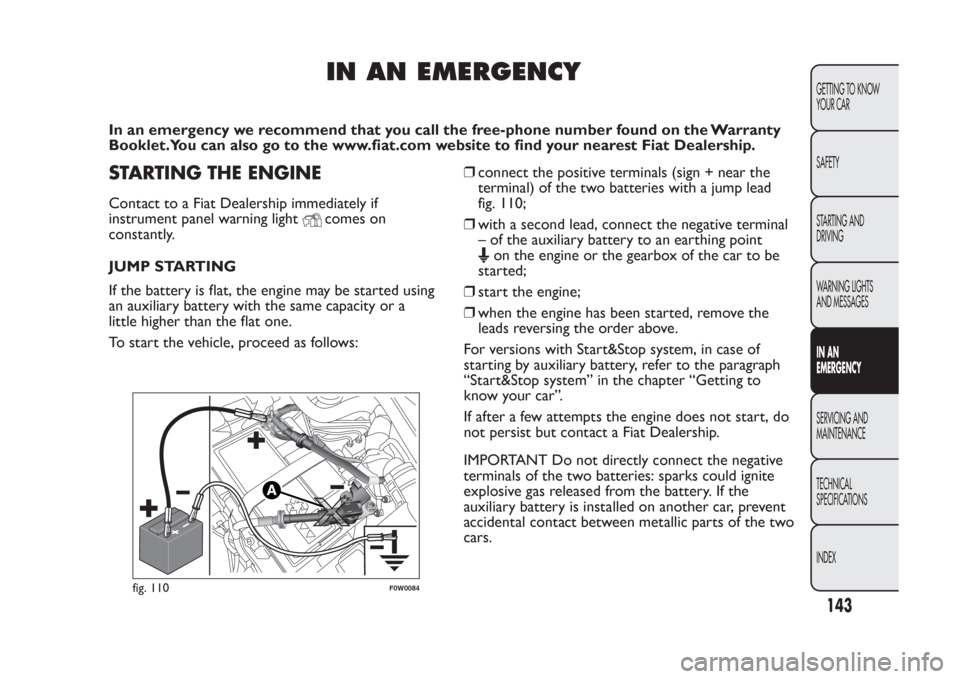
To start the vehicle, proceed as follows:❒connect the positive terminals (sign + near the
terminal) of the two batteries with a jump lead
fig. 110;
❒with a second lead, connect the negative terminal
– of the auxiliary battery to an earthing point
on the engine or the gearbox of the car to be
started;
❒start the engine;
❒when the engine has been started, remove the
leads reversing the order above.
For versions with Start&Stop system, in case of
starting by auxiliary battery, refer to the paragraph
“Start&Stop system” in the chapter “Getting to
know your car”.
If after a few attempts the engine does not start, do
not persist but contact a Fiat Dealership.
IMPORTANT Do not directly connect the negative
terminals of the two batteries: sparks could ignite
explosive gas released from the battery. If the
auxiliary battery is installed on another car, prevent
accidental contact between metallic parts of the two
cars.
fig. 110
F0W0084
143GETTING TO KNOW
YOUR CAR
SAFETY
STARTING AND
DRIVING
WARNING LIGHTS
AND MESSAGESIN AN
EMERGENCYSERVICING AND
MAINTENANCE
TECHNICAL
SPECIFICATIONS
INDEX
Page 148 of 284
Never use a fast batter y-charger to star t
the engine as this could damage the
electronic systems of your car, par ticularly
the ignition and fuel supply control units.
WARNING
This procedure must be performed by
exper t personnel because incorrect
actions could cause electrical discharge of
considerable intensity. Furthermore, battery
fluid is poisonous and corrosive: avoid contact
with skin and eyes. Keep naked flames and
lighted cigarettes away from the battery and do
not cause sparks.
BUMP STARTING
Never bump start the engine by pushing, towing or
coasting downhill.
IMPORTANT Remember that the brake servo and
electrical power steering system are not active until
the engine is started. A much greater effort will
therefore be required to use the brake pedal or turn
the steering wheel.
CHANGING A WHEELGENERAL INSTRUCTIONS
The car is equipped with the “FIX&GO Automatic
Kit”: see the paragraph “FIX&GO Automatic Kit” for
how to use this device. As an alternative to the
“FIX&GO Automatic Kit” the car may be equipped
with a space-saver wheel: see the instructions on the
following pages for changing the tyre.
WARNING
The space-saver wheel (for versions/
markets where provided) is specific to
your car, do not use it on other models, or use
the space-saver wheel of other models on your
car.The space-saver wheel must only be used
in case of emergency. It must only be used
for the distance necessary to reach a service
point and the car speed must not exceed 80
km/h.The space-saver wheel has an orange
sticker that summarises the main cautions for
use and limitations. Never remove or cover
the label.The following information is provided
in four languages on the label: "Important!
For temporar y use only! 80 km/h max! Replace
with a standard tire as soon as possible. Never
cover this indication." Never apply a wheel
cap on a space-saver wheel.
144
GETTING TO KNOW
YOUR CAR
SAFETY
STARTING AND
DRIVING
WARNING LIGHTS
AND MESSAGES
IN AN
EMERGENCY
SERVICING AND
MAINTENANCE
TECHNICAL
SPECIFICATIONS
INDEX