brake light FIAT PANDA 2013 319 / 3.G User Guide
[x] Cancel search | Manufacturer: FIAT, Model Year: 2013, Model line: PANDA, Model: FIAT PANDA 2013 319 / 3.GPages: 284, PDF Size: 11.33 MB
Page 81 of 284
HBA SYSTEM
(Hydraulic Brake Assist)
The HBA system is designed to improve the car's
braking capacity during emergency braking. The
system detects an emergency braking by monitoring
the speed and strength with which the brake pedal
is pressed, thereby applying the optimal brake
pressure.
This can reduce the stopping distance, the HBA
system therefore completes the ABS.
Max. assistance from the HBA system is obtained
pressing the brake pedal very quickly. In addition, the
brake pedal should be pressed continuously during
braking, avoiding intermittent presses, to obtain
benefits from the system.
Do not reduce pressure on the brake pedal until
braking is not necessary anymore.
The HBA system is deactivated when the brake pedal
is released.
WARNING
The HBA system cannot increase tyre
grip on the road over the limits imposed
by laws of physics: always drive carefully
according to the conditions of the road surface.
WARNING
The HBA system cannot prevent
accidents, including those due
to excessive speed on bends, travelling on
low-grip surfaces or aquaplaning.
WARNING
The HBA system is an aid for the driver,
who must always pay full attention
while driving.The responsibility always rests
with the driver.The features of the HBA system
must never be tested in imprudent or dangerous
ways, with the possibility of putting the safety
of the driver, occupants or other road users
at risk.
77GETTING TO
KNOW YOUR CARSAFETY
STARTING AND
DRIVING
WARNING LIGHTS
AND MESSAGES
IN AN EMERGENCY
SERVICING AND
MAINTENANCE
TECHNICAL
SPECIFICATIONS
INDEX
Page 84 of 284
❒driver's door not shut;
❒driver's seat belt not fastened;
❒reverse gear engaged (for example, for parking
manoeuvres);
❒for versions equipped with automatic climate
control (for versions/markets, where provided), if
an adequate level of thermal comfort has not
been reached or with MAX-DEF activation;
❒during the first period of use for a new car, to
initialise the system.
If climate comfort is to be favoured, the
Star t&Stop system can be disabled, for
continuous operation of the climate
control system and avoidance of, for example, the
windows misting up.
ENGINE RESTARTING CONDITIONS
For reasons of comfort, limiting harmful emissions
and safety purposes, the power unit can restart
automatically without any action on behalf of the
driver if certain conditions are met, including:
❒battery not sufficiently charged;
❒reduced braking system vacuum (e.g. if the brake
pedal is pressed repeatedly);
❒car moving (e.g. when driving on roads with a
gradient);❒engine stopping by Start&Stop system for over 3
minutes;
❒for versions equipped with automatic climate
control (for versions/markets where provided), to
enable suitable thermal comfort or with MAX-DEF
activation.
If a gear in engaged during stopping with Start&Stop,
the automatic restarting of the engine is only
permitted by fully depressing the clutch pedal.
The driver is informed by a message on the display
and - for versions/markets, where provided - by
the flashing of the
symbol.
If the clutch is not pressed, about 3 minutes after the
engine stops, the engine can be restarted only using
the ignition key.
In cases of undesired engine stops, due for example
to the clutch pedal being released abruptly with a
gear engaged, if the Start&Stop system is activated,
the engine can be restarted by fully depressing
the clutch pedal.
SAFETY FUNCTIONS
When the engine is stopped by the Start&Stop
system, if the driver releases his/her seat belt and
opens the driver's or passenger's door, the engine
can be restarted only using the ignition key.
The driver is informed by a buzzer and by the
flashing of the symbol
on the display; on some
versions, a message is displayed as well.
80GETTING TO
KNOW YOUR CAR
SAFETY
STARTING AND
DRIVING
WARNING LIGHTS
AND MESSAGES
IN AN EMERGENCY
SERVICING AND
MAINTENANCE
TECHNICAL
SPECIFICATIONS
INDEX
Page 87 of 284
CITY BRAKE CONTROL - "Collision
Mitigation" SYSTEM(for versions/markets, where provided)
This is a driving assistance system that can detect the
presence of nearby cars in front of the vehicle and,
in case of imminent collision, intervenes
automatically, braking the car to prevent the impact
or mitigate its effects.
The system only works if:
❒the ignition key is at MAR-ON;
❒the car speed is between 5 and 30 km/h;
❒the front seat belts are fastened.
The system can be deactivated (and then reactivated)
with the display setup menu (see paragraph “Menu
items” in this chapter).
The system activates if there is risk of imminent
collision and the driver does not press the brake
pedal promptly.
If the system detects that the vehicle ahead could be
hit, it may prepare the car to a possible emergency
braking.
If the driver does not carry out any action to prevent
the collision, the system may automatically slow
down the car, in order to prepare it to a possible
impact.When there is risk of impact, if the action on the
brake pedal by the driver is not sufficient, the system
may intervene in order to improve the reaction of
the braking system, therefore reducing car speed
further.
When driving uphill on a steep slope, the system may
intervene, activating the braking system.
Versions equipped with Start&Stop system:at
the end of the automatic braking, the Start&Stop
system will activate as described in paragraph
"Start&Stop system" of this chapter.
Versions equipped with manual gearbox:atthe
end of the automatic braking the engine may stall
and turn off, unless the driver presses the clutch
pedal.
Versions equipped with Dualogic automatic
transmission(for versions/markets, where
provided): at the end of braking the last gear stored
remains engaged.
IMPORTANT Both on versions equipped with
manual gearbox and on those with Dualogic
automatic transmission (for versions/markets, where
provided), after the car is stopped the brake calipers
may be stuck for about 2 seconds for safety reasons.
Make sure you press the brake pedal if the car moves
slightly forwards.
IMPORTANT The system doesNOTactivate
engaging the reverse. The system doesNOTactivate
if the front seat belts are not fastened.
83GETTING TO
KNOW YOUR CARSAFETY
STARTING AND
DRIVING
WARNING LIGHTS
AND MESSAGES
IN AN EMERGENCY
SERVICING AND
MAINTENANCE
TECHNICAL
SPECIFICATIONS
INDEX
Page 89 of 284
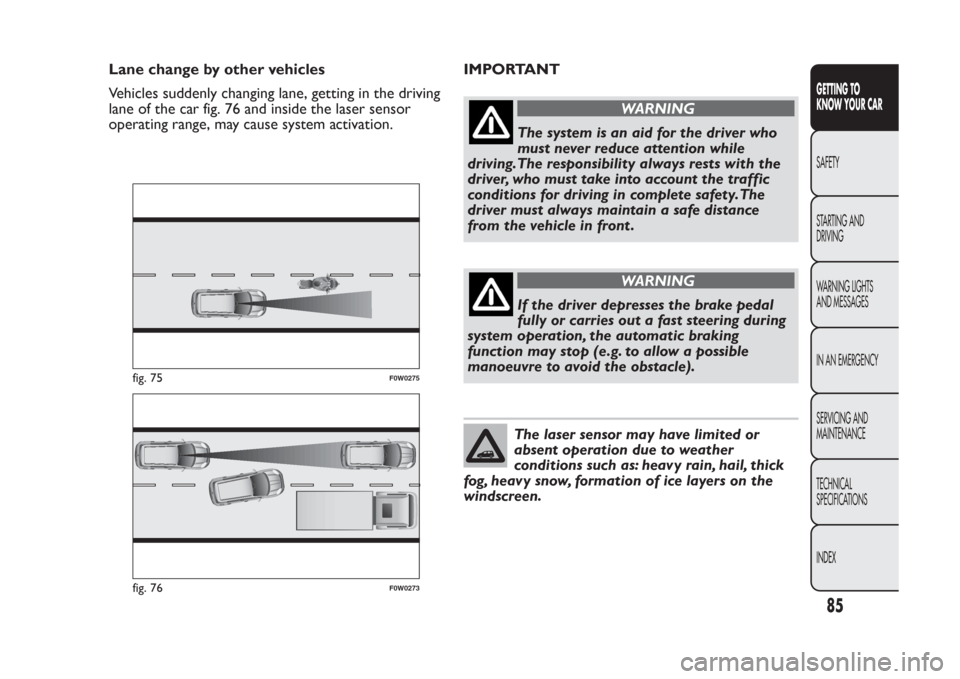
Lane change by other vehicles
Vehicles suddenly changing lane, getting in the driving
lane of the car fig. 76 and inside the laser sensor
operating range, may cause system activation.IMPORTANT
WARNING
The system is an aid for the driver who
must never reduce attention while
driving.The responsibility always rests with the
driver, who must take into account the traffic
conditions for driving in complete safety.The
driver must always maintain a safe distance
from the vehicle in front .
WARNING
If the driver depresses the brake pedal
fully or carries out a fast steering during
system operation, the automatic braking
function may stop (e.g. to allow a possible
manoeuvre to avoid the obstacle).The laser sensor may have limited or
absent operation due to weather
conditions such as: heavy rain, hail, thick
fog, heavy snow, formation of ice layers on the
windscreen.
fig. 75
F0W0275
fig. 76
F0W0273
85GETTING TO
KNOW YOUR CARSAFETY
STARTING AND
DRIVING
WARNING LIGHTS
AND MESSAGES
IN AN EMERGENCY
SERVICING AND
MAINTENANCE
TECHNICAL
SPECIFICATIONS
INDEX
Page 93 of 284
For correct operation, sensors must always
be clean from mud, dirt , snow or ice. Be
careful not to scratch or damage the
sensors while cleaning them. Avoid using dr y,
rough or hard cloths.The sensors should be
washed using clean water with the addition of car
shampoo if necessary.When using special
washing equipment such as high pressure jets or
steam cleaning, clean the sensors very quickly
keeping the jet more than 10 cm away.
GENERAL WARNINGS
❒When parking, take the utmost care over
obstacles that may be above or under the sensors.
❒Objects close to the car, are not detected under
certain circumstances and could therefore cause
damage to the car or be damaged.
Some of the conditions that could affect the
performance of the parking system are described
below:
❒Reduced sensor sensitivity and a reduction in the
parking assistance system performance could be
due to the presence on the surface of the sensor
of: ice, snow, mud, thick paint
❒The sensor may detect a non-existent obstacle
(echo interference) due to mechanical
interference, for example when washing the
vehicle, in rain, (strong wind), hail.❒The signals sent by the sensors can also be altered
by the presence of ultrasonic systems (e.g.
pneumatic brake systems or pneumatic drills) near
the vehicle.
❒Parking assistance system performance can also be
influenced by the position of the sensors, for
example due to a change in the ride setting
(caused by wear to the shock absorbers,
suspension), or by changing tyres, overloading the
car or carrying out specific tuning operations
that require the car to be lowered.
❒The presence of a tow hook without trailer
interferes with the correct operation of the
parking sensors. If a fixed tow hook is installed, the
sensors cannot be used. If the customer installs a
removable tow hook, this must always be
disconnected from the crossmember whenever
the trailer is not attached to prevent the activation
of the sensors.
WARNING
The responsibility for parking and other
dangerous manoeuvres always and in
every case lies with the driver.When making
these manoeuvres, always make sure that no
people (especially children) or animals are
present in your manoeuvering space.The parking
sensors serve to assist the driver, but must never
allow his attention to lapse during potentially
dangerous manoeuvres, even those executed at
low speeds.
89GETTING TO
KNOW YOUR CARSAFETY
STARTING AND
DRIVING
WARNING LIGHTS
AND MESSAGES
IN AN EMERGENCY
SERVICING AND
MAINTENANCE
TECHNICAL
SPECIFICATIONS
INDEX
Page 125 of 284
STARTING AND DRIVING
STARTING THE ENGINESTARTING PROCEDURE FOR PETROL
VERSIONS
0.9 TwinAir 65 HP and 85 HP versions
excluded
Proceed as follows:
❒engage the handbrake and place the gearbox lever
in neutral;
❒fully press the clutch pedal without touching the
accelerator;
❒turn the ignition key to AVV and release it as soon
as the engine starts.
If the engine does not start at the first attempt,
return the ignition key to STOP before repeating the
procedure.
If, when the ignition key is at MAR-ON, the
instrument panel warning light
remains on
together with warning light
, turn the key to
STOP and then back to MAR-ON; if the warning
light remains on, try the other keys provided with
the vehicle.
Contact a Fiat Dealership if you still cannot start the
engine.
Never leave the ignition key in MAR-ON position
when the engine is stopped.For 0.9 TwinAir 65 HP and 85 HP versions
Proceed as follows:
❒engage the handbrake and place the gear lever in
neutral or fully press the clutch pedal if a gear
other than neutral is engaged;
❒turn the ignition key to AVV and release it as soon
as the engine starts.
NoteIf the vehicle does not start at the first
attempt, return the ignition key to STOP and repeat
the starting procedure placing the gear lever in
neutral and fully pressing the clutch pedal.
If, when the ignition key is at MAR-ON, the
instrument panel warning light
remains on
together with warning light
, turn the key to
STOP and then back to MAR-ON; if the warning
light remains on, try the other keys provided with
the vehicle.
Contact a Fiat Dealership if you still cannot start the
engine.
Never leave the ignition key in MAR-ON position
when the engine is stopped.
121GETTING TO KNOW
YOUR CAR
SAFETYSTARTING AND
DRIVINGWARNING LIGHTS
AND MESSAGES
IN AN EMERGENCY
SERVICING AND
MAINTENANCE
TECHNICAL
SPECIFICATIONS
INDEX
Page 126 of 284
STARTING PROCEDURE FOR DIESEL
VERSIONS
Proceed as follows:
❒engage the handbrake and place the gearbox lever
in neutral;
❒turn the ignition key to MAR-ON: the warning
lights
and
on the instrument panel will
turn on;
❒wait for the warning lights
and
to switch
off;
❒fully press the clutch pedal without touching the
accelerator;
❒turn the ignition key to AVV as soon as warning
light
switches off. Waiting too long will waste
the heating work carried out by the plugs. Release
the key as soon as the engine starts.
IMPORTANT With cold engine, the accelerator must
be entirely released when turning the ignition key
to position AVV.
If the engine does not start at the first attempt,
return the ignition key to STOP before repeating the
procedure.
If, when the ignition key is at MAR-ON the
warning light remains lit, turn the key to STOP
and then back to MAR-ON; if the warning light
remains lit, try with the other keys provided with the
car.
Contact the Fiat Dealership if the engine still will not
start.
Warning light
will flash for 60 seconds
after starting or during prolonged
cranking to indicate a fault with the glow
plug heating system.You can use the car as usual
if the engine starts but you should contact a
Fiat Dealership as soon as possible.
WARNING
It is dangerous to run the engine in
enclosed areas.The engine takes
in oxygen and releases carbon dioxide, carbon
monoxide and other toxic gases.
WARNING
Remember that the brake servo and
power steering are not operational until
the engine has been started, therefore much
effort than usual is required on the brake pedal
and steering wheel.We recommend that during the initial
period you do not demand to full
performance from the car (e.g. excessive
acceleration, long journeys at top speed, sharp
braking etc .).
122
GETTING TO KNOW
YOUR CAR
SAFETYSTARTING AND
DRIVINGWARNING LIGHTS
AND MESSAGES
IN AN EMERGENCY
SERVICING AND
MAINTENANCE
TECHNICAL
SPECIFICATIONS
INDEX
Page 128 of 284
PARKINGStop the engine and engage the handbrake. Engage a
gear (1
st
gear if parked uphill or reverse if facing
downhill) and leave the wheels turned. If the car is
parked on a steep slope block the wheels with a
wedge or stone. Always remove the ignition key
when leaving the car.
WARNING
Never leave children unattended in the
car. Always remove the key from the
ignition when leaving the car and take it with
you.HANDBRAKE
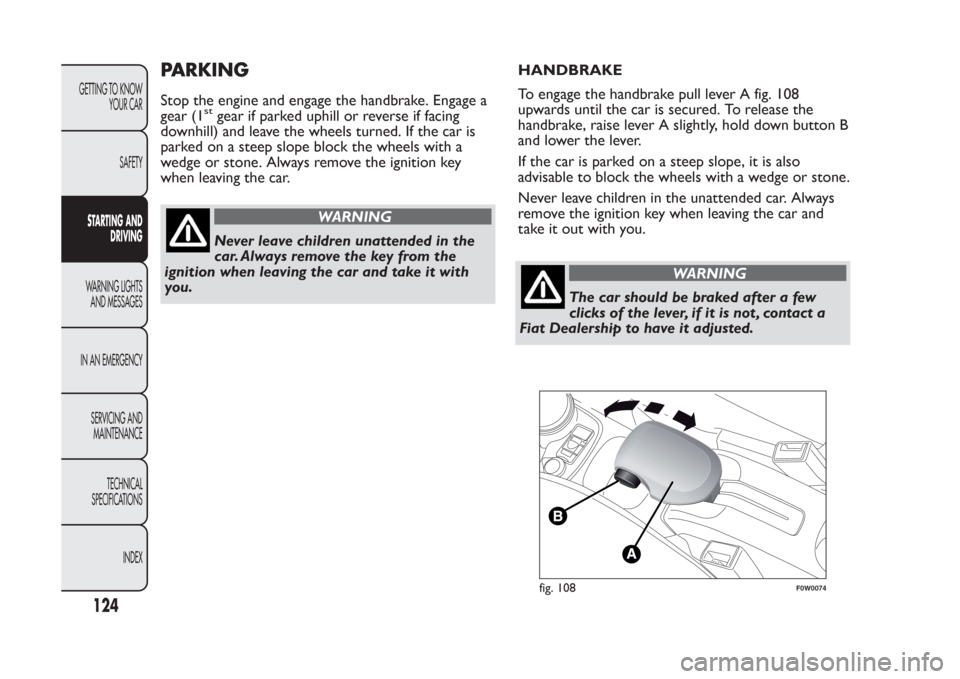
To engage the handbrake pull lever A fig. 108
upwards until the car is secured. To release the
handbrake, raise lever A slightly, hold down button B
and lower the lever.
If the car is parked on a steep slope, it is also
advisable to block the wheels with a wedge or stone.
Never leave children in the unattended car. Always
remove the ignition key when leaving the car and
take it out with you.
WARNING
The car should be braked after a few
clicks of the lever, if it is not , contact a
Fiat Dealership to have it adjusted.
fig. 108
F0W0074
124
GETTING TO KNOW
YOUR CAR
SAFETYSTARTING AND
DRIVINGWARNING LIGHTS
AND MESSAGES
IN AN EMERGENCY
SERVICING AND
MAINTENANCE
TECHNICAL
SPECIFICATIONS
INDEX
Page 132 of 284
TOWING TRAILERSIMPORTANT NOTES
For towing caravans or trailers the car must be fitted
with a type-approved tow hook and an adequate
electrical system. Installation must be carried out by
a specialist.
Fit any specific and/or additional rear view mirrors as
specified by the Highway Code.
Remember that when towing a trailer, steep hills are
harder to climb, braking distances increase and
overtaking takes longer depending on the overall
weight of the trail.
Engage a low gear when driving downhill, rather than
constantly using the brake.
The weight of the trailer on the car's tow hook will
reduce the load capacity of the car by the same
amount. To make sure that the maximum towable
weight is not exceeded (given in the car registration
document) account should be taken of the fully
laden trailer, including accessories and luggage.
Respect the speed limits specific to each country for
vehicles towing trailers. In any case, the maximum
speed must not exceed 100 km/h.
An electric brake or winch must be powered directly
by the battery through a cable with a cross-section
of no less than 2.5 mm
2.In addition to the electrical branches, the vehicle's
electrical system can be connected only to the supply
cable for an electric brake and to the cable for an
internal trailer light, though not more than 15 W. For
connections, use the preset control unit with a
battery cable with section no less than 2.5 mm
2.
IMPORTANT The use of auxiliary loads other than
external lights (electric brake, winch, etc.) must
be used with engine running.
IMPORTANT To install a tow hook contact a Fiat
Dealership.
WARNING
The ABS with which the car may be
equipped will not control the braking
system of the trailer. Particular caution is
required on slippery roads.
WARNING
Never modify the braking system of the
car to control the trailer brake.The
trailer braking system must be fully
independent of the car ’s hydraulic system.
128
GETTING TO KNOW
YOUR CAR
SAFETYSTARTING AND
DRIVINGWARNING LIGHTS
AND MESSAGES
IN AN EMERGENCY
SERVICING AND
MAINTENANCE
TECHNICAL
SPECIFICATIONS
INDEX
Page 135 of 284
STORING THE CARIf the car is to be left inactive for longer than a
month, the following precautions should be taken:
❒park the car in covered, dry and if possible
well-ventilated premises and slightly open
the windows;
❒engage a gear and check that the handbrake is not
engaged;
❒disconnect the negative battery terminal (for
versions with Start&Stop system refer to the
paragraph "Start&Stop system" in the chapter
"Knowing your car"); If the battery is not
disconnected from the electrical system, check its
charge every thirty days;
❒clean and protect the painted parts using
protective wax;
❒clean and protect the shiny metal parts using
special compounds available commercially;❒sprinkle talcum powder on the windscreen and
rear window wiper rubber blades and lift them
off the glass;
❒cover the car with a cloth or perforated plastic
sheet. Do not use sheets of non-perforated plastic
as they do not allow moisture on the car body
to evaporate;
❒inflate tyres to +0.5 bar above the standard
specified pressure and check it at intervals;
❒do not drain the engine cooling system.
131GETTING TO KNOW
YOUR CAR
SAFETYSTARTING AND
DRIVINGWARNING LIGHTS
AND MESSAGES
IN AN EMERGENCY
SERVICING AND
MAINTENANCE
TECHNICAL
SPECIFICATIONS
INDEX