climate control FIAT PANDA 2013 319 / 3.G User Guide
[x] Cancel search | Manufacturer: FIAT, Model Year: 2013, Model line: PANDA, Model: FIAT PANDA 2013 319 / 3.GPages: 284, PDF Size: 11.33 MB
Page 43 of 284
IMPORTANT It is inadvisable to use air recirculation
when the outside temperature is low, since the
windows could mist rapidly.
Button E
- Climate control on/off
Pressing thebutton switches the system on/off.
With the system off, the climate control system
conditions are as follows:
❒all LEDs are off;
❒set temperature display is off;
❒air recirculation is off;
❒compressor is off;
❒fan is off.
Button F- Heated rear window, folding
mirror/heated windscreen (for versions/
markets, where available) activation/
deactivation
Pressing thebutton switches on the LED on the
button.
Buttons G/M
/
- Fan speed adjustment
Use buttons G
or M
to increase or decrease the
air flow.
Button H (AUTO) - AUTO function activation
(automatic climate control operation)
When the AUTO button is pressed and the required
temperature is set, the system adjusts thetemperature, quantity and distribution of air entering
the passenger compartment and controls
compressor operation.
Button I - Air temperature increase
When the button is pressed, the passenger
compartment air temperature increases.
Button L - Air temperature decrease
When the button is pressed, the passenger
compartment air temperature decreases.
DESCRIPTION
The automatically controlled parameters and
functions are:
❒air temperature at the vents;
❒air distribution at the vents;
❒fan speed (continuous variation of the air flow);
❒compressor activation (for cooling/dehumidifying
the air);
❒air recirculation.
All functions may be changed manually. In other
words, you may select one or more functions and
change the parameters as required. Automatic
control of the manually changed functions will be
suspended: the system will only override your
settings for safety-related reasons (e.g. risk
of misting).
39GETTING TO
KNOW YOUR CARSAFETY
STARTING AND
DRIVING
WARNING LIGHTS
AND MESSAGES
IN AN EMERGENCY
SERVICING AND
MAINTENANCE
TECHNICAL
SPECIFICATIONS
INDEX
Page 44 of 284
Manual selections always have higher priority over
automatic settings and are stored until the user
switches the system back to automatic control
except for cases in which the system intervenes for
particular safety-related reasons. You can adjust
one function manually without affecting the
automatic control of the others.
The amount of air introduced into the passenger
compartment is not affected by car speed; it is
regulated by the fan, which is controlled
electronically.
The temperature of the air supplied is always
controlled automatically, depending on the
temperature set in the driver’s display (except when
the system is off or in certain conditions when the
compressor is switched off ).
The system allows the following to be set or adjusted
manually:
❒air temperature;
❒fan speed (continuous variation);
❒air distribution with 5 positions;
❒compressor enablement;
❒rapid defrosting/demisting function;
❒air recirculation;
❒heated rear window, folding mirror/heated
windscreen (for versions/markets, where available);
❒system deactivation.SWITCHING ON THE CLIMATE CONTROL
SYSTEM
The system can be switched on in various ways; it is
however advisable to press the AUTO button and
set the desired temperature on the display.
The climate control system allows you to customise
the requested temperatures.
The climate control system compressor works only
with the engine running and with an outside
temperature of above 0°C.
AUTOMATIC CLIMATE CONTROL SYSTEM
OPERATION
Press the AUTO button; the system will
automatically adjust:
❒the amount of air introduced into the passenger
compartment;
❒the distribution of the air in the passenger
compartment;
cancelling all previous manual adjustments.
The LED on the AUTO button switches on during
automatic climate control operation.
During automatic operation it is still possible to
adjust the temperatures set and carry out one of the
following operations manually:
❒fan speed adjustment;
❒air distribution selection;
❒internal air recirculation activation/deactivation;
❒climate control compressor activation.
40GETTING TO
KNOW YOUR CAR
SAFETY
STARTING AND
DRIVING
WARNING LIGHTS
AND MESSAGES
IN AN EMERGENCY
SERVICING AND
MAINTENANCE
TECHNICAL
SPECIFICATIONS
INDEX
Page 45 of 284
WARNING
It is advisable not to use the air
recirculation function when the outside
temperature is low to prevent the windows from
rapidly misting up.
ADJUSTING THE FAN SPEED
Press the G fig. 30
or M
button to increase/
decrease the fan speed
.
The possible speeds are displayed through a
progression of individual bars which comprise the
symbol:
❒maximum fan speed = all bars lit
❒minimum fan speed = half a bar lit.
The fan can be disabled (no bars lit) only if the
climate control compressor has been switched off by
pressing the
button.
To restore automatic fan speed control after a
manual adjustment, press the AUTO button.RAPID FRONT WINDOW
DEMISTING/DEFROSTING (MAX-DEF
function)
Press the
button to automatically activate the
timed operation of all the functions required to
rapidly demist/defrost the windscreen and front side
windows (for versions/markets, where provided).
The functions are:
❒climate control compressor activation (with an
outside temperature of above 0°C);
❒deactivation, if previously activated, of the internal
air recirculation;
❒activation of heated rear window (LED on
button on) and door mirror heater coils (for
versions/markets, where provided);
❒setting maximum air temperature;
❒activation of air flow.
HEATED WINDSCREEN/HEATED REAR
WINDOW AND DOOR MIRROR
DEMISTING/DEFROSTING (for
versions/markets, where provided)
Press the
button to activate: when this function is
activated, the LED on the button switches on.
For versions/markets where provided, press the
button to activate also demisting/defrosting
of windscreen (with engine running only) and door
mirrors (for versions/markets, where provided).
41GETTING TO
KNOW YOUR CARSAFETY
STARTING AND
DRIVING
WARNING LIGHTS
AND MESSAGES
IN AN EMERGENCY
SERVICING AND
MAINTENANCE
TECHNICAL
SPECIFICATIONS
INDEX
Page 46 of 284
This function is timed and switches off automatically
after 4 minutes for the windscreen and 20 minutes
for the rear window and door mirrors.
Press the
button again to switch the function off
in advance.
To activate the heated windscreen again press the
button
:
❒twice with LED on the button still on;
❒once with LED on the button off.
When the button
is pressed, the heated
windscreen activates if it has not been activated
already by button.
IMPORTANT Do not apply stickers on the inside of
the rear window over the heating filaments to avoid
damage.
IMPORTANT To draw in air from the outside, press
the
button. The LED next to the button
switches off.
INTERNAL AIR RECIRCULATION
ACTIVATION
Air recirculation is carried out according to two
possible operating modes:
❒forced deactivation (air recirculation always
deactivated, air taken from the outside);
❒forced activation (internal air circulation always
activated).
To activate internal air recirculation, press button D
.❒LED on button on: internal air recirculation on;
❒LED on button off: internal air recirculation off, air
drawn in from outside.
When the
button is pressed, the climate control
system automatically activates internal air
recirculation. External air recirculation can always be
activated by pressing the
button (LED off )
and vice versa.
Automatic recirculation operation is activated by
pressing the AUTO button.
IMPORTANT Internal air recirculation makes it
possible to reach the required heating or cooling
conditions more quickly depending on the mode
selected. It is not advisable to switch the air
recirculation on when it is rainy/cold to prevent the
windows from misting up, especially if the climate
control is not turned on. It is advisable to switch the
internal air recirculation on whilst queuing or in
tunnels, or whilst driving on dusty roads, to prevent
the introduction of polluted air. Do not use the
function for a long time, particularly if there are
several passengers on board, to prevent the windows
from misting up.
42GETTING TO
KNOW YOUR CAR
SAFETY
STARTING AND
DRIVING
WARNING LIGHTS
AND MESSAGES
IN AN EMERGENCY
SERVICING AND
MAINTENANCE
TECHNICAL
SPECIFICATIONS
INDEX
Page 47 of 284
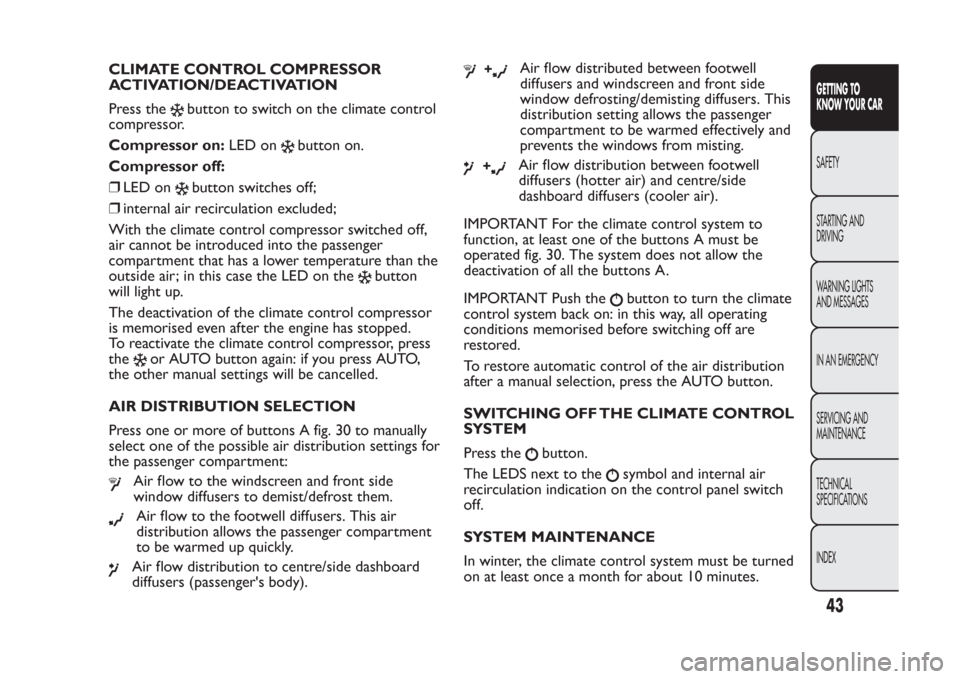
CLIMATE CONTROL COMPRESSOR
ACTIVATION/DEACTIVATION
Press the
button to switch on the climate control
compressor.
Compressor on:LED on
button on.
Compressor off:
❒LED on
button switches off;
❒internal air recirculation excluded;
With the climate control compressor switched off,
air cannot be introduced into the passenger
compartment that has a lower temperature than the
outside air; in this case the LED on the
button
will light up.
The deactivation of the climate control compressor
is memorised even after the engine has stopped.
To reactivate the climate control compressor, press
the
or AUTO button again: if you press AUTO,
the other manual settings will be cancelled.
AIR DISTRIBUTION SELECTION
Press one or more of buttons A fig. 30 to manually
select one of the possible air distribution settings for
the passenger compartment:
Air flow to the windscreen and front side
window diffusers to demist/defrost them.Air flow to the footwell diffusers. This air
distribution allows the passenger compartment
to be warmed up quickly.Air flow distribution to centre/side dashboard
diffusers (passenger's body).
+
Air flow distributed between footwell
diffusers and windscreen and front side
window defrosting/demisting diffusers. This
distribution setting allows the passenger
compartment to be warmed effectively and
prevents the windows from misting.
+
Air flow distribution between footwell
diffusers (hotter air) and centre/side
dashboard diffusers (cooler air).
IMPORTANT For the climate control system to
function, at least one of the buttons A must be
operated fig. 30. The system does not allow the
deactivation of all the buttons A.
IMPORTANT Push the
button to turn the climate
control system back on: in this way, all operating
conditions memorised before switching off are
restored.
To restore automatic control of the air distribution
after a manual selection, press the AUTO button.
SWITCHING OFF THE CLIMATE CONTROL
SYSTEM
Press the
button.
The LEDS next to the
symbol and internal air
recirculation indication on the control panel switch
off.
SYSTEM MAINTENANCE
In winter, the climate control system must be turned
on at least once a month for about 10 minutes.
43GETTING TO
KNOW YOUR CARSAFETY
STARTING AND
DRIVING
WARNING LIGHTS
AND MESSAGES
IN AN EMERGENCY
SERVICING AND
MAINTENANCE
TECHNICAL
SPECIFICATIONS
INDEX
Page 48 of 284
Have the system inspected at a Fiat Dealership
before the summer.
The system uses R134a coolant which
does not pollute the environment in the
event of accidental leakage. Never use
R12 fluid, which is not compatible with the
system components.
ADDITIONAL HEATER
(for versions/markets, where provided)
This allows the passenger compartment to be heated
more quickly in cold weather conditions. The heater
switches on automatically according to the
environmental conditions and with engine started
when the temperature of the engine coolant is low.
The additional heater turns off automatically after
the required comfort conditions are achieved.
The heater only operates if the outside temperature
and engine coolant temperature are low. The heater
will not activate if the battery voltage is too low.
Interaction of Automatic Climate Control
with START&STOP
(for versions/markets, where provided)
Automatic Climate Control
The automatic climate control manages the
Start&Stop function (engine off when the car speed
is zero) to guarantee adequate comfort inside the
passenger compartment.In particular, when the weather is extremely hot or
cold, the Start&Stop function is deactivated until
adequate passenger compartment comfort is
ensured. During these transitory stages the engine is
not stopped, even if the car speed is zero.
When the Start&Stop function is active (engine off at
zero car speed), the climate control system will
request the reactivation of the engine if the inside
temperature conditions rapidly deteriorate (or if the
user requests maximum cooling – LO – or quick
demisting – MAX DEF).
With Start&Stop function active (engine off at zero
car speed), the air flow rate (if managed
automatically) is reduced in order to maintain the
passenger compartment comfort conditions for
as long as possible.
The climate control system control unit manages the
decreased comfort caused by stopping the engine,
and consequently the compressor, as far as possible.
The operation of the climate control system can in
any case be favoured by deactivating the Start&Stop
function using the dedicated button on the
dashboard.
NOTE In particularly severe climate conditions it is
recommended to limit the use of the Start&Stop
function to prevent the compressor from
continuously switching on and off, with consequent
rapid misting of the windows and accumulation of
humidity with unpleasant smells in the passenger
compartment.
44GETTING TO
KNOW YOUR CAR
SAFETY
STARTING AND
DRIVING
WARNING LIGHTS
AND MESSAGES
IN AN EMERGENCY
SERVICING AND
MAINTENANCE
TECHNICAL
SPECIFICATIONS
INDEX
Page 84 of 284
❒driver's door not shut;
❒driver's seat belt not fastened;
❒reverse gear engaged (for example, for parking
manoeuvres);
❒for versions equipped with automatic climate
control (for versions/markets, where provided), if
an adequate level of thermal comfort has not
been reached or with MAX-DEF activation;
❒during the first period of use for a new car, to
initialise the system.
If climate comfort is to be favoured, the
Star t&Stop system can be disabled, for
continuous operation of the climate
control system and avoidance of, for example, the
windows misting up.
ENGINE RESTARTING CONDITIONS
For reasons of comfort, limiting harmful emissions
and safety purposes, the power unit can restart
automatically without any action on behalf of the
driver if certain conditions are met, including:
❒battery not sufficiently charged;
❒reduced braking system vacuum (e.g. if the brake
pedal is pressed repeatedly);
❒car moving (e.g. when driving on roads with a
gradient);❒engine stopping by Start&Stop system for over 3
minutes;
❒for versions equipped with automatic climate
control (for versions/markets where provided), to
enable suitable thermal comfort or with MAX-DEF
activation.
If a gear in engaged during stopping with Start&Stop,
the automatic restarting of the engine is only
permitted by fully depressing the clutch pedal.
The driver is informed by a message on the display
and - for versions/markets, where provided - by
the flashing of the
symbol.
If the clutch is not pressed, about 3 minutes after the
engine stops, the engine can be restarted only using
the ignition key.
In cases of undesired engine stops, due for example
to the clutch pedal being released abruptly with a
gear engaged, if the Start&Stop system is activated,
the engine can be restarted by fully depressing
the clutch pedal.
SAFETY FUNCTIONS
When the engine is stopped by the Start&Stop
system, if the driver releases his/her seat belt and
opens the driver's or passenger's door, the engine
can be restarted only using the ignition key.
The driver is informed by a buzzer and by the
flashing of the symbol
on the display; on some
versions, a message is displayed as well.
80GETTING TO
KNOW YOUR CAR
SAFETY
STARTING AND
DRIVING
WARNING LIGHTS
AND MESSAGES
IN AN EMERGENCY
SERVICING AND
MAINTENANCE
TECHNICAL
SPECIFICATIONS
INDEX
Page 130 of 284
SAVING FUELHere are some suggestions which can help you to
save fuel and lower harmful emissions.
GENERAL CONSIDERATIONS
Car maintenance
Have checks and adjustments carried out in
accordance with the “Scheduled Servicing Plan”.
Ty r e s
Check the tyre pressures at least once every 4
weeks: if the pressure is too low, consumption levels
increase as resistance to rolling is higher.
Unnecessary loads
Do not travel with an overloaded boot. The weight
of the car and its arrangement greatly affect fuel
consumption and stability.
Roof rack/ski rack
Remove the roof rack or the ski rack from the roof
after use. These accessories lower aerodynamic
penetration and adversely affect consumption levels.
When transporting particularly large objects, use a
trailer if possible.Electrical devices
Only use electrical devices for the amount of time
needed. The heated rear window, additional
headlights, windscreen wipers and heater fan need a
considerable amount of energy, therefore increasing
fuel consumption (by up to 25% in the urban cycle).
Climate control system
The use of the climate control system leads to higher
fuel consumption. If the temperature outside
permits, try to use ventilation only.
Devices for aerodynamic control
The use of non-certified devices for aerodynamic
control may adversely affect air drag and fuel
consumption.
DRIVING STYLE
Starting
Do not warm the engine with the car at a standstill
or at idle or high speed: under these conditions
the engine warms up much more slowly, increasing
consumption and emissions. It is therefore advisable
to move off immediately, slowly, avoiding high speeds:
in this way the engine will warm up more quickly.
126
GETTING TO KNOW
YOUR CAR
SAFETYSTARTING AND
DRIVINGWARNING LIGHTS
AND MESSAGES
IN AN EMERGENCY
SERVICING AND
MAINTENANCE
TECHNICAL
SPECIFICATIONS
INDEX
Page 229 of 284
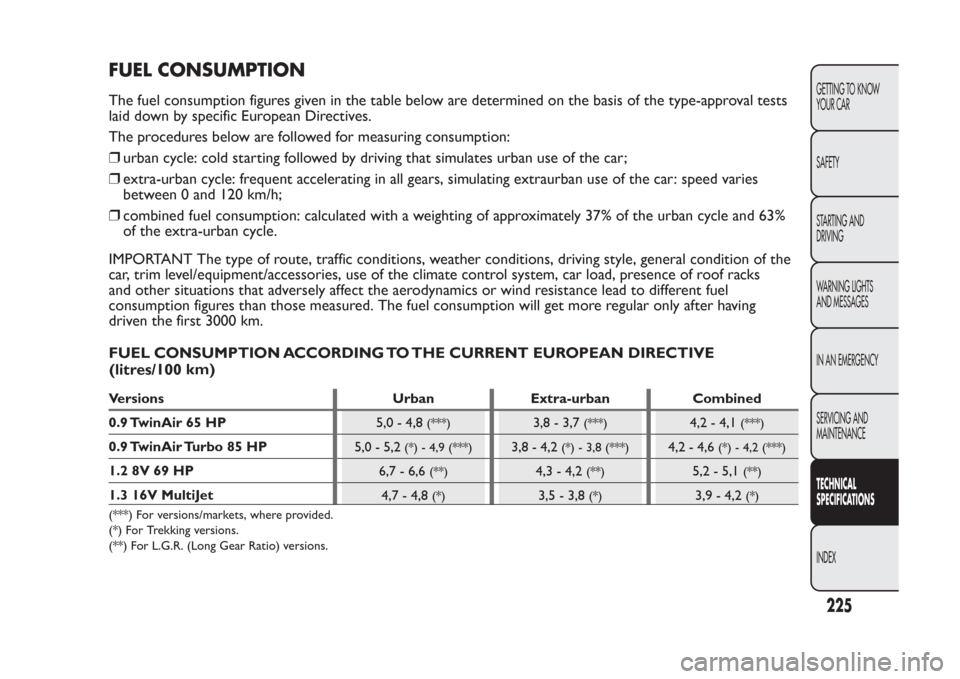
FUEL CONSUMPTIONThe fuel consumption figures given in the table below are determined on the basis of the type-approval tests
laid down by specific European Directives.
The procedures below are followed for measuring consumption:
❒urban cycle: cold starting followed by driving that simulates urban use of the car;
❒extra-urban cycle: frequent accelerating in all gears, simulating extraurban use of the car: speed varies
between 0 and 120 km/h;
❒combined fuel consumption: calculated with a weighting of approximately 37% of the urban cycle and 63%
of the extra-urban cycle.
IMPORTANT The type of route, traffic conditions, weather conditions, driving style, general condition of the
car, trim level/equipment/accessories, use of the climate control system, car load, presence of roof racks
and other situations that adversely affect the aerodynamics or wind resistance lead to different fuel
consumption figures than those measured. The fuel consumption will get more regular only after having
driven the first 3000 km.
FUEL CONSUMPTION ACCORDING TO THE CURRENT EUROPEAN DIRECTIVE
km)Versions Urban Extra-urban Combined
0.9 TwinAir 65 HP
5,0 - 4,8
(***)
3,8 - 3,7
(***)
4,2 - 4,1
(***)
0.9 TwinAir Turbo 85 HP
5,0 - 5,2
(*) - 4,9 (***)
3,8 - 4,2
(*) - 3,8 (***)
4,2 - 4,6
(*) - 4,2 (***)
1.2 8V 69 HP
6,7 - 6,6
(**)
4,3 - 4,2
(**)
5,2 - 5,1
(**)
1.3 16V MultiJet
4,7 - 4,8
(*)
3,5 - 3,8
(*)
3,9 - 4,2
(*)
(***) For versions/markets, where provided.
(*) For Trekking versions.
(**) For L.G.R. (Long Gear Ratio) versions.
225GETTING TO KNOW
YOUR CAR
SAFETY
STARTING AND
DRIVING
WARNING LIGHTS
AND MESSAGES
IN AN EMERGENCY
SERVICING AND
MAINTENANCETECHNICAL
SPECIFICATIONSINDEX
(litres/100
Page 269 of 284
RIGHT HAND DRIVE VERSIONS
2
(RIGHT-HAND DRIVE VERSION)
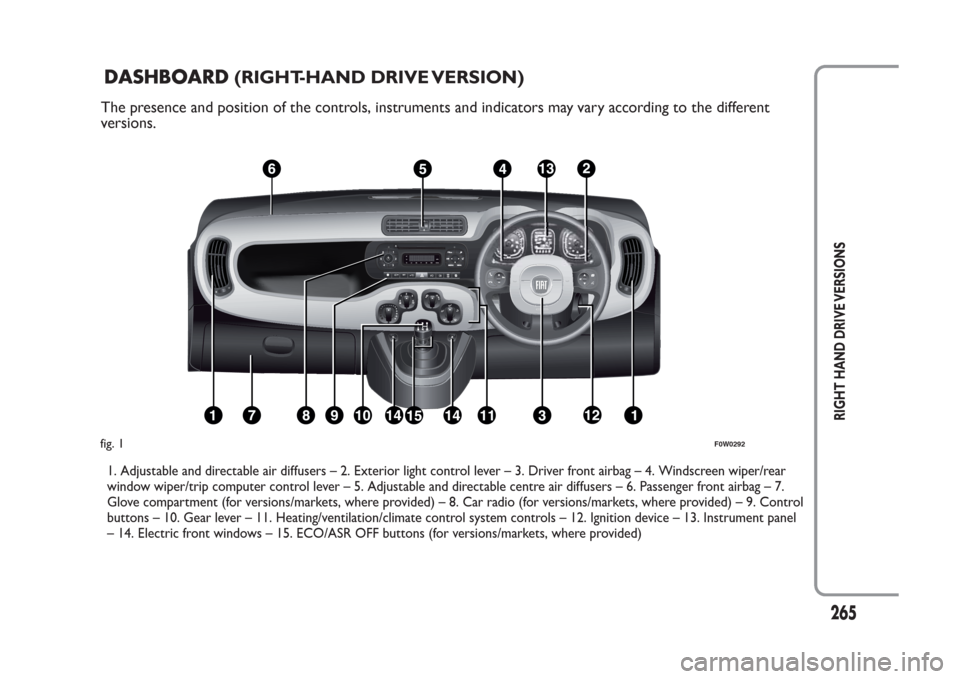
The presence and position of the controls, instruments and indicators may vary according to the different
versions.1. Adjustable and directable air diffusers – 2. Exterior light control lever – 3. Driver front airbag – 4. Windscreen wiper/rear
window wiper/trip computer control lever – 5. Adjustable and directable centre air diffusers – 6. Passenger front airbag – 7.
Glove compartment (for versions/markets, where provided) – 8. Car radio (for versions/markets, where provided) – 9. Control
buttons – 10. Gear lever – 11. Heating/ventilation/climate control system controls – 12. Ignition device – 13. Instrument panel
– 14. Electric front windows – 15. ECO/ASR OFF buttons (for versions/markets, where provided)
TOTkmiC
fig. 1
F0W0292
65
DASHBOARD