roof FIAT PANDA 2013 319 / 3.G User Guide
[x] Cancel search | Manufacturer: FIAT, Model Year: 2013, Model line: PANDA, Model: FIAT PANDA 2013 319 / 3.GPages: 284, PDF Size: 11.33 MB
Page 96 of 284
WARNING
If you wish to have a sound system
installed after purchasing the car, first
contact a Fiat Dealership whose qualified
personnel will give you advise about a sound
system that does not damage the batter y
charge. Excessive nonrunning consumption
damages the batter y and may cause your
batter y warranty to be terminated.
SETUP
(for versions/markets, where provided)
The system consists of:
❒radio supply leads;
❒radio housing;
❒aerial (on car roof );
❒according to the option requested, the setup
consists of four or six speakers.
Setup for four speakers
(for versions/markets, where provided)
The system consists of:
❒two 165-mm diameter full-range speakers in the
front door panels;
❒two 130-mm diameter full-range speakers in rear
front door panels.Setup for six speakers
(if requested as an optional, as an alternative to the
basic audio level)
The system consists of:
❒two 38-mm diameter tweeters in the front pillar at
the sides of the windscreen;
❒two 165-mm diameter mid-woofer speakers in the
front door panels;
❒two 130-mm diameter full-range speakers in rear
front door panels.
92GETTING TO
KNOW YOUR CAR
SAFETY
STARTING AND
DRIVING
WARNING LIGHTS
AND MESSAGES
IN AN EMERGENCY
SERVICING AND
MAINTENANCE
TECHNICAL
SPECIFICATIONS
INDEX
Page 119 of 284
AIR BAGSThe car is fitted with front air bags for driver and
passenger, front side bags for driver and passenger
chest-shoulder protection (for versions/markets,
where provided) and window bags for protecting the
heads of front occupants.
FRONT AIR BAGS
The front (driver and passenger) air bags protect the
front seat occupants in the event of head-on impacts
of medium-high severity, by placing the bag between
the occupant and the steering wheel or dashboard.
Therefore non-deployment in other types of impacts
(side impacts, rear shunts, roll-overs, etc.) does not
indicate a system malfunction.
Front (driver and passenger) air bags are not a
replacement of but complementary to the seat belts,
which you are recommended to always wear, as
specified by law in Europe and most non-European
countries.
In the event of an impact, those not wearing a seat
belt move forwards and may come into contact with
the bag which is still inflating. The protection offered
by the bag is compromised in these circumstances.
Front airbags may not deploy in the following
situations:❒frontal impacts against highly deformable objects
not involving the front surface of the car (e.g.
wing collision against guard rail, etc.);
❒car wedging under other vehicles or protective
barriers (e.g. trucks or guard rails);
they may not provide any additional protection
compared with seat belts, so their activation would
be inappropriate. In these cases, non-deployment
does not indicate a system malfunction.
WARNING
Do not apply stickers or other objects
on the steering wheel, on the dashboard
in the passenger side air bag area, on side
upholstery on roof and on the seats. Never put
objects (e.g. mobile phones) on the passenger's
side dashboard since they could interfere with
correct inflation of the air bag and also cause
serious injur y to the passengers.
Driver's front air bag
This consists of an instantly inflating bag contained in
a special recess in the centre of the steering wheel
fig. 104.
115GETTING TO KNOW
YOUR CARSAFETYSTARTING AND
DRIVING
WARNING LIGHTS
AND MESSAGES
IN AN EMERGENCY
SERVICING AND
MAINTENANCE
TECHNICAL
SPECIFICATIONS
INDEX
Page 122 of 284
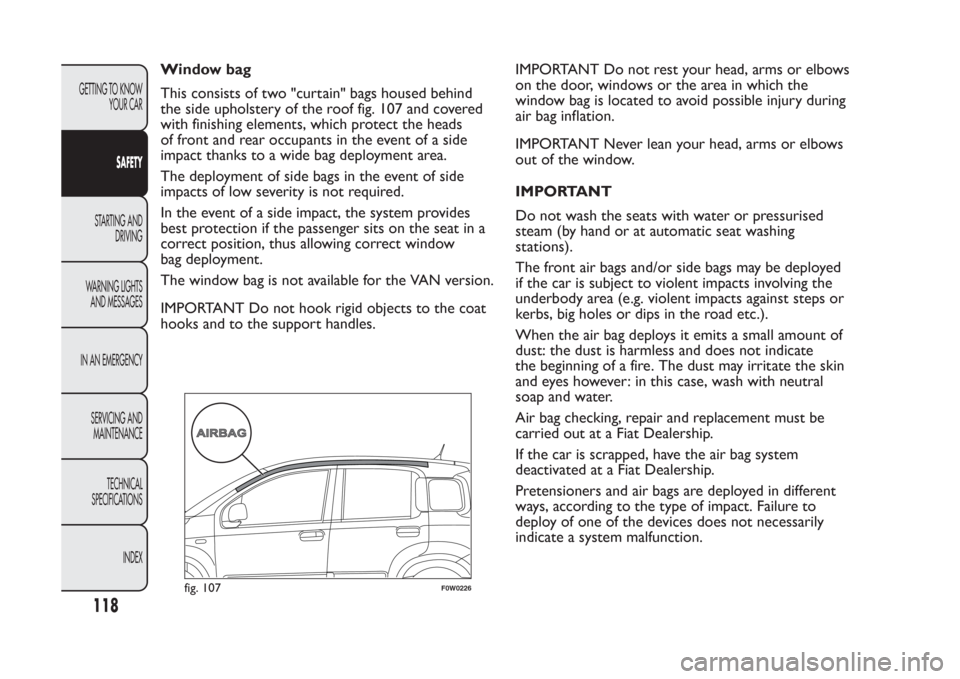
Window bag
This consists of two "curtain" bags housed behind
the side upholstery of the roof fig. 107 and covered
with finishing elements, which protect the heads
of front and rear occupants in the event of a side
impact thanks to a wide bag deployment area.
The deployment of side bags in the event of side
impacts of low severity is not required.
In the event of a side impact, the system provides
best protection if the passenger sits on the seat in a
correct position, thus allowing correct window
bag deployment.
The window bag is not available for the VAN version.
IMPORTANT Do not hook rigid objects to the coat
hooks and to the support handles.IMPORTANT Do not rest your head, arms or elbows
on the door, windows or the area in which the
window bag is located to avoid possible injury during
air bag inflation.
IMPORTANT Never lean your head, arms or elbows
out of the window.
IMPORTANT
Do not wash the seats with water or pressurised
steam (by hand or at automatic seat washing
stations).
The front air bags and/or side bags may be deployed
if the car is subject to violent impacts involving the
underbody area (e.g. violent impacts against steps or
kerbs, big holes or dips in the road etc.).
When the air bag deploys it emits a small amount of
dust: the dust is harmless and does not indicate
the beginning of a fire. The dust may irritate the skin
and eyes however: in this case, wash with neutral
soap and water.
Air bag checking, repair and replacement must be
carried out at a Fiat Dealership.
If the car is scrapped, have the air bag system
deactivated at a Fiat Dealership.
Pretensioners and air bags are deployed in different
ways, according to the type of impact. Failure to
deploy of one of the devices does not necessarily
indicate a system malfunction.
fig. 107
F0W0226
118
GETTING TO KNOW
YOUR CAR
SAFETY
STARTING AND
DRIVING
WARNING LIGHTS
AND MESSAGES
IN AN EMERGENCY
SERVICING AND
MAINTENANCE
TECHNICAL
SPECIFICATIONS
INDEX
Page 130 of 284
SAVING FUELHere are some suggestions which can help you to
save fuel and lower harmful emissions.
GENERAL CONSIDERATIONS
Car maintenance
Have checks and adjustments carried out in
accordance with the “Scheduled Servicing Plan”.
Ty r e s
Check the tyre pressures at least once every 4
weeks: if the pressure is too low, consumption levels
increase as resistance to rolling is higher.
Unnecessary loads
Do not travel with an overloaded boot. The weight
of the car and its arrangement greatly affect fuel
consumption and stability.
Roof rack/ski rack
Remove the roof rack or the ski rack from the roof
after use. These accessories lower aerodynamic
penetration and adversely affect consumption levels.
When transporting particularly large objects, use a
trailer if possible.Electrical devices
Only use electrical devices for the amount of time
needed. The heated rear window, additional
headlights, windscreen wipers and heater fan need a
considerable amount of energy, therefore increasing
fuel consumption (by up to 25% in the urban cycle).
Climate control system
The use of the climate control system leads to higher
fuel consumption. If the temperature outside
permits, try to use ventilation only.
Devices for aerodynamic control
The use of non-certified devices for aerodynamic
control may adversely affect air drag and fuel
consumption.
DRIVING STYLE
Starting
Do not warm the engine with the car at a standstill
or at idle or high speed: under these conditions
the engine warms up much more slowly, increasing
consumption and emissions. It is therefore advisable
to move off immediately, slowly, avoiding high speeds:
in this way the engine will warm up more quickly.
126
GETTING TO KNOW
YOUR CAR
SAFETYSTARTING AND
DRIVINGWARNING LIGHTS
AND MESSAGES
IN AN EMERGENCY
SERVICING AND
MAINTENANCE
TECHNICAL
SPECIFICATIONS
INDEX
Page 166 of 284
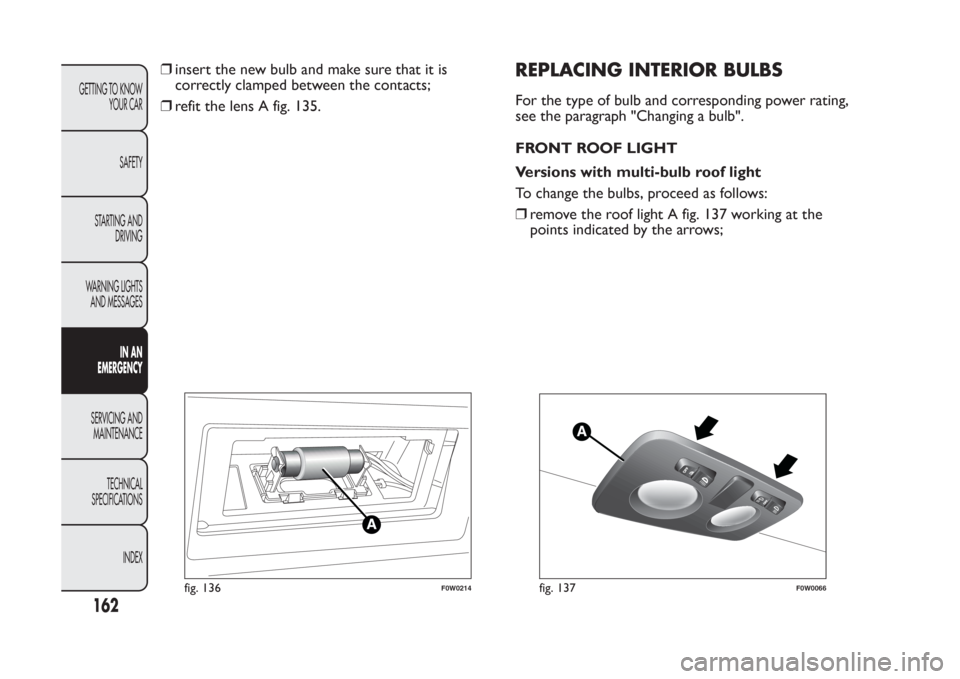
❒insert the new bulb and make sure that it is
correctly clamped between the contacts;
❒refit the lens A fig. 135.
REPLACING INTERIOR BULBSFor the type of bulb and corresponding power rating,
see the paragraph "Changing a bulb".
FRONT ROOF LIGHT
Versions with multi-bulb roof light
To change the bulbs, proceed as follows:
❒remove the roof light A fig. 137 working at the
points indicated by the arrows;
fig. 136
F0W0214
fig. 137
F0W0066
162
GETTING TO KNOW
YOUR CAR
SAFETY
STARTING AND
DRIVING
WARNING LIGHTS
AND MESSAGES
IN AN
EMERGENCY
SERVICING AND
MAINTENANCE
TECHNICAL
SPECIFICATIONS
INDEX
Page 167 of 284
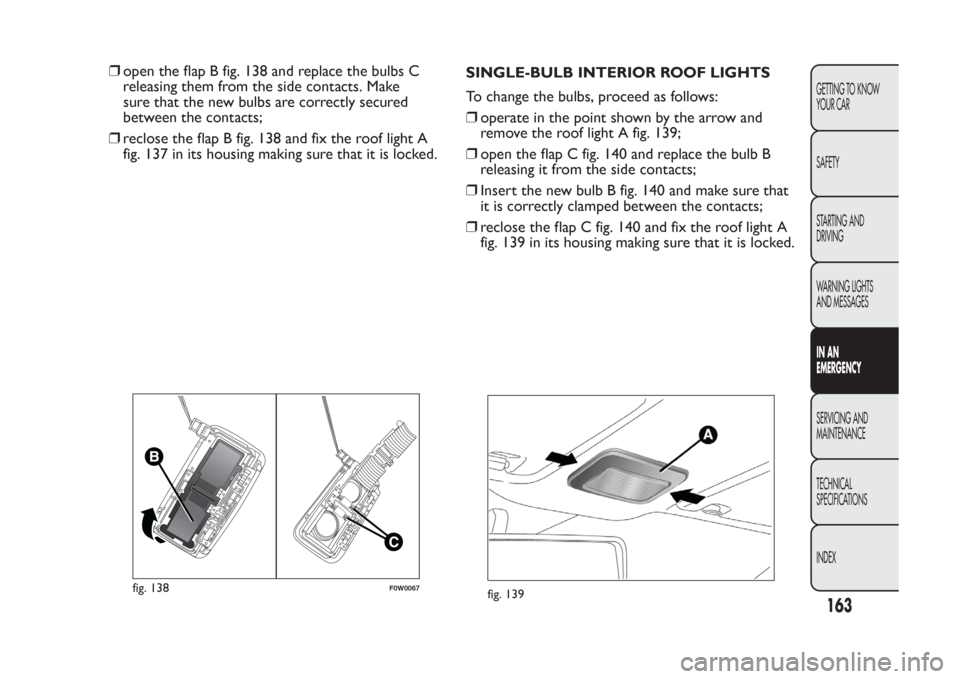
❒open the flap B fig. 138 and replace the bulbs C
releasing them from the side contacts. Make
sure that the new bulbs are correctly secured
between the contacts;
❒reclose the flap B fig. 138 and fix the roof light A
fig. 137 in its housing making sure that it is locked.
fig. 138
F0W0067
163GETTING TO KNOW
YOUR CAR
SAFETY
STARTING AND
DRIVING
WARNING LIGHTS
AND MESSAGESIN AN
EMERGENCYSERVICING AND
MAINTENANCE
TECHNICAL
SPECIFICATIONS
INDEX
SINGLE-BULB INTERIOR ROOF LIGHTS
To change the bulbs, proceed as follows:
❒operate in the point shown by the arrow and
remove the roof light A fig. 139;
❒open the flap C fig. 140 and replace the bulb B
releasing it from the side contacts;
❒Insert the new bulb B fig. 140 and make sure that
it is correctly clamped between the contacts;
❒reclose the flap C fig. 140 and fix the roof light A
fig. 139 in its housing making sure that it is locked.
fig. 139
Page 168 of 284
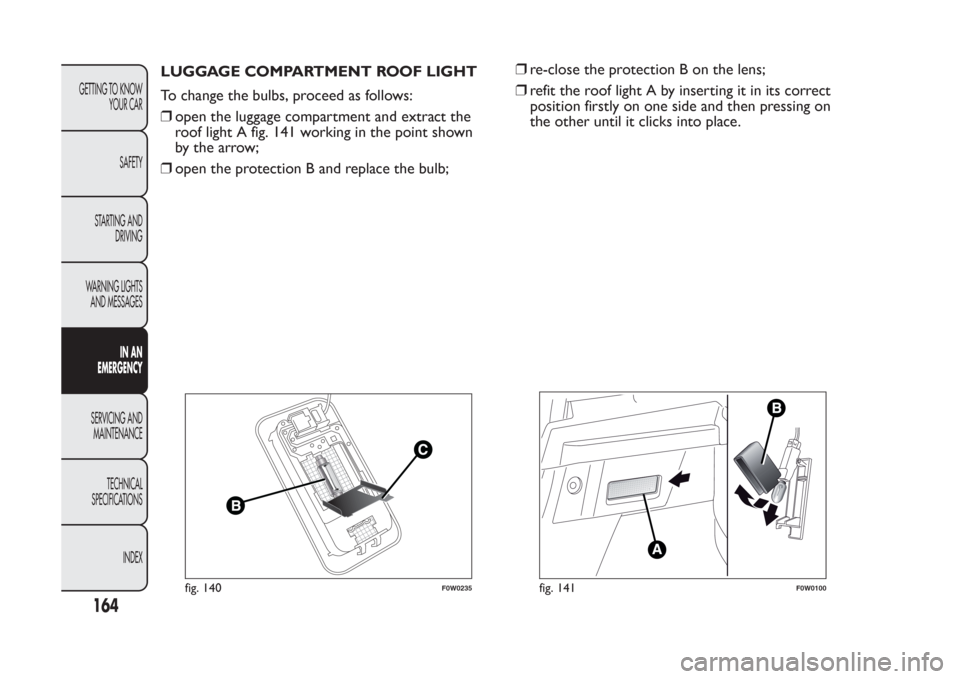
LUGGAGE COMPARTMENT ROOF LIGHT
To change the bulbs, proceed as follows:
❒open the luggage compartment and extract the
roof light A fig. 141 working in the point shown
by the arrow;
❒open the protection B and replace the bulb;❒re-close the protection B on the lens;
❒refit the roof light A by inserting it in its correct
position firstly on one side and then pressing on
the other until it clicks into place.
fig. 140
F0W0235
fig. 141
F0W0100
164
GETTING TO KNOW
YOUR CAR
SAFETY
STARTING AND
DRIVING
WARNING LIGHTS
AND MESSAGES
IN AN
EMERGENCY
SERVICING AND
MAINTENANCE
TECHNICAL
SPECIFICATIONS
INDEX
Page 173 of 284
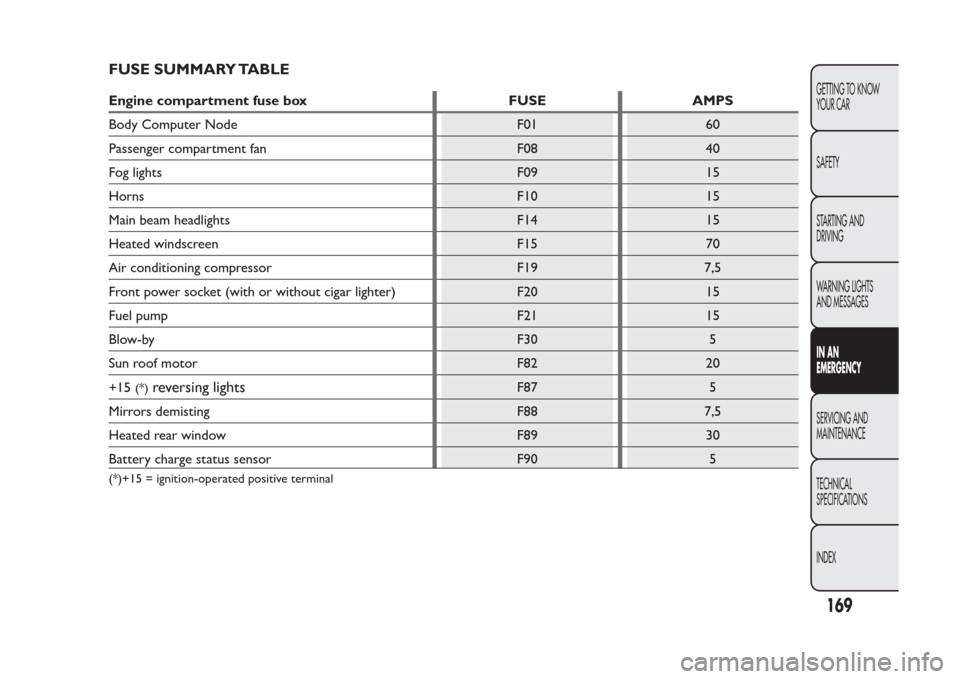
FUSE SUMMARY TABLEEngine compartment fuse box FUSE AMPS
Body Computer Node F01 60
Passenger compartment fan F08 40
Fog lights F09 15
Horns F10 15
Main beam headlights F14 15
Heated windscreen F15 70
Air conditioning compressor F19 7,5
Front power socket (with or without cigar lighter) F20 15
Fuel pump F21 15
Blow-by F30 5
Sun roof motor F82 20
+15
(*)
reversing lights
F87 5
Mirrors demisting F88 7,5
Heated rear window F89 30
Battery charge status sensor F90 5
(*)+15 = ignition-operated positive terminal
169GETTING TO KNOW
YOUR CAR
SAFETY
STARTING AND
DRIVING
WARNING LIGHTS
AND MESSAGESIN AN
EMERGENCYSERVICING AND
MAINTENANCE
TECHNICAL
SPECIFICATIONS
INDEX
Page 194 of 284
BATTERYBattery F (see previous pages) does not require the
electrolyte to be topped up with distilled water. A
periodic check carried out at a Fiat Dealership
is, however, necessary to check efficiency.
REPLACING THE BATTERY
If necessary, replace the battery with another
genuine battery with the same specifications. Follow
the battery manufacturer's instructions for
maintenance.
USEFUL ADVICE FOR EXTENDING THE
LIFE OF YOUR BATTERY
To avoid draining your battery and make it last
longer, observe the following instructions:
❒when you park the car, ensure that the doors,
tailgate and bonnet are closed properly, to prevent
any roof lights from remaining on inside the
passenger's compartment;
❒switch off all roof lights inside the car: the car is
however equipped with a system which switches
all internal lights off automatically;
❒do not keep accessories (e.g. sound system, hazard
lights, etc.) switched on for a long time when the
engine is not running;
❒before performing any operation on the electrical
system, disconnect the negative battery pole;
❒Completely tighten the battery terminals.IMPORTANT If the charge level remains under 50%
for a long time, the battery is damaged by sulphation,
reducing its capacity and efficiency at start-up.
The battery will also be more at risk of freezing (this
can happen as early as -10°C). Refer to the paragraph
"Car inactivity" in "Starting and driving" if the car is
left parked for a long time.
If, after buying the car, you wish to install electrical
accessories which require permanent electrical
supply (alarm, etc.) or accessories which influence
the electrical supply requirements, contact a Fiat
Dealership, whose qualified staff will evaluate the
overall electrical consumption.
WARNING
Battery liquid is poisonous and
corrosive. Avoid contact with the skin
and eyes. Keep naked flames and sources of
sparks away from the battery: risk of explosion
and fire.
WARNING
Using the battery with insufficient fluid
irreparably damages the battery and
may cause an explosion.
190
GETTING TO KNOW
YOUR CAR
SAFETY
STARTING AND
DRIVING
WARNING LIGHTS
AND MESSAGES
IN AN EMERGENCYSERVICING AND
MAINTENANCE
TECHNICAL
SPECIFICATIONS
INDEX
Page 199 of 284
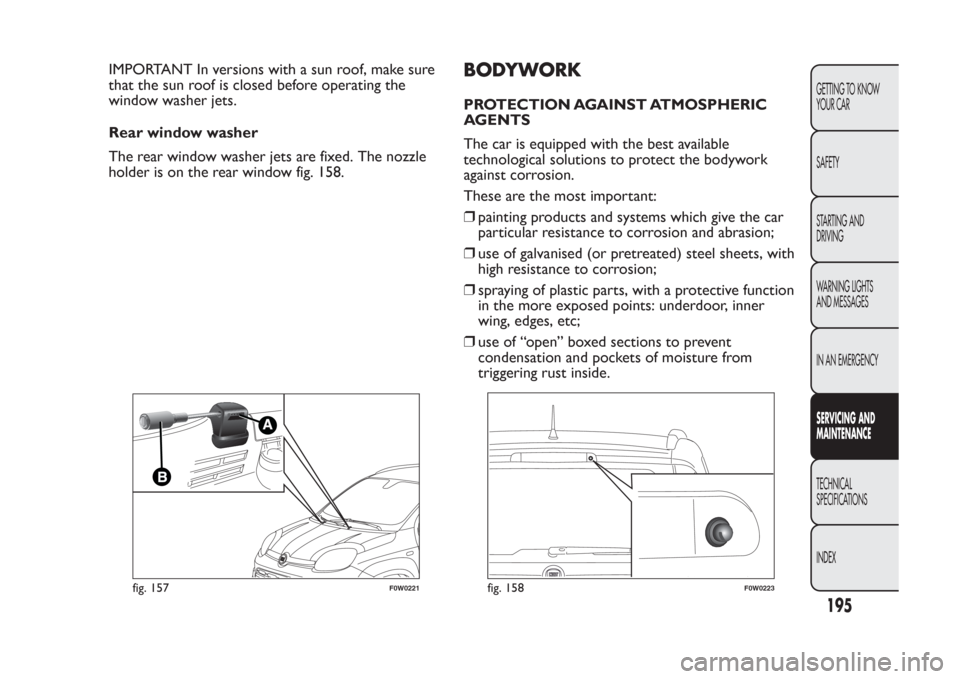
IMPORTANT In versions with a sun roof, make sure
that the sun roof is closed before operating the
window washer jets.
Rear window washer
The rear window washer jets are fixed. The nozzle
holder is on the rear window fig. 158.
BODYWORKPROTECTION AGAINST ATMOSPHERIC
AGENTS
The car is equipped with the best available
technological solutions to protect the bodywork
against corrosion.
These are the most important:
❒painting products and systems which give the car
particular resistance to corrosion and abrasion;
❒use of galvanised (or pretreated) steel sheets, with
high resistance to corrosion;
❒spraying of plastic parts, with a protective function
in the more exposed points: underdoor, inner
wing, edges, etc;
❒use of “open” boxed sections to prevent
condensation and pockets of moisture from
triggering rust inside.
fig. 157
F0W0221
fig. 158
F0W0223
195GETTING TO KNOW
YOUR CAR
SAFETY
STARTING AND
DRIVING
WARNING LIGHTS
AND MESSAGES
IN AN EMERGENCYSERVICING AND
MAINTENANCETECHNICAL
SPECIFICATIONS
INDEX