belt FIAT PANDA 2013 319 / 3.G Owner's Manual
[x] Cancel search | Manufacturer: FIAT, Model Year: 2013, Model line: PANDA, Model: FIAT PANDA 2013 319 / 3.GPages: 284, PDF Size: 11.33 MB
Page 116 of 284
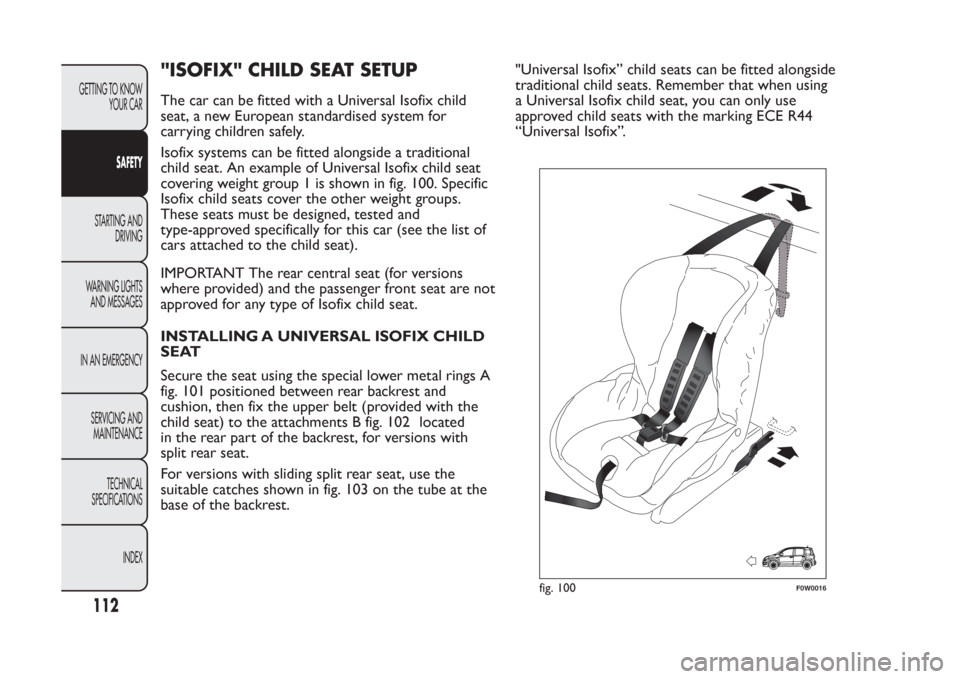
"ISOFIX" CHILD SEAT SETUPThe car can be fitted with a Universal Isofix child
seat, a new European standardised system for
carrying children safely.
Isofix systems can be fitted alongside a traditional
child seat. An example of Universal Isofix child seat
covering weight group 1 is shown in fig. 100. Specific
Isofix child seats cover the other weight groups.
These seats must be designed, tested and
type-approved specifically for this car (see the list of
cars attached to the child seat).
IMPORTANT The rear central seat (for versions
where provided) and the passenger front seat are not
approved for any type of Isofix child seat.
INSTALLING A UNIVERSAL ISOFIX CHILD
SEAT
Secure the seat using the special lower metal rings A
fig. 101 positioned between rear backrest and
cushion, then fix the upper belt (provided with the
child seat) to the attachments B fig. 10 located
in the rear part of the backrest, for versions with
split rear seat.
For versions with sliding split rear seat, use the
suitable catches shown in fig. 103 on the tube at the
base of the backrest."Universal Isofix” child seats can be fitted alongside
traditional child seats. Remember that when using
a Universal Isofix child seat, you can only use
approved child seats with the marking ECE R44
“Universal Isofix”.
fig. 100
F0W0016
112
GETTING TO KNOW
YOUR CAR
SAFETY
STARTING AND
DRIVING
WARNING LIGHTS
AND MESSAGES
IN AN EMERGENCY
SERVICING AND
MAINTENANCE
TECHNICAL
SPECIFICATIONS
INDEX
2
Page 119 of 284
AIR BAGSThe car is fitted with front air bags for driver and
passenger, front side bags for driver and passenger
chest-shoulder protection (for versions/markets,
where provided) and window bags for protecting the
heads of front occupants.
FRONT AIR BAGS
The front (driver and passenger) air bags protect the
front seat occupants in the event of head-on impacts
of medium-high severity, by placing the bag between
the occupant and the steering wheel or dashboard.
Therefore non-deployment in other types of impacts
(side impacts, rear shunts, roll-overs, etc.) does not
indicate a system malfunction.
Front (driver and passenger) air bags are not a
replacement of but complementary to the seat belts,
which you are recommended to always wear, as
specified by law in Europe and most non-European
countries.
In the event of an impact, those not wearing a seat
belt move forwards and may come into contact with
the bag which is still inflating. The protection offered
by the bag is compromised in these circumstances.
Front airbags may not deploy in the following
situations:❒frontal impacts against highly deformable objects
not involving the front surface of the car (e.g.
wing collision against guard rail, etc.);
❒car wedging under other vehicles or protective
barriers (e.g. trucks or guard rails);
they may not provide any additional protection
compared with seat belts, so their activation would
be inappropriate. In these cases, non-deployment
does not indicate a system malfunction.
WARNING
Do not apply stickers or other objects
on the steering wheel, on the dashboard
in the passenger side air bag area, on side
upholstery on roof and on the seats. Never put
objects (e.g. mobile phones) on the passenger's
side dashboard since they could interfere with
correct inflation of the air bag and also cause
serious injur y to the passengers.
Driver's front air bag
This consists of an instantly inflating bag contained in
a special recess in the centre of the steering wheel
fig. 104.
115GETTING TO KNOW
YOUR CARSAFETYSTARTING AND
DRIVING
WARNING LIGHTS
AND MESSAGES
IN AN EMERGENCY
SERVICING AND
MAINTENANCE
TECHNICAL
SPECIFICATIONS
INDEX
Page 124 of 284
WARNING
If the key is inser ted and turned to MAR
when no faults are indicated by the
warning lights, air bags may be deployed if
another vehicle crashes into the vehicle even if
the engine is not running and the vehicle is
stationary. For this reason, children must never
occupy the front seat , even if the car is not
moving. On the other hand, if the key is inser ted
in STOP position, none of the safety devices
(air bags or pretensioners) will be deployed in
the event of impact . Non-deployment of these
devices does not indicate a system malfunction.
WARNING
For versions/markets where provided,
when the ignition key is turned to MAR,
the “yellow”
warning light switches on for a
few seconds. If the passenger air bag/side bag is
active, the “yellow” warning light switches off
after a few seconds. If the passenger air bag/side
bag is NOT active, the “yellow” warning light
stays on.
WARNING
The air bag deployment threshold is
higher than that of the pretensioners.
For collisions in the range between the two
thresholds, it is normal for only the
pretensioners to be activated.
WARNING
The air bag does not replace seat belts
but increases their effectiveness.
Because front air bags are not deployed for
low-speed crashes, side collisions, rear-end
shunts or rollovers, occupants are protected, in
addition to any side bags, only by their seat
belts, which must therefore always be fastened.
WARNING
If the “red”
warning light does not
switch on for a few seconds when the
key is turned to MAR, there may be a fault with
the “red” warning light . In this case, the
“yellow” warning light star ts to flash after a few
seconds and, for versions/markets where
provided, the explosive charges of the passenger
air bag and the side bag are deactivated. Before
continuing, contact a Fiat Dealership
immediately to have the system checked.
120
GETTING TO KNOW
YOUR CAR
SAFETY
STARTING AND
DRIVING
WARNING LIGHTS
AND MESSAGES
IN AN EMERGENCY
SERVICING AND
MAINTENANCE
TECHNICAL
SPECIFICATIONS
INDEX
Page 138 of 284
WARNING
Afaultwiththe
warning light is
indicated by flashing of the
warning
light , which signals the deactivation of the
passenger side front airbag. In addition, the
airbag system automatically disables the
airbags on the passenger's side (front and side
bags - for versions/markets, where provided).
In this case, the
warning light may not
indicate faults in the restraint systems. Before
continuing, contact a Fiat Dealership
immediately to have the system checked.
PASSENGER/SIDE AIRBAGS
DEACTIVATED (amber)
(for versions/markets, where provided)
The
warning light switches on when the front
passenger's airbag and side bag are disabled. With
front passenger airbag on, when the ignition key
is turned to MAR, the
warning light switches on
constantly for several seconds, it flashes for another
few seconds and then it should switch off.
WARNING
A failure of the
warning light is
indicated by
warning light switching
on. In addition, the airbag system automatically
disables the airbags on the passenger's side
(front and side bags where provided). Before
continuing, contact a Fiat Dealership
immediately to have the system checked.
SEAT BELTS NOT FASTENED (red)
(for versions/markets, where provided)
The warning light switches on constantly with the
car stationary and the driver's side or passenger side
seat belt (when the passenger is present) not
fastened. The warning light will flash and a buzzer will
sound if the car is in motion and the front seat belts
are not correctly fastened.
Contact a Fiat Dealership if you wish to permanently
deactivate the SBR (Seat Belt Reminder) system
buzzer. The system can be reactivated using the
Setup menu (see the description in the "Knowing
your car" section).
134
GETTING TO KNOW
YOUR CAR
SAFETY
STARTING AND
DRIVINGWARNING LIGHTS
AND MESSAGESIN AN EMERGENCY
SERVICING AND
MAINTENANCE
TECHNICAL
SPECIFICATIONS
INDEX
Page 180 of 284
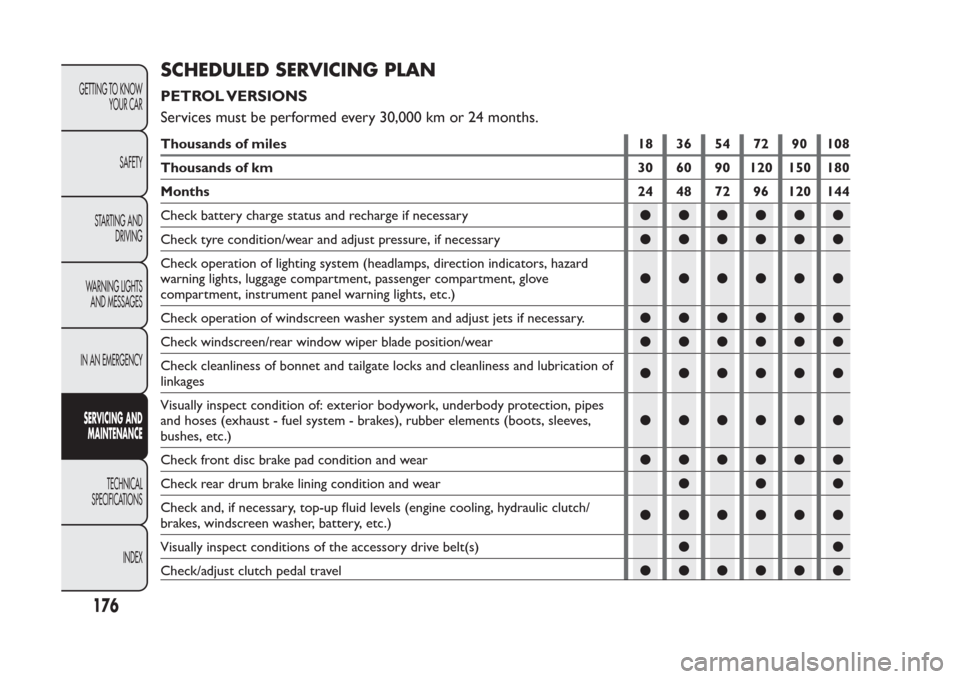
SCHEDULED SERVICING PLANPETROL VERSIONS
Services must be performed every 30,000 km or 24 months.Thousands of miles 18 36 54 72 90 108
Thousands of km 30 60 90 120 150 180
Months 24 48 72 96 120 144
Check battery charge status and recharge if necessary●●●●●●
Check tyre condition/wear and adjust pressure, if necessary●●●●●●
Check operation of lighting system (headlamps, direction indicators, hazard
warning lights, luggage compartment, passenger compartment, glove
compartment, instrument panel warning lights, etc.)●●●●●●
Check operation of windscreen washer system and adjust jets if necessary.●●●●●●
Check windscreen/rear window wiper blade position/wear●●●●●●
Check cleanliness of bonnet and tailgate locks and cleanliness and lubrication of
linkages●●●●●●
Visually inspect condition of: exterior bodywork, underbody protection, pipes
and hoses (exhaust - fuel system - brakes), rubber elements (boots, sleeves,
bushes, etc.)●●●●●●
Check front disc brake pad condition and wear●●●●●●
Check rear drum brake lining condition and wear●●●
Check and, if necessary, top-up fluid levels (engine cooling, hydraulic clutch/
brakes, windscreen washer, battery, etc.)●●●●●●
Visually inspect conditions of the accessory drive belt(s)●●
Check/adjust clutch pedal travel●●●●●●
176
GETTING TO KNOW
YOUR CAR
SAFETY
STARTING AND
DRIVING
WARNING LIGHTS
AND MESSAGES
IN AN EMERGENCYSERVICING AND
MAINTENANCE
TECHNICAL
SPECIFICATIONS
INDEX
Page 181 of 284
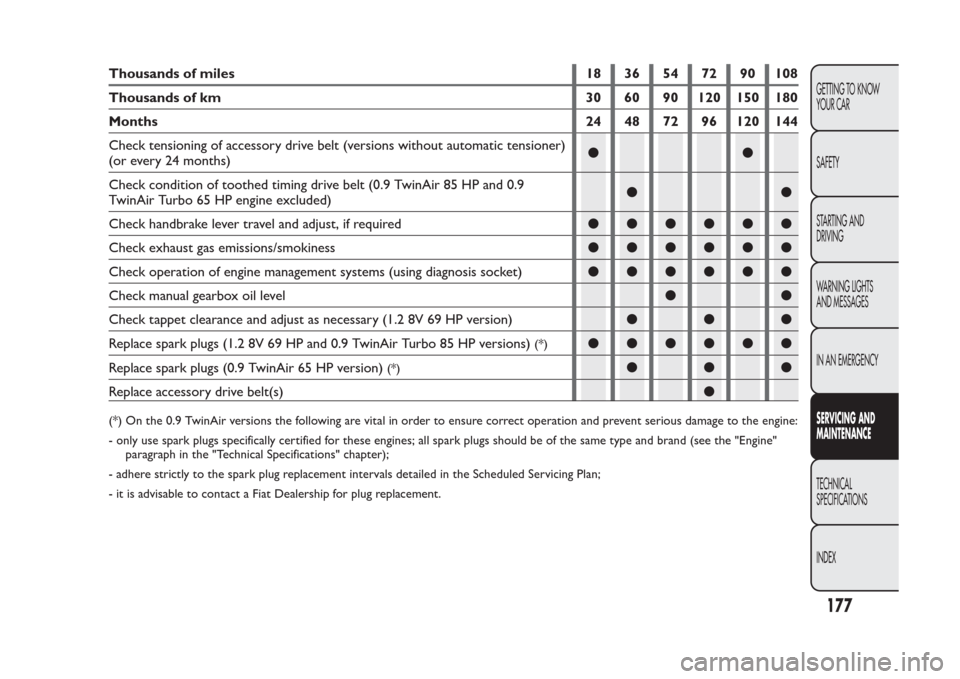
Thousands of miles 18 36 54 72 90 108
Thousands of km 30 60 90 120 150 180
Months 24 48 72 96 120 144
Check tensioning of accessory drive belt (versions without automatic tensioner)
(or every 24 months)●●
Check condition of toothed timing drive belt (0.9 TwinAir 85 HP and 0.9
TwinAir Turbo 65 HP engine excluded)●●
Check handbrake lever travel and adjust, if required●●●●●●
Check exhaust gas emissions/smokiness●●●●●●
Check operation of engine management systems (using diagnosis socket)●●●●●●
Check manual gearbox oil level●●
Check tappet clearance and adjust as necessary (1.2 8V 69 HP version)●●●
Replace spark plugs (1.2 8V 69 HP and 0.9 TwinAir Turbo 85 HP versions)
(*)
●●●●●●
Replace spark plugs (0.9 TwinAir 65 HP version)
(*)
●●●
Replace accessory drive belt(s)●
(*) On the 0.9 TwinAir versions the following are vital in order to ensure correct operation and prevent serious damage to the engine:
- only use spark plugs specifically certified for these engines; all spark plugs should be of the same type and brand (see the "Engine"
paragraph in the "Technical Specifications" chapter);
- adhere strictly to the spark plug replacement intervals detailed in the Scheduled Servicing Plan;
- it is advisable to contact a Fiat Dealership for plug replacement.
177GETTING TO KNOW
YOUR CAR
SAFETY
STARTING AND
DRIVING
WARNING LIGHTS
AND MESSAGES
IN AN EMERGENCYSERVICING AND
MAINTENANCETECHNICAL
SPECIFICATIONS
INDEX
Page 182 of 284
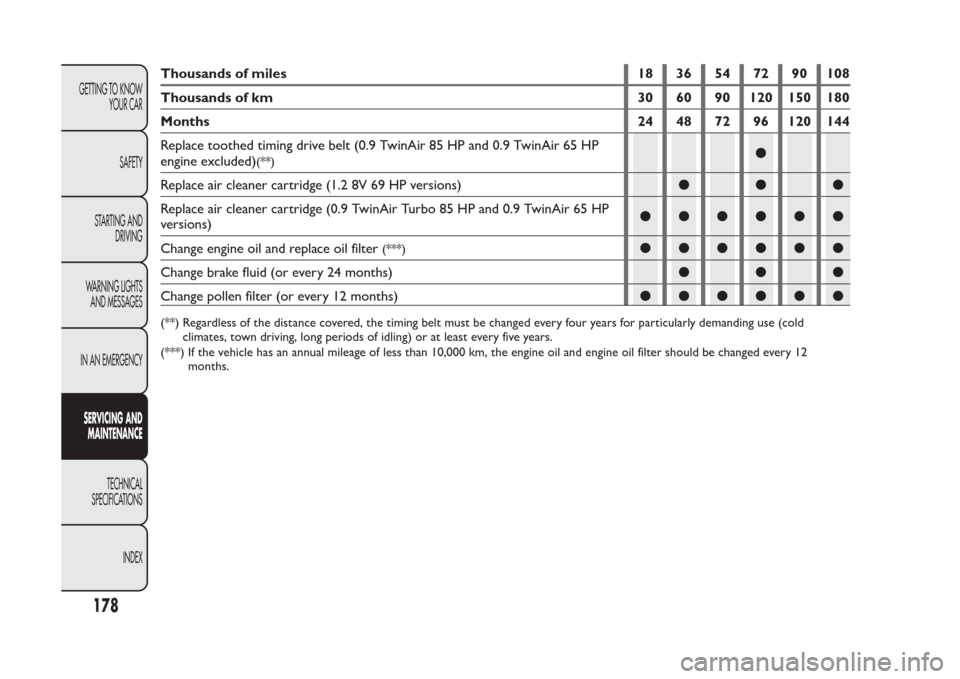
Thousands of miles 18 36 54 72 90 108
Thousands of km 30 60 90 120 150 180
Months 24 48 72 96 120 144
Replace toothed timing drive belt (0.9 TwinAir 85 HP and 0.9 TwinAir 65 HP
engine excluded)
(**)
●
Replace air cleaner cartridge (1.2 8V 69 HP versions)●●●
Replace air cleaner cartridge (0.9 TwinAir Turbo 85 HP and 0.9 TwinAir 65 HP
versions)●●●●●●
Change engine oil and replace oil filter
(***)
●●●●●●
Change brake fluid (or every 24 months)●●●
Change pollen filter (or every 12 months)●●●●●●
(**) Regardless of the distance covered, the timing belt must be changed every four years for particularly demanding use (cold
climates, town driving, long periods of idling) or at least every five years.
(***) If the vehicle has an annual mileage of less than 10,000 km, the engine oil and engine oil filter should be changed every 12
months.
178
GETTING TO KNOW
YOUR CAR
SAFETY
STARTING AND
DRIVING
WARNING LIGHTS
AND MESSAGES
IN AN EMERGENCYSERVICING AND
MAINTENANCE
TECHNICAL
SPECIFICATIONS
INDEX
Page 183 of 284
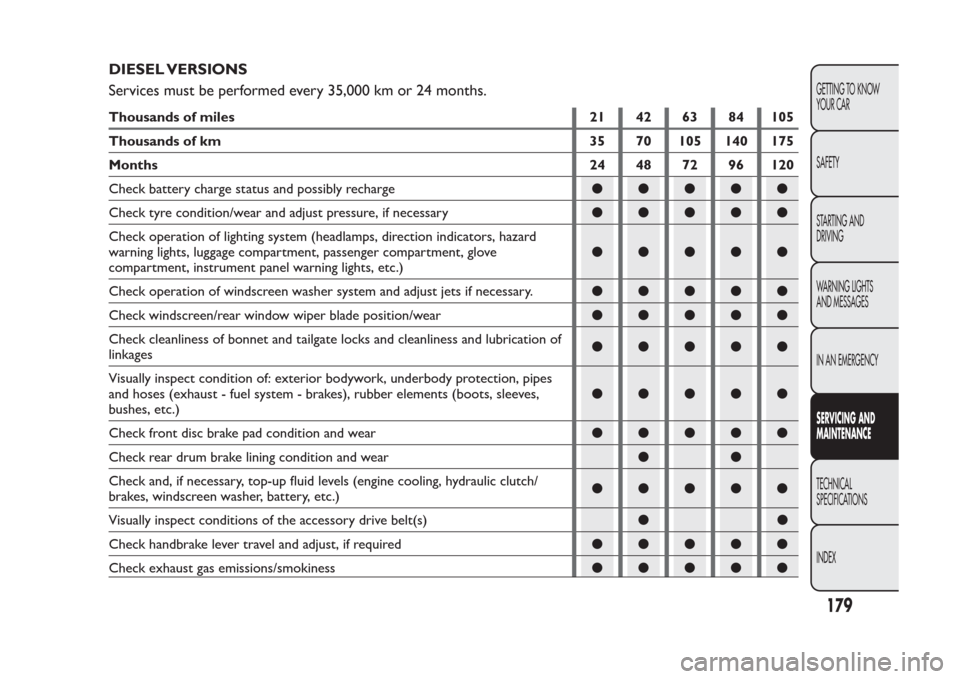
DIESEL VERSIONS
Services must be performed every 35,000 km or 24 months.Thousands of miles 21 42 63 84 105
Thousands of km 35 70 105 140 175
Months 24 48 72 96 120
Check battery charge status and possibly recharge●●●●●
Check tyre condition/wear and adjust pressure, if necessary●●●●●
Check operation of lighting system (headlamps, direction indicators, hazard
warning lights, luggage compartment, passenger compartment, glove
compartment, instrument panel warning lights, etc.)●●●●●
Check operation of windscreen washer system and adjust jets if necessary.●●●●●
Check windscreen/rear window wiper blade position/wear●●●●●
Check cleanliness of bonnet and tailgate locks and cleanliness and lubrication of
linkages●●●●●
Visually inspect condition of: exterior bodywork, underbody protection, pipes
and hoses (exhaust - fuel system - brakes), rubber elements (boots, sleeves,
bushes, etc.)●●●●●
Check front disc brake pad condition and wear●●●●●
Check rear drum brake lining condition and wear●●
Check and, if necessary, top-up fluid levels (engine cooling, hydraulic clutch/
brakes, windscreen washer, battery, etc.)●●●●●
Visually inspect conditions of the accessory drive belt(s)●●
Check handbrake lever travel and adjust, if required●●●●●
Check exhaust gas emissions/smokiness●●●●●
179GETTING TO KNOW
YOUR CAR
SAFETY
STARTING AND
DRIVING
WARNING LIGHTS
AND MESSAGES
IN AN EMERGENCYSERVICING AND
MAINTENANCETECHNICAL
SPECIFICATIONS
INDEX
Page 184 of 284
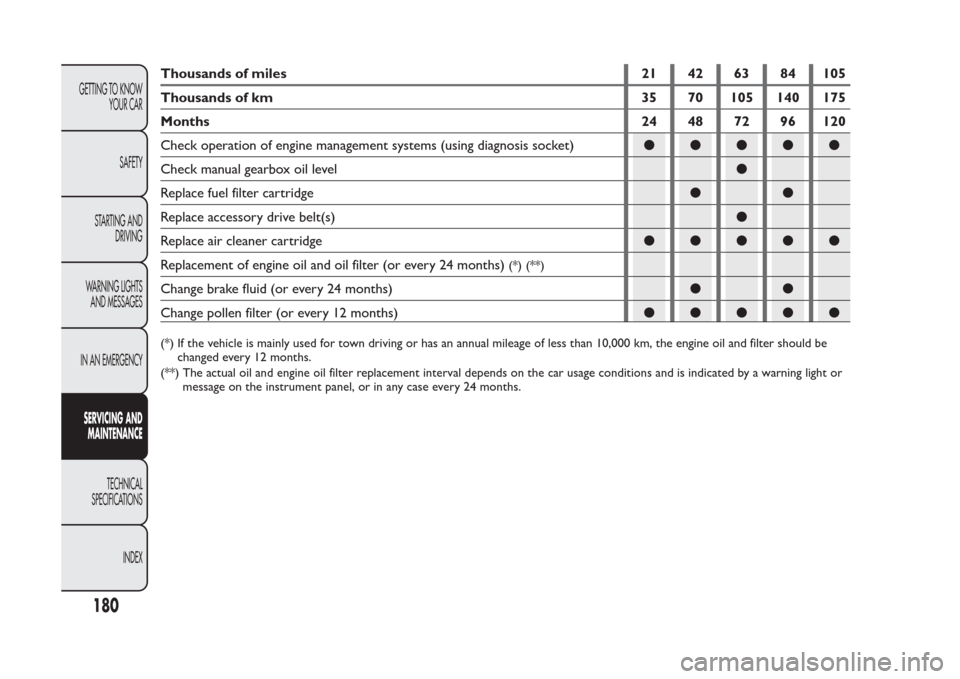
Thousands of miles 21 42 63 84 105
Thousands of km 35 70 105 140 175
Months 24 48 72 96 120
Check operation of engine management systems (using diagnosis socket)●●●●●
Check manual gearbox oil level●
Replace fuel filter cartridge●●
Replace accessory drive belt(s)●
Replace air cleaner cartridge●●●●●
Replacement of engine oil and oil filter (or every 24 months)
(*) (**)
Change brake fluid (or every 24 months)●●
Change pollen filter (or every 12 months)●●●●●(*) If the vehicle is mainly used for town driving or has an annual mileage of less than 10,000 km, the engine oil and filter should be
changed every 12 months.
(**) The actual oil and engine oil filter replacement interval depends on the car usage conditions and is indicated by a warning light or
message on the instrument panel, or in any case every 24 months.
180
GETTING TO KNOW
YOUR CAR
SAFETY
STARTING AND
DRIVING
WARNING LIGHTS
AND MESSAGES
IN AN EMERGENCYSERVICING AND
MAINTENANCE
TECHNICAL
SPECIFICATIONS
INDEX
Page 185 of 284
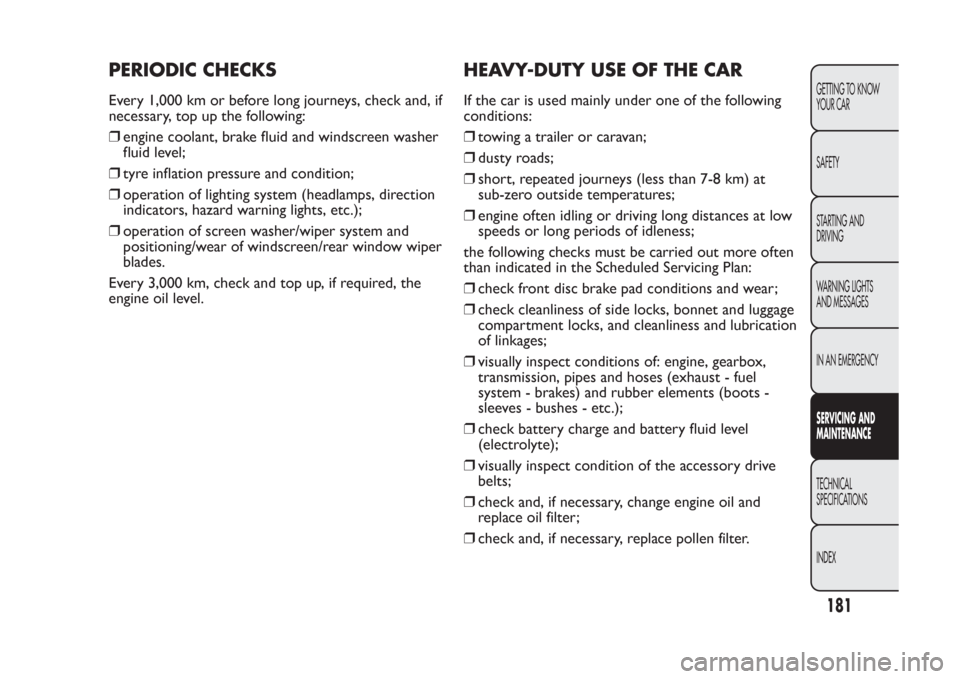
PERIODIC CHECKSEvery 1,000 km or before long journeys, check and, if
necessary, top up the following:
❒engine coolant, brake fluid and windscreen washer
fluid level;
❒tyre inflation pressure and condition;
❒operation of lighting system (headlamps, direction
indicators, hazard warning lights, etc.);
❒operation of screen washer/wiper system and
positioning/wear of windscreen/rear window wiper
blades.
Every 3,000 km, check and top up, if required, the
engine oil level.
HEAVY-DUTY USE OF THE CARIf the car is used mainly under one of the following
conditions:
❒towing a trailer or caravan;
❒dusty roads;
❒short, repeated journeys (less than 7-8 km) at
sub-zero outside temperatures;
❒engine often idling or driving long distances at low
speeds or long periods of idleness;
the following checks must be carried out more often
than indicated in the Scheduled Servicing Plan:
❒check front disc brake pad conditions and wear;
❒check cleanliness of side locks, bonnet and luggage
compartment locks, and cleanliness and lubrication
of linkages;
❒visually inspect conditions of: engine, gearbox,
transmission, pipes and hoses (exhaust - fuel
system - brakes) and rubber elements (boots -
sleeves - bushes - etc.);
❒check battery charge and battery fluid level
(electrolyte);
❒visually inspect condition of the accessory drive
belts;
❒check and, if necessary, change engine oil and
replace oil filter;
❒check and, if necessary, replace pollen filter.
181GETTING TO KNOW
YOUR CAR
SAFETY
STARTING AND
DRIVING
WARNING LIGHTS
AND MESSAGES
IN AN EMERGENCYSERVICING AND
MAINTENANCETECHNICAL
SPECIFICATIONS
INDEX