lock FIAT PANDA 2013 319 / 3.G Owner's Manual
[x] Cancel search | Manufacturer: FIAT, Model Year: 2013, Model line: PANDA, Model: FIAT PANDA 2013 319 / 3.GPages: 284, PDF Size: 11.33 MB
Page 76 of 284
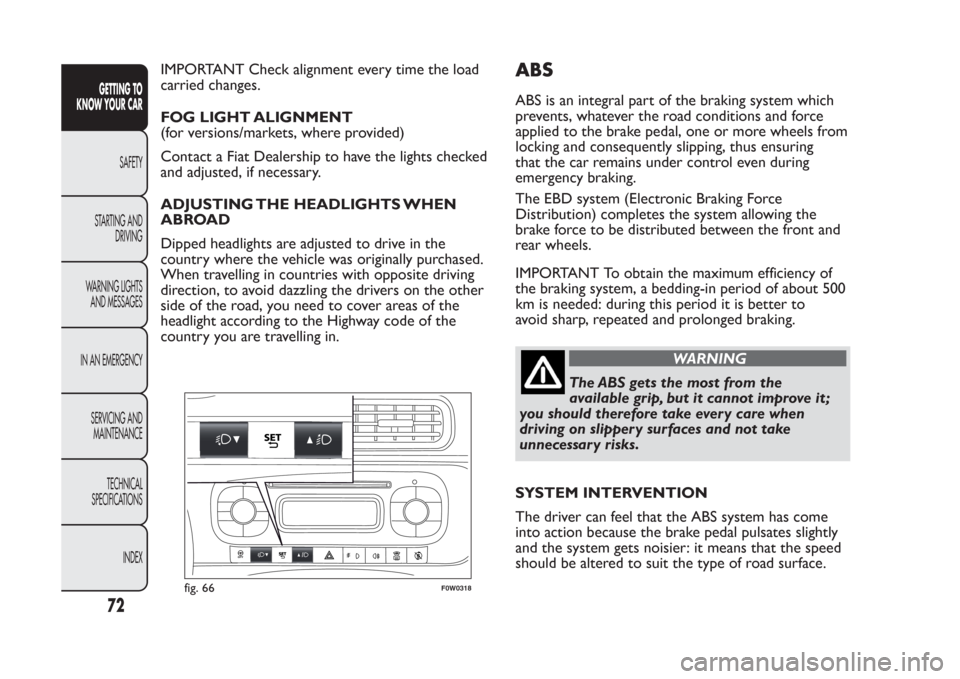
IMPORTANT Check alignment every time the load
carried changes.
FOG LIGHT ALIGNMENT
(for versions/markets, where provided)
Contact a Fiat Dealership to have the lights checked
and adjusted, if necessary.
ADJUSTING THE HEADLIGHTS WHEN
ABROAD
Dipped headlights are adjusted to drive in the
country where the vehicle was originally purchased.
When travelling in countries with opposite driving
direction, to avoid dazzling the drivers on the other
side of the road, you need to cover areas of the
headlight according to the Highway code of the
country you are travelling in.
ABSABS is an integral part of the braking system which
prevents, whatever the road conditions and force
applied to the brake pedal, one or more wheels from
locking and consequently slipping, thus ensuring
that the car remains under control even during
emergency braking.
The EBD system (Electronic Braking Force
Distribution) completes the system allowing the
brake force to be distributed between the front and
rear wheels.
IMPORTANT To obtain the maximum efficiency of
the braking system, a bedding-in period of about 500
km is needed: during this period it is better to
avoid sharp, repeated and prolonged braking.
WARNING
The ABS gets the most from the
available grip, but it cannot improve it ;
you should therefore take every care when
driving on slippery surfaces and not take
unnecessary risks.
SYSTEM INTERVENTION
The driver can feel that the ABS system has come
into action because the brake pedal pulsates slightly
and the system gets noisier: it means that the speed
should be altered to suit the type of road surface.
fig. 66
F0W0318
72GETTING TO
KNOW YOUR CAR
SAFETY
STARTING AND
DRIVING
WARNING LIGHTS
AND MESSAGES
IN AN EMERGENCY
SERVICING AND
MAINTENANCE
TECHNICAL
SPECIFICATIONS
INDEX
Page 82 of 284
TRACTION PLUS SYSTEM(for versions/markets, where provided)
Traction Plus is a driving aid, useful for setting off in
poor grip conditions (snow, ice, mud, etc.) which
allows the drive force to be distributed in the best
way over the front axle when one wheel is slipping.
In effect, Traction Plus acts by braking the wheels
with poor grip (or those slipping more than the
others), thereby transferring the drive force to those
which have more grip on the ground.
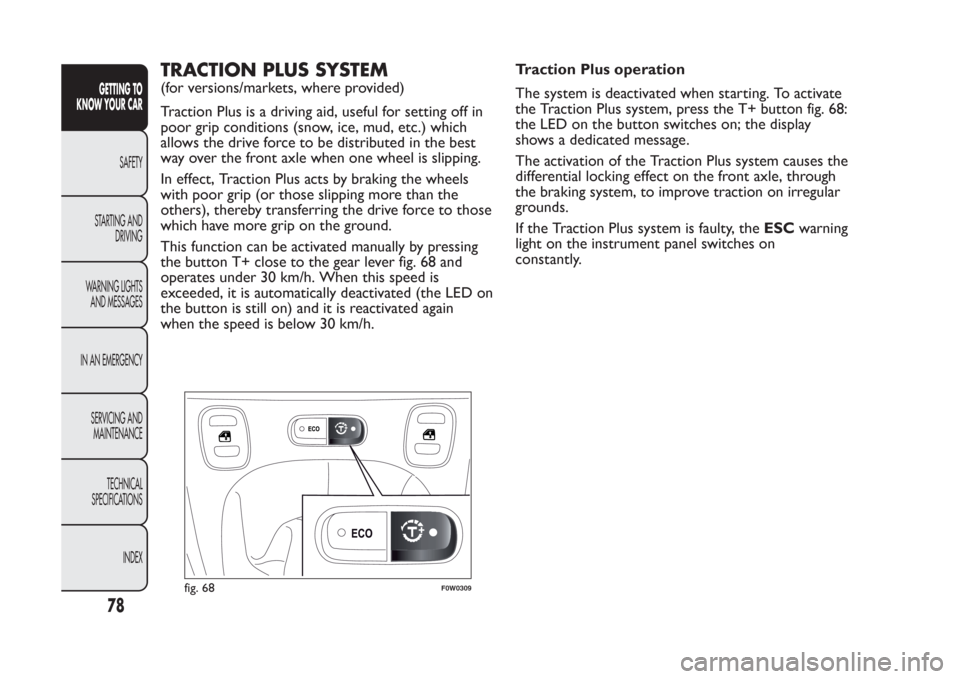
This function can be activated manually by pressing
the button T+ close to the gear lever fig. 68 and
operates under 30 km/h. When this speed is
exceeded, it is automatically deactivated (the LED on
the button is still on) and it is reactivated again
when the speed is below 30 km/h.Traction Plus operation
The system is deactivated when starting. To activate
the Traction Plus system, press the T+ button fig. 68:
the LED on the button switches on; the display
shows a dedicated message.
The activation of the Traction Plus system causes the
differential locking effect on the front axle, through
the braking system, to improve traction on irregular
grounds.
If the Traction Plus system is faulty, theESCwarning
light on the instrument panel switches on
constantly.
fig. 68
F0W0309
78GETTING TO
KNOW YOUR CAR
SAFETY
STARTING AND
DRIVING
WARNING LIGHTS
AND MESSAGES
IN AN EMERGENCY
SERVICING AND
MAINTENANCE
TECHNICAL
SPECIFICATIONS
INDEX
Page 95 of 284
WARNING
Before starting any servicing operation,
stop the engine and remove the key
from the ignition switch to operate the steering
lock, particularly when the wheels do not touch
the ground. If this is not possible (for example
if the key needs to be turned to MAR or the
engine must be running), remove the main fuse
that protects the electric power steering.
WIRING FOR RADIO SYSTEM(for versions/markets, where provided)
If no car radio was requested at the time of
purchase, the car is provided with a compartment on
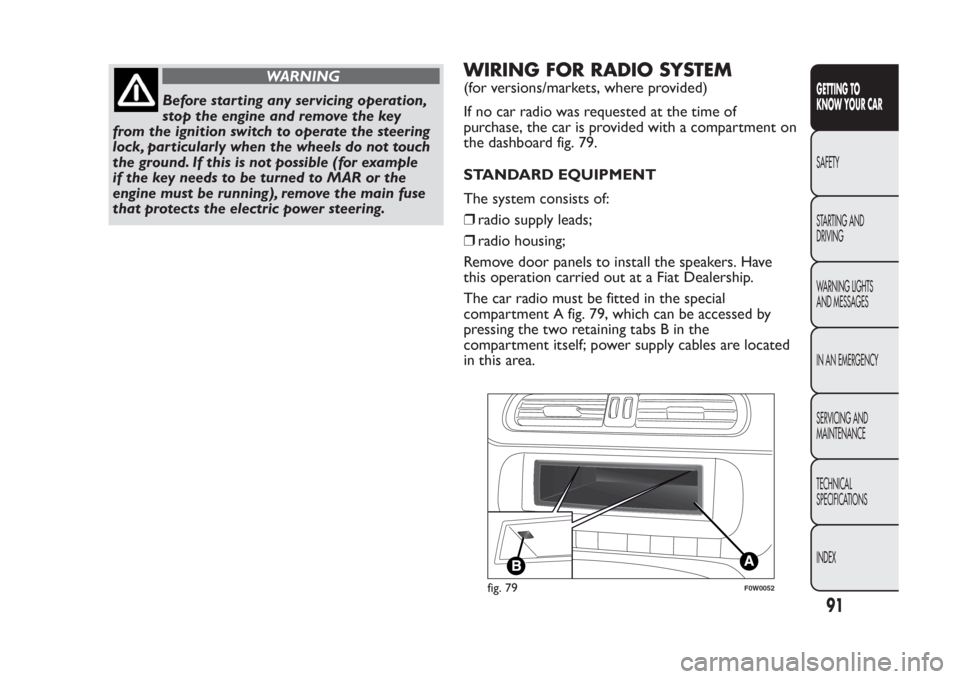
the dashboard fig. 79.
STANDARD EQUIPMENT
The system consists of:
❒radio supply leads;
❒radio housing;
Remove door panels to install the speakers. Have
this operation carried out at a Fiat Dealership.
The car radio must be fitted in the special
compartment A fig. 79, which can be accessed by
pressing the two retaining tabs B in the
compartment itself; power supply cables are located
in this area.
fig. 79
F0W0052
91GETTING TO
KNOW YOUR CARSAFETY
STARTING AND
DRIVING
WARNING LIGHTS
AND MESSAGES
IN AN EMERGENCY
SERVICING AND
MAINTENANCE
TECHNICAL
SPECIFICATIONS
INDEX
Page 103 of 284
SAFETY
SEAT BELTSUSING THE SEAT BELTS
The belt should be worn keeping the torso straight
and rested against the backrest.
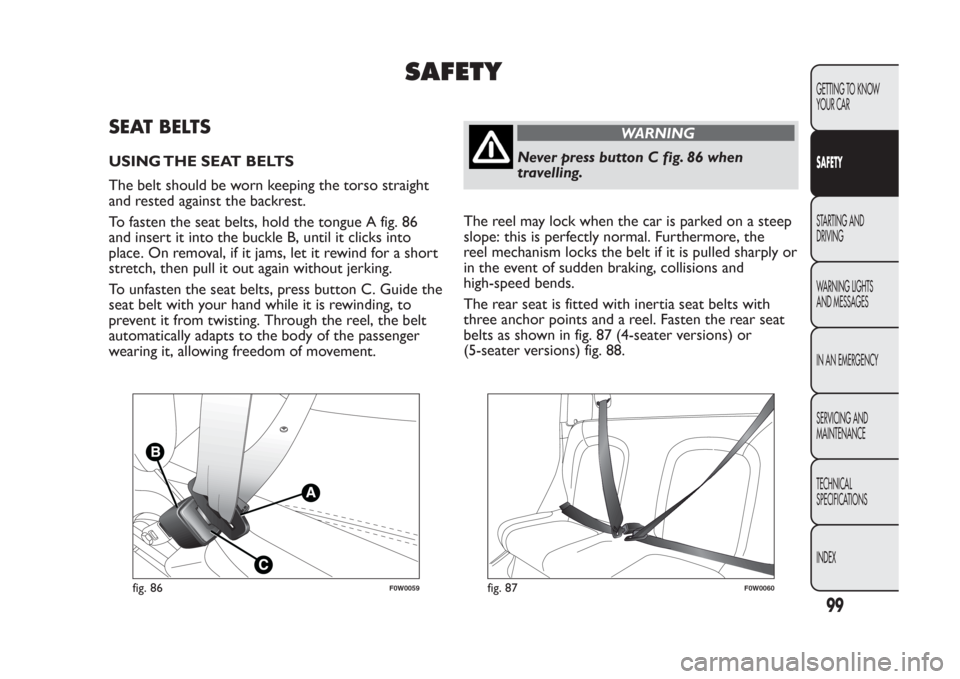
To fasten the seat belts, hold the tongue A fig. 86
and insert it into the buckle B, until it clicks into
place. On removal, if it jams, let it rewind for a short
stretch, then pull it out again without jerking.
To unfasten the seat belts, press button C. Guide the
seat belt with your hand while it is rewinding, to
prevent it from twisting. Through the reel, the belt
automatically adapts to the body of the passenger
wearing it, allowing freedom of movement.
WARNING
Never press button C fig. 86 when
travelling.
The reel may lock when the car is parked on a steep
slope: this is perfectly normal. Furthermore, the
reel mechanism locks the belt if it is pulled sharply or
in the event of sudden braking, collisions and
high-speed bends.
The rear seat is fitted with inertia seat belts with
three anchor points and a reel. Fasten the rear seat
belts as shown in fig. 87 (4-seater versions) or
(5-seater versions) fig. 88.
fig. 86
F0W0059
fig. 87
F0W0060
99GETTING TO KNOW
YOUR CARSAFETYSTARTING AND
DRIVING
WARNING LIGHTS
AND MESSAGES
IN AN EMERGENCY
SERVICING AND
MAINTENANCE
TECHNICAL
SPECIFICATIONS
INDEX
Page 128 of 284
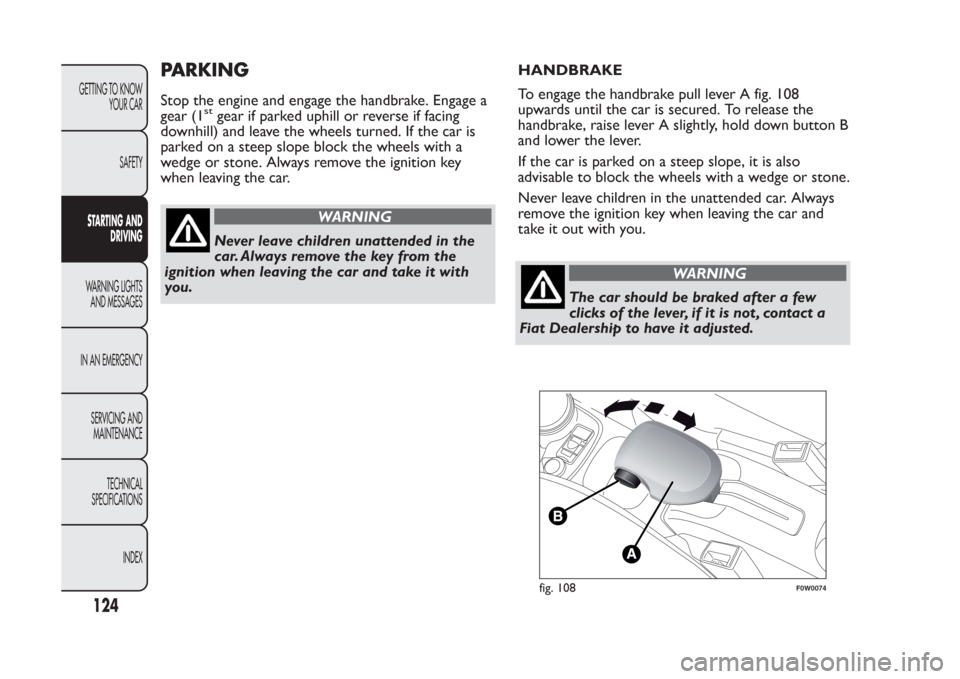
PARKINGStop the engine and engage the handbrake. Engage a
gear (1
st
gear if parked uphill or reverse if facing
downhill) and leave the wheels turned. If the car is
parked on a steep slope block the wheels with a
wedge or stone. Always remove the ignition key
when leaving the car.
WARNING
Never leave children unattended in the
car. Always remove the key from the
ignition when leaving the car and take it with
you.HANDBRAKE
To engage the handbrake pull lever A fig. 108
upwards until the car is secured. To release the
handbrake, raise lever A slightly, hold down button B
and lower the lever.
If the car is parked on a steep slope, it is also
advisable to block the wheels with a wedge or stone.
Never leave children in the unattended car. Always
remove the ignition key when leaving the car and
take it out with you.
WARNING
The car should be braked after a few
clicks of the lever, if it is not , contact a
Fiat Dealership to have it adjusted.
fig. 108
F0W0074
124
GETTING TO KNOW
YOUR CAR
SAFETYSTARTING AND
DRIVINGWARNING LIGHTS
AND MESSAGES
IN AN EMERGENCY
SERVICING AND
MAINTENANCE
TECHNICAL
SPECIFICATIONS
INDEX
Page 137 of 284
IMPORTANT If the warning light comes on when the
vehicle is in motion, check that the handbrake is
not engaged.
EBD FAILURE (red)
(amber)
The simultaneous switching on of the
(red),
(amber) and
(amber) warning lights with the
engine on, indicates either a failure of the EBD
system or that the system is not available. In this
case, the rear wheels may suddenly lock and the
vehicle may swerve when braking sharply. Drive very
carefully to the nearest Fiat Dealership to have the
system inspected immediately. On some versions the
display shows the dedicated message.
ABS FAILURE (amber)
Turning the key to MAR switches on the warning
light, but it should switch off after a few seconds.
The warning light switches on (on some versions,
with a message on the display and a symbol on
the display) when the system is not efficient. In this
case the braking system maintains its own efficiency
unaltered but without the advantage of the ABS
system. Drive carefully and contact a Fiat Dealership
as soon as possible.
AIRBAG FAILURE (red)
Turning the key to MAR switches on the warning
light, but it should switch off after a few seconds.
The warning light switches on constantly (on some
versions, with a message on the display and a symbol
on the display) to indicate an airbag system fault.
WARNING
If, when turning the key to MAR, the
warning light
does not switch on or
stays on whilst driving, a fault may be present in
the restraint systems. In this case the airbags
or pretensioners may not be deployed in an
impact or, in a lower number of cases, they may
be deployed accidentally. Before continuing,
contact a Fiat Dealership immediately to have
the system checked.
133GETTING TO KNOW
YOUR CAR
SAFETY
STARTING AND
DRIVINGWARNING LIGHTS
AND MESSAGESIN AN EMERGENCY
SERVICING AND
MAINTENANCE
TECHNICAL
SPECIFICATIONS
INDEX
Page 149 of 284
WARNING
Alert other drivers that the car is
stationary in compliance with local
regulations: hazard warning lights, warning
triangle, etc . Any passengers on board should
leave the car, especially if it is heavily laden.
Passengers should stay away from on-coming
traffic while the wheel is being changed. On hills
or uneven roads, use chocks or appropriate
objects to block the wheels of the vehicle.
WARNING
The vehicle's driving characteristics will
be modified with the space-saver wheel
fitted. Avoid violent acceleration and braking,
abrupt steering and fast cornering.The overall
duration of the space-saver spare wheel is
of about 3000 km, after which the relevant tyre
must be replaced with another one of the
same type. Never install a traditional tyre on a
rim designed to be used as a small spare wheel.
Have the wheel repaired and refitted as soon
as possible. Using two or more small spare
wheels at the same time is forbidden. Do not
apply grease to the bolt threads before fitting:
they could unscrew themselves.
WARNING
The jack may be used to replace wheels
only on the car that it comes with or
other cars of the same model. Never use the
jack for other purposes, such as lifting other car
models. Never use it for repair operations
under the car. Incorrectly positioning the jack
may cause the car to fall. Do not use the jack
for loads higher than those shown on the label.
Never install snow chains on the space-saver
spare wheel; if a front tyre (driving wheel)
is punctured and you need to use snow chains,
use a standard wheel from the rear axle and
install the space-saver spare wheel on the rear
axle. In this way, with two normal front drive
wheels, it is possible to use snow chains.
WARNING
If the hub cap is not fitted correctly, it
may come off when the car is travelling.
Never tamper with the inflation valve. Never
introduce tools of any kind between rim and
tyre. Check tyre and space-saver wheel
pressures regularly, complying with the values
given in the "Technical specifications" chapter.
145GETTING TO KNOW
YOUR CAR
SAFETY
STARTING AND
DRIVING
WARNING LIGHTS
AND MESSAGESIN AN
EMERGENCYSERVICING AND
MAINTENANCE
TECHNICAL
SPECIFICATIONS
INDEX
Page 150 of 284
JACK
Important notes:
❒the jack weight is 1.76 kg;
❒the jack requires no adjustment;
❒the jack cannot be repaired and in the event of a
fault it must be replaced by another original one;
❒no tool other than its cranking device may be
fitted on the jack.
To change a wheel proceed as follows:
❒stop the car in a position that is not dangerous for
oncoming traffic where you can change the wheel
safely. The ground must be flat and sufficiently
compact;
❒switch off the engine, pull up the handbrake and
engage the 1
st
gear or the reverse gear. Wear the
reflective safety jacket (compulsory by law in
certain countries) before getting out of the car;
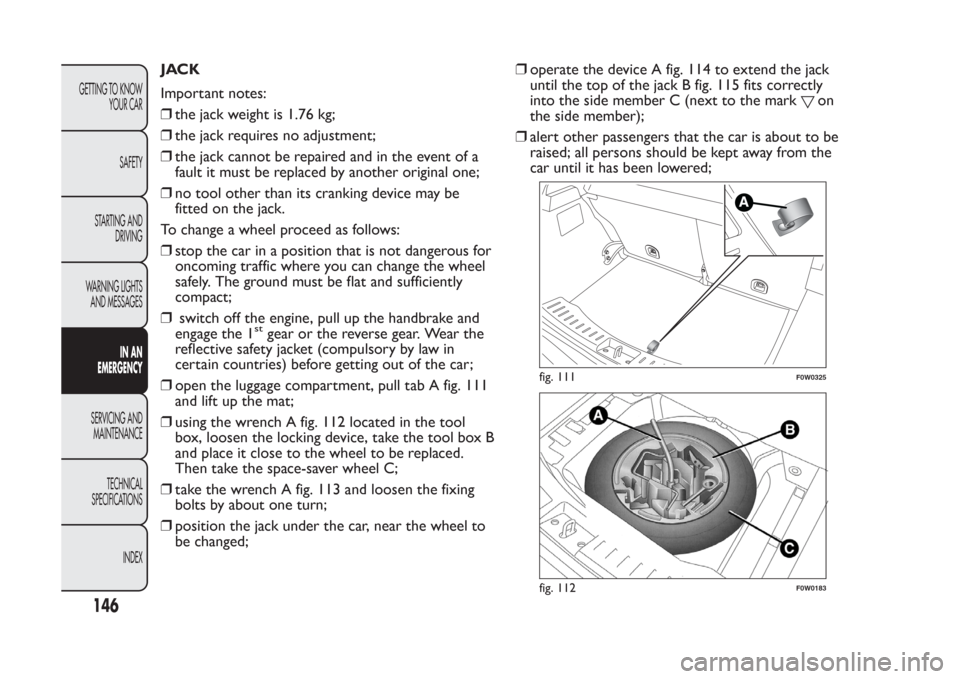
❒open the luggage compartment, pull tab A fig. 111
and lift up the mat;
❒using the wrench A fig. 112 located in the tool
box, loosen the locking device, take the tool box B
and place it close to the wheel to be replaced.
Then take the space-saver wheel C;
❒take the wrench A fig. 113 and loosen the fixing
bolts by about one turn;
❒position the jack under the car, near the wheel to
be changed;❒operate the device A fig. 114 to extend the jack
until the top of the jack B fig. 115 fits correctly
into the side member C (next to the mark
on
the side member);
❒alert other passengers that the car is about to be
raised; all persons should be kept away from the
car until it has been lowered;
fig. 111
F0W0325
fig. 112
F0W0183
146
GETTING TO KNOW
YOUR CAR
SAFETY
STARTING AND
DRIVING
WARNING LIGHTS
AND MESSAGES
IN AN
EMERGENCY
SERVICING AND
MAINTENANCE
TECHNICAL
SPECIFICATIONS
INDEX
Page 157 of 284
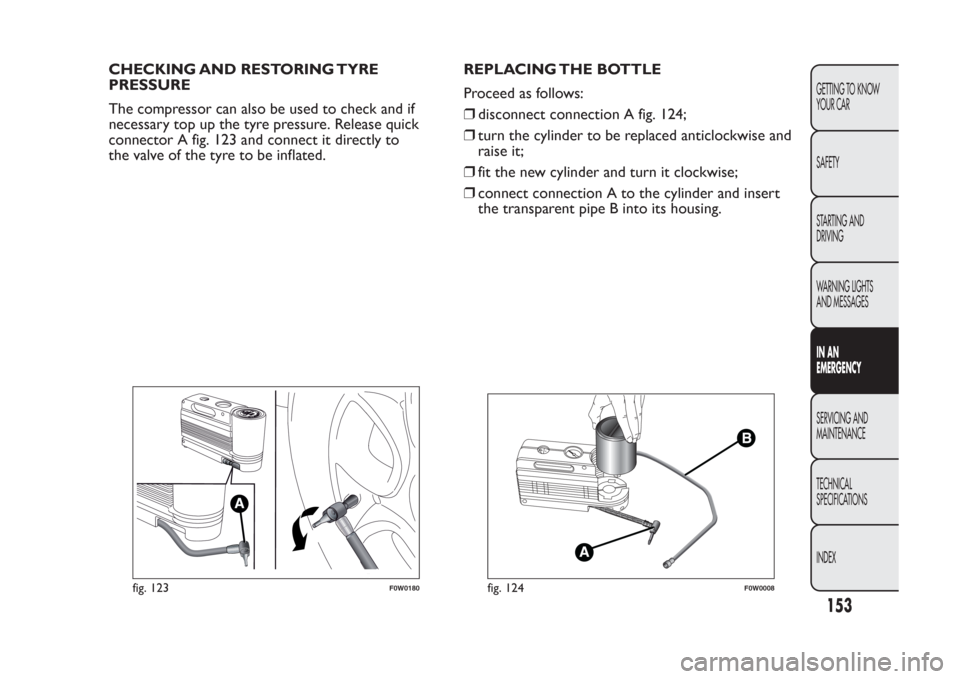
CHECKING AND RESTORING TYRE
PRESSURE
The compressor can also be used to check and if
necessary top up the tyre pressure. Release quick
connector A fig. 123 and connect it directly to
the valve of the tyre to be inflated.REPLACING THE BOTTLE
Proceed as follows:
❒disconnect connection A fig. 124;
❒turn the cylinder to be replaced anticlockwise and
raise it;
❒fit the new cylinder and turn it clockwise;
❒connect connection A to the cylinder and insert
the transparent pipe B into its housing.
fig. 123
F0W0180
fig. 124
F0W0008
153GETTING TO KNOW
YOUR CAR
SAFETY
STARTING AND
DRIVING
WARNING LIGHTS
AND MESSAGESIN AN
EMERGENCYSERVICING AND
MAINTENANCE
TECHNICAL
SPECIFICATIONS
INDEX
Page 159 of 284
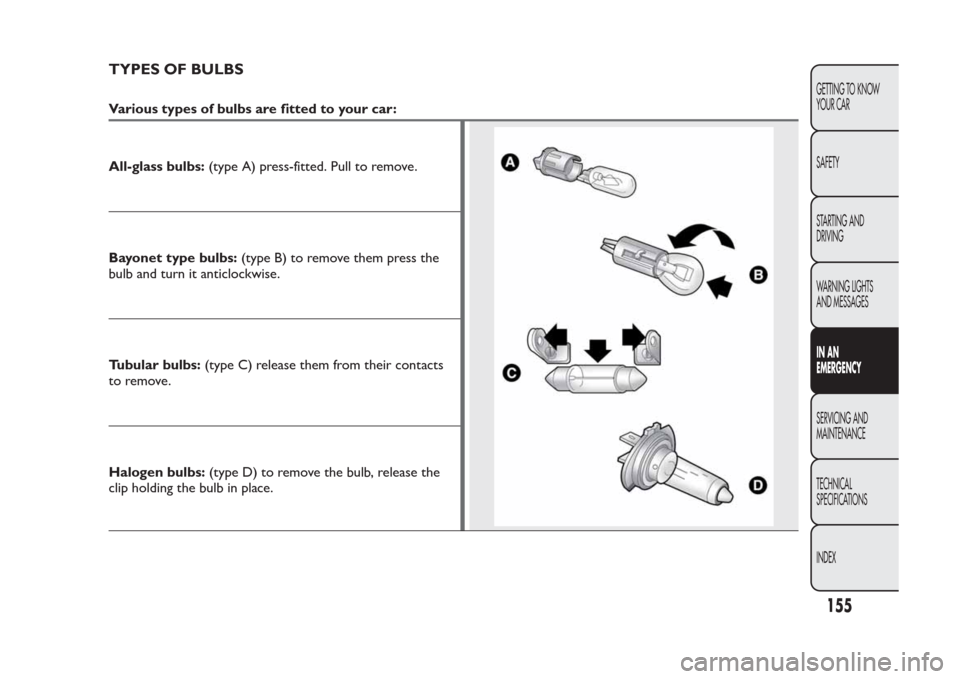
TYPES OF BULBSVarious types of bulbs are fitted to your car:
All-glass bulbs:(type A) press-fitted. Pull to remove.Bayonet type bulbs:(type B) to remove them press the
bulb and turn it anticlockwise.
Tubular bulbs:(type C) release them from their contacts
to remove.
Halogen bulbs:(type D) to remove the bulb, release the
clip holding the bulb in place.
155GETTING TO KNOW
YOUR CAR
SAFETY
STARTING AND
DRIVING
WARNING LIGHTS
AND MESSAGESIN AN
EMERGENCYSERVICING AND
MAINTENANCE
TECHNICAL
SPECIFICATIONS
INDEX