lamp FIAT PANDA 2013 319 / 3.G Owners Manual
[x] Cancel search | Manufacturer: FIAT, Model Year: 2013, Model line: PANDA, Model: FIAT PANDA 2013 319 / 3.GPages: 284, PDF Size: 11.33 MB
Page 163 of 284
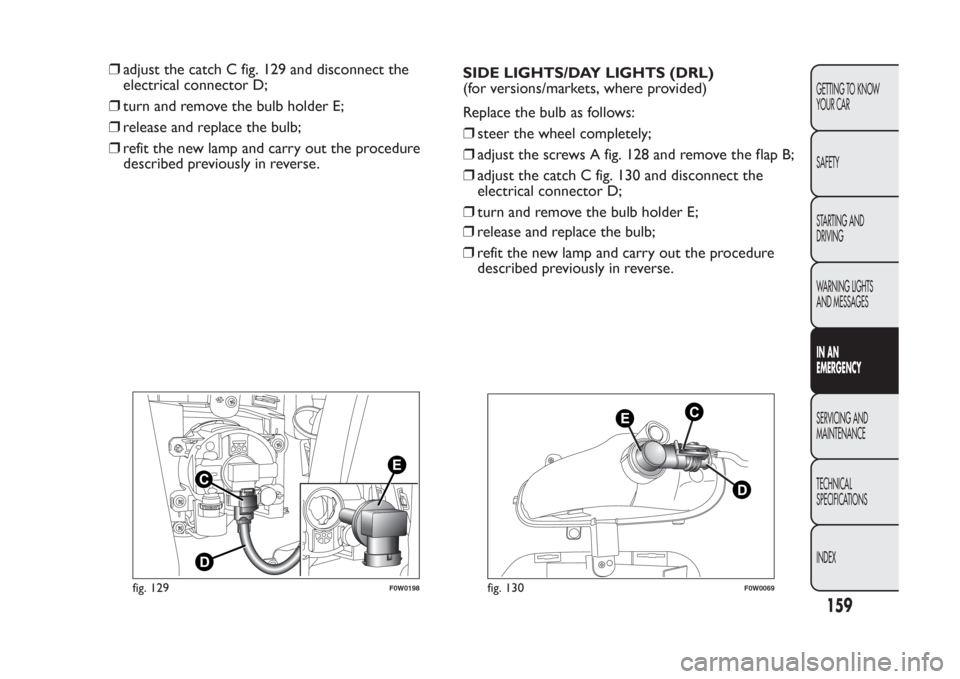
❒adjust the catch C fig. 129 and disconnect the
electrical connector D;
❒turn and remove the bulb holder E;
❒release and replace the bulb;
❒refit the new lamp and carry out the procedure
described previously in reverse.SIDE LIGHTS/DAY LIGHTS (DRL)
(for versions/markets, where provided)
Replace the bulb as follows:
❒steer the wheel completely;
❒adjust the screws A fig. 128 and remove the flap B;
❒adjust the catch C fig. 130 and disconnect the
electrical connector D;
❒turn and remove the bulb holder E;
❒release and replace the bulb;
❒refit the new lamp and carry out the procedure
described previously in reverse.
fig. 129
F0W0198
fig. 130
F0W0069
159GETTING TO KNOW
YOUR CAR
SAFETY
STARTING AND
DRIVING
WARNING LIGHTS
AND MESSAGESIN AN
EMERGENCYSERVICING AND
MAINTENANCE
TECHNICAL
SPECIFICATIONS
INDEX
Page 164 of 284
REAR LIGHT CLUSTERS
These contain the bulbs for the side lights, brake
lights and direction indicators. The reversing lights
and rear fog lights are located instead in the rear
bumper.
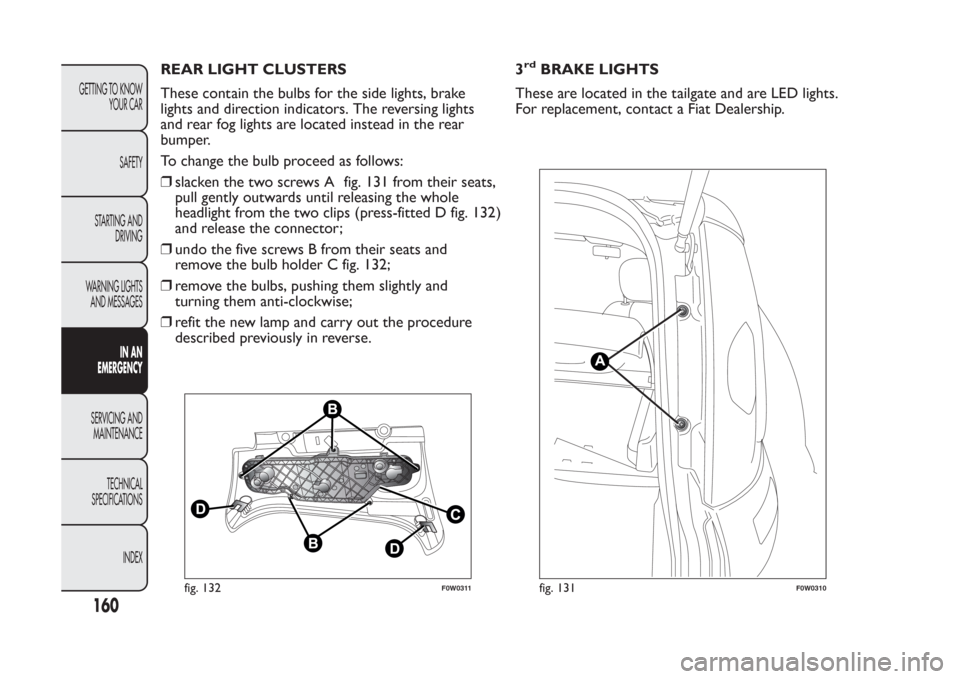
To change the bulb proceed as follows:
❒slacken the two screws fig. 131 from their seats,
pull gently outwards until releasing the whole
headlight from the two clips (press-fitted D fig. 13
and release the connector;
❒undo the five screws B from their seats and
remove the bulb holder C fig. 132;
❒remove the bulbs, pushing them slightly and
turning them anti-clockwise;
❒refit the new lamp and carry out the procedure
described previously in reverse.3
rd
BRAKE LIGHTS
These are located in the tailgate and are LED lights.
For replacement, contact a Fiat Dealership.
fig. 132
F0W0311
fig. 131
F0W0310
160
GETTING TO KNOW
YOUR CAR
SAFETY
STARTING AND
DRIVING
WARNING LIGHTS
AND MESSAGES
IN AN
EMERGENCY
SERVICING AND
MAINTENANCE
TECHNICAL
SPECIFICATIONS
INDEX
A
2)
Page 165 of 284
FOG LIGHT/REAR FOG LIGHT
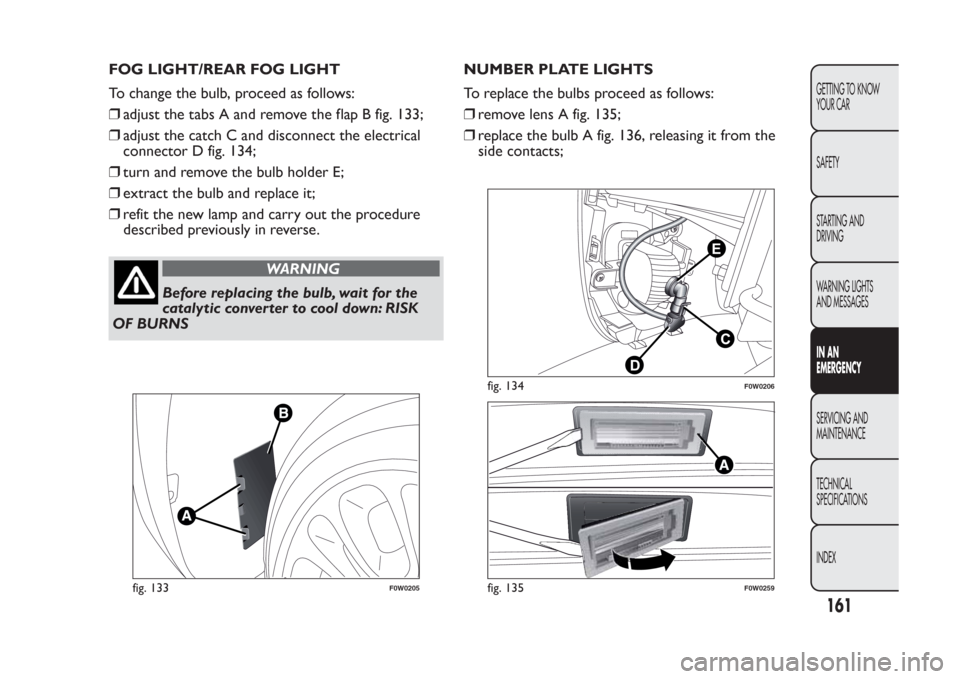
To change the bulb, proceed as follows:
❒adjust the tabs A and remove the flap B fig. 133;
❒adjust the catch C and disconnect the electrical
connector D fig. 134;
❒turn and remove the bulb holder E;
❒extract the bulb and replace it;
❒refit the new lamp and carry out the procedure
described previously in reverse.
WARNING
Before replacing the bulb, wait for the
catalytic conver ter to cool down: RISK
OF BURNSNUMBER PLATE LIGHTS
To replace the bulbs proceed as follows:
❒remove lens A fig. 135;
❒replace the bulb A fig. 136, releasing it from the
side contacts;
fig. 133
F0W0205
fig. 134
F0W0206
fig. 135
F0W0259
161GETTING TO KNOW
YOUR CAR
SAFETY
STARTING AND
DRIVING
WARNING LIGHTS
AND MESSAGESIN AN
EMERGENCYSERVICING AND
MAINTENANCE
TECHNICAL
SPECIFICATIONS
INDEX
Page 166 of 284
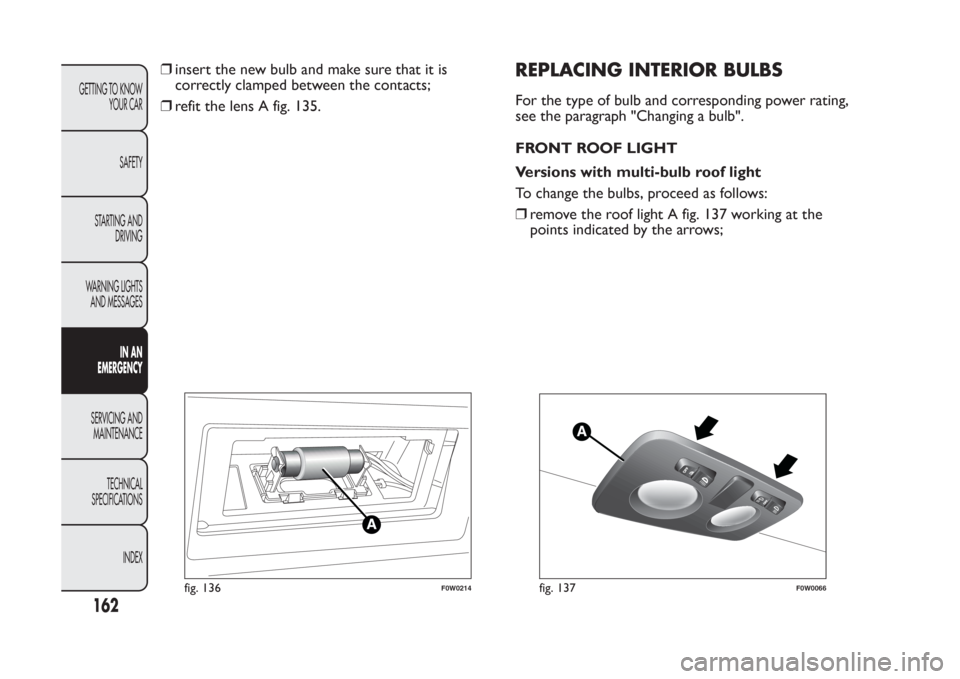
❒insert the new bulb and make sure that it is
correctly clamped between the contacts;
❒refit the lens A fig. 135.
REPLACING INTERIOR BULBSFor the type of bulb and corresponding power rating,
see the paragraph "Changing a bulb".
FRONT ROOF LIGHT
Versions with multi-bulb roof light
To change the bulbs, proceed as follows:
❒remove the roof light A fig. 137 working at the
points indicated by the arrows;
fig. 136
F0W0214
fig. 137
F0W0066
162
GETTING TO KNOW
YOUR CAR
SAFETY
STARTING AND
DRIVING
WARNING LIGHTS
AND MESSAGES
IN AN
EMERGENCY
SERVICING AND
MAINTENANCE
TECHNICAL
SPECIFICATIONS
INDEX
Page 167 of 284
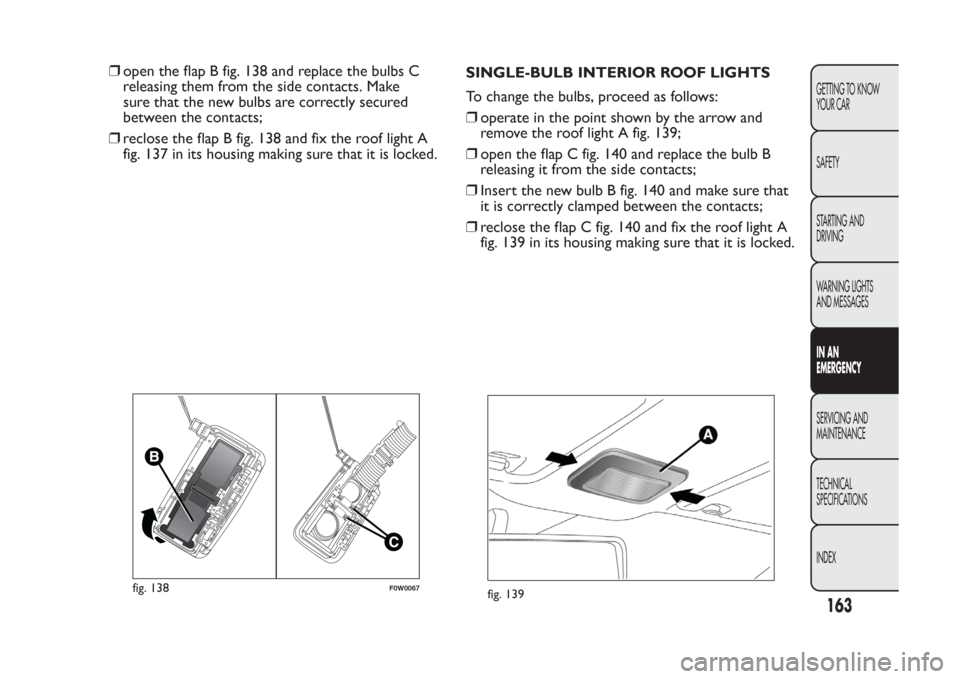
❒open the flap B fig. 138 and replace the bulbs C
releasing them from the side contacts. Make
sure that the new bulbs are correctly secured
between the contacts;
❒reclose the flap B fig. 138 and fix the roof light A
fig. 137 in its housing making sure that it is locked.
fig. 138
F0W0067
163GETTING TO KNOW
YOUR CAR
SAFETY
STARTING AND
DRIVING
WARNING LIGHTS
AND MESSAGESIN AN
EMERGENCYSERVICING AND
MAINTENANCE
TECHNICAL
SPECIFICATIONS
INDEX
SINGLE-BULB INTERIOR ROOF LIGHTS
To change the bulbs, proceed as follows:
❒operate in the point shown by the arrow and
remove the roof light A fig. 139;
❒open the flap C fig. 140 and replace the bulb B
releasing it from the side contacts;
❒Insert the new bulb B fig. 140 and make sure that
it is correctly clamped between the contacts;
❒reclose the flap C fig. 140 and fix the roof light A
fig. 139 in its housing making sure that it is locked.
fig. 139
Page 174 of 284
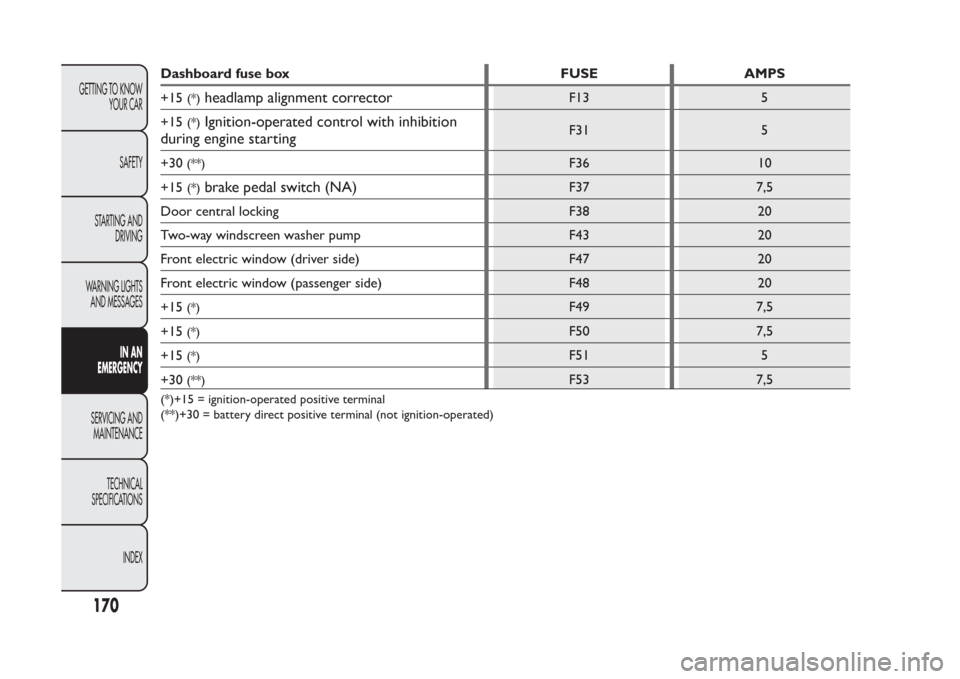
Dashboard fuse box FUSE AMPS
+15
(*)
headlamp alignment corrector
F13 5
+15
(*)
Ignition-operated control with inhibition
during engine starting
F31 5
+30
(**)
F36 10
+15
(*)
brake pedal switch (NA)
F37 7,5
Door central locking F38 20
Two-way windscreen washer pump F43 20
Front electric window (driver side) F47 20
Front electric window (passenger side) F48 20
+15
(*)
F49 7,5
+15
(*)
F50 7,5
+15
(*)
F51 5
+30
(**)
F53 7,5
(*)+15 = ignition-operated positive terminal
(**)+30 = battery direct positive terminal (not ignition-operated)
170
GETTING TO KNOW
YOUR CAR
SAFETY
STARTING AND
DRIVING
WARNING LIGHTS
AND MESSAGES
IN AN
EMERGENCY
SERVICING AND
MAINTENANCE
TECHNICAL
SPECIFICATIONS
INDEX
Page 180 of 284
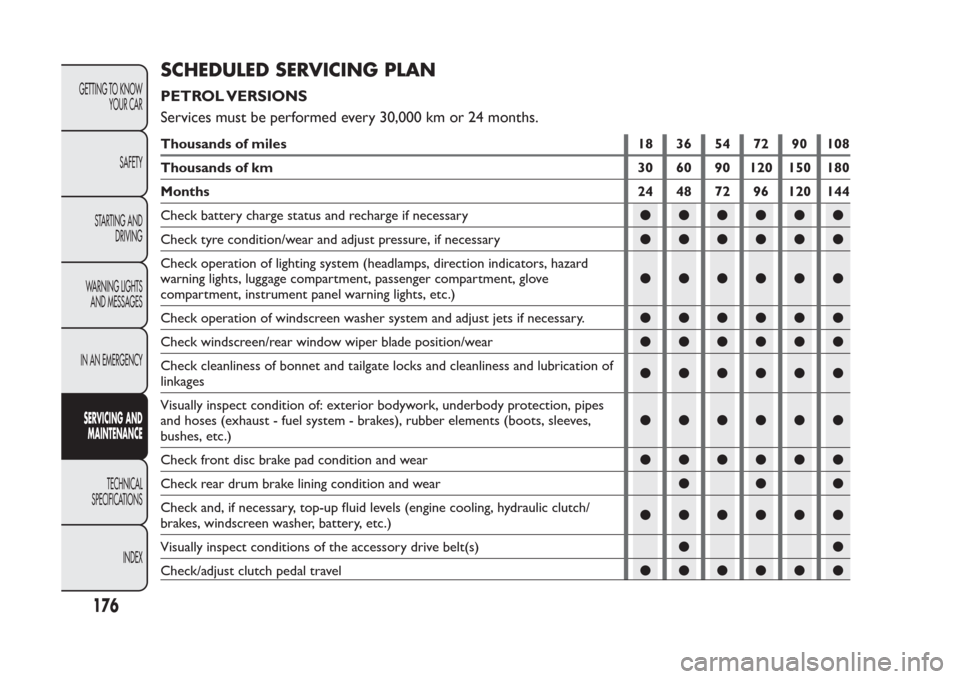
SCHEDULED SERVICING PLANPETROL VERSIONS
Services must be performed every 30,000 km or 24 months.Thousands of miles 18 36 54 72 90 108
Thousands of km 30 60 90 120 150 180
Months 24 48 72 96 120 144
Check battery charge status and recharge if necessary●●●●●●
Check tyre condition/wear and adjust pressure, if necessary●●●●●●
Check operation of lighting system (headlamps, direction indicators, hazard
warning lights, luggage compartment, passenger compartment, glove
compartment, instrument panel warning lights, etc.)●●●●●●
Check operation of windscreen washer system and adjust jets if necessary.●●●●●●
Check windscreen/rear window wiper blade position/wear●●●●●●
Check cleanliness of bonnet and tailgate locks and cleanliness and lubrication of
linkages●●●●●●
Visually inspect condition of: exterior bodywork, underbody protection, pipes
and hoses (exhaust - fuel system - brakes), rubber elements (boots, sleeves,
bushes, etc.)●●●●●●
Check front disc brake pad condition and wear●●●●●●
Check rear drum brake lining condition and wear●●●
Check and, if necessary, top-up fluid levels (engine cooling, hydraulic clutch/
brakes, windscreen washer, battery, etc.)●●●●●●
Visually inspect conditions of the accessory drive belt(s)●●
Check/adjust clutch pedal travel●●●●●●
176
GETTING TO KNOW
YOUR CAR
SAFETY
STARTING AND
DRIVING
WARNING LIGHTS
AND MESSAGES
IN AN EMERGENCYSERVICING AND
MAINTENANCE
TECHNICAL
SPECIFICATIONS
INDEX
Page 183 of 284
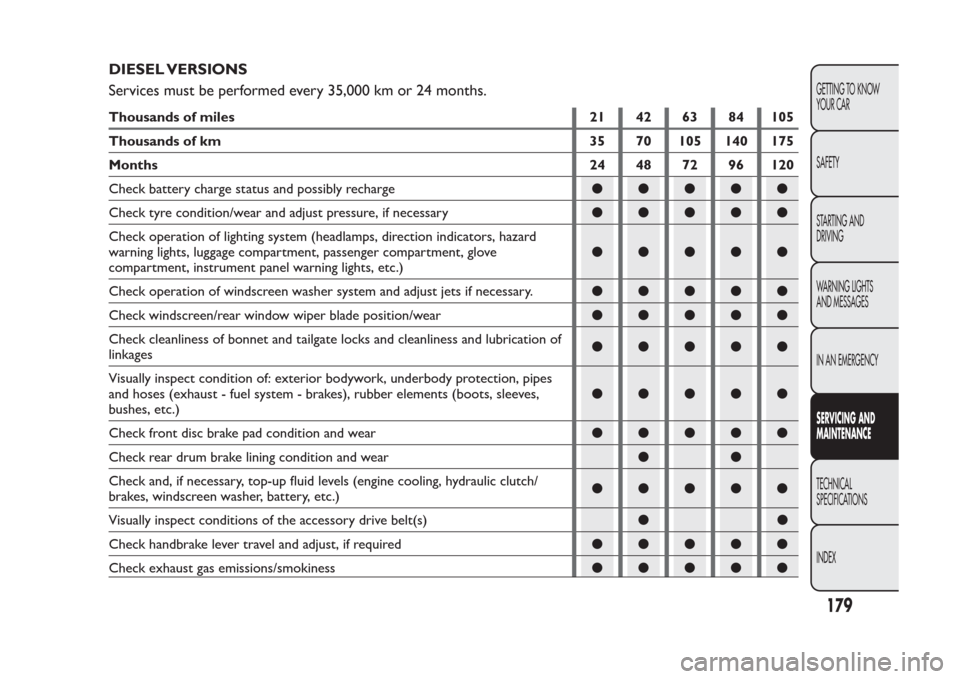
DIESEL VERSIONS
Services must be performed every 35,000 km or 24 months.Thousands of miles 21 42 63 84 105
Thousands of km 35 70 105 140 175
Months 24 48 72 96 120
Check battery charge status and possibly recharge●●●●●
Check tyre condition/wear and adjust pressure, if necessary●●●●●
Check operation of lighting system (headlamps, direction indicators, hazard
warning lights, luggage compartment, passenger compartment, glove
compartment, instrument panel warning lights, etc.)●●●●●
Check operation of windscreen washer system and adjust jets if necessary.●●●●●
Check windscreen/rear window wiper blade position/wear●●●●●
Check cleanliness of bonnet and tailgate locks and cleanliness and lubrication of
linkages●●●●●
Visually inspect condition of: exterior bodywork, underbody protection, pipes
and hoses (exhaust - fuel system - brakes), rubber elements (boots, sleeves,
bushes, etc.)●●●●●
Check front disc brake pad condition and wear●●●●●
Check rear drum brake lining condition and wear●●
Check and, if necessary, top-up fluid levels (engine cooling, hydraulic clutch/
brakes, windscreen washer, battery, etc.)●●●●●
Visually inspect conditions of the accessory drive belt(s)●●
Check handbrake lever travel and adjust, if required●●●●●
Check exhaust gas emissions/smokiness●●●●●
179GETTING TO KNOW
YOUR CAR
SAFETY
STARTING AND
DRIVING
WARNING LIGHTS
AND MESSAGES
IN AN EMERGENCYSERVICING AND
MAINTENANCETECHNICAL
SPECIFICATIONS
INDEX
Page 185 of 284
PERIODIC CHECKSEvery 1,000 km or before long journeys, check and, if
necessary, top up the following:
❒engine coolant, brake fluid and windscreen washer
fluid level;
❒tyre inflation pressure and condition;
❒operation of lighting system (headlamps, direction
indicators, hazard warning lights, etc.);
❒operation of screen washer/wiper system and
positioning/wear of windscreen/rear window wiper
blades.
Every 3,000 km, check and top up, if required, the
engine oil level.
HEAVY-DUTY USE OF THE CARIf the car is used mainly under one of the following
conditions:
❒towing a trailer or caravan;
❒dusty roads;
❒short, repeated journeys (less than 7-8 km) at
sub-zero outside temperatures;
❒engine often idling or driving long distances at low
speeds or long periods of idleness;
the following checks must be carried out more often
than indicated in the Scheduled Servicing Plan:
❒check front disc brake pad conditions and wear;
❒check cleanliness of side locks, bonnet and luggage
compartment locks, and cleanliness and lubrication
of linkages;
❒visually inspect conditions of: engine, gearbox,
transmission, pipes and hoses (exhaust - fuel
system - brakes) and rubber elements (boots -
sleeves - bushes - etc.);
❒check battery charge and battery fluid level
(electrolyte);
❒visually inspect condition of the accessory drive
belts;
❒check and, if necessary, change engine oil and
replace oil filter;
❒check and, if necessary, replace pollen filter.
181GETTING TO KNOW
YOUR CAR
SAFETY
STARTING AND
DRIVING
WARNING LIGHTS
AND MESSAGES
IN AN EMERGENCYSERVICING AND
MAINTENANCETECHNICAL
SPECIFICATIONS
INDEX