Electrical FIAT PANDA 2014 319 / 3.G User Guide
[x] Cancel search | Manufacturer: FIAT, Model Year: 2014, Model line: PANDA, Model: FIAT PANDA 2014 319 / 3.GPages: 284, PDF Size: 11.54 MB
Page 135 of 284
STORING THE CARIf the car is to be left inactive for longer than a
month, the following precautions should be taken:
❒park the car in covered, dry and if possible
well-ventilated premises and slightly open
the windows;
❒engage a gear and check that the handbrake is not
engaged;
❒disconnect the negative battery terminal (for
versions with Start&Stop system refer to the
paragraph "Start&Stop system" in the chapter
"Knowing your car"); If the battery is not
disconnected from the electrical system, check its
charge every thirty days;
❒clean and protect the painted parts using
protective wax;
❒clean and protect the shiny metal parts using
special compounds available commercially;❒sprinkle talcum powder on the windscreen and
rear window wiper rubber blades and lift them
off the glass;
❒cover the car with a cloth or perforated plastic
sheet. Do not use sheets of non-perforated plastic
as they do not allow moisture on the car body
to evaporate;
❒inflate tyres to +0.5 bar above the standard
specified pressure and check it at intervals;
❒do not drain the engine cooling system.
131GETTING TO KNOW
YOUR CAR
SAFETYSTARTING AND
DRIVINGWARNING LIGHTS
AND MESSAGES
IN AN EMERGENCY
SERVICING AND
MAINTENANCE
TECHNICAL
SPECIFICATIONS
INDEX
Page 148 of 284
Never use a fast batter y-charger to star t
the engine as this could damage the
electronic systems of your car, par ticularly
the ignition and fuel supply control units.
WARNING
This procedure must be performed by
exper t personnel because incorrect
actions could cause electrical discharge of
considerable intensity. Furthermore, battery
fluid is poisonous and corrosive: avoid contact
with skin and eyes. Keep naked flames and
lighted cigarettes away from the battery and do
not cause sparks.
BUMP STARTING
Never bump start the engine by pushing, towing or
coasting downhill.
IMPORTANT Remember that the brake servo and
electrical power steering system are not active until
the engine is started. A much greater effort will
therefore be required to use the brake pedal or turn
the steering wheel.
CHANGING A WHEELGENERAL INSTRUCTIONS
The car is equipped with the “FIX&GO Automatic
Kit”: see the paragraph “FIX&GO Automatic Kit” for
how to use this device. As an alternative to the
“FIX&GO Automatic Kit” the car may be equipped
with a space-saver wheel: see the instructions on the
following pages for changing the tyre.
WARNING
The space-saver wheel (for versions/
markets where provided) is specific to
your car, do not use it on other models, or use
the space-saver wheel of other models on your
car.The space-saver wheel must only be used
in case of emergency. It must only be used
for the distance necessary to reach a service
point and the car speed must not exceed 80
km/h.The space-saver wheel has an orange
sticker that summarises the main cautions for
use and limitations. Never remove or cover
the label.The following information is provided
in four languages on the label: "Important!
For temporar y use only! 80 km/h max! Replace
with a standard tire as soon as possible. Never
cover this indication." Never apply a wheel
cap on a space-saver wheel.
144
GETTING TO KNOW
YOUR CAR
SAFETY
STARTING AND
DRIVING
WARNING LIGHTS
AND MESSAGES
IN AN
EMERGENCY
SERVICING AND
MAINTENANCE
TECHNICAL
SPECIFICATIONS
INDEX
Page 163 of 284
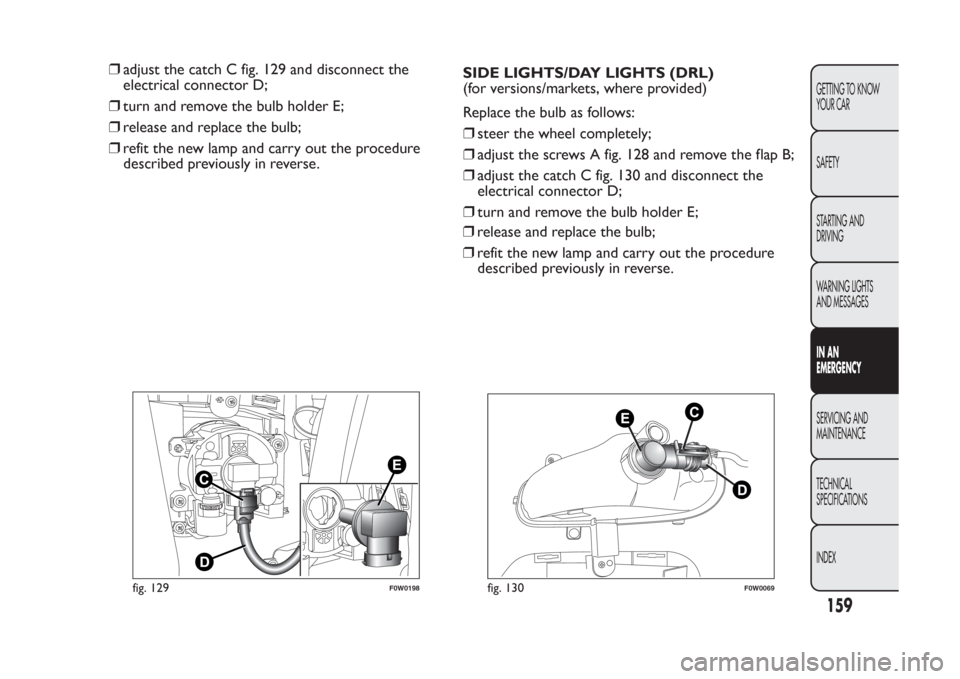
❒adjust the catch C fig. 129 and disconnect the
electrical connector D;
❒turn and remove the bulb holder E;
❒release and replace the bulb;
❒refit the new lamp and carry out the procedure
described previously in reverse.SIDE LIGHTS/DAY LIGHTS (DRL)
(for versions/markets, where provided)
Replace the bulb as follows:
❒steer the wheel completely;
❒adjust the screws A fig. 128 and remove the flap B;
❒adjust the catch C fig. 130 and disconnect the
electrical connector D;
❒turn and remove the bulb holder E;
❒release and replace the bulb;
❒refit the new lamp and carry out the procedure
described previously in reverse.
fig. 129
F0W0198
fig. 130
F0W0069
159GETTING TO KNOW
YOUR CAR
SAFETY
STARTING AND
DRIVING
WARNING LIGHTS
AND MESSAGESIN AN
EMERGENCYSERVICING AND
MAINTENANCE
TECHNICAL
SPECIFICATIONS
INDEX
Page 165 of 284
FOG LIGHT/REAR FOG LIGHT
To change the bulb, proceed as follows:
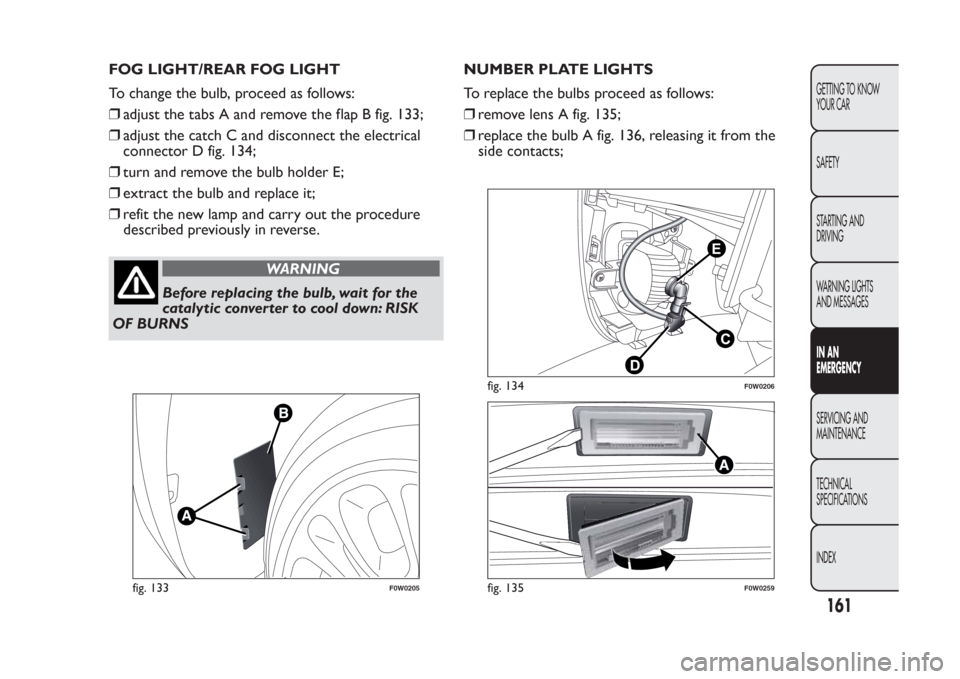
❒adjust the tabs A and remove the flap B fig. 133;
❒adjust the catch C and disconnect the electrical
connector D fig. 134;
❒turn and remove the bulb holder E;
❒extract the bulb and replace it;
❒refit the new lamp and carry out the procedure
described previously in reverse.
WARNING
Before replacing the bulb, wait for the
catalytic conver ter to cool down: RISK
OF BURNSNUMBER PLATE LIGHTS
To replace the bulbs proceed as follows:
❒remove lens A fig. 135;
❒replace the bulb A fig. 136, releasing it from the
side contacts;
fig. 133
F0W0205
fig. 134
F0W0206
fig. 135
F0W0259
161GETTING TO KNOW
YOUR CAR
SAFETY
STARTING AND
DRIVING
WARNING LIGHTS
AND MESSAGESIN AN
EMERGENCYSERVICING AND
MAINTENANCE
TECHNICAL
SPECIFICATIONS
INDEX
Page 169 of 284
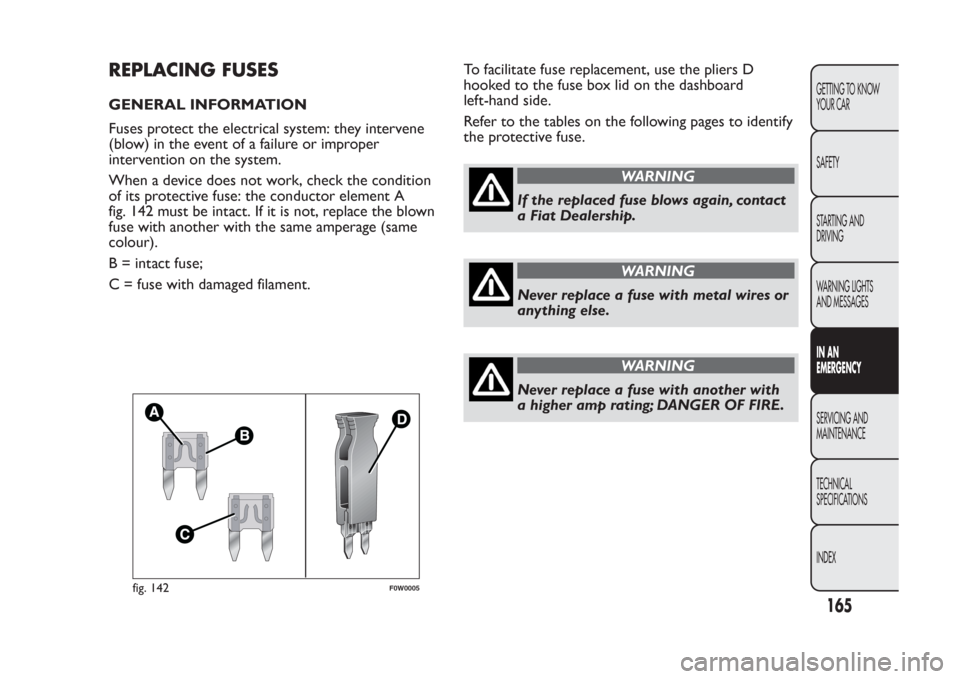
REPLACING FUSESGENERAL INFORMATION
Fuses protect the electrical system: they intervene
(blow) in the event of a failure or improper
intervention on the system.
When a device does not work, check the condition
of its protective fuse: the conductor element A
fig. 142 must be intact. If it is not, replace the blown
fuse with another with the same amperage (same
colour).
B = intact fuse;
C = fuse with damaged filament.To facilitate fuse replacement, use the pliers D
hooked to the fuse box lid on the dashboard
left-hand side.
Refer to the tables on the following pages to identify
the protective fuse.
WARNING
If the replaced fuse blows again, contact
a Fiat Dealership.
WARNING
Never replace a fuse with metal wires or
anything else.
WARNING
Never replace a fuse with another with
a higher amp rating; DANGER OF FIRE.
fig. 142
F0W0005
165GETTING TO KNOW
YOUR CAR
SAFETY
STARTING AND
DRIVING
WARNING LIGHTS
AND MESSAGESIN AN
EMERGENCYSERVICING AND
MAINTENANCE
TECHNICAL
SPECIFICATIONS
INDEX
Page 171 of 284
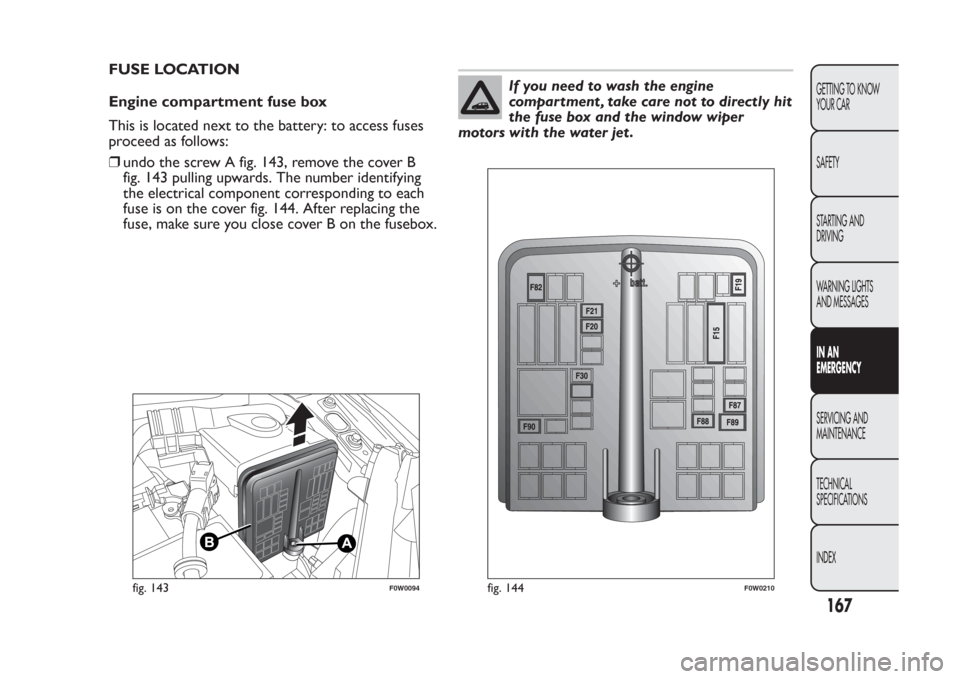
FUSE LOCATION
Engine compartment fuse box
This is located next to the battery: to access fuses
proceed as follows:
❒undo the screw A fig. 143, remove the cover B
fig. 143 pulling upwards. The number identifying
the electrical component corresponding to each
fuse is on the cover fig. 144. After replacing the
fuse, make sure you close cover B on the fusebox.
If you need to wash the engine
compartment , take care not to directly hit
the fuse box and the window wiper
motors with the water jet .
fig. 143
F0W0094
fig. 144
F0W0210
167GETTING TO KNOW
YOUR CAR
SAFETY
STARTING AND
DRIVING
WARNING LIGHTS
AND MESSAGESIN AN
EMERGENCYSERVICING AND
MAINTENANCE
TECHNICAL
SPECIFICATIONS
INDEX
Page 194 of 284
BATTERYBattery F (see previous pages) does not require the
electrolyte to be topped up with distilled water. A
periodic check carried out at a Fiat Dealership
is, however, necessary to check efficiency.
REPLACING THE BATTERY
If necessary, replace the battery with another
genuine battery with the same specifications. Follow
the battery manufacturer's instructions for
maintenance.
USEFUL ADVICE FOR EXTENDING THE
LIFE OF YOUR BATTERY
To avoid draining your battery and make it last
longer, observe the following instructions:
❒when you park the car, ensure that the doors,
tailgate and bonnet are closed properly, to prevent
any roof lights from remaining on inside the
passenger's compartment;
❒switch off all roof lights inside the car: the car is
however equipped with a system which switches
all internal lights off automatically;
❒do not keep accessories (e.g. sound system, hazard
lights, etc.) switched on for a long time when the
engine is not running;
❒before performing any operation on the electrical
system, disconnect the negative battery pole;
❒Completely tighten the battery terminals.IMPORTANT If the charge level remains under 50%
for a long time, the battery is damaged by sulphation,
reducing its capacity and efficiency at start-up.
The battery will also be more at risk of freezing (this
can happen as early as -10°C). Refer to the paragraph
"Car inactivity" in "Starting and driving" if the car is
left parked for a long time.
If, after buying the car, you wish to install electrical
accessories which require permanent electrical
supply (alarm, etc.) or accessories which influence
the electrical supply requirements, contact a Fiat
Dealership, whose qualified staff will evaluate the
overall electrical consumption.
WARNING
Battery liquid is poisonous and
corrosive. Avoid contact with the skin
and eyes. Keep naked flames and sources of
sparks away from the battery: risk of explosion
and fire.
WARNING
Using the battery with insufficient fluid
irreparably damages the battery and
may cause an explosion.
190
GETTING TO KNOW
YOUR CAR
SAFETY
STARTING AND
DRIVING
WARNING LIGHTS
AND MESSAGES
IN AN EMERGENCYSERVICING AND
MAINTENANCE
TECHNICAL
SPECIFICATIONS
INDEX