wheel FIAT PANDA 2014 319 / 3.G User Guide
[x] Cancel search | Manufacturer: FIAT, Model Year: 2014, Model line: PANDA, Model: FIAT PANDA 2014 319 / 3.GPages: 284, PDF Size: 11.54 MB
Page 79 of 284
IMPORTANT The Hill Holder system is not a parking
brake; therefore, never leave the vehicle without
having engaged the handbrake, turned the engine off
and engaged the first gear, so that the parked vehicle
is in safe conditions (further read the paragraph
"When parked" in the chapter "Starting and driving").
ASR SYSTEM (AntiSlip Regulation)
It is an integral part of the ESC system. It
automatically operates in the event of drive wheels
slipping, loss of grip on wet roads (aquaplaning)
and acceleration on slippery, snowy or icy roads,
etc…
Depending on the slipping conditions, two different
control systems are activated:
❒if the slipping involves both drive wheels, the ASR
intervenes reducing the power transmitted by the
engine;
❒if the slipping only involves one of the drive
wheels, it intervenes automatically braking the
wheel that is slipping.Activation/deactivation of the ASR system
The ASR system activates automatically each time
the engine is started.
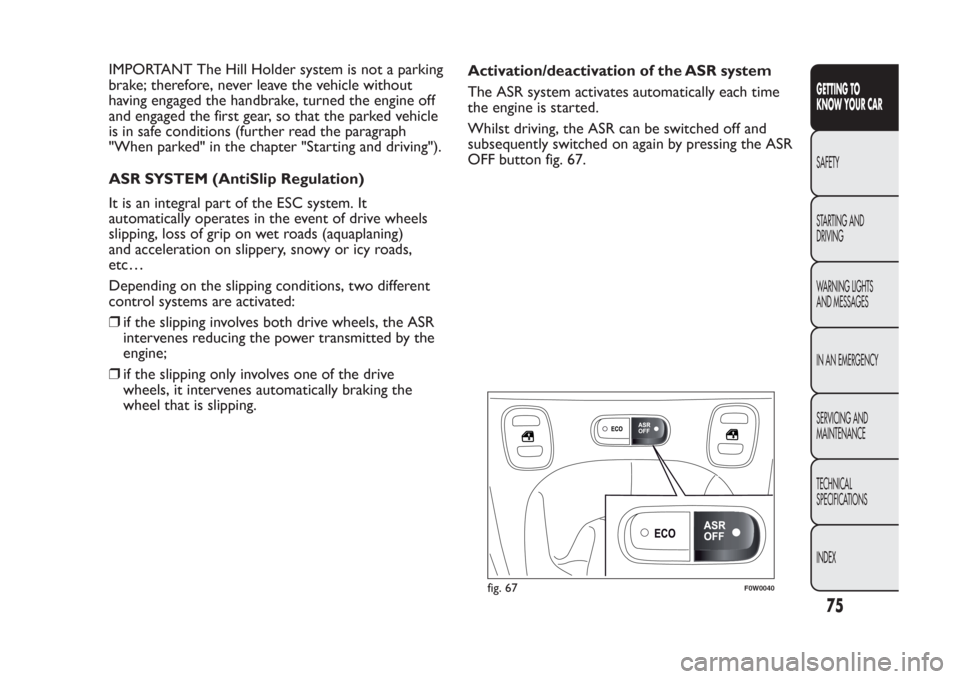
Whilst driving, the ASR can be switched off and
subsequently switched on again by pressing the ASR
OFF button fig. 67.
fig. 67
F0W0040
75GETTING TO
KNOW YOUR CARSAFETY
STARTING AND
DRIVING
WARNING LIGHTS
AND MESSAGES
IN AN EMERGENCY
SERVICING AND
MAINTENANCE
TECHNICAL
SPECIFICATIONS
INDEX
Page 80 of 284
On some versions, the intervention of the system is
indicated by a message shown on the display. When
the system is not active, the LED on the button ASR
OFF turns on and, on some versions, a message
appears on the display.
When the ASR is deactivated whilst driving, the next
time the car is started the ASR is automatically
activated.
When travelling on snowy roads with snow chains, it
may be helpful to turn the ASR off: in fact, in these
conditions, slipping of the drive wheels when moving
off makes it possible to obtain better traction.
WARNING
For the correct operation of the ESC
and ASR systems it is vital that the tyres
are the same make and the same type on all
the wheels, in perfect condition and, above all,
the recommended type, make and size.
WARNING
The ESC functions even when the
space-saver wheel is being used. Always
remember that the space-saver wheel, being
smaller than the original wheel, provides less
grip.
WARNING
Do not take unnecessary risks, even if
your vehicle is fitted with the ESC and
ASR systems.Your driving style must always be
suited to the road conditions, visibility and
traffic .The driver is always responsible for road
safety.
76GETTING TO
KNOW YOUR CAR
SAFETY
STARTING AND
DRIVING
WARNING LIGHTS
AND MESSAGES
IN AN EMERGENCY
SERVICING AND
MAINTENANCE
TECHNICAL
SPECIFICATIONS
INDEX
Page 82 of 284
TRACTION PLUS SYSTEM(for versions/markets, where provided)
Traction Plus is a driving aid, useful for setting off in
poor grip conditions (snow, ice, mud, etc.) which
allows the drive force to be distributed in the best
way over the front axle when one wheel is slipping.
In effect, Traction Plus acts by braking the wheels
with poor grip (or those slipping more than the
others), thereby transferring the drive force to those
which have more grip on the ground.
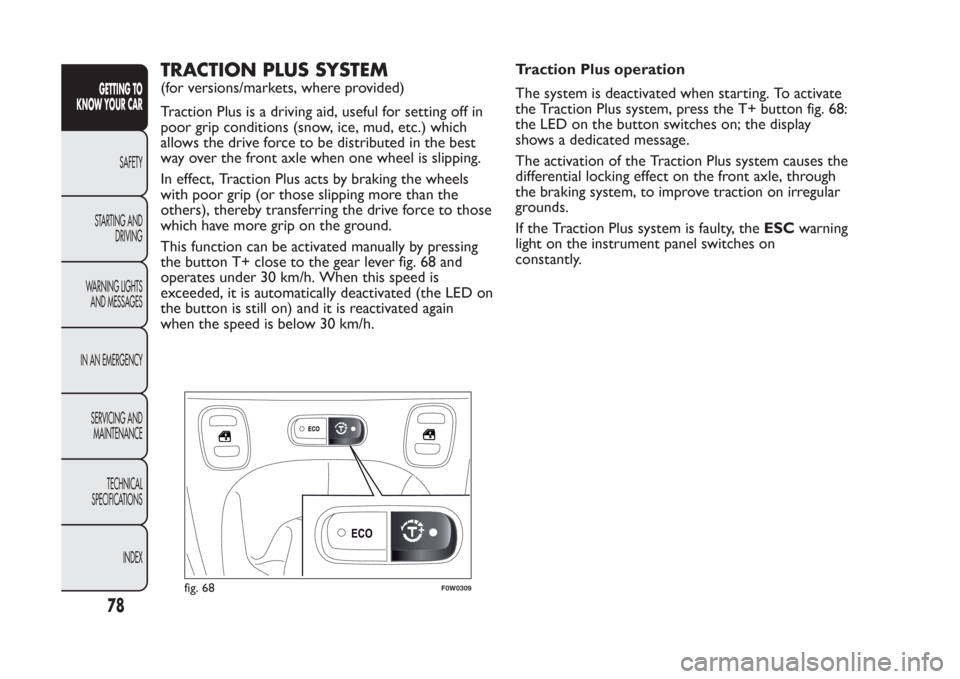
This function can be activated manually by pressing
the button T+ close to the gear lever fig. 68 and
operates under 30 km/h. When this speed is
exceeded, it is automatically deactivated (the LED on
the button is still on) and it is reactivated again
when the speed is below 30 km/h.Traction Plus operation
The system is deactivated when starting. To activate
the Traction Plus system, press the T+ button fig. 68:
the LED on the button switches on; the display
shows a dedicated message.
The activation of the Traction Plus system causes the
differential locking effect on the front axle, through
the braking system, to improve traction on irregular
grounds.
If the Traction Plus system is faulty, theESCwarning
light on the instrument panel switches on
constantly.
fig. 68
F0W0309
78GETTING TO
KNOW YOUR CAR
SAFETY
STARTING AND
DRIVING
WARNING LIGHTS
AND MESSAGES
IN AN EMERGENCY
SERVICING AND
MAINTENANCE
TECHNICAL
SPECIFICATIONS
INDEX
Page 94 of 284
DUALDRIVE ELECTRIC POWER
STEERINGThis only operates with the key turned to MAR and
the engine started. The steering allows the force
required at the steering wheel to be adjusted to suit
driving conditions.
IMPORTANT When turning the ignition key quickly,
full power steering functionality can be achieved after
a few seconds.
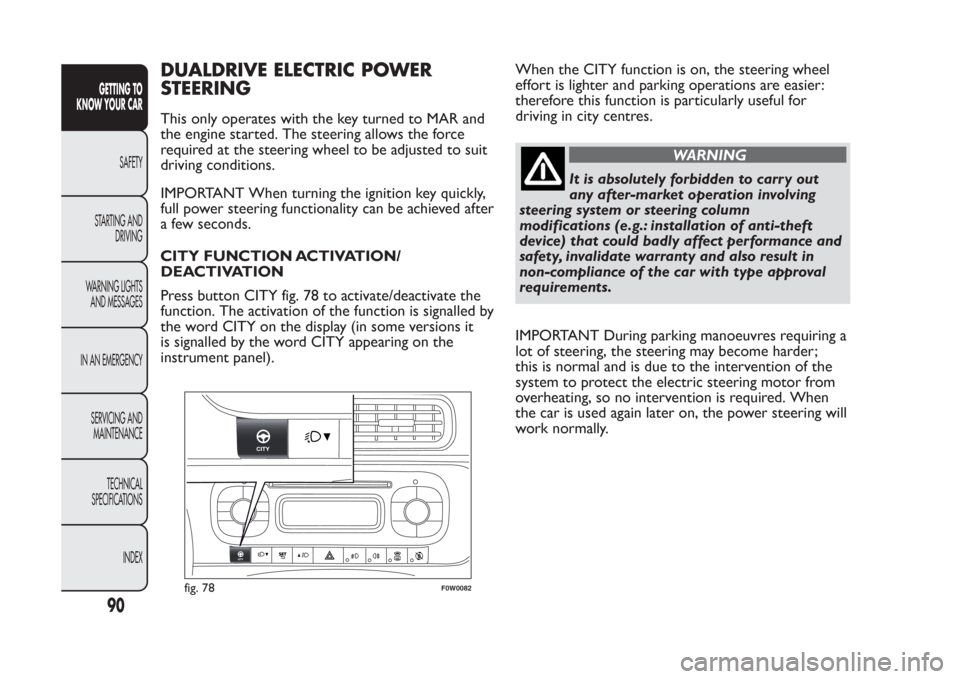
CITY FUNCTION ACTIVATION/
DEACTIVATION
Press button CITY fig. 78 to activate/deactivate the
function. The activation of the function is signalled by
the word CITY on the display (in some versions it
is signalled by the word CITY appearing on the
instrument panel).When the CITY function is on, the steering wheel
effort is lighter and parking operations are easier:
therefore this function is particularly useful for
driving in city centres.
WARNING
It is absolutely forbidden to carr y out
any after-market operation involving
steering system or steering column
modifications (e.g.: installation of anti-theft
device) that could badly affect performance and
safety, invalidate warranty and also result in
non-compliance of the car with type approval
requirements.
IMPORTANT During parking manoeuvres requiring a
lot of steering, the steering may become harder;
this is normal and is due to the intervention of the
system to protect the electric steering motor from
overheating, so no intervention is required. When
the car is used again later on, the power steering will
work normally.
fig. 78
F0W0082
90GETTING TO
KNOW YOUR CAR
SAFETY
STARTING AND
DRIVING
WARNING LIGHTS
AND MESSAGES
IN AN EMERGENCY
SERVICING AND
MAINTENANCE
TECHNICAL
SPECIFICATIONS
INDEX
Page 95 of 284
WARNING
Before starting any servicing operation,
stop the engine and remove the key
from the ignition switch to operate the steering
lock, particularly when the wheels do not touch
the ground. If this is not possible (for example
if the key needs to be turned to MAR or the
engine must be running), remove the main fuse
that protects the electric power steering.
WIRING FOR RADIO SYSTEM(for versions/markets, where provided)
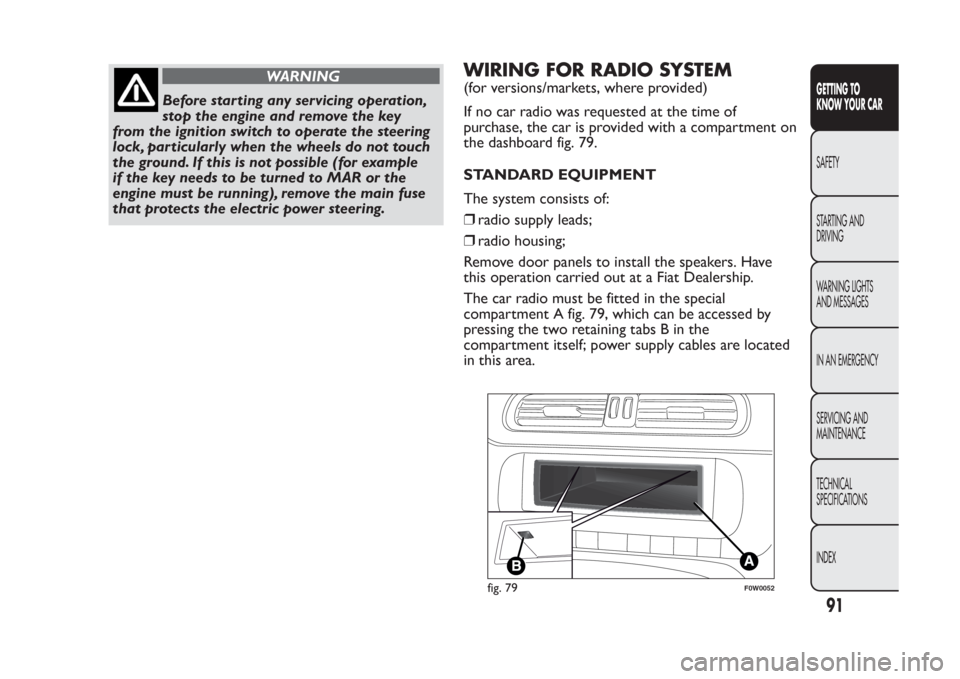
If no car radio was requested at the time of
purchase, the car is provided with a compartment on
the dashboard fig. 79.
STANDARD EQUIPMENT
The system consists of:
❒radio supply leads;
❒radio housing;
Remove door panels to install the speakers. Have
this operation carried out at a Fiat Dealership.
The car radio must be fitted in the special
compartment A fig. 79, which can be accessed by
pressing the two retaining tabs B in the
compartment itself; power supply cables are located
in this area.
fig. 79
F0W0052
91GETTING TO
KNOW YOUR CARSAFETY
STARTING AND
DRIVING
WARNING LIGHTS
AND MESSAGES
IN AN EMERGENCY
SERVICING AND
MAINTENANCE
TECHNICAL
SPECIFICATIONS
INDEX
Page 100 of 284
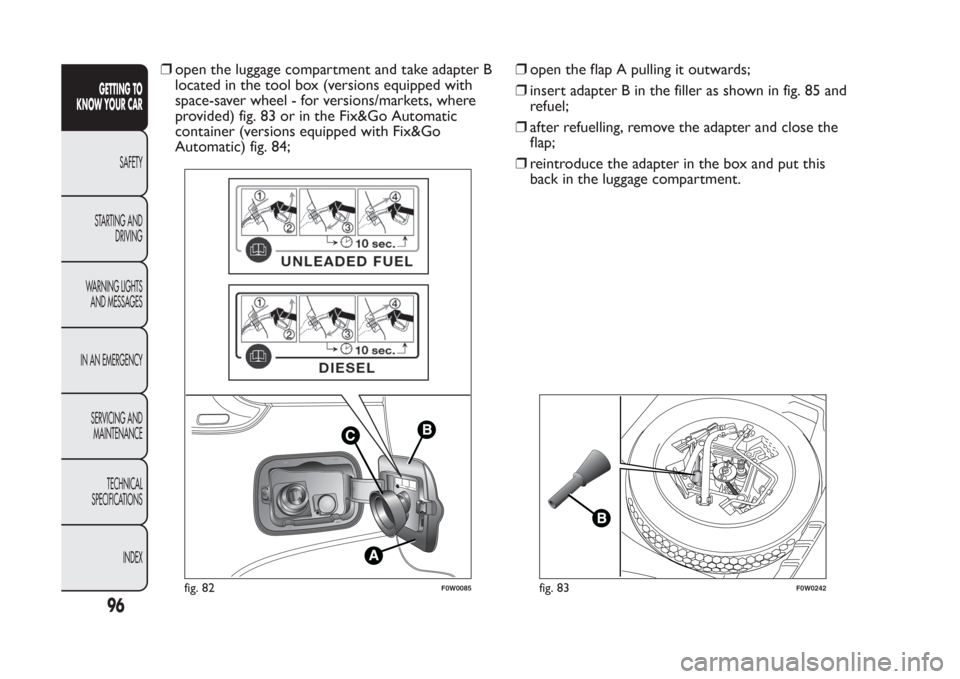
❒open the luggage compartment and take adapter B
located in the tool box (versions equipped with
space-saver wheel - for versions/markets, where
provided) fig. 83 or in the Fix&Go Automatic
container (versions equipped with Fix&Go
Automatic) fig. 84;❒open the flap A pulling it outwards;
❒insert adapter B in the filler as shown in fig. 85 and
refuel;
❒after refuelling, remove the adapter and close the
flap;
❒reintroduce the adapter in the box and put this
back in the luggage compartment.
fig. 82
F0W0085
fig. 83
F0W0242
96GETTING TO
KNOW YOUR CAR
SAFETY
STARTING AND
DRIVING
WARNING LIGHTS
AND MESSAGES
IN AN EMERGENCY
SERVICING AND
MAINTENANCE
TECHNICAL
SPECIFICATIONS
INDEX
Page 119 of 284
AIR BAGSThe car is fitted with front air bags for driver and
passenger, front side bags for driver and passenger
chest-shoulder protection (for versions/markets,
where provided) and window bags for protecting the
heads of front occupants.
FRONT AIR BAGS
The front (driver and passenger) air bags protect the
front seat occupants in the event of head-on impacts
of medium-high severity, by placing the bag between
the occupant and the steering wheel or dashboard.
Therefore non-deployment in other types of impacts
(side impacts, rear shunts, roll-overs, etc.) does not
indicate a system malfunction.
Front (driver and passenger) air bags are not a
replacement of but complementary to the seat belts,
which you are recommended to always wear, as
specified by law in Europe and most non-European
countries.
In the event of an impact, those not wearing a seat
belt move forwards and may come into contact with
the bag which is still inflating. The protection offered
by the bag is compromised in these circumstances.
Front airbags may not deploy in the following
situations:❒frontal impacts against highly deformable objects
not involving the front surface of the car (e.g.
wing collision against guard rail, etc.);
❒car wedging under other vehicles or protective
barriers (e.g. trucks or guard rails);
they may not provide any additional protection
compared with seat belts, so their activation would
be inappropriate. In these cases, non-deployment
does not indicate a system malfunction.
WARNING
Do not apply stickers or other objects
on the steering wheel, on the dashboard
in the passenger side air bag area, on side
upholstery on roof and on the seats. Never put
objects (e.g. mobile phones) on the passenger's
side dashboard since they could interfere with
correct inflation of the air bag and also cause
serious injur y to the passengers.
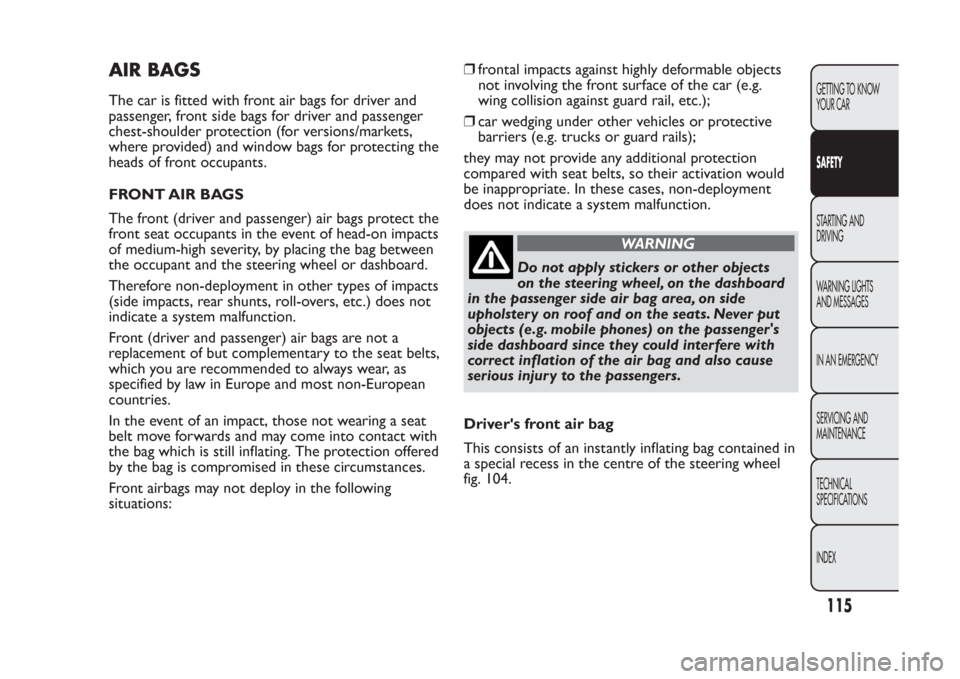
Driver's front air bag
This consists of an instantly inflating bag contained in
a special recess in the centre of the steering wheel
fig. 104.
115GETTING TO KNOW
YOUR CARSAFETYSTARTING AND
DRIVING
WARNING LIGHTS
AND MESSAGES
IN AN EMERGENCY
SERVICING AND
MAINTENANCE
TECHNICAL
SPECIFICATIONS
INDEX
Page 120 of 284
WARNING
Always drive keeping your hands on the
steering wheel rim so that the air bag
can inflate freely if necessary. Do not drive with
your body bent forward. Keep your back straight
against the backrest .
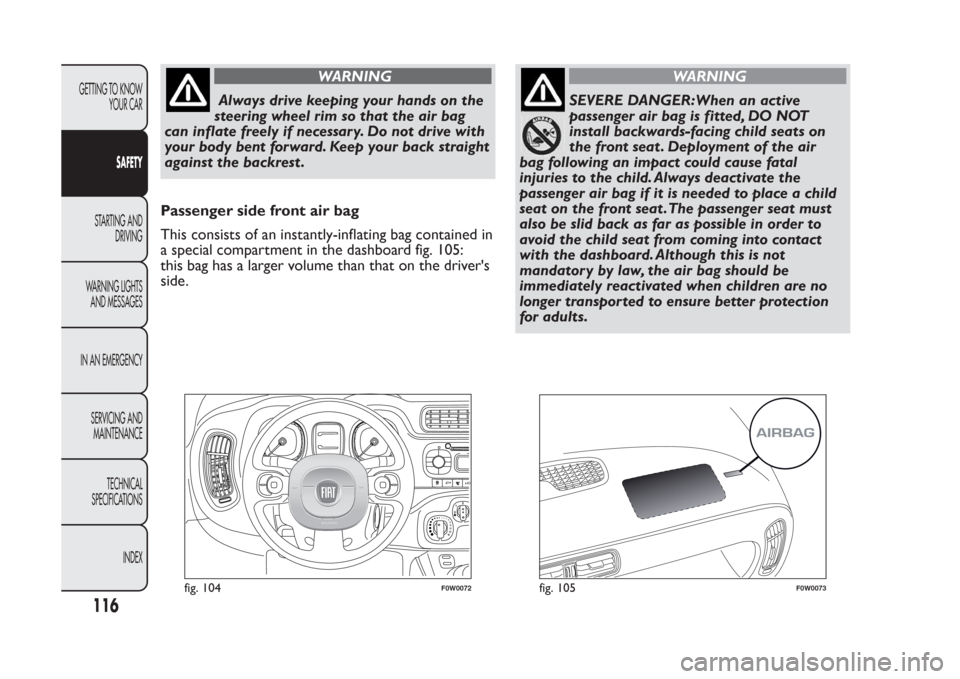
Passenger side front air bag
This consists of an instantly-inflating bag contained in
a special compartment in the dashboard fig. 105:
this bag has a larger volume than that on the driver's
side.
WARNING
SEVERE DANGER:When an active
passenger air bag is fitted, DO NOT
install backwards-facing child seats on
the front seat . Deployment of the air
bag following an impact could cause fatal
injuries to the child. Always deactivate the
passenger air bag if it is needed to place a child
seat on the front seat .The passenger seat must
also be slid back as far as possible in order to
avoid the child seat from coming into contact
with the dashboard. Although this is not
mandatory by law, the air bag should be
immediately reactivated when children are no
longer transpor ted to ensure better protection
for adults.
1
02
fig. 104
F0W0072
fig. 105
F0W0073
116
GETTING TO KNOW
YOUR CAR
SAFETY
STARTING AND
DRIVING
WARNING LIGHTS
AND MESSAGES
IN AN EMERGENCY
SERVICING AND
MAINTENANCE
TECHNICAL
SPECIFICATIONS
INDEX
Page 126 of 284
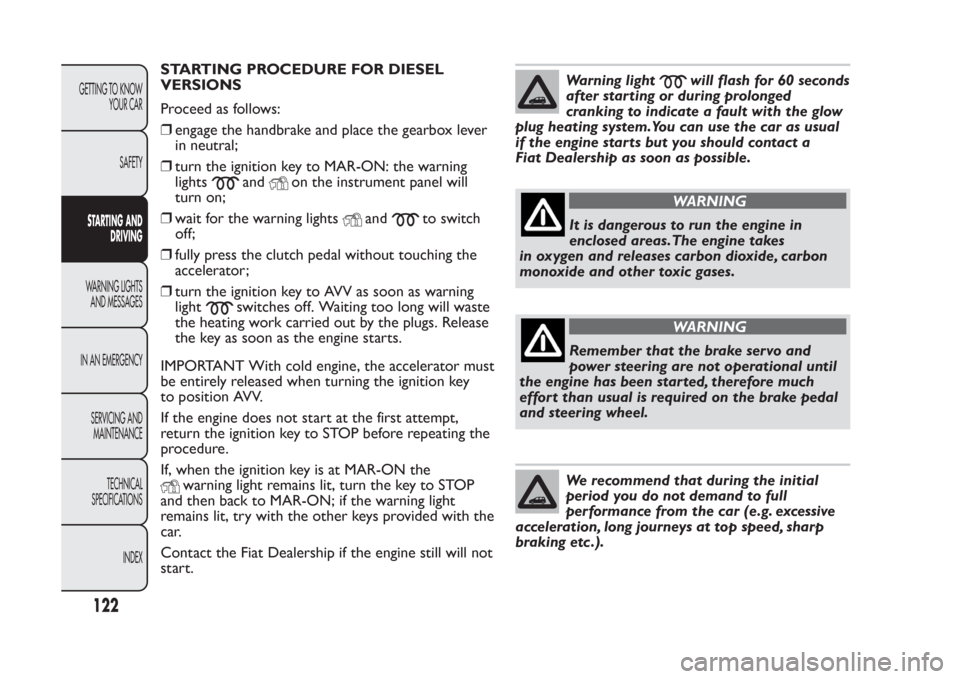
STARTING PROCEDURE FOR DIESEL
VERSIONS
Proceed as follows:
❒engage the handbrake and place the gearbox lever
in neutral;
❒turn the ignition key to MAR-ON: the warning
lights
and
on the instrument panel will
turn on;
❒wait for the warning lights
and
to switch
off;
❒fully press the clutch pedal without touching the
accelerator;
❒turn the ignition key to AVV as soon as warning
light
switches off. Waiting too long will waste
the heating work carried out by the plugs. Release
the key as soon as the engine starts.
IMPORTANT With cold engine, the accelerator must
be entirely released when turning the ignition key
to position AVV.
If the engine does not start at the first attempt,
return the ignition key to STOP before repeating the
procedure.
If, when the ignition key is at MAR-ON the
warning light remains lit, turn the key to STOP
and then back to MAR-ON; if the warning light
remains lit, try with the other keys provided with the
car.
Contact the Fiat Dealership if the engine still will not
start.
Warning light
will flash for 60 seconds
after starting or during prolonged
cranking to indicate a fault with the glow
plug heating system.You can use the car as usual
if the engine starts but you should contact a
Fiat Dealership as soon as possible.
WARNING
It is dangerous to run the engine in
enclosed areas.The engine takes
in oxygen and releases carbon dioxide, carbon
monoxide and other toxic gases.
WARNING
Remember that the brake servo and
power steering are not operational until
the engine has been started, therefore much
effort than usual is required on the brake pedal
and steering wheel.We recommend that during the initial
period you do not demand to full
performance from the car (e.g. excessive
acceleration, long journeys at top speed, sharp
braking etc .).
122
GETTING TO KNOW
YOUR CAR
SAFETYSTARTING AND
DRIVINGWARNING LIGHTS
AND MESSAGES
IN AN EMERGENCY
SERVICING AND
MAINTENANCE
TECHNICAL
SPECIFICATIONS
INDEX
Page 128 of 284
PARKINGStop the engine and engage the handbrake. Engage a
gear (1
st
gear if parked uphill or reverse if facing
downhill) and leave the wheels turned. If the car is
parked on a steep slope block the wheels with a
wedge or stone. Always remove the ignition key
when leaving the car.
WARNING
Never leave children unattended in the
car. Always remove the key from the
ignition when leaving the car and take it with
you.HANDBRAKE
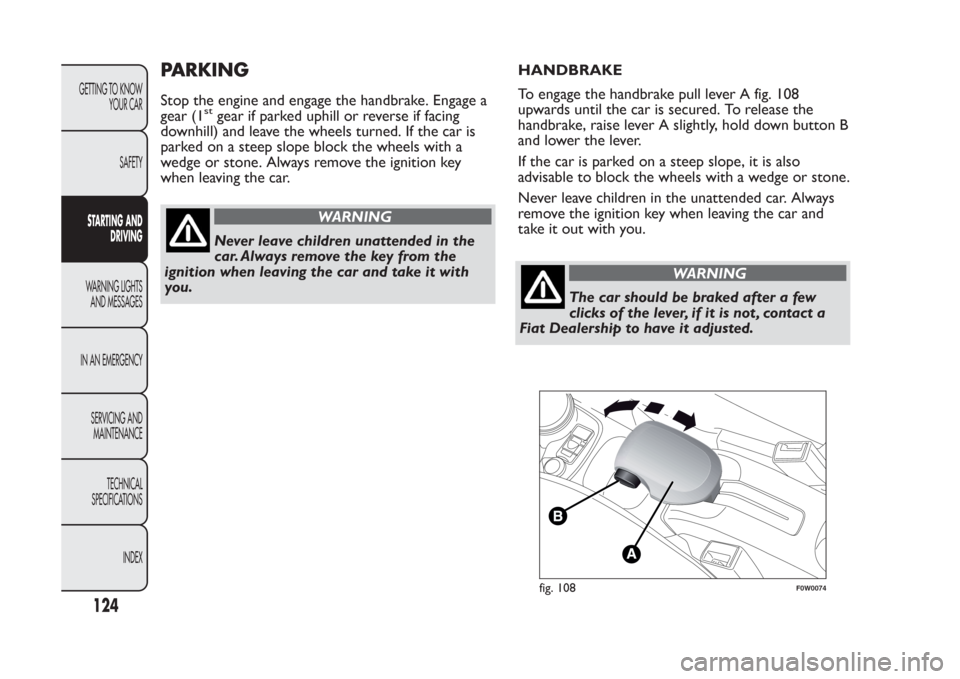
To engage the handbrake pull lever A fig. 108
upwards until the car is secured. To release the
handbrake, raise lever A slightly, hold down button B
and lower the lever.
If the car is parked on a steep slope, it is also
advisable to block the wheels with a wedge or stone.
Never leave children in the unattended car. Always
remove the ignition key when leaving the car and
take it out with you.
WARNING
The car should be braked after a few
clicks of the lever, if it is not , contact a
Fiat Dealership to have it adjusted.
fig. 108
F0W0074
124
GETTING TO KNOW
YOUR CAR
SAFETYSTARTING AND
DRIVINGWARNING LIGHTS
AND MESSAGES
IN AN EMERGENCY
SERVICING AND
MAINTENANCE
TECHNICAL
SPECIFICATIONS
INDEX