belt FIAT PANDA 2015 319 / 3.G User Guide
[x] Cancel search | Manufacturer: FIAT, Model Year: 2015, Model line: PANDA, Model: FIAT PANDA 2015 319 / 3.GPages: 196, PDF Size: 19.49 MB
Page 76 of 196
PRETENSIONERS
87) 88) 89) 90) 91)
35)
The vehicle is equipped with front seat
belt pretensioners, which draw back
the seat belts by several centimetres in
the event of a strong frontal impact.
This guarantees the perfect adherence
of the seat belts to the occupant's
bodies before the retention action
begins.
It is evident that the pretensioners have
operated when the belt withdraws
towards the retractor. This vehicle is
also equipped with a second
pretensioner (in the kick plate area). Its
activation is signalled by the shortening
of the metal cable.
A slight discharge of smoke may be
produced during the activation of the
pretensioner which is not harmful and
does not involve any fire hazard.
If, due to unusual natural events (floods,
sea storms, etc.), the device has been
affected by water and/or mud, contact
a Fiat Dealership to have it replaced.
IMPORTANT To obtain the highest
degree of protection from the action of
the pretensioner, wear the seat belt
tight to the chest and pelvis.LOAD LIMITERS
To increase occupant safety, the
retractors contain a load limiter to dose
the force acting on the chest and
shoulders during the belt restraining
action in the case of frontal collisions.
GENERAL
INSTRUCTIONS FOR
USING THE SEAT BELTS
The driver is responsible for respecting,
and ensuring that all the other
occupants of the vehicle also respect,
the local laws in force in relation to
the use of the seat belts. Always fasten
the seat belts before setting off.
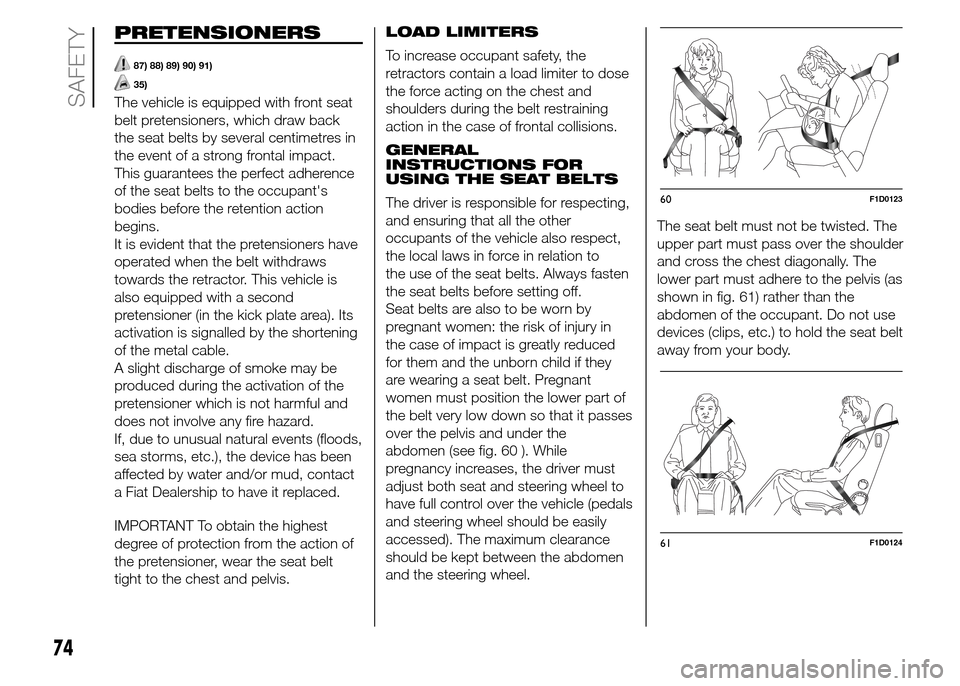
Seat belts are also to be worn by
pregnant women: the risk of injury in
the case of impact is greatly reduced
for them and the unborn child if they
are wearing a seat belt. Pregnant
women must position the lower part of
the belt very low down so that it passes
over the pelvis and under the
abdomen (see fig. 60 ). While
pregnancy increases, the driver must
adjust both seat and steering wheel to
have full control over the vehicle (pedals
and steering wheel should be easily
accessed). The maximum clearance
should be kept between the abdomen
and the steering wheel.The seat belt must not be twisted. The
upper part must pass over the shoulder
and cross the chest diagonally. The
lower part must adhere to the pelvis (as
shown in fig. 61) rather than the
abdomen of the occupant. Do not use
devices (clips, etc.) to hold the seat belt
away from your body.
60F1D0123
61F1D0124
74
SAFETY
Page 77 of 196
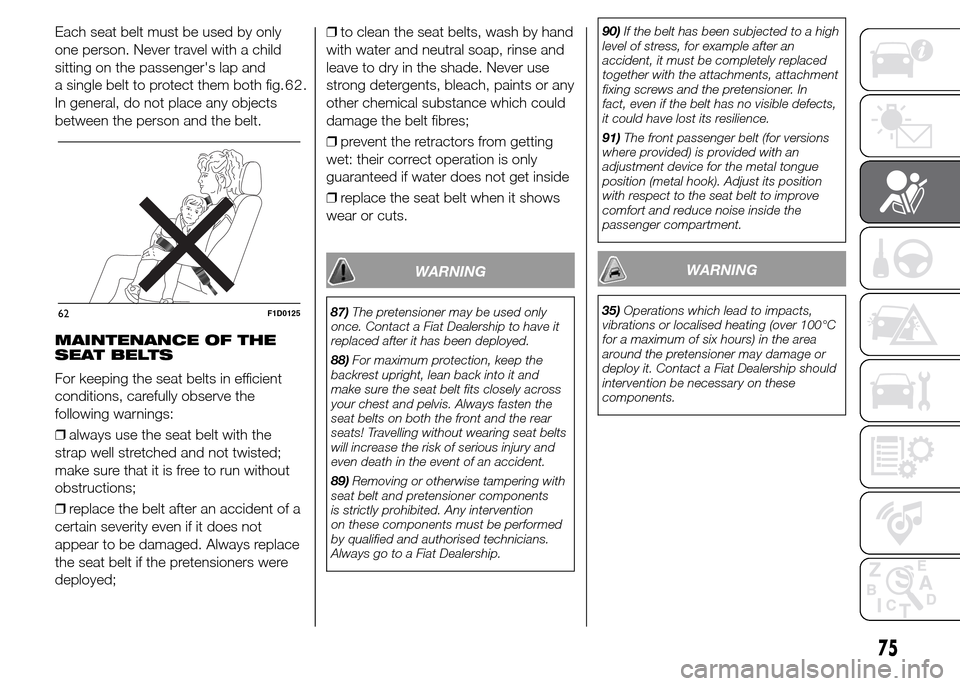
Each seat belt must be used by only
one person. Never travel with a child
sitting on the passenger's lap and
a single belt to protect them both fig.
In general, do not place any objects
between the person and the belt.
MAINTENANCE OF THE
SEAT BELTS
For keeping the seat belts in efficient
conditions, carefully observe the
following warnings:
❒always use the seat belt with the
strap well stretched and not twisted;
make sure that it is free to run without
obstructions;
❒replace the belt after an accident of a
certain severity even if it does not
appear to be damaged. Always replace
the seat belt if the pretensioners were
deployed;❒to clean the seat belts, wash by hand
with water and neutral soap, rinse and
leave to dry in the shade. Never use
strong detergents, bleach, paints or any
other chemical substance which could
damage the belt fibres;
❒prevent the retractors from getting
wet: their correct operation is only
guaranteed if water does not get inside
❒replace the seat belt when it shows
wear or cuts.
WARNING
87)The pretensioner may be used only
once. Contact a Fiat Dealership to have it
replaced after it has been deployed.
88)For maximum protection, keep the
backrest upright, lean back into it and
make sure the seat belt fits closely across
your chest and pelvis. Always fasten the
seat belts on both the front and the rear
seats! Travelling without wearing seat belts
will increase the risk of serious injury and
even death in the event of an accident.
89)Removing or otherwise tampering with
seat belt and pretensioner components
is strictly prohibited. Any intervention
on these components must be performed
by qualified and authorised technicians.
Always go to a Fiat Dealership.90)If the belt has been subjected to a high
level of stress, for example after an
accident, it must be completely replaced
together with the attachments, attachment
fixing screws and the pretensioner. In
fact, even if the belt has no visible defects,
it could have lost its resilience.
91)The front passenger belt (for versions
where provided) is provided with an
adjustment device for the metal tongue
position (metal hook). Adjust its position
with respect to the seat belt to improve
comfort and reduce noise inside the
passenger compartment.
WARNING
35)Operations which lead to impacts,
vibrations or localised heating (over 100°C
for a maximum of six hours) in the area
around the pretensioner may damage or
deploy it. Contact a Fiat Dealership should
intervention be necessary on these
components.62F1D0125
75
62.
Page 78 of 196
CHILD PROTECTION
SYSTEMS
CARRYING CHILDREN
SAFELY
92) 93) 94) 95)
For optimal protection in the event of an
impact, all occupants must be seated
and wearing adequate restraint
systems, including newborn and other
children! This prescription is
compulsory in all EC countries
according to EC Directive 2003/20/EC.
Children below the height of 1.50
metres and up to 12 years must be
protected with suitable restraint
systems and be seated on the rear
seats.
Statistics on accidents indicate that the
rear seats offer greater safety for
children.
Compared with an adult, a child's head
is larger and heavier in proportion to
their body and the child's muscular and
bone structures are not fully developed.
Therefore, correct restraint systems
other than adult seat belts are
necessary to reduce as much as
possible the risk of injuries in the event
of an accident, braking or sudden
manoeuvre.Children must be seated safely and
comfortably. Depending on the
characteristics of the child restraint
systems used, you are advised to keep
children in rearward facing child
restraint systems for as long as
possible (at least until 3–4 years old),
since this is the most protected position
in the event of an impact.
The choice of the most suitable child
restraint system depends on the weight
and size of the child. There are various
types of child restraint systems, which
can be secured to the vehicle by means
of the seat belts or with the ISOFIX
anchorages.
It is recommended to always choose
the restraint system most suitable
for the child; for this reason always refer
to the Owner Handbook provided with
the child restraint system, to be sure
that it is of the right type for the children
it is intended for.
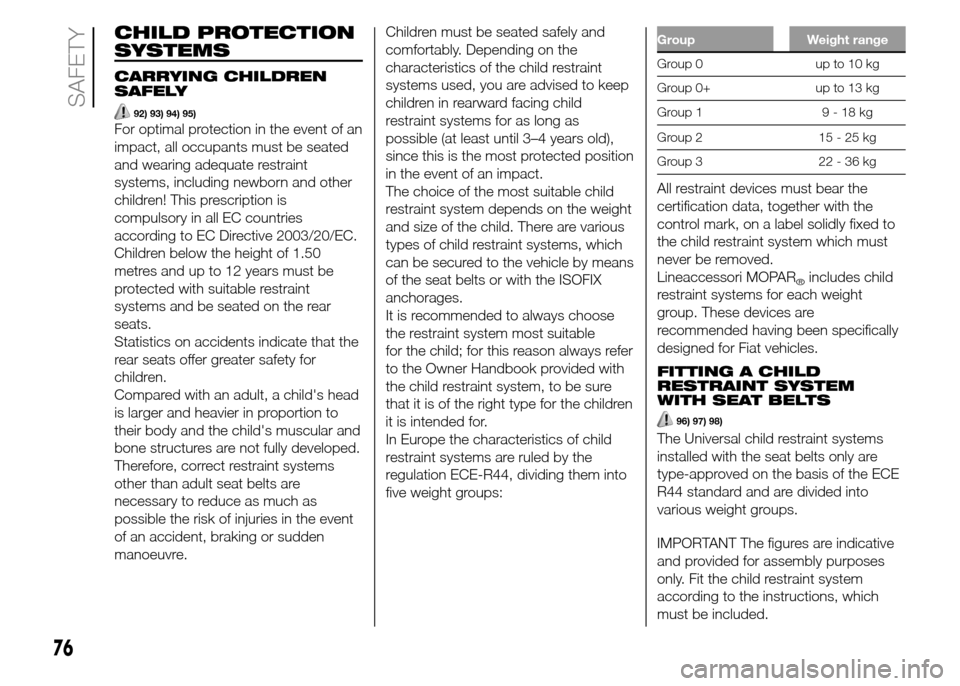
In Europe the characteristics of child
restraint systems are ruled by the
regulation ECE-R44, dividing them into
five weight groups:
Group Weight range
Group0 upto10kg
Group 0+ up to 13 kg
Group 1 9 - 18 kg
Group 2 15 - 25 kg
Group 3 22 - 36 kg
All restraint devices must bear the
certification data, together with the
control mark, on a label solidly fixed to
the child restraint system which must
never be removed.
Lineaccessori MOPAR
®includes child
restraint systems for each weight
group. These devices are
recommended having been specifically
designed for Fiat vehicles.
FITTING A CHILD
RESTRAINT SYSTEM
WITH SEAT BELTS
96) 97) 98)
The Universal child restraint systems
installed with the seat belts only are
type-approved on the basis of the ECE
R44 standard and are divided into
various weight groups.
IMPORTANT The figures are indicative
and provided for assembly purposes
only. Fit the child restraint system
according to the instructions, which
must be included.
76
SAFETY
Page 79 of 196
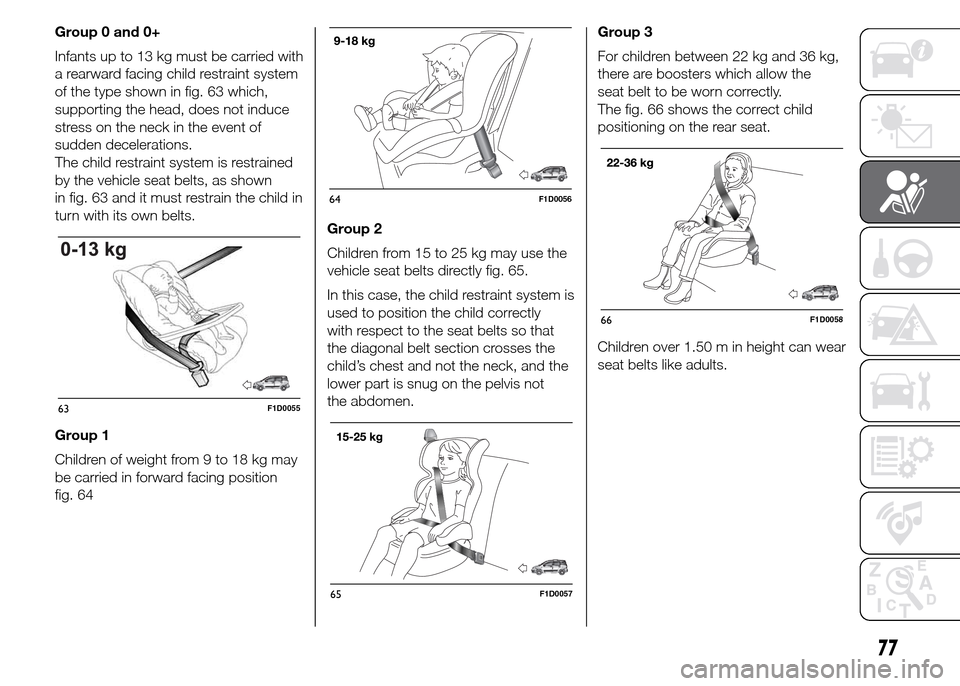
Group 0 and 0+
Infants up to 13 kg must be carried with
a rearward facing child restraint system
of the type shown in fig. 63 which,
supporting the head, does not induce
stress on the neck in the event of
sudden decelerations.
The child restraint system is restrained
by the vehicle seat belts, as shown
in fig. 63 and it must restrain the child in
turn with its own belts.
Group 1
Children of weight from 9 to 18 kg may
be carried in forward facing position
fig. 64Group 2
Children from 15 to 25 kg may use the
vehicle seat belts directly fig. 65.
In this case, the child restraint system is
used to position the child correctly
with respect to the seat belts so that
the diagonal belt section crosses the
child’s chest and not the neck, and the
lower part is snug on the pelvis not
the abdomen.Group 3
For children between 22 kg and 36 kg,
there are boosters which allow the
seat belt to be worn correctly.
The fig. 66 shows the correct child
positioning on the rear seat.
Children over 1.50 m in height can wear
seat belts like adults.
63F1D0055
64F1D0056
65F1D0057
66F1D0058
77
Page 81 of 196
FITTING AN ISOFIX
CHILD RESTRAINT
SYSTEM
99) 100) 101) 102)
The vehicle is equipped with ISOFIX
anchorages, a new standard which
makes fitting a child restraint system
quick, simple and safe.
The ISOFIX system allows the ISOFIX
child restraint systems to be fitted,
without using the vehicle's seat belt,
but directly securing the child restraint
system to three anchorages present on
the vehicle. Traditional child restraint
systems can be fitted alongside ISOFIX
child restraint systems on different
seats in the same vehicle.
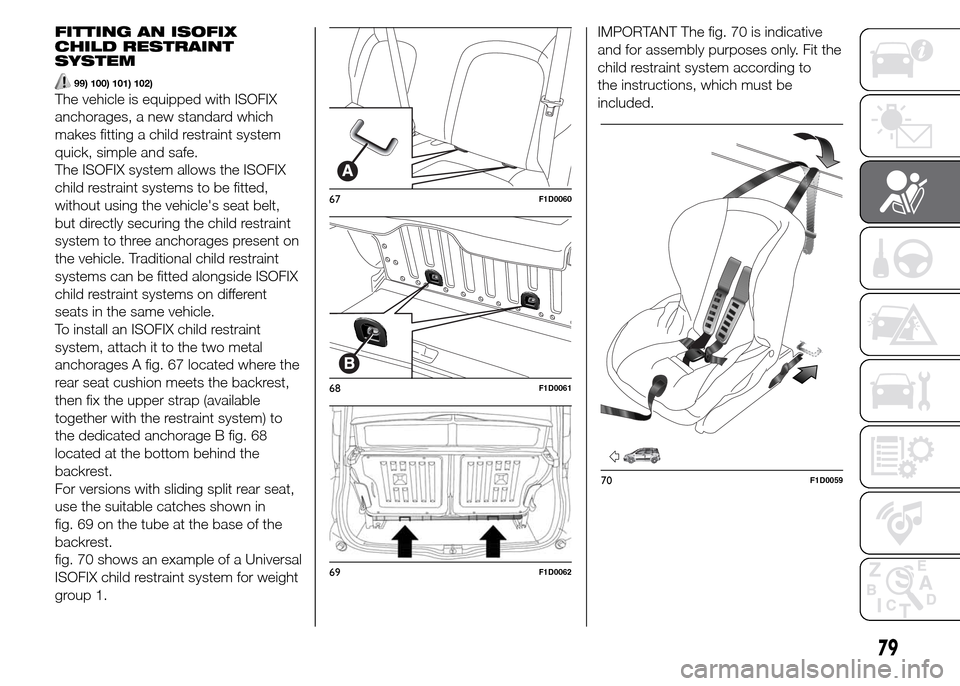
To install an ISOFIX child restraint
system, attach it to the two metal
anchorages A fig. 67 located where the
rear seat cushion meets the backrest,
then fix the upper strap (available
together with the restraint system) to
the dedicated anchorage B fig. 68
located at the bottom behind the
backrest.
For versions with sliding split rear seat,
use the suitable catches shown in
fig. 69 on the tube at the base of the
backrest.
fig. 70 shows an example of a Universal
ISOFIX child restraint system for weight
group 1.IMPORTANT The fig. 70 is indicative
and for assembly purposes only. Fit the
child restraint system according to
the instructions, which must be
included.
67F1D0060
68F1D0061
69F1D0062
70F1D0059
79
Page 83 of 196
Main recommendations to carry
children safely
❒Install the child restraint systems on
the rear seat, which is the most
protected position in the event of an
impact.
❒Keep children in rearward facing child
restraint systems for as long as
possible, until 3–4 years old if possible.
❒Should a rearward facing child
restraint system be installed on the rear
seats, it is advisable to position it as
far forward as the position of the front
seat allows.
❒If the passenger's front airbag is
deactivated, always check that the
warning light is on constantly in the
central dashboard, to make sure that it
has actually been deactivated.
❒Carefully follow the instructions
supplied with the child restraint system.
Keep the instructions in the vehicle
along with the other documents and
this handbook. Do not use second-
hand child restraint systems without
instructions.
❒Only one child is to be strapped into
each restraint system; never carry
two children using one child restraint
system.
❒Always check that the seat belts do
not rest on the child’s neck.❒Always check that the seat belt is
well fastened by pulling on it.
❒While travelling, do not let the child sit
incorrectly or unfasten the belts.
❒Never allow a child to put the belt's
diagonal section under an arm or
behind their back.
❒Never carry children on your lap,
even newborns. No one can hold
a child in the case of an accident.
❒In the event of an accident, replace
the child restraint system with a new
one.
WARNING
92)SEVERE DANGER When a front
passenger airbag is fitted, do not install
rear facing child restraint systems on the
front passenger seat. Deployment of
the airbag in an accident could cause fatal
injuries to the child regardless of the
severity of the collision. It is advisable to
always carry children in a child restraint
system on the rear seat, which is the most
protected position in the event of an
impact.
93)On the sun visor there is a label with
suitable symbols reminding the user that it
is compulsory to deactivate the airbag if
a rearward facing child restraint system is
fitted. Always comply with the instructions
on the passenger's side sun visor (see
the "Supplementary Restraint System
(SRS) - Airbag" paragraph).94)Should it be necessary to carry a child
on the passenger side front seat in a rear
facing child restraint system, the passenger
side front airbag and side bag must be
deactivated through the display main
menu, verifying deactivation by checking
that the
warning light has switched
on in the central part of the dashboard.
Move the passenger's seat as far back as
possible to avoid contact between the child
restraint system and the dashboard.
95)Do not adjust the front or rear seat if a
child is seated on it or on the dedicated
child restraint system.
96)Incorrect fitting of the child restraint
system may result in an inefficient
protection system. In the event of an
accident the child restraint system may
become loose and the child may be
injured, even fatally. When fitting a restraint
system for newborns or children, strictly
comply with the instructions provided
by the Manufacturer.
97)When the child restraint system is not
used, secure it with the seat belt or with
the ISOFIX anchorages, or remove it from
the vehicle. Do not leave it unsecured
inside the passenger compartment. In this
way, in the case of sudden braking or an
accident, it will not cause injuries to the
occupants.
98)After installing a child restraint system,
do not move the seat: always remove
the child restraint system before making
any adjustment.
81
Page 84 of 196
99)Always make sure that the chest
section of the seat belt does not pass
under the arms or behind the back of the
child. In the event of an accident the seat
belt will not be able to secure the child,
with the risk of injury, including fatal injury.
Therefore the child must always wear
the seat belt correctly.
100)Do not use the same lower anchorage
to install more than one child restraint
system.
101)If a Universal ISOFIX child restraint
system is not fixed to all three anchorages,
it will not be able to protect the child
correctly. In a crash, the child could be
seriously or fatally injured.
102)Fit the child restraint system only
when the vehicle is stationary. The child
restraint system is correctly fixed to the
brackets when you hear the click. Follow
the instructions for assembly, disassembly
and positioning that the Manufacturer
must supply with the child restraint system.SUPPLEMENTARY
RESTRAINT SYSTEM
(SRS) - AIRBAG
The vehicle is equipped with:
❒front driver airbag;
❒front passenger airbag;
❒front side bags for pelvis, chest and
shoulder protection of driver and
passenger (for versions/markets, where
provided);
❒side bags for head protection of front
seat passengers and rear side seat
passengers (window bag).
FRONT AIRBAGS
103)
The front (driver and passenger) airbags
protect the front seat occupants in the
event of head-on crashes of medium-
high severity, by placing the cushion
between the occupant and the steering
wheel or dashboard.
Therefore non-activation of airbags in
other types of collisions (side impacts,
rear shunts, roll-overs, etc.) does not
indicate a system malfunction.
Driver and passenger front airbags are
not a replacement of but
complementary to the seat belts, which
should always be worn, as specified
by law in Europe and most non-
European countries.In the event of an impact, those not
wearing a seat belt are projected
forwards, and may come into contact
with the bag which is still inflating.
The protection offered by the bag is
compromised in these circumstances.
The front airbags may not activate in
the case of a frontal impact against
highly deformable objects not involving
the front surface of the vehicle (e.g.
wing collision against guard rail) or in
the case of the vehicle wedging under
other vehicles or protective barriers
(e.g. under trucks or guard rails).
Failure to activate in the conditions
described above is due to the fact that
they may not provide any additional
protection compared with seat belts, so
their activation would be inappropriate.
In these cases, non-deployment does
not indicate a system malfunction.
82
SAFETY
Page 89 of 196
114)Airbags may be deployed if another
vehicle crashes into the vehicle, if the key is
inserted and at MAR even if the engine is
not running and the vehicle is stationary.
Therefore, even if the vehicle is stationary,
when an active front passenger airbag
is fitted, DO NOT install rearward facing
child restraint systems on the front
passenger seat. Deployment of the airbag
following an impact could cause fatal
injuries to the child. Therefore, always
deactivate the passenger side airbag when
a rearward facing child restraint system is
installed on the front passenger seat.
The front passenger seat must also be
positioned back as far as possible in order
to prevent the child restraint system from
coming into contact with the dashboard.
Immediately reactivate the passenger
airbag as soon as the child restraint system
has been removed. Also remember that, if
the key is turned to STOP, none of the
safety devices (airbags or pretensioners)
will be deployed in the event of collision.
Non-deployment in such cases does
not indicate a system malfunction.115)Theairbag warning light indicates
the passenger protection status. If the
warning light is off, the passenger side
protection is activated. It can be
deactivated from the menu, in this case the
warning light comes on. When the vehicle
is started (ignition key in MAR position), the
warning light comes on for approx. 8
seconds, provided that at least 5 seconds
have elapsed from the previous switching
off. If this does not happen please contact
a Fiat Dealership. If the vehicle is switched
off/on again in less than 5 seconds the
warning light may remain off. In this case,
to check correct warning light operation,
switch the vehicle off, wait at least 5
seconds and switch on again. During the
first 8 seconds, the activation of the
warning light does not actually show the
passenger protection status, but only
checks its correct operation. The warning
light may light up with various intensity
levels depending on the vehicle conditions.
The intensity may also vary during the
same key cycle. (The warning light is tested
also for markets where the passenger
protection deactivation function is
not provided, and the warning light
switches on for less than one second when
the key is turned to MAR, then switches
off again.)
116)The front airbag deployment threshold
is higher than that of the pretensioners.
For collisions in the range between the two
thresholds, it is normal for only the
pretensioners to be activated.117)The airbag does not replace seat
belts but increases their effectiveness.
Because front airbags are not deployed for
low-speed crashes, side collisions,
rear-end shunts or rollovers, occupants are
protected, in addition to any side bags,
only by their seat belts, which must
therefore always be fastened.
118)If the “red”
warning light does not
switch on for a few seconds when the
key is turned to MAR, there may be a fault
with the “red” warning light. In this case,
after a few seconds, the
warning light
starts flashing. Before proceeding, contact
a Fiat Dealership immediately to have the
system checked.
87
Page 91 of 196
STARTING THE
ENGINE
119) 120)
36) 37) 38) 39)
Before starting the engine, adjust the
seat, the interior rear view mirrors,
the door mirrors and fasten the seat
belt correctly.
Never press the accelerator pedal for
starting the engine.
VERSIONS WITH MANUAL
GEARBOX
Petrol versions
Proceed as follows:
❒engage the handbrake and place the
gear lever in neutral.For 0.9 TwinAir
and 0.9 TwinAir Turbo versions
engage the handbrake and place the
gear lever in neutral or fully press the
clutch pedal if a gear other than neutral
is engaged;
❒for all versions (except 0.9
TwinAir Turbo)fully depress the clutch
pedal, without pressing the accelerator;
❒turn the ignition key to AVV and
release it as soon as the engine starts.Diesel versions
Proceed as follows:
❒engage the handbrake, put the gear
lever into neutral and turn the ignition
key to MAR: the warning lights
andon the instrument panel
will turn on;
❒wait for the warning lights
and
to turn off and then fully depress
the clutch pedal without pressing the
accelerator;
❒turn the ignition key to AVV as soon
as warning light
switches off.
Release the ignition key as soon as the
engine starts.
IMPORTANT If the engine does not
start at the first attempt, return the
ignition key to STOP before repeating
the procedure. If, with the ignition
key at MAR, the warning lights
and
(only for petrol versions) stay on
in the instrument panel, the ignition key
must be brought back to STOP and
then to MAR again. If the
warning
light stays on, retry with the other
keys provided. Contact a Fiat
Dealership if you still cannot start the
engine.VERSIONS WITH
DUALOGIC GEARBOX
121)
Engine starting is allowed both with a
gear engaged and with the gearbox
in neutral (N).
However, the brake pedal must always
be pressed first if neutral is not
engaged. It is therefore advisable to
place the gear lever in neutral (N) before
starting the engine.
LPG AND NATURAL
POWER VERSIONS
The engine always starts up on petrol
independently of the mode previously
selected.
40)
STOPPING THE ENGINE
41)
Turn the ignition key to STOP while the
engine is idling.
IMPORTANT After a demanding drive,
before turning the engine off you should
allow it to idle to allow the temperature
in the engine compartment to
decrease.
89
Page 123 of 196
SCHEDULED
SERVICING
Correct servicing is crucial for
guaranteeing a long life for the vehicle
under the best conditions. For this
reason, Fiat has planned a series of
checks and services at fixed distance
intervals and, where provided, at fixed
time intervals, as described in the
Scheduled Servicing Plan.
Before each service, it is always
necessary to carefully follow the
instructions in the Scheduled Servicing
Plan (e.g. periodically check level of
fluids, tyre pressure, etc.).
Scheduled Servicing is offered by all
Fiat Dealerships according to a set time
schedule. If, during each operation, in
addition to the ones scheduled, the
need arises for further replacements or
repairs, these may be carried out with
your explicit agreement only. If your
vehicle is used frequently for towing,
the interval between one service
operation and the next should be
reduced.IMPORTANT Scheduled Servicing
interventions are set out by the
Manufacturer. Failure to have them
carried out may invalidate the warranty.
It is advisable to inform a Fiat
Dealership of any small operating
irregularities without waiting for the next
service.
PERIODIC CHECKS
Every1,000km or before long
journeys, check and if necessary, top
up: engine coolant level; brake fluid
level; screen washer fluid level; tyre
inflation pressure and condition; lighting
system operation (headlights, direction
indicators, hazard warning lights, etc.);
screen washer/wiper system operation
and positioning/wear of windscreen/
rear window wiper blades.
Every3,000km, check and top up if
required: engine oil level.HEAVY-DUTY USE OF THE
VEHICLE
If the vehicle is used under one of the
following conditions: towing a trailer
or motorhome; dusty roads; short (less
than 7-8 km) and repeated journeys
with sub-zero outside temperatures;
engine often idling or driving long
distances at low speed or long periods
of inactivity, the following checks must
be carried out more often than
indicated in the Scheduled Servicing
Plan:
❒check front disc brake pad condition
and wear;
❒check cleanliness of bonnet and
luggage compartment locks,
cleanliness and lubrication of linkage;
❒visually inspect conditions of: engine,
gearbox, transmission, pipes and
hoses (exhaust/fuel system/brakes) and
rubber elements (gaiters/sleeves/
bushes, etc.);
❒check battery charge and battery
fluid level (electrolyte);
❒visually inspect conditions of the
auxiliary drive belts;
❒check and, if necessary, change
engine oil and replace oil filter / pollen
filter / air cleaner.
121