tow FIAT PANDA 2015 319 / 3.G Owner's Manual
[x] Cancel search | Manufacturer: FIAT, Model Year: 2015, Model line: PANDA, Model: FIAT PANDA 2015 319 / 3.GPages: 196, PDF Size: 19.49 MB
Page 99 of 196
TOWING TRAILERS
129) 130)
IMPORTANT
For towing motorhomes or trailers the
vehicle must be fitted with an approved
tow hook and an adequate electrical
system. Installation must be carried out
by a specialist.
Install any specific and/or additional
door mirrors as specified by the
Highway Code.
Remember that when towing a trailer,
steep hills are harder to climb, braking
distances increase and overtaking
takes longer depending on the overall
weight of the trailer.
Engage a low gear when driving
downhill, rather than constantly using
the brake.
The weight the trailer exerts on the
vehicle tow hook reduces the vehicle's
loading capacity by the same amount.
To make sure that the maximum
towable weight is not exceeded (given
in the vehicle registration document)
account should be taken of the fully
laden trailer, including accessories and
luggage.Do not exceed the speed limits specific
to each country you are driving in, in
the case of vehicles towing trailers.
In any case, the top speed must not
exceed 100 km/h.
An electric brake (or electric winch)
should be supplied directly by the
battery through a cable with a cross
section of no less than 2.5 mm
2.
In addition to the electrical branches,
the vehicle electrical system can only
be connected to the supply cable for an
electric brake and to the cable for an
internal light for the trailer, not
exceeding 15 W. For connections, use
the preset control unit with a battery
cable with section not less than 2.5
mm
2.
On Panda Cross and Panda 4x4
versions, in the event of prolonged
vehicle use at maximum tow capacity
on slopes, replacing engine oil more
frequently (every 10,000 km) is
advisable.
IMPORTANT The use of auxiliary loads
other than external lights (electric brake,
winch, etc.) must be used with engine
running.
IMPORTANT To install a tow hook
contact a Fiat Dealership.
WARNING
129)The ABS with which the vehicle is
equipped will not control the braking
system of the trailer. Particular caution is
required on slippery roads.
130)Never modify the braking system of
the vehicle to control the trailer brake.
The trailer braking system must be fully
independent of the vehicle’s hydraulic
system.
97
Page 103 of 196
IN AN EMERGENCY
A punctured tyre or a burnt-out bulb?
At times, a problem may interfere
with our journey.
The pages on emergencies can help
you to deal with critical situations
independently and with calm.
In an emergency we recommend that
you call the freephone number found in
the Warranty Booklet.
It is also possible to call the national or
international universal freephone
number to search for the nearest
Dealership.HAZARD WARNING LIGHTS...........102
REPLACING A BULB ......................102
REPLACING FUSES........................108
CHANGING A WHEEL ....................111
"FIX&GO AUTOMATIC" KIT .............114
JUMP STARTING ............................116
FUEL CUT-OFF SYSTEM ................118
TOWING THE VEHICLE ..................118
101
Page 104 of 196
HAZARD WARNING
LIGHTS
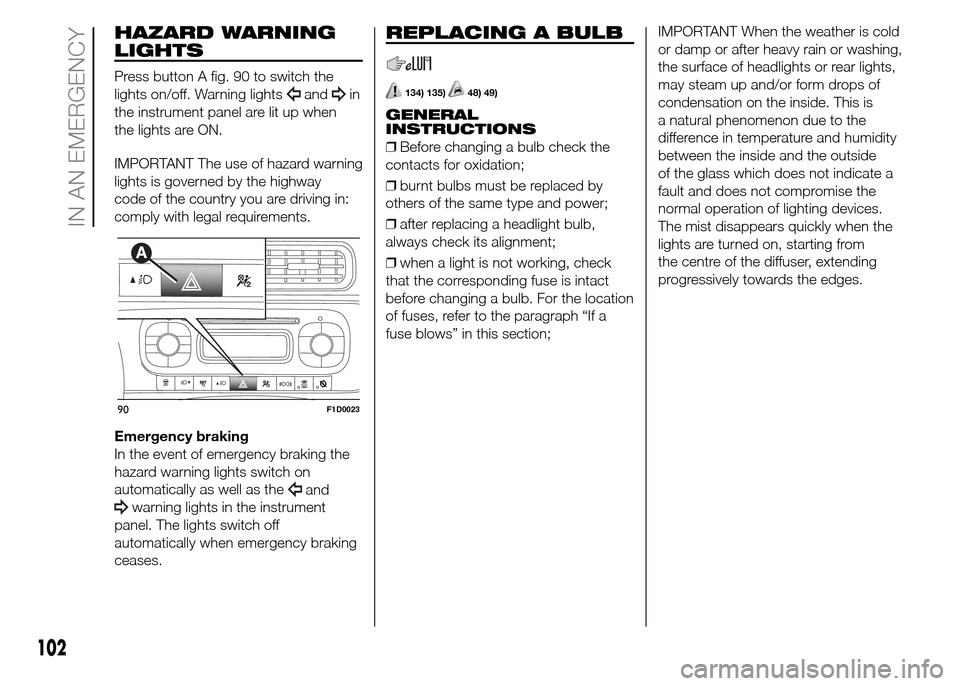
Press button A fig. 90 to switch the
lights on/off. Warning lights
andin
the instrument panel are lit up when
the lights are ON.
IMPORTANT The use of hazard warning
lights is governed by the highway
code of the country you are driving in:
comply with legal requirements.
Emergency braking
In the event of emergency braking the
hazard warning lights switch on
automatically as well as the
and
warning lights in the instrument
panel. The lights switch off
automatically when emergency braking
ceases.
REPLACING A BULB
134) 135)48) 49)
GENERAL
INSTRUCTIONS
❒Before changing a bulb check the
contacts for oxidation;
❒burnt bulbs must be replaced by
others of the same type and power;
❒after replacing a headlight bulb,
always check its alignment;
❒when a light is not working, check
that the corresponding fuse is intact
before changing a bulb. For the location
of fuses, refer to the paragraph “If a
fuse blows” in this section;IMPORTANT When the weather is cold
or damp or after heavy rain or washing,
the surface of headlights or rear lights,
may steam up and/or form drops of
condensation on the inside. This is
a natural phenomenon due to the
difference in temperature and humidity
between the inside and the outside
of the glass which does not indicate a
fault and does not compromise the
normal operation of lighting devices.
The mist disappears quickly when the
lights are turned on, starting from
the centre of the diffuser, extending
progressively towards the edges.
90F1D0023
102
IN AN EMERGENCY
Page 115 of 196
❒lower the vehicle and remove the
jack;
❒use the wrench provided to fully
tighten the bolts, passing alternately
from one bolt to the opposite one.
Versions with alloy wheels
Proceed as follows:
❒insert the wheel on the hub and using
the wrench provided tighten the bolts;
❒lower the vehicle and remove the
jack;
❒use the wrench provided to fully
tighten the bolts, passing alternately
from one bolt to the opposite one.
❒reinsert the press-fitted hub cap,
making sure that the reference hole on
the wheel is aligned with the reference
pin on the cap.
IMPORTANT If it is not fitted properly,
the hub cap may detach itself when the
vehicle is running.
At the end of operation
❒stow the space-saver wheel in the
compartment provided in the luggage
compartment;
❒insert the jack and the other tools in
the container;
❒arrange the container and tools on
the space-saver wheel;
❒correctly reposition the boot mat.
WARNING
143)The space-saver wheel (for
versions/markets, where provided) is
specific to your vehicle, do not use it on
other models, or use the space-saver
wheel of other models on your vehicle. The
space-saver wheel must only be used in
the event of an emergency. It must only be
used for the distance necessary to reach
a service point and the vehicle speed must
not exceed 80 km/h. The space-saver
wheel has an orange label that
summarises the main cautions for use and
limitations. Never remove or cover the
label. The following information is provided
in four languages on the label: "Important!
For temporary use only! 80 km/h max!
Replace with a standard wheel as soon as
possible. Never cover this indication".
Never apply any hub cap to the
space-saver wheel.
144)Use your hazard lights, warning
triangle, etc to show that your vehicle is
stationary. Passengers should get out
of the vehicle, particularly if it is heavily
loaded, and wait for the wheel to be
changed away from the traffic. On hills or
uneven roads, use chocks or appropriate
objects to block the wheels of the vehicle.145)The vehicle's driving characteristics
will be modified with the space-saver wheel
fitted. Avoid violent acceleration and
braking, abrupt steering and fast cornering.
The overall duration of the space-saver
wheel is about 3000 km, after which the
relevant tyre must be replaced with another
one of the same type. Never install a
traditional tyre on a rim designed to be
used as a space-saver wheel. Have the
wheel repaired and refitted as soon as
possible. Using two or more space-saver
wheels at the same time is forbidden.
Do not apply grease to the bolt threads
before fitting: they could come unscrewed.
146)The jack may be used to replace
wheels only on the vehicle that it comes
with, or other vehicles of the same model.
Never use the jack for other purposes,
such as lifting other vehicle models. Never
use it for repair operations under the
vehicle. Incorrect positioning of the jack
may cause the vehicle to fall. Do not use
the jack for loads higher than those shown
on the label. Never install snow chains
on the space-saver wheel; if a front tyre
(driving wheel) is punctured and you need
to use snow chains, use a standard wheel
from the rear axle and install the
space-saver wheel on the rear axle. In this
way, with two normal front drive wheels,
it is possible to use snow chains.
147)Incorrect hub cap assembly may
cause it to come off when the vehicle is
moving. Never tamper with the inflation
valve. Never introduce tools of any kind
between rim and tyre. Check tyre and
space-saver wheel pressures regularly,
complying with the values given in the
"Technical specifications" chapter.
113
Page 116 of 196
WARNING
51)Contact a Fiat Dealership as soon as
possible to have the correct tightening
of the wheel bolts checked.
"Fix&Go Automatic"
kit
148) 149) 150) 151) 152) 153) 154) 155) 156)
52)3)
DESCRIPTION
This is located in the luggage
compartment, inside a dedicated
container. The container also includes a
screwdriver and the tow hook.
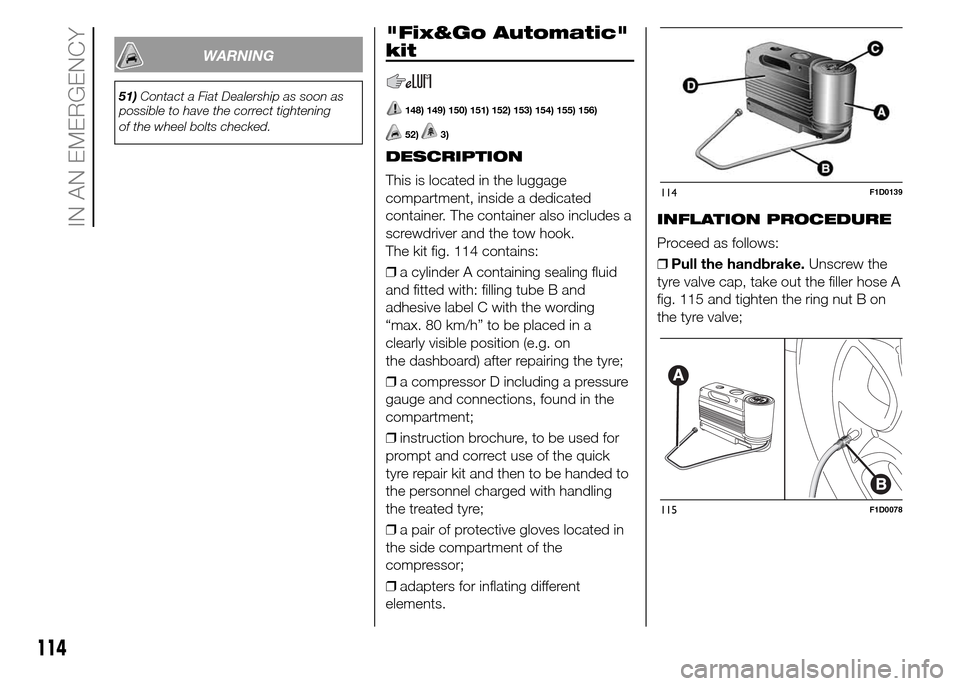
The kit fig. 114 contains:
❒a cylinder A containing sealing fluid
and fitted with: filling tube B and
adhesive label C with the wording
“max. 80 km/h” to be placed in a
clearly visible position (e.g. on
the dashboard) after repairing the tyre;
❒a compressor D including a pressure
gauge and connections, found in the
compartment;
❒instruction brochure, to be used for
prompt and correct use of the quick
tyre repair kit and then to be handed to
the personnel charged with handling
the treated tyre;
❒a pair of protective gloves located in
the side compartment of the
compressor;
❒adapters for inflating different
elements.INFLATION PROCEDURE
Proceed as follows:
❒Pull the handbrake.Unscrew the
tyre valve cap, take out the filler hose A
fig. 115 and tighten the ring nut B on
the tyre valve;
114F1D0139
115F1D0078
114
IN AN EMERGENCY
Page 120 of 196
FUEL CUT-OFF
SYSTEM
159)
This intervenes in the case of an impact
causing:
❒the interruption of the fuel supply with
the engine consequently cutting out;
❒the automatic unlocking of the doors;
❒the automatic switching on of the
interior lights
❒the switching on of the hazard
warning lights.
IMPORTANT Carefully check the car for
fuel leaks, for instance in the engine
compartment, under the car or near the
tank area. After an impact, turn the
ignition key to STOP to prevent the
battery from running down.
To restore the correct operation of the
car, proceed as follows:
❒turn the ignition key to the MAR
position;
❒activate the right direction indicator;
❒deactivate the right direction
indicator;
❒activate the left direction indicator;
❒deactivate the left direction indicator;
❒activate the right direction indicator;
❒deactivate the right direction
indicator;❒activate the left direction indicator;
❒deactivate the left direction indicator;
❒turn the ignition key to STOP and
then to MAR.
LPG versions: in the event of an
impact, petrol supply is immediately
cut-off, the LPG safety valves are
closed and the injection is interrupted,
switching off the engine.
Natural Power versions: in the event
of an impact, the power supply is
immediately cut off, causing engine
switching off.
WARNING
159)If, after an impact, you smell fuel or
notice leaks from the fuel system, do
not reactivate the system to avoid the risk
of fire.
TOWING THE
VEHICLE
160) 161) 162) 163) 164)
The tow hook, which is supplied with
the vehicle, is housed in the tool box,
under the carpet in the luggage
compartment.
ATTACHING THE TOW
HOOK
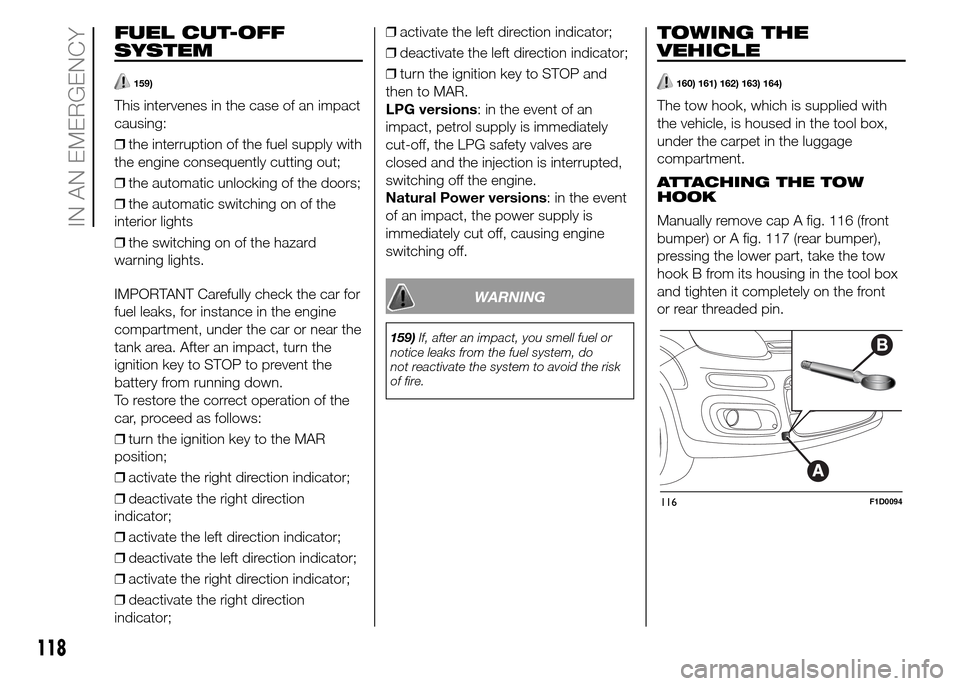
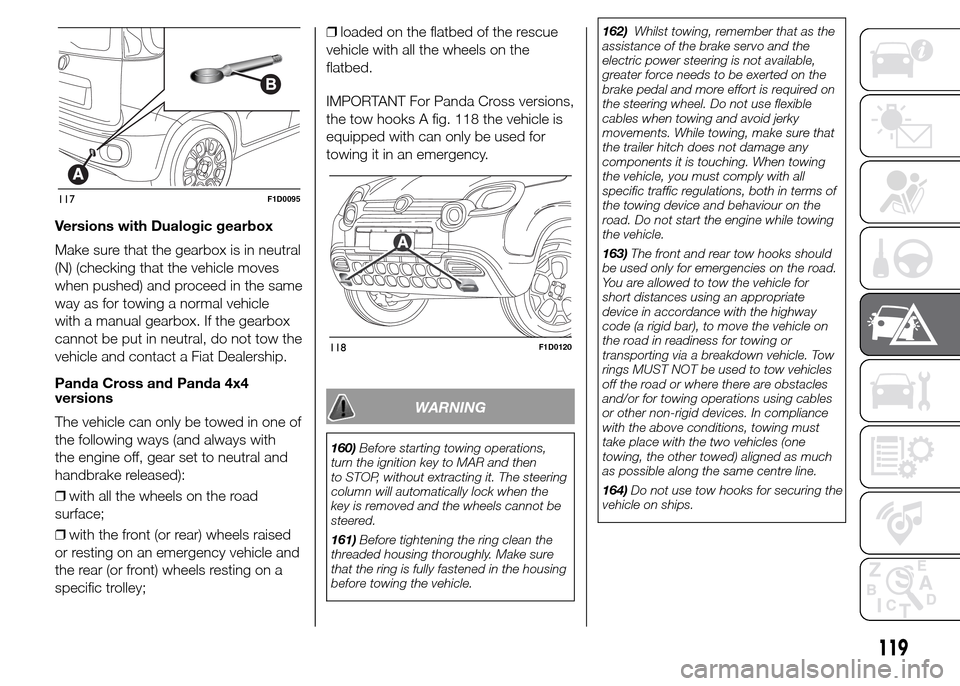
Manually remove cap A fig. 116 (front
bumper) or A fig. 117 (rear bumper),
pressing the lower part, take the tow
hook B from its housing in the tool box
and tighten it completely on the front
or rear threaded pin.
116F1D0094
118
IN AN EMERGENCY
Page 121 of 196
Versions with Dualogic gearbox
Make sure that the gearbox is in neutral
(N) (checking that the vehicle moves
when pushed) and proceed in the same
way as for towing a normal vehicle
with a manual gearbox. If the gearbox
cannot be put in neutral, do not tow the
vehicle and contact a Fiat Dealership.
Panda Cross and Panda 4x4
versions
The vehicle can only be towed in one of
the following ways (and always with
the engine off, gear set to neutral and
handbrake released):
❒with all the wheels on the road
surface;
❒with the front (or rear) wheels raised
or resting on an emergency vehicle and
the rear (or front) wheels resting on a
specific trolley;❒loaded on the flatbed of the rescue
vehicle with all the wheels on the
flatbed.
IMPORTANT For Panda Cross versions,
the tow hooks A fig. 118 the vehicle is
equipped with can only be used for
towing it in an emergency.
WARNING
160)Before starting towing operations,
turn the ignition key to MAR and then
to STOP, without extracting it. The steering
column will automatically lock when the
key is removed and the wheels cannot be
steered.
161)Before tightening the ring clean the
threaded housing thoroughly. Make sure
that the ring is fully fastened in the housing
before towing the vehicle.162)Whilst towing, remember that as the
assistance of the brake servo and the
electric power steering is not available,
greater force needs to be exerted on the
brake pedal and more effort is required on
the steering wheel. Do not use flexible
cables when towing and avoid jerky
movements. While towing, make sure that
the trailer hitch does not damage any
components it is touching. When towing
the vehicle, you must comply with all
specific traffic regulations, both in terms of
the towing device and behaviour on the
road. Do not start the engine while towing
the vehicle.
163)The front and rear tow hooks should
be used only for emergencies on the road.
You are allowed to tow the vehicle for
short distances using an appropriate
device in accordance with the highway
code (a rigid bar), to move the vehicle on
the road in readiness for towing or
transporting via a breakdown vehicle. Tow
rings MUST NOT be used to tow vehicles
off the road or where there are obstacles
and/or for towing operations using cables
or other non-rigid devices. In compliance
with the above conditions, towing must
take place with the two vehicles (one
towing, the other towed) aligned as much
as possible along the same centre line.
164)Do not use tow hooks for securing the
vehicle on ships.
117F1D0095
118F1D0120
119
Page 123 of 196
SCHEDULED
SERVICING
Correct servicing is crucial for
guaranteeing a long life for the vehicle
under the best conditions. For this
reason, Fiat has planned a series of
checks and services at fixed distance
intervals and, where provided, at fixed
time intervals, as described in the
Scheduled Servicing Plan.
Before each service, it is always
necessary to carefully follow the
instructions in the Scheduled Servicing
Plan (e.g. periodically check level of
fluids, tyre pressure, etc.).
Scheduled Servicing is offered by all
Fiat Dealerships according to a set time
schedule. If, during each operation, in
addition to the ones scheduled, the
need arises for further replacements or
repairs, these may be carried out with
your explicit agreement only. If your
vehicle is used frequently for towing,
the interval between one service
operation and the next should be
reduced.IMPORTANT Scheduled Servicing
interventions are set out by the
Manufacturer. Failure to have them
carried out may invalidate the warranty.
It is advisable to inform a Fiat
Dealership of any small operating
irregularities without waiting for the next
service.
PERIODIC CHECKS
Every1,000km or before long
journeys, check and if necessary, top
up: engine coolant level; brake fluid
level; screen washer fluid level; tyre
inflation pressure and condition; lighting
system operation (headlights, direction
indicators, hazard warning lights, etc.);
screen washer/wiper system operation
and positioning/wear of windscreen/
rear window wiper blades.
Every3,000km, check and top up if
required: engine oil level.HEAVY-DUTY USE OF THE
VEHICLE
If the vehicle is used under one of the
following conditions: towing a trailer
or motorhome; dusty roads; short (less
than 7-8 km) and repeated journeys
with sub-zero outside temperatures;
engine often idling or driving long
distances at low speed or long periods
of inactivity, the following checks must
be carried out more often than
indicated in the Scheduled Servicing
Plan:
❒check front disc brake pad condition
and wear;
❒check cleanliness of bonnet and
luggage compartment locks,
cleanliness and lubrication of linkage;
❒visually inspect conditions of: engine,
gearbox, transmission, pipes and
hoses (exhaust/fuel system/brakes) and
rubber elements (gaiters/sleeves/
bushes, etc.);
❒check battery charge and battery
fluid level (electrolyte);
❒visually inspect conditions of the
auxiliary drive belts;
❒check and, if necessary, change
engine oil and replace oil filter / pollen
filter / air cleaner.
121
Page 127 of 196
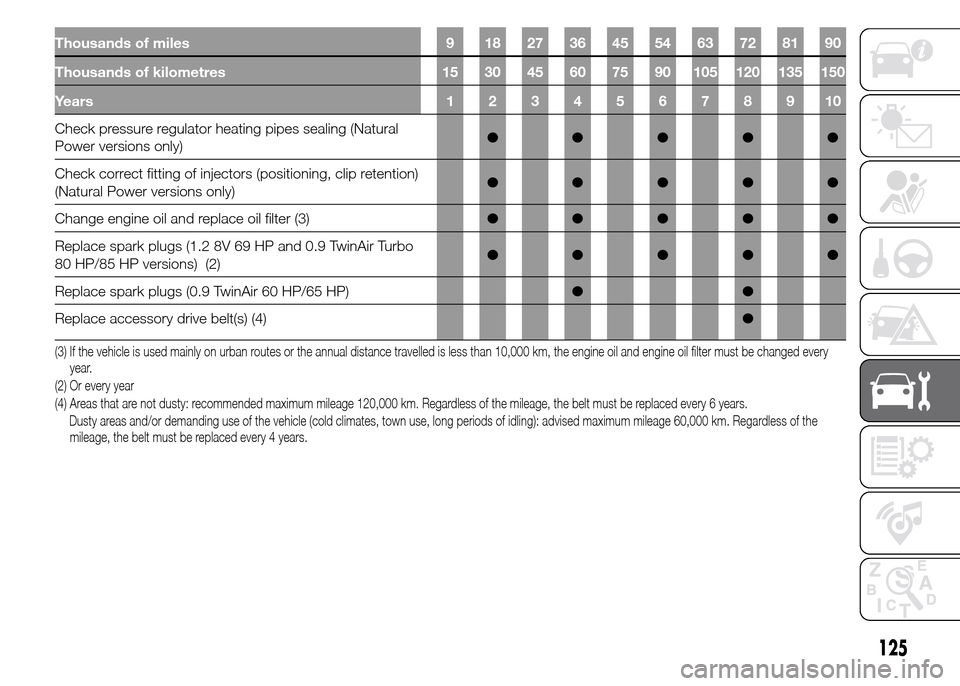
Thousands of miles 9 18 27 36 45 54 63 72 81 90
Thousands of kilometres 15 30 45 60 75 90 105 120 135 150
Years12345678910
Check pressure regulator heating pipes sealing (Natural
Power versions only)●●●●●
Check correct fitting of injectors (positioning, clip retention)
(Natural Power versions only)●●●●●
Change engine oil and replace oil filter (3)●●●●●
Replace spark plugs (1.2 8V 69 HP and 0.9 TwinAir Turbo
80 HP/85 HP versions) (2)●●●●●
Replace spark plugs (0.9 TwinAir 60 HP/65 HP)●●
Replace accessory drive belt(s) (4)●
(3) If the vehicle is used mainly on urban routes or the annual distance travelled is less than 10,000 km, the engine oil and engine oil filter must be changed every
year.
(2) Or every year
(4) Areas that are not dusty: recommended maximum mileage 120,000 km. Regardless of the mileage, the belt must be replaced every 6 years.
Dusty areas and/or demanding use of the vehicle (cold climates, town use, long periods of idling): advised maximum mileage 60,000 km. Regardless of the
mileage, the belt must be replaced every 4 years.
125
Page 128 of 196
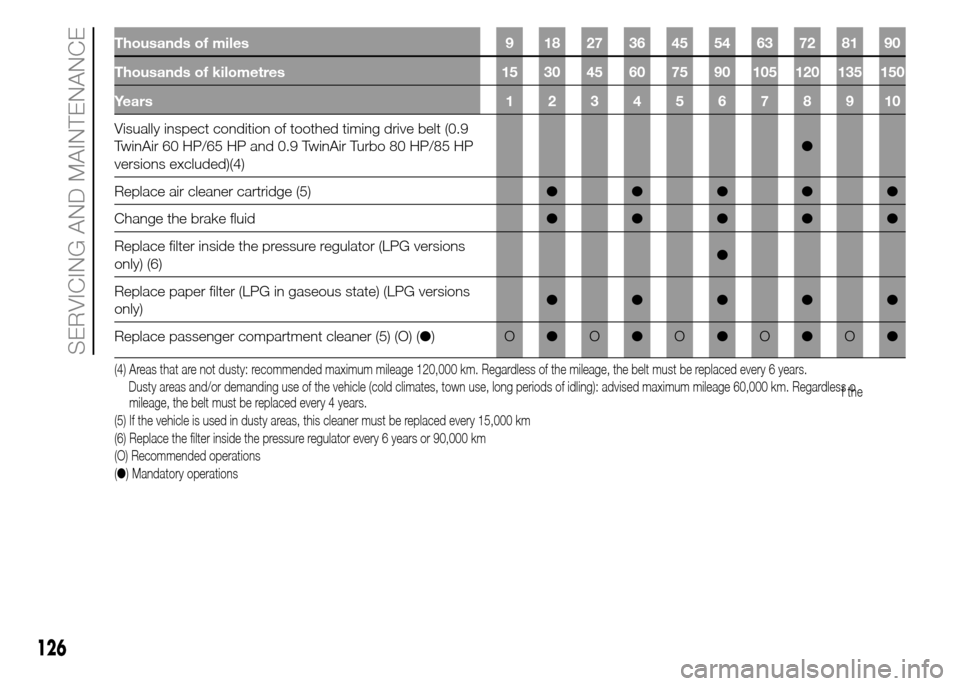
Thousands of miles 9 18 27 36 45 54 63 72 81 90
Thousands of kilometres 15 30 45 60 75 90 105 120 135 150
Years12345678910
Visually inspect condition of toothed timing drive belt (0.9
TwinAir 60 HP/65 HP and 0.9 TwinAir Turbo 80 HP/85 HP
versions excluded)(4)●
Replace air cleaner cartridge (5)●●●●●
Change the brake fluid●●●●●
Replace filter inside the pressure regulator (LPG versions
only) (6)●
Replace paper filter (LPG in gaseous state) (LPG versions
only)●●●●●
Replace passenger compartment cleaner (5) (O) (●)O●O●O●O●O●
(4) Areas that are not dusty: recommended maximum mileage 120,000 km. Regardless of the mileage, the belt must be replaced every 6 years.
Dusty areas and/or demanding use of the vehicle (cold climates, town use, long periods of idling): advised maximum mileage 60,000 km. Regardless o
f the
mileage, the belt must be replaced every 4 years.
(5) If the vehicle is used in dusty areas, this cleaner must be replaced every 15,000 km
(6) Replace the filter inside the pressure regulator every 6 years or 90,000 km
(O) Recommended operations
(●) Mandatory operations
126
SERVICING AND MAINTENANCE