tow FIAT PANDA 2016 319 / 3.G User Guide
[x] Cancel search | Manufacturer: FIAT, Model Year: 2016, Model line: PANDA, Model: FIAT PANDA 2016 319 / 3.GPages: 204, PDF Size: 18.77 MB
Page 48 of 204
Warning light What it means
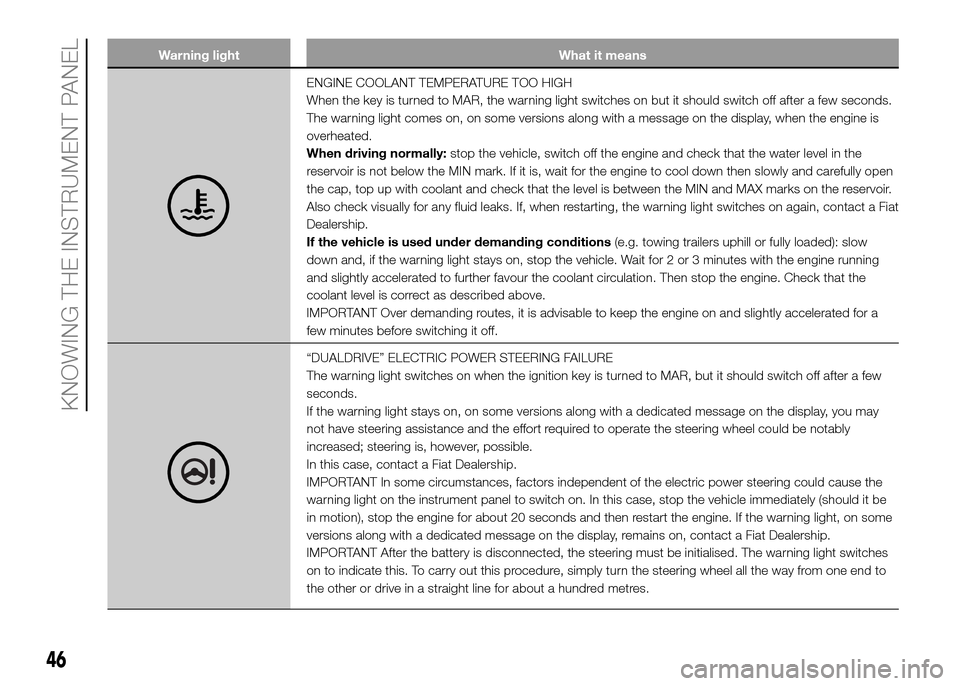
ENGINE COOLANT TEMPERATURE TOO HIGH
When the key is turned to MAR, the warning light switches on but it should switch off after a few seconds.
The warning light comes on, on some versions along with a message on the display, when the engine is
overheated.
When driving normally:stop the vehicle, switch off the engine and check that the water level in the
reservoir is not below the MIN mark. If it is, wait for the engine to cool down then slowly and carefully open
the cap, top up with coolant and check that the level is between the MIN and MAX marks on the reservoir.
Also check visually for any fluid leaks. If, when restarting, the warning light switches on again, contact a Fiat
Dealership.
If the vehicle is used under demanding conditions(e.g. towing trailers uphill or fully loaded): slow
down and, if the warning light stays on, stop the vehicle. Wait for 2 or 3 minutes with the engine running
and slightly accelerated to further favour the coolant circulation. Then stop the engine. Check that the
coolant level is correct as described above.
IMPORTANT Over demanding routes, it is advisable to keep the engine on and slightly accelerated for a
few minutes before switching it off.
“DUALDRIVE” ELECTRIC POWER STEERING FAILURE
The warning light switches on when the ignition key is turned to MAR, but it should switch off after a few
seconds.
If the warning light stays on, on some versions along with a dedicated message on the display, you may
not have steering assistance and the effort required to operate the steering wheel could be notably
increased; steering is, however, possible.
In this case, contact a Fiat Dealership.
IMPORTANT In some circumstances, factors independent of the electric power steering could cause the
warning light on the instrument panel to switch on. In this case, stop the vehicle immediately (should it be
in motion), stop the engine for about 20 seconds and then restart the engine. If the warning light, on some
versions along with a dedicated message on the display, remains on, contact a Fiat Dealership.
IMPORTANT After the battery is disconnected, the steering must be initialised. The warning light switches
on to indicate this. To carry out this procedure, simply turn the steering wheel all the way from one end to
the other or drive in a straight line for about a hundred metres.
46
KNOWING THE INSTRUMENT PANEL
Page 71 of 204
If the Reset procedure is not carried
out, in all above cases, the
warning
light may give false indications on
one or more tyres.
To carry out the RESET procedure, with
the vehicle stopped and the ignition
device at MAR, use the Main Menu as
follows:
❒briefly press
button: the display will
show Reset;
❒press
button orto select
(“Yes” or “No”);
❒briefly press the
button: the
display will show "Confirm";
❒press
button orto select
("Yes" to reset or "No" to exit the video
page);
❒hold the
button down again to
return to the standard screen or to the
main menu according to where you
are in the menu.
At the end of the Reset procedure the
display will show the "Reset saved"
message, indicating that the self-
learning has been started.
Working conditions
The system is active for speeds above
15 km/h.In a few situations such as sporty
driving, particular conditions of the road
surface (e.g. icy, snowy, unsurfaced
roads...) the signalling may be delayed
or partial in detecting the contemporary
deflation of more than one tyre.
Under special conditions (e.g. vehicle
loaded asymmetrically on one side,
towing a trailer, damaged or worn tyre,
fitting the space-saver wheel, use of the
"Fix&Go Automatic" kit, fitting snow
chains, fitting different tyres on the
axles) the system may give false
indications or be temporarily
deactivated.
If the system is temporarily deactivated
the
warning light flashes for about
75 seconds and then is continuously
on; at the same time, the display shows
a dedicated message.
This indication is displayed also after
the engine has been switched off and
then on again if the correct operating
conditions are not restored.
WARNING
70)The system is an aid for the driver, who
must always pay full attention while
driving. The responsibility always rests with
the driver, who must take into account
the traffic conditions in order to drive
in complete safety. The driver must always
maintain a safe distance from the vehicle
in front.
71)If the driver depresses the brake pedal
fully or carries out a fast steering during
system operation, the automatic braking
function may stop (e.g. to allow a possible
manoeuvre to avoid the obstacle).
72)The laser beam is not visible at the
naked eye. Do not look directly, or with
optical instruments (e.g. lenses), at the
laser beam from a distance lower than 10
cm: this may cause damage to the sight.
The laser beam is also present when
the key is at MAR but its operation is off,
not available or manually deactivated
with the display Setup Menu.
73)The system intervenes on vehicles
travelling in the same lane. Small sized
vehicles (e.g. bicycles or motorbikes)
or people, animals and things (e.g.
pushchairs) and more in general all those
obstacles with a low reflection of the light
emitted by the laser (e.g. vehicles soiled
with mud) are not taken into consideration.
69
Page 72 of 204
74)If the vehicle must be placed on a roller
bench (at a speed within 5 and 30 km/h)
for maintenance interventions or if it is
washed in an automatic roller washing
tunnel with an obstacle in the front part
(e.g. another vehicle, a wall or another
obstacle), the system may detect its
presence and activate. In this case the
system must be deactivated through the
display Setup Menu.
75)If the system signals a pressure
decrease on a specific tyre, it is
recommended to check the pressure on all
four tyres.
76)iTPMS does not relieve the driver from
the obligation to check the tyre pressure
every month; it is not even to be
considered a replacing system for
maintenance or a safety system.
77)Tyre pressure must be checked with
tyres cold. Should it become necessary for
whatever reason to check pressure with
warm tyres, do not reduce pressure even
though it is higher than the prescribed
value, but repeat the check when tyres are
cold.
78)The iTPMS cannot indicate sudden
tyre pressure drops (for example when
a tyre bursts). In this case, stop the vehicle,
braking with caution and avoiding abrupt
steering.
79)The system only warns that the tyre
pressure is low: it is not able to inflate
them.
80)Insufficient tyre inflation increases fuel
consumption, reduces the tread duration
and may affect the capacity to drive safely.
WARNING
28)The laser sensor may have limited or
absent operation due to weather
conditions such as: heavy rain, hail, thick
fog, heavy snow, formation of ice layers on
the windscreen.
29)Sensor operation may also be
compromised by the presence of dust,
condensation, dirt or ice on the
windscreen, by traffic conditions (e.g.
vehicles that are driving not aligned with
yours, vehicle driving in a transverse or
opposite way on the same lane, bend with
a small radius of curvature), by road
surface conditions and by driving
conditions (e.g. off-road driving). Make sure
the windscreen is always clean. Use
specific detergents and clean cloths to
avoid scratching the windscreen. The
sensor operation may also be limited or
absent in some driving, traffic and road
surface conditions.
30)Projecting loads on the roof of the
vehicle may interfere with the correct
operation of the sensor. Before starting
make sure the load is correctly positioned,
in order not to cover the sensor operating
range.
31)If the windscreen must be replaced
due to scratches, chipping or breakage,
contact exclusively a Fiat Dealership.
Do not replace the windscreen on your
own, risk of malfunction! It is advisable to
replace the windscreen if it is damaged
in the laser sensor area.32)Do not tamper nor operate on the laser
sensor. Do not close the openings in the
aesthetic cover located under the interior
rear view mirror. In the event of a sensor
failure, contact a Fiat Dealership.
33)Do not cover the operating range of the
sensor with stickers or other objects. Also
pay attention to other objects on the
bonnet (e.g. a layer of snow) and make
sure they do not interfere with the light
emitted by the laser.
34)If a trailer or a vehicle is towed the
system must be deactivated with the
display Setup Menu.
70
SAFETY
Page 76 of 204
PRETENSIONERS
87) 88) 89) 90)
35)
The vehicle is equipped with front seat
belt pretensioners, which draw back
the seat belts by several centimetres in
the event of a strong frontal impact.
This guarantees the perfect adherence
of the seat belts to the occupant's
bodies before the retention action
begins.
It is evident that the pretensioners have
operated when the belt withdraws
towards the retractor. This vehicle is
also equipped with a second
pretensioner (in the kick plate area). Its
activation is signalled by the shortening
of the metal cable.
A slight discharge of smoke may be
produced during the activation of the
pretensioner which is not harmful and
does not involve any fire hazard.
If, due to unusual natural events (floods,
sea storms, etc.), the device has been
affected by water and/or mud, contact
a Fiat Dealership to have it replaced.
IMPORTANT To obtain the highest
degree of protection from the action of
the pretensioner, wear the seat belt
tight to the chest and pelvis.LOAD LIMITERS
To increase occupant safety, the
retractors contain a load limiter to dose
the force acting on the chest and
shoulders during the belt restraining
action in the case of frontal collisions.
GENERAL
INSTRUCTIONS FOR
USING THE SEAT BELTS
The driver is responsible for respecting,
and ensuring that all the other
occupants of the vehicle also respect,
the local laws in force in relation to
the use of the seat belts. Always fasten
the seat belts before setting off.
Seat belts are also to be worn by
pregnant women: the risk of injury in
the case of impact is greatly reduced
for them and the unborn child if they
are wearing a seat belt. Pregnant
women must position the lower part of
the belt very low down so that it passes
over the pelvis and under the
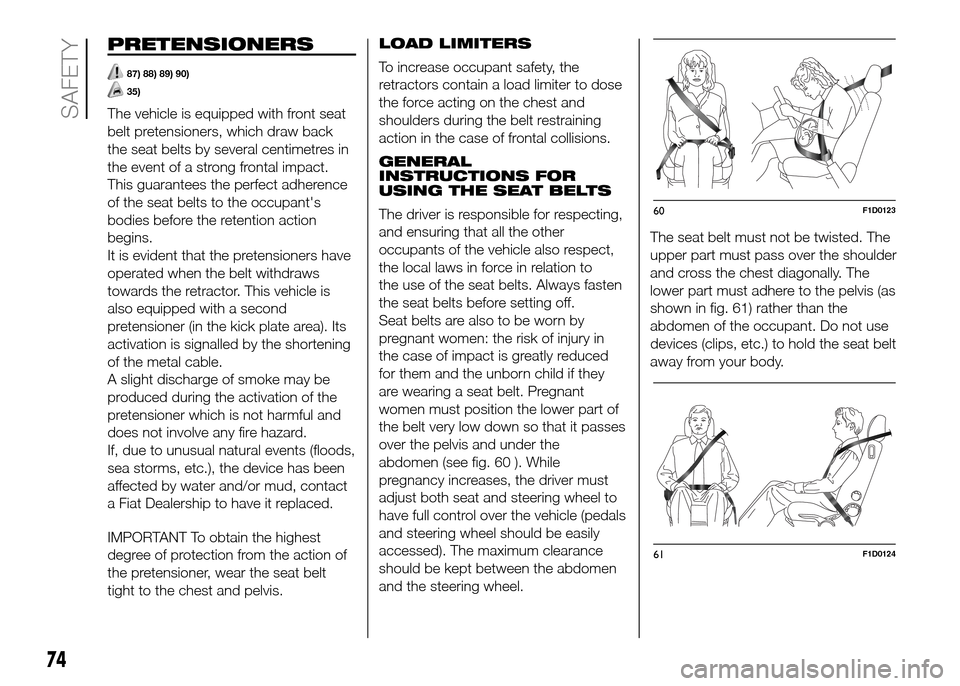
abdomen (see fig. 60 ). While
pregnancy increases, the driver must
adjust both seat and steering wheel to
have full control over the vehicle (pedals
and steering wheel should be easily
accessed). The maximum clearance
should be kept between the abdomen
and the steering wheel.The seat belt must not be twisted. The
upper part must pass over the shoulder
and cross the chest diagonally. The
lower part must adhere to the pelvis (as
shown in fig. 61) rather than the
abdomen of the occupant. Do not use
devices (clips, etc.) to hold the seat belt
away from your body.
60F1D0123
61F1D0124
74
SAFETY
Page 93 of 204
STARTING AND DRIVING
Let’s get to the "heart" of the vehicle:
seeing how you can exploit all of its
potential to the full.
We’ll look at how to drive it safely in any
situation, so that it can be a welcome
companion, with our comfort and
our wallets in mind.STARTING THE ENGINE ................. 92
HANDBRAKE .................................. 93
MANUAL GEARBOX ....................... 94
DUALOGIC GEARBOX .................... 9
STOP/START SYSTEM ................... 96
PARKING SENSORS....................... 96
MODE SELECTOR .......................... 98
TOWING TRAILERS ........................
REFUELLING THE VEHICLE ...........
91
4
99
99
Page 95 of 204
WARNING
36)If the warning lightflashes for 60
seconds after starting or during an
extended towing period, this indicates a
problem in the glow plug preheating
system. You can use the vehicle as usual if
the engine starts but you should contact
a Fiat Dealership as soon as possible.
37)It is advisable not to demand maximum
performance from your vehicle (e.g.
excessive acceleration, long distances at
maximum rpm, excessively intense braking,
etc.) when it is first used.
38)When the engine is off, do not leave
the key turned to MAR to prevent
unnecessary electrical consumption from
draining the battery.
39)Never bump start the engine by
pushing, towing or coasting downhill. This
could cause fuel to flow into the catalytic
converter and damage it beyond repair.
40)There must therefore always be some
petrol in the tank to protect the petrol
pump and to guarantee temporary
switching from LPG or Methane to petrol
operation, if high performance is required.
41)A quick burst on the accelerator
before stopping the engine serves no
practical purpose; it wastes fuel and is
especially damaging to turbocharged
engines.
HANDBRAKE
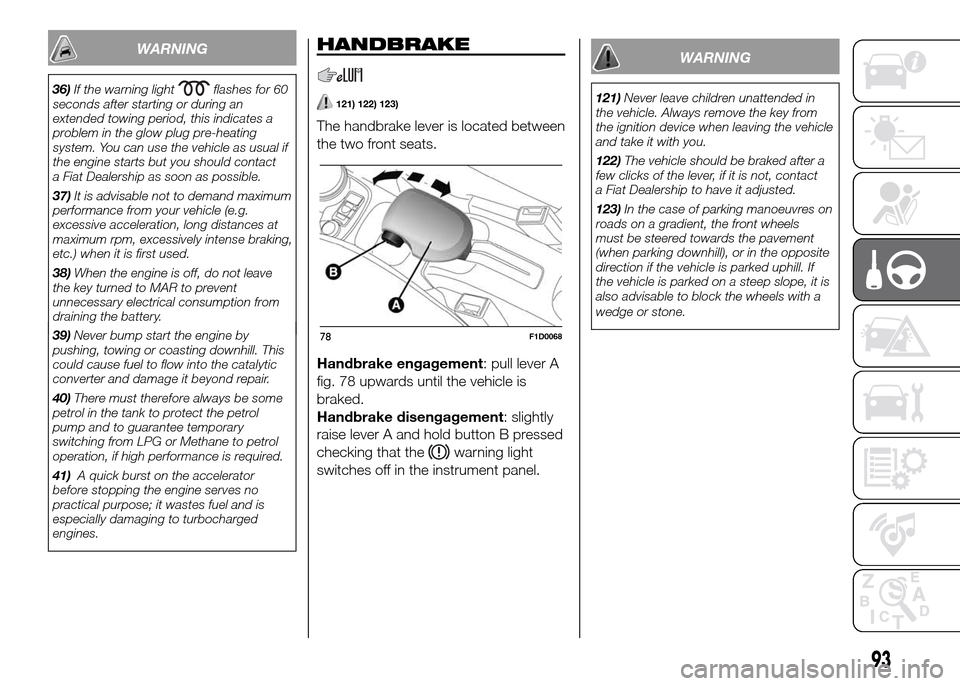
121) 122) 123)
The handbrake lever is located between
the two front seats.
Handbrake engagement: pull lever A
fig. 78 upwards until the vehicle is
braked.
Handbrake disengagement: slightly
raise lever A and hold button B pressed
checking that the
warning light
switches off in the instrument panel.
78F1D0068
93
WARNING
121)Never leave children unattended in
the vehicle. Always remove the key from
the ignition device when leaving the vehicle
and take it with you.
122)The vehicle should be braked after a
few clicks of the lever, if it is not, contact
a Fiat Dealership to have it adjusted.
123)In the case of parking manoeuvres on
roads on a gradient, the front wheels
must be steered towards the pavement
(when parking downhill), or in the opposite
direction if the vehicle is parked uphill. If
the vehicle is parked on a steep slope, it is
also advisable to block the wheels with a
wedge or stone.
Page 97 of 204
The unstable positions, in other words
those that are abandoned as soon
as the lever is released, are the
positions for requesting a higher gear
(+), requesting a lower gear (–) and
requesting automatic operating mode
(A/M).
IMPORTANT With the engine started,
any error between the lever position
and the gear actually engaged is
signalled by a buzzer until consistency
is restored.
MANUAL MODE
Proceed as follows:
❒press the brake pedal and start the
engine;
❒if AUTO appears on the display,
move the lever A fig. 80 to A/M
to select MANUAL mode;
❒push gear lever A towards (+) to
engage first gear (if starting from N or
R, simply place the lever in the middle
position) or R to engage reverse;
❒release the brake pedal and press
the accelerator pedal;
❒in driving conditions, push lever A of
the gearbox towards (+) to engage
the next gear up or towards (–) to
engage the next gear down.AUTOMATIC MODE
Proceed as follows:
❒press the brake pedal;
❒start the engine;
❒if AUTO does not appear on the
display, move the gear lever A fig. 80 to
A/M to select AUTOMATIC mode;
❒push the gear lever towards (+) to
engage 1st gear (if starting from N or R,
simply place the lever in the middle
position) or R to engage reverse;
❒release the brake pedal and press
the accelerator pedal: the gear most
suited to the vehicle speed will be
engaged.
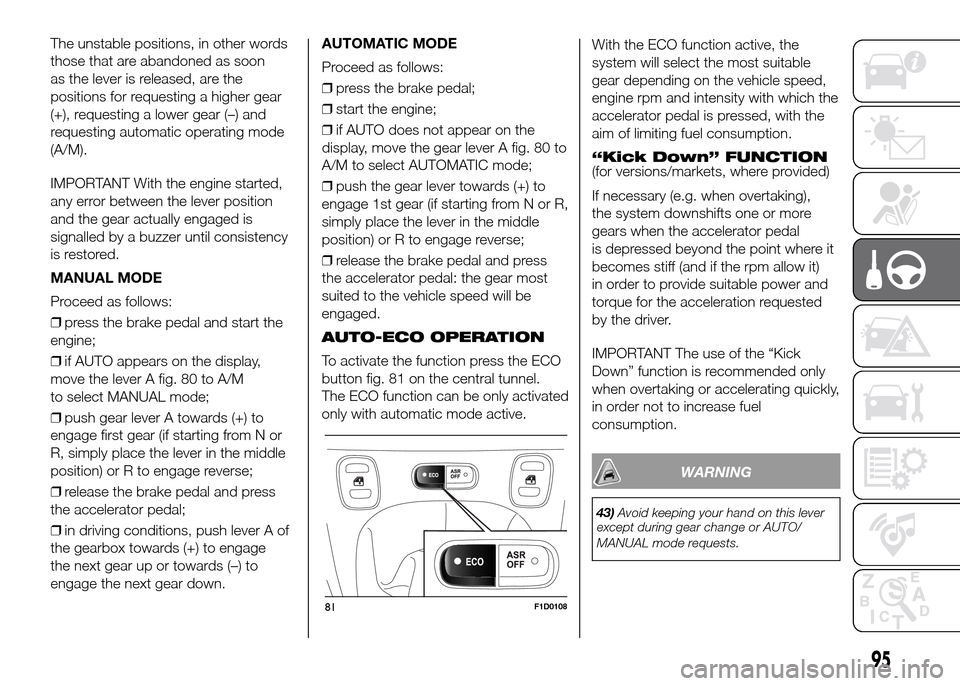
AUTO-ECO OPERATION
To activate the function press the ECO
button fig. 81 on the central tunnel.
The ECO function can be only activated
only with automatic mode active.
81F1D0108
95
With the ECO function active, the
system will select the most suitable
gear depending on the vehicle speed,
engine rpm and intensity with which the
accelerator pedal is pressed, with the
aim of limiting fuel consumption.
“Kick Down” FUNCTION
(for versions/markets, where provided)
If necessary (e.g. when overtaking),
the system downshifts one or more
gears when the accelerator pedal
is depressed beyond the point where it
becomes stiff (and if the rpm allow it)
in order to provide suitable power and
torque for the acceleration requested
by the driver.
IMPORTANT The use of the “Kick
Down” function is recommended only
when overtaking or accelerating quickly,
in order not to increase fuel
consumption.
WARNING
43)Avoid keeping your hand on this lever
except during gear change or AUTO/
MANUAL mode requests.
Page 99 of 204
OPERATION WITH A
TRAILER
Sensor operation is automatically
deactivated when the trailer's electric
cable plug is fitted in the vehicle's
tow hook socket. The sensors are
automatically reactivated when the
trailer's cable plug is removed.
IMPORTANT
INFORMATION
When parking, take the utmost care
over obstacles that may be above
or under the sensor.
Objects close to the vehicle are not
detected under certain circumstances
and could therefore cause damage
to the vehicle or be damaged.
The following conditions may influence
the performance of the parking
assistance system:
❒the presence of ice, snow, mud or
multiple layers of paint on the surface of
the sensor may reduce its sensitivity
and the system performance;
❒mechanical interference (e.g. washing
the vehicle, rain, strong wind, hail) may
cause the sensor to detect a
non-existent obstacle ("echo
interference");
97
❒the presence of ultrasonic systems
(e.g. pneumatic brake systems of
trucks or pneumatic drills) near the
vehicle could alter the signals sent to
the sensor;
❒the variation in sensor position,
caused by variation in ride (due
to suspension or shock absorber wear),
changing tyres, overloaded vehicle, or
tuning that lowers the vehicle, for
example, may affect parking sensor
system performance;
❒the presence of a tow hook without
trailer interferes with the correct
operation of the parking sensors. If a
fixed tow hook is installed, the sensors
cannot be used. If the customer installs
a removable tow hook, this must
always be disconnected from
the crossmember whenever the trailer
is not attached to prevent the activation
of the sensors.
WARNING
127)The responsibility for parking and
other dangerous manoeuvres always and
in every case lies with the driver. While
carrying out these manoeuvres, always
make sure that no people (especially
children) or animals are in the area
concerned. The parking sensors are used
to assist the driver, who must never allow
his attention to lapse during potentially
dangerous manoeuvres, even those
executed at low speeds.
WARNING
45)The sensors must be clean of mud,
dirt, snow or ice in order for the system to
operate correctly. Be careful not to scratch
or damage the sensors while cleaning
them. Avoid using dry, rough or hard
cloths. The sensors must be washed using
clean water, with the addition of vehicle
shampoo if necessary. When using special
washing equipment such as high pressure
jets or steam cleaning, clean the sensors
very quickly keeping the jet more than
10 cm away.
Page 101 of 204
99
TOWING TRAILERS
128) 129)
IMPORTANT
For towing motorhomes or trailers the
vehicle must be fitted with an approved
tow hook and an adequate electrical
system. Installation must be carried out
by a specialist.
Install any specific and/or additional
door mirrors as specified by the
Highway Code.
Remember that when towing a trailer,
steep hills are harder to climb, braking
distances increase and overtaking
takes longer depending on the overall
weight of the trailer.
Engage a low gear when driving
downhill, rather than constantly using
the brake.
The weight the trailer exerts on the
vehicle tow hook reduces the vehicle's
loading capacity by the same amount.
To make sure that the maximum
towable weight is not exceeded (given
in the vehicle registration document)
account should be taken of the fully
laden trailer, including accessories and
luggage.
Do not exceed the speed limits specific
to each country you are driving in, in
the case of vehicles towing trailers.
In any case, the top speed must not
exceed 100 km/h.An electric brake (or electric winch)
should be supplied directly by the
battery through a cable with a cross
section of no less than 2.5 mm2.
In addition to the electrical branches,
the vehicle electrical system can only
be connected to the supply cable for an
electric brake and to the cable for an
internal light for the trailer, not
exceeding 15 W. For connections, use
the preset control unit with a battery
cable with section not less than 2.5
mm2.
On Panda Cross and Panda 4x4
versions, in the event of prolonged
vehicle use at maximum tow capacity
on slopes, replacing engine oil more
frequently (every 10,000 km) is
advisable.
IMPORTANT The use of auxiliary loads
other than external lights (electric brake,
winch, etc.) must be used with engine
running.
IMPORTANT To install a tow hook
contact a Fiat Dealership.
WARNING
128)The ABS with which the vehicle is
equipped will not control the braking
system of the trailer. Particular caution is
required on slippery roads.
129)Never modify the braking system of
the vehicle to control the trailer brake.
The trailer braking system must be fully
independent of the vehicle’s hydraulic
system.
REFUELLING THE
VEHICLE
130) 131) 132)Always stop the engine before
refuelling.
PETROL ENGINES
Use unleaded petrol only, with an
octane number (R.O.N.) no lower than
95. Never introduce even the smallest
amount of leaded petrol, even in the
event of an emergency, in order to
prevent damage to the catalytic
converter.
DIESEL ENGINES
Only use Diesel for motor vehicles (EN
590 specification).
When using or parking the car for a
long time in the mountains or cold
areas, it is advisable to refuel using
locally available diesel. In this case, it is
also advisable to keep the tank over
50% full.
Page 104 of 204
IN AN EMERGENCY
A punctured tyre or a burnt-out bulb?
At times, a problem may interfere
with our journey.
The pages on emergencies can help
you to deal with critical situations
independently and with calm.
In an emergency we recommend that
you call the freephone number found in
the Warranty Booklet.
It is also possible to call the national or
international universal freephone
number to search for the nearest
Dealership.HAZARD WARNING LIGHTS...........103
REPLACING A BULB ......................10
REPLACING FUSES........................109
CHANGING A WHEEL ....................112
"FIX&GO AUTOMATIC" KIT .............11
JUMP STARTING ............................117
FUEL CUT-OFF SYSTEM ................119
TOWING THE VEHICLE ..................119
102
IN AN EMERGENCY
3
5