ESP FIAT PANDA 2016 319 / 3.G Owner's Manual
[x] Cancel search | Manufacturer: FIAT, Model Year: 2016, Model line: PANDA, Model: FIAT PANDA 2016 319 / 3.GPages: 204, PDF Size: 18.77 MB
Page 99 of 204
OPERATION WITH A
TRAILER
Sensor operation is automatically
deactivated when the trailer's electric
cable plug is fitted in the vehicle's
tow hook socket. The sensors are
automatically reactivated when the
trailer's cable plug is removed.
IMPORTANT
INFORMATION
When parking, take the utmost care
over obstacles that may be above
or under the sensor.
Objects close to the vehicle are not
detected under certain circumstances
and could therefore cause damage
to the vehicle or be damaged.
The following conditions may influence
the performance of the parking
assistance system:
❒the presence of ice, snow, mud or
multiple layers of paint on the surface of
the sensor may reduce its sensitivity
and the system performance;
❒mechanical interference (e.g. washing
the vehicle, rain, strong wind, hail) may
cause the sensor to detect a
non-existent obstacle ("echo
interference");
97
❒the presence of ultrasonic systems
(e.g. pneumatic brake systems of
trucks or pneumatic drills) near the
vehicle could alter the signals sent to
the sensor;
❒the variation in sensor position,
caused by variation in ride (due
to suspension or shock absorber wear),
changing tyres, overloaded vehicle, or
tuning that lowers the vehicle, for
example, may affect parking sensor
system performance;
❒the presence of a tow hook without
trailer interferes with the correct
operation of the parking sensors. If a
fixed tow hook is installed, the sensors
cannot be used. If the customer installs
a removable tow hook, this must
always be disconnected from
the crossmember whenever the trailer
is not attached to prevent the activation
of the sensors.
WARNING
127)The responsibility for parking and
other dangerous manoeuvres always and
in every case lies with the driver. While
carrying out these manoeuvres, always
make sure that no people (especially
children) or animals are in the area
concerned. The parking sensors are used
to assist the driver, who must never allow
his attention to lapse during potentially
dangerous manoeuvres, even those
executed at low speeds.
WARNING
45)The sensors must be clean of mud,
dirt, snow or ice in order for the system to
operate correctly. Be careful not to scratch
or damage the sensors while cleaning
them. Avoid using dry, rough or hard
cloths. The sensors must be washed using
clean water, with the addition of vehicle
shampoo if necessary. When using special
washing equipment such as high pressure
jets or steam cleaning, clean the sensors
very quickly keeping the jet more than
10 cm away.
Page 100 of 204
MODE SELECTOR
(Panda Cross versions)
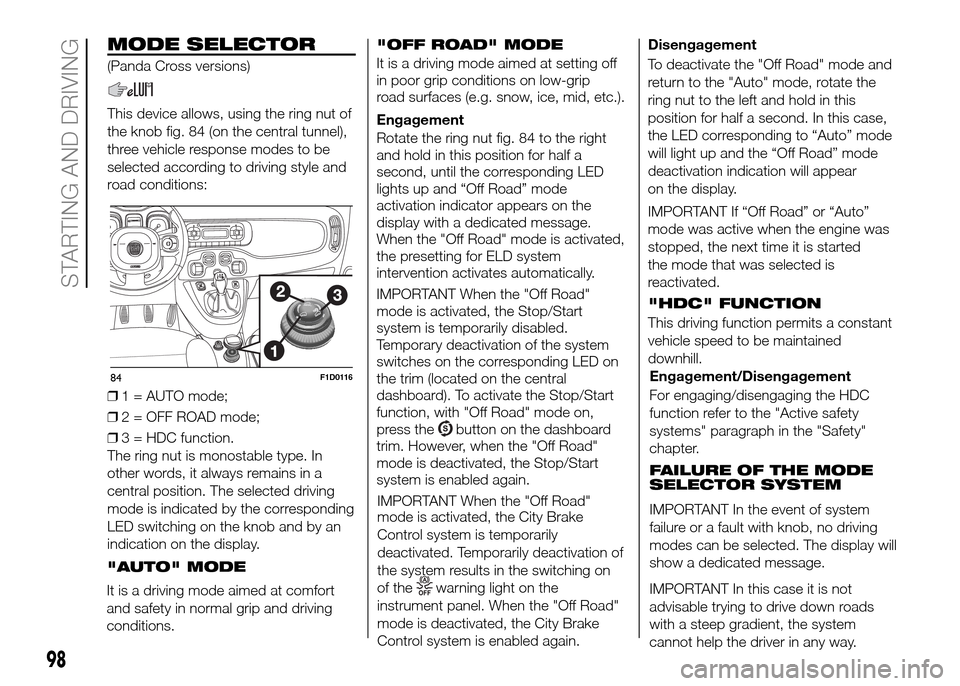
This device allows, using the ring nut of
the knob fig. 84 (on the central tunnel),
three vehicle response modes to be
selected according to driving style and
road conditions:
❒1 = AUTO mode;
❒2 = OFF ROAD mode;
❒3 = HDC function.
The ring nut is monostable type. In
other words, it always remains in a
central position. The selected driving
mode is indicated by the corresponding
LED switching on the knob and by an
indication on the display.
84F1D0116
98
STARTING AND DRIVING
"AUTO" MODE
It is a driving mode aimed at comfort
and safety in normal grip and driving
conditions."OFF ROAD" MODE
It is a driving mode aimed at setting off
in poor grip conditions on low-grip
road surfaces (e.g. snow, ice, mid, etc.).
Engagement
Rotate the ring nut fig. 84 to the right
and hold in this position for half a
second, until the corresponding LED
lights up and “Off Road” mode
activation indicator appears on the
display with a dedicated message.
When the "Off Road" mode is activated,
the presetting for ELD system
intervention activates automatically.
IMPORTANT When the "Off Road"
mode is activated, the Stop/Start
system is temporarily disabled.
Temporary deactivation of the system
switches on the corresponding LED on
the trim (located on the central
dashboard). To activate the Stop/Start
function, with "Off Road" mode on,
press the
button on the dashboard
trim. However, when the "Off Road"
mode is deactivated, the Stop/Start
system is enabled again.
IMPORTANT When the "Off Road"
mode is activated, the City Brake
Control system is temporarily
deactivated. Temporarily deactivation of
the system results in the switching on
of the
warning light on the
instrument panel. When the "Off Road"
mode is deactivated, the City Brake
Control system is enabled again.Disengagement
To deactivate the "Off Road" mode and
return to the "Auto" mode, rotate the
ring nut to the left and hold in this
position for half a second. In this case,
the LED corresponding to “Auto” mode
will light up and the “Off Road” mode
deactivation indication will appear
on the display.
IMPORTANT If “Off Road” or “Auto”
mode was active when the engine was
stopped, the next time it is started
the mode that was selected is
reactivated.
"HDC" FUNCTION
This driving function permits a constant
vehicle speed to be maintained
downhill.
Engagement/Disengagement
For engaging/disengaging the HDC
function refer to the "Active safety
systems" paragraph in the "Safety"
chapter.
FAILURE OF THE MODE
SELECTOR SYSTEM
IMPORTANT In the event of system
failure or a fault with knob, no driving
modes can be selected. The display will
show a dedicated message.
IMPORTANT In this case it is not
advisable trying to drive down roads
with a steep gradient, the system
cannot help the driver in any way.
Page 105 of 204
HAZARD WARNING
LIGHTS
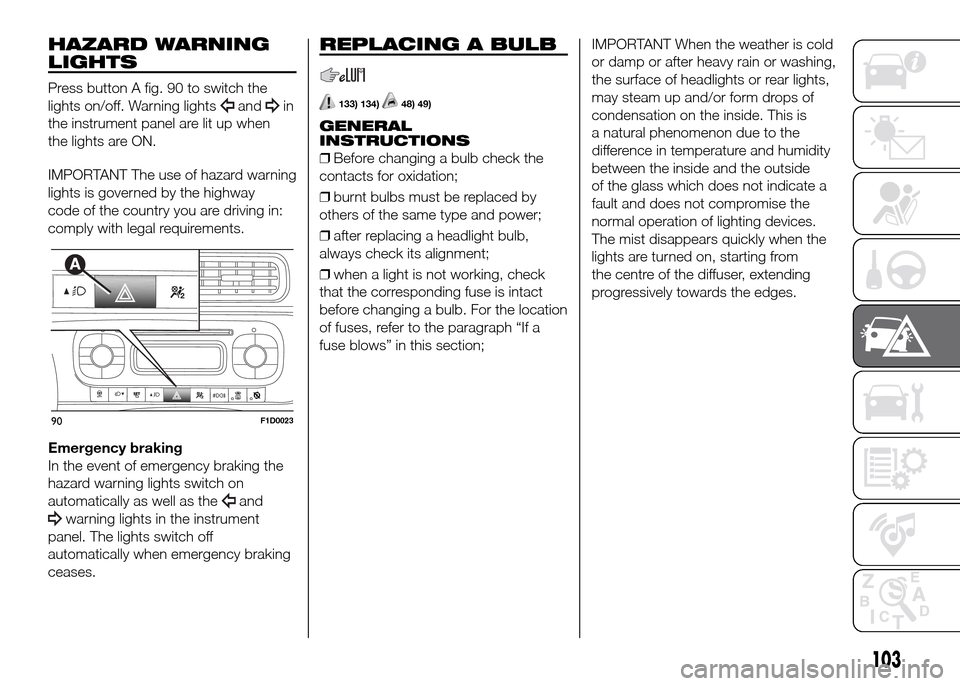
Press button A fig. 90 to switch the
lights on/off. Warning lights
andin
the instrument panel are lit up when
the lights are ON.
IMPORTANT The use of hazard warning
lights is governed by the highway
code of the country you are driving in:
comply with legal requirements.
Emergency braking
In the event of emergency braking the
hazard warning lights switch on
automatically as well as the
and
warning lights in the instrument
panel. The lights switch off
automatically when emergency braking
ceases.
REPLACING A BULB
133) 134)48) 49)
GENERAL
INSTRUCTIONS
❒Before changing a bulb check the
contacts for oxidation;
❒burnt bulbs must be replaced by
others of the same type and power;
❒after replacing a headlight bulb,
always check its alignment;
❒when a light is not working, check
that the corresponding fuse is intact
before changing a bulb. For the location
of fuses, refer to the paragraph “If a
fuse blows” in this section;IMPORTANT When the weather is cold
or damp or after heavy rain or washing,
the surface of headlights or rear lights,
may steam up and/or form drops of
condensation on the inside. This is
a natural phenomenon due to the
difference in temperature and humidity
between the inside and the outside
of the glass which does not indicate a
fault and does not compromise the
normal operation of lighting devices.
The mist disappears quickly when the
lights are turned on, starting from
the centre of the diffuser, extending
progressively towards the edges.
90F1D0023
103
Page 111 of 204
REPLACING FUSES
136) 137) 138) 139) 140) 141)
50)
INTRODUCTION
To facilitate fuse replacement, use the
pliers hooked inside the fuse box lid on
the dashboard left-hand side.
ENGINE COMPARTMENT
FUSE BOX
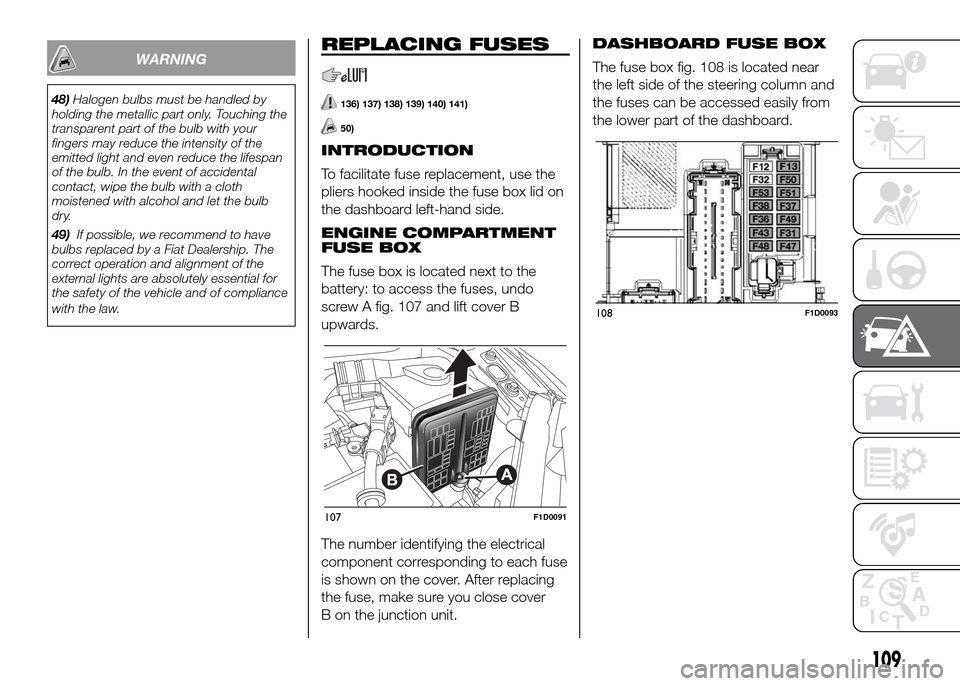
The fuse box is located next to the
battery: to access the fuses, undo
screw A fig. 107 and lift cover B
upwards.
The number identifying the electrical
component corresponding to each fuse
is shown on the cover. After replacing
the fuse, make sure you close cover
B on the junction unit.DASHBOARD FUSE BOX
The fuse box fig. 108 is located near
the left side of the steering column and
the fuses can be accessed easily from
the lower part of the dashboard.
107F1D0091
108F1D0093
109
WARNING
48)Halogen bulbs must be handled by
holding the metallic part only. Touching the
transparent part of the bulb with your
fingers may reduce the intensity of the
emitted light and even reduce the lifespan
of the bulb. In the event of accidental
contact, wipe the bulb with a cloth
moistened with alcohol and let the bulb
dry.
49)If possible, we recommend to have
bulbs replaced by a Fiat Dealership. The
correct operation and alignment of the
external lights are absolutely essential for
the safety of the vehicle and of compliance
with the law.
Page 118 of 204
❒make sure that the compressor
switch is in position 0 (off), start the
engine, plug into the power socket in
the central tunnel and operate the
compressor, turning switch A to
position I (on);
❒inflate the tyre to the pressure
specified in the "Inflation pressure"
paragraph in the "Technical
specifications" section. Check tyre
pressure on gauge B with compressor
off to obtain a more precise reading;
❒if after five minutes it is still impossible
to reach at least 1.8 bar, disengage
the compressor from the valve and
power socket, then move the vehicle
forwards by approx. ten metres in order
to distribute the sealing fluid inside the
tyre evenly, then repeat the inflation
operation;
❒if after this operation you still cannot
reach at least 1.8 bar after 5 minutes
from switching on the compressor,
do not resume driving but contact a
Fiat Dealership;
❒after driving for about 10 minutes
stop and check the tyre pressure again;
engage the handbrakeand park
safely;❒if a pressure value of at least 1.8 bar
is detected, restore the correct
pressure (with the engine running and
the handbrake engaged), resume
driving and drive with great care to the
nearest Fiat Dealership.
WARNING
147)Give the instruction brochure to the
personnel charged with handling the
tyre treated with the quick tyre repair kit.
148)Punctures on the sides of the tyre
cannot be repaired. Do not use the quick
tyre repair kit if the tyre is damaged as
a result of driving with it deflated.
149)If the wheel rim has been damaged
(bent so as to cause air to leak), the wheel
cannot be repaired. Do not remove foreign
bodies (screws or nails) from the tyre.
150)Do not use the compressor for more
than 20 consecutive minutes. Risk of
overheating. Tyres repaired with the quick
tyre repair kit must only be used
temporarily, as the kit is not suitable for a
definitive repair.
11
IN AN EMERGENCY
6
151)The information required by current
regulations, regarding the chemical
substances for the protection of human
health and the environment and on the safe
use of the sealing fluid, are on the
packaging label. Compliance with the
indications on the label is an essential
condition to ensure the safety and
the effectiveness of the product.
Remember to carefully read the label
before use; the user of the product
is responsible for any damages caused by
improper use. The sealing fluid has an
expiry date. Replace the bottle if the
sealant has expired.
152)Put on the protective gloves provided
together with the quick tyre repair kit.
153)Apply the adhesive label where it can
be easily seen by the driver as a reminder
that the tyre has been treated with the
quick repair kit. Drive carefully, particularly
on bends. Do not exceed 80 km/h. Avoid
sudden acceleration or braking.
154)If the pressure has fallen below 1.8
bar, do not drive any further: the quick tyre
repair kit cannot guarantee the correct
hold because the tyre is too damaged.
Contact a Fiat Dealership.
155)Always indicate that the tyre was
repaired using the quick tyre repair kit. Give
the leaflet to the personnel charged with
handling the tyre treated with the tyre
repair kit.
Page 129 of 204
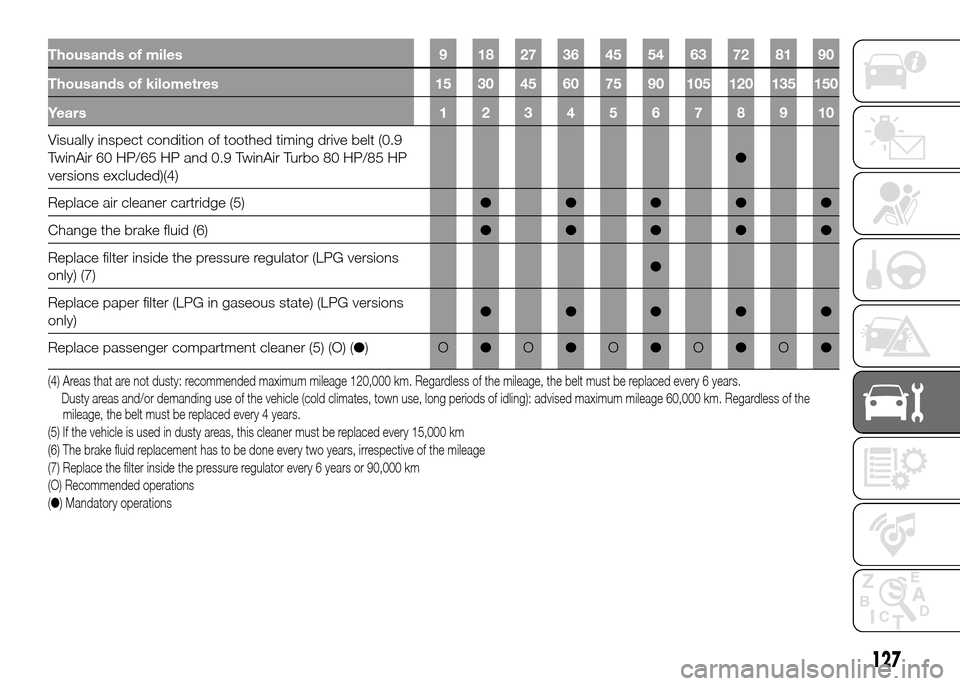
Thousands of miles 9 18 27 36 45 54 63 72 81 90
Thousands of kilometres 15 30 45 60 75 90 105 120 135 150
Years12345678910
Visually inspect condition of toothed timing drive belt (0.9
TwinAir 60 HP/65 HP and 0.9 TwinAir Turbo 80 HP/85 HP
versions excluded)(4)●
Replace air cleaner cartridge (5)●●●●●
Change the brake fluid (6)●●●●●
Replace filter inside the pressure regulator (LPG versions
only) (7)●
Replace paper filter (LPG in gaseous state) (LPG versions
only)●●●●●
Replace passenger compartment cleaner (5) (O) (●)O●O●O●O●O●
(4) Areas that are not dusty: recommended maximum mileage 120,000 km. Regardless of the mileage, the belt must be replaced every 6 years.
Dusty areas and/or demanding use of the vehicle (cold climates, town use, long periods of idling): advised maximum mileage 60,000 km. Regardless of the
mileage, the belt must be replaced every 4 years.
(5) If the vehicle is used in dusty areas, this cleaner must be replaced every 15,000 km
(6) The brake fluid replacement has to be done every two years, irrespective of the mileage
(7) Replace the filter inside the pressure regulator every 6 years or 90,000 km
(O) Recommended operations
(●) Mandatory operations
127
Page 132 of 204
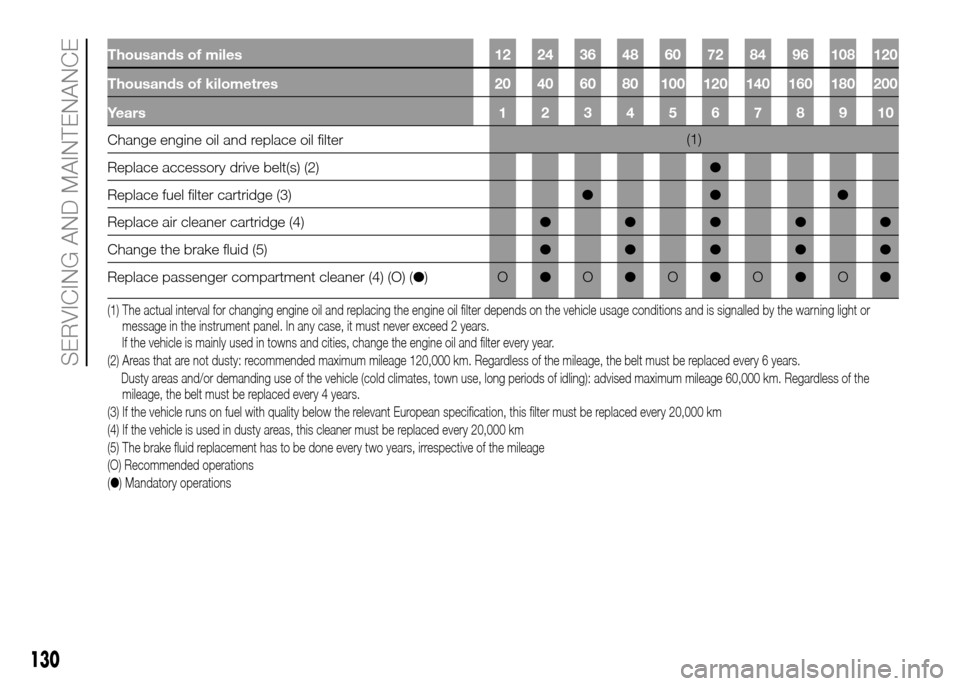
Thousands of miles 12 24 36 48 60 72 84 96 108 120
Thousands of kilometres 20 40 60 80 100 120 140 160 180 200
Years12345678910
Change engine oil and replace oil filter(1)
Replace accessory drive belt(s) (2)●
Replace fuel filter cartridge (3)●●●
Replace air cleaner cartridge (4)●●●●●
Change the brake fluid (5)●●●●●
Replace passenger compartment cleaner (4) (O) (●)O●O●O●O●O●
(1) The actual interval for changing engine oil and replacing the engine oil filter depends on the vehicle usage conditions and is signalled by the warning light or
message in the instrument panel. In any case, it must never exceed 2 years.
If the vehicle is mainly used in towns and cities, change the engine oil and filter every year.
(2) Areas that are not dusty: recommended maximum mileage 120,000 km. Regardless of the mileage, the belt must be replaced every 6 years.
Dusty areas and/or demanding use of the vehicle (cold climates, town use, long periods of idling): advised maximum mileage 60,000 km. Regardless of the
mileage, the belt must be replaced every 4 years.
(3) If the vehicle runs on fuel with quality below the relevant European specification, this filter must be replaced every 20,000 km
(4) If the vehicle is used in dusty areas, this cleaner must be replaced every 20,000 km
(5) The brake fluid replacement has to be done every two years, irrespective of the mileage
(O) Recommended operations
(●) Mandatory operations
130
SERVICING AND MAINTENANCE
Page 138 of 204
WARNING
164)Never smoke when performing
operations in the engine compartment.
Flammable gases and fumes may be
present and risk igniting.
165)Be very careful when working in the
engine compartment when the engine
is hot: you may get burnt.
166)The cooling system is pressurised. If
necessary, only replace the cap with
another original one or the operation of the
system may be adversely affected. Do
not remove the reservoir cap when the
engine is hot: risk of burns.
167)Do not travel with the washer fluid
reservoir empty: the washer operation
is essential for improving visibility. Some
commercial windscreen washer additives
are flammable. The engine compartment
contains hot components which may set it
on fire.
168)Brake fluid is poisonous and highly
corrosive. In the event of accidental
contact, immediately wash the affected
parts with water and mild soap. Then rinse
thoroughly. Call a doctor immediately if
swallowed.
169)The
symbol on the container
indicates a synthetic brake fluid, which is
different from a mineral fluid. Using a
mineral fluid will damage the special rubber
seals of the braking system beyond repair.170)Battery fluid is poisonous and
corrosive. Avoid contact with the skin and
eyes. Keep naked flames and sources
of sparks away from the battery: risk of
explosion and fire.
171)Using the battery with insufficient
fluid irreparably damages the battery and
may cause an explosion.
172)If the vehicle is left for long periods in
very cold environments, remove the battery
and store it in a warm place to prevent
freezing.
173)Always wear the proper protective
eyewear when working on the battery
or near it.
WARNING
55)Be careful not to confuse the various
types of fluids while topping up: they
are not compatible with each other!
Topping up with an unsuitable fluid could
severely damage your vehicle.
56)The oil level should never exceed the
MAX mark.
57)Do not add oil with specifications other
than those of the oil already in the engine.
58)PARAFLU
UPanti-freeze is used in
the engine cooling system. Use the same
fluid as in the cooling system when topping
up. PARAFLU
UPcannot be mixed with
any other type of fluid. If this happens, do
not start the engine and contact a Fiat
Dealership.59)Avoid allowing brake fluid, which is
extremely corrosive, to come into contact
with painted areas. Should it happen, wash
immediately with water.
60)Incorrect assembly of electrical and
electronic accessories may cause severe
damage to your vehicle. After purchasing
your vehicle, if you wish to install any
accessories (anti-theft, phone, etc.),
contact a Fiat Dealership, which
will suggest the most appropriate devices
for your vehicle, and will, most importantly,
advise you if a higher capacity battery
needs to be installed.
WARNING
4)Used engine oil and oil filters contain
substances which are harmful to the
environment. To change the oil and filters,
we advise you to contact a Fiat Dealership.
5)Used transmission fluid contains
substances that are harmful to the
environment. It is advisable to have the oil
changed by a Fiat Dealership where it
will be disposed of respecting the
environment and according to legal
requirements.
6)Batteries contain substances which are
very dangerous for the environment. For
battery replacement, contact a Fiat
Dealership.
136
SERVICING AND MAINTENANCE
Page 144 of 204
IDENTIFICATION
DATA
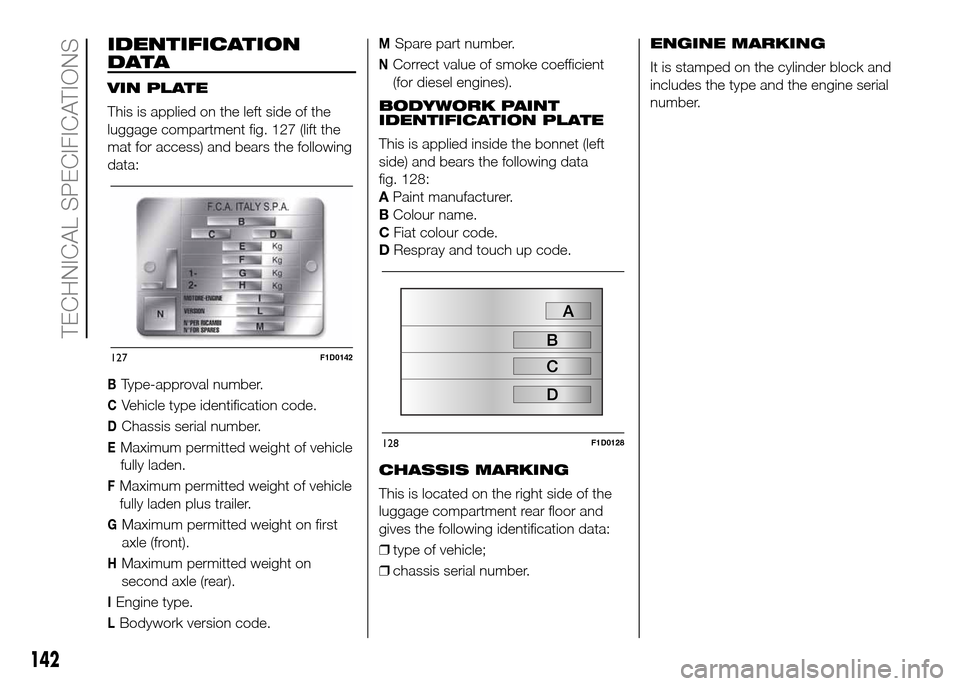
VIN PLATE
This is applied on the left side of the
luggage compartment fig. 127 (lift the
mat for access) and bears the following
data:
BType-approval number.
CVehicle type identification code.
DChassis serial number.
EMaximum permitted weight of vehicle
fully laden.
FMaximum permitted weight of vehicle
fully laden plus trailer.
GMaximum permitted weight on first
axle (front).
HMaximum permitted weight on
second axle (rear).
IEngine type.
LBodywork version code.
MSpare part number.
NCorrect value of smoke coefficient
(for diesel engines).
BODYWORK PAINT
IDENTIFICATION PLATE
This is applied inside the bonnet (left
side) and bears the following data
fig. 128:
APaint manufacturer.
BColour name.
CFiat colour code.
DRespray and touch up code.
CHASSIS MARKING
This is located on the right side of the
luggage compartment rear floor and
gives the following identification data:
❒type of vehicle;
❒chassis serial number.ENGINE MARKING
It is stamped on the cylinder block and
includes the type and the engine serial
number.
127F1D0142
128F1D0128
142
TECHNICAL SPECIFICATIONS
Page 145 of 204
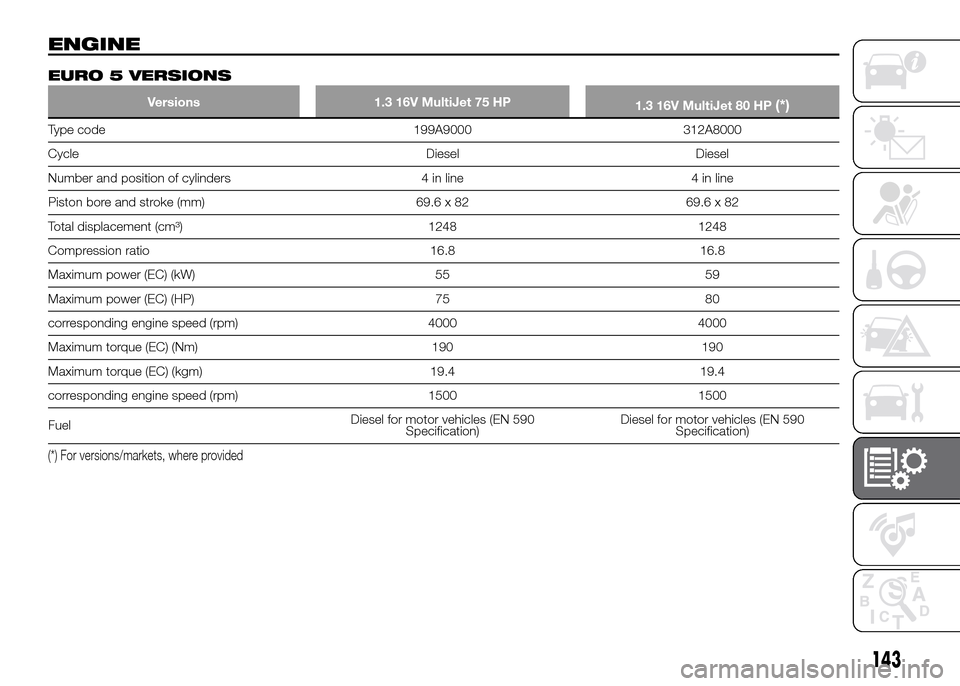
ENGINE
EURO 5 VERSIONS
Versions 1.3 16V MultiJet 75 HP
1.3 16V MultiJet 80 HP(*)
Type code 199A9000 312A8000
Cycle Diesel Diesel
Number and position of cylinders 4 in line 4 in line
Piston bore and stroke (mm) 69.6 x 82 69.6 x 82
Total displacement (cm³) 1248 1248
Compression ratio 16.8 16.8
Maximum power (EC) (kW) 55 59
Maximum power (EC) (HP) 75 80
corresponding engine speed (rpm) 4000 4000
Maximum torque (EC) (Nm) 190 190
Maximum torque (EC) (kgm) 19.4 19.4
corresponding engine speed (rpm) 1500 1500
FuelDiesel for motor vehicles (EN 590
Specification)Diesel for motor vehicles (EN 590
Specification)
(*) For versions/markets, where provided
143