wheel FIAT PANDA 2016 319 / 3.G Owner's Manual
[x] Cancel search | Manufacturer: FIAT, Model Year: 2016, Model line: PANDA, Model: FIAT PANDA 2016 319 / 3.GPages: 204, PDF Size: 18.77 MB
Page 68 of 204
69)The HBA system is an aid for the driver,
who must always pay full attention while
driving. The responsibility always rests with
the driver. The features of the HBA system
must never be tested in imprudent or
dangerous ways, with the possibility of
putting the safety of the driver, occupants
or other road users at risk.DRIVING
ASSISTANCE
SYSTEMS
TP (Traction Plus)
SYSTEM
(for versions/markets, where provided)
Traction Plus is a driving aid, useful
for setting off in poor grip conditions
(snow, ice, mud, etc.) which allows the
drive force to be distributed in the
best way over the front axle when one
wheel is slipping.
Traction Plus acts by braking the
wheels with poor grip (or those slipping
more than the others), thereby
transferring the drive force to those
which have greater grip on the ground.
Engagement/disengagement
The system is deactivated when
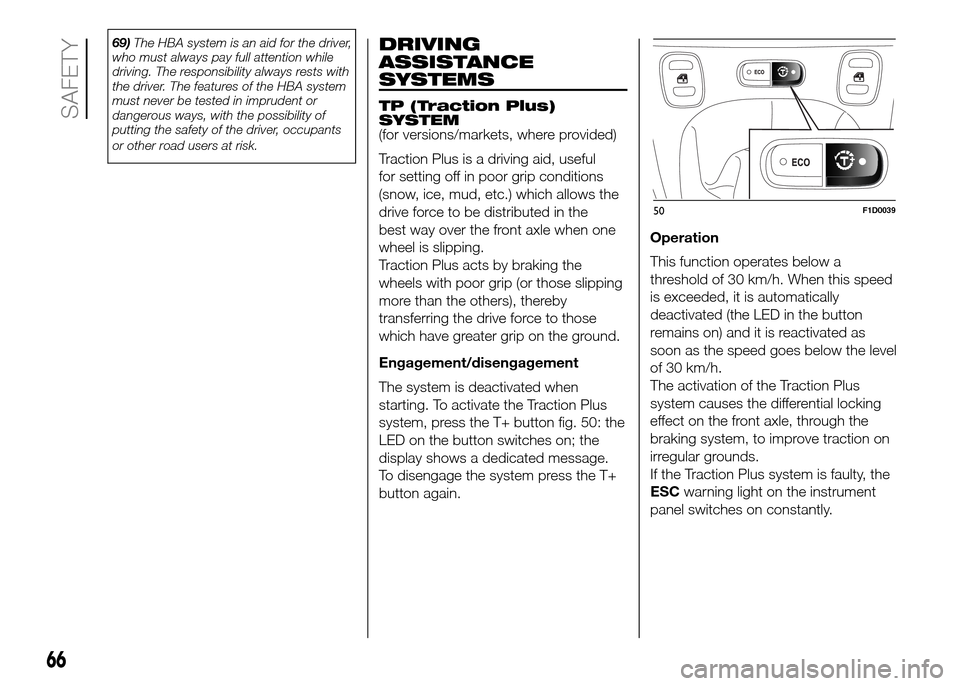
starting. To activate the Traction Plus
system, press the T+ button fig. 50: the
LED on the button switches on; the
display shows a dedicated message.
To disengage the system press the T+
button again.Operation
This function operates below a
threshold of 30 km/h. When this speed
is exceeded, it is automatically
deactivated (the LED in the button
remains on) and it is reactivated as
soon as the speed goes below the level
of 30 km/h.
The activation of the Traction Plus
system causes the differential locking
effect on the front axle, through the
braking system, to improve traction on
irregular grounds.
If the Traction Plus system is faulty, the
ESCwarning light on the instrument
panel switches on constantly.
50F1D0039
66
SAFETY
Page 70 of 204
Driving in special conditions
In certain driving conditions, such as,
for example:
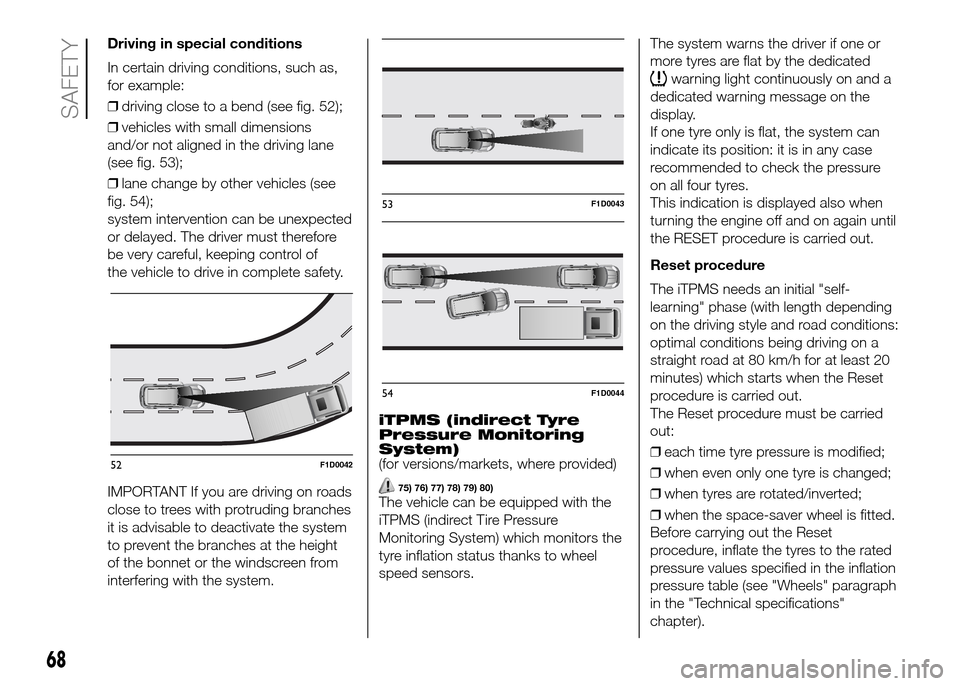
❒driving close to a bend (see fig. 52);
❒vehicles with small dimensions
and/or not aligned in the driving lane
(see fig. 53);
❒lane change by other vehicles (see
fig. 54);
system intervention can be unexpected
or delayed. The driver must therefore
be very careful, keeping control of
the vehicle to drive in complete safety.
IMPORTANT If you are driving on roads
close to trees with protruding branches
it is advisable to deactivate the system
to prevent the branches at the height
of the bonnet or the windscreen from
interfering with the system.iTPMS (indirect Tyre
Pressure Monitoring
System)
(for versions/markets, where provided)
75) 76) 77) 78) 79) 80)
The vehicle can be equipped with the
iTPMS (indirect Tire Pressure
Monitoring System) which monitors the
tyre inflation status thanks to wheel
speed sensors.The system warns the driver if one or
more tyres are flat by the dedicated
warning light continuously on and a
dedicated warning message on the
display.
If one tyre only is flat, the system can
indicate its position: it is in any case
recommended to check the pressure
on all four tyres.
This indication is displayed also when
turning the engine off and on again until
the RESET procedure is carried out.
Reset procedure
The iTPMS needs an initial "self-
learning" phase (with length depending
on the driving style and road conditions:
optimal conditions being driving on a
straight road at 80 km/h for at least 20
minutes) which starts when the Reset
procedure is carried out.
The Reset procedure must be carried
out:
❒each time tyre pressure is modified;
❒when even only one tyre is changed;
❒when tyres are rotated/inverted;
❒when the space-saver wheel is fitted.
Before carrying out the Reset
procedure, inflate the tyres to the rated
pressure values specified in the inflation
pressure table (see "Wheels" paragraph
in the "Technical specifications"
chapter).
52F1D0042
53F1D0043
54F1D0044
68
SAFETY
Page 71 of 204
If the Reset procedure is not carried
out, in all above cases, the
warning
light may give false indications on
one or more tyres.
To carry out the RESET procedure, with
the vehicle stopped and the ignition
device at MAR, use the Main Menu as
follows:
❒briefly press
button: the display will
show Reset;
❒press
button orto select
(“Yes” or “No”);
❒briefly press the
button: the
display will show "Confirm";
❒press
button orto select
("Yes" to reset or "No" to exit the video
page);
❒hold the
button down again to
return to the standard screen or to the
main menu according to where you
are in the menu.
At the end of the Reset procedure the
display will show the "Reset saved"
message, indicating that the self-
learning has been started.
Working conditions
The system is active for speeds above
15 km/h.In a few situations such as sporty
driving, particular conditions of the road
surface (e.g. icy, snowy, unsurfaced
roads...) the signalling may be delayed
or partial in detecting the contemporary
deflation of more than one tyre.
Under special conditions (e.g. vehicle
loaded asymmetrically on one side,
towing a trailer, damaged or worn tyre,
fitting the space-saver wheel, use of the
"Fix&Go Automatic" kit, fitting snow
chains, fitting different tyres on the
axles) the system may give false
indications or be temporarily
deactivated.
If the system is temporarily deactivated
the
warning light flashes for about
75 seconds and then is continuously
on; at the same time, the display shows
a dedicated message.
This indication is displayed also after
the engine has been switched off and
then on again if the correct operating
conditions are not restored.
WARNING
70)The system is an aid for the driver, who
must always pay full attention while
driving. The responsibility always rests with
the driver, who must take into account
the traffic conditions in order to drive
in complete safety. The driver must always
maintain a safe distance from the vehicle
in front.
71)If the driver depresses the brake pedal
fully or carries out a fast steering during
system operation, the automatic braking
function may stop (e.g. to allow a possible
manoeuvre to avoid the obstacle).
72)The laser beam is not visible at the
naked eye. Do not look directly, or with
optical instruments (e.g. lenses), at the
laser beam from a distance lower than 10
cm: this may cause damage to the sight.
The laser beam is also present when
the key is at MAR but its operation is off,
not available or manually deactivated
with the display Setup Menu.
73)The system intervenes on vehicles
travelling in the same lane. Small sized
vehicles (e.g. bicycles or motorbikes)
or people, animals and things (e.g.
pushchairs) and more in general all those
obstacles with a low reflection of the light
emitted by the laser (e.g. vehicles soiled
with mud) are not taken into consideration.
69
Page 76 of 204
PRETENSIONERS
87) 88) 89) 90)
35)
The vehicle is equipped with front seat
belt pretensioners, which draw back
the seat belts by several centimetres in
the event of a strong frontal impact.
This guarantees the perfect adherence
of the seat belts to the occupant's
bodies before the retention action
begins.
It is evident that the pretensioners have
operated when the belt withdraws
towards the retractor. This vehicle is
also equipped with a second
pretensioner (in the kick plate area). Its
activation is signalled by the shortening
of the metal cable.
A slight discharge of smoke may be
produced during the activation of the
pretensioner which is not harmful and
does not involve any fire hazard.
If, due to unusual natural events (floods,
sea storms, etc.), the device has been
affected by water and/or mud, contact
a Fiat Dealership to have it replaced.
IMPORTANT To obtain the highest
degree of protection from the action of
the pretensioner, wear the seat belt
tight to the chest and pelvis.LOAD LIMITERS
To increase occupant safety, the
retractors contain a load limiter to dose
the force acting on the chest and
shoulders during the belt restraining
action in the case of frontal collisions.
GENERAL
INSTRUCTIONS FOR
USING THE SEAT BELTS
The driver is responsible for respecting,
and ensuring that all the other
occupants of the vehicle also respect,
the local laws in force in relation to
the use of the seat belts. Always fasten
the seat belts before setting off.
Seat belts are also to be worn by
pregnant women: the risk of injury in
the case of impact is greatly reduced
for them and the unborn child if they
are wearing a seat belt. Pregnant
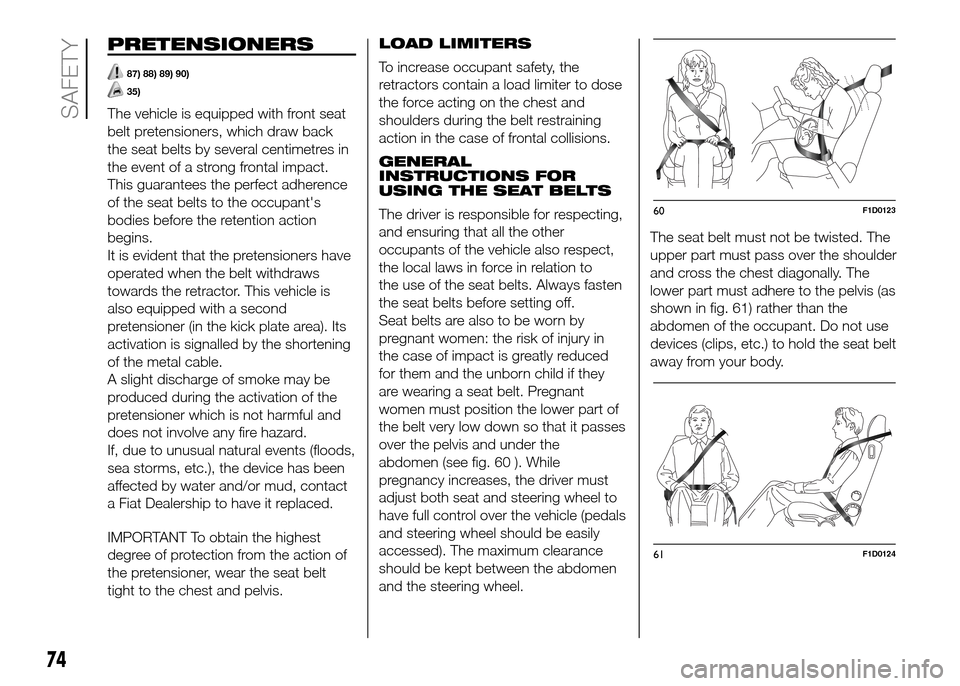
women must position the lower part of
the belt very low down so that it passes
over the pelvis and under the
abdomen (see fig. 60 ). While
pregnancy increases, the driver must
adjust both seat and steering wheel to
have full control over the vehicle (pedals
and steering wheel should be easily
accessed). The maximum clearance
should be kept between the abdomen
and the steering wheel.The seat belt must not be twisted. The
upper part must pass over the shoulder
and cross the chest diagonally. The
lower part must adhere to the pelvis (as
shown in fig. 61) rather than the
abdomen of the occupant. Do not use
devices (clips, etc.) to hold the seat belt
away from your body.
60F1D0123
61F1D0124
74
SAFETY
Page 87 of 204
98)Always make sure that the chest
section of the seat belt does not pass
under the arms or behind the back of the
child. In the event of an accident the seat
belt will not be able to secure the child,
with the risk of injury, including fatal injury.
Therefore the child must always wear
the seat belt correctly.
99)Do not use the same lower anchorage
to install more than one child restraint
system.
100)If a Universal ISOFIX child restraint
system is not fixed to all three anchorages,
it will not be able to protect the child
correctly. In a crash, the child could be
seriously or fatally injured.
101)Fit the child restraint system only
when the vehicle is stationary. The child
restraint system is correctly fixed to the
brackets when you hear the click. Follow
the instructions for assembly, disassembly
and positioning that the Manufacturer
must supply with the child restraint system.SUPPLEMENTARY
RESTRAINT SYSTEM
(SRS) - AIRBAG
The vehicle is equipped with:
❒front driver airbag;
❒front passenger airbag;
❒front side bags for pelvis, chest and
shoulder protection of driver and
passenger (for versions/markets, where
provided);
❒side bags for head protection of front
seat passengers and rear side seat
passengers (window bag).
FRONT AIRBAGS
102)The front (driver and passenger) airbags
protect the front seat occupants in the
event of head-on crashes of medium-
high severity, by placing the cushion
between the occupant and the steering
wheel or dashboard.
Therefore non-activation of airbags in
other types of collisions (side impacts,
rear shunts, roll-overs, etc.) does not
indicate a system malfunction.
Driver and passenger front airbags are
not a replacement of but
complementary to the seat belts, which
should always be worn, as specified
by law in Europe and most non-
European countries.In the event of an impact, those not
wearing a seat belt are projected
forwards, and may come into contact
with the bag which is still inflating.
The protection offered by the bag is
compromised in these circumstances.
The front airbags may not activate in
the case of a frontal impact against
highly deformable objects not involving
the front surface of the vehicle (e.g.
wing collision against guard rail) or in
the case of the vehicle wedging under
other vehicles or protective barriers
(e.g. under trucks or guard rails).
Failure to activate in the conditions
described above is due to the fact that
they may not provide any additional
protection compared with seat belts, so
their activation would be inappropriate.
In these cases, non-deployment does
not indicate a system malfunction.
85
Page 88 of 204
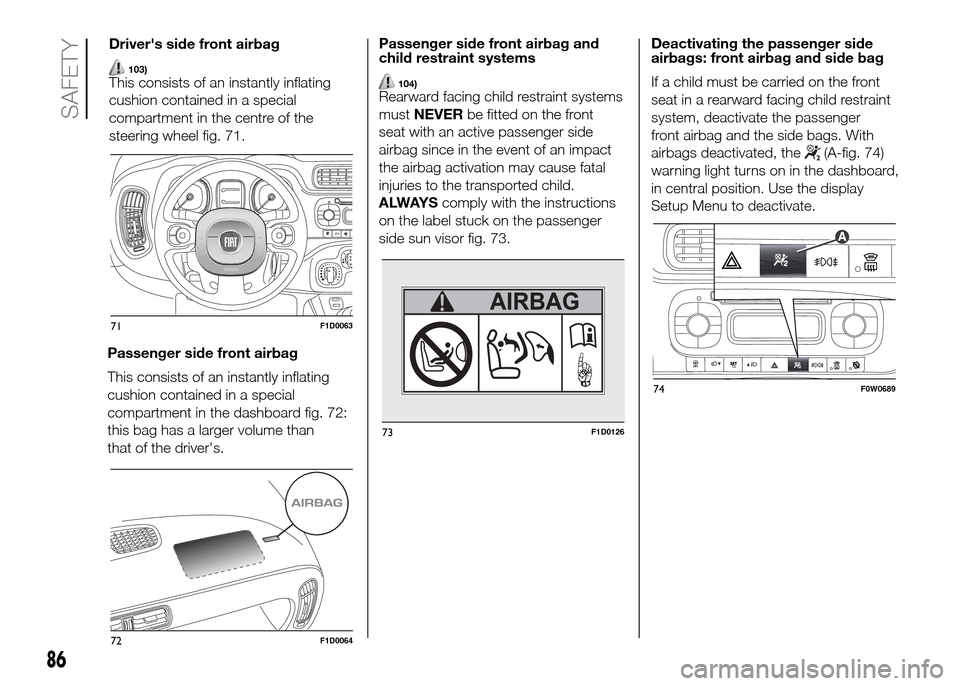
Passenger side front airbag
This consists of an instantly inflating
cushion contained in a special
compartment in the dashboard fig. 72:
this bag has a larger volume than
that of the driver's.Passenger side front airbag and
child restraint systems
104)Rearward facing child restraint systems
mustNEVERbe fitted on the front
seat with an active passenger side
airbag since in the event of an impact
the airbag activation may cause fatal
injuries to the transported child.
ALWAYScomply with the instructions
on the label stuck on the passenger
side sun visor fig. 73.Deactivating the passenger side
airbags: front airbag and side bag
If a child must be carried on the front
seat in a rearward facing child restraint
system, deactivate the passenger
front airbag and the side bags. With
airbags deactivated, the
(A-fig. 74)
warning light turns on in the dashboard,
in central position. Use the display
Setup Menu to deactivate.
71F1D0063
72F1D0064
73F1D0126
74F0W0689
86
SAFETY
Driver's side front airbag
103)This consists of an instantly inflating
cushion contained in a special
compartment in the centre of the
steering wheel fig. 71.
Page 91 of 204
Pretensioners and airbags are deployed
in different ways on the basis of the
type of collision. Failure to deploy
of one of the devices does not
necessarily indicate a system
malfunction.
WARNING
102)Do not apply stickers or other objects
on the steering wheel, on the dashboard
in the passenger side airbag area, on
the side cover on the roof and on
the seats. Never put objects (e.g. mobile
phones) on the passenger's side
dashboard since they could interfere with
correct inflation of the airbag and also
cause serious injury to the passengers.
103)Always drive keeping your hands on
the steering wheel rim so that the airbag
can inflate freely if necessary. Do not drive
with your body bent forward. Keep your
back straight against the backrest.104)When an active passenger airbag is
fitted, DO NOT install rearward facing child
restraint systems on the front seat.
Deployment of the airbag in an accident
could cause fatal injuries to the child
regardless of the severity of the impact.
Therefore, always deactivate the passenger
side airbag when a rearward facing child
restraint system is installed on the front
passenger seat. The front passenger seat
must also be positioned back as far as
possible in order to prevent the child
restraint system from coming into contact
with the dashboard. Immediately reactivate
the passenger airbag as soon as the child
restraint system has been removed.
105)Do not affix rigid objects to the coat
hooks or support handles.
106)Do not rest the head, arms or elbows
on the door, windows and window bag
area to avoid possible injuries during
inflation.
107)Never lean your head, arms and
elbows out of the window.
108)If the
warning light stays on whilst
driving, a fault may have occurred in the
restraint systems. In this case the airbags
or pretensioners may not be deployed
in an impact or, in a lower number of
cases, they may be deployed accidentally.
Before continuing, contact a Fiat
Dealership immediately to have the system
checked.109)In the event of “yellow”
warning
light failure, the “red”warning light
switches on and, for versions/markets
where provided, the explosive charges of
the passenger airbag and the side bags
are deactivated. When the "red" warning
light is on, before proceeding contact a Fiat
Dealership to have the system immediately
checked (see previous warning).
110)On vehicles with side bags, do not
cover the front seat backrests with extra
covers.
111)Do not travel carrying objects in your
lap, in front of your chest or between
your lips (pipe, pencils, etc.). They could
cause severe injury if the airbag is
deployed.
112)If the vehicle has been stolen or in the
case of attempt to steal it, if it has been
subjected to vandalism or floods, have the
airbag system checked by a Fiat
Dealership.
89
Page 94 of 204
STARTING THE
ENGINE
118) 119)
36) 37) 38) 39)
Before starting the engine, adjust the
seat, the interior rear view mirrors,
the door mirrors and fasten the seat
belt correctly.
Never press the accelerator pedal for
starting the engine.
VERSIONS WITH MANUAL
GEARBOX
Petrol versions
Proceed as follows:
❒engage the handbrake and place the
gear lever in neutral.For 0.9 TwinAir
and 0.9 TwinAir Turbo versions
engage the handbrake and place the
gear lever in neutral or fully press the
clutch pedal if a gear other than neutral
is engaged;
❒for all versions (except 0.9
TwinAir Turbo)fully depress the clutch
pedal, without pressing the accelerator;
❒turn the ignition key to AVV and
release it as soon as the engine starts.
Diesel versions
Proceed as follows:
❒engage the handbrake, put the gear
lever into neutral and turn the ignition
key to MAR: the warning lights
andon the instrument panel
will turn on;❒wait for the warning lights
and
to turn off and then fully depress
the clutch pedal without pressing the
accelerator;
❒turn the ignition key to AVV as soon
as warning light
switches off.
Release the ignition key as soon as the
engine starts.
IMPORTANT If the engine does not
start at the first attempt, return the
ignition key to STOP before repeating
the procedure. If, with the ignition
key at MAR, the warning lights
and
(only for petrol versions) stay on
in the instrument panel, the ignition key
must be brought back to STOP and
then to MAR again. If the
warning
light stays on, retry with the other
keys provided. Contact a Fiat
Dealership if you still cannot start the
engine.
VERSIONS WITH
DUALOGIC GEARBOX
120)Engine starting is allowed both with a
gear engaged and with the gearbox
in neutral (N).
However, the brake pedal must always
be pressed first if neutral is not
engaged. It is therefore advisable to
place the gear lever in neutral (N) before
starting the engine.LPG AND NATURAL
POWER VERSIONS
The engine always starts up on petrol
independently of the mode previously
selected.
40)
STOPPING THE ENGINE
41)Turn the ignition key to STOP while the
engine is idling.
IMPORTANT After a demanding drive,
before turning the engine off you should
allow it to idle to allow the temperature
in the engine compartment to
decrease.
92
STARTING AND DRIVING
WARNING
118)It is dangerous to run the engine in
enclosed areas. The engine takes in
oxygen and releases carbon dioxide,
carbon monoxide and other toxic gases.
119)Remember that the brake servo
and power steering are not operational until
the engine has been started, therefore
you need to apply much more force than
usual to the brake pedal and steering
wheel.
120)If the engine fails to start with a gear
engaged, the potentially dangerous
situation due to the fact that the gearbox is
automatically placed in neutral will be
signalled by an acoustic signal.
Page 95 of 204
WARNING
36)If the warning lightflashes for 60
seconds after starting or during an
extended towing period, this indicates a
problem in the glow plug preheating
system. You can use the vehicle as usual if
the engine starts but you should contact
a Fiat Dealership as soon as possible.
37)It is advisable not to demand maximum
performance from your vehicle (e.g.
excessive acceleration, long distances at
maximum rpm, excessively intense braking,
etc.) when it is first used.
38)When the engine is off, do not leave
the key turned to MAR to prevent
unnecessary electrical consumption from
draining the battery.
39)Never bump start the engine by
pushing, towing or coasting downhill. This
could cause fuel to flow into the catalytic
converter and damage it beyond repair.
40)There must therefore always be some
petrol in the tank to protect the petrol
pump and to guarantee temporary
switching from LPG or Methane to petrol
operation, if high performance is required.
41)A quick burst on the accelerator
before stopping the engine serves no
practical purpose; it wastes fuel and is
especially damaging to turbocharged
engines.
HANDBRAKE
121) 122) 123)
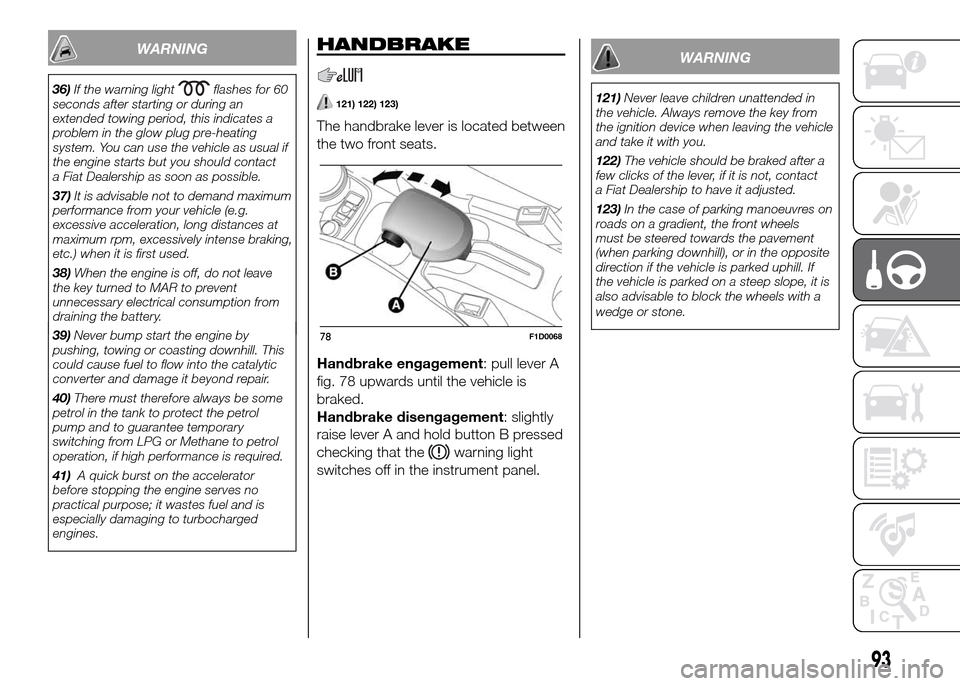
The handbrake lever is located between
the two front seats.
Handbrake engagement: pull lever A
fig. 78 upwards until the vehicle is
braked.
Handbrake disengagement: slightly
raise lever A and hold button B pressed
checking that the
warning light
switches off in the instrument panel.
78F1D0068
93
WARNING
121)Never leave children unattended in
the vehicle. Always remove the key from
the ignition device when leaving the vehicle
and take it with you.
122)The vehicle should be braked after a
few clicks of the lever, if it is not, contact
a Fiat Dealership to have it adjusted.
123)In the case of parking manoeuvres on
roads on a gradient, the front wheels
must be steered towards the pavement
(when parking downhill), or in the opposite
direction if the vehicle is parked uphill. If
the vehicle is parked on a steep slope, it is
also advisable to block the wheels with a
wedge or stone.
Page 102 of 204
100
STARTING AND DRIVING
Diesel and petrol versions
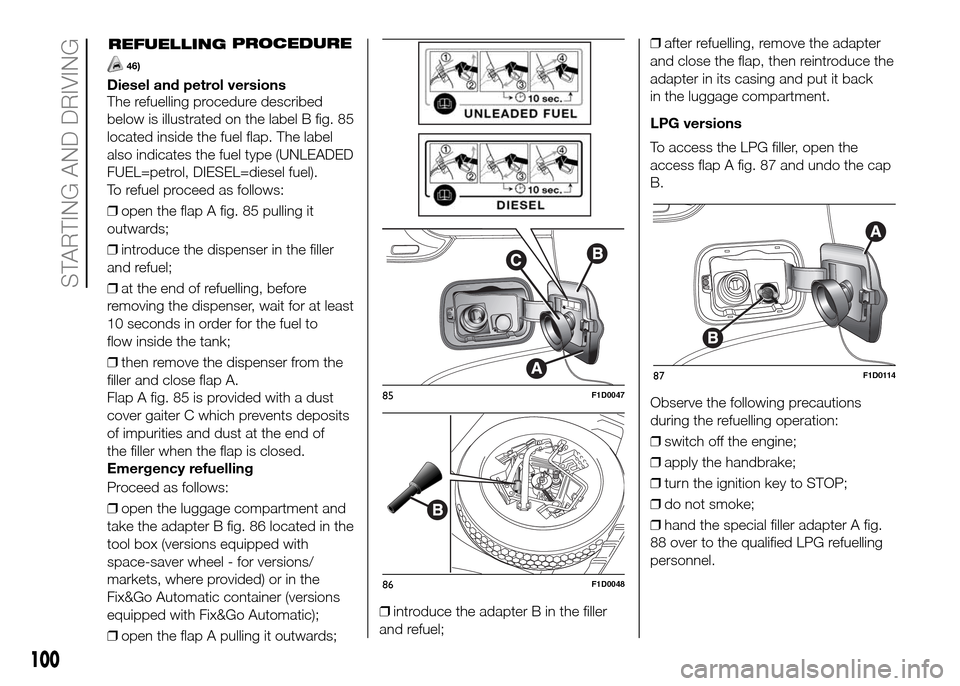
The refuelling procedure described
below is illustrated on the label B fig. 85
located inside the fuel flap. The label
also indicates the fuel type (UNLEADED
FUEL=petrol, DIESEL=diesel fuel).
To refuel proceed as follows:
❒open the flap A fig. 85 pulling it
outwards;
❒introduce the dispenser in the filler
and refuel;
❒at the end of refuelling, before
removing the dispenser, wait for at least
10 seconds in order for the fuel to
flow inside the tank;
❒then remove the dispenser from the
filler and close flap A.
Flap A fig. 85 is provided with a dust
cover gaiter C which prevents deposits
of impurities and dust at the end of
the filler when the flap is closed.
Emergency refuelling
Proceed as follows:
❒open the luggage compartment and
take the adapter B fig. 86 located in the
tool box (versions equipped with
space-saver wheel - for versions/
markets, where provided) or in the
Fix&Go Automatic container (versions
equipped with Fix&Go Automatic);
❒open the flap A pulling it outwards;❒introduce the adapter B in the filler
and refuel;
85F1D0047
86F1D0048
REFUELLINGPROCEDURE
46)
❒after refuelling, remove the adapter
and close the flap, then reintroduce the
adapter in its casing and put it back
in the luggage compartment.
LPG versions
To access the LPG filler, open the
access flap A fig. 87 and undo the cap
B.
Observe the following precautions
during the refuelling operation:
❒switch off the engine;
❒apply the handbrake;
❒turn the ignition key to STOP;
❒do not smoke;
❒hand the special filler adapter A fig.
88 over to the qualified LPG refuelling
personnel.
87F1D0114