warning light FIAT PANDA 2016 319 / 3.G Workshop Manual
[x] Cancel search | Manufacturer: FIAT, Model Year: 2016, Model line: PANDA, Model: FIAT PANDA 2016 319 / 3.GPages: 204, PDF Size: 18.77 MB
Page 104 of 204
IN AN EMERGENCY
A punctured tyre or a burnt-out bulb?
At times, a problem may interfere
with our journey.
The pages on emergencies can help
you to deal with critical situations
independently and with calm.
In an emergency we recommend that
you call the freephone number found in
the Warranty Booklet.
It is also possible to call the national or
international universal freephone
number to search for the nearest
Dealership.HAZARD WARNING LIGHTS...........103
REPLACING A BULB ......................10
REPLACING FUSES........................109
CHANGING A WHEEL ....................112
"FIX&GO AUTOMATIC" KIT .............11
JUMP STARTING ............................117
FUEL CUT-OFF SYSTEM ................119
TOWING THE VEHICLE ..................119
102
IN AN EMERGENCY
3
5
Page 105 of 204
HAZARD WARNING
LIGHTS
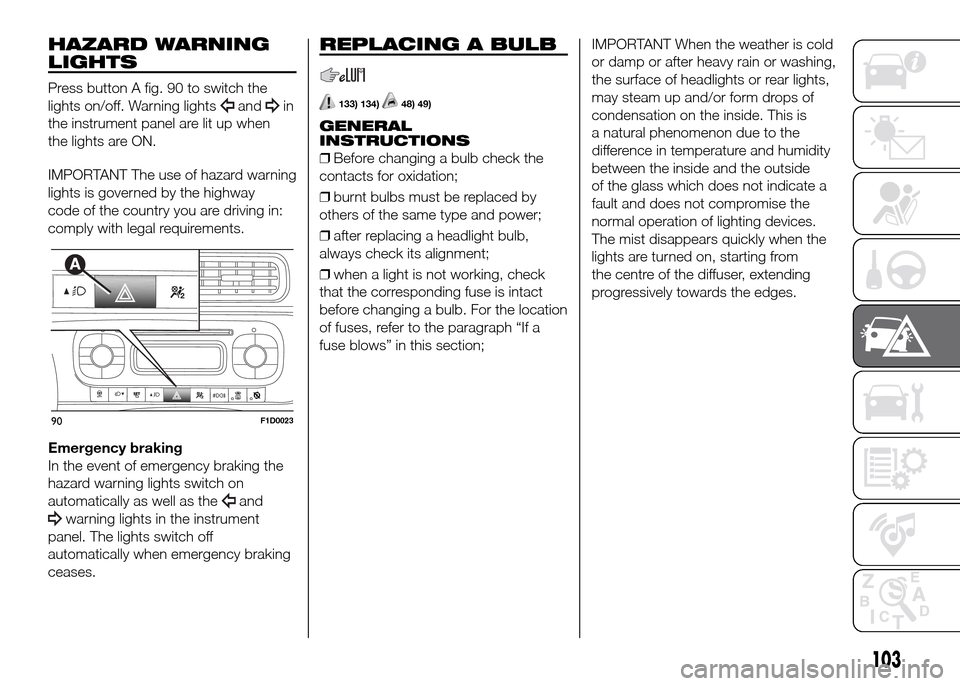
Press button A fig. 90 to switch the
lights on/off. Warning lights
andin
the instrument panel are lit up when
the lights are ON.
IMPORTANT The use of hazard warning
lights is governed by the highway
code of the country you are driving in:
comply with legal requirements.
Emergency braking
In the event of emergency braking the
hazard warning lights switch on
automatically as well as the
and
warning lights in the instrument
panel. The lights switch off
automatically when emergency braking
ceases.
REPLACING A BULB
133) 134)48) 49)
GENERAL
INSTRUCTIONS
❒Before changing a bulb check the
contacts for oxidation;
❒burnt bulbs must be replaced by
others of the same type and power;
❒after replacing a headlight bulb,
always check its alignment;
❒when a light is not working, check
that the corresponding fuse is intact
before changing a bulb. For the location
of fuses, refer to the paragraph “If a
fuse blows” in this section;IMPORTANT When the weather is cold
or damp or after heavy rain or washing,
the surface of headlights or rear lights,
may steam up and/or form drops of
condensation on the inside. This is
a natural phenomenon due to the
difference in temperature and humidity
between the inside and the outside
of the glass which does not indicate a
fault and does not compromise the
normal operation of lighting devices.
The mist disappears quickly when the
lights are turned on, starting from
the centre of the diffuser, extending
progressively towards the edges.
90F1D0023
103
Page 110 of 204
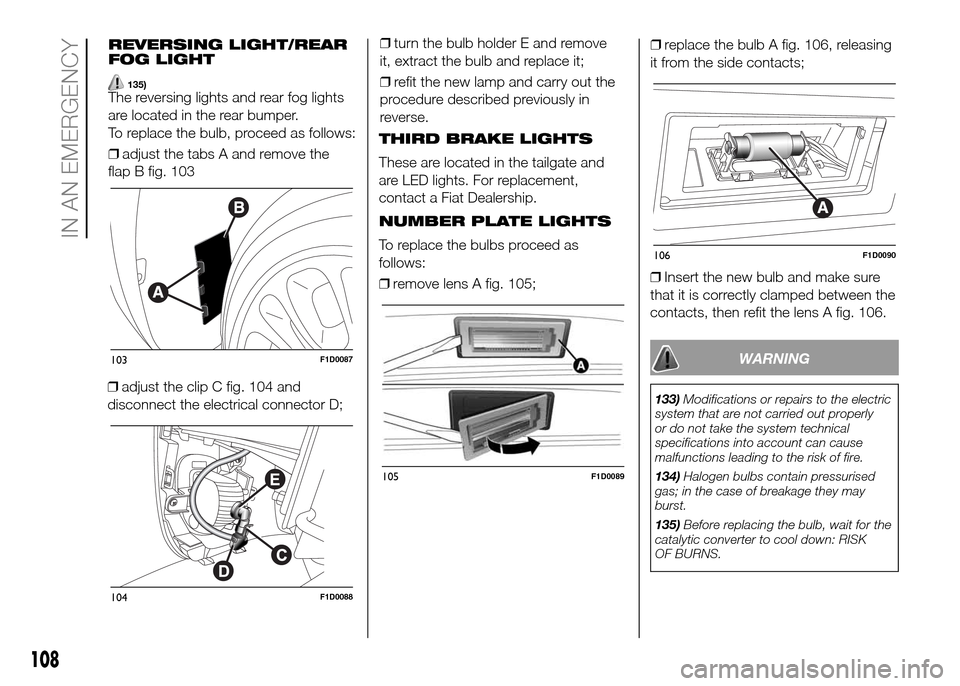
❒adjust the clip C fig. 104 and
disconnect the electrical connector D;❒turn the bulb holder E and remove
it, extract the bulb and replace it;
❒refit the new lamp and carry out the
procedure described previously in
reverse.
THIRD BRAKE LIGHTS
These are located in the tailgate and
are LED lights. For replacement,
contact a Fiat Dealership.
NUMBER PLATE LIGHTS
To replace the bulbs proceed as
follows:
❒remove lens A fig. 105;❒replace the bulb A fig. 106, releasing
it from the side contacts;
❒Insert the new bulb and make sure
that it is correctly clamped between the
contacts, then refit the lens A fig. 106.
WARNING
133)Modifications or repairs to the electric
system that are not carried out properly
or do not take the system technical
specifications into account can cause
malfunctions leading to the risk of fire.
134)Halogen bulbs contain pressurised
gas; in the case of breakage they may
burst.
135)Before replacing the bulb, wait for the
catalytic converter to cool down: RISK
OF BURNS.
103F1D0087
104F1D0088
105F1D0089
106F1D0090
108
IN AN EMERGENCY
REVERSING LIGHT/REAR
FOG LIGHT
135)The reversing lights and rear fog lights
are located in the rear bumper.
To replace the bulb, proceed as follows:
❒adjust the tabs A and remove the
flap B fig. 103
Page 111 of 204
REPLACING FUSES
136) 137) 138) 139) 140) 141)
50)
INTRODUCTION
To facilitate fuse replacement, use the
pliers hooked inside the fuse box lid on
the dashboard left-hand side.
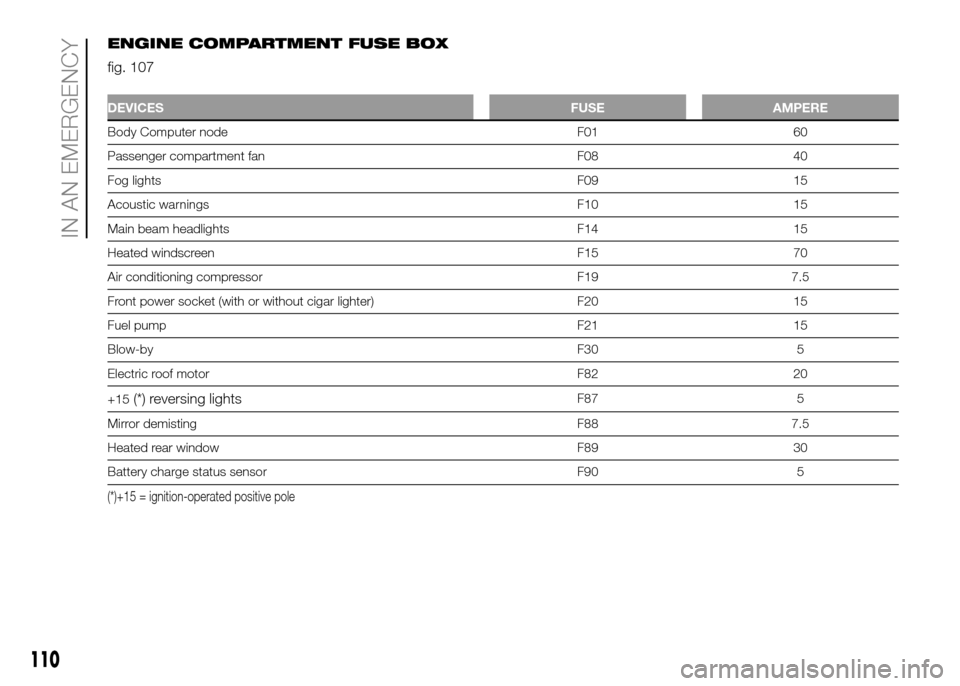
ENGINE COMPARTMENT
FUSE BOX
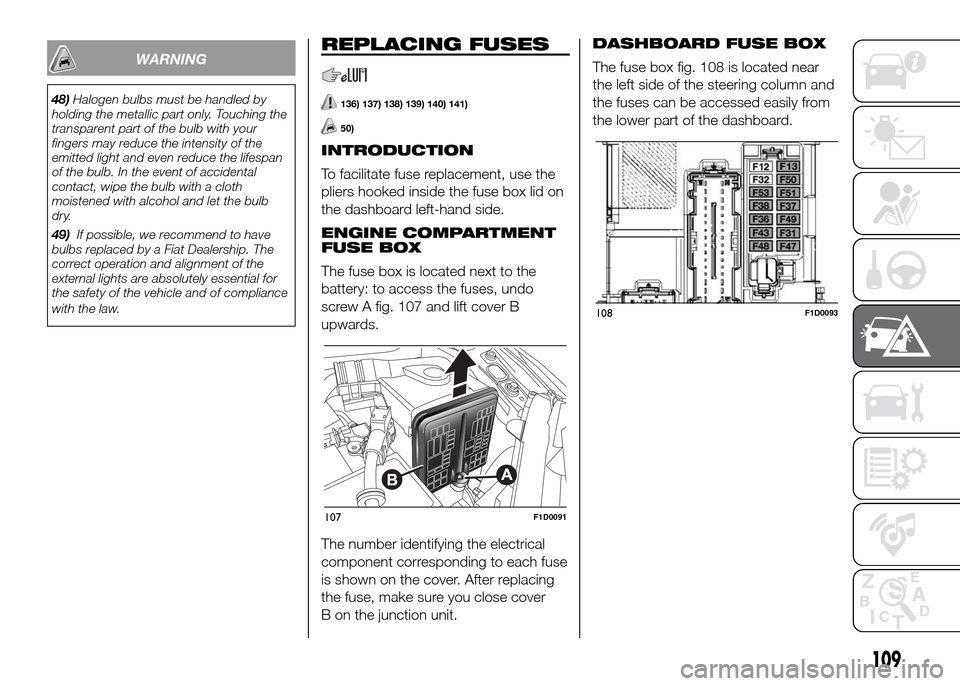
The fuse box is located next to the
battery: to access the fuses, undo
screw A fig. 107 and lift cover B
upwards.
The number identifying the electrical
component corresponding to each fuse
is shown on the cover. After replacing
the fuse, make sure you close cover
B on the junction unit.DASHBOARD FUSE BOX
The fuse box fig. 108 is located near
the left side of the steering column and
the fuses can be accessed easily from
the lower part of the dashboard.
107F1D0091
108F1D0093
109
WARNING
48)Halogen bulbs must be handled by
holding the metallic part only. Touching the
transparent part of the bulb with your
fingers may reduce the intensity of the
emitted light and even reduce the lifespan
of the bulb. In the event of accidental
contact, wipe the bulb with a cloth
moistened with alcohol and let the bulb
dry.
49)If possible, we recommend to have
bulbs replaced by a Fiat Dealership. The
correct operation and alignment of the
external lights are absolutely essential for
the safety of the vehicle and of compliance
with the law.
Page 112 of 204
ENGINE COMPARTMENT FUSE BOX
fig. 107
DEVICES FUSE AMPERE
Body Computer node F01 60
Passenger compartment fan F08 40
Fog lightsF09 15
Acoustic warnings F10 15
Main beam headlights F14 15
Heated windscreen F15 70
Air conditioning compressor F19 7.5
Front power socket (with or without cigar lighter) F20 15
Fuel pump F21 15
Blow-byF30 5
Electric roof motor F82 20
+15
(*) reversing lightsF87 5
Mirror demisting F88 7.5
Heated rear window F89 30
Battery charge status sensor F90 5
(*)+15 = ignition-operated positive pole
110
IN AN EMERGENCY
Page 116 of 204
❒lower the vehicle and remove the
jack;
❒use the wrench provided to fully
tighten the bolts, passing alternately
from one bolt to the opposite one.
Versions with alloy wheels
Proceed as follows:
❒insert the wheel on the hub and using
the wrench provided tighten the bolts;
❒lower the vehicle and remove the
jack;
❒use the wrench provided to fully
tighten the bolts, passing alternately
from one bolt to the opposite one.
❒reinsert the press-fitted hub cap,
making sure that the reference hole on
the wheel is aligned with the reference
pin on the cap.
IMPORTANT If it is not fitted properly,
the hub cap may detach itself when the
vehicle is running.
At the end of operation
❒stow the space-saver wheel in the
compartment provided in the luggage
compartment;
❒insert the jack and the other tools in
the container;
❒arrange the container and tools on
the space-saver wheel;
❒correctly reposition the boot mat.
WARNING
142)The space-saver wheel (for
versions/markets, where provided) is
specific to your vehicle, do not use it on
other models, or use the space-saver
wheel of other models on your vehicle. The
space-saver wheel must only be used in
the event of an emergency. It must only be
used for the distance necessary to reach
a service point and the vehicle speed must
not exceed 80 km/h. The space-saver
wheel has an orange label that
summarises the main cautions for use and
limitations. Never remove or cover the
label. The following information is provided
in four languages on the label: "Important!
For temporary use only! 80 km/h max!
Replace with a standard wheel as soon as
possible. Never cover this indication".
Never apply any hub cap to the
space-saver wheel.
143)Use your hazard lights, warning
triangle, etc to show that your vehicle is
stationary. Passengers should get out
of the vehicle, particularly if it is heavily
loaded, and wait for the wheel to be
changed away from the traffic. On hills or
uneven roads, use chocks or appropriate
objects to block the wheels of the vehicle.144)The vehicle's driving characteristics
will be modified with the space-saver wheel
fitted. Avoid violent acceleration and
braking, abrupt steering and fast cornering.
The overall duration of the space-saver
wheel is about 3000 km, after which the
relevant tyre must be replaced with another
one of the same type. Never install a
traditional tyre on a rim designed to be
used as a space-saver wheel. Have the
wheel repaired and refitted as soon as
possible. Using two or more space-saver
wheels at the same time is forbidden.
Do not apply grease to the bolt threads
before fitting: they could come unscrewed.
145)The jack may be used to replace
wheels only on the vehicle that it comes
with, or other vehicles of the same model.
Never use the jack for other purposes,
such as lifting other vehicle models. Never
use it for repair operations under the
vehicle. Incorrect positioning of the jack
may cause the vehicle to fall. Do not use
the jack for loads higher than those shown
on the label. Never install snow chains
on the space-saver wheel; if a front tyre
(driving wheel) is punctured and you need
to use snow chains, use a standard wheel
from the rear axle and install the
space-saver wheel on the rear axle. In this
way, with two normal front drive wheels,
it is possible to use snow chains.
146)Incorrect hub cap assembly may
cause it to come off when the vehicle is
moving. Never tamper with the inflation
valve. Never introduce tools of any kind
between rim and tyre. Check tyre and
space-saver wheel pressures regularly,
complying with the values given in the
"Technical specifications" chapter.
11
IN AN EMERGENCY
4
Page 120 of 204
❒connect the other end of the cable
used for positive (+) to the positive
terminal (+) of the auxiliary battery;
❒connect one end of the cable used
for negative (–) to the negative terminal
(–) of the auxiliary battery;
❒Connect the other end of the cable
used for negative (–) to an engine earth
(the visible metal part of the vehicle
engine with flat battery) away from the
battery and the fuel injection system;
❒start the vehicle engine with the
auxiliary battery, let it run for a
few minutes at idling. Start the engine
of the vehicle with flat battery.
Cable disconnection.
Once the engine has been started,
remove the cables proceeding as
follows:
❒disconnect the end of the cable used
for negative (–) from the engine earth
of the vehicle with flat battery;
❒disconnect the other end of the cable
used for negative (–) from the negative
terminal (–) of the auxiliary battery;
❒disconnect the end of the cable used
for positive (+) from the positive terminal
(+) of the auxiliary battery;
❒disconnect one end of the cable
used for positive (+) from the positive
terminal (+) of the vehicle with flat
battery;If it is often necessary to perform a
jump starting, have the vehicle battery
and the recharging system checked
by a Fiat Dealership.
IMPORTANT Any accessories (e.g.
mobile phones, etc.) connected to the
vehicle power sockets draw current
even if they are not used. These
devices, if left connected too much time
with engine off, may cause the battery
to drain with following reduction of
its life and/or failure to start the engine.
WARNING
156)This procedure must be performed by
qualified personnel as incorrect actions
may cause high-intensity electrical
discharge. Furthermore, battery fluid is
poisonous and corrosive: avoid contact
with skin and eyes. Keep naked flames and
lighted cigarettes away from the battery
and do not cause sparks.
157)Remove any metal objects (e.g. rings,
watches, bracelets), that might cause an
accidental electrical contact and cause
serious injury.
WARNING
53)Do not connect the cable to the
negative terminal (–) of the flat battery. The
following spark could lead to battery
explosion and cause serious harm. Only
use the specific earth point; do not use any
other exposed metallic part.
54)Never use a fast battery-charger to
start the engine as this could damage the
electronic systems of your vehicle,
particularly the ignition and engine fuel
supply control units.
1
IN AN EMERGENCY
18
Page 121 of 204
FUEL CUT-OFF
SYSTEM
158)
This intervenes in the case of an impact
causing:
❒the interruption of the fuel supply with
the engine consequently cutting out;
❒the automatic unlocking of the doors;
❒the automatic switching on of the
interior lights
❒the switching on of the hazard
warning lights.
IMPORTANT Carefully check the car for
fuel leaks, for instance in the engine
compartment, under the car or near the
tank area. After an impact, turn the
ignition key to STOP to prevent the
battery from running down.
To restore the correct operation of the
car, proceed as follows:
❒turn the ignition key to the MAR
position;
❒activate the right direction indicator;
❒deactivate the right direction
indicator;
❒activate the left direction indicator;
❒deactivate the left direction indicator;
❒activate the right direction indicator;
❒deactivate the right direction
indicator;❒activate the left direction indicator;
❒deactivate the left direction indicator;
❒turn the ignition key to STOP and
then to MAR.
LPG versions: in the event of an
impact, petrol supply is immediately
cut-off, the LPG safety valves are
closed and the injection is interrupted,
switching off the engine.
Natural Power versions: in the event
of an impact, the power supply is
immediately cut off, causing engine
switching off.
WARNING
158)If, after an impact, you smell fuel or
notice leaks from the fuel system, do
not reactivate the system to avoid the risk
of fire.
TOWING THE
VEHICLE
159) 160) 161) 162) 163)
The tow hook, which is supplied with
the vehicle, is housed in the tool box,
under the carpet in the luggage
compartment.
ATTACHING THE TOW
HOOK
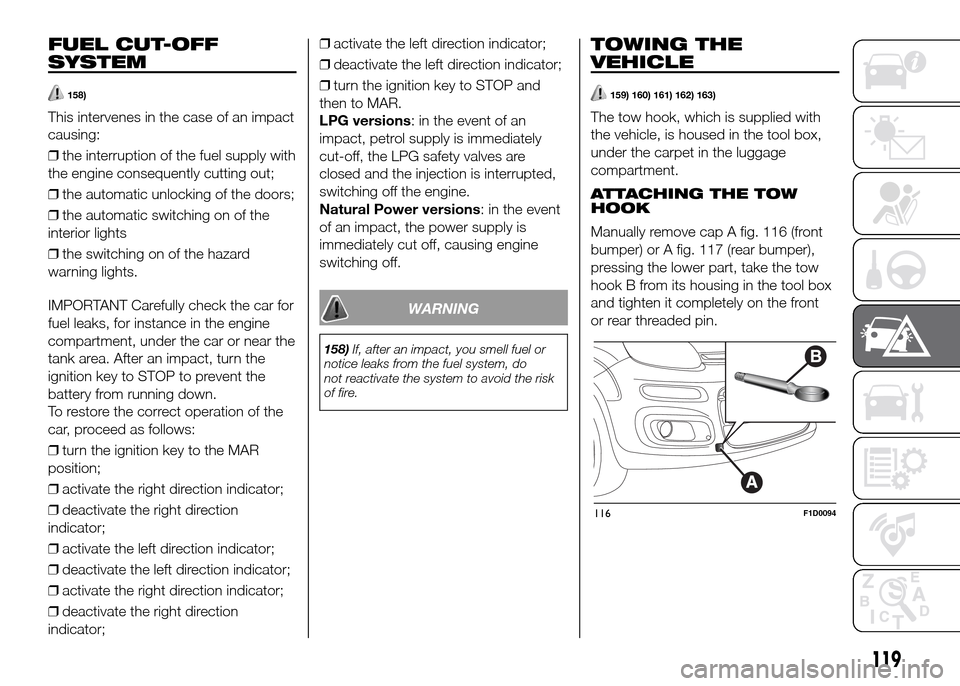
Manually remove cap A fig. 116 (front
bumper) or A fig. 117 (rear bumper),
pressing the lower part, take the tow
hook B from its housing in the tool box
and tighten it completely on the front
or rear threaded pin.
116F1D0094
119
Page 124 of 204
SCHEDULED
SERVICING
Correct servicing is crucial for
guaranteeing a long life for the vehicle
under the best conditions. For this
reason, Fiat has planned a series of
checks and services at fixed distance
intervals and, where provided, at fixed
time intervals, as described in the
Scheduled Servicing Plan.
Before each service, it is always
necessary to carefully follow the
instructions in the Scheduled Servicing
Plan (e.g. periodically check level of
fluids, tyre pressure, etc.).
Scheduled Servicing is offered by all
Fiat Dealerships according to a set time
schedule. If, during each operation, in
addition to the ones scheduled, the
need arises for further replacements or
repairs, these may be carried out with
your explicit agreement only. If your
vehicle is used frequently for towing,
the interval between one service
operation and the next should be
reduced.IMPORTANT Scheduled Servicing
interventions are set out by the
Manufacturer. Failure to have them
carried out may invalidate the warranty.
It is advisable to inform a Fiat
Dealership of any small operating
irregularities without waiting for the next
service.
PERIODIC CHECKS
Every1,000km or before long
journeys, check and if necessary, top
up: engine coolant level; brake fluid
level; screen washer fluid level; tyre
inflation pressure and condition; lighting
system operation (headlights, direction
indicators, hazard warning lights, etc.);
screen washer/wiper system operation
and positioning/wear of windscreen/
rear window wiper blades.
Every3,000km, check and top up if
required: engine oil level.HEAVY-DUTY USE OF THE
VEHICLE
If the vehicle is used under one of the
following conditions: towing a trailer
or motorhome; dusty roads; short (less
than 7-8 km) and repeated journeys
with sub-zero outside temperatures;
engine often idling or driving long
distances at low speed or long periods
of inactivity, the following checks must
be carried out more often than
indicated in the Scheduled Servicing
Plan:
❒check front disc brake pad condition
and wear;
❒check cleanliness of bonnet and
luggage compartment locks,
cleanliness and lubrication of linkage;
❒visually inspect conditions of: engine,
gearbox, transmission, pipes and
hoses (exhaust/fuel system/brakes) and
rubber elements (gaiters/sleeves/
bushes, etc.);
❒check battery charge and battery
fluid level (electrolyte);
❒visually inspect conditions of the
auxiliary drive belts;
❒check and, if necessary, change
engine oil and replace oil filter / pollen
filter / air cleaner.
12
SERVICING AND MAINTENANCE
2
Page 125 of 204
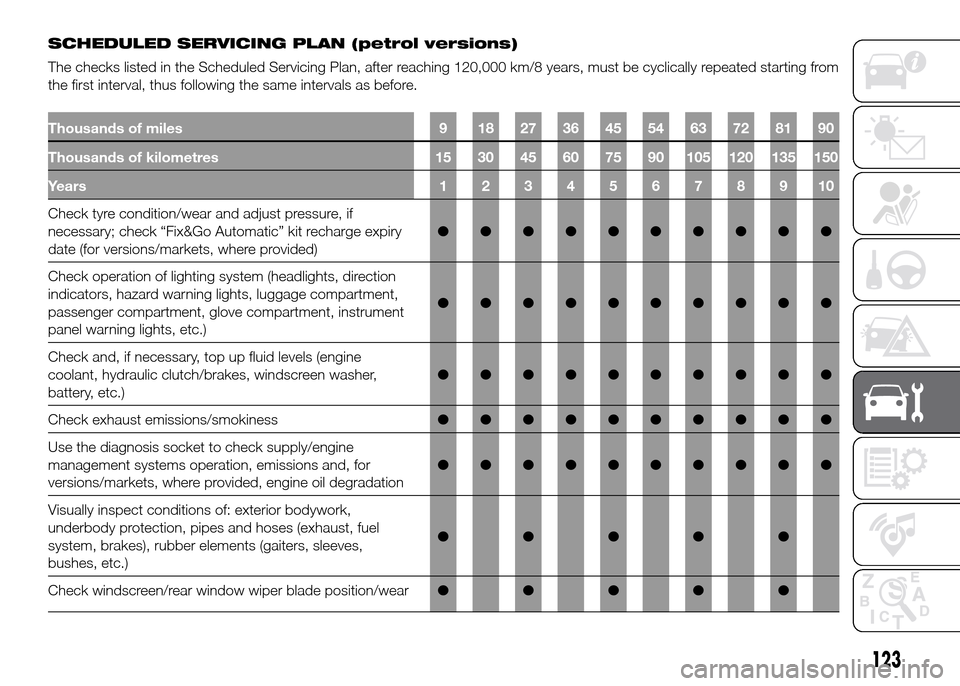
SCHEDULED SERVICING PLAN (petrol versions)
The checks listed in the Scheduled Servicing Plan, after reaching 120,000 km/8 years, must be cyclically repeated starting from
the first interval, thus following the same intervals as before.
Thousands of miles 9 18 27 36 45 54 63 72 81 90
Thousands of kilometres 15 30 45 60 75 90 105 120 135 150
Years12345678910
Check tyre condition/wear and adjust pressure, if
necessary; check “Fix&Go Automatic” kit recharge expiry
date (for versions/markets, where provided)●●●●●●●●●●
Check operation of lighting system (headlights, direction
indicators, hazard warning lights, luggage compartment,
passenger compartment, glove compartment, instrument
panel warning lights, etc.)●●●●●●●●●●
Check and, if necessary, top up fluid levels (engine
coolant, hydraulic clutch/brakes, windscreen washer,
battery, etc.)●●●●●●●●●●
Check exhaust emissions/smokiness●●●●●●●●●●
Use the diagnosis socket to check supply/engine
management systems operation, emissions and, for
versions/markets, where provided, engine oil degradation●●●●●●●●●●
Visually inspect conditions of: exterior bodywork,
underbody protection, pipes and hoses (exhaust, fuel
system, brakes), rubber elements (gaiters, sleeves,
bushes, etc.)●●●●●
Check windscreen/rear window wiper blade position/wear●●●●●
123