handbrake FIAT PANDA 2017 319 / 3.G User Guide
[x] Cancel search | Manufacturer: FIAT, Model Year: 2017, Model line: PANDA, Model: FIAT PANDA 2017 319 / 3.GPages: 216, PDF Size: 19.25 MB
Page 121 of 216
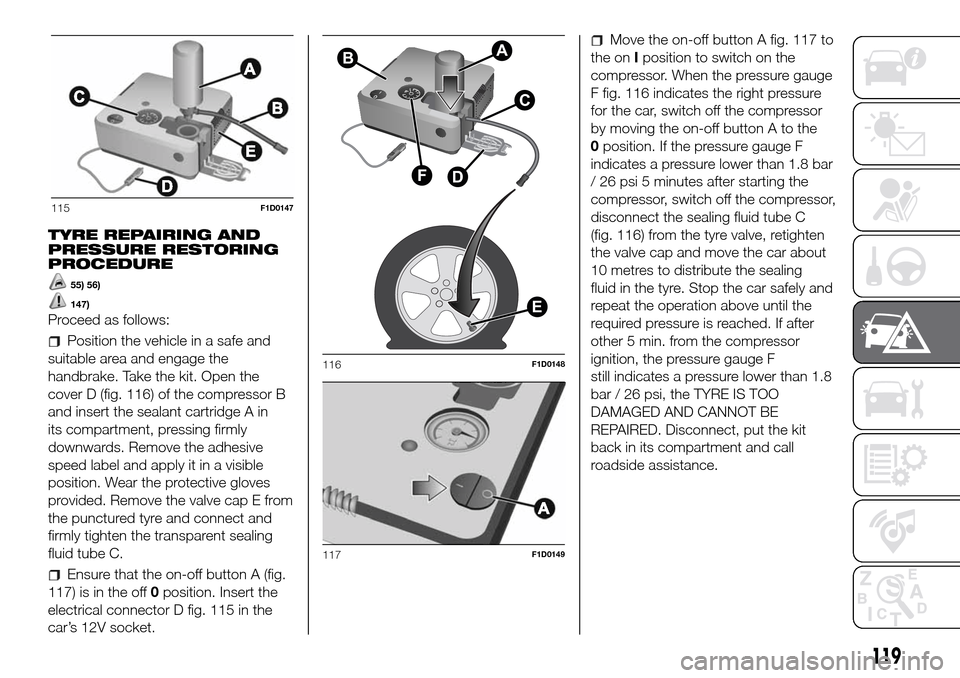
TYRE REPAIRING AND
PRESSURE RESTORING
PROCEDURE
55) 56)
147)
Proceed as follows:
Position the vehicle in a safe and
suitable area and engage the
handbrake. Take the kit. Open the
cover D (fig. 116) of the compressor B
and insert the sealant cartridge A in
its compartment, pressing firmly
downwards. Remove the adhesive
speed label and apply it in a visible
position. Wear the protective gloves
provided. Remove the valve cap E from
the punctured tyre and connect and
firmly tighten the transparent sealing
fluid tube C.
Ensure that the on-off button A (fig.
117) is in the off0position. Insert the
electrical connector D fig. 115 in the
car’s 12V socket.
Move the on-off button A fig. 117 to
the onIposition to switch on the
compressor. When the pressure gauge
F fig. 116 indicates the right pressure
for the car, switch off the compressor
by moving the on-off button A to the
0position. If the pressure gauge F
indicates a pressure lower than 1.8 bar
/ 26 psi 5 minutes after starting the
compressor, switch off the compressor,
disconnect the sealing fluid tube C
(fig. 116) from the tyre valve, retighten
the valve cap and move the car about
10 metres to distribute the sealing
fluid in the tyre. Stop the car safely and
repeat the operation above until the
required pressure is reached. If after
other 5 min. from the compressor
ignition, the pressure gauge F
still indicates a pressure lower than 1.8
bar / 26 psi, the TYRE IS TOO
DAMAGED AND CANNOT BE
REPAIRED. Disconnect, put the kit
back in its compartment and call
roadside assistance.
115F1D0147
B
D
A
C
E
F
116F1D0148
117F1D0149
119
Page 122 of 216
If the required pressure is reached,
continue driving. Do not exceed
80 km/h. Avoid sudden acceleration or
braking. After driving for about 8 km /
5 miles, position the vehicle in a safe
and suitable area and engage the
handbrake. Take the kit, ensure that the
on-off button A (fig. 117) is in the0
position and insert the electrical
connector in the car’s 12V socket.
Remove the repaired tyre’s valve cap,
take out the black inflation tube and
screw it firmly onto the valve. Inspect
the pressure gauge F to check the tyre
pressure.
If the pressure is lower than 1.8 bar /
26 psi, the TYRE IS TOO DAMAGED
AND CANNOT BE REPAIRED.
Disconnect, put the kit back in its
compartment and call roadside
assistance.
If the pressure is equal to or higher
than 1.8 bar / 26 psi, switch on the
compressor to reach the required
pressure. Disconnect and replace the
kit in the specific compartment. Drive
carefully to a specialist or the
manufacturer’s dealership as soon as
possible.PRESSURE RESTORING
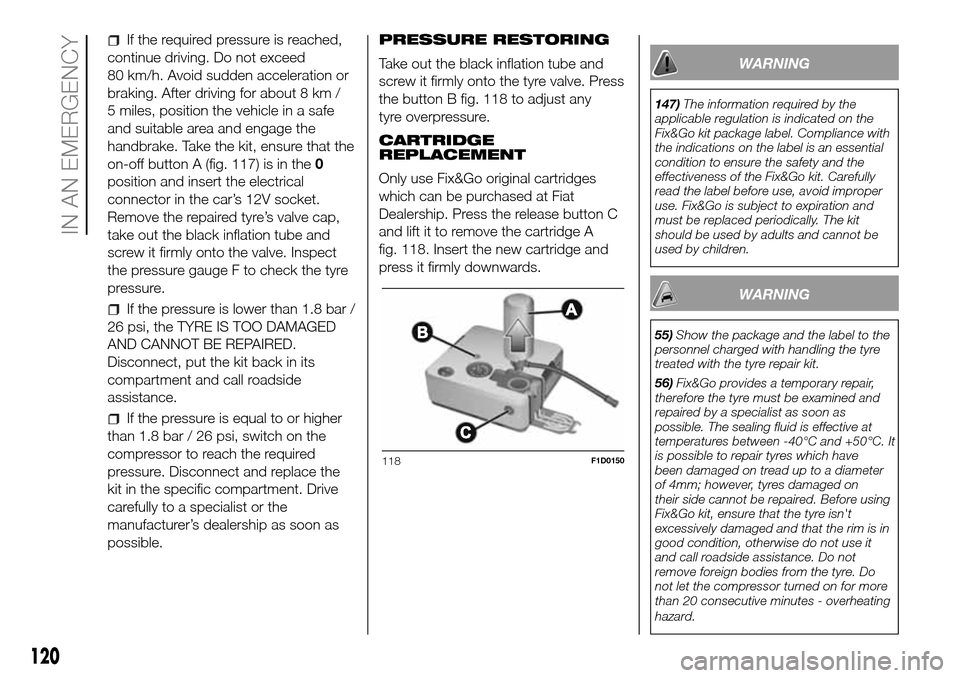
Take out the black inflation tube and
screw it firmly onto the tyre valve. Press
the button B fig. 118 to adjust any
tyre overpressure.
CARTRIDGE
REPLACEMENT
Only use Fix&Go original cartridges
which can be purchased at Fiat
Dealership. Press the release button C
and lift it to remove the cartridge A
fig. 118. Insert the new cartridge and
press it firmly downwards.
WARNING
147)The information required by the
applicable regulation is indicated on the
Fix&Go kit package label. Compliance with
the indications on the label is an essential
condition to ensure the safety and the
effectiveness of the Fix&Go kit. Carefully
read the label before use, avoid improper
use. Fix&Go is subject to expiration and
must be replaced periodically. The kit
should be used by adults and cannot be
used by children.
WARNING
55)Show the package and the label to the
personnel charged with handling the tyre
treated with the tyre repair kit.
56)Fix&Go provides a temporary repair,
therefore the tyre must be examined and
repaired by a specialist as soon as
possible. The sealing fluid is effective at
temperatures between -40°C and +50°C. It
is possible to repair tyres which have
been damaged on tread up to a diameter
of 4mm; however, tyres damaged on
their side cannot be repaired. Before using
Fix&Go kit, ensure that the tyre isn't
excessively damaged and that the rim is in
good condition, otherwise do not use it
and call roadside assistance. Do not
remove foreign bodies from the tyre. Do
not let the compressor turned on for more
than 20 consecutive minutes - overheating
hazard.
118F1D0150
120
IN AN EMERGENCY
Page 123 of 216
JUMP STARTING
If the battery is flat, a jump starting can
be performed using the battery and
the cables of another vehicle, or using a
booster battery.
IMPORTANT
When a booster battery is used, comply
with the utilisation and precaution
instructions specified by the producer.
Do not use the booster battery or
any other source of external supply with
a voltage above 12 V: the battery, the
starter, the alternator and the electrical
system of the vehicle could be
damaged.
Do not attempt jump starting if the
battery is frozen. The battery could
break and explode!
PREPARATION TO JUMP
STARTING
148) 149)
57) 58)
IMPORTANT The positive terminal (+) of
the battery is shielded by a protective
cover. Lift the cover to access the
positive terminal.
Proceed as follows:
engage the handbrake, move the
Dualogic gear lever to P (Park) or,
for versions with manual gearbox, to
neutral and bring the ignition key to
STOP;
switch off all the other electrical
devices in the vehicle;
if another vehicle is ready for jump
starting, park the vehicle within the
reach of the cables to be used for
starting, operate the handbrake and
make sure that the ignition is
deactivated.
IMPORTANT Avoid contact between
the two vehicles since this could cause
a connection to earth and may result
in serious injury to any people nearby.
PROCEDURE FOR JUMP
STARTING
IMPORTANT If the procedure below is
carried out incorrectly, it can cause
severe injury to people or damage the
recharging system of one or both
vehicles. Carefully follow the
instructions given below.
Cable connection
Proceed as follows to carry out a jump
starting:
connect one end of the cable used
for positive (+) to the positive terminal
(+) of the vehicle with flat battery;
connect the other end of the cable
used for positive (+) to the positive
terminal (+) of the auxiliary battery;
connect one end of the cable used
for negative (–) to the negative terminal
(–) of the auxiliary battery;
Connect the other end of the cable
used for negative (–) to an engine
earth (the visible metal part of
the vehicle engine with flat battery)
away from the battery and the fuel
injection system;
start the vehicle engine with the
auxiliary battery, let it run for a few
minutes at idling. Start the engine of the
vehicle with flat battery.
Cable disconnection.
Once the engine has been started,
remove the cables proceeding as
follows:
disconnect the end of the cable
used for negative (–) from the engine
earth of the vehicle with flat battery;
disconnect the other end of the
cable used for negative (–) from the
negative terminal (–) of the auxiliary
battery;
disconnect the end of the cable
used for positive (+) from the positive
terminal (+) of the auxiliary battery;
121
Page 125 of 216
deactivate the right direction
indicator;
activate the left direction indicator;
deactivate the left direction indicator;
turn the ignition key to STOP and
then to MAR.
LPG versions: in the event of an
impact, petrol supply is immediately
cut-off, the LPG safety valves are
closed and the injection is interrupted,
switching off the engine.
Natural Power versions: in the event
of an impact, the power supply is
immediately cut off, causing engine
switching off.
WARNING
150)If, after an impact, you smell fuel or
notice leaks from the fuel system, do
not reactivate the system to avoid the risk
of fire.
TOWING THE
VEHICLE
151) 152) 153) 154) 155)
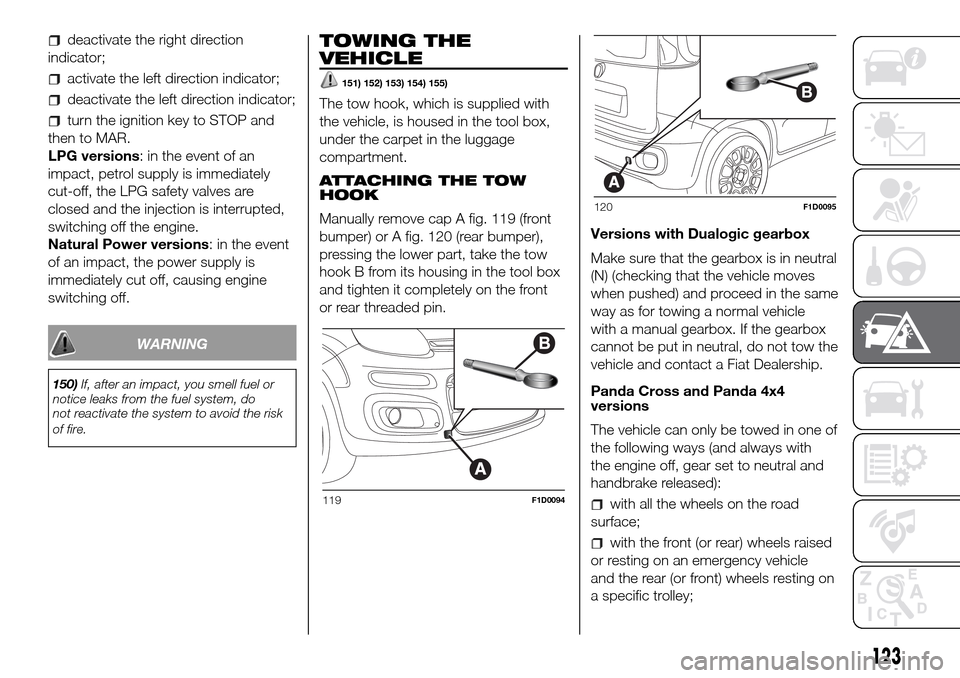
The tow hook, which is supplied with
the vehicle, is housed in the tool box,
under the carpet in the luggage
compartment.
ATTACHING THE TOW
HOOK
Manually remove cap A fig. 119 (front
bumper) or A fig. 120 (rear bumper),
pressing the lower part, take the tow
hook B from its housing in the tool box
and tighten it completely on the front
or rear threaded pin.Versions with Dualogic gearbox
Make sure that the gearbox is in neutral
(N) (checking that the vehicle moves
when pushed) and proceed in the same
way as for towing a normal vehicle
with a manual gearbox. If the gearbox
cannot be put in neutral, do not tow the
vehicle and contact a Fiat Dealership.
Panda Cross and Panda 4x4
versions
The vehicle can only be towed in one of
the following ways (and always with
the engine off, gear set to neutral and
handbrake released):
with all the wheels on the road
surface;
with the front (or rear) wheels raised
or resting on an emergency vehicle
and the rear (or front) wheels resting on
a specific trolley;
119F1D0094
120F1D0095
123
Page 130 of 216
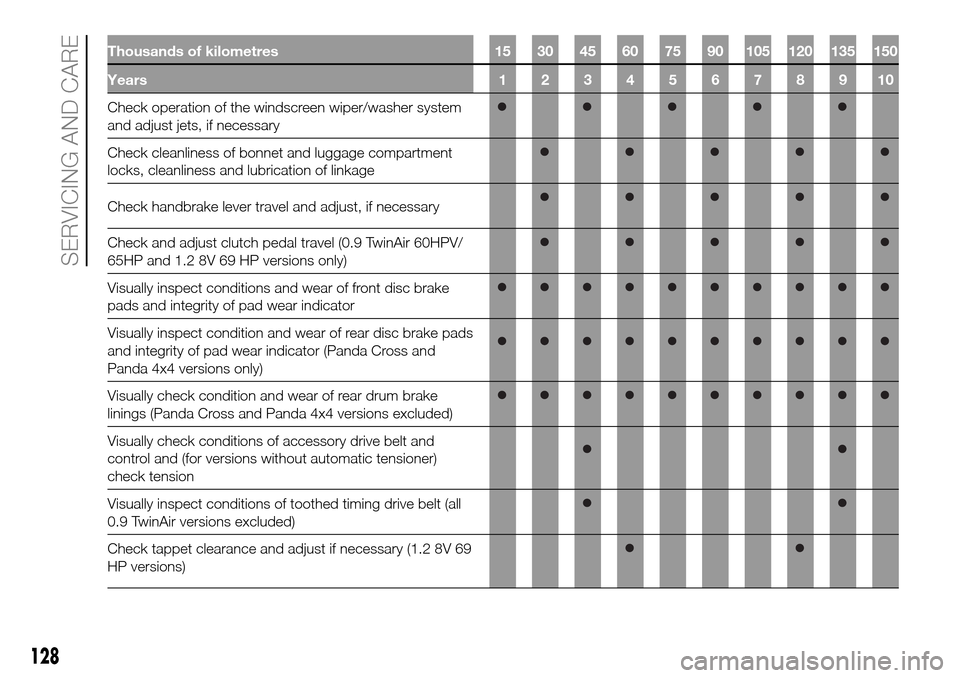
Thousands of kilometres 15 30 45 60 75 90 105 120 135 150
Years12345678910
Check operation of the windscreen wiper/washer system
and adjust jets, if necessary
Check cleanliness of bonnet and luggage compartment
locks, cleanliness and lubrication of linkage
Check handbrake lever travel and adjust, if necessary
Check and adjust clutch pedal travel (0.9 TwinAir 60HPV/
65HP and 1.2 8V 69 HP versions only)
Visually inspect conditions and wear of front disc brake
pads and integrity of pad wear indicator
Visually inspect condition and wear of rear disc brake pads
and integrity of pad wear indicator (Panda Cross and
Panda 4x4 versions only)
Visually check condition and wear of rear drum brake
linings (Panda Cross and Panda 4x4 versions excluded)
Visually check conditions of accessory drive belt and
control and (for versions without automatic tensioner)
check tension
Visually inspect conditions of toothed timing drive belt (all
0.9 TwinAir versions excluded)
Check tappet clearance and adjust if necessary (1.2 8V 69
HP versions)
128
SERVICING AND CARE
Page 135 of 216
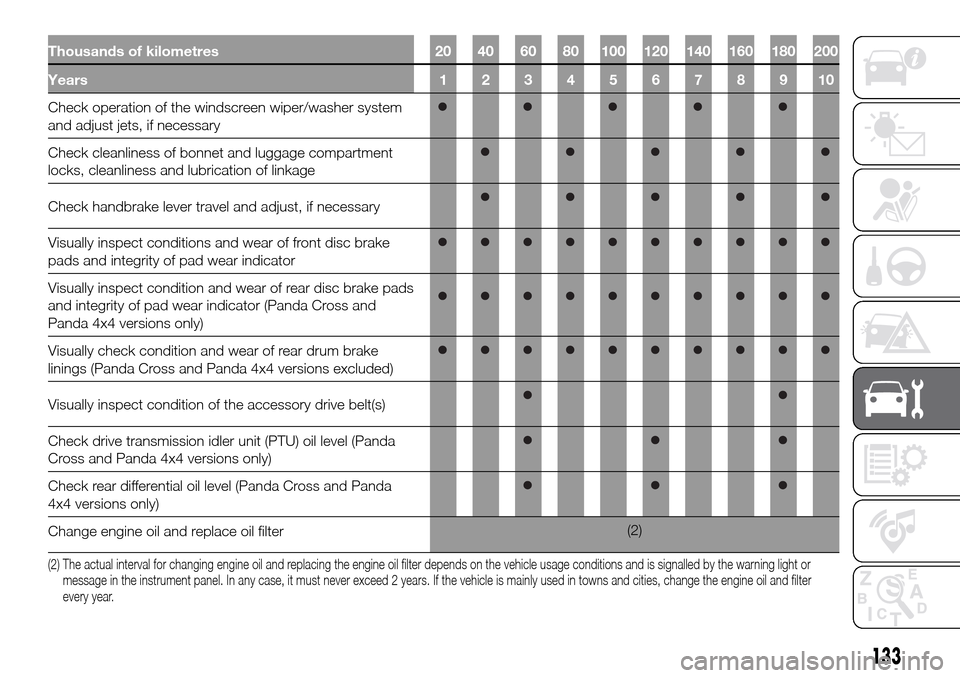
Thousands of kilometres 20 40 60 80 100 120 140 160 180 200
Years12345678910
Check operation of the windscreen wiper/washer system
and adjust jets, if necessary
Check cleanliness of bonnet and luggage compartment
locks, cleanliness and lubrication of linkage
Check handbrake lever travel and adjust, if necessary
Visually inspect conditions and wear of front disc brake
pads and integrity of pad wear indicator
Visually inspect condition and wear of rear disc brake pads
and integrity of pad wear indicator (Panda Cross and
Panda 4x4 versions only)
Visually check condition and wear of rear drum brake
linings (Panda Cross and Panda 4x4 versions excluded)
Visually inspect condition of the accessory drive belt(s)
Check drive transmission idler unit (PTU) oil level (Panda
Cross and Panda 4x4 versions only)
Check rear differential oil level (Panda Cross and Panda
4x4 versions only)
Change engine oil and replace oil filter(2)
(2) The actual interval for changing engine oil and replacing the engine oil filter depends on the vehicle usage conditions and is signalled by the warning light or
message in the instrument panel. In any case, it must never exceed 2 years. If the vehicle is mainly used in towns and cities, change the engine oil and filter
every year.
133
Page 205 of 216
REPLACING FUSES
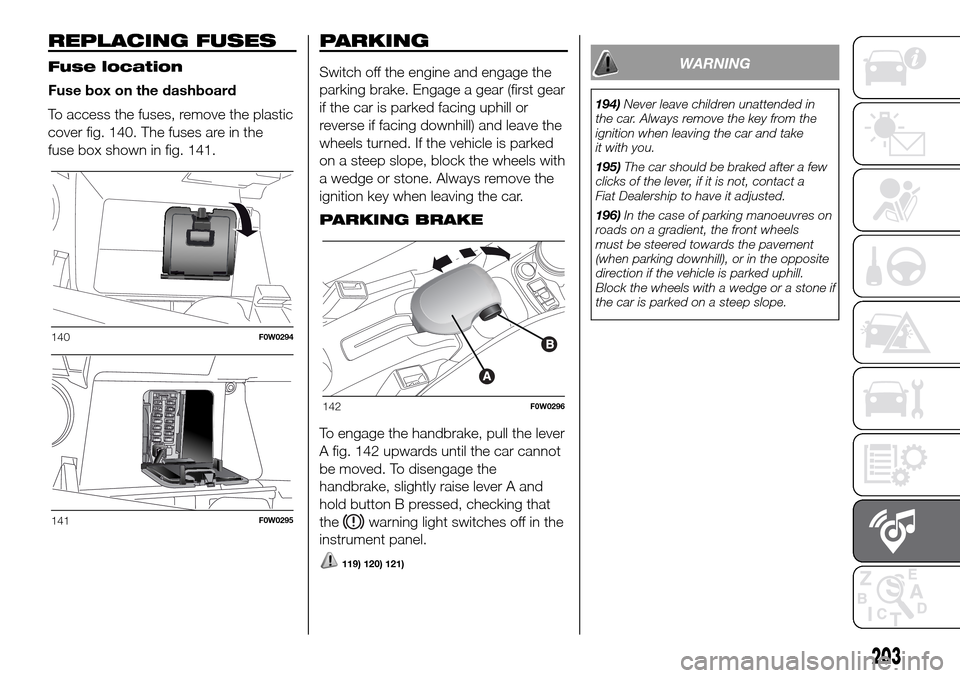
Fuse location
Fuse box on the dashboard
To access the fuses, remove the plastic
cover fig. 140. The fuses are in the
fuse box shown in fig. 141.
PARKING
Switch off the engine and engage the
parking brake. Engage a gear (first gear
if the car is parked facing uphill or
reverse if facing downhill) and leave the
wheels turned. If the vehicle is parked
on a steep slope, block the wheels with
a wedge or stone. Always remove the
ignition key when leaving the car.
PARKING BRAKE
To engage the handbrake, pull the lever
A fig. 142 upwards until the car cannot
be moved. To disengage the
handbrake, slightly raise lever A and
hold button B pressed, checking that
the
warning light switches off in the
instrument panel.
119) 120) 121)
WARNING
194)Never leave children unattended in
the car. Always remove the key from the
ignition when leaving the car and take
it with you.
195)The car should be braked after a few
clicks of the lever, if it is not, contact a
Fiat Dealership to have it adjusted.
196)In the case of parking manoeuvres on
roads on a gradient, the front wheels
must be steered towards the pavement
(when parking downhill), or in the opposite
direction if the vehicle is parked uphill.
Block the wheels with a wedge or a stone if
the car is parked on a steep slope.
140F0W0294
141F0W0295
142F0W0296
203
Page 213 of 216
INDEX
3
rd brake light (bulb
replacement)
................................ 111
ABS (system)
................................ 60
Active safety systems ..................... 60
Airbag ............................................ 84
ASR (system) ................................. 61
Battery (recharging)
....................... 135
Bonnet ........................................... 26
CBC system
................................. 65
Checking levels .............................. 137
Child protection systems ................ 74
Climate control system ................... 22
CO2 emissions............................... 175
Control panel and on-board
instruments .................................. 37.................................. 202
Dashboard
.................................... 8
Daytime running lights (DRL)
– "Daytime Running Lights" .......... 17
Dimensions .................................... 158
Dipped beam headlights
– control....................................... 17
Dipped headlights
– control....................................... 17
Dipped/main beam headlights
(bulb replacement) ....................... 108
Direction indicators
– control....................................... 17Direction indicators (changing a
bulb) ............................................ 108
Display ........................................... 38
Doors ............................................. 11
– door locking/unlocking .............. 11
Driving assistance systems ............ 65
DRL (daytime running lights) ........... 17
Dualdrive electric power steering .... 97
Dualogic gearbox ........................... 95
ECO function
................................ 98
Electric windows ............................ 26
Engine............................................ 147
Engine compartment...................... 137
ESC (system) ................................. 60
External lights................................. 17
Fiat CODE (system)
....................... 11
Fix&Go Airflat kit ............................. 118
Fluids and lubricants ...................... 168
Fog lights (bulb replacement) ......... 109
Follow me home (device) ................ 17
Front airbags .................................. 84
Front roof light ................................ 19
Front/rear fog lights ........................ 18
Fuel consumption .......................... 173
Fuel cut-off system......................... 122
Fuses (replacement) ....................... 112
Gear Shift Indicator
....................... 38
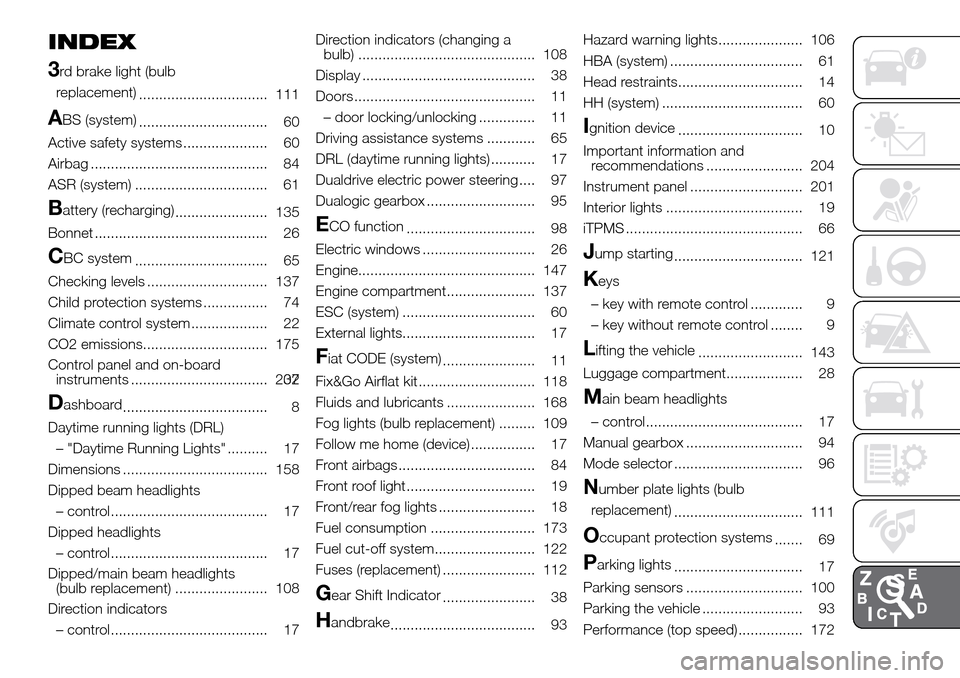
Handbrake
.................................... 93Hazard warning lights..................... 106
HBA (system) ................................. 61
Head restraints............................... 14
HH (system) ................................... 60
Ignition device
............................... 10
Important information and
recommendations ........................ 204
Instrument panel ............................ 201
Interior lights .................................. 19
iTPMS ............................................ 66
Jump starting
................................ 121
Keys
– key with remote control ............. 9
– key without remote control ........ 9
Lifting the vehicle
.......................... 143
Luggage compartment................... 28
Main beam headlights
– control....................................... 17
Manual gearbox ............................. 94
Mode selector ................................ 96
Number plate lights (bulb
replacement)
................................ 111
Occupant protection systems
....... 69
Parking lights
................................ 17
Parking sensors ............................. 100
Parking the vehicle ......................... 93
Performance (top speed) ................ 172