tow FIAT PANDA 2017 319 / 3.G User Guide
[x] Cancel search | Manufacturer: FIAT, Model Year: 2017, Model line: PANDA, Model: FIAT PANDA 2017 319 / 3.GPages: 216, PDF Size: 19.25 MB
Page 37 of 216
WARNING
33)The Fiat Panda Natural Power is
equipped with a high pressure methane
fuel supply system, designed to operate at
a rated pressure of 200 bar. It is dangerous
to stretch the system with higher
pressures. To prevent damage to the gas
system parts when towing or lifting the
vehicle, follow the instructions in the Owner
Handbook, in the paragraph: “Towing the
vehicle”. If there is a fault in the methane
system, only contact a Fiat Dealership. Do
not alter the methane system configuration
or components. They are designed
exclusively for the Fiat Panda Natural
Power. The use of other components or
materials could cause malfunctions and
prejudice safety.
34)When oven painting, the cylinders must
be removed from the vehicle and
subsequently refitted by a Fiat Dealership.
Although the methane system has
numerous safety features, it is advisable to
close the manual cocks for the cylinders
every time the vehicle is not in use for
a long period, transported on other
vehicles or moved in an emergency as a
result of a breakdown or accident.
35)Modifications or repairs to the supply
system that are not carried out correctly or
do not take the system technical
specifications into account can cause
malfunctions leading to the risk of fire.
36)Do not switch between the two
operating modes whilst starting the engine.
WARNING
21)If the fuel runs out while running on
methane, the car switches to petrol
automatically and all the bars of the digital
indicator on the display turn off. The
display remains in this state until the next
methane refuelling.
22)Regardless of the last fuel system
used, at the following engine starting, after
the initial petrol stage, the system will
automatically switch to methane.
23)When switching from petrol to methane
is requested, a metal noise from the valves
which pressurise the circuit can be heard,
as it happens while starting the car. As a
result of the switching logic described
above, a delay between the valve ticking
and the the green warning light
on
the instrument panel turning off is
completely normal.24)In particular usage conditions, such as
starting and operation at low ambient
temperature, the system may switch
temporarily to petrol operation, without
indicating the performed switching. In the
event of low methane levels in the tank or a
request for high performance (e.g.
overtaking, fully laden vehicle, steep hills)
the system may automatically switch to
petrol operation to guarantee the engine
power requested. The green warning light
on the instrument panel turns on to
indicate this. When the above conditions
are no longer present, the system
automatically restores methane operation.
The green warning light
turns off. To
achieve the automatic switching described
above, make sure that there is always
enough fuel in the petrol tank.
35
Page 46 of 216
Warning light What it means
Engine oil degraded
(diesel versions with DPF)
The warning light comes on flashing, on some versions along with a dedicated message on the display.
The warning light flashes for 3 minute cycles with the warning light off for intervals of 5 seconds until oil is
changed.
After the initial warning, each time the engine is started up, the warning light will continue to flash in the
same mode, until the oil is changed. On certain versions a dedicated message is displayed.
The flashing of the warning light should not be considered as a fault, it simply informs the customer that the
oil needs to be changed following normal car use.
Remember that the deterioration of the engine oil is accelerated by:
mainly town use of the vehicle which makes the DPF regeneration process more frequent;
use of the vehicle for short drives, in which the engine does not have time to reach its regular operating
temperature;
repeated interruptions to the regeneration process signalled by the DPF warning light coming on.
41)
WARNING
41)If the warning light switches on, the deteriorated engine oil must be changed as soon as possible, and never more than 500 km from the
first time that the warning light switches on. Failure to observe the above may result in severe damage to the engine and invalidate the
warranty. Remember that the operation of this warning light is not related to the amount of oil in the engine. Therefore, never top up with oil
when the light starts flashing.
44
KNOWING THE INSTRUMENT PANEL
Page 47 of 216
Warning light What it means
ENGINE COOLANT TEMPERATURE TOO HIGH
The warning light switches on when the ignition key is turned to MAR, but it should switch off after a few
seconds.
The warning light comes on, on some versions along with a message on the display, when the engine is
overheated.
In normal driving conditions: stop the car, switch off the engine and check that the water level in the
reservoir is not below the MIN mark. In this case, wait for the engine to cool down, then slowly and
carefully open the cap, top up with coolant and check that the level is between the MIN and MAX marks on
the reservoir itself. Also check visually for any fluid leaks. If, when restarting, the warning light switches on
again, contact a Fiat Dealership.
If the car is used under demanding conditions(e.g. towing trailers uphill or fully loaded): slow down
and, if the warning light stays on, stop the car. Wait for 2 or 3 minutes with the engine running and slightly
accelerated to further favour the coolant circulation. Then stop the engine. Check that the coolant level is
correct as described above.
IMPORTANT Over demanding routes, it is advisable to keep the engine on and slightly accelerated for a
few minutes before switching it off.
“DUALDRIVE” ELECTRIC POWER STEERING FAILURE
When the key is turned to MAR, the warning light switches on but it should switch off after a few seconds.
If the warning light stays on, on some versions along with a dedicated message on the display, you may
not have steering assistance and the effort required to operate the steering wheel could be notably
increased; steering is, however, possible.
In this case, contact a Fiat Dealership.
IMPORTANT In some circumstances, factors independent of the electric power steering could cause the
warning light on the instrument panel to switch on. In this case, stop the car immediately (should it be in
motion), stop the engine for about 20 seconds and then restart the engine. If the warning light, on some
versions along with a dedicated message on the display, remains on, contact a Fiat Dealership.
IMPORTANT After the battery is disconnected, the steering must be initialised. The warning light switches
on to indicate this. To carry out this procedure, simply turn the steering wheel all the way from one end to
the other or drive in a straight line for about a hundred metres.
45
Page 69 of 216
The system warns the driver if one or
more tyres are flat by the
warning
light continuously lit on the instrument
panel and a dedicated warning
message on the display.
If one tyre only is flat, the system can
indicate its position: it is in any case
recommended to check the pressure
on all four tyres.
This indication is displayed also when
turning the engine off and on again until
the RESET procedure is carried out.
Reset procedure
The iTPMS needs an initial "self-
learning" phase (with length depending
on the driving style and road conditions:
optimal conditions being driving on a
straight road at 80 km/h for at least 20
minutes) which starts when the Reset
procedure is carried out.
The Reset procedure must be carried
out:
each time tyre pressure is modified;
when even only one tyre is changed;
when tyres are rotated/inverted;
when the space-saver wheel is
fitted.Before carrying out the Reset
procedure, inflate the tyres to the rated
pressure values specified in the inflation
pressure table (see "Wheels" paragraph
in the "Technical specifications"
chapter).
If the Reset procedure is not carried
out, in all above cases, the
warning
light may give false indications on
one or more tyres.
To carry out the RESET procedure, with
the vehicle stopped and the ignition
device at MAR, use the Main Menu as
follows:
briefly press thebutton: the
display will show Reset;
press thebutton or the
button to select ("Yes" or "No");
briefly press thebutton: the
display will show "Confirm";
pressbutton orto select
("Yes" to Reset or "No" to exit the video
page);
press thebutton again to return
to the standard screen or to the main
menu according to where you are in the
menu.
At the end of the Reset procedure the
display will show the "Reset saved"
message, indicating that the self-
learning has been started.Operating conditions
The system is active for speeds above
15 km/h.
In a few situations such as sporty
driving, particular conditions of the road
surface (e.g. icy, snowy, unsurfaced
roads...) the signalling may be delayed
or partial in detecting the contemporary
deflation of more than one tyre.
Under special conditions (e.g. vehicle
loaded asymmetrically on one side,
towing a trailer, damaged or worn tyre,
fitting the space-saver wheel, use of the
"Fix&Go Airflat" kit, fitting snow chains,
fitting different tyres on the axles) the
system may give false indications or be
temporarily deactivated.
If the system is temporarily deactivated,
the warning light
flashes for about
75 seconds and then is continuously
on; at the same time, the display shows
a dedicated message.
This indication is displayed also after
the engine has been switched off and
then on again if the correct operating
conditions are not restored.
67
Page 71 of 216
34)Do not tamper nor operate on the laser
sensor. Do not close the openings in the
aesthetic cover located under the interior
rear view mirror. In the event of a sensor
failure, contact a Fiat Dealership.
35)Do not cover the operating range of the
sensor with stickers or other objects. Also
pay attention to other objects on the
bonnet (e.g. a layer of snow) and make
sure they do not interfere with the light
emitted by the laser.
36)If a trailer or a vehicle is towed the
system must be deactivated with the
display Setup Menu.OCCUPANT
PROTECTION
SYSTEMS
The most important safety equipment
of the vehicle comprises the following
protection systems:
seat belts;
SBR (Seat Belt Reminder) system;
head restraints;
child restraint systems;
front airbags and side bags.
Read the information given the
following pages with the utmost care. It
is of fundamental importance that the
protection systems are used in the
correct way to guarantee the maximum
possible safety level for the driver and
the passengers.
For the description of the headrest
adjustment see the "Headrests"
paragraph in the "Knowing your
vehicle" chapter.
SEAT BELTS
USING THE SEAT BELTS
All vehicle seats are equipped with seat
belts with three anchor points and a
retractor. The retractor mechanism
operates locking the belt in the event of
sharp braking or strong deceleration
due to an impact. This allows the belt
strap to slide freely and to adapt to the
body of the occupant. In the event of
an accident, the belt will lock reducing
the risk of impact inside the passenger
compartment and of being projected
outside the vehicle.
The driver is responsible for respecting,
and ensuring that all the other
occupants of the vehicle also respect,
the local laws in force in relation to
the use of the seat belts.
Always fasten the seat belts before
setting off.
The belt should be worn keeping the
torso straight and rested against the
backrest.
To fasten the seat belts, hold tongue A
fig. 55 and insert it into buckle B, until
it clicks into place. On removal, if the
belt jams, let it rewind for a short
stretch, then pull it out again without
jerking.
69
Page 74 of 216
With driver and/or passenger side (with
passenger present) seat belts
unfastened, when 20 km/h are
exceeded or when travelling at a speed
between 10 and 20 km/h for longer
than 5 seconds, an acoustic signal
cycle will be started for the front seats
(continuous acoustic signal for 6
seconds followed by a 90 second
beep) and the warning light will flash.
Once the cycle is complete, the
warning lights stay on with a fixed light
until the vehicle is turned off or the
seat belt fastened.
If the seat belt is unfastened again while
travelling, the acoustic warning restarts
as described previously and the
icon is displayed.
For the rear seats, the reminder cycle is
only activated when any seat belt is
unfastened together with an acoustic
warning (three beeps). If the condition
of any (front or rear) seat belt changes,
also the condition of the other
(front/rear) seat belts is reported.
The visual indication (display of the
icon) will start and stop
independently for each warning light if
several seat belts are unfastened.
The visual indication will change
condition (display of the
icon) after
the corresponding seat belt has been
fastened again.IMPORTANT When the ignition key is
turned to MAR, if all the front and
rear belts are already fastened the
warning lights will be displayed for
30 seconds.
PRE-TENSIONERS
84) 85) 86) 87)
37)
The vehicle is equipped with front seat
belt pretensioners, which draw back
the seat belts by several centimetres in
the event of a strong frontal impact.
This guarantees the perfect adherence
of the seat belts to the occupant's
bodies before the retention action
begins.
It is evident that the pretensioners have
operated when the belt withdraws
towards the retractor. This vehicle is
also equipped with a second
pretensioner (in the kick plate area). Its
activation is signalled by the shortening
of the metal cable.
A slight discharge of smoke may be
produced during the activation of the
pretensioner which is not harmful and
does not involve any fire hazard.
The pretensioner does not require any
maintenance or lubrication. Anything
that modifies its original conditions
invalidates its efficiency.
If, due to unusual natural events (floods,
sea storms, etc.), the device has been
affected by water and/or mud, contact
a Fiat Dealership to have it replaced.
72
SAFETY
Page 93 of 216
STARTING AND DRIVING
Let’s get to the "heart" of the vehicle:
seeing how you can exploit all of its
potential to the full.
We’ll look at how to drive it safely in any
situation, so that it can be a welcome
companion, with our comfort and
our wallets in mind.STARTING THE ENGINE ................. 92
PARKING THE VEHICLE ................. 93
MANUAL GEARBOX ....................... 94
DUALOGIC GEARBOX .................... 95
MODE SELECTOR .......................... 96
DUALDRIVE ELECTRIC POWER
STEERING ...................................... 97
ECO FUNCTION ............................. 98
STOP/START SYSTEM ................... 99
PARKING SENSORS.......................100
REFUELLING THE VEHICLE ...........101
TOWING TRAILERS ........................103
91
Page 95 of 216
WARNING
116)It is dangerous to run the engine in
enclosed areas. The engine takes in
oxygen and releases carbon dioxide,
carbon monoxide and other toxic gases.
117)Remember that the brake servo
and power steering are not operational until
the engine has been started, therefore
you need to apply much more force than
usual to the brake pedal and steering
wheel.
118)If the engine fails to start with a gear
engaged, the potentially dangerous
situation due to the fact that the gearbox is
automatically placed in neutral will be
signalled by an acoustic signal.
WARNING
38)If the warning lightflashes for 60
seconds after starting or during an
extended towing period, this indicates a
problem in the glow plug preheating
system. You can use the vehicle as usual if
the engine starts but you should contact
a Fiat Dealership as soon as possible.
39)It is advisable not to demand maximum
performance from your vehicle (e.g.
excessive acceleration, long distances at
maximum rpm, excessively intense braking,
etc.) when it is first used.
40)When the engine is off, do not leave
the key turned to MAR to prevent
unnecessary electrical consumption from
draining the battery.41)Never bump start the engine by
pushing, towing or coasting downhill. This
could cause fuel to flow into the catalytic
converter and damage it beyond repair.
42)There must therefore always be some
petrol in the tank to protect the petrol
pump and to guarantee temporary
switching from LPG or Methane to petrol
operation, if high performance is required.
43)A quick burst on the accelerator
before stopping the engine serves no
practical purpose; it wastes fuel and is
especially damaging to turbocharged
engines.
PARKING THE
VEHICLE
When parking and leaving the car,
proceed as follows:
engage a gear (1st gear if facing
uphill or reverse if facing downhill) and
leave the wheels turned;
stop the engine and engage the
handbrake;
always remove the ignition key.
Block the wheels with a wedge or a
stone if the car is parked on a steep
slope.
On versions equipped with Dualogic
transmission, wait for the letter P to be
displayed before releasing the brake
pedal.
WARNING Never leave the car with the
gearbox in neutral (or, on versions
equipped with Dualogic transmission,
before putting the gear lever in the
P position).
Handbrake
194) 195) 196)
The handbrake lever is located between
the two front seats.
Handbrake engagement: pull lever A
fig. 77 upwards until the vehicle is
braked.
93
Page 96 of 216
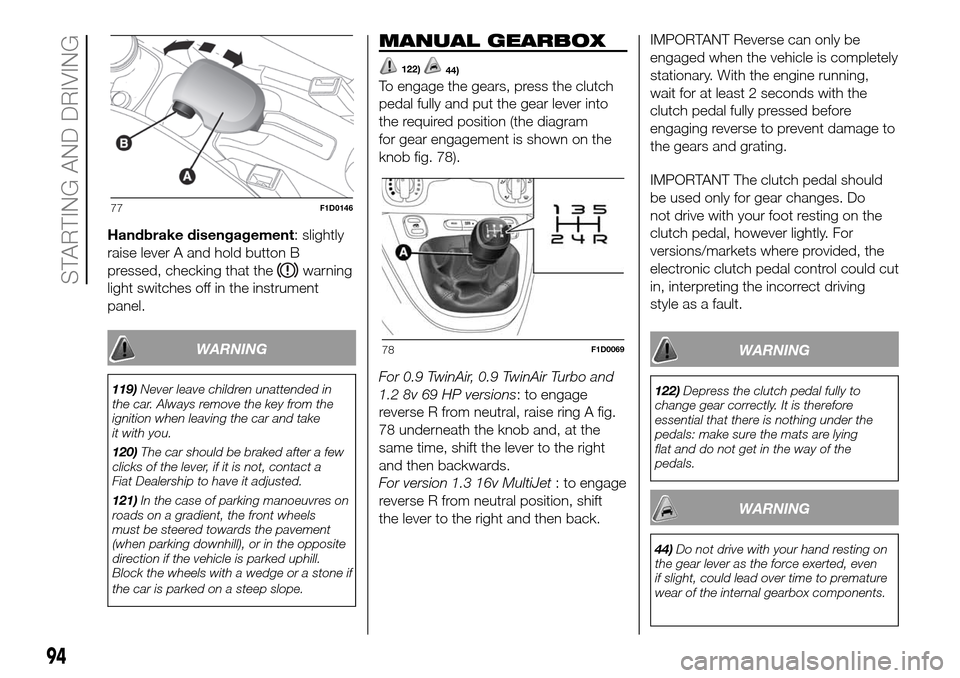
Handbrake disengagement: slightly
raise lever A and hold button B
pressed, checking that the
warning
light switches off in the instrument
panel.
WARNING
119)Never leave children unattended in
the car. Always remove the key from the
ignition when leaving the car and take
it with you.
120)The car should be braked after a few
clicks of the lever, if it is not, contact a
Fiat Dealership to have it adjusted.
121)In the case of parking manoeuvres on
roads on a gradient, the front wheels
must be steered towards the pavement
(when parking downhill), or in the opposite
direction if the vehicle is parked uphill.
Block the wheels with a wedge or a stone if
the car is parked on a steep slope.
MANUAL GEARBOX
122)44)
To engage the gears, press the clutch
pedal fully and put the gear lever into
the required position (the diagram
for gear engagement is shown on the
knob fig. 78).
For 0.9 TwinAir, 0.9 TwinAir Turbo and
1.2 8v 69 HP versions: to engage
reverse R from neutral, raise ring A fig.
78 underneath the knob and, at the
same time, shift the lever to the right
and then backwards.
For version 1.3 16v MultiJet: to engage
reverse R from neutral position, shift
the lever to the right and then back.IMPORTANT Reverse can only be
engaged when the vehicle is completely
stationary. With the engine running,
wait for at least 2 seconds with the
clutch pedal fully pressed before
engaging reverse to prevent damage to
the gears and grating.
IMPORTANT The clutch pedal should
be used only for gear changes. Do
not drive with your foot resting on the
clutch pedal, however lightly. For
versions/markets where provided, the
electronic clutch pedal control could cut
in, interpreting the incorrect driving
style as a fault.
WARNING
122)Depress the clutch pedal fully to
change gear correctly. It is therefore
essential that there is nothing under the
pedals: make sure the mats are lying
flat and do not get in the way of the
pedals.
WARNING
44)Do not drive with your hand resting on
the gear lever as the force exerted, even
if slight, could lead over time to premature
wear of the internal gearbox components.
77F1D0146
78F1D0069
94
STARTING AND DRIVING
Page 97 of 216
DUALOGIC
GEARBOX
(for versions/markets, where provided)
45)
The vehicle can be equipped with an
electronically controlled manual
gearbox known as Dualogic which
allows two operating modes: MANUAL
and AUTO.
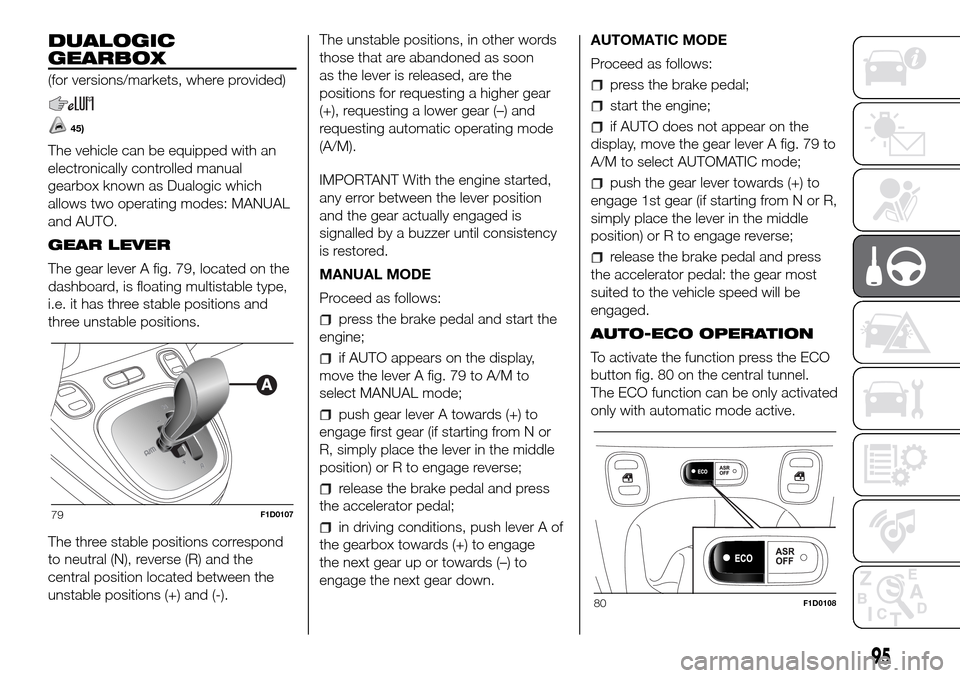
GEAR LEVER
The gear lever A fig. 79, located on the
dashboard, is floating multistable type,
i.e. it has three stable positions and
three unstable positions.
The three stable positions correspond
to neutral (N), reverse (R) and the
central position located between the
unstable positions (+) and (-).The unstable positions, in other words
those that are abandoned as soon
as the lever is released, are the
positions for requesting a higher gear
(+), requesting a lower gear (–) and
requesting automatic operating mode
(A/M).
IMPORTANT With the engine started,
any error between the lever position
and the gear actually engaged is
signalled by a buzzer until consistency
is restored.
MANUAL MODE
Proceed as follows:
press the brake pedal and start the
engine;
if AUTO appears on the display,
move the lever A fig. 79 to A/M to
select MANUAL mode;
push gear lever A towards (+) to
engage first gear (if starting from N or
R, simply place the lever in the middle
position) or R to engage reverse;
release the brake pedal and press
the accelerator pedal;
in driving conditions, push lever A of
the gearbox towards (+) to engage
the next gear up or towards (–) to
engage the next gear down.AUTOMATIC MODE
Proceed as follows:
press the brake pedal;
start the engine;
if AUTO does not appear on the
display, move the gear lever A fig. 79 to
A/M to select AUTOMATIC mode;
push the gear lever towards (+) to
engage 1st gear (if starting from N or R,
simply place the lever in the middle
position) or R to engage reverse;
release the brake pedal and press
the accelerator pedal: the gear most
suited to the vehicle speed will be
engaged.
AUTO-ECO OPERATION
To activate the function press the ECO
button fig. 80 on the central tunnel.
The ECO function can be only activated
only with automatic mode active.
79F1D0107
80F1D0108
95