wheel FIAT PANDA 2017 319 / 3.G User Guide
[x] Cancel search | Manufacturer: FIAT, Model Year: 2017, Model line: PANDA, Model: FIAT PANDA 2017 319 / 3.GPages: 216, PDF Size: 19.25 MB
Page 41 of 216
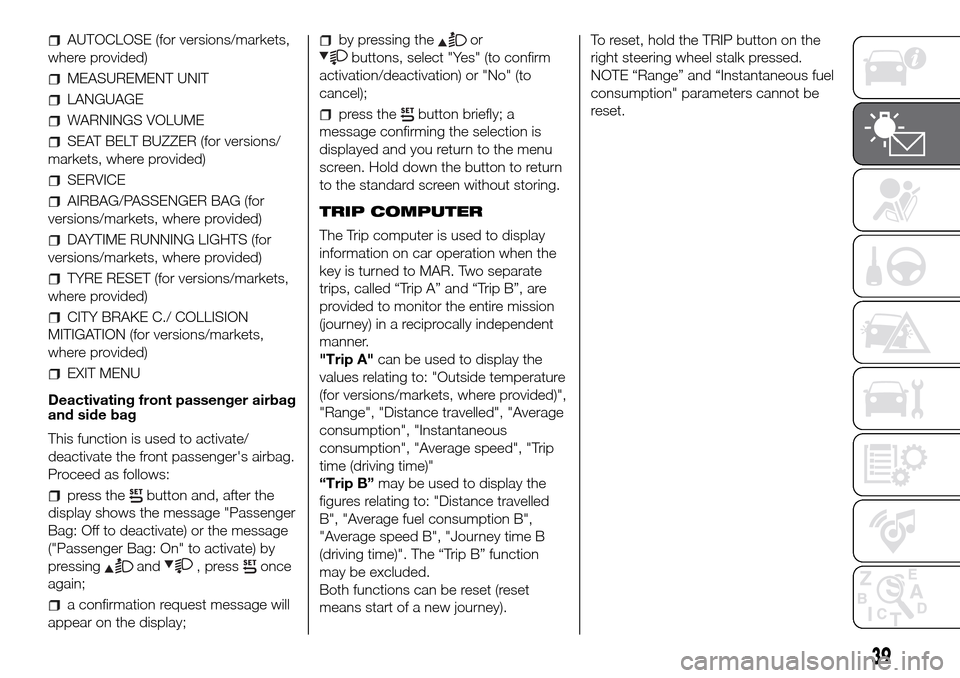
AUTOCLOSE (for versions/markets,
where provided)
MEASUREMENT UNIT
LANGUAGE
WARNINGS VOLUME
SEAT BELT BUZZER (for versions/
markets, where provided)
SERVICE
AIRBAG/PASSENGER BAG (for
versions/markets, where provided)
DAYTIME RUNNING LIGHTS (for
versions/markets, where provided)
TYRE RESET (for versions/markets,
where provided)
CITY BRAKE C./ COLLISION
MITIGATION (for versions/markets,
where provided)
EXIT MENU
Deactivating front passenger airbag
and side bag
This function is used to activate/
deactivate the front passenger's airbag.
Proceed as follows:
press thebutton and, after the
display shows the message "Passenger
Bag: Off to deactivate) or the message
("Passenger Bag: On" to activate) by
pressing
and, pressonce
again;
a confirmation request message will
appear on the display;
by pressing theor
buttons, select "Yes" (to confirm
activation/deactivation) or "No" (to
cancel);
press thebutton briefly; a
message confirming the selection is
displayed and you return to the menu
screen. Hold down the button to return
to the standard screen without storing.
TRIP COMPUTER
The Trip computer is used to display
information on car operation when the
key is turned to MAR. Two separate
trips, called “Trip A” and “Trip B”, are
provided to monitor the entire mission
(journey) in a reciprocally independent
manner.
"Trip A"can be used to display the
values relating to: "Outside temperature
(for versions/markets, where provided)",
"Range", "Distance travelled", "Average
consumption", "Instantaneous
consumption", "Average speed", "Trip
time (driving time)"
“Trip B”may be used to display the
figures relating to: "Distance travelled
B", "Average fuel consumption B",
"Average speed B", "Journey time B
(driving time)". The “Trip B” function
may be excluded.
Both functions can be reset (reset
means start of a new journey).To reset, hold the TRIP button on the
right steering wheel stalk pressed.
NOTE “Range” and “Instantaneous fuel
consumption" parameters cannot be
reset.
39
Page 43 of 216
Warning light What it means
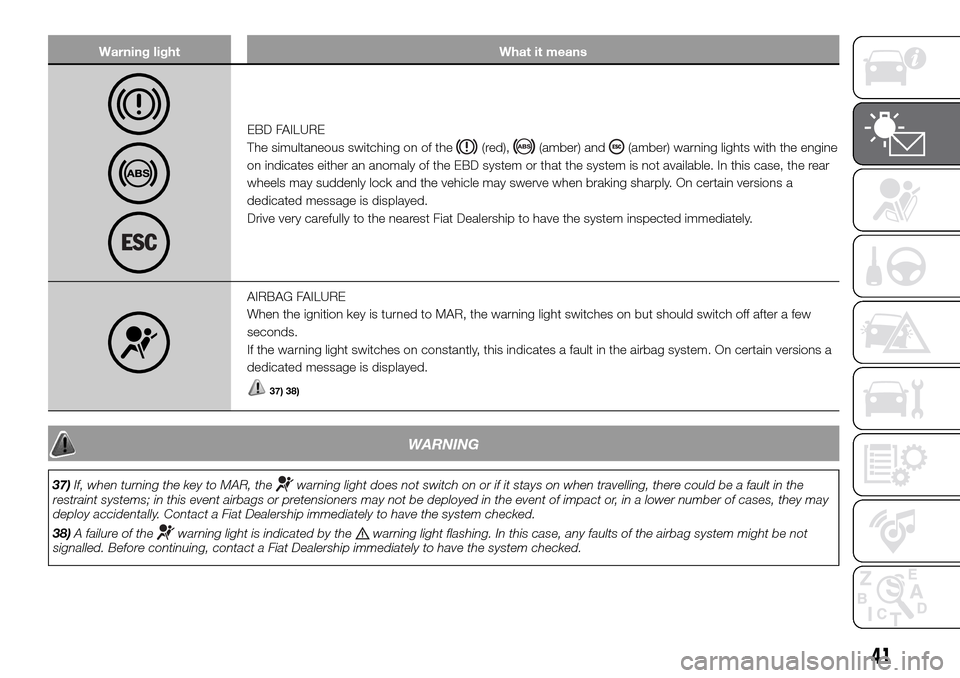
EBD FAILURE
The simultaneous switching on of the
(red),(amber) and(amber) warning lights with the engine
on indicates either an anomaly of the EBD system or that the system is not available. In this case, the rear
wheels may suddenly lock and the vehicle may swerve when braking sharply. On certain versions a
dedicated message is displayed.
Drive very carefully to the nearest Fiat Dealership to have the system inspected immediately.
AIRBAG FAILURE
When the ignition key is turned to MAR, the warning light switches on but should switch off after a few
seconds.
If the warning light switches on constantly, this indicates a fault in the airbag system. On certain versions a
dedicated message is displayed.
37) 38)
WARNING
37)If, when turning the key to MAR, thewarning light does not switch on or if it stays on when travelling, there could be a fault in the
restraint systems; in this event airbags or pretensioners may not be deployed in the event of impact or, in a lower number of cases, they may
deploy accidentally. Contact a Fiat Dealership immediately to have the system checked.
38)A failure of the
warning light is indicated by thewarning light flashing. In this case, any faults of the airbag system might be not
signalled. Before continuing, contact a Fiat Dealership immediately to have the system checked.
41
Page 47 of 216
Warning light What it means
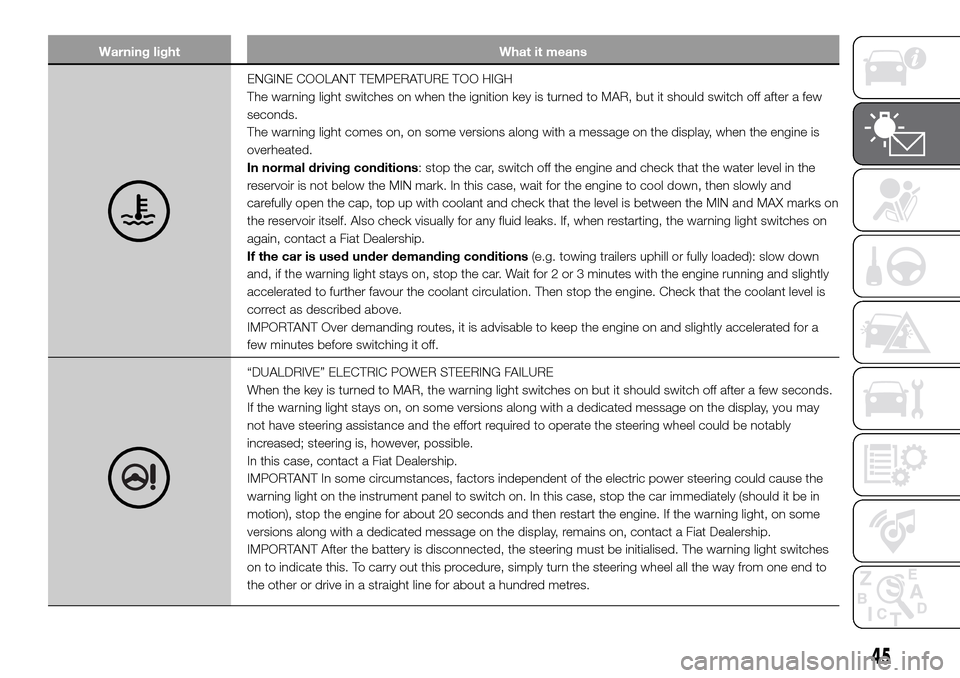
ENGINE COOLANT TEMPERATURE TOO HIGH
The warning light switches on when the ignition key is turned to MAR, but it should switch off after a few
seconds.
The warning light comes on, on some versions along with a message on the display, when the engine is
overheated.
In normal driving conditions: stop the car, switch off the engine and check that the water level in the
reservoir is not below the MIN mark. In this case, wait for the engine to cool down, then slowly and
carefully open the cap, top up with coolant and check that the level is between the MIN and MAX marks on
the reservoir itself. Also check visually for any fluid leaks. If, when restarting, the warning light switches on
again, contact a Fiat Dealership.
If the car is used under demanding conditions(e.g. towing trailers uphill or fully loaded): slow down
and, if the warning light stays on, stop the car. Wait for 2 or 3 minutes with the engine running and slightly
accelerated to further favour the coolant circulation. Then stop the engine. Check that the coolant level is
correct as described above.
IMPORTANT Over demanding routes, it is advisable to keep the engine on and slightly accelerated for a
few minutes before switching it off.
“DUALDRIVE” ELECTRIC POWER STEERING FAILURE
When the key is turned to MAR, the warning light switches on but it should switch off after a few seconds.
If the warning light stays on, on some versions along with a dedicated message on the display, you may
not have steering assistance and the effort required to operate the steering wheel could be notably
increased; steering is, however, possible.
In this case, contact a Fiat Dealership.
IMPORTANT In some circumstances, factors independent of the electric power steering could cause the
warning light on the instrument panel to switch on. In this case, stop the car immediately (should it be in
motion), stop the engine for about 20 seconds and then restart the engine. If the warning light, on some
versions along with a dedicated message on the display, remains on, contact a Fiat Dealership.
IMPORTANT After the battery is disconnected, the steering must be initialised. The warning light switches
on to indicate this. To carry out this procedure, simply turn the steering wheel all the way from one end to
the other or drive in a straight line for about a hundred metres.
45
Page 62 of 216
ACTIVE SAFETY
SYSTEMS
ABS (Anti-lock Braking
System)
This system, which is an integral part of
the braking system, prevents one or
more wheels from locking and slipping
in all road surface conditions,
irrespective of the intensity of the
braking action, ensuring that the vehicle
can be controlled even during
emergency braking.
IMPORTANT To obtain the maximum
efficiency of the braking system, a
bedding-in period of about 500 km is
needed: during this period it is better to
avoid sharp, repeated and prolonged
braking.
The ABS also includes the following
systems: EBD (Electronic Braking Force
Distribution), MSR (Motor
Schleppmoment Regelung) and MBA
(Mechanical Brake Assist) (for
versions/markets, where provided).
System intervention
The driver can feel that the ABS system
has come into action because the
brake pedal pulsates slightly and the
system gets noisier: this is entirely
normal with the system operating.
44) 45) 46) 47) 48) 49) 50) 51) 52)
ESC SYSTEM (Electronic
Stability Control)
(for versions/markets, where provided)
This is an electronic system that
controls vehicle stability in the event of
tyre grip loss, helping maintain
directional control. The system is
capable of recognising potentially
dangerous situations in terms of the
stability and intervenes automatically on
the brakes in a differentiated manner
for the four wheels in order to provide a
stabilising torque.
The ESC system switches on
automatically when the engine is
started and cannot be switched off.
System intervention
The intervention of the system is
indicated by the flashing of theESC
warning light on the instrument panel,
to inform the driver that the vehicle is in
critical stability and grip conditions.
53) 54) 55) 56) 57) 58)
HH (Hill Holder) SYSTEM
This system is an integral part of the
ESC system and facilitates starting on
slopes.
It is automatically activated in the
following conditions:
uphill: vehicle stationary on a road
with a gradient higher than 5%, engine
running, brake pressed and
transmission in neutral or gear other
than reverse engaged;
downhill: vehicle stationary on a
road with a gradient higher than 5%,
engine running, brake pressed and
reverse gear engaged.
When setting off, the ESC system
control unit maintains the braking
pressure on the wheels until the torque
necessary for starting is reached, or
in any case for a maximum of 2
seconds, allowing your right foot to be
moved easily from the brake pedal to
the accelerator.
When two seconds have elapsed,
without starting, the system is
automatically deactivated, gradually
releasing the braking pressure. During
this release stage, the typical
mechanical brake release noise can be
heard, indicating that the vehicle is
about to move.
NOTE: the Hill Holder system is not
active with parking brake engaged.
60
SAFETY
Page 63 of 216
IMPORTANT The Hill Holder system is
not a parking brake, therefore do not
leave the vehicle without activating the
handbrake, switching off the engine,
and engaging first gear, with the vehicle
parked in safe conditions.
ASR (AntiSlip
Regulation) SYSTEM
It is an integral part of the ESC system.
It is automatically activated in the case
of drive wheels slipping, loss of grip
on wet roads (aquaplaning) and
acceleration on slippery, snowy or icy
roads, etc.
Depending on the slipping conditions,
two different control systems are
activated:
if the slipping involves both drive
wheels, the ASR intervenes reducing
the power transmitted by the engine;
if the slipping only involves one
of the drive wheels, it intervenes
automatically braking the wheel that is
slipping.
Engagement/disengagement of the
ASR system
The ASR system switches on
automatically each time the engine is
started.Whilst driving, the ASR can be switched
off and subsequently switched on
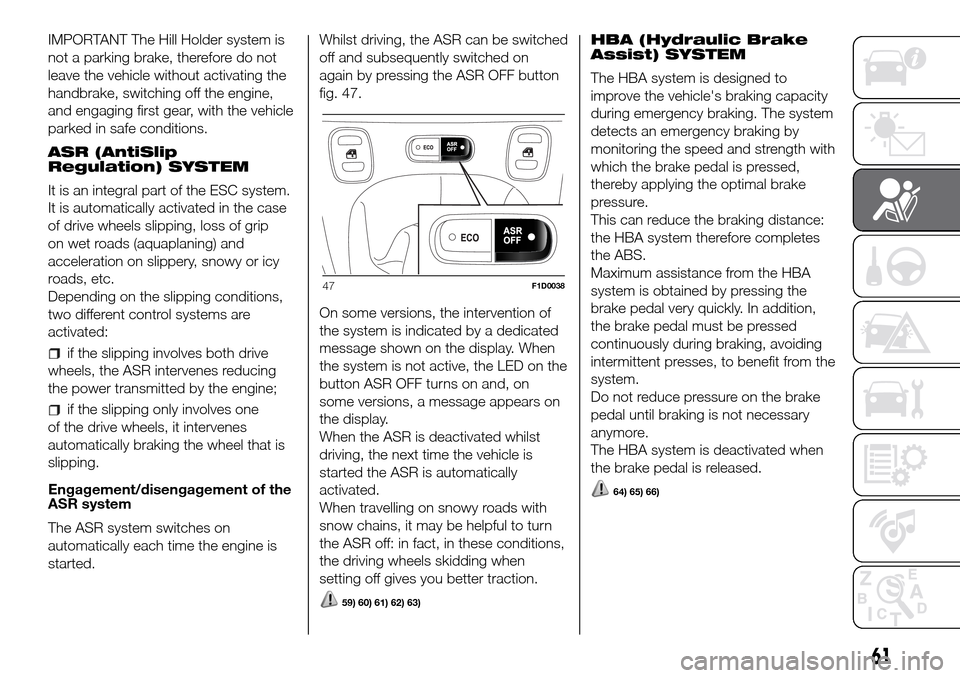
again by pressing the ASR OFF button
fig. 47.
On some versions, the intervention of
the system is indicated by a dedicated
message shown on the display. When
the system is not active, the LED on the
button ASR OFF turns on and, on
some versions, a message appears on
the display.
When the ASR is deactivated whilst
driving, the next time the vehicle is
started the ASR is automatically
activated.
When travelling on snowy roads with
snow chains, it may be helpful to turn
the ASR off: in fact, in these conditions,
the driving wheels skidding when
setting off gives you better traction.
59) 60) 61) 62) 63)
HBA (Hydraulic Brake
Assist) SYSTEM
The HBA system is designed to
improve the vehicle's braking capacity
during emergency braking. The system
detects an emergency braking by
monitoring the speed and strength with
which the brake pedal is pressed,
thereby applying the optimal brake
pressure.
This can reduce the braking distance:
the HBA system therefore completes
the ABS.
Maximum assistance from the HBA
system is obtained by pressing the
brake pedal very quickly. In addition,
the brake pedal must be pressed
continuously during braking, avoiding
intermittent presses, to benefit from the
system.
Do not reduce pressure on the brake
pedal until braking is not necessary
anymore.
The HBA system is deactivated when
the brake pedal is released.
64) 65) 66)
47F1D0038
61
Page 64 of 216
ELD (Electronic Locking
Differential) SYSTEM
(Panda Cross and Panda 4x4 versions)
The ELD system allows the drive force
to be evenly distributed over the same
axle when one or both wheels are
slipping. The ELD acts by braking the
wheels with poor grip (or those slipping
more than the others), thereby
transferring the drive force to those
which have greater grip on the ground.
The system operates at speeds below
50 km/h. Above this speed, it is
automatically deactivated and it is
reactivated when the speed falls below
50 km/h.
The activation of the ELD system
involves the following functions being
switched on:
inhibition of the ASR function, in
order to fully exploit the engine torque;
differential lock effect on the front
and rear axles, via the braking system,
to improve drive on uneven surfaces.
Enabling the system
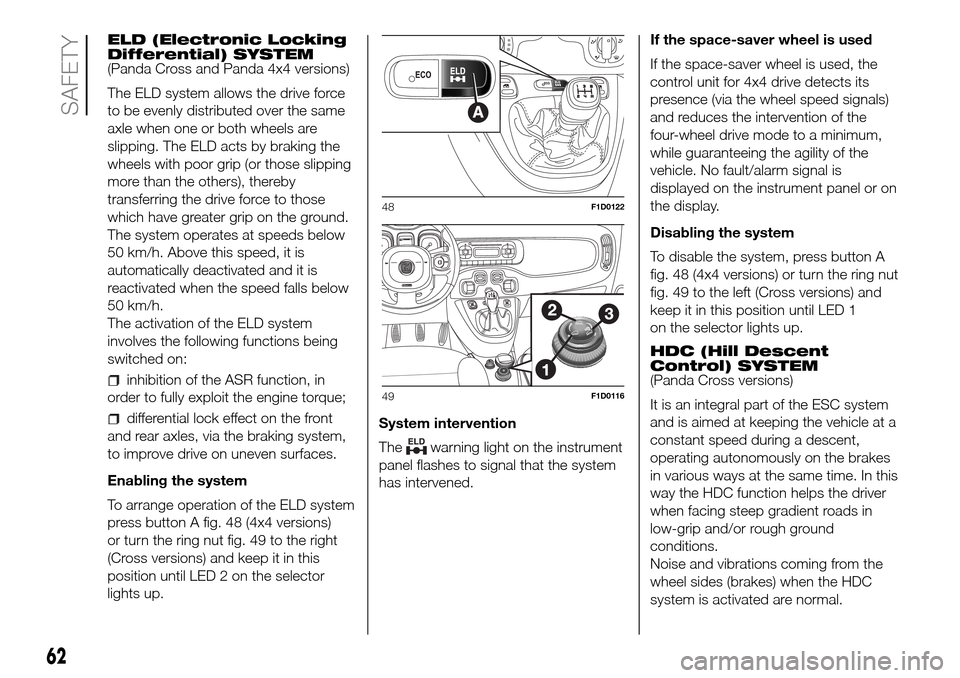
To arrange operation of the ELD system
press button A fig. 48 (4x4 versions)
or turn the ring nut fig. 49 to the right
(Cross versions) and keep it in this
position until LED 2 on the selector
lights up.System intervention
The
warning light on the instrument
panel flashes to signal that the system
has intervened.If the space-saver wheel is used
If the space-saver wheel is used, the
control unit for 4x4 drive detects its
presence (via the wheel speed signals)
and reduces the intervention of the
four-wheel drive mode to a minimum,
while guaranteeing the agility of the
vehicle. No fault/alarm signal is
displayed on the instrument panel or on
the display.
Disabling the system
To disable the system, press button A
fig. 48 (4x4 versions) or turn the ring nut
fig. 49 to the left (Cross versions) and
keep it in this position until LED 1
on the selector lights up.
HDC (Hill Descent
Control) SYSTEM
(Panda Cross versions)
It is an integral part of the ESC system
and is aimed at keeping the vehicle at a
constant speed during a descent,
operating autonomously on the brakes
in various ways at the same time. In this
way the HDC function helps the driver
when facing steep gradient roads in
low-grip and/or rough ground
conditions.
Noise and vibrations coming from the
wheel sides (brakes) when the HDC
system is activated are normal.
48F1D0122
49F1D0116
62
SAFETY
Page 66 of 216
IMPORTANT If the speed exceeds 25
km/h and is below 50 km/h, the HDC
system intervention set-up is
deactivated but is ready for being
reactivated when the speed drops back
below 25 km/h. In this case the
indication on the instrument panel turns
off and the LED on the ring nut stays
on. If vehicle speed exceeds 50 km/h,
the HDC system completely
deactivates and each individual action
made by the system on the brakes
is blocked. To reactivate it, turn the ring
nut again when the speed is again
below 25 km/h.
WARNING
44)The ABS exploits the grip available to
the full, but it cannot improve it. Therefore,
you should take great care when driving
on slippery surfaces, without taking
unnecessary risks.
45)When the ABS cuts in and you feel the
brake pedal pulsating, do not raise your
foot, but keep it pressed; in doing so you
will stop in the shortest amount of space
possible depending on the current road
conditions.
46)If the ABS intervenes, this indicates
that the grip of the tyres on the road is
nearing its limit. You must slow down to a
speed compatible with the available grip.47)For maximum efficiency of the braking
system, a bedding-in period of about
500 km is required: during this period it is
advisable to avoid sharp, repeated and
prolonged braking.
48)The ABS cannot alter the natural laws
of physics, and cannot increase grip which
depends on the condition of the road.
49)The ABS cannot prevent accidents,
including those due to excessive speed on
corners, driving on low-grip surfaces or
aquaplaning.
50)The capability of the ABS must never
be tested irresponsibly and dangerously, in
such a way as to compromise personal
safety and the safety of others.
51)For the correct operation of the ABS,
the tyres must of necessity be the same
make and type on all wheels, in perfect
condition and, above all, of the prescribed
type and dimensions.
52)When the Mechanical Brake Assist
intervenes, noises may be heard from the
system. This is normal. In any case, keep
the brake pedal firmly depressed while
braking.
53)For the correct operation of the ESC
system, the tyres must of necessity be the
same make and type on all wheels, in
perfect condition and, above all, of the
prescribed type and size.
54)The ESC functions even when the
space-saver wheel is being used. Always
remember that the space-saver wheel,
being smaller than the original wheel,
provides less grip.55)Do not take unnecessary risks, even if
your vehicle is fitted with an ESC system.
Your driving style must always be suited to
the road conditions, visibility and traffic.
The driver is always responsible for road
safety.
56)The ESC system cannot alter the
natural laws of physics, and cannot
increase grip which depends on the
condition of the road.
57)The ESC system cannot prevent
accidents, including those due to excessive
speed on corners, driving on low-grip
surfaces or aquaplaning.
58)The capability of the ESC system must
never be tested irresponsibly and
dangerously, in such a way as to
compromise personal safety and the safety
of others.
59)For the correct operation of the ASR
system, the tyres must of necessity be the
same make and type on all wheels, in
perfect condition and, above all, of the
prescribed type and size.
60)Do not take unnecessary risks, even if
your vehicle is fitted with an ASR system.
Your driving style must always be suited to
the road conditions, visibility and traffic.
The driver is ultimately responsible for road
safety.
61)The ASR system cannot alter the
natural laws of physics, and cannot
increase grip which depends on the
condition of the road.
62)The ASR system cannot prevent
accidents, including those due to excessive
speed on corners, driving on low-grip
surfaces or aquaplaning.
64
SAFETY
Page 68 of 216
Versions equipped with manual
gearbox: at the end of the automatic
braking the engine may stall and turn
off, unless the driver presses the clutch
pedal.
Versions equipped with "Dualogic"
gearbox(for versions/markets, where
provided): at the end of braking the last
gear stored remains engaged.
IMPORTANT Both on versions
equipped with manual gearbox and on
those with "Dualogic" gearbox (for
versions/markets, where provided),
after the vehicle is stopped the brake
calipers may be stuck for about 2
seconds for safety reasons. Make sure
you press the brake pedal if the vehicle
moves slightly forwards.
IMPORTANT The system doesNOT
activate when reverse is engaged. The
system doesNOTactivate if the front
seat belts are not fastened.
Engagement/disengagement
The system can be deactivated (then
reactivated) through the Setup Menu on
the display.Driving in special conditions
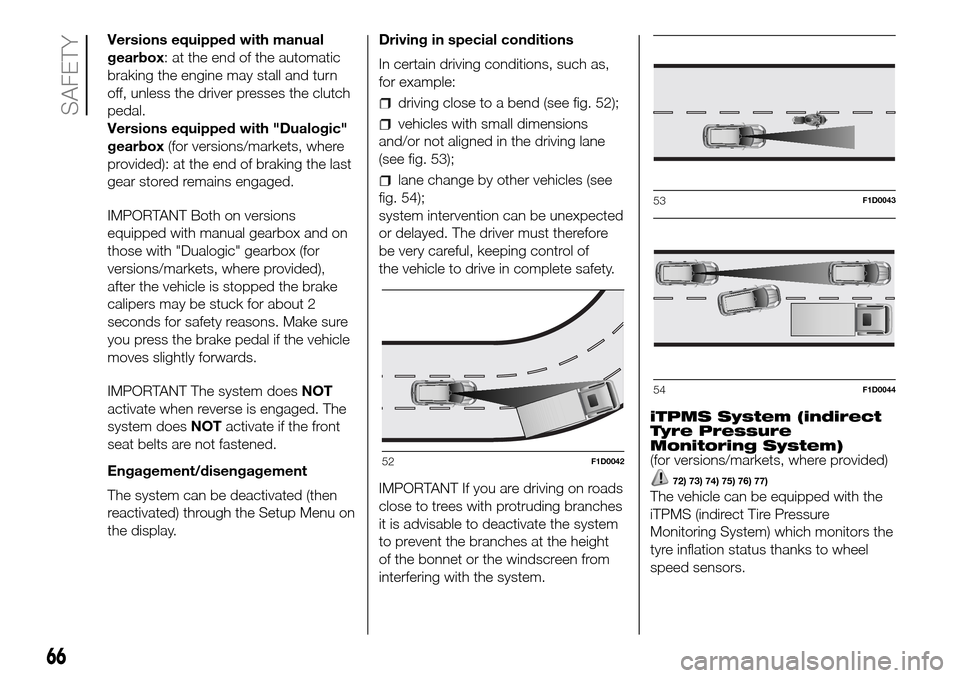
In certain driving conditions, such as,
for example:
driving close to a bend (see fig. 52);
vehicles with small dimensions
and/or not aligned in the driving lane
(see fig. 53);
lane change by other vehicles (see
fig. 54);
system intervention can be unexpected
or delayed. The driver must therefore
be very careful, keeping control of
the vehicle to drive in complete safety.
IMPORTANT If you are driving on roads
close to trees with protruding branches
it is advisable to deactivate the system
to prevent the branches at the height
of the bonnet or the windscreen from
interfering with the system.iTPMS System (indirect
Tyre Pressure
Monitoring System)
(for versions/markets, where provided)
72) 73) 74) 75) 76) 77)
The vehicle can be equipped with the
iTPMS (indirect Tire Pressure
Monitoring System) which monitors the
tyre inflation status thanks to wheel
speed sensors.
52F1D0042
53F1D0043
54F1D0044
66
SAFETY
Page 69 of 216
The system warns the driver if one or
more tyres are flat by the
warning
light continuously lit on the instrument
panel and a dedicated warning
message on the display.
If one tyre only is flat, the system can
indicate its position: it is in any case
recommended to check the pressure
on all four tyres.
This indication is displayed also when
turning the engine off and on again until
the RESET procedure is carried out.
Reset procedure
The iTPMS needs an initial "self-
learning" phase (with length depending
on the driving style and road conditions:
optimal conditions being driving on a
straight road at 80 km/h for at least 20
minutes) which starts when the Reset
procedure is carried out.
The Reset procedure must be carried
out:
each time tyre pressure is modified;
when even only one tyre is changed;
when tyres are rotated/inverted;
when the space-saver wheel is
fitted.Before carrying out the Reset
procedure, inflate the tyres to the rated
pressure values specified in the inflation
pressure table (see "Wheels" paragraph
in the "Technical specifications"
chapter).
If the Reset procedure is not carried
out, in all above cases, the
warning
light may give false indications on
one or more tyres.
To carry out the RESET procedure, with
the vehicle stopped and the ignition
device at MAR, use the Main Menu as
follows:
briefly press thebutton: the
display will show Reset;
press thebutton or the
button to select ("Yes" or "No");
briefly press thebutton: the
display will show "Confirm";
pressbutton orto select
("Yes" to Reset or "No" to exit the video
page);
press thebutton again to return
to the standard screen or to the main
menu according to where you are in the
menu.
At the end of the Reset procedure the
display will show the "Reset saved"
message, indicating that the self-
learning has been started.Operating conditions
The system is active for speeds above
15 km/h.
In a few situations such as sporty
driving, particular conditions of the road
surface (e.g. icy, snowy, unsurfaced
roads...) the signalling may be delayed
or partial in detecting the contemporary
deflation of more than one tyre.
Under special conditions (e.g. vehicle
loaded asymmetrically on one side,
towing a trailer, damaged or worn tyre,
fitting the space-saver wheel, use of the
"Fix&Go Airflat" kit, fitting snow chains,
fitting different tyres on the axles) the
system may give false indications or be
temporarily deactivated.
If the system is temporarily deactivated,
the warning light
flashes for about
75 seconds and then is continuously
on; at the same time, the display shows
a dedicated message.
This indication is displayed also after
the engine has been switched off and
then on again if the correct operating
conditions are not restored.
67
Page 75 of 216
IMPORTANT To obtain the highest
degree of protection from the action of
the pretensioner, wear the seat belt
tight to the chest and pelvis.
LOAD LIMITERS
To increase occupant safety, the
retractors contain a load limiter to dose
the force acting on the chest and
shoulders during the belt restraining
action in the case of frontal collisions.
GENERAL
INSTRUCTIONS FOR
USING THE SEAT BELTS
Seat belts are also to be worn by
pregnant women: the risk of injury in
the case of impact is greatly reduced
for them and the unborn child if they
are wearing a seat belt. Pregnant
women must position the lower part of
the belt very low down so that it passes
over the pelvis and under the
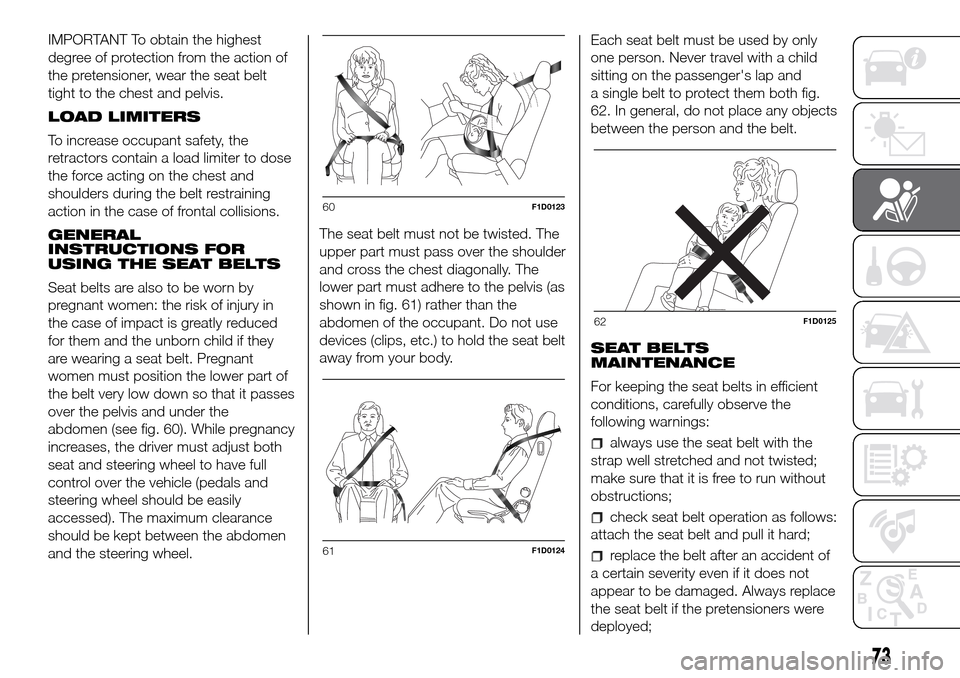
abdomen (see fig. 60). While pregnancy
increases, the driver must adjust both
seat and steering wheel to have full
control over the vehicle (pedals and
steering wheel should be easily
accessed). The maximum clearance
should be kept between the abdomen
and the steering wheel.The seat belt must not be twisted. The
upper part must pass over the shoulder
and cross the chest diagonally. The
lower part must adhere to the pelvis (as
shown in fig. 61) rather than the
abdomen of the occupant. Do not use
devices (clips, etc.) to hold the seat belt
away from your body.Each seat belt must be used by only
one person. Never travel with a child
sitting on the passenger's lap and
a single belt to protect them both fig.
62. In general, do not place any objects
between the person and the belt.
SEAT BELTS
MAINTENANCE
For keeping the seat belts in efficient
conditions, carefully observe the
following warnings:
always use the seat belt with the
strap well stretched and not twisted;
make sure that it is free to run without
obstructions;
check seat belt operation as follows:
attach the seat belt and pull it hard;
replace the belt after an accident of
a certain severity even if it does not
appear to be damaged. Always replace
the seat belt if the pretensioners were
deployed;
60F1D0123
61F1D0124
62F1D0125
73