engine FIAT PANDA 2017 319 / 3.G Repair Manual
[x] Cancel search | Manufacturer: FIAT, Model Year: 2017, Model line: PANDA, Model: FIAT PANDA 2017 319 / 3.GPages: 216, PDF Size: 19.25 MB
Page 134 of 216
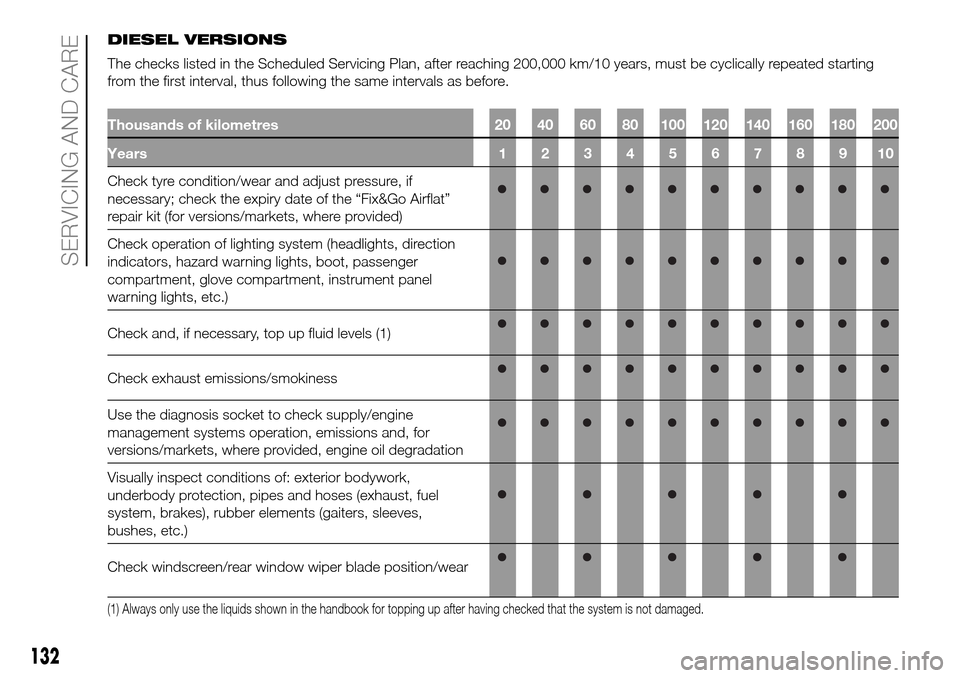
DIESEL VERSIONS
The checks listed in the Scheduled Servicing Plan, after reaching 200,000 km/10 years, must be cyclically repeated starting
from the first interval, thus following the same intervals as before.
Thousands of kilometres 20 40 60 80 100 120 140 160 180 200
Years12345678910
Check tyre condition/wear and adjust pressure, if
necessary; check the expiry date of the “Fix&Go Airflat”
repair kit (for versions/markets, where provided)
Check operation of lighting system (headlights, direction
indicators, hazard warning lights, boot, passenger
compartment, glove compartment, instrument panel
warning lights, etc.)
Check and, if necessary, top up fluid levels (1)
Check exhaust emissions/smokiness
Use the diagnosis socket to check supply/engine
management systems operation, emissions and, for
versions/markets, where provided, engine oil degradation
Visually inspect conditions of: exterior bodywork,
underbody protection, pipes and hoses (exhaust, fuel
system, brakes), rubber elements (gaiters, sleeves,
bushes, etc.)
Check windscreen/rear window wiper blade position/wear
(1) Always only use the liquids shown in the handbook for topping up after having checked that the system is not damaged.
132
SERVICING AND CARE
Page 135 of 216
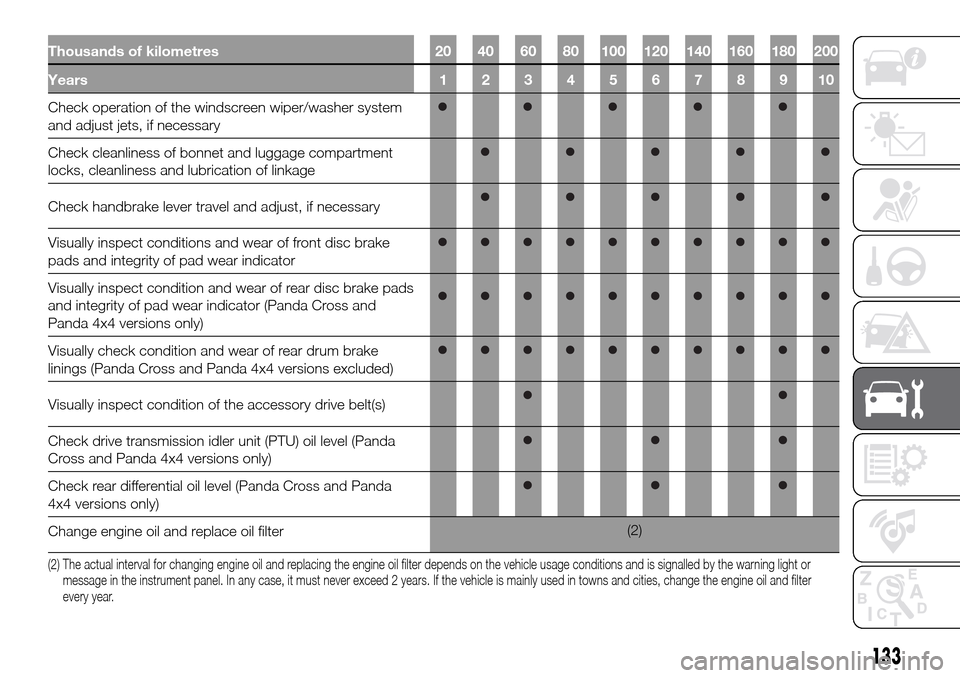
Thousands of kilometres 20 40 60 80 100 120 140 160 180 200
Years12345678910
Check operation of the windscreen wiper/washer system
and adjust jets, if necessary
Check cleanliness of bonnet and luggage compartment
locks, cleanliness and lubrication of linkage
Check handbrake lever travel and adjust, if necessary
Visually inspect conditions and wear of front disc brake
pads and integrity of pad wear indicator
Visually inspect condition and wear of rear disc brake pads
and integrity of pad wear indicator (Panda Cross and
Panda 4x4 versions only)
Visually check condition and wear of rear drum brake
linings (Panda Cross and Panda 4x4 versions excluded)
Visually inspect condition of the accessory drive belt(s)
Check drive transmission idler unit (PTU) oil level (Panda
Cross and Panda 4x4 versions only)
Check rear differential oil level (Panda Cross and Panda
4x4 versions only)
Change engine oil and replace oil filter(2)
(2) The actual interval for changing engine oil and replacing the engine oil filter depends on the vehicle usage conditions and is signalled by the warning light or
message in the instrument panel. In any case, it must never exceed 2 years. If the vehicle is mainly used in towns and cities, change the engine oil and filter
every year.
133
Page 139 of 216
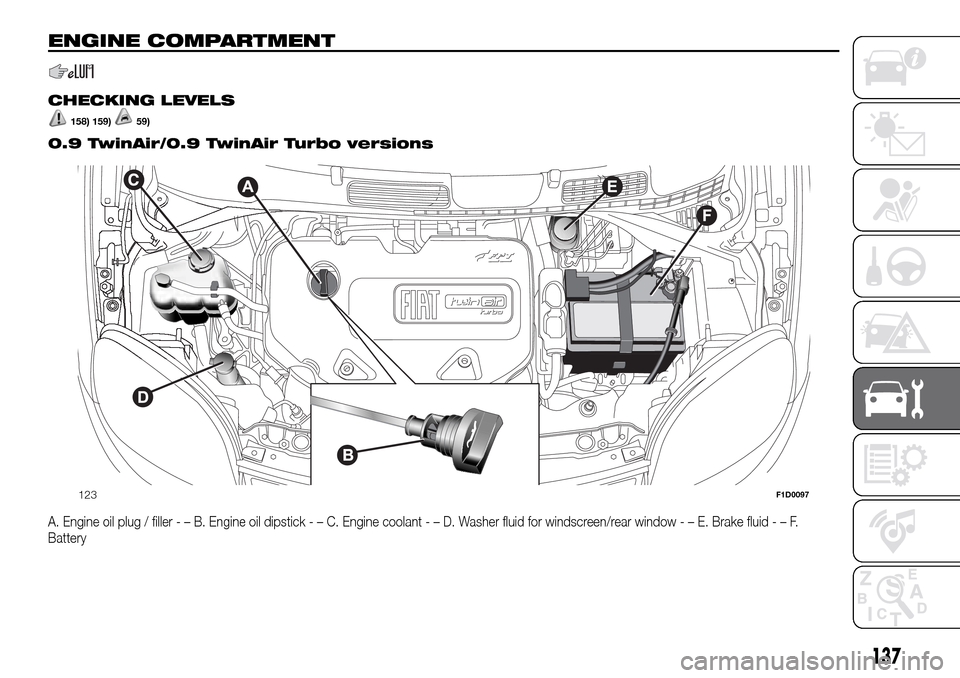
ENGINE COMPARTMENT
.
CHECKING LEVELS
158) 159)59)
0.9 TwinAir/0.9 TwinAir Turbo versions
A. Engine oil plug / filler-–B.Engine oil dipstick-–C.Engine coolant-–D.Washer fluid for windscreen/rear window-–E.Brake fluid-–F.
Battery
123F1D0097
137
Page 140 of 216
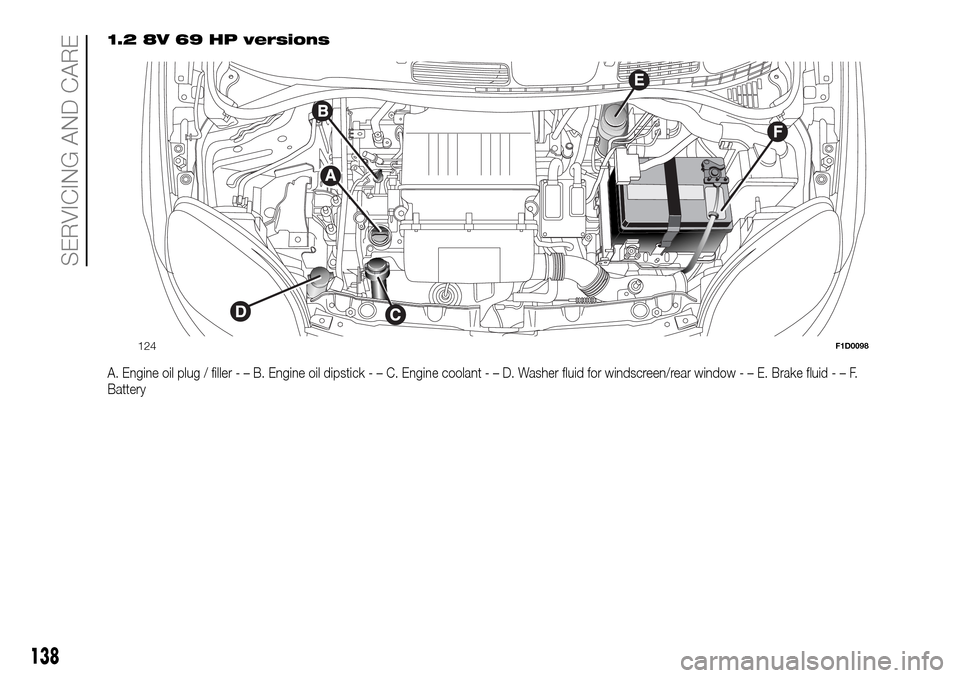
1.2 8V 69 HP versions
A. Engine oil plug / filler-–B.Engine oil dipstick-–C.Engine coolant-–D.Washer fluid for windscreen/rear window-–E.Brake fluid-–F.
Battery
124F1D0098
138
SERVICING AND CARE
Page 141 of 216
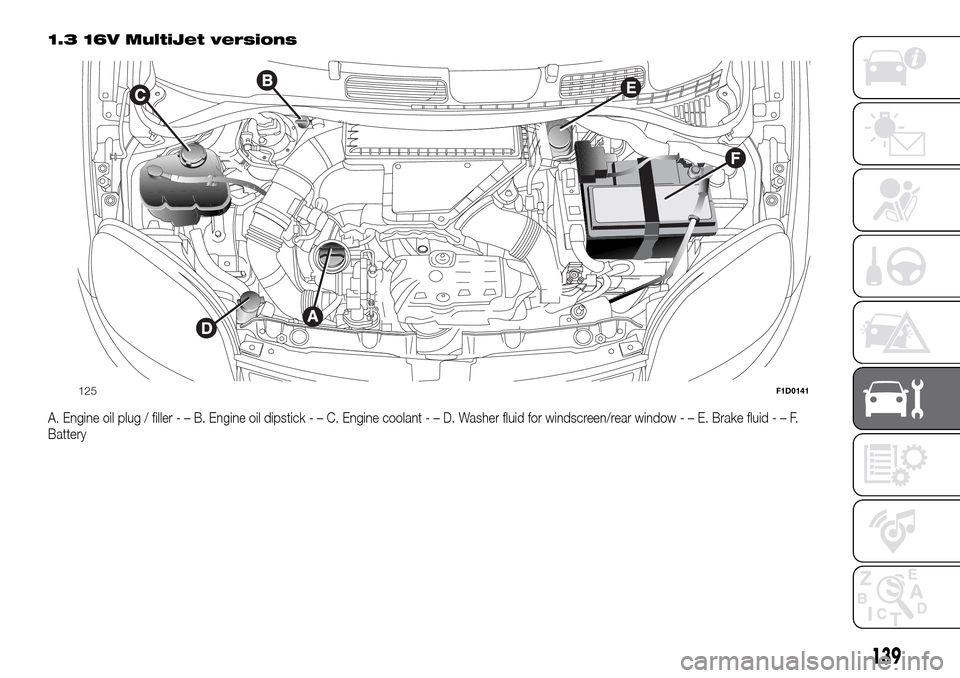
1.3 16V MultiJet versions
A. Engine oil plug / filler-–B.Engine oil dipstick-–C.Engine coolant-–D.Washer fluid for windscreen/rear window-–E.Brake fluid-–F.
Battery
125F1D0141
139
Page 142 of 216
ENGINE OIL
60) 61)3)
Check the oil level a few minutes (about
five) after the engine has stopped,
with the vehicle parked on level ground.
Check that the oil level is between the
MIN and MAX references on the
dipstick B. If the oil level is near or even
under the MIN mark, add oil using the
filler A to reach the MAX mark.
NOTE For the 0.9 TwinAir and 0.9
TwinAir Turbo versions, engine oil
dipstick B is integral with the cap A.
Take out the engine oil dipstick A, clean
it with a lint-free cloth and reinsert it.
Extract it again and check that the level
is between the MIN and MAX marks
on the dipstick.
Engine oil consumption
The maximum engine oil consumption
is usually 400 grams every 1000 km.
During the initial period of use the
engine oil consumption conditions
should be considered as having
stabilised after the first 5000 - 6000
km.
IMPORTANT After adding or changing
the oil, let the engine run for a few
seconds and wait a few minutes after
switching it off before checking the
level.ENGINE COOLANT FLUID
160)62)
The coolant level must be checked
when the engine is cold and must
range between the MIN and MAX
marks on the reservoir.
If the level is too low, unscrew reservoir
cap C and add the fluid described in
the "Technical Specifications" section.
WINDSCREEN/REAR
WINDOW WASHING FLUID
161)
If the level is too low, raise reservoir cap
D (see previous pages) and add the
fluid described in the chapter "Technical
Specifications".
BRAKE FLUID
162) 163)63)
Check that the fluid is at the maximum
level (the fluid level in the reservoir
must not exceed the MAX mark). If the
fluid level in the reservoir is too low,
undo reservoir cap E and add the fluid
described in the "Technical
Specifications" chapter.
DUALOGIC GEARBOX
HYDRAULIC ACTIVATION
SYSTEM OIL
4)
The fluid level should only be checked
at a Fiat Dealership.BATTERY
164) 165) 166) 167)
64)5)
Battery F does not require topping up
the electrolyte with distilled water. A
periodic check carried out at a Fiat
Dealership is, however, necessary to
check efficiency.
IMPORTANT After the battery is
disconnected, the steering must be
initialised. The
warning light on the
instrument panel switches on to
indicate this. To carry out this
procedure turn the steering wheel all
the way from one end to the other
or drive in a straight line for about a
hundred metres.
IMPORTANT If the charge level remains
under 50% for a long time, the battery
is damaged by sulphation, reducing
its capacity and efficiency at start-up.
CLIMATE CONTROL
SYSTEM MAINTENANCE
In winter, the climate control system
must be turned on at least once a
month for about 10 minutes. Before
summer, have the system checked at a
Fiat Dealership.
140
SERVICING AND CARE
Page 143 of 216
WARNING
158)Never smoke while working in the
engine compartment: gas and inflammable
vapours may be present, with the risk of
fire.
159)Be very careful when working in the
engine compartment when the engine
is hot: you may get burned.
160)The cooling system is pressurised. If
necessary, only replace the plug with
another original or the operation of the
system may be adversely affected. Do not
remove the reservoir plug when the engine
is hot: you risk scalding yourself.
161)Do not travel with the windscreen
washer fluid reservoir empty: the
windscreen washer is essential for
improving visibility. Some commercial
windscreen washer additives are
flammable. The engine compartment
contains hot components which may set it
on fire.
162)Brake fluid is poisonous and highly
corrosive. In the event of accidental
contact, immediately wash the affected
parts with water and mild soap. Then rinse
thoroughly. Call a doctor immediately if
swallowed.
163)The symbol
, on the brake fluid
container indicates if a brake fluid is
synthetic or mineralbased. Use of mineral
type fluids will damage the special rubber
seals of the braking system beyond repair.164)Battery fluid is poisonous and
corrosive. Avoid contact with the skin and
eyes. Keep naked flames and sources
of sparks away from the battery: risk of
explosion and fire.
165)Using the battery with insufficient
fluid irreparably damages the battery and
may cause an explosion.
166)If the car will be unused for an
extended period of time in extremely cold
weather conditions, remove the battery
and store it in a heated area to avoid
it freezing.
167)Always wear appropriate goggles
when working on or near the battery.
WARNING
59)Be careful not to confuse the various
types of fluids while topping up: they
are not compatible with each other!
Topping up with an unsuitable fluid could
severely damage your vehicle.
60)The oil level must never exceed the
MAX reference.
61)Do not add oil with specifications other
than those of the oil already existing in
the engine.
62)PARAFLU
UPantifreeze is used in the
engine cooling system. Use the same fluid
as in the cooling system when topping
up. PARAFLU
UPcannot be mixed with any
other type of fluid. If this occurs, do not
start the engine and contact your Fiat
Dealership immediately.63)Prevent brake fluid, which is highly
corrosive, from coming into contact with
painted parts. Should it happen,
immediately wash with water.
64)Incorrect installation of electric and
electronic devices may cause severe
damage to your car. After purchasing your
vehicle, if you wish to install any
accessories (anti-theft, phone, etc.),
contact a Fiat Dealership, which
will suggest the most appropriate devices
for your vehicle, and will, most importantly,
advise you if a higher capacity battery
needs to be installed.
WARNING
3)Used engine oil and oil filters contain
substances which are harmful to the
environment. To change the oil and filters,
we advise you to contact a Fiat Dealership.
4)Used transmission fluid contains
substances that are harmful to the
environment. It is advisable to have the oil
changed by a Fiat Dealership where it
will be disposed of respecting the
environment and according to legal
requirements.
5)Batteries contain substances which are
very dangerous for the environment. For
battery replacement, contact a Fiat
Dealership.
141
Page 147 of 216
TECHNICAL DATA
Everything you may find useful for
understanding how your vehicle
is made and works is contained in this
chapter and illustrated with data, tables
and graphics. For the enthusiasts and
the technician, but also just for those
who want to know every detail of their
vehicle.IDENTIFICATION DATA....................146
ENGINE ..........................................147
WHEELS .........................................151
DIMENSIONS ..................................158
WEIGHTS........................................161
REFUELLING ..................................166
FLUIDS AND LUBRICANTS ............168
PERFORMANCE .............................172
FUEL CONSUMPTION ....................173
CO
2EMISSIONS ...........................175
PRESCRIPTIONS FOR HANDLING
THE VEHICLE AT THE END OF ITS
LIFE ................................................176
145
Page 148 of 216
IDENTIFICATION
DATA
VEHICLE IDENTIFICATION
NUMBER (VIN) PLATE
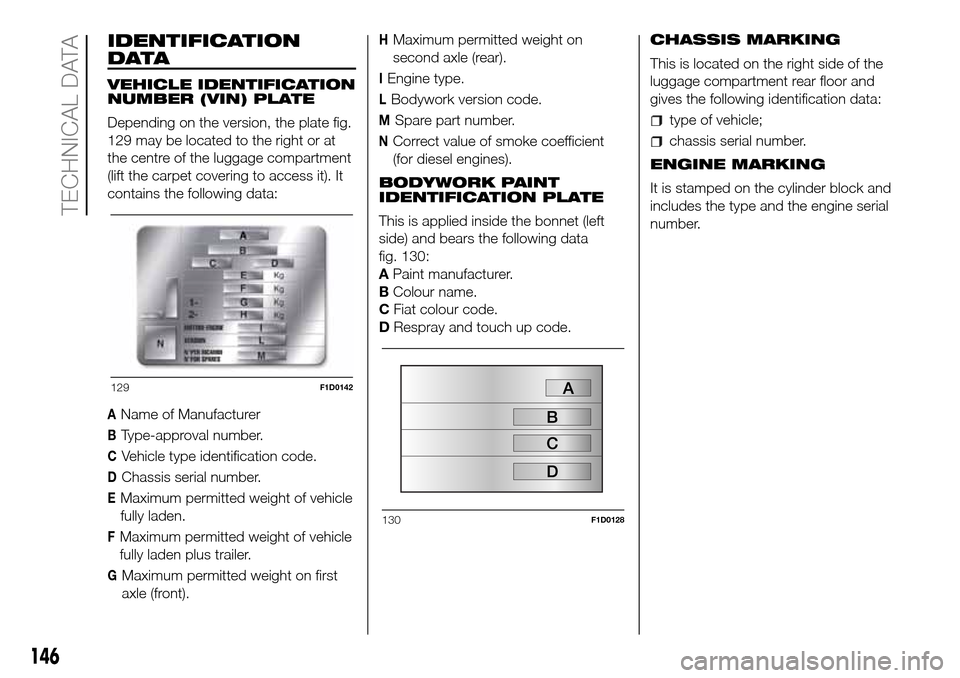
Depending on the version, the plate fig.
129 may be located to the right or at
the centre of the luggage compartment
(lift the carpet covering to access it). It
contains the following data:
AName of Manufacturer
BType-approval number.
CVehicle type identification code.
DChassis serial number.
EMaximum permitted weight of vehicle
fully laden.
FMaximum permitted weight of vehicle
fully laden plus trailer.
GMaximum permitted weight on first
axle (front).
HMaximum permitted weight on
second axle (rear).
IEngine type.
LBodywork version code.
MSpare part number.
NCorrect value of smoke coefficient
(for diesel engines).
BODYWORK PAINT
IDENTIFICATION PLATE
This is applied inside the bonnet (left
side) and bears the following data
fig. 130:
APaint manufacturer.
BColour name.
CFiat colour code.
DRespray and touch up code.CHASSIS MARKING
This is located on the right side of the
luggage compartment rear floor and
gives the following identification data:
type of vehicle;
chassis serial number.
ENGINE MARKING
It is stamped on the cylinder block and
includes the type and the engine serial
number.
129F1D0142
130F1D0128
146
TECHNICAL DATA
Page 149 of 216
ENGINE
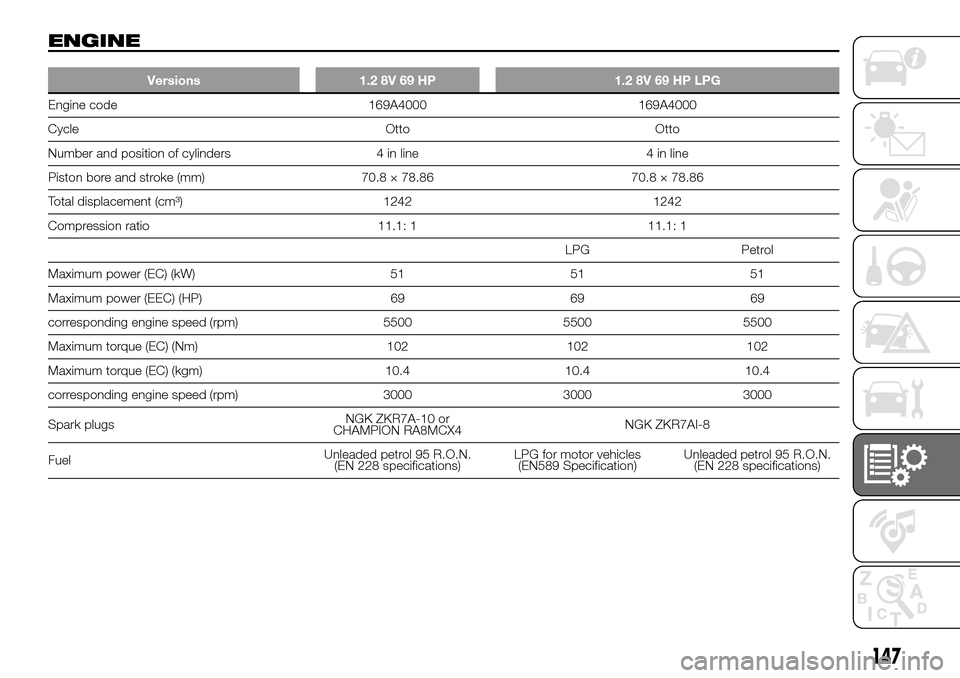
Versions 1.2 8V 69 HP 1.2 8V 69 HP LPG
Engine code 169A4000 169A4000
Cycle Otto Otto
Number and position of cylinders 4 in line 4 in line
Piston bore and stroke (mm) 70.8 × 78.86 70.8 × 78.86
Total displacement (cm³) 1242 1242
Compression ratio 11.1: 1 11.1: 1
LPG Petrol
Maximum power (EC) (kW) 51 51 51
Maximum power (EEC) (HP) 69 69 69
corresponding engine speed (rpm) 5500 5500 5500
Maximum torque (EC) (Nm) 102 102 102
Maximum torque (EC) (kgm) 10.4 10.4 10.4
corresponding engine speed (rpm) 3000 3000 3000
Spark plugsNGK ZKR7A-10 or
CHAMPION RA8MCX4NGK ZKR7AI-8
FuelUnleaded petrol 95 R.O.N.
(EN 228 specifications)LPG for motor vehicles
(EN589 Specification)Unleaded petrol 95 R.O.N.
(EN 228 specifications)
147