climate control FIAT PANDA 2017 319 / 3.G Owners Manual
[x] Cancel search | Manufacturer: FIAT, Model Year: 2017, Model line: PANDA, Model: FIAT PANDA 2017 319 / 3.GPages: 216, PDF Size: 19.25 MB
Page 2 of 216

We really know your car because we invented, designed and built it: we r\
eally know every single detail. At Fiat Service authorised workshops you can find technicians directly trained by us,
offering quality and professionalism for all service operations.
Fiat workshops are always close to you for the regular servicing operati\
ons, season checks and practical recommendations by our experts.
With Original Parts distributed by MOPAR
®, you maintain the reliability, comfort
and performance features that you bought your new car for over time.
Always ask for Genuine Parts for the components used on our cars; we rec\
ommend them because
they come from our steady commitment in research and development of high\
ly innovative technologies. For all these reasons: rely on Genuine Parts, because they are the only ones designed
by FCA for your car.
SAFETY:
BRAKING SYSTEMENVIRONMENT: PARTICULATE FILTERS, CLIMATE CONTROL MAINTENANCECOMFORT: SUSPENSION
AND WINDSCREEN WIPERS PERFORMANCE: SPARK PLUGS, INJECTORS AND BATTERIESLINEACCESSORI
ROOF RACK BARS, WHEEL RIMS
WHY CHOOSING GENUINE PARTS
This Owner Handbook is intended to show the vehicle's operating conditio\
ns.
For the enthusiast user who wants to have insights, curiosities and deta\
iled information about the characteristics and function s
of the vehicle, Fiat gives the opportunity to consult a dedicated sectio\
n which is available in electronic format.
ONLINE VEHICLE OWNER HANDBOOK
The following symbol is reported within the text of the Owner Handbook, next to the subjects \
for which details are provided.
Go to the www.mopar.eu/owner
website and access your personal area.
The “Maintenance and care” page includes all the information about\
your vehicle and the link to access eLUM, where you will find
all the details of the Owner Handbook.
The eLUM website is free and will allow you, among many other things, to easily c\
onsult the on-board documents
of all the other vehicles of the Group.
Have a nice reading and happy motoring!
COP PANDA UM GB COMPAT QUAD 30/04/15 15:19 Pagina 2
Page 9 of 216
KNOWING YOUR CAR
In-depth knowledge of your new vehicle
starts here.
The handbook that you are reading
simply and directly explains how it
is made and how it works.
That’s why we advise you to read it
seated comfortably on board, so that
you can see immediately what is
described here for yourself.DASHBOARD ................................. 8
THE KEYS....................................... 9
IGNITION DEVICE ........................... 10
THE FIAT CODE SYSTEM ............... 11
DOORS ........................................... 11
SEATS ............................................ 12
HEAD RESTRAINTS ........................ 14
STEERING WHEEL ......................... 15
REAR VIEW MIRRORS .................... 16
EXTERNAL LIGHTS......................... 17
INTERIOR LIGHTS .......................... 19
WINDOW CLEANING ...................... 20
CLIMATE CONTROL SYSTEM ........ 22
ELECTRIC WINDOWS .................... 26
BONNET ......................................... 26
LUGGAGE COMPARTMENT ........... 28
USB PORTS AND AUX INPUT ........ 29
SMARTPHONE DOCKING .............. 30
VERSION WITH LPG SYSTEM ........ 31
VERSION WITH METHANE
SYSTEM (NATURAL POWER) ......... 33
7
Page 10 of 216
DASHBOARD
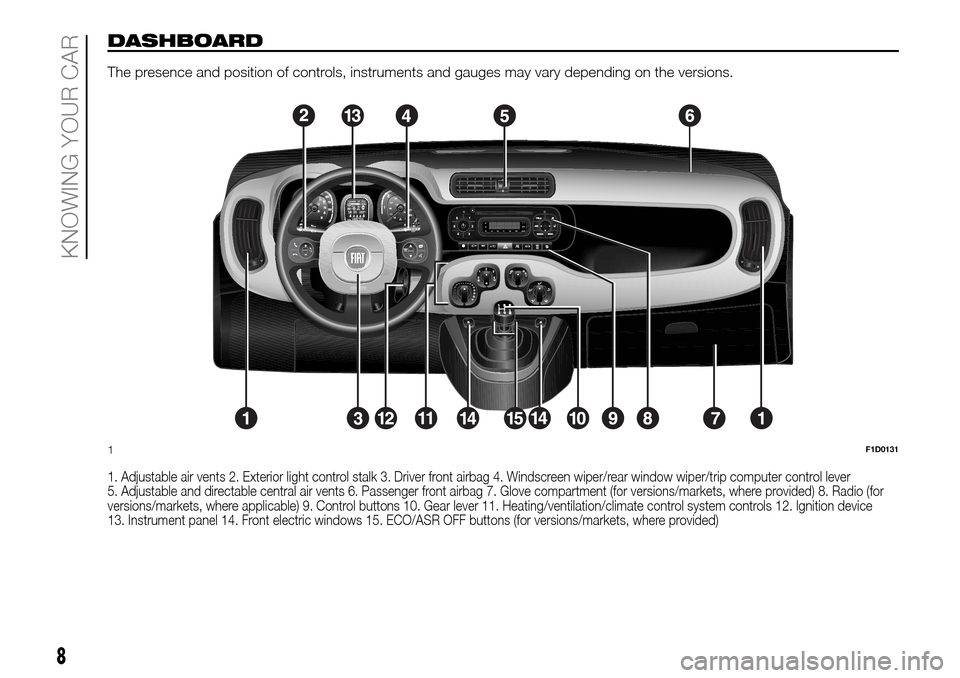
The presence and position of controls, instruments and gauges may vary depending on the versions.
1. Adjustable air vents 2. Exterior light control stalk 3. Driver front airbag 4. Windscreen wiper/rear window wiper/trip computer control lever
5. Adjustable and directable central air vents 6. Passenger front airbag 7. Glove compartment (for versions/markets, where provided) 8. Radio (for
versions/markets, where applicable) 9. Control buttons 10. Gear lever 11. Heating/ventilation/climate control system controls 12. Ignition device
13. Instrument panel 14. Front electric windows 15. ECO/ASR OFF buttons (for versions/markets, where provided)
1F1D0131
8
KNOWING YOUR CAR
Page 24 of 216
CLIMATE CONTROL SYSTEM
18)2)
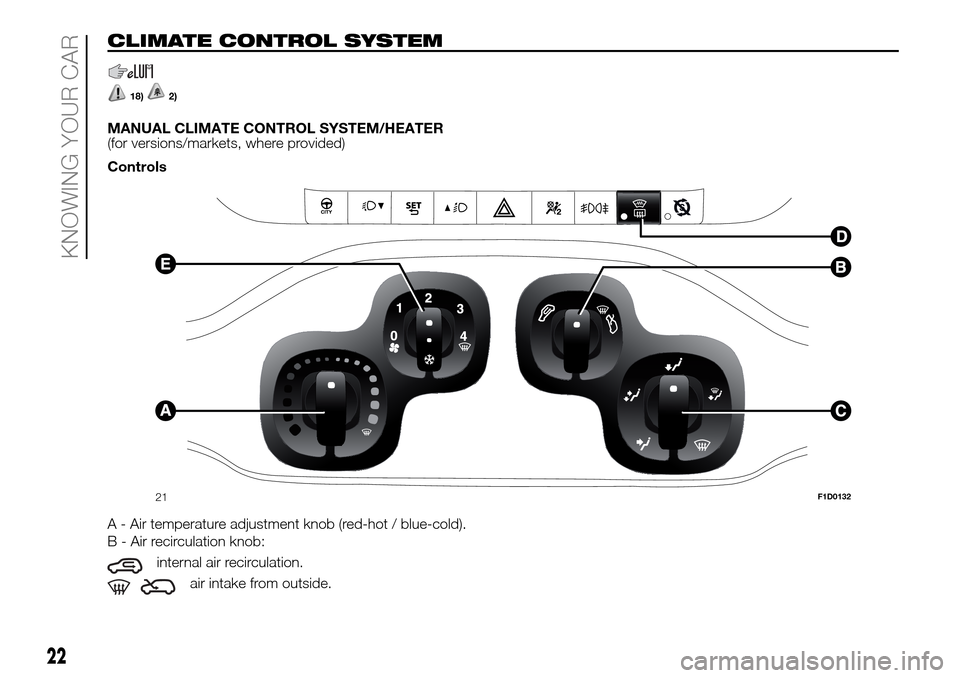
MANUAL CLIMATE CONTROL SYSTEM/HEATER
(for versions/markets, where provided)
Controls
A - Air temperature adjustment knob (red-hot / blue-cold).
B - Air recirculation knob:
internal air recirculation.
air intake from outside.
1
02
3
4
21F1D0132
22
KNOWING YOUR CAR
Page 25 of 216
IMPORTANT It is advisable to switch the air recirculation on whilst queuing or in tunnels, or whilst driving on dusty roads, to
prevent the introduction of polluted air. However, it is better not to use the function for long periods, particularly if there are
many people on board, to prevent the windows from misting.
C - Air distribution knob:
air flow to central and side dashboard vents to ventilate the chest and the face during the hot season.
distribution between feet area diffusers (warmest air) and dashboard diffusers (coolest air).
towards the footwell diffusers. Due to the natural tendency of heat to spread upwards, this type of distribution warms the
passenger compartment up as quickly as possible, providing an immediate feeling of warmth.
distribution between footwell diffusers and windscreen/front side window vents. This type of distribution achieves effective
heating of the passenger compartment and prevents the windows from misting up.
air flow to the windscreen and front side window diffusers to demist or defrost them.
D - Heated rear window, folding mirror/heated windscreen (for versions/markets, where available) activation/deactivation
button. The LED on the button switches on to indicate activation. To maintain battery efficiency, the function is automatically
deactivated after about 20 minutes
E - Fan speed and climate control system activation/deactivation knob (for versions/markets, where available).
IMPORTANT In warm-humid weather conditions, using cold air on the windscreen may cause external condensation, which
could limit visibility.
NoteTo stop the air flow from the vents, position the knob at 0 and put knob B to internal air recirculation.
ADDITIONAL HEATER
(for versions/markets, where provided)
This device speeds up passenger compartment warming when it is very cold. The heater switches on automatically according
to the environmental conditions, with engine started and when the temperature of the engine coolant is low. The additional
heater turns off automatically after the required comfort conditions are achieved.
The heater only operates if the outside temperature and engine coolant temperature are low. The heater will not activate if the
battery voltage is too low.
23
Page 26 of 216
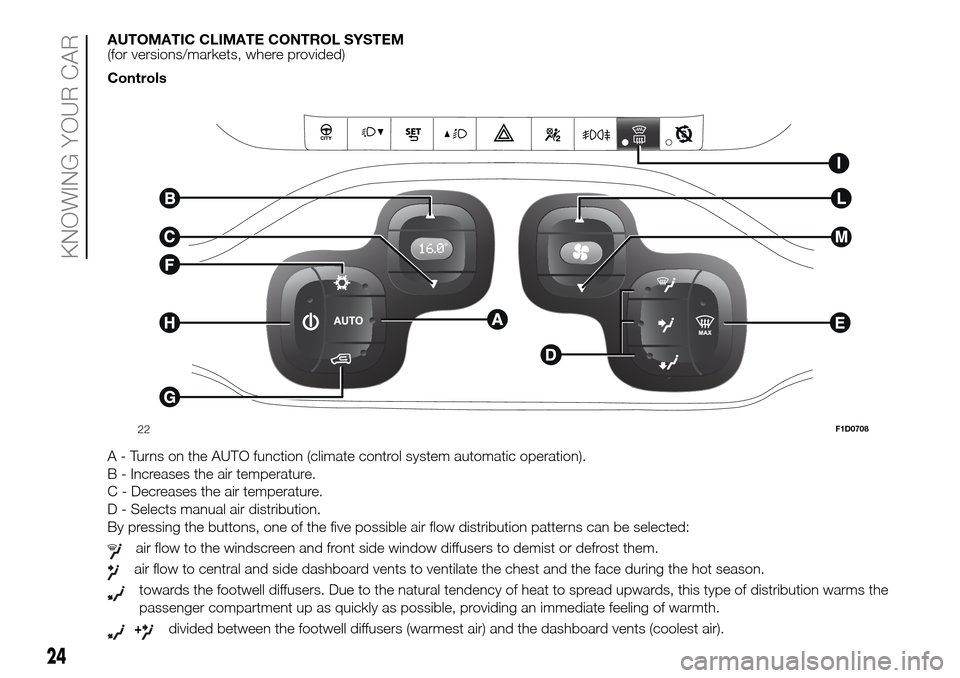
AUTOMATIC CLIMATE CONTROL SYSTEM
(for versions/markets, where provided)
Controls
A - Turns on the AUTO function (climate control system automatic operation).
B - Increases the air temperature.
C - Decreases the air temperature.
D - Selects manual air distribution.
By pressing the buttons, one of the five possible air flow distribution patterns can be selected:
air flow to the windscreen and front side window diffusers to demist or defrost them.
air flow to central and side dashboard vents to ventilate the chest and the face during the hot season.
towards the footwell diffusers. Due to the natural tendency of heat to spread upwards, this type of distribution warms the
passenger compartment up as quickly as possible, providing an immediate feeling of warmth.
+divided between the footwell diffusers (warmest air) and the dashboard vents (coolest air).
22F1D0708
24
KNOWING YOUR CAR
Page 27 of 216
+distribution between footwell diffusers and windscreen/front side window vents. This type of distribution achieves
effective heating of the passenger compartment and prevents the windows from misting up.
IMPORTANT In warm-humid weather conditions, using cold air on the windscreen may cause external condensation, which
could limit visibility.
E - Turns on/off the MAX-DEF function (fast front window defrosting/demisting).
F - Turns on/off the air conditioning compressor.
G - Turns on/off the internal air recirculation.
H - Turns on/off the air conditioning.
F - Turns on/off the heated rear window and (for versions/markets, where available) the heated mirrors/heated windscreen.
L/M - Adjusts the fan speed.
The automatic climate control manages the Start&Stop function (engine off when the car speed is zero) to guarantee a suitable
comfort inside the passenger compartment.
NOTE In particularly severe climate conditions it is recommended to limit the use of the Start&Stop function to prevent the
compressor from continuously switching on and off, with consequent rapid misting of the windows and accumulation of
humidity with unpleasant smells in the passenger compartment.
WARNING
18)It is advisable not to use the internal air recirculation function when the outside temperature is low, because the windows could mist
rapidly.
WARNING
2)The system uses a coolant that is compatible with the laws in force in countries where the vehicle is sold, R134a or R1234yf. In case of a
recharge operation, only use the gas indicated on the label placed in the engine compartment. The use of other coolants affects the efficiency
and condition of the system. The lubricant used for the compressor is also strictly linked to the type of cooling gas, please refer to a Fiat
Dealership.
25
Page 101 of 216
STOP/START
SYSTEM
125) 126)46)
The Stop/Start system automatically
stops the engine when the vehicle
is stationary and starts it again when
the driver wants to move off. This
reduces consumption, the emission of
harmful gases and noise pollution.
OPERATING MODE
Engine stopping mode: with the
vehicle stopped, the engine stops with
gearbox in neutral and clutch pedal
released.
NoteThe engine can only be stopped
automatically after exceeding a speed
of about 10 km/h, to prevent the engine
from being repeatedly stopped when
driving at walking pace.
Restarting the engine: press the
clutch pedal to restart the engine.MANUAL SYSTEM
ACTIVATION/
DEACTIVATION
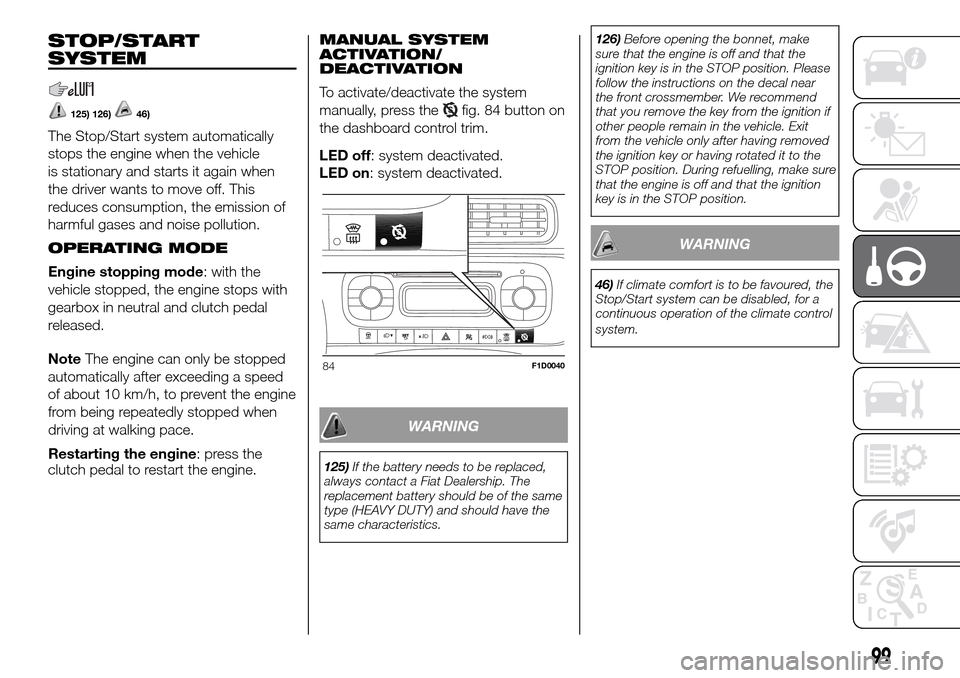
To activate/deactivate the system
manually, press the
fig. 84 button on
the dashboard control trim.
LED off: system deactivated.
LED on: system deactivated.
WARNING
125)If the battery needs to be replaced,
always contact a Fiat Dealership. The
replacement battery should be of the same
type (HEAVY DUTY) and should have the
same characteristics.126)Before opening the bonnet, make
sure that the engine is off and that the
ignition key is in the STOP position. Please
follow the instructions on the decal near
the front crossmember. We recommend
that you remove the key from the ignition if
other people remain in the vehicle. Exit
from the vehicle only after having removed
the ignition key or having rotated it to the
STOP position. During refuelling, make sure
that the engine is off and that the ignition
key is in the STOP position.
WARNING
46)If climate comfort is to be favoured, the
Stop/Start system can be disabled, for a
continuous operation of the climate control
system.
84F1D0040
99
Page 142 of 216
ENGINE OIL
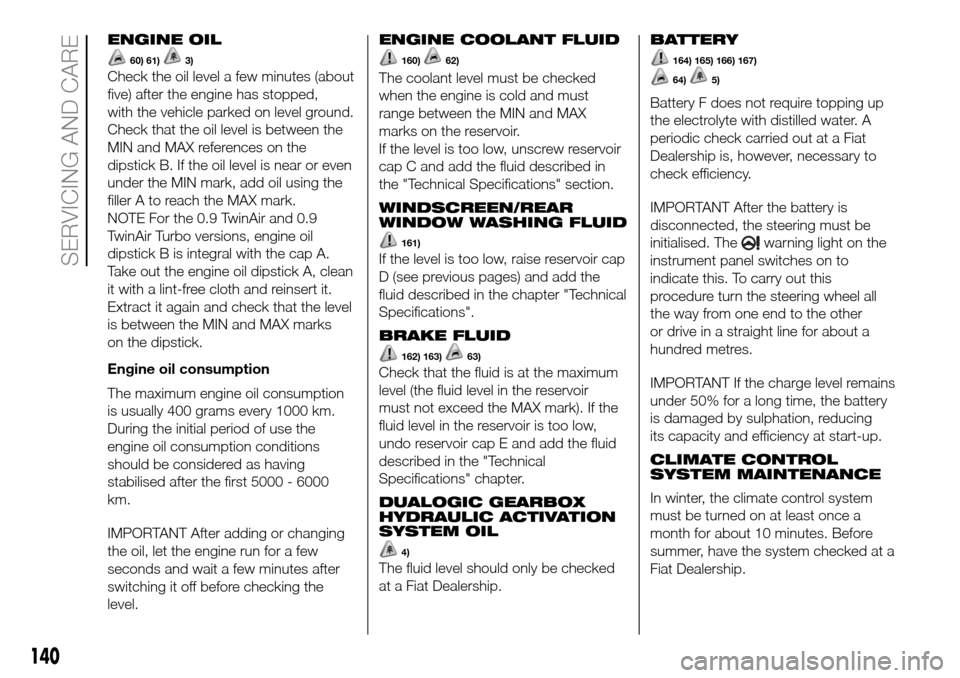
60) 61)3)
Check the oil level a few minutes (about
five) after the engine has stopped,
with the vehicle parked on level ground.
Check that the oil level is between the
MIN and MAX references on the
dipstick B. If the oil level is near or even
under the MIN mark, add oil using the
filler A to reach the MAX mark.
NOTE For the 0.9 TwinAir and 0.9
TwinAir Turbo versions, engine oil
dipstick B is integral with the cap A.
Take out the engine oil dipstick A, clean
it with a lint-free cloth and reinsert it.
Extract it again and check that the level
is between the MIN and MAX marks
on the dipstick.
Engine oil consumption
The maximum engine oil consumption
is usually 400 grams every 1000 km.
During the initial period of use the
engine oil consumption conditions
should be considered as having
stabilised after the first 5000 - 6000
km.
IMPORTANT After adding or changing
the oil, let the engine run for a few
seconds and wait a few minutes after
switching it off before checking the
level.ENGINE COOLANT FLUID
160)62)
The coolant level must be checked
when the engine is cold and must
range between the MIN and MAX
marks on the reservoir.
If the level is too low, unscrew reservoir
cap C and add the fluid described in
the "Technical Specifications" section.
WINDSCREEN/REAR
WINDOW WASHING FLUID
161)
If the level is too low, raise reservoir cap
D (see previous pages) and add the
fluid described in the chapter "Technical
Specifications".
BRAKE FLUID
162) 163)63)
Check that the fluid is at the maximum
level (the fluid level in the reservoir
must not exceed the MAX mark). If the
fluid level in the reservoir is too low,
undo reservoir cap E and add the fluid
described in the "Technical
Specifications" chapter.
DUALOGIC GEARBOX
HYDRAULIC ACTIVATION
SYSTEM OIL
4)
The fluid level should only be checked
at a Fiat Dealership.BATTERY
164) 165) 166) 167)
64)5)
Battery F does not require topping up
the electrolyte with distilled water. A
periodic check carried out at a Fiat
Dealership is, however, necessary to
check efficiency.
IMPORTANT After the battery is
disconnected, the steering must be
initialised. The
warning light on the
instrument panel switches on to
indicate this. To carry out this
procedure turn the steering wheel all
the way from one end to the other
or drive in a straight line for about a
hundred metres.
IMPORTANT If the charge level remains
under 50% for a long time, the battery
is damaged by sulphation, reducing
its capacity and efficiency at start-up.
CLIMATE CONTROL
SYSTEM MAINTENANCE
In winter, the climate control system
must be turned on at least once a
month for about 10 minutes. Before
summer, have the system checked at a
Fiat Dealership.
140
SERVICING AND CARE
Page 175 of 216
FUEL CONSUMPTION
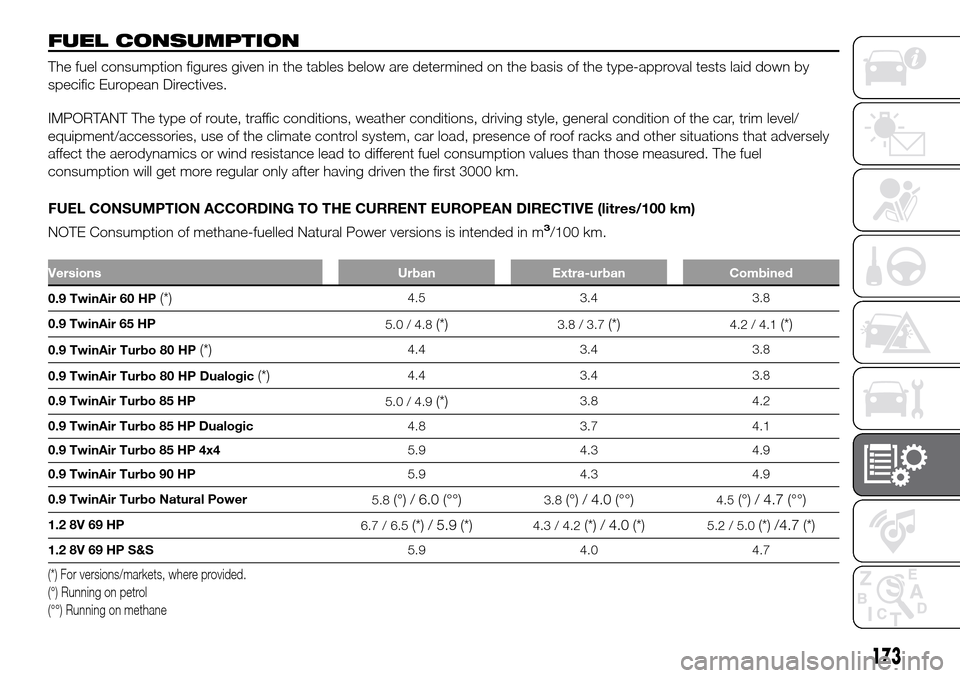
The fuel consumption figures given in the tables below are determined on the basis of the type-approval tests laid down by
specific European Directives.
IMPORTANT The type of route, traffic conditions, weather conditions, driving style, general condition of the car, trim level/
equipment/accessories, use of the climate control system, car load, presence of roof racks and other situations that adversely
affect the aerodynamics or wind resistance lead to different fuel consumption values than those measured. The fuel
consumption will get more regular only after having driven the first 3000 km.
FUEL CONSUMPTION ACCORDING TO THE CURRENT EUROPEAN DIRECTIVE (litres/100 km)
NOTE Consumption of methane-fuelled Natural Power versions is intended in m
3/100 km.
Versions Urban Extra-urban Combined
0.9 TwinAir 60 HP(*)4.5 3.4 3.8
0.9 TwinAir 65 HP
5.0 / 4.8
(*)3.8 / 3.7(*)4.2 / 4.1(*)
0.9 TwinAir Turbo 80 HP(*)4.4 3.4 3.8
0.9 TwinAir Turbo 80 HP Dualogic
(*)4.4 3.4 3.8
0.9 TwinAir Turbo 85 HP
5.0 / 4.9
(*)3.8 4.2
0.9 TwinAir Turbo 85 HP Dualogic4.8 3.7 4.1
0.9 TwinAir Turbo 85 HP 4x45.9 4.3 4.9
0.9 TwinAir Turbo 90 HP5.9 4.3 4.9
0.9 TwinAir Turbo Natural Power
5.8
(°) / 6.0 (°°)3.8(°) / 4.0 (°°)4.5(°) / 4.7 (°°)
1.2 8V 69 HP
6.7 / 6.5(*) / 5.9 (*)4.3 / 4.2(*) / 4.0 (*)5.2 / 5.0(*) /4.7 (*)
1.2 8V 69 HP S&S5.9 4.0 4.7
(*) For versions/markets, where provided.
(°) Running on petrol
(°°) Running on methane
173