Psi FIAT PUNTO 1994 176 / 1.G Workshop Manual
[x] Cancel search | Manufacturer: FIAT, Model Year: 1994, Model line: PUNTO, Model: FIAT PUNTO 1994 176 / 1.GPages: 225, PDF Size: 18.54 MB
Page 69 of 225
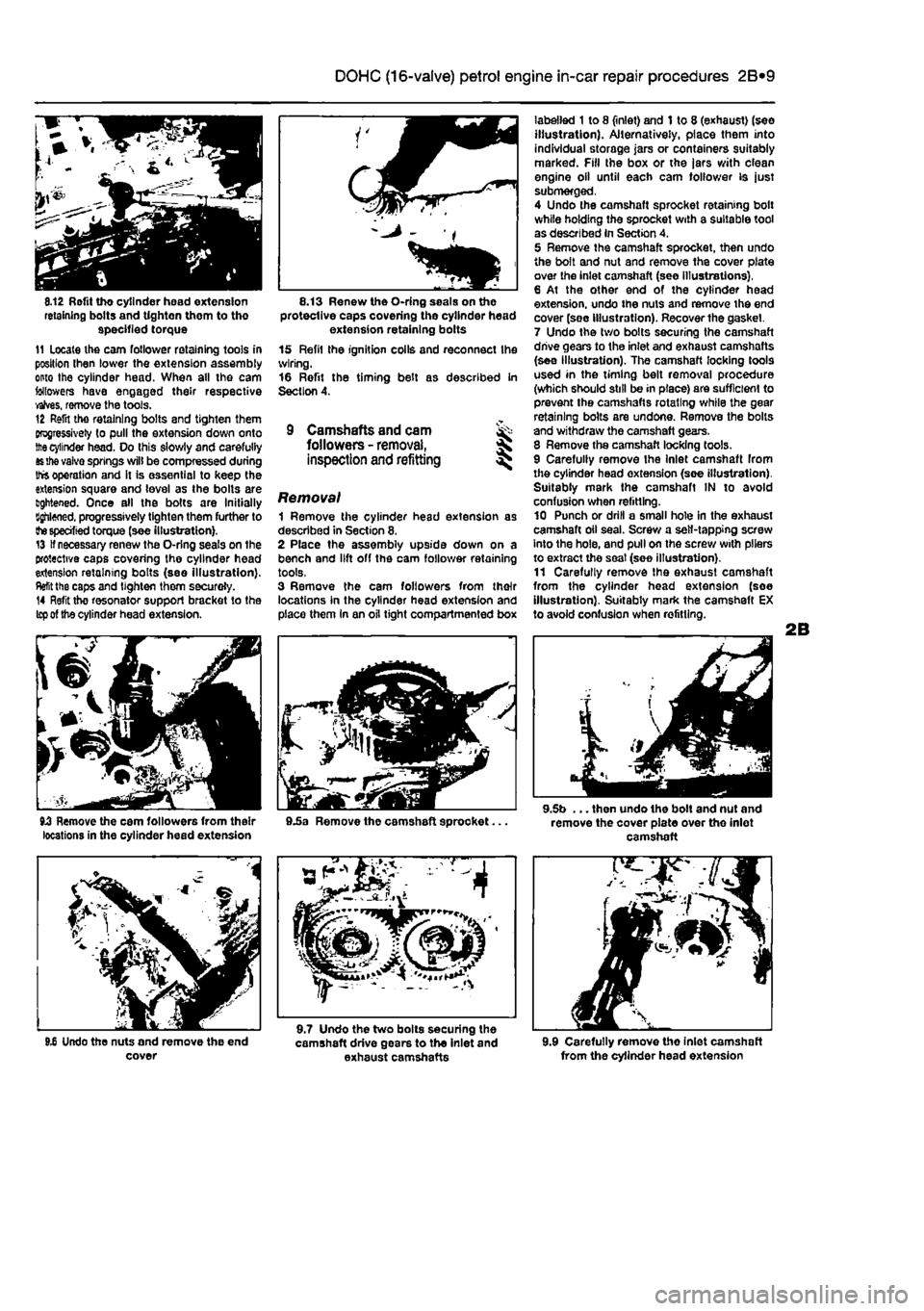
2B*9 DOHC (16-valve) petrol engine in-car repair procedures
8.12 Rofit tho cylinder head extension retaining bolts and tighten them to tho specified torque 11 Locate the cam follower retaining tools in position Ihen lower the extension assembly onto the cylinder head. When all the cam followers have engaged their respective valves, remove the tools. 12 Refit tho retaining bolts and tighten them progressively to pull the extension down onto
the
cylinder head. Do this slowly and carefully
as the
vaivo springs will be compressed during Ihfs operation and it is essential to keep the extension square and level as the bolts are lightened. Once all the bolts are Initially Bghloned. progressively tighten them further to
the specified
torque (see illustration). 13 If necessary renew the O-rlng seals on the protective caps covering the cylinder head extension retaining bolts (see illustration).
Refit
the caps and tighten them securoly. 14 Refit the resonator support bracket to the
Icp of
the cylinder head extension.
8.13 Renew the O-ring seals on the protective caps covering the cylinder head extension retaining bolts 15 Refil the ignition coils and reconnect Ihe wiring. 16 Refit the timing belt as described in Section 4.
9 Camshafts and cam ^ followers -
removal,
S inspection and refitting ^
Removal 1 Remove the cylinder head extension as described in Section 8. 2 Place the assembly upside down on a bench and lift off the cam follower retaining tools, 3 Remove the cam followers from their locations In the cylinder head extension and place them In an oil tight compartmented box
labelled 1 to 8 (inlet) and 1 to 8 (exhaust) (see illustration). Alternatively, place them into individual storage jars or containers suitably marked. Fill the box or the jars with clean engine oil until each cam follower is just submerged, 4 Undo the camshaft sprocket retaining bolt while holding the sprocket with a suitable tool as described In Section 4. 5 Remove the camshaft sprocket, then undo the bolt and nut and remove the cover plate over the inlet camshaft (see Illustrations), 6 At the other end of the cylinder head extension, undo the nuts and remove the end cover (soe Illustration). Recover the gasket. 7 Undo the two bolts securing the camshaft drive gears to the inlet and exhaust camshafts (see illustration). The camshaft locking tools used in the timing belt removal procedure (which should still be in place) are sufficient to prevent the camshafts rotating while the gear retaining bolts are undone. Remove the bolts and withdraw the camshaft gears. 8 Remove the camshaft locking tools. 9 Carefully remove the Inlet camshaft from the cylinder head extension (see illustration). Suitably mark the camshaft IN to avoid confusion when refitting. 10 Punch or drill a small hole in the exhaust camshaft oil seal. Screw a self-tapping screw into the hole, and pull on the screw with pliers to extract the seat (soe illustration). 11 Carefully remove Ihe exhaust camshaft from the cylinder head extension (soe illustration). Suitably mark the camshaft EX to avoid confusion when refitting.
JJ Remove the cam followers from their 9.5a Remove the camshaft sprocket... locations in the cylinder head extension
9.5b ... then undo the bolt and nut and remove the cover plate over tho inlet camshaft
9.6 Undo the nuts and remove the end cover
9.7 Undo the two bolts securing the camshaft drive gears to the inlet and exhaust camshafts 9.9 Carefully remove tho Inlet camshaft from the cylinder head extension
Page 103 of 225
2D*10 Engine removal and overhaul procedures
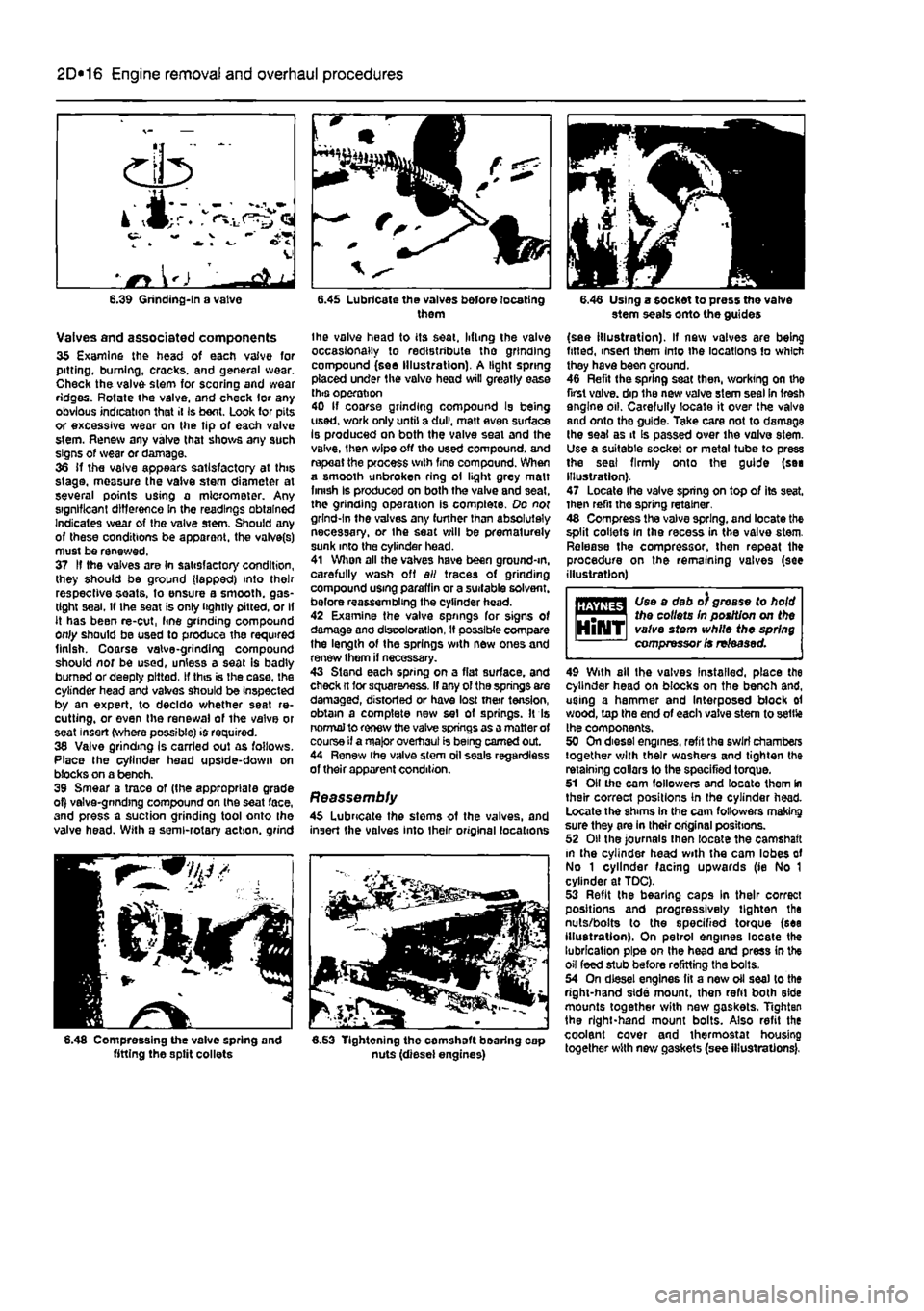
Valves and associated components 35 Examine the head of each vaive for pitting, burning, cracks, and general wear. Check the valve stem for scoring and wear ridges. Rotate the valve, and check lor any obvious indication that it Is bent. Look tor pits or excessive wear on the tip of each valve stem. Renew any valve that shows any such signs of wear or damage. 36 if the valve appears satisfactory at this stage, measure the vaive stem diameter at several points using a micrometer. Any significant difference in the readings obtained Indicates wear of the valve stem. Should any of these conditions be apparent, the valve(s) must be renewed. 37 If the valves are In satisfactory condition, they should be ground (lapped) into their respective seats, to ensure a smooth, gas-tight seal. If the seat is only tightly pitted, or if it has been re-cut, fine grinding compound only should be used to produce the required finish. Coarse valve-grinding compound should nor be used, unless a seat is badly bumed or deeply pitted, If this is the case, the cylinder head and valves should be Inspected by an expert, to decldo whether seat re-cutting, or even the renewal of the valve or seat insert (where possible) is required. 38 Valve grinding Is carried out as follows. Place the cylinder head upside-down on blocks on a bench. 39 Smear a trace of (the appropriate grade of) valve-gnndtng compound on the seat face, and press a suction grinding tool onto the valve head. With a semi-rotary action, grind
6.48 Compressing the vaive spring and fitting the split collets
them
the valve head to its seat, lifting the valve occasionally to redistribute tho grinding compound (see Illustration). A light spring placed under the valve head will greatly ease this operation 40 If coarse grinding compound Is being used, v/ork only until a dull, matt even surface Is produced on both the valve seal and the valve, then wipe off tho used compound, and repeat the process with fine compound. When a smooth unbroken ring ol light grey malt finish Is produced on both the valve and seat, the grinding operation is complete. Do not grind-In the valves any further than absolutely necessary, or the seat will be prematurely sunk into the cylinder head. 41 When all the valves have been ground-m, carefully wash off all traces of grinding compound using paraffin or a suitable solvent, before reassembling the cylinder head. 42 Examine the valve springs for signs of damage ano discoloration, If possible compare the length of the springs with new ones and renew them if necessary. 43 Stand each spring on a flat surface, and check ft tor squareness. If any of the springs are damaged, distorted or have lost mar tension, obtain a complete new set of springs. It Is normal to renew the valve springs as a matter of course if a major overhaul is being earned out. 44 Renew (he valve stem oil seals regardless of their apparent condition.
Reassembly 45 Lubricate the stems of the valves, and insert the valves into their original locations
6.53 Tightening the camshaft bearing cap nuts (diesel engines)
6.46 Using a socket to press the valve stem seals onto the guides
(see illustration). If new valves are being fitted, insert them Into the locations to which they have been ground. 46 Refit the spring sea( then, working on the first valve, dip the new valve stem sesl in fresh engine oil. Carefully locate it over the valve and onto the guide. Take care not to damage the seal as it Is passed over the valve stem. Use a suitable socket or metal tube to press the seal firmly onto the guide (sea Illustration). 47 Locate the valve spring on top of its seat, then refit the spring retainer. 48 Compress the valve spring, and locate the split collets in the recess in the valve stem. Release the compressor, then repeat the procedure on the remaining valves (see illustration)
Use a dab o) grease to hold Uiejitts* the collets In position on the HlNT valve stem while the spring compressor is released.
49 With ail the valves Installed, place the cylinder head on blocks on the bench and, using a hammer and Interposed block ol wood, top the end of each valve stem to settle the components. 50 On diesel engines, refit the swirl chambers together with their washers and tighten the retaining collars to the specified torque. 51 Oil the cam followers and locate them In their correct positions in the cylinder head. Locate the shims In the cam followers making sure they are in their original positions. 52 Oil the journals then locate the camshaft m the cylinder head with the cam lobes of No 1 cylinder facing upwards (ie No 1 cylinder at TDC). 53 Refit the bearing caps In their correct positions and progressively tighten the nuts/bolts to the specified torque (sea illustration). On petrol engines locate the lubrication pipe on Ihe head and press in the oil feed stub before refitting the bolts. 54 On diesel engines fit a new oil sea) to the right-hand side mount, then refit both side mounts together with new gaskets, Tighten the right-hand mount bolts. Also refit the coolant cover and thermostat housing together with new gaskets (see illustrations).