cap FIAT PUNTO 1995 176 / 1.G Workshop Manual
[x] Cancel search | Manufacturer: FIAT, Model Year: 1995, Model line: PUNTO, Model: FIAT PUNTO 1995 176 / 1.GPages: 225, PDF Size: 18.54 MB
Page 6 of 225
Safety first! 0.5
Working on your ear can be dangerous. This page shows just some of the potential risks and hazards, with the aim of creating a safety-conscious attitude.
General hazards
Scalding • Don't remove the radiator or expansion tank cap while the engine is hot. • Engine oil, automatic transmission fluid or power steering fluid may also be dangerously hot if the engine has recently been running.
Burning • Beware of burns from the exhau3t system and from any part of the engine. Brake discs and drums can also be extremely hot immediately after use.
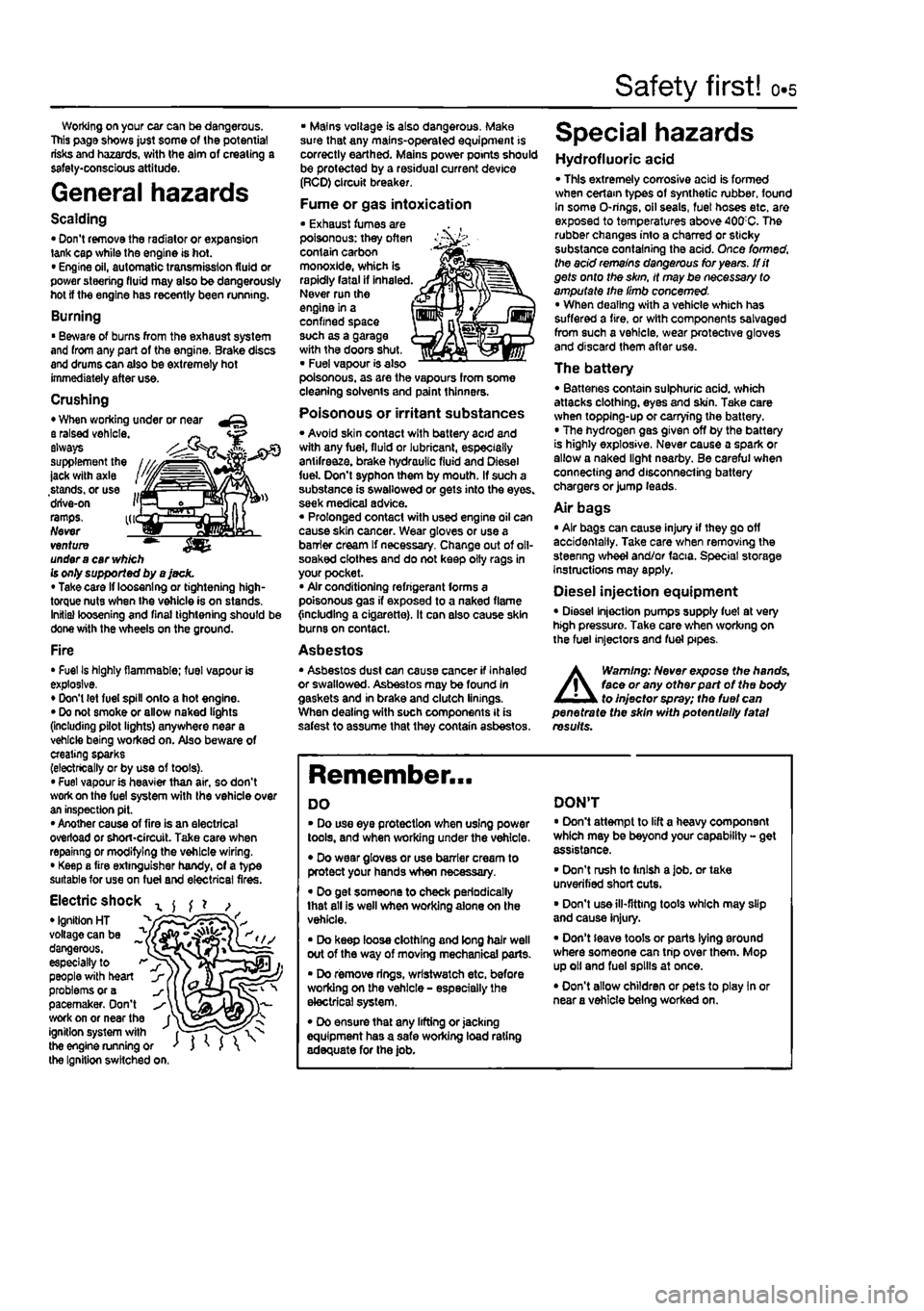
Crushing • When working under or near a raised vehicle. ~ always supplement the ' ' -jack with axle stands, or use ... drive-on i'j ramps. kr Never venture ™ under
a
car
vv/j/ch
Is only supported by a jack. • Take card if loosening or tightening high-torque nuts when the vehicle is on stands. Initial loosening and final tightening should be done with the wheels on the ground.
Fire • Fuel Is highly flammable; fuel vapour is explosive. • Don't (et fuel spill onto a hot engine. • Do not smoke or allow naked lights (including pilot lights) anywhere near a vehicle being worked on. Also beware of creating sparks (electrically or by use of toots). • Fuel vapour is heavier than air, so don't work on the fuel system with the vehicle over an inspection pit. • Another cause of fire is an electrical overload or short-circuit. Take care when repainng or modifying the vehicle wiring. • Keep a fire extinguisher handy, of a type suitable for use on fuel and electrical fires.
Electric shock x ^ ^ ? , • Ignition HT _ " voltage can be ^ dangerous, ~ especially to > people with heart problems or a pacemaker. Don't work on or near the f^ ignition system with fT") the engine running or ' J ' J the Ignition switched on.
• Mains voltage is also dangerous. Make sure that any mains-operated equipment is correctly earthed. Mains power points should be protected by a residual current device (RCD) circuit breaker.
Fume or gas intoxication • Exhaust fumes are poisonous: they often contain carbon monoxide, which is rapidly fatal if inhaled. Never run the engine in a confined space such as a garage with the doors shut, • Fuel vapour is also poisonous, as are the vapours from some cleaning solvents and paint thinners.
Poisonous or irritant substances • Avoid skin contact with battery acid and with any fuel, fluid or lubricant, especially antifreeze, brake hydraulic fluid and Diesel fuel. Don't syphon them by mouth. If such a substance is swallowed or gets into the eyes, seek medical advice. « Prolonged contact with used engine oil can cause skin cancer. Wear gloves or use a barrier cream If necessary. Change out of oll-soaked clothes and do not keep oily rags in your pocket. • Air conditioning refrigerant forms a poisonous gas if exposed to a naked flame {including a cigarette). It can also cause skin burns on contact.
Asbestos • Asbestos dust can cause cancer if inhaled or swallowed. Asbestos may be found In gaskets and in brake and clutch linings. When dealing with soch components It is safest to assume that they contain asbestos.
Special hazards
Hydrofluoric acid • This extremely corrosive acid is formed when cerlam types of synthetic rubber, found In some O-rings, oil seals, fuel hoses etc. are exposed to temperatures above 400;C. The rubber changes into a charred or sticky substance containing the acid. Once formed, the acid remains dangerous for years, tfit gets onto the skin, it may be necessary to amputate the limb concerned. • When dealing with a vehicle which has suffered a fire, or with components salvaged from such a vehicle, wear protective gloves and discard them after use.
The battery • Batteries contain sulphuric acid, which attacks clothing, eyes and skin. Take care when topping-up or carrying the battery. • The hydrogen gas given off by the battery is highly explosive. Never cause a spark or allow a naked light nearby. Be careful when connecting and disconnecting battery chargers or jump leads.
Air bags • Air bags can cause injury if they go off accidentally. Take care when removing the steenng wheel and/or facia. Special storage instructions may apply.
Diesel injection equipment • Diesel injection pumps supply fuel at very high pressure. Take care when working on the fuel injectors and fuel pipes.
A
Warning: Never expose the hands, face or any otfterpart of the body to injector spray; the fuel can penetrate the skin with potentially fatal results.
Remember...
DO • Do use eye protection when using power tools, and when working under the vehicle. • Do wear gloves or use barrier cream to protect your hands when necessary. • Do get someone to check periodically that all is well when working alone on the vehicle. • Do keep loose clothing and long hair well out of the way of moving mechanical parts. • Do remove rings, wrtstwatch etc. before working on the vehicle - especially the electrical system, • Do ensure that any lifting or jacking equipment has a safe working load rating adequate for the job.
DON'T • Don't attempt to lift a heavy component which may be beyond your capability - get assistance. • Don't rush to finish a job. or take unverified short cuts. • Don't use ill-fitting toots which may slip and cause injury. • Don't leave tools or parts lying around where someone can trip over them. Mop up oil and fuel spills at once. • Don't allow children or pets to play In or near a vehicle being worked on.
Page 11 of 225
do Weekly checks
Introduction
There are some very simple checks which need only take a few minutes to carry out, but which could save you a lot of inconvenience and expense.
These Weekly checks require no great skill or special lools, and the small amount of lime they take to perform could prove to be very well spent, for example;
P Keeping an eye on tyre condition and pressures, will not only help to stop them wearing out prematurely, but could also save your life.
C Many breakdowns are caused by electacai problems. Battery-relalod faults are particularly common, and a quick check on a regular basis will ofton prevent the majority of these.
• If your car develops a brake fluid teak, the first time you might know about it is when your brakes don't work properly. Checking the level regularly will give advance warning of this kind of problem.
• If the oil or coolant levels run low. the cost of repairing any engine damage will be far greater than fixing the leak, for example.
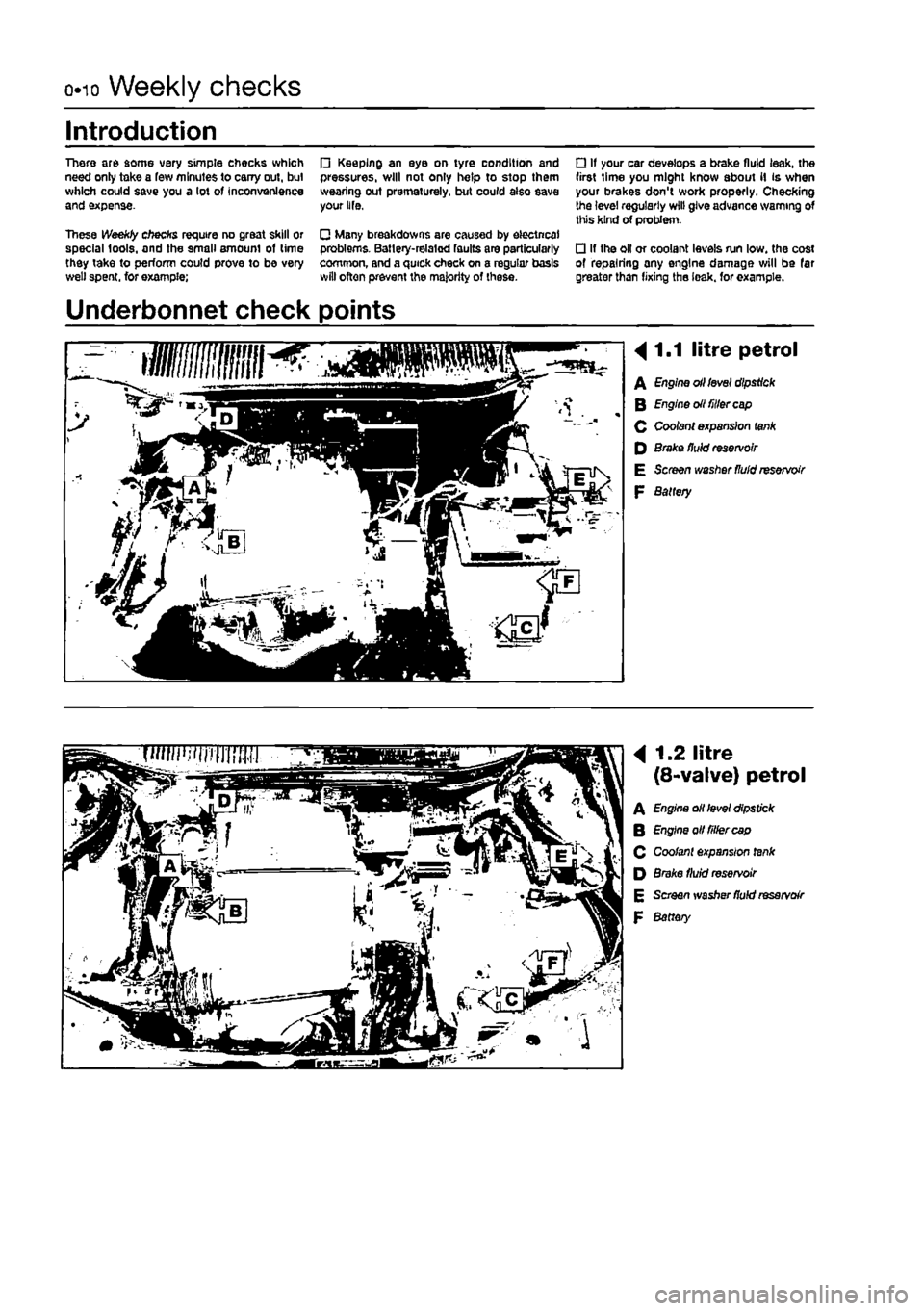
Underbonnet check points
4 1.1 litre petrol
A Engine oil level dipstick Q Engine oil filler cap C Cooteof expansion tank P Brake fluid reservoir E Screen washer fluid reservoir p Battery
< 1.2 litre
m (8-valve) petrol
^ 1 A Engine oII level dipstick
B Engine otl tiller cap
fi i: c Coolant expansion tank
D Brake fluid reservoir
E Screen washer fluid reservoir
F Battery
Page 12 of 225
Weekly checks o.n
Ulllllli
B
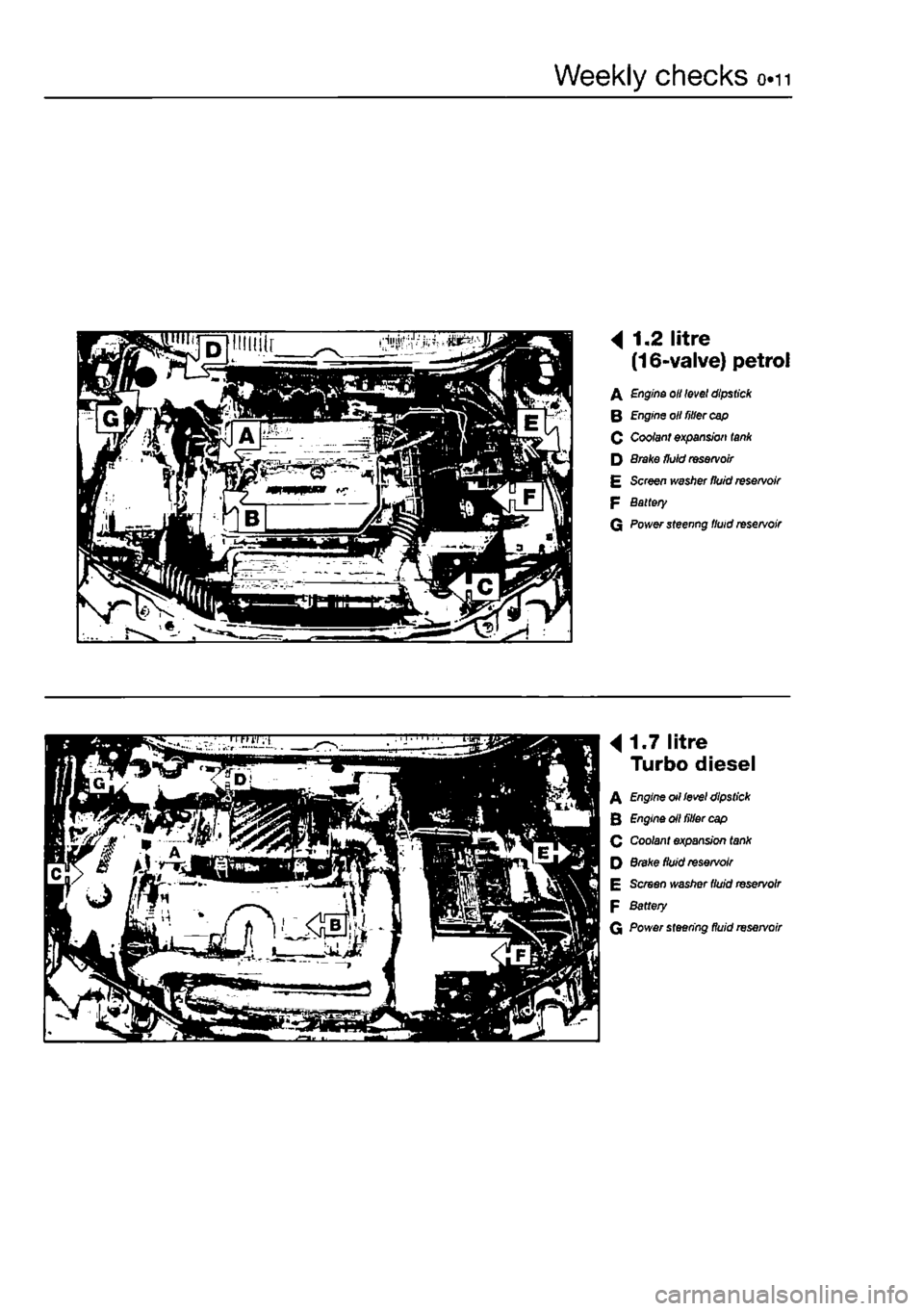
4 1.2 litre (16-valve) petrol
A Engine oil level dipstick
B Engine oil fitter cap 0 Coolant expansion tank D 8rake fluid reservoir £ Screen ivasfter fluid reservoir P Battery G Power steenng fluid reservoir
B
4
1.7 litre Turbo diesel
A Engine otl level dipstick B Engine oil filler cap Q Coolant expansion tank Q Brake fluid reservoir E Screen washer fluid reservoir F Battery
G Power steering fluid reservoir
Page 13 of 225
o*i2 Weekly checks
Engine oil level
Before you start • Make euro that your cor is on level ground. • Check ihe oil level oefore ihe cor is driven, or at least 5 minutes alter the engine has been switched off.
HHifffl If tho oil Is checked rTf"™^ Immediately after driving the IHlAIT vehicle,
some
of the oil will " remain In the upper engine components, resulting in on inaccurate reading on the dipstick!
The correct oil Modern engines place great demands on their oil. It Is very important that the correct oil for your car is used
Car Care • If you have to add oil frequently, you should check whother you have any oil leaks. Place some clean paper under the car overnight, and check for stains In the morning. If there are no leaks, the engine may be burning oil.
• Always maintain the level between the upper and lower dipstick marks (see pholo 2). If Ihe level Is too low
sqvoio
engine damage may oecur. Oil seal failure may result if tho engine is overfilled by adding too much oil.
I
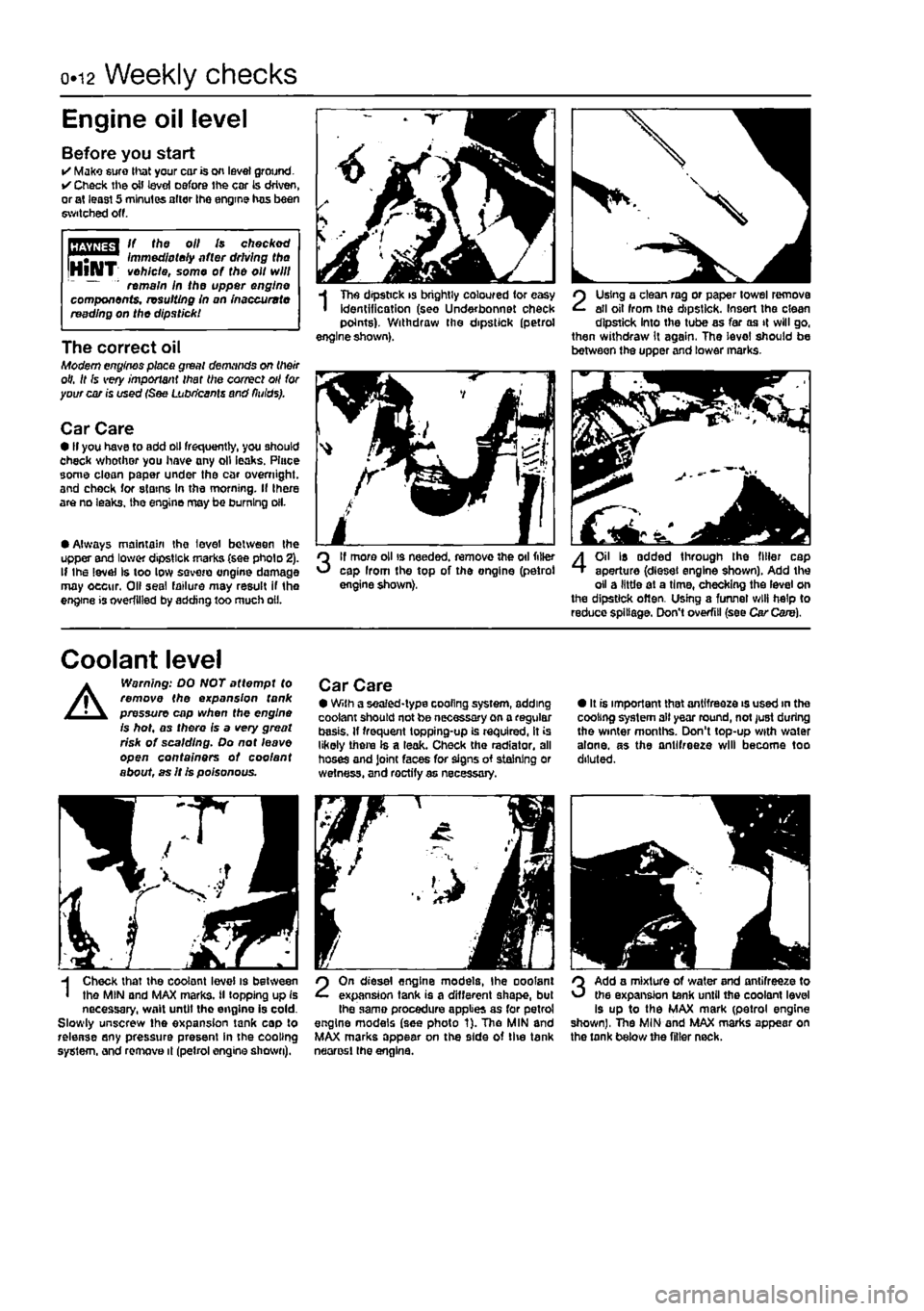
Tho dipstick is brightly coloured for easy identification (seo Under bonnet check points). Withdraw the dipstick (petrol engine shown).
3
If more oil is needed, remove the oil filler cap Irom the top of the ongine (petrol engine shown).
SI i J
2
Using a clean rag or paper towel remove all oil from the dipstick. Insert the clean dipstick into the tube as far as it will go, then withdraw it again. The level should be between the upper and lower marks.
4
Oil Is added through the filler cap aperture (diesel engine shown). Add the oil a little at a time, checking the level on the dipstick often. Using a funnel will help to reduce spillage. Don't overfill (see Car Care).
Coolant level
A
Warning: DO NOT attempt to remove the expansion tank pressure cap when the engine is hot, as there is a very great risk of scalding. Do not leave open containers of coo/ant about, as It is poisonous.
Car Care • With a sealed-type cooling system, adding coolant should not be necessary on a regular basis. If frequent topping-up is required, it is likely there Is a leak. Check the radiator, all hoses and Joint faces for signs of staining or wetness, and roctify as necessary.
• It is important that antifreeze is used in the cooling system all year round, not just during the winter months. Don't top-up with water alone, as the antifreeze will become too diluted.
H Check that the coolant level is between I the MIN and MAX marks, il topping up is necessary, wait until tho engine is cold. Slowly unscrew the expansion tank cap to release any pressure present in the cooling system, and remove it (petrol engine shown).
2
On diesel engine models, Ihe ooolant expansion tank is a different shape, but Ihe same procedure applies as for petrol engine models (see photo 1). Tho MlN and MAX marks appear on the side of tlie tank neorosl the engine.
3
Add a mixture of water and antifreeze to the expansion tank until the coolant level is up to the MAX mark (petrol engine shown), The MIN and MAX marks appear on the tank below the filler neck.
Page 14 of 225
Weekly checks 0.13
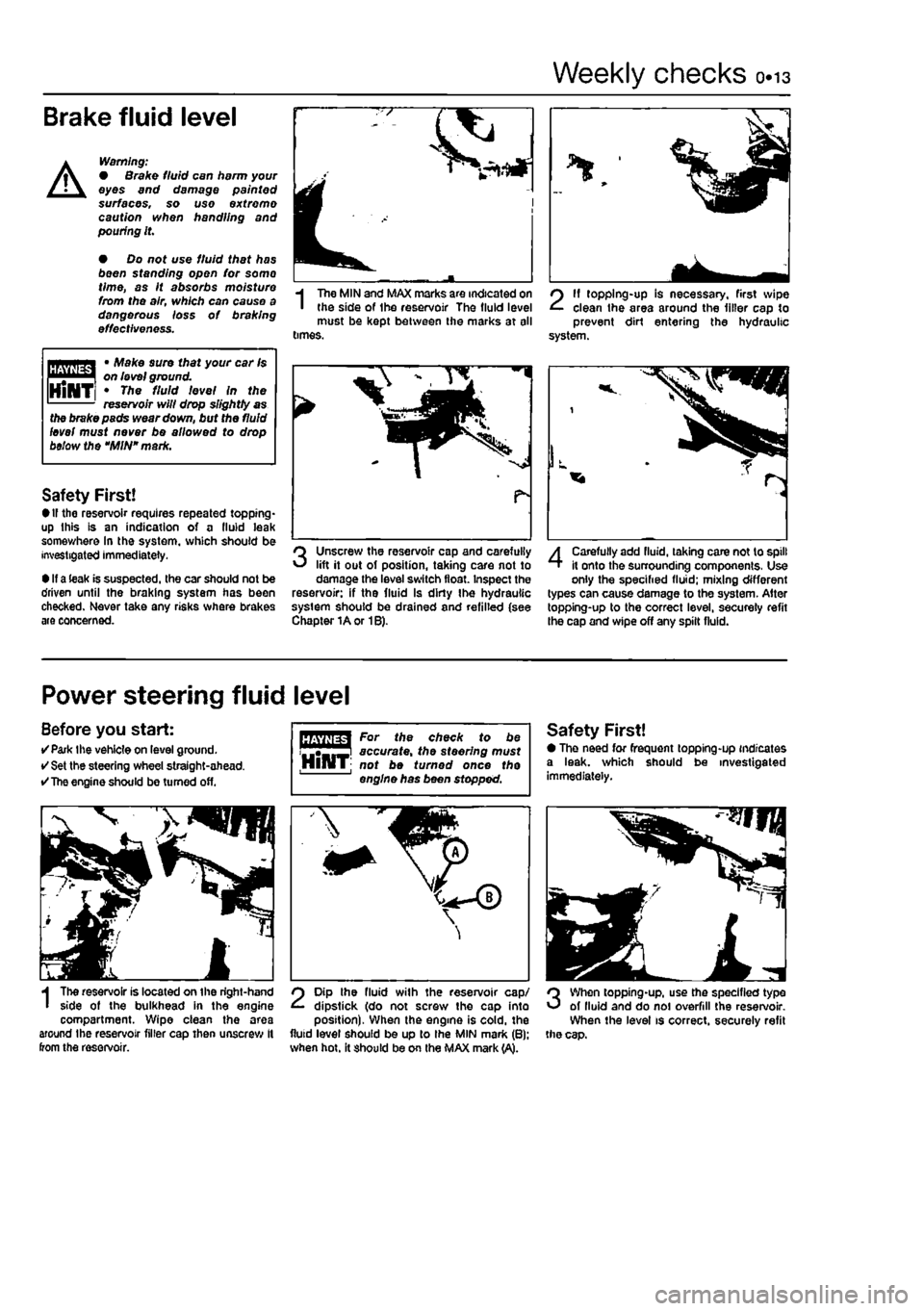
Brake fluid level
A
Warning: • Brake fluid can harm your eyes and damage painted surfaces, so use extreme caution when handling and pouting it.
• Do not use fluid that has been standing open for so mo time, as It absorbs moisture from the air, which can cause a dangerous loss of braking effectiveness.
Mpmna * Make sure that your car Is I on level ground. HiNTi * Th* ffftt 'eve/ In the reservoir will drop slightly as
I
The MIN and MAX marks are indicated on the side of Ihe reservoir The fluid level must be kept between the marks at all times.
2
11 topping-up is necessary, first wipe clean the area around the filler cap to prevent dirt entering the hydraulic system.
the brake pads wear down, but the fluid level must never be allowed to drop below the "MIN" mark.
Safety First! • If the reservoir requires repeated topping* up this is an indication of a fluid leak somev/here In the system, which should be investigated immediately.
• If a leak is suspected, the car should not be driven until the braking system has been checked. Never take any risks where brakes are concerned.
Unscrew the reservoir cap and carefully lift it out of position, taking care not to damage the level switch float. Inspect the reservoir: if the fluid Is dirty Ihe hydraulic system should be drained and refilled (see Chapter 1A or 1B).
4
Carefully add fluid, taking care not to spill it onto the surrounding components, Use only the specified fluid; mixing different types can cause damage to the system. After topping-up to the correct level, secureiy refit the cap and wipe off any spilt fluid.
Power steering fluid level
Before you start: •Park the vehicle on level ground. • Set the steering wheel straight-ahead. •
The
engine should be turned off.
I
The reservoir is located on the right-hand side of the bulkhead in the engine compartment. Wipe clean the area around the reservoir filler cap then unscrew It from the reservoir.
For the check to be accurate, the steering must HlHT; not be turned once the engine has been stopped.
2
Dip the fluid with the reservoir cap/ dipstick (do not screw the cap into position). When the engine is cold, the fluid level should be up to Ihe MIN mark (B): when hot. it should be on the MAX mark (A).
Safety First! • The need for frequent topping-up indicates a leak, which should be investigated immediately.
3
When topping-up, use the specified type of lluid and do noi overfill the reservoir. When the level is correct, securely refit the cap.
Page 16 of 225
Weekly checks 015
Automatic transmission fluid level
Before you start: • Park the vohicle on level ground, and apply the handbrake firmly. Let the engine idle, and select P or N.
Safety First! • The need for frequent topping-up indicates a leak, which should bo Investigated immediately.
I
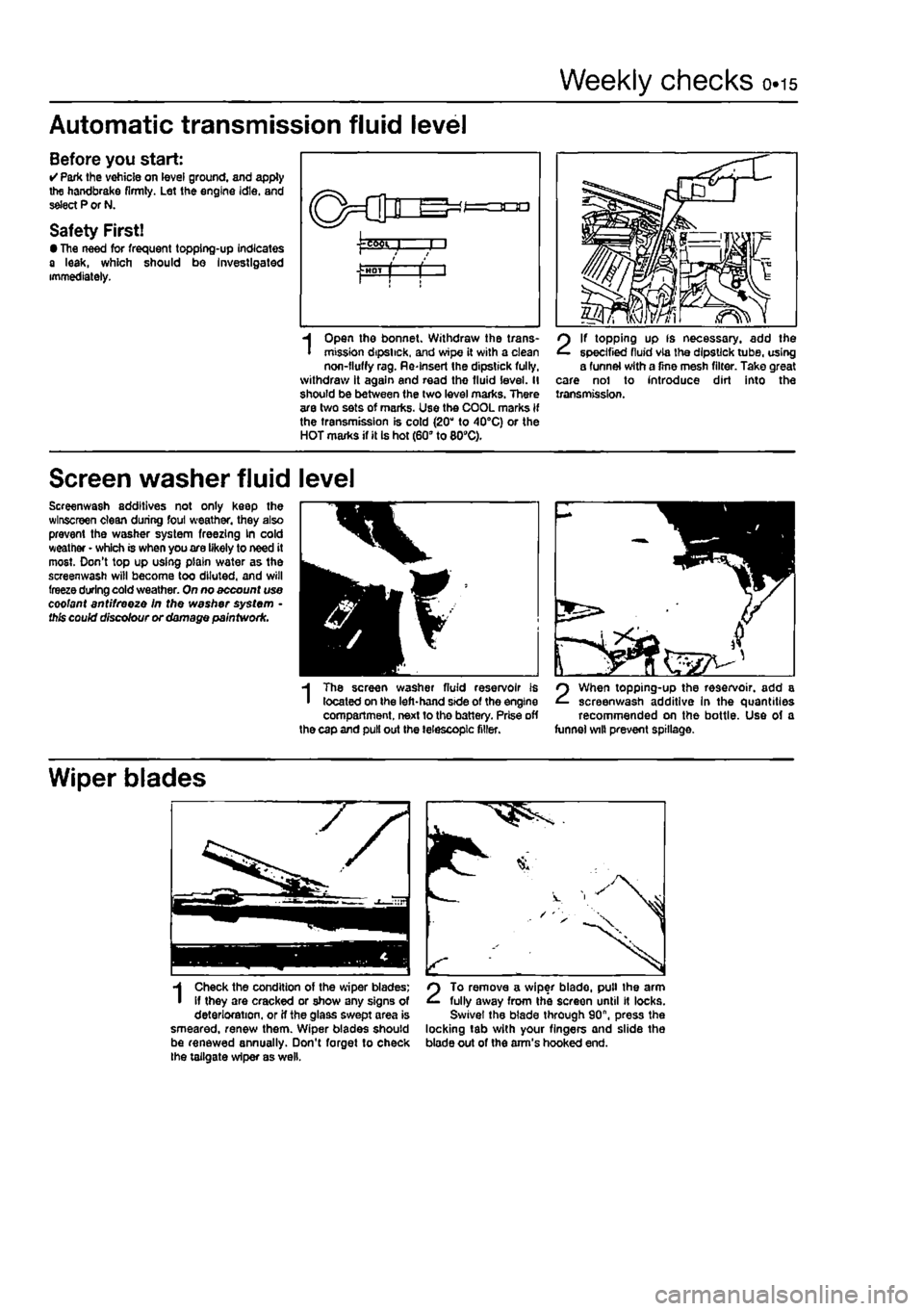
Open the bonnet. Withdraw the trans-mission dipstick, and wipe it with a clean non-fluffy rag. Re-Insert the dipstick fully, withdraw it again and read the fluid level. II should be between (he two level marks. There are two sets of marks. Use the COOL marks if the transmission is cold (20" to 40°C) or the HOT marks if it Is hot (60" to 809C).
2
If topping up fs necessary, add the specified fluid via the dipstick tube, using a funnel with a fine mesh filter. Take great care nol to introduce dirt into the transmission.
Screen washer fluid level
Screenwash additives not only keep the wlnscreen clean during foul weather, they also prevent the washer system freezing kn cold weather • which is when you are likely to need it most. Don't top up using plain water as the screenwash will become too diluted, and will freeze during cold weather. On no account use coolant antifreeze In the washer system • this could discolour or damage paintwork.
3H
m
I
The screen washer fluid reservoir is located on the left-hand side of the engine compartment, next to the battery. Prise off the cap and pull out the telescopic filler.
2
When topping-up the reservoir, add a screenwash additive In the quantities recommended on the bottle. Use of a funnel wilt prevent spillage.
Wiper blades
1
Check the condition of the wiper blades; if they are cracked or show any signs of deterioration, or if the glass swept area is smeared, renew them. Wiper blades should be renewed annually. Don't forget to check the tailgate wiper as well.
2
To remove a wiper blade, pull the arm fully away from the screen until It locks. Swivel the blade through 90", press the locking tab with your fingers and slide the blade out of the arm's hooked end.
Page 21 of 225
ia.2 Servicing specifications - petrol models
Lubricants and fluids Refer to end ot Weekly checks on page 0*17
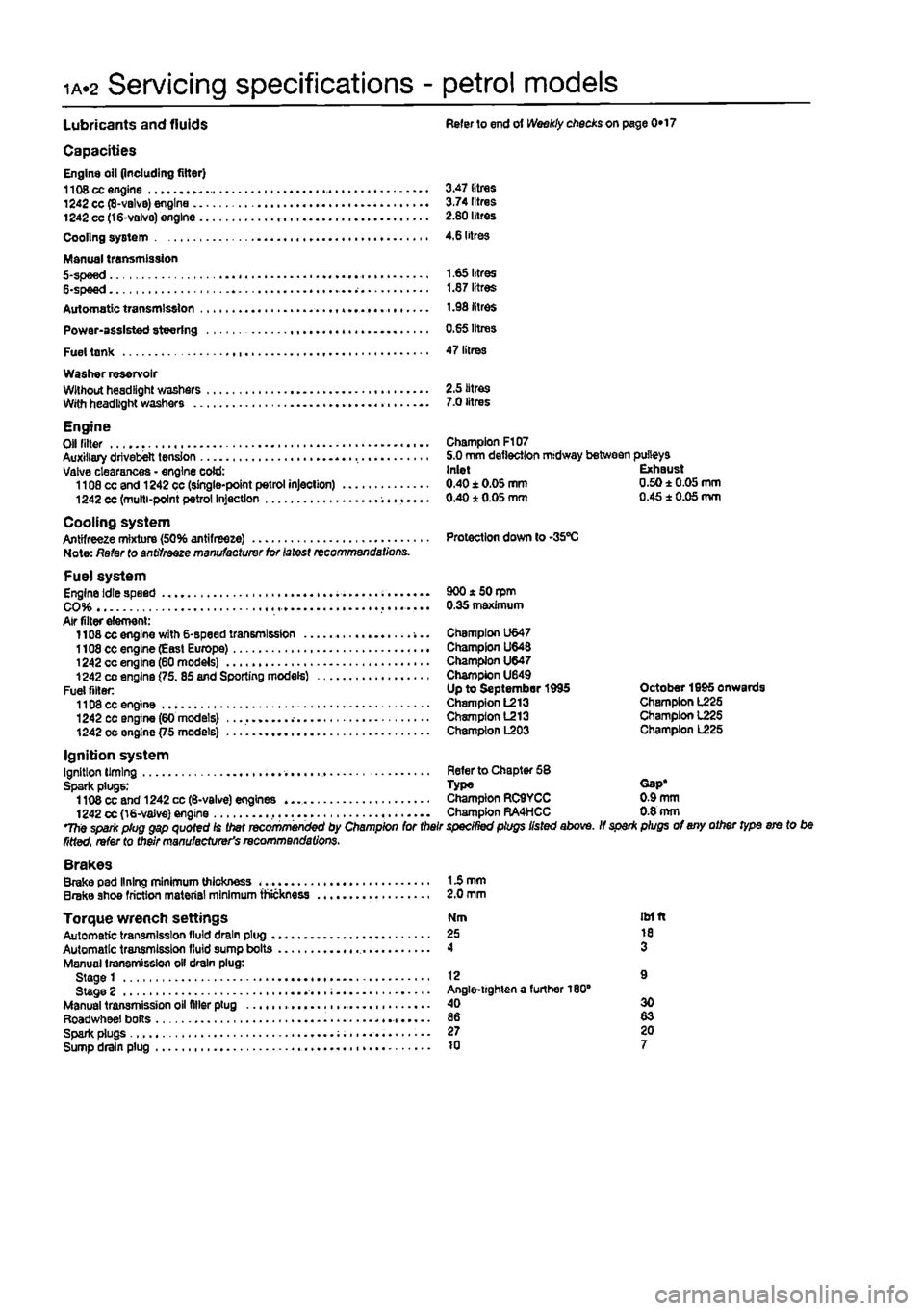
Capacities Engine oil (including filter) 1108 cc engine 3.47 litres 1242 cc (8-valvB) engine 3.74 litres 1242 cc (16-valve) engine 2.80 litres Cooling system 4,6 litres
Manual transmission 5-spee d 1.65 litres 6-spee d 1.87 litres Automatic transmission 1.98 litres Power-assisted steering 0.65 Irtres Fuel tank 47 litres Washer reservoir Wllhouthesdllghl washers 2.5 litres With headlight washers 7.0 litres
Engine Olf niter - Champion F107 Auxiliary drivebelt tension 5.0 mm deflection midway between pulleys Valve clearances - engine cold: Inlet Exhaust 1108 cc and 1242 cc (single-point petrol injection) 0.40±0.05mm 0.50±0.05mm 1242 cc (multi-point petrol Injection 0.40 1 0.05 mm 0.45 1 0.05 mm
Cooling system Antifreeze mixture (50% antifreeze) Protection down to -35"C Note: Refer to antifreeze manufacturer for latest recommendations.
Fuel system Engine idle speed . 900 * 50 rpm CO 0.35 maximum Air filter element: 1108 cc engine with 6-speed transmission -... Champion U647 1108 cc engine (Easl Europe) Champion U648 1242 cc engine (60 models) Champion U647 1242
CO
engine (75.85 and Sporting models) Champion U649 Fuel filler: Up to September 1995 October 1995 onwards 1108 cc engine Champion L213 Champion L225 1242 cc engine (60 models) Champion L213 Champion 1225 1242 cc engine {75 models) Champion L203 Champion L225
Ignition system Ignition liming Refer to Chapter 58 Spark plugs: Type Gap* 1108 cc and 1242 cc (6-valve) engines Champion RC9YCC 0.9 mm 1242 cc (16-valve) engine ,... Champion RA4HCC 0.8 mm The spark plug gap quoted Is Diet recommenced by Champion for their specined plugs listed above. If spar* plugs of any other type ere to be fitted, refer to their manufacturer's recommendations. Brakes Brake pad lining minimum thickness 15 mm Brake shoe friction material minimum thickness 2.0 mm
Torque wrench settings Nm itrfft Automatic transmission lluld drain plug 25 10 Automatic transmission fluid sump bolts 4 3 Manual transmission oil drain plug: Stage 1 12 9 Stage 2 Angle-lighten a further 180" Manual transmission oil filler plug 40 30 Roadwheel bolts 86 83 Spark plugs 27 20 Sump drain plug 10 7
Page 23 of 225
ia«4 Component location - petrol models
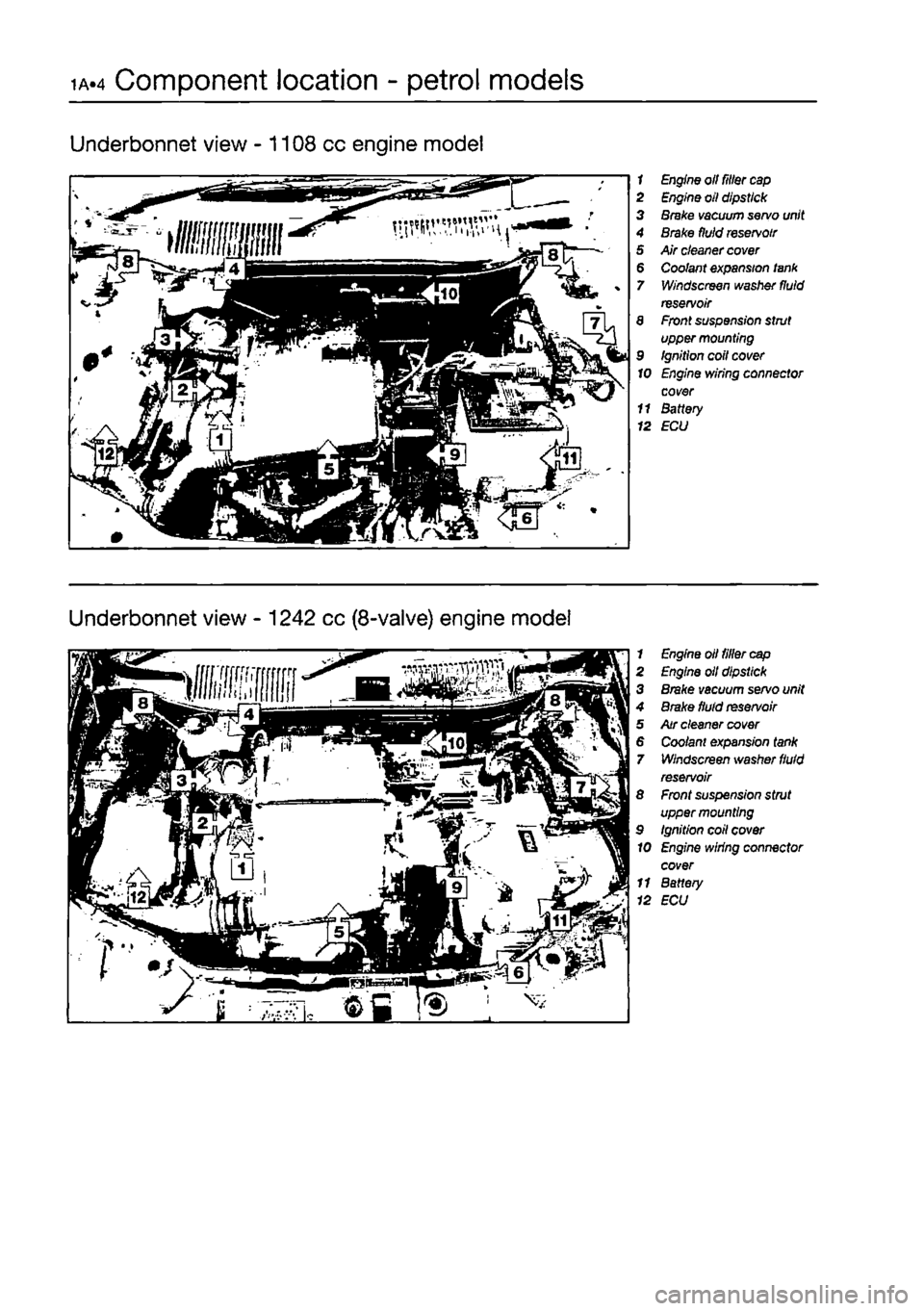
Underbonnet view -1108 cc engine model
1 Engine oil filler
cap
2 Engine oil dipstick 3 Brake vacuum servo unit 4 Brake fluid
reservoir
5 Air cleaner
cover
6 Coolant expansion lank 7 Windscreen washer fluid reservoir 8 Front suspension strut upper mounting 9 Ignition coil cover 10 Engine wiring connector cover 11 Battery 12 ECU
Underbonnet view - 1242 cc (8-valve) engine model
1 Engine oil tiller
cap
2 Engine oil dipstick 3 Brake vacuum servo unit 4 Brake fluid
reservoir
5 Air cleaner cover 6 Coo/ant expansion tank 7 Windscreen washer
fluid
reservoir 8 Front suspension strut upper mounting 9 Ignition coil cover 10 Engine wiring connector cover 11 Battery 12 ECU
Page 24 of 225
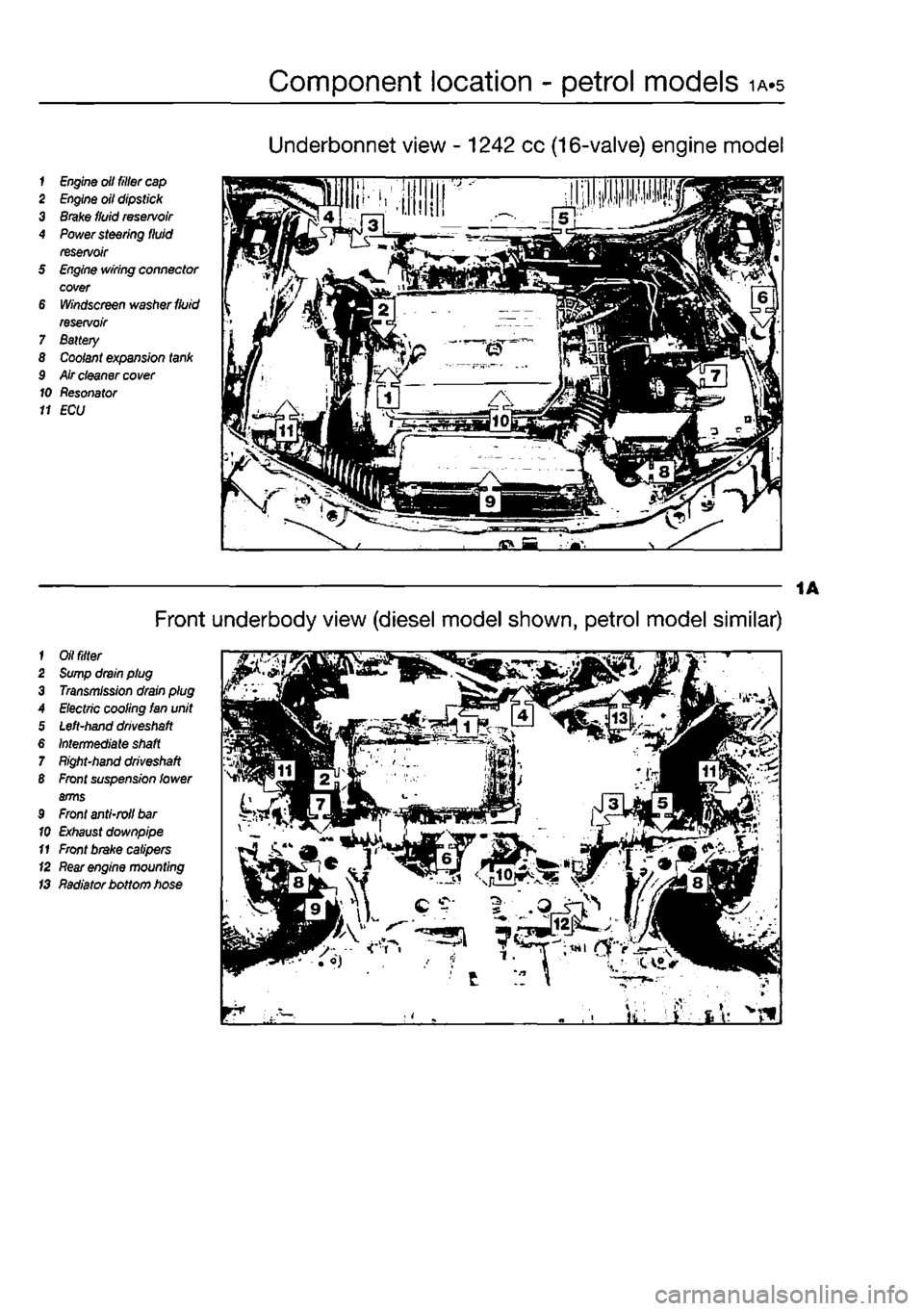
Component location - petrol models 1A.5
Underbonnet view - 1242 cc (16-valve) engine model
1
Engine
olt filler
cap
2
Engine
oil dipstick 3
Brake
fluid
reservoir
4
Power
steering fluid reservoir 5
Engine
wiring connector cover 6
Windscreen
washer
fluid
reservoir 7 Battery 8
Coolant
expansion
tank
9 Air cleaner
cover
10 Resonator 11 ECU
1
Oil filter
2
Sump
drain plug 3
Transmission
drain plug A
Electric
cooling Ian unit 5
Left-hand driveshaft
6
Intermediate shaft
7
Right-hand driveshaft
B
Front
suspension lower arms 9
Front
anti-roll
bar
10
Exhaust
downpipe 11
Front
brake calipers (2
Rear engine
mounting IS Radiator bottom hose
Front underbody view (diesel model shown, petrol model similar)
Page 26 of 225
Maintenance procedures - petrol models ia./
Every 5000 miles (7500 km) or 6 months
3 Engine oil and filter renewal Ja*
1 Frequent oil and filter changes are the most important preventative maintenance which can be undertaken by the DIY owner. As engine oil ages, it becomes diluted and contaminated, which leads to premature engine wear. 2 Before starting this procedure, gather all Ihe necessary tools and materials. Also make sure that you have plenty of clean rags and newspapers handy, to mop up any spills. Ideally, the engine oil should be warm, as It
will
drain better, and more built-up sludge will
be
removed with it. Tske care, however, not to touch the exhaust or any other hot parts of the engine when working under the vehicle. To avoid any possibility of scalding, and to protect yourself from possible skin irritants end other harmful contaminants in used engine oils, it Is advisable to wear gloves when carrying out this work. Access to the underside of the vehicle will be greatly Improved if it can be raised on a lift, driven onto ramps, or jacked up and supported on axle stands (see Jacking and vehicle support). Whichever method is chosen, make sure that
the
vehicle remains level, or if it is at an angle, that the drain plug Is at the lowest point. 3 Slacken the drain plug about half a turn using an Allen key. Position the draining container under the drain plug, then remove
the plug
completely (see Haynes Hint). 4 Allow some time for the old oil to dram, noting that it may be necessary to reposition
the
container as the oil flow slows to a trickle. 5 After all the oil has drained, wipe off the drain plug with a clean rag, then clean the area around the drain plug opening and refit
(MB
HiNT '
Keep the drain plug pressed Into the sump white unscrewing it by hand the last couple of turns. As the plug releases, move it away sharply so that the stream
of
oil Issuing from the sump runs into the container, net up your sleeve.
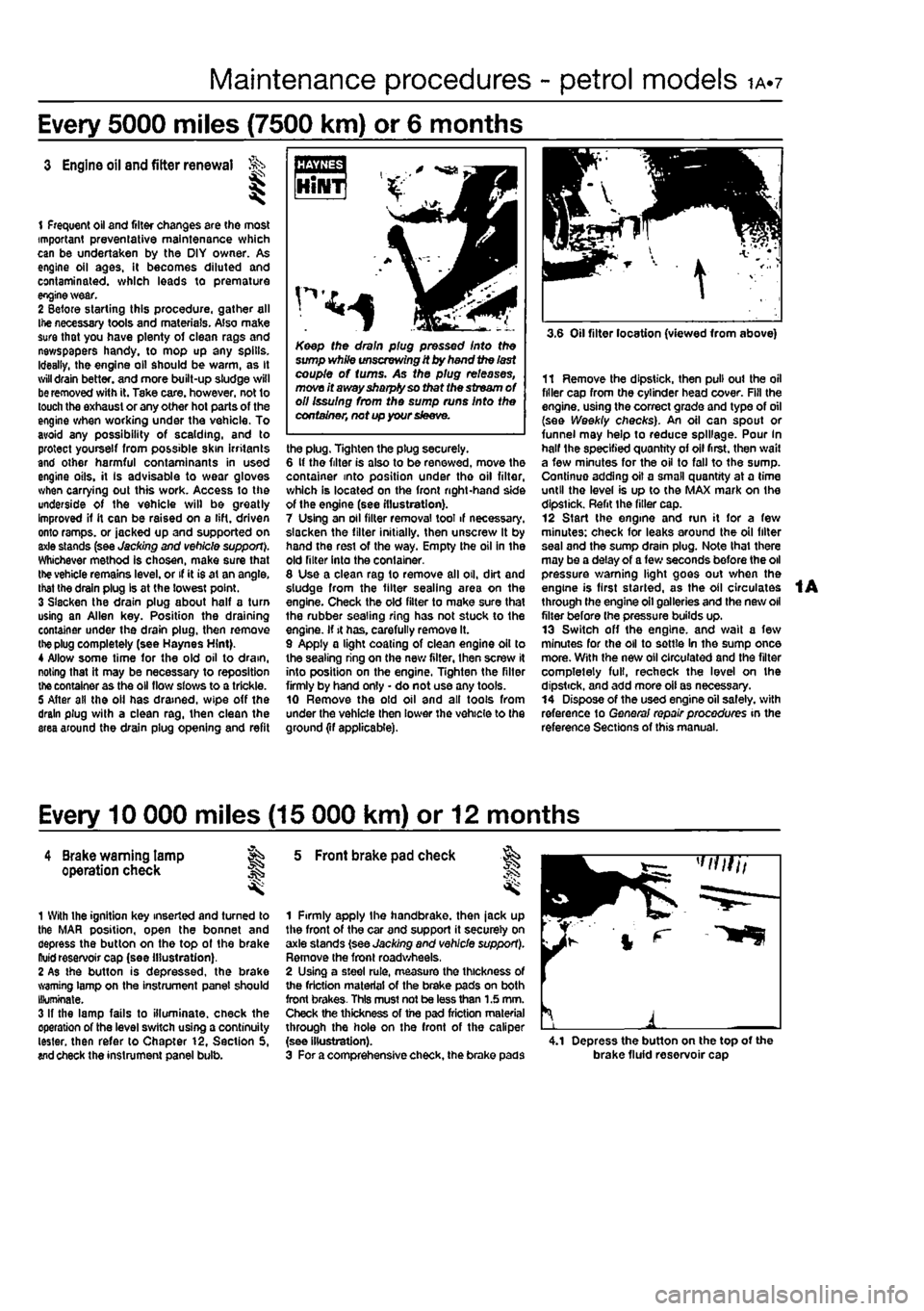
the plug. Tighten the plug securely. 6 It the filter is also to be renewed, move the container into position under tho oil filter, which is located on the front right-hand side of the engine (see illustration). 7 Using an oil filter removal tool if necessary, slacken the filter initially, then unscrew It by hand the rest of the way. Empty the oil in the old filter into the container. 8 Use a clean rag to remove all oil, dirt and sludge from the filter sealing area on the engine. Check the old filter to make sure that the rubber sealing ring has not stuck to the engine. If it has. carefully remove It. 9 Apply a light coating of clean engine oil to the sealing ring on the new filter, then screw it into position on the engine. Tighten the filter firmly by hand only • do not use any tools. 10 Remove the old oil and all tools from under the vehicle then lower the vehicle to the ground (if applicable).
3.6 Oil filter location (viewed from above)
11 Remove the dipstick, then pull out the oil filler cap from the cylinder head cover. Fill the engine, using the correct grade and type of oil (see Weekly checks). An oil can spout or funnel may help to reduce spillage. Pour In half the specified quantity of oil first, then wail a few minutes for the oil to fall to the sump. Continue adding oil a small quantity at a time until the level is up to the MAX mark on the dipstick. Refit the filler cap. 12 Start the engine and run it for a few minutes: check for leaks around the oil filter seal and the sump drain plug. Note that there may be a delay of a few seconds before the oil pressure warning light goes out when the engine is first started, as the oil circulates through the engine oil galleries and the new oil filter before (he pressure builds up. 13 Switch off the engine, and wait a few minutes for the oil to settle In the sump once more. With the new oil circulated and the filter completely full, recheck the level on the dipstick, and add more oil as necessary. 14 Dispose of the used engine oil safely, with reference to General repair procedures in the reference Sections of this manual.
Every 10 000 miles (15 000 km) or 12 months
4 Brake warning lamp ag operation check J§
1 With the ignition key inserted and turned to the MAR position, open the bonnet and depress the button on the top of the brake ftuid reservoir cap (see illustration). 2 As the button is depressed, the brake warning lamp on the instrument panel should Illuminate. 3 If the lamp fails to illuminate, check the operation of the level switch using a continuity tester, then refer to Chapter 12, Section 5, wd check the instrument panel bulb.
5 Front brake pad check
1 Firmly apply the handbrake, then jack up the front of the car and support it securely on axle stands (see Jacking and vehicle support). Remove the front roadwheels, 2 Using a steel rule, measure the thickness of the friction material of the brake pads on both front brakes- This must not be less than 1.5 mm. Check the thickness of the pad friction material through the hole on the front of the caliper (see illustration). 3 For a comprehensive check, the brake pads 4.1 Depress the button on the top of the brake fluid reservoir cap