air condition FIAT PUNTO 2020 Owner handbook (in English)
[x] Cancel search | Manufacturer: FIAT, Model Year: 2020, Model line: PUNTO, Model: FIAT PUNTO 2020Pages: 219, PDF Size: 9.82 MB
Page 131 of 219
127
SAFETY
STARTING
AND DRIVING
IN AN
EMERGENCY
SERVICE
AND CARE
TECHNICAL
SPECIFICATIONS
INDEX
CONTROLS
AND DEVICES
WARNING
LIGHTS AND MESSAGES
ç
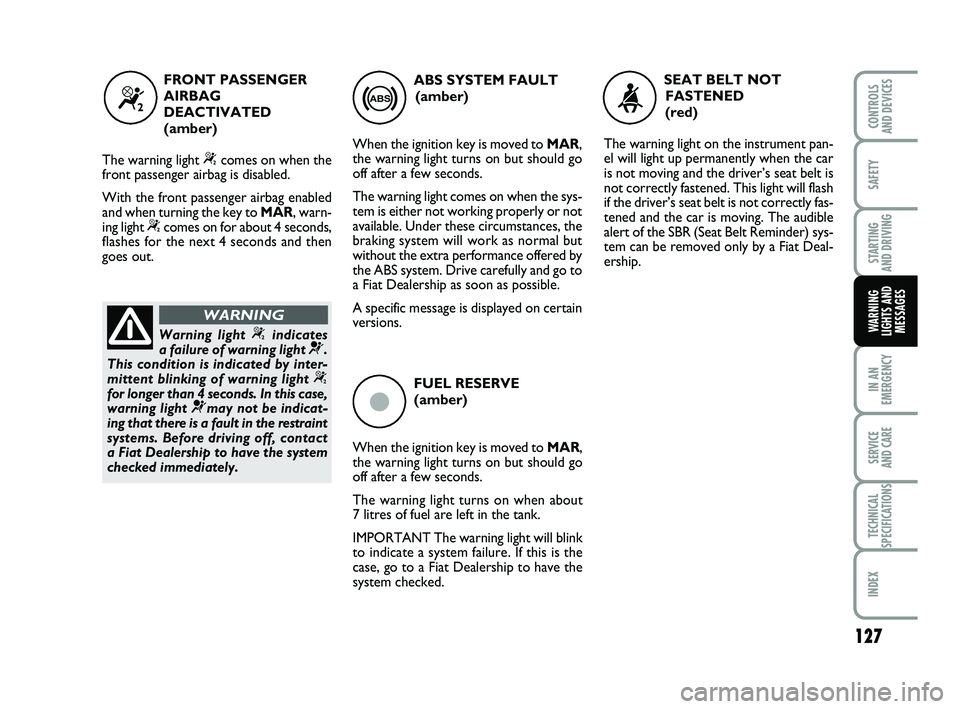
FUEL RESERVE
(amber)
When the ignition key is moved to MAR,
the warning light turns on but should go
off after a few seconds.
The warning light turns on when about
7 litres of fuel are left in the tank.
IMPORTANT The warning light will blink
to indicate a system failure. If this is the
case, go to a Fiat Dealership to have the
system checked. ABS SYSTEM FAULT
(amber)
When the ignition key is moved to MAR,
the warning light turns on but should go
off after a few seconds.
The warning light comes on when the sys-
tem is either not working properly or not
available. Under these circumstances, the
braking system will work as normal but
without the extra performance offered by
the ABS system. Drive carefully and go to
a Fiat Dealership as soon as possible.
A specific message is displayed on certain
versions.
>“
FRONT PASSENGER
AIRBAG
DEACTIVATED
(amber)
The warning light
“comes on when the
front passenger airbag is disabled.
With the front passenger airbag enabled
and when turning the key to MAR, warn-
ing light
“comes on for about 4 seconds,
flashes for the next 4 seconds and then
goes out.
Warning light
“indicates
a failure of warning light ¬.
This condition is indicated by inter-
mittent blinking of warning light
“for longer than 4 seconds. In this case,
warning light ¬may not be indicat-
ing that there is a fault in the restraint
systems. Before driving off, contact
a Fiat Dealership to have the system
checked immediately.
WARNING
SEAT BELT NOT
FASTENED
(red)
The warning light on the instrument pan-
el will light up permanently when the car
is not moving and the driver’s seat belt is
not correctly fastened. This light will flash
if the driver’s seat belt is not correctly fas-
tened and the car is moving. The audible
alert of the SBR (Seat Belt Reminder) sys-
tem can be removed only by a Fiat Deal-
ership.
<
121-132 PUNTO POP 1ed EN 29/08/13 15.03 Pagina 127
Page 162 of 219
158
SAFETY
STARTING
AND DRIVING
WARNING
LIGHTS AND MESSAGES
SERVICE
AND CARE
TECHNICAL
SPECIFICATIONS
INDEX
CONTROLS
AND DEVICES
IN AN
EMERGENCY
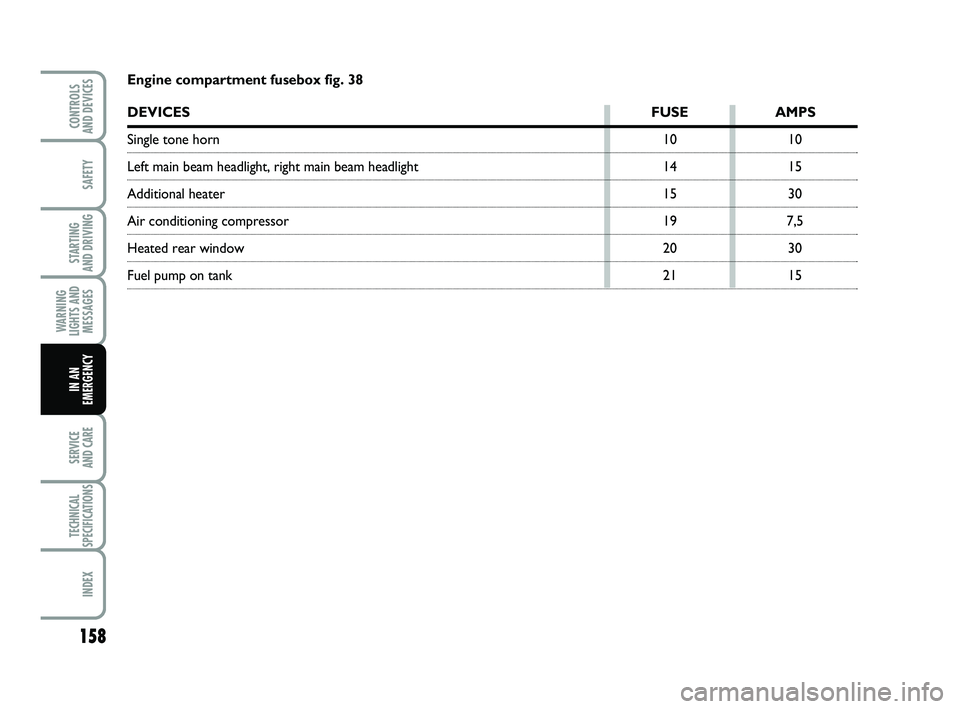
Engine compartment fusebox fig. 38
DEVICES FUSE AMPS
Single tone horn
Left main beam headlight, right main beam headlight
Additional heater
Air conditioning compressor
Heated rear window
Fuel pump on tank 10
14
15
19
20
21
10
15
30
7,5 30
15
133-164 PUNTO POP 1ed EN 24/03/14 13:05 Pagina 158
Page 170 of 219
166
SAFETY
STARTING
AND DRIVING
WARNING
LIGHTS AND MESSAGES
IN AN
EMERGENCY
TECHNICAL
SPECIFICATIONS
INDEX
CONTROLS
AND DEVICES
SERVICE
AND CARE
Scheduled Servicing is offered by all Fiat
Dealerships according to fixed time or
kilometres/miles intervals.
If, during each operation, in addition to
the ones scheduled, the need arises for
further replacements or repairs, these
may be carried out only with your explicit
agreement. If your car is used frequent-
ly for towing, the interval between one
service operation and the next should be
reduced. IMPORTANT INFORMATION
The Scheduled Servicing services are set
out by the Manufacturer. Failure to have
them carried out may invalidate the war-
ranty.
It is advisable to inform a Fiat Dealership
of any small operating irregularities with-
out waiting for the following servicing.
For versions equipped with specific fuel
supply and/or trim level (e.g. LPG, Dua-
logic), in addition to what is described in
the following Scheduled Servicing Plan,
refer to the relevant additional items in
the dedicated supplements. SCHEDULED SERVICING
Correct servicing is crucial for guaran-
teeing a long life for the car under the
best conditions.
For this reason, Fiat has planned a series
of checks and services at fixed distance
intervals and, for versions/markets,
where provided, at fixed time intervals,
as described in the Scheduled Servicing
Plan.
Regardless of the above, it is always nec-
essary to carefully follow the instructions
in the Scheduled Servicing Plan (e.g. pe-
riodically check level of liquids, tyre pres-
sure, etc.).
165-184 PUNTO POP 1ed EN 07/04/14 09:35 Pagina 166
Page 172 of 219
168
SAFETY
STARTING
AND DRIVING
WARNING
LIGHTS AND MESSAGES
IN AN
EMERGENCY
TECHNICAL
SPECIFICATIONS
INDEX
CONTROLS
AND DEVICES
SERVICE
AND CARE
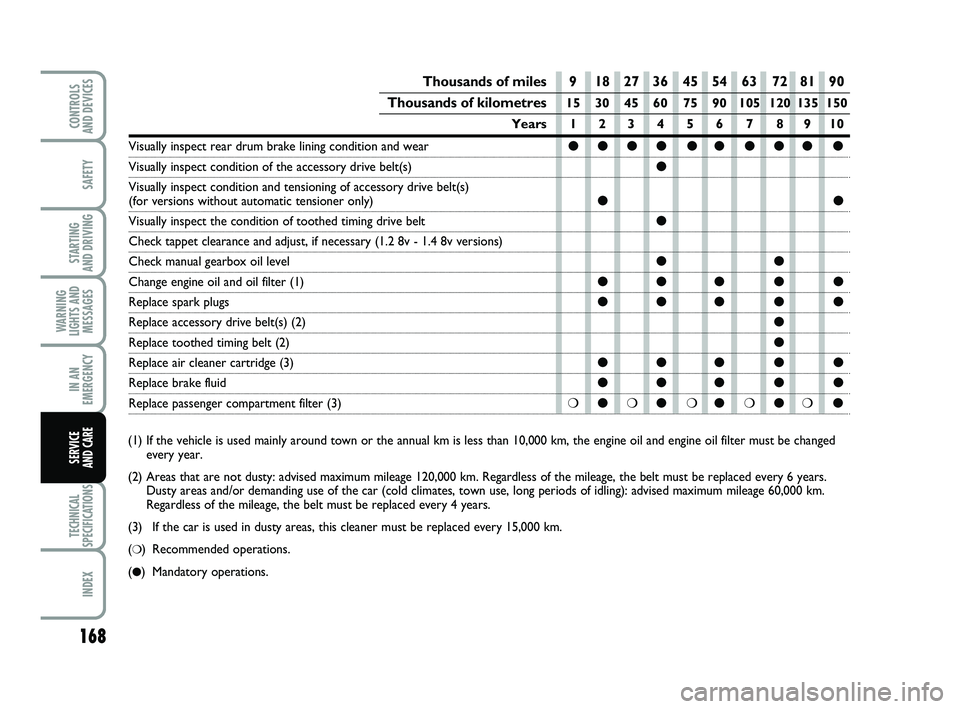
Thousands of miles 9 18 27 36 45 54 63 72 81 90
Thousands of kilometres15 30 45 60 75 90 105 120 135 150
Years 1234 56 7 8910
Visually inspect rear drum brake lining condition and wear●●●● ●● ●●● ●
Visually inspect condition of the accessory drive belt(s)●
Visually inspect condition and tensioning of accessory drive belt(s) (for versions without automatic tensioner only)●●
Visually inspect the condition of toothed timing drive belt●
Check tappet clearance and adjust, if necessary (1.2 8v - 1.4 8v versio\
ns)
Check manual gearbox oil level●●
Change engine oil and oil filter (1)●●● ●●
Replace spark plugs ●●● ●●
Replace accessory drive belt(s) (2)●
Replace toothed timing belt (2)●
Replace air cleaner cartridge (3) ●●● ●●
Replace brake fluid●●● ●●
Replace passenger compartment filter (3) ❍●❍●❍●❍●❍●
(1) If the vehicle is used mainly around town or the annual km is less\
than 10,000 km, the engine oil and engine oil filter mus t be changed
every year.
(2) Areas that are not dusty: advised maximum mileage 120,000 km. Rega\
rdless of the mileage, the belt must be replaced every 6 years.
Dusty areas and/or demanding use of the car (cold climates, town use, l\
ong periods of idling): advised maximum mileage 60,000 km.
Regardless of the mileage, the belt must be replaced every 4 years.
(3) If the car is used in dusty areas, this cleaner must be replaced every 1\
5,000 km.
(
❍) Recommended operations.
(
●) Mandatory operations.
165-184 PUNTO POP 1ed EN 07/04/14 09:35 Pagina 168
Page 174 of 219
170
SAFETY
STARTING
AND DRIVING
WARNING
LIGHTS AND MESSAGES
IN AN
EMERGENCY
TECHNICAL
SPECIFICATIONS
INDEX
CONTROLS
AND DEVICES
SERVICE
AND CARE
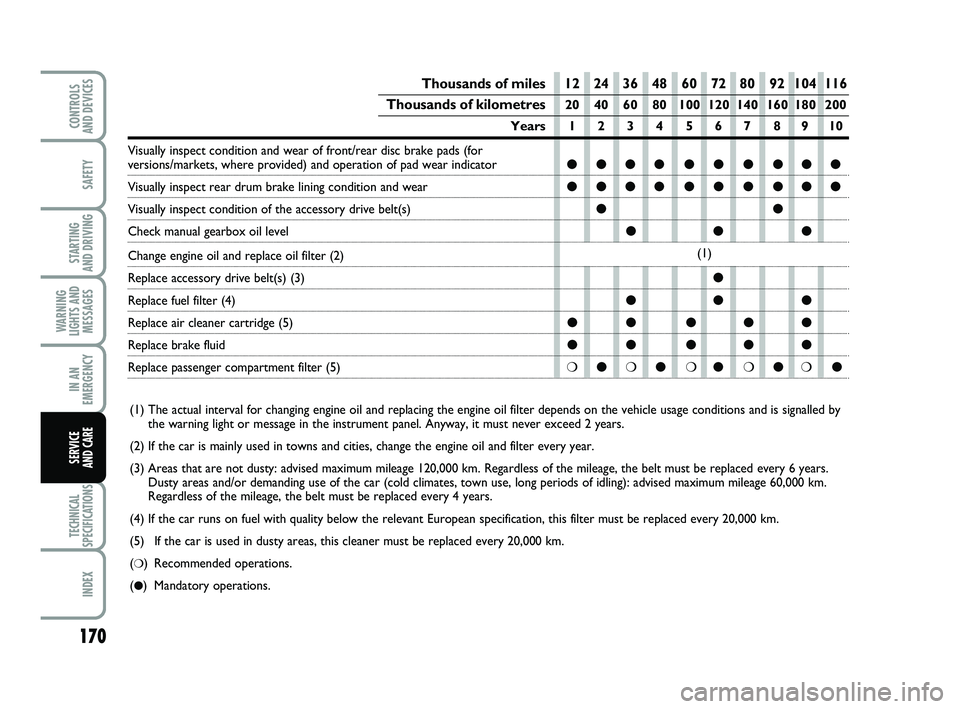
Thousands of miles 12 24 36 48 60 72 80 92 104 116
Thousands of kilometres20 40 60 80 100 120 140 160 180 200
Years 1234 567 8910
Visually inspect condition and wear of front/rear disc brake pads (for \
versions/markets, where provided) and operation of pad wear indicator●●●● ●● ●●●●
Visually inspect rear drum brake lining condition and wear●●●● ●● ●●●●
Visually inspect condition of the accessory drive belt(s)●●
Check manual gearbox oil level●● ●
Change engine oil and replace oil filter (2)
Replace accessory drive belt(s) (3) ●
Replace fuel filter (4)●● ●
Replace air cleaner cartridge (5) ●● ●●●
Replace brake fluid ●● ●●●
Replace passenger compartment filter (5) ❍●❍●❍●❍●❍●
(1) The actual interval for changing engine oil and replacing the engi\
ne oil filter depends on the vehicle usage conditions and is signalled by
the warning light or message in the instrument panel. Anyway, it must ne\
ver exceed 2 years.
(2) If the car is mainly used in towns and cities, change the engine o\
il and filter every year.
(3) Areas that are not dusty: advised maximum mileage 120,000 km. Rega\
rdless of the mileage, the belt must be replaced every 6 years.
Dusty areas and/or demanding use of the car (cold climates, town use, l\
ong periods of idling): advised maximum mileage 60,000 km.
Regardless of the mileage, the belt must be replaced every 4 years.
(4) If the car runs on fuel with quality below the relevant European s\
pecification, this filter must be replaced every 20,000 k m.
(5) If the car is used in dusty areas, this cleaner must be replaced every 2\
0,000 km.
(
❍) Recommended operations.
(
●) Mandatory operations.
(1)
165-184 PUNTO POP 1ed EN 07/04/14 09:35 Pagina 170
Page 175 of 219
171
SAFETY
STARTING
AND DRIVING
WARNING
LIGHTS AND MESSAGES
IN AN
EMERGENCY
TECHNICAL
SPECIFICATIONS
INDEX
CONTROLS
AND DEVICES
SERVICE
AND CARE
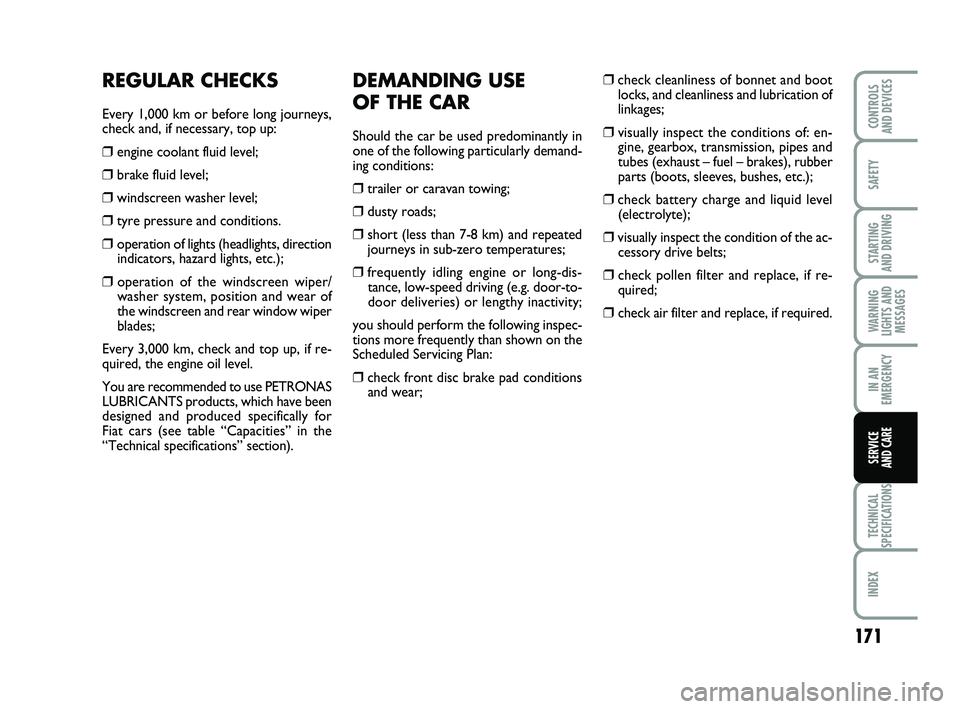
DEMANDING USE
OF THE CAR
Should the car be used predominantly in
one of the following particularly demand-
ing conditions:
❒trailer or caravan towing;
❒dusty roads;
❒short (less than 7-8 km) and repeated journeys in sub-zero temperatures;
❒ frequently idling engine or long-dis- tance, low-speed driving (e.g. door-to-
door deliveries) or lengthy inactivity;
you should perform the following inspec-
tions more frequently than shown on the
Scheduled Servicing Plan:
❒ check front disc brake pad conditions and wear;
❒check cleanliness of bonnet and bootlocks, and cleanliness and lubrication of
linkages;
❒ visually inspect the conditions of: en- gine, gearbox, transmission, pipes and
tubes (exhaust – fuel – brakes), rubber
parts (boots, sleeves, bushes, etc.);
❒check battery charge and liquid level(electrolyte);
❒visually inspect the condition of the ac-cessory drive belts;
❒check pollen filter and replace, if re-
quired;
❒check air filter and replace, if required.
REGULAR CHECKS
Every 1,000 km or before long journeys,
check and, if necessary, top up:
❒engine coolant fluid level;
❒brake fluid level;
❒windscreen washer level;
❒tyre pressure and conditions.
❒operation of lights (headlights, directionindicators, hazard lights, etc.);
❒operation of the windscreen wiper/
washer system, position and wear of
the windscreen and rear window wiper
blades;
Every 3,000 km, check and top up, if re-
quired, the engine oil level.
You are recommended to use PETRONAS
LUBRICANTS products, which have been
designed and produced specifically for
Fiat cars (see table “Capacities” in the
“Technical specifications” section).
165-184 PUNTO POP 1ed EN 07/04/14 09:35 Pagina 171
Page 181 of 219
177
SAFETY
STARTING
AND DRIVING
WARNING
LIGHTS AND MESSAGES
IN AN
EMERGENCY
TECHNICAL
SPECIFICATIONS
INDEX
CONTROLS
AND DEVICES
SERVICE
AND CARE
AIR FILTER
Have the air filter replaced by a Fiat Deal-
ership.
POLLEN FILTER
Have the pollen filter replaced by a Fiat
Dealership.
BATTERY
The battery is of the “Limited mainte-
nance” type: under normal conditions of
use, the electrolyte does not need topping
up with distilled water.
The battery fluid is poiso-
nous and corrosive. Avoid
contact with the skin and eyes. Keep
naked flames or possible sources of
sparks away from the battery: risk of
explosion or fire.
WARNING
CHECKING THE CHARGE
AND THE ELECTROLYTE LEVEL
Inspection operations must be carried out
only by specialised personnel, following
the prescriptions contained in this Own-
er Handbook. Any top-up operations
must be carried out only by specialised
personnel at a Fiat Dealership.
Using the battery when the
fluid is too low can damage
it irreparably and generate a risk of
explosion.
WARNING
REPLACING THE BATTERY
If required, replace the battery with an
original spare part with the same specifi-
cations.
If a battery with different specifications is
fitted, the service intervals given in the
“Scheduled Servicing Plan” will no longer
be valid.
For battery maintenance, you should
therefore refer to the instructions pro-
vided by the battery manufacturer.
165-184 PUNTO POP 1ed EN 07/04/14 09:35 Pagina 177
Page 186 of 219
182
SAFETY
STARTING
AND DRIVING
WARNING
LIGHTS AND MESSAGES
IN AN
EMERGENCY
TECHNICAL
SPECIFICATIONS
INDEX
CONTROLS
AND DEVICES
SERVICE
AND CARE
❒spraying protective plastic materials in the most exposed areas: underdoor, in-
ner mudguard parts, edges, etc.;
❒using “open” boxed sections to preventcondensation and pockets of moisture
from triggering rust inside.
BODY AND UNDERBODY
WARRANTY
Your car is covered by warranty against
perforation due to corrosion of any origi-
nal element of the structure or bodywork.
For the general terms of this warranty, re-
fer to your Warranty Booklet.
ADVICE FOR PRESERVING
THE BODYWORK
Paint
Paintwork does not only serve an aes-
thetic purpose, but also protects the un-
derlying sheet metal.
Touch up abrasions and scratches immedi-
ately to prevent the formation of rust. Use
only original paint products for touch-ups
(see “Bodywork paint identification” in the
“Technical specifications” section).
BODYWORK
PROTECTION FROM
ATMOSPHERIC AGENTS
The main causes of corrosion are the fol-
lowing:
❒atmospheric pollution;
❒salty air and humidity (coastal areas or hot and humid climates);
❒seasonal environmental conditions.
The abrasive action of wind-borne at-
mospheric dust and sand, as well as mud
and gravel raised by other cars, should not
be underestimated either.
Fiat used the best manufacturing tech-
nologies on your car to effectively protect
the bodywork against corrosion.
These are the most important:
❒painting products and systems which give the car particular resistance to cor-
rosion and abrasion;
❒use of galvanised (or pre-treated) steelsheets with high resistance to corro-
sion;
❒spraying the underbody, engine com-partment, wheelhouse internal parts
and other elements with highly protec-
tive wax-based products;
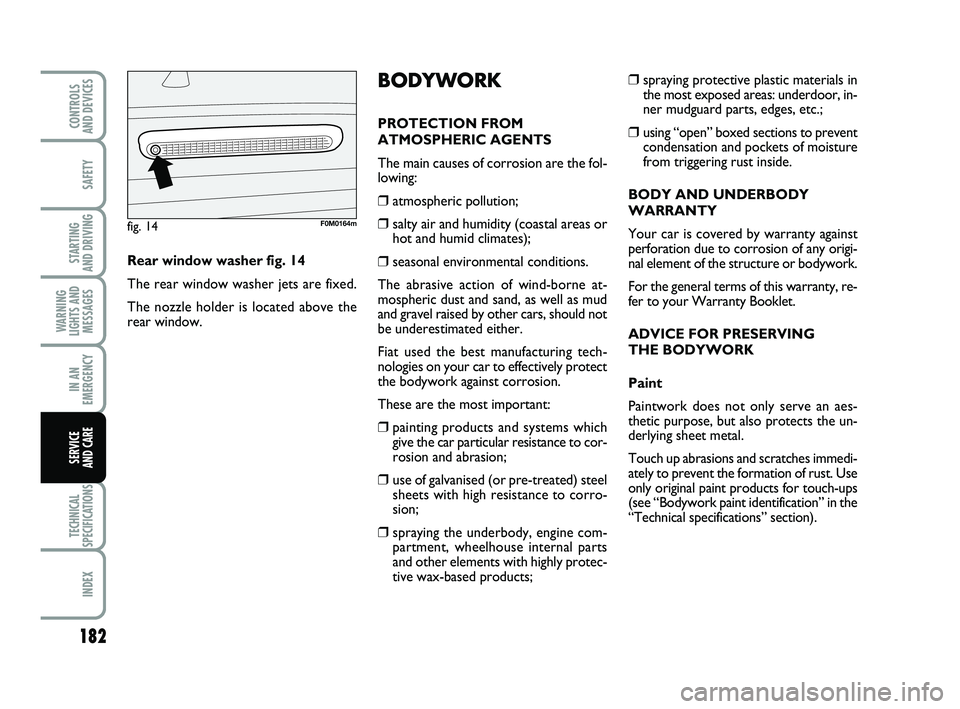
Rear window washer fig. 14
The rear window washer jets are fixed.
The nozzle holder is located above the
rear window.
fig. 14F0M0164m
165-184 PUNTO POP 1ed EN 07/04/14 09:35 Pagina 182
Page 187 of 219
183
SAFETY
STARTING
AND DRIVING
WARNING
LIGHTS AND MESSAGES
IN AN
EMERGENCY
TECHNICAL
SPECIFICATIONS
INDEX
CONTROLS
AND DEVICES
SERVICE
AND CARE
Standard upkeep of the paintwork consists
of washing the vehicle: the frequency de-
pends on the conditions and environment
where the vehicle is used. For example, it
is advisable to wash the car more often in
areas with high atmospheric pollution or
on gritted roads.
To wash the car properly, proceed as fol-
lows:
❒if taking your car through an automat- ic car wash, remove the aerial from the
roof;
❒wash the body using a low-pressure jetof water;
❒use a sponge to wipe a slightly soapy so-lution over the bodywork, frequently
rinsing the sponge;
❒rinse with plenty of water and dry witha jet of air or a chamois leather.
Take particular care when drying the less
visible parts, such as the door, bonnet and
headlight frames, where water can stagnate
more easily. It is a good idea to leave the
car in the open for a while after washing
it to give time for the water to evaporate. Do not wash the car after it has been left
in the sun or with the bonnet hot: this may
alter the shine of the paintwork.
Exterior plastic parts must be cleaned in
the same way as the rest of the car.
Where possible, do not park under trees;
the resinous substances that fall off many
species give the paint a dull appearance
and increase the possibility of triggering
rust processes.
IMPORTANT Bird droppings should be
washed off immediately and thoroughly
as the acid they contain is particularly
aggressive.Detergents pollute water. The
vehicle should be washed only
in areas equipped for collect-
ing and purifying the liquids
used in the washing process.
Windows
Use specific detergents to clean the win-
dows.
Also use clean cloths to avoid scratching
the glass or altering the transparency.
IMPORTANT Wipe the rear window
gently with a cloth in the direction of the
filaments to avoid damaging the heating
device.
Engine compartment
Wash the engine compartment thor-
oughly at the end of every winter. Be care-
ful not to direct the jet of water onto elec-
tronic control units. Adequately protect
the upper air vents to prevent damage to
the windscreen wiper motor. Have this
operation performed at a specialised
workshop.
IMPORTANT Washing should take place
with a cold engine and with the key at
STOP. After the wash, make sure that
the various protective devices (e.g. rubber
caps and guards) have not been removed
or damaged.
Front headlights
IMPORTANT Never use aromatic sub-
stances (e.g. petrol) or ketenes (e.g. ace-
tone) for cleaning the plastic lenses of the
front headlights.
165-184 PUNTO POP 1ed EN 07/04/14 09:35 Pagina 183
Page 206 of 219
202
SAFETY
STARTING
AND DRIVING
WARNING
LIGHTS AND MESSAGES
IN AN
EMERGENCY
SERVICE
AND CARE
INDEX
CONTROLS
AND DEVICES
TECHNICAL
SPECIFICATIONS
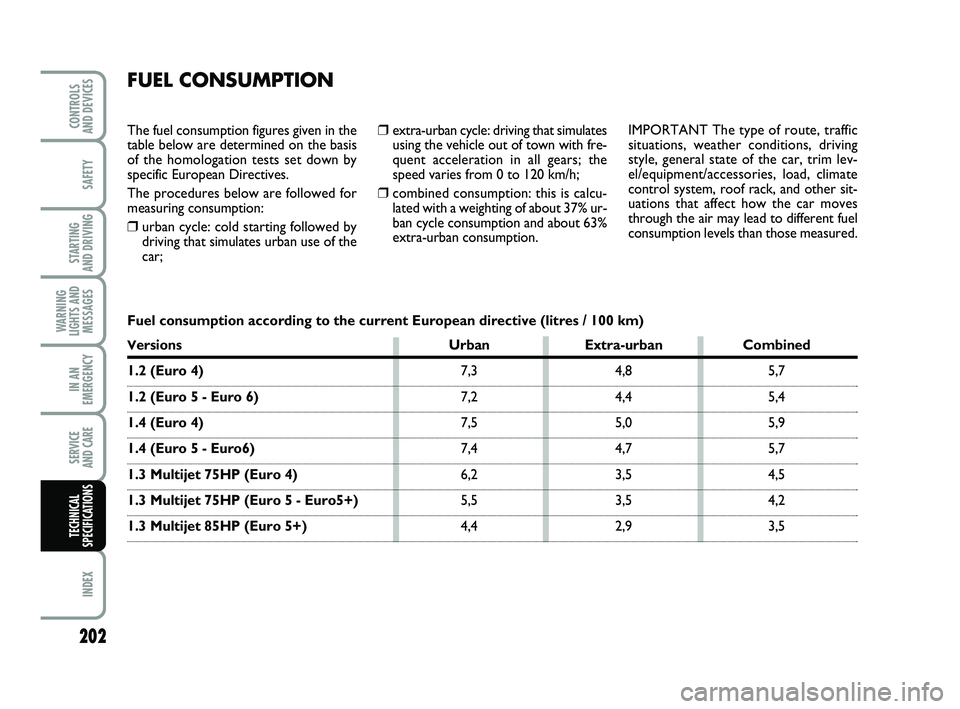
❒extra-urban cycle: driving that simulates using the vehicle out of town with fre-
quent acceleration in all gears; the
speed varies from 0 to 120 km/h;
❒combined consumption: this is calcu-lated with a weighting of about 37% ur-
ban cycle consumption and about 63%
extra-urban consumption.
The fuel consumption figures given in the
table below are determined on the basis
of the homologation tests set down by
specific European Directives.
The procedures below are followed for
measuring consumption:
❒urban cycle: cold starting followed by
driving that simulates urban use of the
car; IMPORTANT The type of route, traffic
situations, weather conditions, driving
style, general state of the car, trim lev-
el/equipment/accessories, load, climate
control system, roof rack, and other sit-
uations that affect how the car moves
through the air may lead to different fuel
consumption levels than those measured.
Fuel consumption according to the current European directive (litres / \
100 km)
Versions UrbanExtra-urban Combined
1.2 (Euro 4) 7,3 4,8 5,7
1.2 (Euro 5 - Euro 6)7,2 4,4 5,4
1.4 (Euro 4)7,5 5,0 5,9
1.4 (Euro 5 - Euro6)7,4 4,7 5,7
1.3 Multijet 75HP (Euro 4)6,2 3,5 4,5
1.3 Multijet 75HP (Euro 5 - Euro5+)5,5 3,5 4,2
1.3 Multijet 85HP (Euro 5+)4,4 2,9 3,5
FUEL CONSUMPTION
185-206 PUNTO POP 1ed EN 24/03/14 13:52 Pagina 202