instrument panel FIAT PUNTO 2020 Owner handbook (in English)
[x] Cancel search | Manufacturer: FIAT, Model Year: 2020, Model line: PUNTO, Model: FIAT PUNTO 2020Pages: 219, PDF Size: 9.82 MB
Page 116 of 219

112
SAFETY
WARNING
LIGHTS AND MESSAGES
IN AN
EMERGENCY
SERVICE
AND CARE
TECHNICAL
SPECIFICATIONS
INDEX
CONTROLS
AND DEVICES
STARTING
AND DRIVING
If, when the ignition key is at MAR, the in-
strument panel warning light
Yremains
lit together with warning light U, turn the
key to STOP and then back to MAR; if
the warning lights remain on, try using the
other keys provided with the car.
IMPORTANT If the instrument panel
warning light
Ystays on permanently,
contact a Fiat Dealership immediately.
IMPORTANT Never leave the ignition key
at MAR when the engine is off.
STARTING PROCEDURE
FOR DIESEL VERSIONS
Proceed as follows:
❒ensure that the handbrake is on;
❒put the gear lever into neutral;
❒turn the ignition key to MAR: the
warning lights
mand Yon the in-
strument panel will turn on;
❒wait for the warning lights Yand mto turn off. The hotter the engine is, the
quicker this will happen;
❒press the clutch pedal all the way down without touching the accelerator;
STARTING THE ENGINE
The car is fitted with an electronic engine
lock device: if the engine fails to start, see
the paragraph on “The Fiat CODE sys-
tem” in the “Dashboard and controls”
section.
The engine may be noisier during the first
few seconds of operation, particularly af-
ter a long period of inactivity. This is a fea-
ture of hydraulic tappets, the timing sys-
tem chosen to reduce the number of
servicing interventions, and effects neither
functionality nor reliability.
We recommend that during
the initial period you do not
drive to full car performance
(e.g. excessive acceleration,
long journeys at top speed, sharp brak-
ing etc.).
When the engine is switched
off, never leave the key in
the ignition switch to prevent
draining the battery.
It is dangerous to have the
engine running indoors. The
engine consumes oxygen and pro-
duces carbon dioxide, carbon monox-
ide and other toxic gases.
WARNING
Remember that the brake
booster and power steering
are not operational until the engine
has been started, therefore you need
to apply much more force than usu-
al to the brake pedal and steering
wheel.
WARNING
STARTING PROCEDURE
FOR PETROL VERSIONS
Proceed as follows:
❒ensure that the handbrake is on;
❒put the gear lever into neutral;
❒press the clutch pedal all the way down without touching the accelerator;
❒turn the ignition key to AVVand re-
lease it the moment the engine starts.
If the engine does not start at the first at-
tempt, return the ignition key to STOP
before repeating the starting procedure.
111-120 PUNTO POP 1ed EN 24/09/13 14.29 Pagina 112
Page 117 of 219
113
SAFETY
WARNING
LIGHTS AND MESSAGES
IN AN
EMERGENCY
SERVICE
AND CARE
TECHNICAL
SPECIFICATIONS
INDEX
CONTROLS
AND DEVICES
STARTING
AND DRIVING
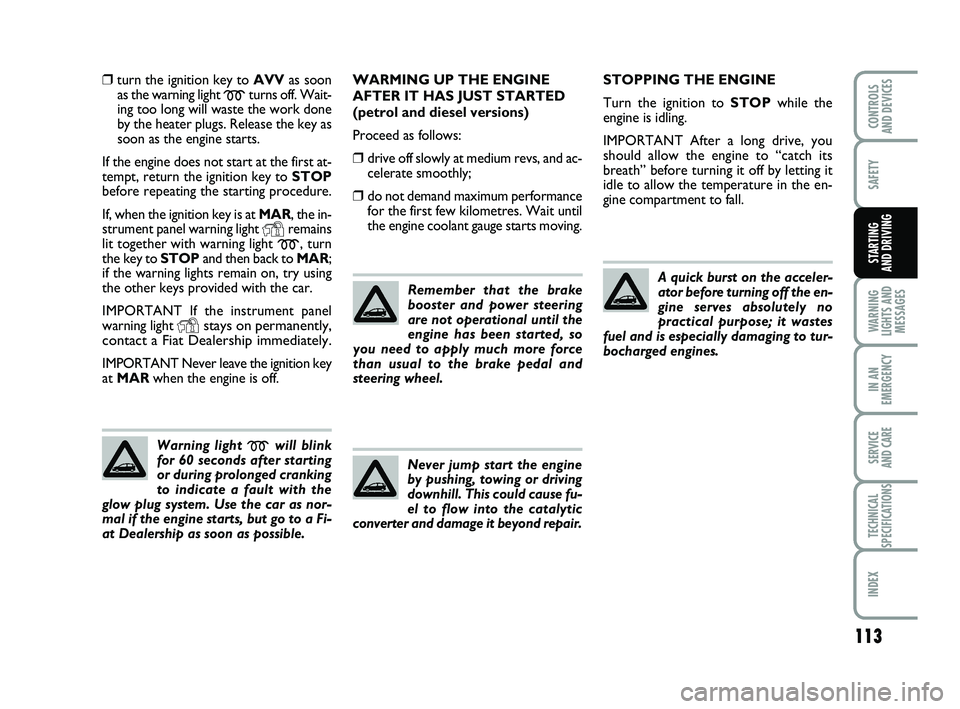
❒turn the ignition key to AVV as soon
as the warning light
mturns off. Wait-
ing too long will waste the work done
by the heater plugs. Release the key as
soon as the engine starts.
If the engine does not start at the first at-
tempt, return the ignition key to STOP
before repeating the starting procedure.
If, when the ignition key is at MAR, the in-
strument panel warning light
Yremains
lit together with warning light
m, turn
the key to STOP and then back to MAR;
if the warning lights remain on, try using
the other keys provided with the car.
IMPORTANT If the instrument panel
warning light
Ystays on permanently,
contact a Fiat Dealership immediately.
IMPORTANT Never leave the ignition key
at MAR when the engine is off.
Warning light
mwill blink
for 60 seconds after starting
or during prolonged cranking
to indicate a fault with the
glow plug system. Use the car as nor-
mal if the engine starts, but go to a Fi-
at Dealership as soon as possible.
WARMING UP THE ENGINE
AFTER IT HAS JUST STARTED
(petrol and diesel versions)
Proceed as follows:
❒drive off slowly at medium revs, and ac- celerate smoothly;
❒do not demand maximum performancefor the first few kilometres. Wait until
the engine coolant gauge starts moving.
Remember that the brake
booster and power steering
are not operational until the
engine has been started, so
you need to apply much more force
than usual to the brake pedal and
steering wheel.
Never jump start the engine
by pushing, towing or driving
downhill. This could cause fu-
el to flow into the catalytic
converter and damage it beyond repair.
STOPPING THE ENGINE
Turn the ignition to STOP while the
engine is idling.
IMPORTANT After a long drive, you
should allow the engine to “catch its
breath” before turning it off by letting it
idle to allow the temperature in the en-
gine compartment to fall.
A quick burst on the acceler-
ator before turning off the en-
gine serves absolutely no
practical purpose; it wastes
fuel and is especially damaging to tur-
bocharged engines.
111-120 PUNTO POP 1ed EN 03/10/13 13.21 Pagina 113
Page 118 of 219

114
SAFETY
WARNING
LIGHTS AND MESSAGES
IN AN
EMERGENCY
SERVICE
AND CARE
TECHNICAL
SPECIFICATIONS
INDEX
CONTROLS
AND DEVICES
STARTING
AND DRIVINGIMPORTANT If this is not the case, con-
tact a Fiat Dealership to have the hand-
brake adjusted.
When the handbrake is on and the igni-
tion key is at MAR, the instrument panel
warning light
xwill come on.
To release the handbrake, proceed as
follows:
❒pull up slightly on the lever and press
release button A;
❒hold button A down and lower the
lever. The xwarning light on the in-
strument panel will go out.
Press the brake pedal when carrying out
this operation to prevent the car from
moving accidentally.
PARKING THE VEHICLE
Proceed as follows:
❒stop the engine and engage the hand- brake;
❒engage a gear (first gear if the vehicleis parked uphill or reverse if it is facing
downhill) and leave the wheels turned.
If the car is parked on a steep slope, it is
also advisable to block the wheels with
a wedge or stone. Do not leave the key in
the ignition switch as this drains the bat-
tery. Always remove the key when you
leave the car.
Never leave children unat-
tended in the car. Always re-
move the ignition key when leaving
the car and take it with you.
WARNING
fig. 1F0M0115m
HANDBRAKE fig. 1
The handbrake is located between the
two front seats.
Pull the lever upwards to operate the
handbrake. Four or five notches are nor-
mally sufficient to secure the car on flat
terrain, while nine or ten may be neces-
sary on a steep slope with the car loaded.
USING THE MANUAL
GEARBOX
To engage the gears, press the clutch ped-
al down fully and shift the gear lever into
one of the required positions (a diagram
is shown on the knob fig. 2).
IMPORTANT Reverse may be engaged
only when the car is at a standstill. With
the engine running, wait for at least 2 sec-
onds with the clutch pedal fully depressed
before engaging reverse to prevent dam-
age to the gears and grating.
To engage reverse R from neutral, lift ring
A under the knob and at the same time
move the gearshift lever to the right and
then backwards fig. 2.
IMPORTANT The clutch pedal should be
used only to change gear. Do not drive
with your foot resting on the clutch ped-
al, however slightly. For versions/markets,
where provided, the electronic clutch
control can intervene if it interprets the
incorrect driving style as a fault.
111-120 PUNTO POP 1ed EN 24/09/13 14.29 Pagina 114
Page 126 of 219

122
SAFETY
STARTING
AND DRIVING
IN AN
EMERGENCY
SERVICE
AND CARE
TECHNICAL
SPECIFICATIONS
INDEX
CONTROLS
AND DEVICES
WARNING
LIGHTS AND MESSAGES
WARNING LIGHTS
AND MESSAGES
GENERAL WARNINGS
Warning lights are accompanied by a spe-
cific message and/or sound when applica-
ble. These indications are synthetic and
precautionary and, as such, must not be
considered as exhaustive and/or alterna-
tive to the information contained in this
Owner Handbook, which you are rec-
ommended to read carefully in all cases.
Refer to the information in this section if
a fault is signalled .
IMPORTANT The fault indications ap-
pearing on the display are divided into two
categories: very serious and less seri-
ous failures.
Very serious failures are indicated by
a repeated and prolonged warning “cycle”.
Less serious failures are indicated by
a shorter warning “cycle”.
Press MENU ESC to stop the warning
cycle in both cases. Warning lights on the
instrument panel will stay on until the
cause of the failure is eliminated.
For messages relevant to the versions
equipped with a Dualogic gearbox, see the
attached Supplement. LOW BRAKE FLUID
LEVEL (red)
HANDBRAKE ON (red)
When the ignition key is moved to MAR,
the warning light turns on but should go
off after a few seconds.
Low brake fluid level
The warning light comes on when the lev-
el of the brake fluid in the reservoir falls
below the minimum level due to possible
leaks in the circuit.
A specific message is displayed on certain
versions.
x
If the warning light xturns
on when travelling (togeth-
er with the message on the display on
certain versions), stop the car imme-
diately and contact a Fiat Dealership.
WARNING
Handbrake on
The warning light turns on when the hand-
brake is engaged.
If the car is moving, an audible warning will
also sound on certain versions.
IMPORTANT If the warning light comes
on with the vehicle in motion, check that
the handbrake is not engaged.
121-132 PUNTO POP 1ed EN 29/08/13 15.03 Pagina 122
Page 129 of 219

125
SAFETY
STARTING
AND DRIVING
IN AN
EMERGENCY
SERVICE
AND CARE
TECHNICAL
SPECIFICATIONS
INDEX
CONTROLS
AND DEVICES
WARNING
LIGHTS AND MESSAGES
DOOR OPEN (red)
On certain versions, the warn-
ing light turns on when one or
more doors or the boot are not proper-
ly closed.
A specific message is displayed on certain
versions.
You will hear a warning sound if a door
is open and the car is moving.
´
“DUALDRIVE”
ELECTRIC POWER
STEERING FAILURE (red)
This warning light comes on
when the ignition key is turned to MAR,
but it should go off after a few seconds.
If the warning light stays on, you will not
get the benefit from the electric power
steering and the effort needed to turn the
wheel will be greatly increased, although
it will still be possible to steer the car.
Contact a Fiat Dealership.
A specific message is displayed on certain
versions.
g
EBD FAULT
(red)
(amber)
Warning lights
xand >lit at the same
time with the engine running indicates an
EBD system failure or that the system is
not available. This may cause premature
locking of the rear wheels in the event of
violent braking, causing the car to swerve.
Drive very carefully to a Fiat Dealership to
have the system inspected immediately.
A specific message is displayed on certain
versions.
x>
LOW ENGINE OIL
LEVEL (red)
(for versions/markets, where
provided)
When turning the ignition key to MAR,
the warning light turns on but it should go
off after a few seconds.
This warning light where provided comes
on when the engine oil level falls below the
minimum recommended value. Restore
the correct engine oil level (see “Check-
ing fluid levels” in the “Servicing and care”
section).
A specific message is displayed on certain
versions.
kExhausted engine oil should
be replaced as soon as pos-
sible after the warning light comes on,
never more than 500 km after the
warning light first comes on. Failure
to change the oil within the first 500
km may result in severe damage to
the engine and will result in forfeiture
of the warranty. Remember that
when the warning light flashes, it does
not mean that the level of engine oil
is low, so if the light flashes you must
not top up.
WARNING
For versions/markets, where
provided:
the
vwarning light turns on and flash-
es along with the message on the display
(if applied) when the system detects that
the engine oil is exhausted. The flashing of
the warning light should not be considered
as a fault, rather simply informs the driver
that oil needs to be changed after a stan-
dard period of car utilisation. If the oil is
not changed, when reaching a second de-
terioration threshold, also the warning
light
Uswitches on in the instrument
panel and the engine operation is limited
at 3000 rpm.
If the oil is still not changed, when reaching
a third deterioration threshold, the engine
is limited at 1500 rpm to avoid damage.
WARNING! To avoid dam-
aging the engine it is recom-
mended to change the en-
gine oil when the warning light
v
flashes. Contact a Fiat Dealership.
121-132 PUNTO POP 1ed EN 29/08/13 15.03 Pagina 125
Page 138 of 219

134
SAFETY
STARTING
AND DRIVING
WARNING
LIGHTS AND MESSAGES
SERVICE
AND CARE
TECHNICAL
SPECIFICATIONS
INDEX
CONTROLS
AND DEVICES
IN AN
EMERGENCY
STARTING THE ENGINE
EMERGENCY START-UP
If the instrument panel warning light
Ystays on permanently, contact a Fiat
Dealership immediately.
JUMP STARTING fig. 1
If the battery is flat, the engine may be
started using an auxiliary battery with an
equal or slightly higher capacity than the
flat one. Proceed as follows to start the car:
❒connect the positive terminals (+
near
the terminal) of the two batteries with
a jump lead;
❒with a second lead, connect the nega- tive terminal (– ) of the auxiliary battery
to an earthing point
Eon the engine or
the gearbox of the car to be started;
❒start the engine.
❒when the engine has been started, fol- low the sequence above in reverse or-
der to remove the leads.
If after a few attempts the engine does not
start, do not keep trying but contact a Fi-
at Dealership. IMPORTANT Do not directly connect the
negative terminals of the two batteries:
sparks could ignite explosive gas released
from the battery. If the auxiliary battery is
installed on another car, prevent acciden-
tal contact between metallic parts of the
two cars.
NB
For cars with Start&Stop system, in
case of starting by booster battery, refer
to "Dashboard and controls" chapter,
paragraph "Start&Stop system".
This procedure must be per-
formed by expert personnel
because incorrect actions may cause
considerable electrical discharge. Fur-
thermore, battery fluid is poisonous
and corrosive: avoid contact with skin
and eyes. Keep naked flames and lit
cigarettes away from the battery. Do
not create sparks.
WARNING
fig. 1F0M0659m
133-164 PUNTO POP 1ed EN 24/03/14 13:05 Pagina 134
Page 161 of 219
157
SAFETY
STARTING
AND DRIVING
WARNING
LIGHTS AND MESSAGES
SERVICE
AND CARE
TECHNICAL
SPECIFICATIONS
INDEX
CONTROLS
AND DEVICES
IN AN
EMERGENCY
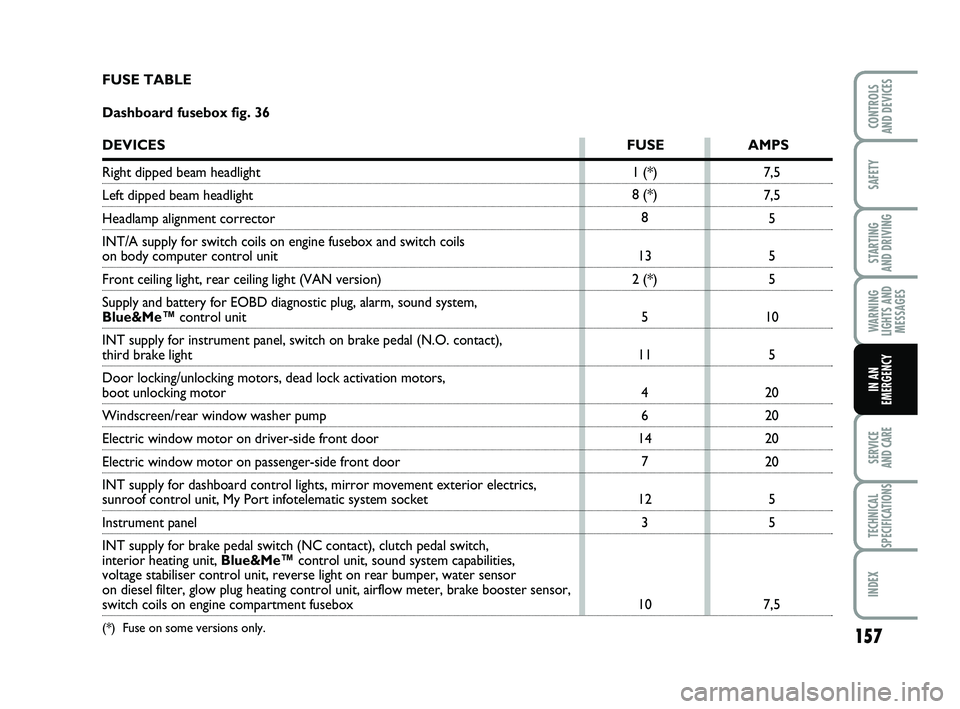
1 (*)
8 (*)
8
13
2 (*)
5
11 4
6
14 7
12 3
10 7,5
7,5
5
5
5
10 5
20
20
20
20 5
5
7,5
FUSE TABLE
Dashboard fusebox fig. 36
DEVICES
FUSE AMPS
Right dipped beam headlight
Left dipped beam headlight
Headlamp alignment corrector
INT/A supply for switch coils on engine fusebox and switch coils
on body computer control unit
Front ceiling light, rear ceiling light (VAN version)
Supply and battery for EOBD diagnostic plug, alarm, sound system,
Blue&Me™control unit
INT supply for instrument panel, switch on brake pedal (N.O. contact),\
third brake light
Door locking/unlocking motors, dead lock activation motors,
boot unlocking motor
Windscreen/rear window washer pump
Electric window motor on driver-side front door
Electric window motor on passenger-side front door
INT supply for dashboard control lights, mirror movement exterior electr\
ics,
sunroof control unit, My Port infotelematic system socket
Instrument panel
INT supply for brake pedal switch (NC contact), clutch pedal switch,
interior heating unit, Blue&Me™control unit, sound system capabilities,
voltage stabiliser control unit, reverse light on rear bumper, water sen\
sor
on diesel filter, glow plug heating control unit, airflow meter, brake b\
ooster sensor,
switch coils on engine compartment fusebox
(*) Fuse on some versions only.
133-164 PUNTO POP 1ed EN 24/03/14 13:05 Pagina 157
Page 171 of 219

167
SAFETY
STARTING
AND DRIVING
WARNING
LIGHTS AND MESSAGES
IN AN
EMERGENCY
TECHNICAL
SPECIFICATIONS
INDEX
CONTROLS
AND DEVICES
SERVICE
AND CARE
Thousands of miles 9 18 27 36 45 54 63 72 81 90
Thousands of kilometres15 30 45 60 75 90 105 120 135 150
Years 1234 56 7 8910
Check tyre condition/wear and adjust pressure, if necessary; check “F\
ix&Go Automatic” kit recharge expiry date (for versions/markets, where pro\
vided)●●●● ●● ●●● ●
Check operation of lighting system (headlights, direction indicators, h\
azard
warning lights, luggage compartment, passenger compartment, glove compar\
tment,
instrument panel warning lights, etc.)●●●● ●● ●●● ●
Check and, if necessary, top up fluid levels (engine coolant, hydraulic brakes/clutch, screen washer, battery, etc.)\
●●●● ●● ●●● ●
Check exhaust emissions/smokiness●●●● ●● ●●● ●
Use the diagnosis socket to check supply/engine management system operat\
ion, emissions and, for versions/markets, where provided, engine oil degradat\
ion●●●● ●● ●●● ●
Visually inspect condition of: exterior bodywork,
underbody protection, pipes and hoses (exhaust, fuel system,
brakes), rubber elements (boots, sleeves, bushes, etc.)●● ●●●
Check windscreen/rear window wiper blade position/wear●● ●●●
Check operation of windscreen washer system and adjust jets if necessary●● ●●●
Check cleanliness of bonnet and boot locks, as well as cleanliness and lubrication of linkages●● ●●●
Check handbrake lever travel and adjust, if required●● ●●●
Visually inspect condition and wear of front/rear disc brake pads (for \
versions/markets, where provided) and operation of pad wear indicator●●●● ●● ●●● ●
SCHEDULED SERVICING PLAN
PETROL VERSIONS
The checks listed in the Scheduled Servicing Plan, after reaching 120,00\
0 km/8 years, must be cyclically repeated starting from
the first interval, thus following the same intervals as before.
165-184 PUNTO POP 1ed EN 07/04/14 09:35 Pagina 167
Page 173 of 219

169
SAFETY
STARTING
AND DRIVING
WARNING
LIGHTS AND MESSAGES
IN AN
EMERGENCY
TECHNICAL
SPECIFICATIONS
INDEX
CONTROLS
AND DEVICES
SERVICE
AND CARE
Thousands of miles 12 24 36 48 60 72 80 92 104 116
Thousands of kilometres20 40 60 80 100 120 140 160 180 200
Years 1234 567 8910
Check tyre condition/wear and adjust pressure, if necessary;
check “Fix&Go Automatic” kit recharge expiry date
(for versions/markets, where provided)●●●● ●● ●●●●
Check operation of lighting system (headlights, direction indicators, h\
azard
warning lights, luggage compartment, passenger compartment, glove compar\
tment,
instrument panel warning lights, etc.)●●●● ●● ●●●●
Check and, if necessary, top up fluid levels (engine coolant, hydraulic brakes/clutch, screen washer, battery, etc.)\
●●●● ●● ●●●●
Check exhaust emissions/smokiness●●●● ●● ●●●●
Use the diagnosis socket to check supply/engine management system operat\
ion, emissions and, for versions/markets, where provided, engine oil degradat\
ion●●●● ●● ●●●●
Visually inspect condition of: exterior bodywork,
underbody protection, pipes and hoses (exhaust,
fuel system, brakes), rubber elements (boots, sleeves, bushes, etc.)●●●●●
Check windscreen/rear window wiper blade position/wear●●●●●
Check operation of windscreen washer system and adjust jets if necessary●●●●●
Check cleanliness of bonnet and luggage compartment locks, cleanliness and lubrication of linkages●● ● ●●
Check handbrake lever travel and adjust, if required●● ● ●●
DIESEL VERSIONS
The checks listed in the Scheduled Servicing Plan, after reaching 120,00\
0 km/6 years, must be cyclically repeated starting from
the first interval, thus following the same intervals as before.
165-184 PUNTO POP 1ed EN 07/04/14 09:35 Pagina 169
Page 174 of 219
170
SAFETY
STARTING
AND DRIVING
WARNING
LIGHTS AND MESSAGES
IN AN
EMERGENCY
TECHNICAL
SPECIFICATIONS
INDEX
CONTROLS
AND DEVICES
SERVICE
AND CARE
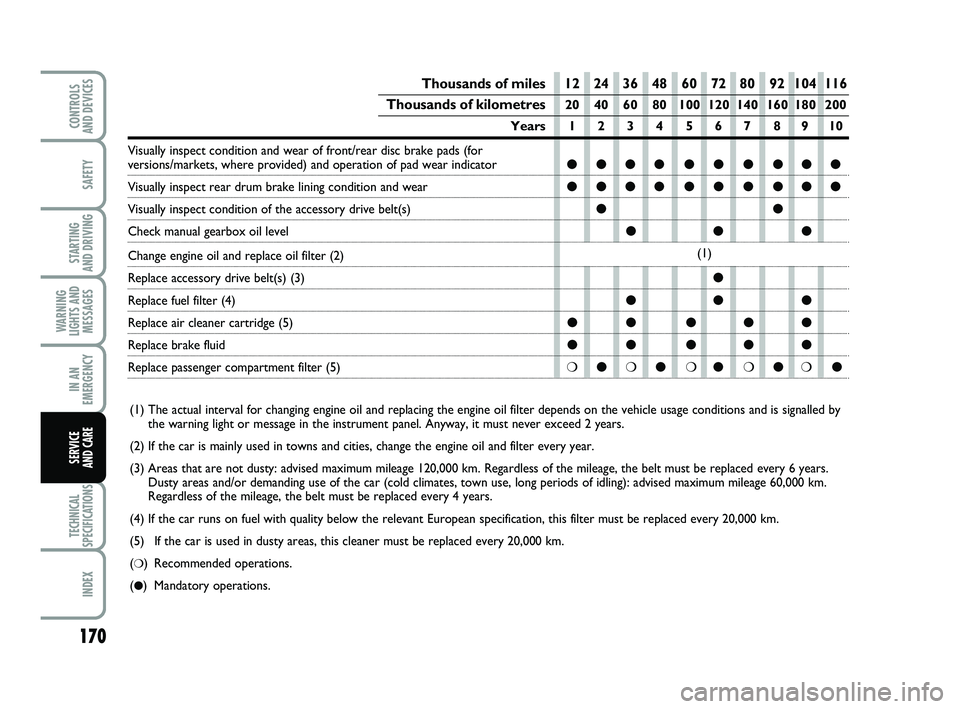
Thousands of miles 12 24 36 48 60 72 80 92 104 116
Thousands of kilometres20 40 60 80 100 120 140 160 180 200
Years 1234 567 8910
Visually inspect condition and wear of front/rear disc brake pads (for \
versions/markets, where provided) and operation of pad wear indicator●●●● ●● ●●●●
Visually inspect rear drum brake lining condition and wear●●●● ●● ●●●●
Visually inspect condition of the accessory drive belt(s)●●
Check manual gearbox oil level●● ●
Change engine oil and replace oil filter (2)
Replace accessory drive belt(s) (3) ●
Replace fuel filter (4)●● ●
Replace air cleaner cartridge (5) ●● ●●●
Replace brake fluid ●● ●●●
Replace passenger compartment filter (5) ❍●❍●❍●❍●❍●
(1) The actual interval for changing engine oil and replacing the engi\
ne oil filter depends on the vehicle usage conditions and is signalled by
the warning light or message in the instrument panel. Anyway, it must ne\
ver exceed 2 years.
(2) If the car is mainly used in towns and cities, change the engine o\
il and filter every year.
(3) Areas that are not dusty: advised maximum mileage 120,000 km. Rega\
rdless of the mileage, the belt must be replaced every 6 years.
Dusty areas and/or demanding use of the car (cold climates, town use, l\
ong periods of idling): advised maximum mileage 60,000 km.
Regardless of the mileage, the belt must be replaced every 4 years.
(4) If the car runs on fuel with quality below the relevant European s\
pecification, this filter must be replaced every 20,000 k m.
(5) If the car is used in dusty areas, this cleaner must be replaced every 2\
0,000 km.
(
❍) Recommended operations.
(
●) Mandatory operations.
(1)
165-184 PUNTO POP 1ed EN 07/04/14 09:35 Pagina 170