Fuel FIAT PUNTO EVO 2010 1.G User Guide
[x] Cancel search | Manufacturer: FIAT, Model Year: 2010, Model line: PUNTO EVO, Model: FIAT PUNTO EVO 2010 1.GPages: 270, PDF Size: 8.34 MB
Page 121 of 270
120
KNOWING
YOUR
VEHICLE
SAFETY
STARTING
AND DRIVING
WARNING LIGHTS
AND MESSAGES
IN AN
EMERGENCY
SERVICING
AND CARE
TECHNICAL
SPECIFICATIONS
CONTENTS
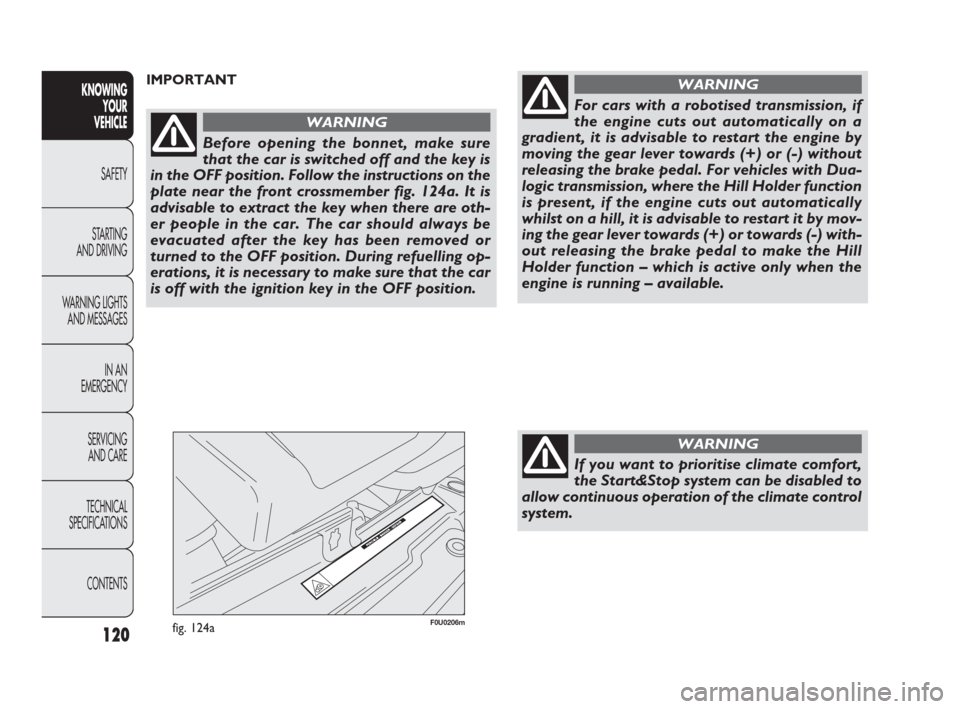
F0U0206mfig. 124a
IMPORTANT
Before opening the bonnet, make sure
that the car is switched off and the key is
in the OFF position. Follow the instructions on the
plate near the front crossmember fig. 124a. It is
advisable to extract the key when there are oth-
er people in the car. The car should always be
evacuated after the key has been removed or
turned to the OFF position. During refuelling op-
erations, it is necessary to make sure that the car
is off with the ignition key in the OFF position.
WARNING
For cars with a robotised transmission, if
the engine cuts out automatically on a
gradient, it is advisable to restart the engine by
moving the gear lever towards (+) or (-) without
releasing the brake pedal. For vehicles with Dua-
logic transmission, where the Hill Holder function
is present, if the engine cuts out automatically
whilst on a hill, it is advisable to restart it by mov-
ing the gear lever towards (+) or towards (-) with-
out releasing the brake pedal to make the Hill
Holder function – which is active only when the
engine is running – available.
WARNING
If you want to prioritise climate comfort,
the Start&Stop system can be disabled to
allow continuous operation of the climate control
system.
WARNING
082-128 PUNTO FL EN 4ed 20-01-2010 15:07 Pagina 120
Page 122 of 270
121
KNOWING
YOUR
VEHICLE
SAFETY
STARTING
AND DRIVING
WARNING LIGHTS
AND MESSAGES
IN AN
EMERGENCY
SERVICING
AND CARE
TECHNICAL
SPECIFICATIONS
CONTENTS
F0U0108mfig. 125
PARKING SENSORS
(for versions/markets where provided)
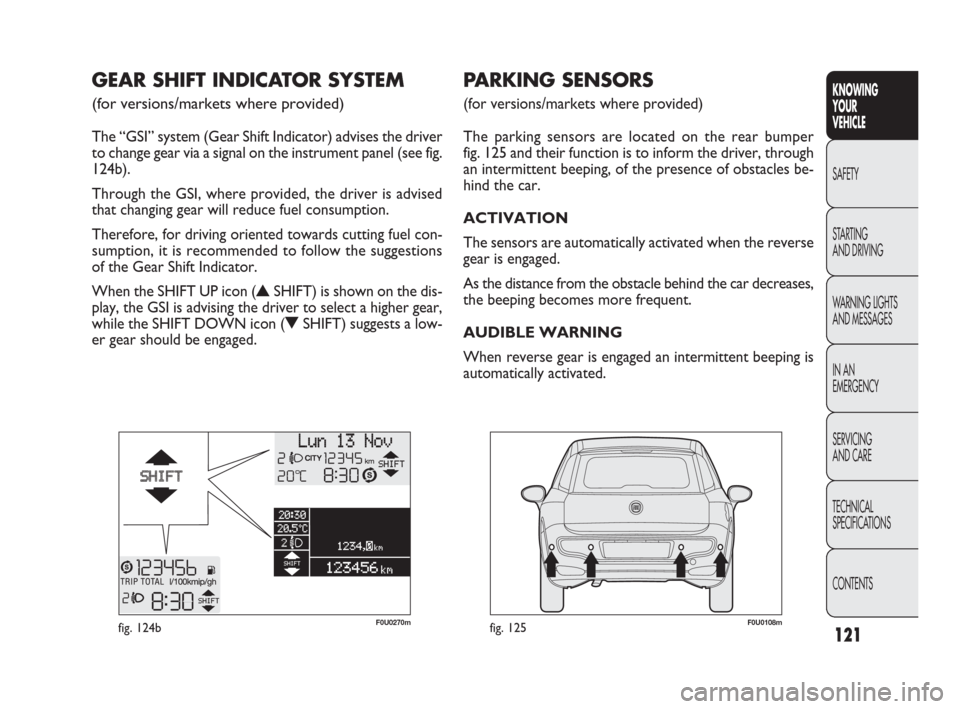
The parking sensors are located on the rear bumper
fig. 125 and their function is to inform the driver, through
an intermittent beeping, of the presence of obstacles be-
hind the car.
ACTIVATION
The sensors are automatically activated when the reverse
gear is engaged.
As the distance from the obstacle behind the car decreases,
the beeping becomes more frequent.
AUDIBLE WARNING
When reverse gear is engaged an intermittent beeping is
automatically activated.
GEAR SHIFT INDICATOR SYSTEM
(for versions/markets where provided)
The “GSI” system (Gear Shift Indicator) advises the driver
to change gear via a signal on the instrument panel (see fig.
124b).
Through the GSI, where provided, the driver is advised
that changing gear will reduce fuel consumption.
Therefore, for driving oriented towards cutting fuel con-
sumption, it is recommended to follow the suggestions
of the Gear Shift Indicator.
When the SHIFT UP icon (
NSHIFT) is shown on the dis-
play, the GSI is advising the driver to select a higher gear,
while the SHIFT DOWN icon (
OSHIFT) suggests a low-
er gear should be engaged.
F0U0270mfig. 124b
082-128 PUNTO FL EN 4ed 20-01-2010 15:07 Pagina 121
Page 127 of 270
126
KNOWING
YOUR
VEHICLE
SAFETY
STARTING
AND DRIVING
WARNING LIGHTS
AND MESSAGES
IN AN
EMERGENCY
SERVICING
AND CARE
TECHNICAL
SPECIFICATIONS
CONTENTS
REFUELLING THE CAR
PETROL ENGINES
Use only unleaded petrol.
To avoid mistakes, the diameter of the fuel tank opening is
too small to insert the nozzle of a leaded petrol pump. The
petrol octane rating (RON) must not be lower than 95.
IMPORTANT An inefficient catalytic converter leads to
harmful exhaust emissions, thus contributing to air pol-
lution.
IMPORTANT Never use leaded petrol, even in small
amounts or in an emergency, as this would damage the
catalytic converter beyond repair.
DIESEL ENGINES
If the outside temperature is very low, the diesel thick-
ens due to the formation of paraffin clots and could clog
the diesel filter. In order to avoid these problems, differ-
ent types of diesel are distributed according to the season:
summer type, winter type and arctic type (cold, moun-
tainous areas).
If refuelling with diesel fuel whose specifications are not
suitable for the usage temperature, it is advisable to mix
TUTELA DIESEL ART additive in the proportions shown
on the container with the fuel. Pour the additive into the
tank before the fuel.When using or parking the vehicle for a long time in the
mountains or cold areas, it is advisable to refuel using lo-
cally available diesel.
In this case, it is also advisable to keep the tank over
50% full.
For diesel engines, use only diesel fuel for
motor vehicles in accordance with EN590
European specifications. The use of other
products or mixtures may damage the engine be-
yond repair and consequently invalidate the war-
ranty, depending on the damage caused. If you ac-
cidentally introduce other types of fuel into the
tank, do not start the engine. Empty the tank. If the
engine has run, even for a very short time, you will
need to have the entire fuel system emptied in ad-
dition to the tank.
FUEL TANK CAP fig. 128
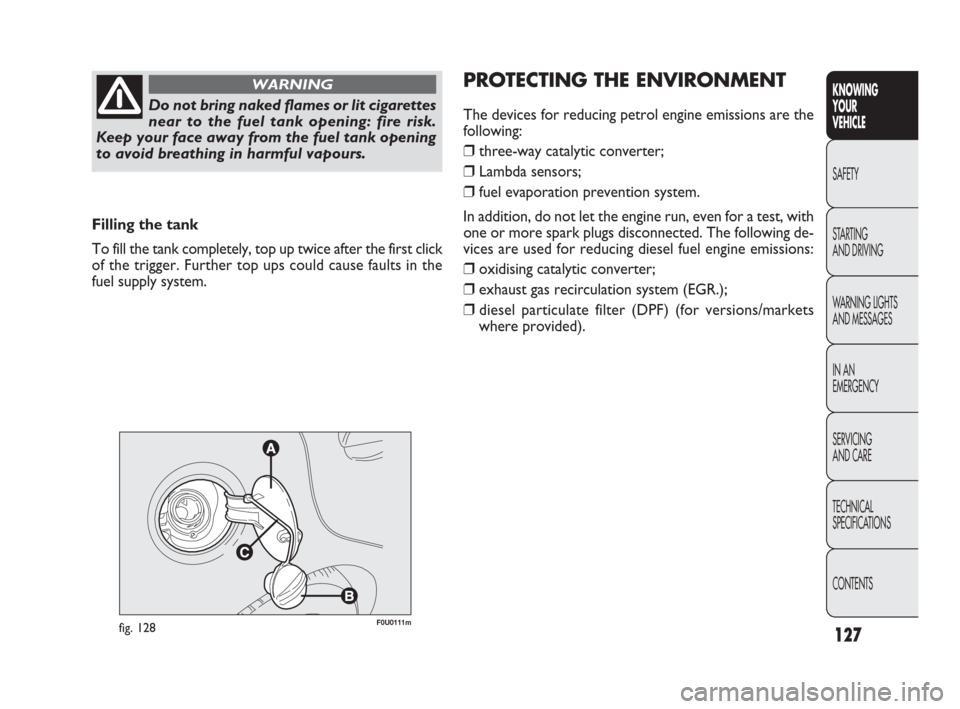
To carry out refuelling, open lid A and unscrew cap B;
the cap is fitted with a device C which fastens it to the lid
so it cannot be mislaid.
In some versions, cap B have a lock and key: open lid A,
insert the ignition key then turn it anti-clockwise and un-
screw the cap itself.
The hermetic seal may cause a slight increase in pressure
in the tank. A suction noise when you release the cap is
therefore entirely normal.
When refuelling, attach the cap to the device inside the
flap as shown in fig. 128.
082-128 PUNTO FL EN 4ed 20-01-2010 15:07 Pagina 126
Page 128 of 270
127
KNOWING
YOUR
VEHICLE
SAFETY
STARTING
AND DRIVING
WARNING LIGHTS
AND MESSAGES
IN AN
EMERGENCY
SERVICING
AND CARE
TECHNICAL
SPECIFICATIONS
CONTENTS
Filling the tank
To fill the tank completely, top up twice after the first click
of the trigger. Further top ups could cause faults in the
fuel supply system.
Do not bring naked flames or lit cigarettes
near to the fuel tank opening: fire risk.
Keep your face away from the fuel tank opening
to avoid breathing in harmful vapours.
WARNING
F0U0111mfig. 128
PROTECTING THE ENVIRONMENT
The devices for reducing petrol engine emissions are the
following:
❒three-way catalytic converter;
❒Lambda sensors;
❒fuel evaporation prevention system.
In addition, do not let the engine run, even for a test, with
one or more spark plugs disconnected. The following de-
vices are used for reducing diesel fuel engine emissions:
❒oxidising catalytic converter;
❒exhaust gas recirculation system (EGR.);
❒diesel particulate filter (DPF) (for versions/markets
where provided).
082-128 PUNTO FL EN 4ed 20-01-2010 15:07 Pagina 127
Page 152 of 270
151
STOPPING THE ENGINE
Turn the ignition key to STOP while the engine is idling.
IMPORTANT After a long drive, you should allow the en-
gine to “catch its breath” before turning it off by letting it
idle to allow the temperature in the engine compartment
to fall. WARMING UP THE ENGINE AFTER IT HAS
JUST STARTED (petrol and diesel versions)
Proceed as follows:
❒drive off slowly at medium revs, and accelerate
smoothly;
❒do not demand maximum performance for the first few
kilometres. Wait until the engine coolant gauge starts
moving.
KNOWING
YOUR
VEHICLE
SAFETY
STARTING
AND DRIVING
WARNING LIGHTS
AND MESSAGES
IN AN
EMERGENCY
SERVICING
AND CARE
TECHNICAL
SPECIFICATIONS
CONTENTSRemember that the brake booster and pow-
er steering are not operational until the en-
gine has been started, so you need to apply
much more force than usual to the brake pedal and
steering wheel.
Never jump start the engine by pushing,
towing or driving downhill. This could cause
fuel to flow into the catalytic converter and
damage it beyond repair.
A quick burst on the accelerator before
turning off the engine serves absolutely no
practical purpose; it wastes fuel and is es-
pecially damaging to turbocharged engines.
149-160 PUNTO FL EN 4ed 20-01-2010 14:37 Pagina 151
Page 155 of 270
154
KNOWING
YOUR
VEHICLE
SAFETY
STARTING
AND DRIVING
WARNING LIGHTS
AND MESSAGES
IN AN
EMERGENCY
SERVICING
AND CARE
TECHNICAL
SPECIFICATIONS
CONTENTS
SAVING FUEL
Here are some suggestions which may help you to save fu-
el and reduce the amount of toxic emissions released in-
to the atmosphere.
GENERAL CONSIDERATIONS
Car maintenance
Have checks and adjustments carried out in accordance
with the “Scheduled Servicing Plan”.
Tyres
Check the tyre pressures at least once every 4 weeks: if
the pressure is too low, consumption levels increase as re-
sistance to rolling is higher.
Unnecessary loads
Do not travel with an overloaded boot. The weight of
the car (especially when driving in town) and its arrange-
ment greatly affect fuel consumption and stability.
Roof rack/ski rack
Remove the roof rack or ski rack from the roof after use.
These accessories decrease aerodynamic penetration and
have a negative effect on fuel consumption. It is better to
use a trailer to transport particularly bulky objects.Electrical devices
Use electrical devices only for the amount of time need-
ed. The heated rear window, auxiliary headlights, wind-
screen wipers and fan heater use up a considerable amount
of current, causing increased fuel consumption (up to
+25% in the urban cycle).
Air conditioning
Air conditioning leads to higher fuel consumption (on av-
erage up to +20%). If the temperature outside is not too
extreme, try and use the air vents.
Spoilers
The use of non-certified spoilers may adversely affect aero-
dynamics and fuel consumption.
DRIVING STYLE
Starting
Do not warm up the engine at low or high revs when the
vehicle is stationary; this causes the engine to warm up more
slowly, thereby increasing fuel consumption and emissions.
It is advisable to set off immediately and slowly, avoiding high
revs: this allows the engine to warm up more quickly.
Unnecessary actions
Avoid revving up when stationary at traffic lights or before
stopping the engine. The latter action, like double de-
clutching, is entirely unnecessary and causes increased fu-
el consumption and pollution.
149-160 PUNTO FL EN 4ed 20-01-2010 14:37 Pagina 154
Page 156 of 270
155
KNOWING
YOUR
VEHICLE
SAFETY
STARTING
AND DRIVING
WARNING LIGHTS
AND MESSAGES
IN AN
EMERGENCY
SERVICING
AND CARE
TECHNICAL
SPECIFICATIONS
CONTENTS
Gear selection
Use a higher gear as soon as traffic and road conditions al-
low. Using a low gear for faster acceleration will increase
fuel consumption. In the same way, improper use of a high
gear increases consumption, emissions and engine wear.
Top speed
Fuel consumption considerably increases as speed in-
creases. Keep your speed as even as possible, avoiding un-
necessary braking and acceleration, which cause excessive
fuel consumption and increased emissions.
Acceleration
Accelerating violently severely affects consumption and
emissions: acceleration should be gradual and should not
exceed the maximum torque.CONDITIONS OF USE
Cold starting
Short distances and frequent cold start-ups will prevent the
engine from reaching optimal running temperature. Con-
sequently, both fuel consumption (from +15 to +30% on
the urban cycle) and emissions will increase.
Traffic and road conditions
Heavy traffic, for instance when travelling in a queue with
frequent use of low gears or in cities with lots of traffic
lights, causes fairly high fuel consumption. Mountain roads
and uneven surfaces also have a negative effect on con-
sumption.
Traffic hold-ups
During prolonged hold-ups (e.g. at level crossings) the en-
gine should be switched off.
149-160 PUNTO FL EN 4ed 20-01-2010 14:37 Pagina 155
Page 166 of 270
165
KNOWING
YOUR
VEHICLE
SAFETY
STARTING
AND DRIVING
WARNING LIGHTS
AND MESSAGES
IN AN
EMERGENCY
SERVICING
AND CARE
TECHNICAL
SPECIFICATIONS
CONTENTS
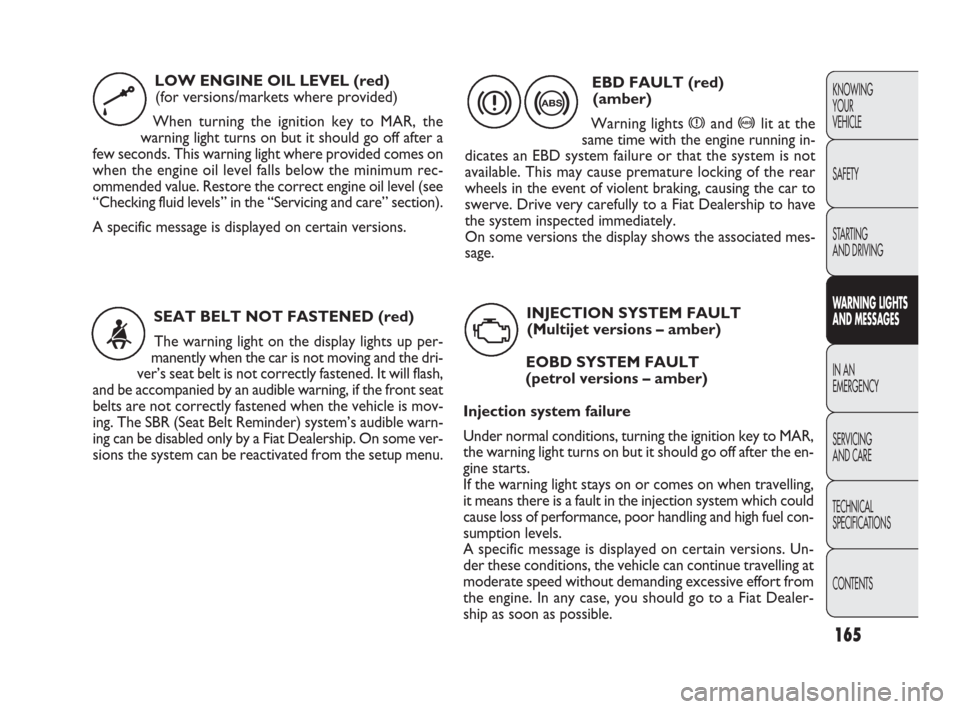
SEAT BELT NOT FASTENED (red)
The warning light on the display lights up per-
manently when the car is not moving and the dri-
ver’s seat belt is not correctly fastened. It will flash,
and be accompanied by an audible warning, if the front seat
belts are not correctly fastened when the vehicle is mov-
ing. The SBR (Seat Belt Reminder) system’s audible warn-
ing can be disabled only by a Fiat Dealership. On some ver-
sions the system can be reactivated from the setup menu.
<
LOW ENGINE OIL LEVEL (red)
(for versions/markets where provided)
When turning the ignition key to MAR, the
warning light turns on but it should go off after a
few seconds. This warning light where provided comes on
when the engine oil level falls below the minimum rec-
ommended value. Restore the correct engine oil level (see
“Checking fluid levels” in the “Servicing and care” section).
A specific message is displayed on certain versions.
k
EBD FAULT (red)
(amber)
Warning lights
xand >lit at the
same time with the engine running in-
dicates an EBD system failure or that the system is not
available. This may cause premature locking of the rear
wheels in the event of violent braking, causing the car to
swerve. Drive very carefully to a Fiat Dealership to have
the system inspected immediately.
On some versions the display shows the associated mes-
sage.> x
INJECTION SYSTEM FAULT
(Multijet versions – amber)
EOBD SYSTEM FAULT
(petrol versions – amber)
Injection system failure
Under normal conditions, turning the ignition key to MAR,
the warning light turns on but it should go off after the en-
gine starts.
If the warning light stays on or comes on when travelling,
it means there is a fault in the injection system which could
cause loss of performance, poor handling and high fuel con-
sumption levels.
A specific message is displayed on certain versions. Un-
der these conditions, the vehicle can continue travelling at
moderate speed without demanding excessive effort from
the engine. In any case, you should go to a Fiat Dealer-
ship as soon as possible.
U
161-174 PUNTO FL EN 4ed 18-01-2010 12:27 Pagina 165
Page 167 of 270
166
KNOWING
YOUR
VEHICLE
SAFETY
STARTING
AND DRIVING
WARNING LIGHTS
AND MESSAGES
IN AN
EMERGENCY
SERVICING
AND CARE
TECHNICAL
SPECIFICATIONS
CONTENTS
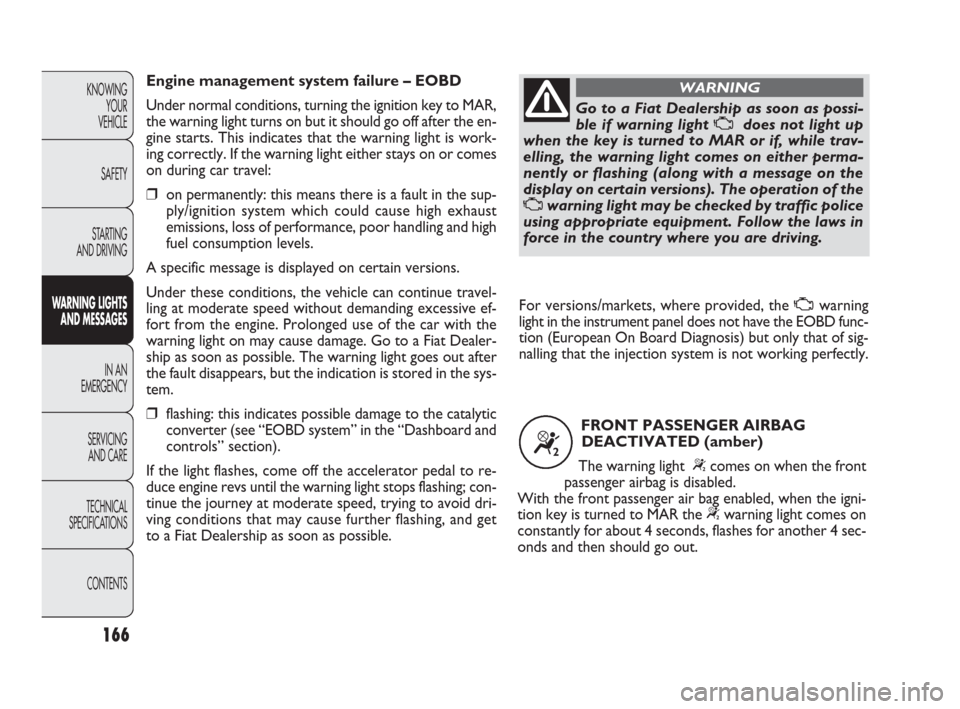
Go to a Fiat Dealership as soon as possi-
ble if warning light Udoes not light up
when the key is turned to MAR or if, while trav-
elling, the warning light comes on either perma-
nently or flashing (along with a message on the
display on certain versions). The operation of the
Uwarning light may be checked by traffic police
using appropriate equipment. Follow the laws in
force in the country where you are driving.
WARNING
FRONT PASSENGER AIRBAG
DEACTIVATED (amber)
The warning light
“comes on when the front
passenger airbag is disabled.
With the front passenger air bag enabled, when the igni-
tion key is turned to MAR the
“warning light comes on
constantly for about 4 seconds, flashes for another 4 sec-
onds and then should go out.
“
Engine management system failure – EOBD
Under normal conditions, turning the ignition key to MAR,
the warning light turns on but it should go off after the en-
gine starts. This indicates that the warning light is work-
ing correctly. If the warning light either stays on or comes
on during car travel:
❒on permanently: this means there is a fault in the sup-
ply/ignition system which could cause high exhaust
emissions, loss of performance, poor handling and high
fuel consumption levels.
A specific message is displayed on certain versions.
Under these conditions, the vehicle can continue travel-
ling at moderate speed without demanding excessive ef-
fort from the engine. Prolonged use of the car with the
warning light on may cause damage. Go to a Fiat Dealer-
ship as soon as possible. The warning light goes out after
the fault disappears, but the indication is stored in the sys-
tem.
❒flashing: this indicates possible damage to the catalytic
converter (see “EOBD system” in the “Dashboard and
controls” section).
If the light flashes, come off the accelerator pedal to re-
duce engine revs until the warning light stops flashing; con-
tinue the journey at moderate speed, trying to avoid dri-
ving conditions that may cause further flashing, and get
to a Fiat Dealership as soon as possible.For versions/markets, where provided, the
Uwarning
light in the instrument panel does not have the EOBD func-
tion (European On Board Diagnosis) but only that of sig-
nalling that the injection system is not working perfectly.
161-174 PUNTO FL EN 4ed 18-01-2010 12:27 Pagina 166
Page 168 of 270
167
KNOWING
YOUR
VEHICLE
SAFETY
STARTING
AND DRIVING
WARNING LIGHTS
AND MESSAGES
IN AN
EMERGENCY
SERVICING
AND CARE
TECHNICAL
SPECIFICATIONS
CONTENTS
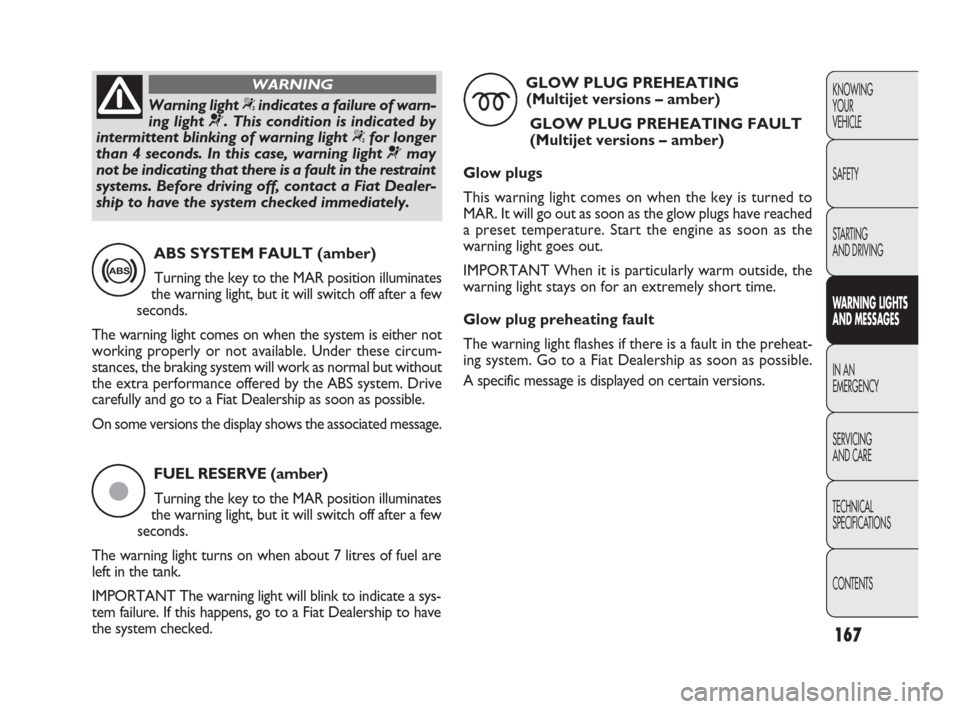
FUEL RESERVE (amber)
Turning the key to the MAR position illuminates
the warning light, but it will switch off after a few
seconds.
The warning light turns on when about 7 litres of fuel are
left in the tank.
IMPORTANT The warning light will blink to indicate a sys-
tem failure. If this happens, go to a Fiat Dealership to have
the system checked.
Warning light “indicates a failure of warn-
ing light ¬. This condition is indicated by
intermittent blinking of warning light “for longer
than 4 seconds. In this case, warning light ¬may
not be indicating that there is a fault in the restraint
systems. Before driving off, contact a Fiat Dealer-
ship to have the system checked immediately.
WARNING
ç
ABS SYSTEM FAULT (amber)
Turning the key to the MAR position illuminates
the warning light, but it will switch off after a few
seconds.
The warning light comes on when the system is either not
working properly or not available. Under these circum-
stances, the braking system will work as normal but without
the extra performance offered by the ABS system. Drive
carefully and go to a Fiat Dealership as soon as possible.
On some versions the display shows the associated message.
>
GLOW PLUG PREHEATING
(Multijet versions – amber)
GLOW PLUG PREHEATING FAULT
(Multijet versions – amber)
Glow plugs
This warning light comes on when the key is turned to
MAR. It will go out as soon as the glow plugs have reached
a preset temperature. Start the engine as soon as the
warning light goes out.
IMPORTANT When it is particularly warm outside, the
warning light stays on for an extremely short time.
Glow plug preheating fault
The warning light flashes if there is a fault in the preheat-
ing system. Go to a Fiat Dealership as soon as possible.
A specific message is displayed on certain versions.
m
161-174 PUNTO FL EN 4ed 18-01-2010 12:27 Pagina 167