tyre FIAT PUNTO EVO 2010 1.G User Guide
[x] Cancel search | Manufacturer: FIAT, Model Year: 2010, Model line: PUNTO EVO, Model: FIAT PUNTO EVO 2010 1.GPages: 270, PDF Size: 8.34 MB
Page 161 of 270
❒clean and protect the painted parts using protective
wax;
❒clean and protect the shiny metal parts using special
compounds readily available;
❒sprinkle talcum powder on the rubber windscreen
and rear window wiper blades and lift them off the
glass;
❒open the windows slightly;
❒cover the car with a fabric or perforated plastic sheet.
Do not use compact plastic sheets which do not allow
humidity to evaporate from the surface of the car;
❒inflate tyres to a pressure of +0.5 bar above the nor-
mal specified pressure and check regularly;
❒if you don’t disconnect the battery from the electrical
system, check its charge every month and recharge it
if the indicator shows a dark colour without the cen-
tral green area;
❒do not drain the engine cooling system.
IMPORTANT Where relevant, switch off the car alarm
with the remote control.
CAR INACTIVITY
If the car is to be left inactive for longer than a month,
the following precautions should be observed:
❒park the car in covered, dry and, if possible, well-ven-
tilated premises;
❒engage a gear;
❒check that the handbrake is engaged;
❒disconnect the clip for the negative battery terminal
and check battery charge. Repeat this check once
every three months during storage. Recharge the
battery if the indicator is dark and the middle area is
not green;
160
KNOWING
YOUR
VEHICLE
SAFETY
STARTING
AND DRIVING
WARNING LIGHTS
AND MESSAGES
IN AN
EMERGENCY
SERVICING
AND CARE
TECHNICAL
SPECIFICATIONS
CONTENTS
16” and 17” tyres cannot be fitted with
chains.
WARNING
Keep your speed down when snow chains
are fitted: do not exceed 50 km/h. Avoid
potholes, steps and pavements, and do
not drive for long distances on roads not
covered with snow to prevent damaging
the car and the road surface.
WARNING
149-160 PUNTO FL EN 4ed 20-01-2010 14:37 Pagina 160
Page 170 of 270
GENERIC INDICATOR
(amber)
(for versions/markets where provided)
The warning light turns on in the following cir-
cumstances:
Engine oil pressure sensor failure
The warning light turns on when a failure is detected in
the engine oil pressure sensor. Go to a Fiat Dealership to
have the fault fixed as soon as possible. The associated mes-
sage is displayed on some versions.
Start&Stop fault
(for versions/markets where provided)
The warning light comes on when a Start&Stop failure is de-
tected.
A specific message is displayed on certain versions.
169
KNOWING
YOUR
VEHICLE
SAFETY
STARTING
AND DRIVING
WARNING LIGHTS
AND MESSAGES
IN AN
EMERGENCY
SERVICING
AND CARE
TECHNICAL
SPECIFICATIONS
CONTENTS
REAR FOG LIGHTS (amber)
The light comes on when the rear fog lights are
turned on.
4
Fuel cut-off intervention
(for versions/markets, where provided)
The warning light comes on when the fuel cut-off system
intervenes (see “Multifunction display” in the “Controls”
section).
A specific message is displayed on certain versions.
Rain sensor fault
(for versions/markets where provided)
The warning light comes on when a rain sensor failure is
detected (see “Multifunction display” in the “Controls”
section). Contact a Fiat Dealership.
A specific message is displayed on certain versions.
Parking sensor fault
(for versions/markets where provided)
The warning light turns on when a failure is detected in
the parking sensors. In this case, contact a Fiat Dealership.
A specific message is displayed on certain versions.
Tyre pressure monitoring system (TPMS) failure
(for versions/markets where provided)
The warning light turns on when a failure is detected in
the TPMS system (for versions/markets where provided).
Contact a Fiat Dealership as soon as possible.
Should one or more wheels without a sensor be fitted, the
instrument panel warning light will come on and stay on
until the initial conditions are restored.
A specific message is displayed on certain versions.
è
The failure relating to these lights could be: one or more
blown bulbs, a blown protection fuse or a break in the elec-
trical connection. On certain versions warning light è
turns on as an alternative. On some versions the display
shows the associated message.
161-174 PUNTO FL EN 4ed 18-01-2010 12:27 Pagina 169
Page 173 of 270
172
KNOWING
YOUR
VEHICLE
SAFETY
STARTING
AND DRIVING
WARNING LIGHTS
AND MESSAGES
IN AN
EMERGENCY
SERVICING
AND CARE
TECHNICAL
SPECIFICATIONS
CONTENTS
IMPORTANT Do not continue driving with one or more
flat tyres as handling may be compromised. Stop the car,
avoiding harsh braking or steering manoeuvres. Replace
the wheel immediately with the small spare wheel (for ver-
sions/markets where provided) or carry out a repair us-
ing the dedicated kit (see “Changing a wheel” in the “In
an emergency” section) and contact a Fiat Dealership as
soon as possible.
Tyre pressure unsuitable for speed
Should you need to travel at a speed higher than 160 km/h,
inflate the tyres to the pressures specified in “Tyre pres-
sures”.
If the TPMS system (for versions/markets where provid-
ed) detects that the pressure of one or more tyres is un-
suitable for the current speed, the warning light will turn
on (together with the message on the display) (see “Tyre
pressure low” in this section) and it will stay on until the
car slows down to a speed below the preset threshold.
IMPORTANT In this case, slow down immediately because
tyre overheating could damage tyre performance and dura-
bility beyond repair, and may even make the tyre explode. CHECK TYRE PRESSURE
(amber)
TYRE PRESSURE LOW (amber)
TYRE PRESSURE UNSUITABLE FOR
SPEED
(amber)
(for versions/markets where provided)
When the ignition key is moved to MAR position, the
warnintg light turns on but should go off after a few sec-
onds.
Check tyre pressures
The warning light turns on to indicate the flat tyre. Should
two or more tyres be flat, the display will show the indi-
cations corresponding to each tyre in sequence.
Restore correct tyre pressures as soon as possible (see
“Cold tyre pressures” in the “Technical specifications” sec-
tion).
Tyre pressure low
The warning light on the panel comes on when the pres-
sure of one or more tyres falls below a preset level. In this
way, the TPMS system warns the driver that one or more
tyres may be dangerously flat and probably punctured.
n
161-174 PUNTO FL EN 4ed 18-01-2010 12:27 Pagina 172
Page 177 of 270
Use your hazard lights, warning triangle,
etc to show that your car is stationary.
Passengers should get out of the car, particularly
if it is heavily loaded, and wait for the wheel to be
changed away from the traffic. Apply the hand-
brake.
WARNING
The spare wheel provided is specifically for
your vehicle. Therefore, it must not be
used on different models and you should not use
spare wheels from other models on your vehicle.
The wheel bolts are specific for your vehicle: do
not use them on different models and do not use
bolts from other models on your car.
WARNING
IMPORTANT Do not directly connect the negative ter-
minals of the two batteries: sparks could ignite explosive
gas released from the battery. If the auxiliary battery is
installed on another vehicle, prevent accidental contact be-
tween metallic parts of the two vehicles.
IMPORTANT For cars with Start&Stop system, in case
of starting by booster battery, refer to "Knowing your car"
chapter, paragraph "Start&Stop system".
BUMP STARTING
Never bump start the engine by pushing, towing or driving
downhill. This could cause fuel to flow into the catalytic
converter and damage it beyond repair.
IMPORTANT Remember that the brake booster and the
power steering system are not active until the engine is
started, so you will need to apply much more force to
the brake pedal or steering wheel.CHANGING A TYRE
GENERAL INSTRUCTIONS
Wheel changing and correct use of the jack and spare
wheel call for some precautions, as listed below.
176
KNOWING
YOUR
VEHICLE
SAFETY
STARTING
AND DRIVING
WARNING LIGHTS
AND MESSAGES
IN AN
EMERGENCY
SERVICING
AND CARE
TECHNICAL
SPECIFICATIONS
CONTENTS
175-210 PUNTO FL EN 4ed 20-01-2010 15:09 Pagina 176
Page 178 of 270
Repair and refit the standard wheel as
soon as possible. Do not apply grease to
the bolt threads before assembly: they might spon-
taneously unscrew.
WARNING
The jack may be used to replace wheels
only on the car which it equips or other
cars of the same model. Never use the jack for
other purposes, such as lifting other models. Nev-
er use the jack to carry out repairs under the car.
Incorrect positioning of the jack may cause the
car to fall. Do not use the jack for loads higher
than the one shown on its label.
WARNING
If the hub cap is not fitted correctly, it may
come off when the car is travelling. Nev-
er tamper with the inflation valve. Never intro-
duce tools of any kind between the rim and the
tyre. Check tyre and spare wheel pressures regu-
larly, referring to the values shown in the “Tech-
nical specifications” section.
WARNING
Important notes:
❒the jack weight is 1.76 kg;
❒the jack requires no adjustment;
❒the jack cannot be repaired. If it breaks, it must be re-
placed with the same type;
❒no tool other than its cranking device may be fitted on
the jack.
To change a tyre, proceed as follows:
❒stop the car where it is not a danger to other road users
and you can replace the wheel safely. The ground should
be flat and solid;
❒turn the engine off and engage the handbrake;
❒engage first gear or reverse;
❒wear the reflective safety jacket (compulsory by law in
certain countries) before getting out of the car;
❒open the boot and lift the carpet or remove the cargo
box (for versions/markets where provided);
❒ unscrew the locking device A-fig. 151;
❒take out the tool container C-fig. 151 and put it along-
side the wheel to be changed;
❒take out the spare wheel B-fig. 151;
❒loosen the bolts of the wheel to be replaced by about
one turn with the wrench provided E-fig. 152; if you
have alloy wheels, rock the car to make it easier to sep-
arate the rim from the wheel hub;
177
KNOWING
YOUR
VEHICLE
SAFETY
STARTING
AND DRIVING
WARNING LIGHTS
AND MESSAGES
IN AN
EMERGENCY
SERVICING
AND CARE
TECHNICAL
SPECIFICATIONS
CONTENTS
175-210 PUNTO FL EN 4ed 20-01-2010 15:09 Pagina 177
Page 181 of 270
REFITTING THE STANDARD WHEEL
Following the procedure described previously, raise the
car and remove the spare wheel.
Versions with steel rims
Proceed as follows:
❒make sure the contact surfaces between standard wheel
and hub are clean so that the fastening bolts will not
come loose;
❒fit the standard wheel by inserting the first bolt two
threads into the hole closest to the inflation valve;
❒fit the hub cap by aligning the crescent hole with the
bolt you have fitted, then insert the other 3 bolts;
❒using the wrench provided, tighten the fastening bolts;
❒lower the car and remove the jack;
❒using the wrench provided, fully tighten the bolts in
the sequence shown previously.Versions with alloy rims
Proceed as follows:
❒place the wheel onto the hub and tighten the bolts us-
ing the wrench provided;
❒lower the car and remove the jack;
❒using the wrench provided, fully tighten the bolts in
the sequence shown previously.
After tyre replacement
❒stow the spare wheel in the space provided in the boot;
❒ put the jack back in its container partially open by forc-
ing it slightly against the container walls to prevent it
from rattling around when travelling;
❒put the tools back into their places in the container;
❒stow the container, complete with tools, inside the
spare wheel;
❒tighten the tool container locking device;
❒refit the boot carpet or the cargo box (for versions/
markets where provided).
180
KNOWING
YOUR
VEHICLE
SAFETY
STARTING
AND DRIVING
WARNING LIGHTS
AND MESSAGES
IN AN
EMERGENCY
SERVICING
AND CARE
TECHNICAL
SPECIFICATIONS
CONTENTS
175-210 PUNTO FL EN 4ed 20-01-2010 15:09 Pagina 180
Page 182 of 270
F0U0139mfig. 156
QUICK TYRE REPAIR KIT -
FIX & GO automatic
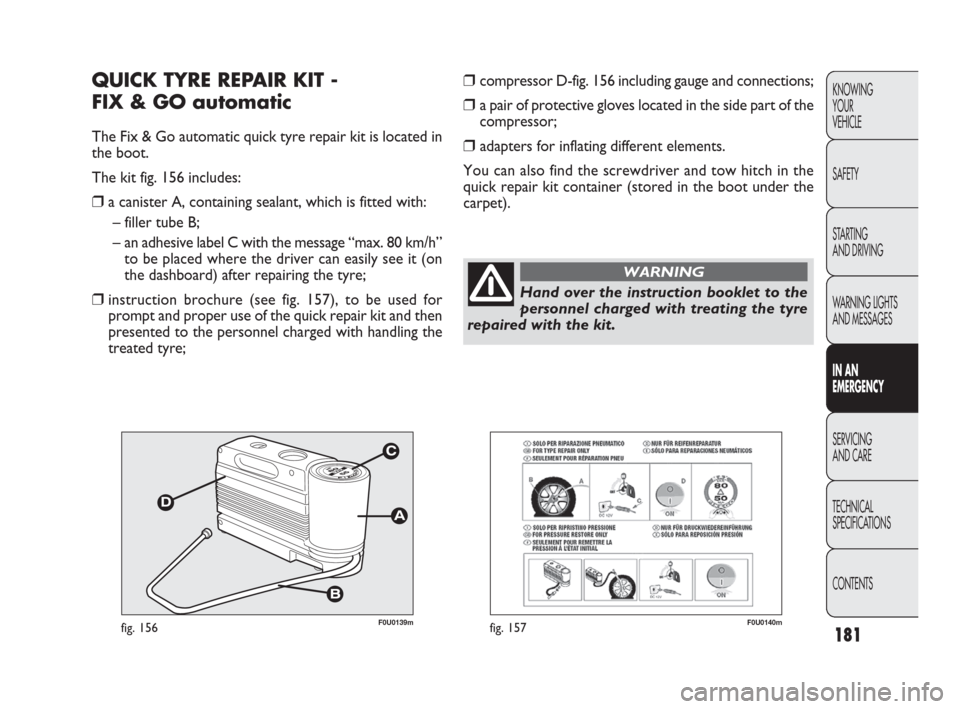
The Fix & Go automatic quick tyre repair kit is located in
the boot.
The kit fig. 156 includes:
❒a canister A, containing sealant, which is fitted with:
– filler tube B;
– an adhesive label C with the message “max. 80 km/h”
to be placed where the driver can easily see it (on
the dashboard) after repairing the tyre;
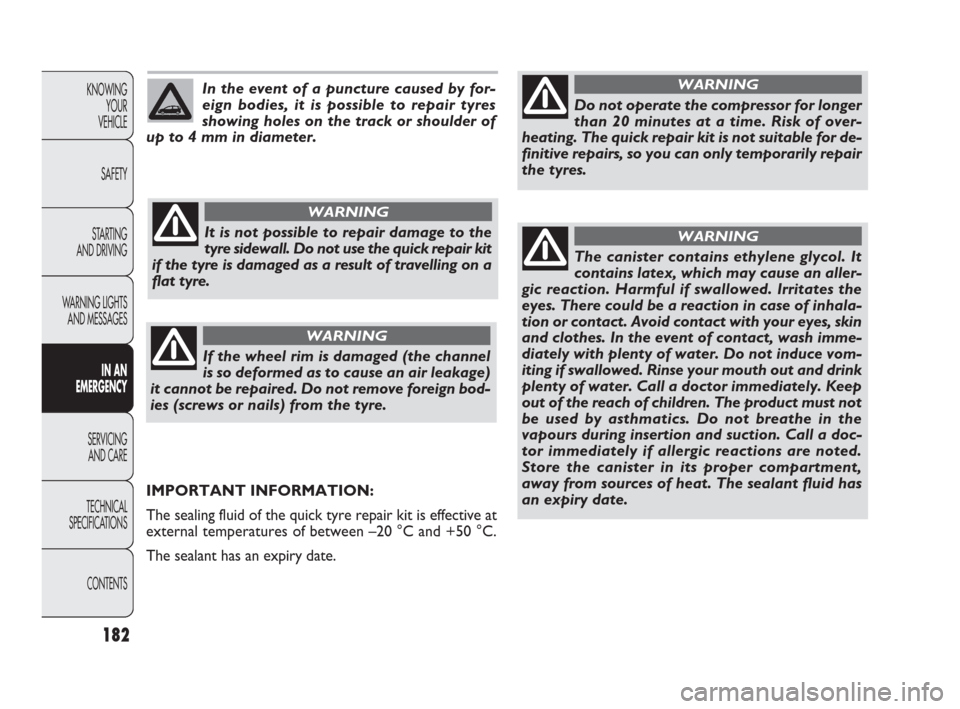
❒instruction brochure (see fig. 157), to be used for
prompt and proper use of the quick repair kit and then
presented to the personnel charged with handling the
treated tyre;
❒compressor D-fig. 156 including gauge and connections;
❒a pair of protective gloves located in the side part of the
compressor;
❒ adapters for inflating different elements.
You can also find the screwdriver and tow hitch in the
quick repair kit container (stored in the boot under the
carpet).
F0U0140mfig. 157
Hand over the instruction booklet to the
personnel charged with treating the tyre
repaired with the kit.
WARNING
181
KNOWING
YOUR
VEHICLE
SAFETY
STARTING
AND DRIVING
WARNING LIGHTS
AND MESSAGES
IN AN
EMERGENCY
SERVICING
AND CARE
TECHNICAL
SPECIFICATIONS
CONTENTS
175-210 PUNTO FL EN 4ed 20-01-2010 15:09 Pagina 181
Page 183 of 270
In the event of a puncture caused by for-
eign bodies, it is possible to repair tyres
showing holes on the track or shoulder of
up to 4 mm in diameter.
It is not possible to repair damage to the
tyre sidewall. Do not use the quick repair kit
if the tyre is damaged as a result of travelling on a
flat tyre.
WARNING
If the wheel rim is damaged (the channel
is so deformed as to cause an air leakage)
it cannot be repaired. Do not remove foreign bod-
ies (screws or nails) from the tyre.
WARNING
IMPORTANT INFORMATION:
The sealing fluid of the quick tyre repair kit is effective at
external temperatures of between –20 °C and +50 °C.
The sealant has an expiry date.
Do not operate the compressor for longer
than 20 minutes at a time. Risk of over-
heating. The quick repair kit is not suitable for de-
finitive repairs, so you can only temporarily repair
the tyres.
WARNING
The canister contains ethylene glycol. It
contains latex, which may cause an aller-
gic reaction. Harmful if swallowed. Irritates the
eyes. There could be a reaction in case of inhala-
tion or contact. Avoid contact with your eyes, skin
and clothes. In the event of contact, wash imme-
diately with plenty of water. Do not induce vom-
iting if swallowed. Rinse your mouth out and drink
plenty of water. Call a doctor immediately. Keep
out of the reach of children. The product must not
be used by asthmatics. Do not breathe in the
vapours during insertion and suction. Call a doc-
tor immediately if allergic reactions are noted.
Store the canister in its proper compartment,
away from sources of heat. The sealant fluid has
an expiry date.
WARNING
182
KNOWING
YOUR
VEHICLE
SAFETY
STARTING
AND DRIVING
WARNING LIGHTS
AND MESSAGES
IN AN
EMERGENCY
SERVICING
AND CARE
TECHNICAL
SPECIFICATIONS
CONTENTS
175-210 PUNTO FL EN 4ed 20-01-2010 15:09 Pagina 182
Page 184 of 270
Replace the cylinder containing out-of-
date sealant fluid. Dispose of the cylinder
and the sealant liquid properly. Dispose ac-
cording to the national and local laws in force.
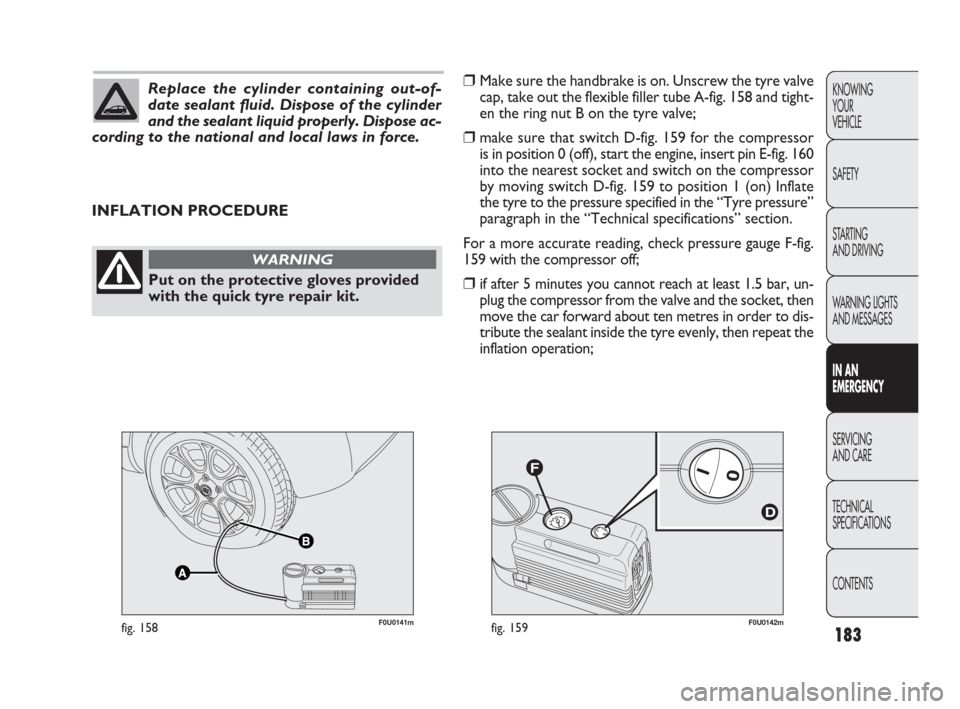
F0U0142mfig. 159F0U0141mfig. 158
INFLATION PROCEDURE
Put on the protective gloves provided
with the quick tyre repair kit.
WARNING
❒Make sure the handbrake is on. Unscrew the tyre valve
cap, take out the flexible filler tube A-fig. 158 and tight-
en the ring nut B on the tyre valve;
❒make sure that switch D-fig. 159 for the compressor
is in position 0 (off), start the engine, insert pin E-fig. 160
into the nearest socket and switch on the compressor
by moving switch D-fig. 159 to position 1 (on) Inflate
the tyre to the pressure specified in the “Tyre pressure”
paragraph in the “Technical specifications” section.
For a more accurate reading, check pressure gauge F-fig.
159 with the compressor off;
❒if after 5 minutes you cannot reach at least 1.5 bar, un-
plug the compressor from the valve and the socket, then
move the car forward about ten metres in order to dis-
tribute the sealant inside the tyre evenly, then repeat the
inflation operation;
183
KNOWING
YOUR
VEHICLE
SAFETY
STARTING
AND DRIVING
WARNING LIGHTS
AND MESSAGES
IN AN
EMERGENCY
SERVICING
AND CARE
TECHNICAL
SPECIFICATIONS
CONTENTS
175-210 PUNTO FL EN 4ed 20-01-2010 15:09 Pagina 183
Page 185 of 270
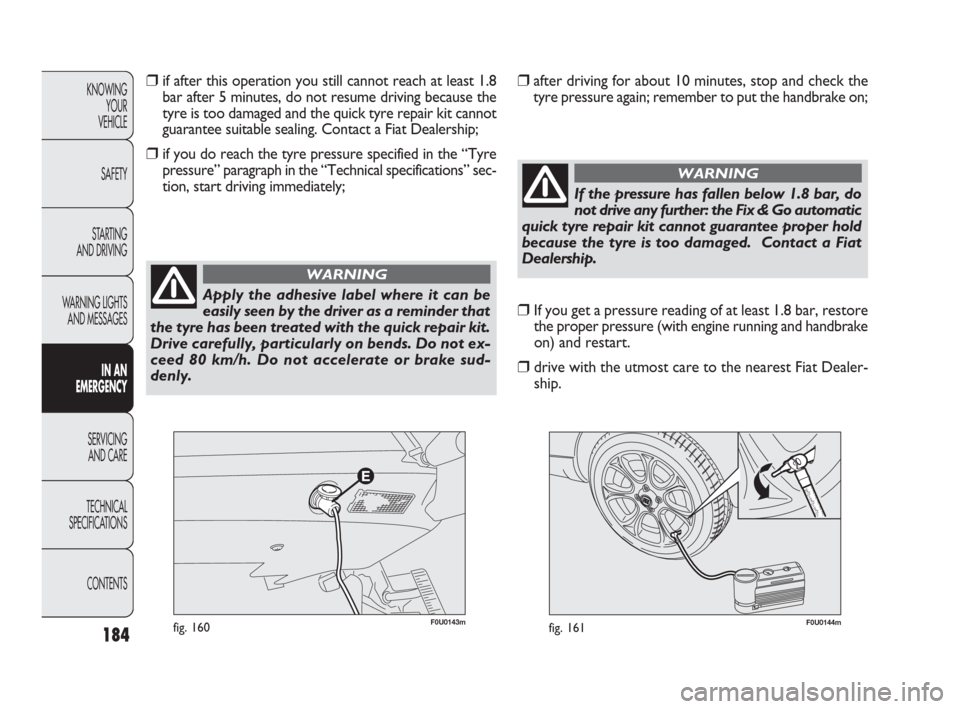
F0U0144mfig. 161F0U0143mfig. 160
❒if after this operation you still cannot reach at least 1.8
bar after 5 minutes, do not resume driving because the
tyre is too damaged and the quick tyre repair kit cannot
guarantee suitable sealing. Contact a Fiat Dealership;
❒if you do reach the tyre pressure specified in the “Tyre
pressure” paragraph in the “Technical specifications” sec-
tion, start driving immediately;
184
KNOWING
YOUR
VEHICLE
SAFETY
STARTING
AND DRIVING
WARNING LIGHTS
AND MESSAGES
IN AN
EMERGENCY
SERVICING
AND CARE
TECHNICAL
SPECIFICATIONS
CONTENTS
Apply the adhesive label where it can be
easily seen by the driver as a reminder that
the tyre has been treated with the quick repair kit.
Drive carefully, particularly on bends. Do not ex-
ceed 80 km/h. Do not accelerate or brake sud-
denly.
WARNING
❒after driving for about 10 minutes, stop and check the
tyre pressure again; remember to put the handbrake on;
If the pressure has fallen below 1.8 bar, do
not drive any further: the Fix & Go automatic
quick tyre repair kit cannot guarantee proper hold
because the tyre is too damaged. Contact a Fiat
Dealership.
WARNING
❒If you get a pressure reading of at least 1.8 bar, restore
the proper pressure (with engine running and handbrake
on) and restart.
❒drive with the utmost care to the nearest Fiat Dealer-
ship.
175-210 PUNTO FL EN 4ed 20-01-2010 15:09 Pagina 184