Brake light FIAT PUNTO EVO 2010 1.G Owner's Manual
[x] Cancel search | Manufacturer: FIAT, Model Year: 2010, Model line: PUNTO EVO, Model: FIAT PUNTO EVO 2010 1.GPages: 270, PDF Size: 8.34 MB
Page 153 of 270
152
KNOWING
YOUR
VEHICLE
SAFETY
STARTING
AND DRIVING
WARNING LIGHTS
AND MESSAGES
IN AN
EMERGENCY
SERVICING
AND CARE
TECHNICAL
SPECIFICATIONS
CONTENTS
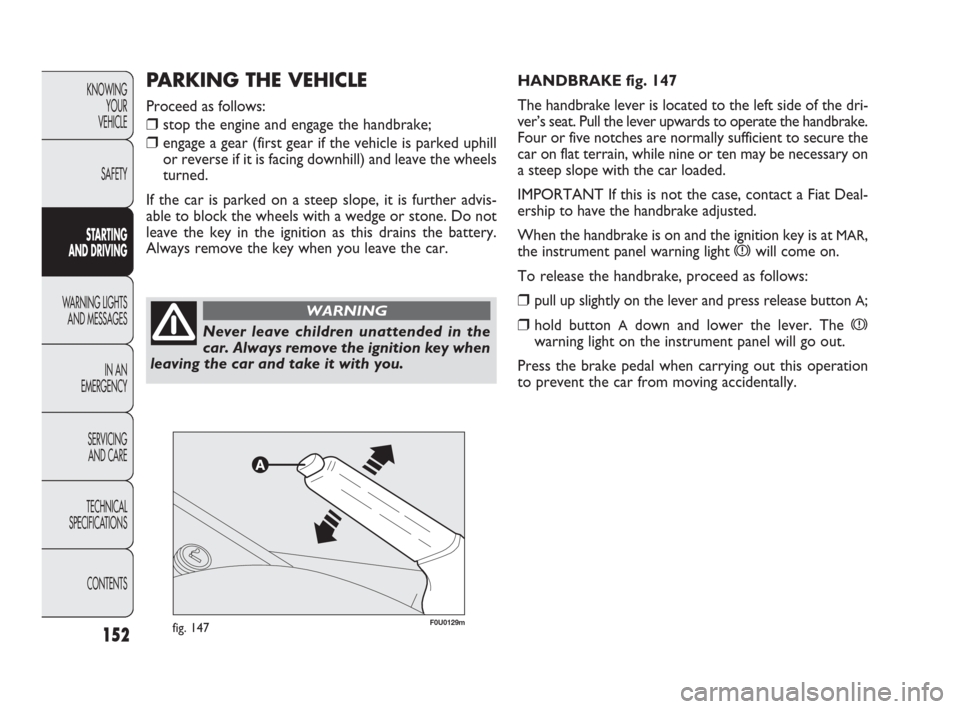
F0U0129mfig. 147
HANDBRAKE fig. 147
The handbrake lever is located to the left side of the dri-
ver’s seat. Pull the lever upwards to operate the handbrake.
Four or five notches are normally sufficient to secure the
car on flat terrain, while nine or ten may be necessary on
a steep slope with the car loaded.
IMPORTANT If this is not the case, contact a Fiat Deal-
ership to have the handbrake adjusted.
When the handbrake is on and the ignition key is at
MAR,
the instrument panel warning light
xwill come on.
To release the handbrake, proceed as follows:
❒pull up slightly on the lever and press release button A;
❒hold button Adown and lower the lever. The x
warning light on the instrument panel will go out.
Press the brake pedal when carrying out this operation
to prevent the car from moving accidentally.
PARKING THE VEHICLE
Proceed as follows:
❒stop the engine and engage the handbrake;
❒engage a gear (first gear if the vehicle is parked uphill
or reverse if it is facing downhill) and leave the wheels
turned.
If the car is parked on a steep slope, it is further advis-
able to block the wheels with a wedge or stone. Do not
leave the key in the ignition as this drains the battery.
Always remove the key when you leave the car.
Never leave children unattended in the
car. Always remove the ignition key when
leaving the car and take it with you.
WARNING
149-160 PUNTO FL EN 4ed 20-01-2010 14:37 Pagina 152
Page 157 of 270
156
TOWING TRAILERS
IMPORTANT NOTES
The car must be equipped with an approved tow hook and
adequate electrical system to tow caravans or trailers. In-
stallation must be performed by specialised personnel who
will issue the required papers for travelling on roads.
Install any specific and/or additional rear-view mirrors in
accordance with the highway code of the country in which
you are travelling.
Remember that, when towing a trailer, steep hills are hard-
er to climb, braking distances increase and overtaking takes
longer relative to the overall weight of the trailer.
Engage a low gear when driving downhill, rather than con-
stantly using the brake.
The weight of the trailer on the car’s tow hook will re-
duce the load capacity of the car by the same amount. Con-
sider the weight of the trailer fully laden, including acces-
sories and luggage, to make sure you do not exceed the
maximum towable weight (shown on the vehicle regis-
tration document).
Respect each country’s speed limits for vehicles towing
trailers. The top speed must not exceed 100 km/h at any
time.
You should fit a suitable stabiliser to the trailer.
KNOWING
YOUR
VEHICLE
SAFETY
STARTING
AND DRIVING
WARNING LIGHTS
AND MESSAGES
IN AN
EMERGENCY
SERVICING
AND CARE
TECHNICAL
SPECIFICATIONS
CONTENTS
The ABS with which the car may be
equipped will not control the braking sys-
tem of the trailer. Particular caution is therefore
required on slippery roads.
WARNING
Never modify the braking system of the
car to control the trailer brake. The trail-
er braking system must be fully independent from
the hydraulic system of the car.
WARNING
149-160 PUNTO FL EN 4ed 20-01-2010 14:37 Pagina 156
Page 158 of 270
157
An electric brake or winch should be powered directly by
the battery through a cable with a cross-section of no less
than 2.5 mm
2.
IMPORTANT The engine must be running to use the elec-
tric brake or winch.
In addition to the electrical branches, the vehicle’s elec-
trical system can be connected only to the supply cable for
an electric brake and to the cable for an internal trailer
light, though not above 15W.
For connections, use the preset control unit with a bat-
tery cable no less than 2.5 mm
2.
KNOWING
YOUR
VEHICLE
SAFETY
STARTING
AND DRIVING
WARNING LIGHTS
AND MESSAGES
IN AN
EMERGENCY
SERVICING
AND CARE
TECHNICAL
SPECIFICATIONS
CONTENTS
INSTALLING THE TOW HOOK
The towing device should be fastened to the body by spe-
cialised personnel in accordance with any additional infor-
mation supplied by the manufacturer of the device.
The towing device must meet current regulations with ref-
erence to Directive 94/20/EC and subsequent amendments.
For any version, the towing device used must be right for
the towable weight of the car on which it is to be installed.
For the electric connection a unified connector should be
used, which is generally placed on a special bracket fastened
to the towing device, and a special ECU should be installed
on the car to control the trailer’s exterior lights. 7 or 13-
pin 12VDC connections should be used (CUNA/UNI and
ISO/DIN Standards). Follow any instructions provided by
the car manufacturer and/or the towing device manufac-
turer.
149-160 PUNTO FL EN 4ed 20-01-2010 14:37 Pagina 157
Page 161 of 270
❒clean and protect the painted parts using protective
wax;
❒clean and protect the shiny metal parts using special
compounds readily available;
❒sprinkle talcum powder on the rubber windscreen
and rear window wiper blades and lift them off the
glass;
❒open the windows slightly;
❒cover the car with a fabric or perforated plastic sheet.
Do not use compact plastic sheets which do not allow
humidity to evaporate from the surface of the car;
❒inflate tyres to a pressure of +0.5 bar above the nor-
mal specified pressure and check regularly;
❒if you don’t disconnect the battery from the electrical
system, check its charge every month and recharge it
if the indicator shows a dark colour without the cen-
tral green area;
❒do not drain the engine cooling system.
IMPORTANT Where relevant, switch off the car alarm
with the remote control.
CAR INACTIVITY
If the car is to be left inactive for longer than a month,
the following precautions should be observed:
❒park the car in covered, dry and, if possible, well-ven-
tilated premises;
❒engage a gear;
❒check that the handbrake is engaged;
❒disconnect the clip for the negative battery terminal
and check battery charge. Repeat this check once
every three months during storage. Recharge the
battery if the indicator is dark and the middle area is
not green;
160
KNOWING
YOUR
VEHICLE
SAFETY
STARTING
AND DRIVING
WARNING LIGHTS
AND MESSAGES
IN AN
EMERGENCY
SERVICING
AND CARE
TECHNICAL
SPECIFICATIONS
CONTENTS
16” and 17” tyres cannot be fitted with
chains.
WARNING
Keep your speed down when snow chains
are fitted: do not exceed 50 km/h. Avoid
potholes, steps and pavements, and do
not drive for long distances on roads not
covered with snow to prevent damaging
the car and the road surface.
WARNING
149-160 PUNTO FL EN 4ed 20-01-2010 14:37 Pagina 160
Page 162 of 270
161
WARNING LIGHTS AND MESSAGES
GENERAL WARNINGS
Warning lights are accompanied by a specific message
and/or sound when applicable. These indications are brief
and precautionary and as such must not be considered as
exhaustive and/or alternative to the information contained
in the Owner’s Handbook, which you are recommended
to read carefully in all cases. Always refer to the informa-
tion in this chapter in the event of a failure indication.
IMPORTANT The fault indicators appearing on the dis-
play are divided into two categories: very serious and less
serious failures.
Serious failures prompt a prolonged cycle of signals.
Less serious failures prompt a shorter cycle of signals.
Press MENU ESC to stop the warning cycle in both cas-
es. Warning lights on the instrument panel will stay on un-
til the cause of the failure is eliminated.
For messages relevant to the versions equipped with
a Dualogic gearbox, see the attached Supplement.
KNOWING
YOUR
VEHICLE
SAFETY
STARTING
AND DRIVING
WARNING LIGHTS
AND MESSAGES
IN AN
EMERGENCY
SERVICING
AND CARE
TECHNICAL
SPECIFICATIONS
CONTENTS
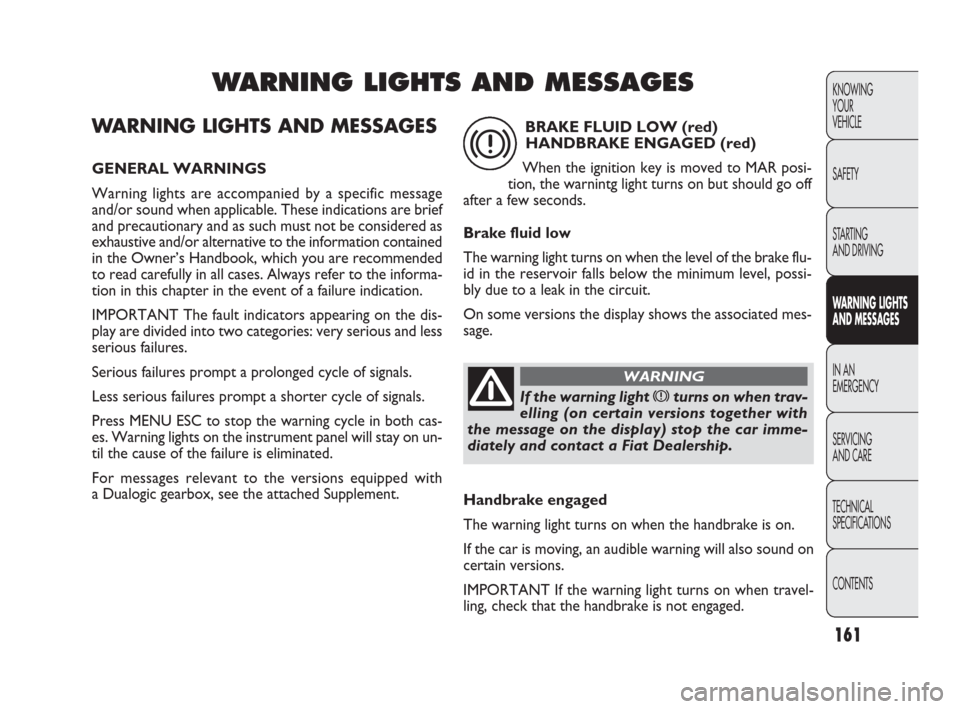
WARNING LIGHTS AND MESSAGES
If the warning light xturns on when trav-
elling (on certain versions together with
the message on the display) stop the car imme-
diately and contact a Fiat Dealership.
WARNING
BRAKE FLUID LOW (red)
HANDBRAKE ENGAGED (red)
When the ignition key is moved to MAR posi-
tion, the warnintg light turns on but should go off
after a few seconds.
Brake fluid low
The warning light turns on when the level of the brake flu-
id in the reservoir falls below the minimum level, possi-
bly due to a leak in the circuit.
On some versions the display shows the associated mes-
sage.
x
Handbrake engaged
The warning light turns on when the handbrake is on.
If the car is moving, an audible warning will also sound on
certain versions.
IMPORTANT If the warning light turns on when travel-
ling, check that the handbrake is not engaged.
161-174 PUNTO FL EN 4ed 18-01-2010 12:27 Pagina 161
Page 169 of 270
168
KNOWING
YOUR
VEHICLE
SAFETY
STARTING
AND DRIVING
WARNING LIGHTS
AND MESSAGES
IN AN
EMERGENCY
SERVICING
AND CARE
TECHNICAL
SPECIFICATIONS
CONTENTS
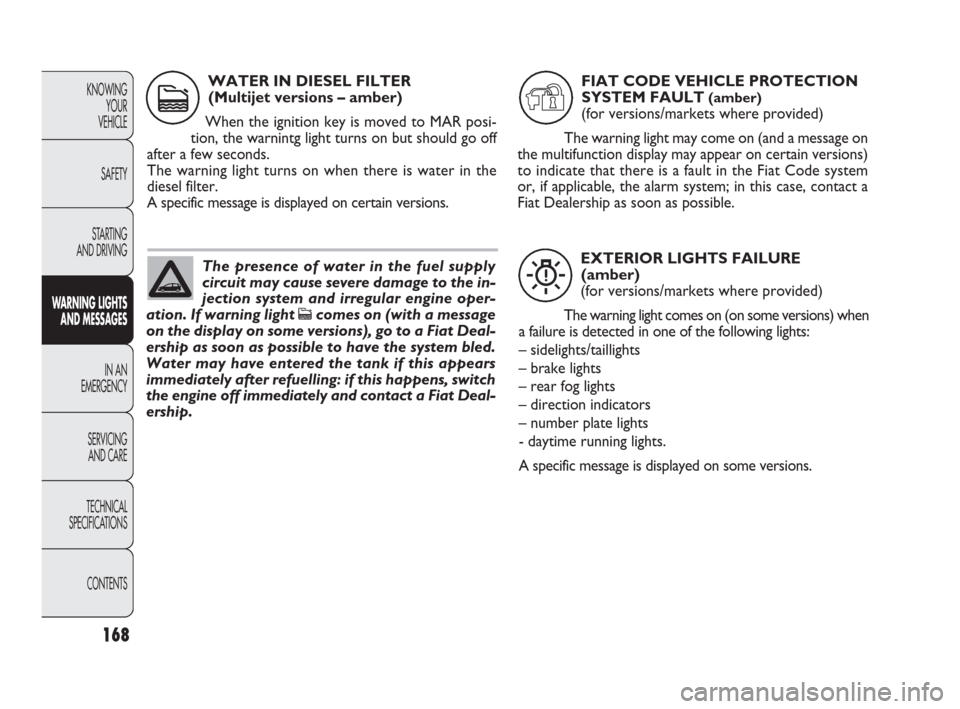
EXTERIOR LIGHTS FAILURE
(amber)
(for versions/markets where provided)
The warning light comes on (on some versions) when
a failure is detected in one of the following lights:
– sidelights/taillights
– brake lights
– rear fog lights
– direction indicators
– number plate lights
- daytime running lights.
A specific message is displayed on some versions.
W
The presence of water in the fuel supply
circuit may cause severe damage to the in-
jection system and irregular engine oper-
ation. If warning light
ccomes on (with a message
on the display on some versions), go to a Fiat Deal-
ership as soon as possible to have the system bled.
Water may have entered the tank if this appears
immediately after refuelling: if this happens, switch
the engine off immediately and contact a Fiat Deal-
ership.
FIAT CODE VEHICLE PROTECTION
SYSTEM FAULT
(amber)
(for versions/markets where provided)
The warning light may come on (and a message on
the multifunction display may appear on certain versions)
to indicate that there is a fault in the Fiat Code system
or, if applicable, the alarm system; in this case, contact a
Fiat Dealership as soon as possible.Y
WATER IN DIESEL FILTER
(Multijet versions – amber)
When the ignition key is moved to MAR posi-
tion, the warnintg light turns on but should go off
after a few seconds.
The warning light turns on when there is water in the
diesel filter.
A specific message is displayed on certain versions.
c
161-174 PUNTO FL EN 4ed 18-01-2010 12:27 Pagina 168
Page 172 of 270
171
KNOWING
YOUR
VEHICLE
SAFETY
STARTING
AND DRIVING
WARNING LIGHTS
AND MESSAGES
IN AN
EMERGENCY
SERVICING
AND CARE
TECHNICAL
SPECIFICATIONS
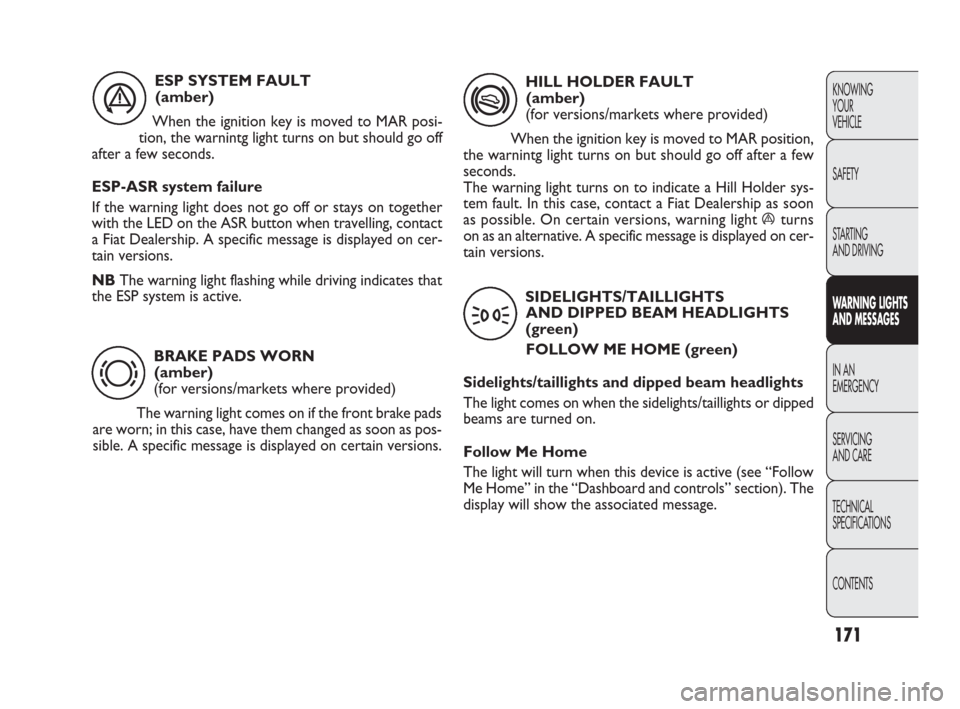
CONTENTSBRAKE PADS WORN
(amber)
(for versions/markets where provided)
The warning light comes on if the front brake pads
are worn; in this case, have them changed as soon as pos-
sible. A specific message is displayed on certain versions.
d
HILL HOLDER FAULT
(amber)
(for versions/markets where provided)
When the ignition key is moved to MAR position,
the warnintg light turns on but should go off after a few
seconds.
The warning light turns on to indicate a Hill Holder sys-
tem fault. In this case, contact a Fiat Dealership as soon
as possible. On certain versions, warning light
áturns
on as an alternative. A specific message is displayed on cer-
tain versions.
*
SIDELIGHTS/TAILLIGHTS
AND DIPPED BEAM HEADLIGHTS
(green)
FOLLOW ME HOME (green)
Sidelights/taillights and dipped beam headlights
The light comes on when the sidelights/taillights or dipped
beams are turned on.
Follow Me Home
The light will turn when this device is active (see “Follow
Me Home” in the “Dashboard and controls” section). The
display will show the associated message.
3
ESP SYSTEM FAULT
(amber)
When the ignition key is moved to MAR posi-
tion, the warnintg light turns on but should go off
after a few seconds.
ESP-ASR system failure
If the warning light does not go off or stays on together
with the LED on the ASR button when travelling, contact
a Fiat Dealership. A specific message is displayed on cer-
tain versions.
NBThe warning light flashing while driving indicates that
the ESP system is active.
á
161-174 PUNTO FL EN 4ed 18-01-2010 12:27 Pagina 171
Page 177 of 270
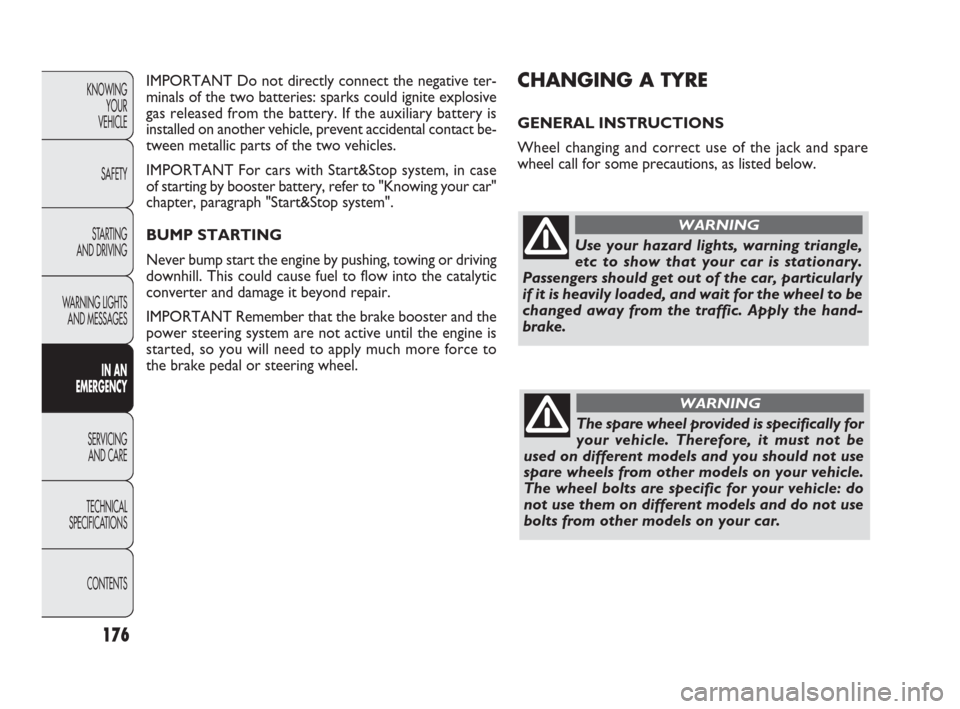
Use your hazard lights, warning triangle,
etc to show that your car is stationary.
Passengers should get out of the car, particularly
if it is heavily loaded, and wait for the wheel to be
changed away from the traffic. Apply the hand-
brake.
WARNING
The spare wheel provided is specifically for
your vehicle. Therefore, it must not be
used on different models and you should not use
spare wheels from other models on your vehicle.
The wheel bolts are specific for your vehicle: do
not use them on different models and do not use
bolts from other models on your car.
WARNING
IMPORTANT Do not directly connect the negative ter-
minals of the two batteries: sparks could ignite explosive
gas released from the battery. If the auxiliary battery is
installed on another vehicle, prevent accidental contact be-
tween metallic parts of the two vehicles.
IMPORTANT For cars with Start&Stop system, in case
of starting by booster battery, refer to "Knowing your car"
chapter, paragraph "Start&Stop system".
BUMP STARTING
Never bump start the engine by pushing, towing or driving
downhill. This could cause fuel to flow into the catalytic
converter and damage it beyond repair.
IMPORTANT Remember that the brake booster and the
power steering system are not active until the engine is
started, so you will need to apply much more force to
the brake pedal or steering wheel.CHANGING A TYRE
GENERAL INSTRUCTIONS
Wheel changing and correct use of the jack and spare
wheel call for some precautions, as listed below.
176
KNOWING
YOUR
VEHICLE
SAFETY
STARTING
AND DRIVING
WARNING LIGHTS
AND MESSAGES
IN AN
EMERGENCY
SERVICING
AND CARE
TECHNICAL
SPECIFICATIONS
CONTENTS
175-210 PUNTO FL EN 4ed 20-01-2010 15:09 Pagina 176
Page 178 of 270
Repair and refit the standard wheel as
soon as possible. Do not apply grease to
the bolt threads before assembly: they might spon-
taneously unscrew.
WARNING
The jack may be used to replace wheels
only on the car which it equips or other
cars of the same model. Never use the jack for
other purposes, such as lifting other models. Nev-
er use the jack to carry out repairs under the car.
Incorrect positioning of the jack may cause the
car to fall. Do not use the jack for loads higher
than the one shown on its label.
WARNING
If the hub cap is not fitted correctly, it may
come off when the car is travelling. Nev-
er tamper with the inflation valve. Never intro-
duce tools of any kind between the rim and the
tyre. Check tyre and spare wheel pressures regu-
larly, referring to the values shown in the “Tech-
nical specifications” section.
WARNING
Important notes:
❒the jack weight is 1.76 kg;
❒the jack requires no adjustment;
❒the jack cannot be repaired. If it breaks, it must be re-
placed with the same type;
❒no tool other than its cranking device may be fitted on
the jack.
To change a tyre, proceed as follows:
❒stop the car where it is not a danger to other road users
and you can replace the wheel safely. The ground should
be flat and solid;
❒turn the engine off and engage the handbrake;
❒engage first gear or reverse;
❒wear the reflective safety jacket (compulsory by law in
certain countries) before getting out of the car;
❒open the boot and lift the carpet or remove the cargo
box (for versions/markets where provided);
❒ unscrew the locking device A-fig. 151;
❒take out the tool container C-fig. 151 and put it along-
side the wheel to be changed;
❒take out the spare wheel B-fig. 151;
❒loosen the bolts of the wheel to be replaced by about
one turn with the wrench provided E-fig. 152; if you
have alloy wheels, rock the car to make it easier to sep-
arate the rim from the wheel hub;
177
KNOWING
YOUR
VEHICLE
SAFETY
STARTING
AND DRIVING
WARNING LIGHTS
AND MESSAGES
IN AN
EMERGENCY
SERVICING
AND CARE
TECHNICAL
SPECIFICATIONS
CONTENTS
175-210 PUNTO FL EN 4ed 20-01-2010 15:09 Pagina 177
Page 184 of 270
Replace the cylinder containing out-of-
date sealant fluid. Dispose of the cylinder
and the sealant liquid properly. Dispose ac-
cording to the national and local laws in force.
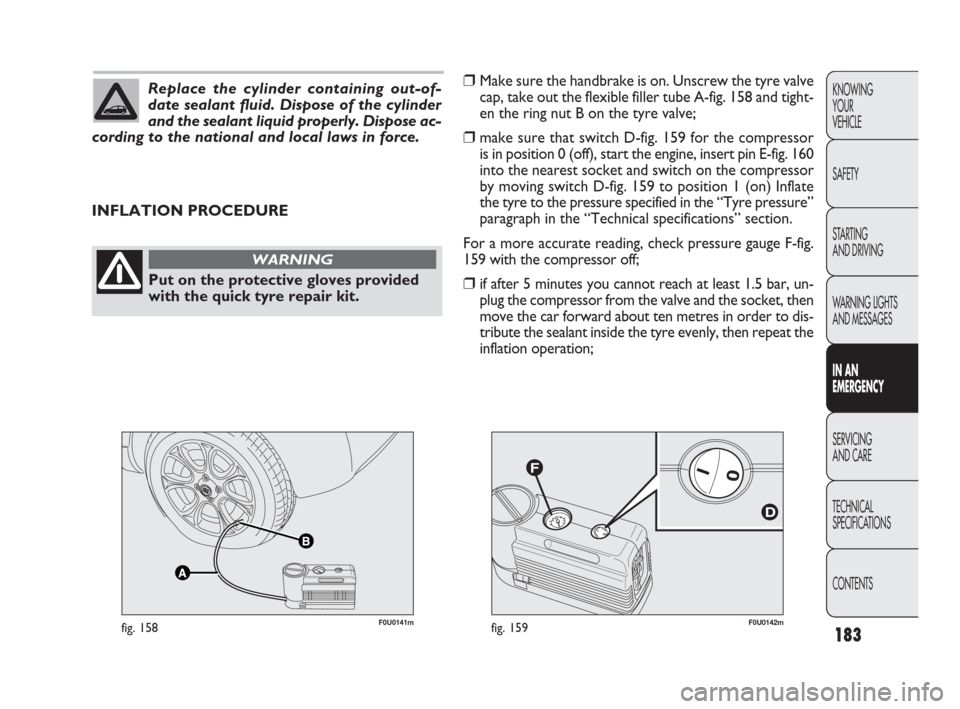
F0U0142mfig. 159F0U0141mfig. 158
INFLATION PROCEDURE
Put on the protective gloves provided
with the quick tyre repair kit.
WARNING
❒Make sure the handbrake is on. Unscrew the tyre valve
cap, take out the flexible filler tube A-fig. 158 and tight-
en the ring nut B on the tyre valve;
❒make sure that switch D-fig. 159 for the compressor
is in position 0 (off), start the engine, insert pin E-fig. 160
into the nearest socket and switch on the compressor
by moving switch D-fig. 159 to position 1 (on) Inflate
the tyre to the pressure specified in the “Tyre pressure”
paragraph in the “Technical specifications” section.
For a more accurate reading, check pressure gauge F-fig.
159 with the compressor off;
❒if after 5 minutes you cannot reach at least 1.5 bar, un-
plug the compressor from the valve and the socket, then
move the car forward about ten metres in order to dis-
tribute the sealant inside the tyre evenly, then repeat the
inflation operation;
183
KNOWING
YOUR
VEHICLE
SAFETY
STARTING
AND DRIVING
WARNING LIGHTS
AND MESSAGES
IN AN
EMERGENCY
SERVICING
AND CARE
TECHNICAL
SPECIFICATIONS
CONTENTS
175-210 PUNTO FL EN 4ed 20-01-2010 15:09 Pagina 183