battery FIAT PUNTO EVO 2010 1.G Owner's Manual
[x] Cancel search | Manufacturer: FIAT, Model Year: 2010, Model line: PUNTO EVO, Model: FIAT PUNTO EVO 2010 1.GPages: 270, PDF Size: 8.34 MB
Page 177 of 270
Use your hazard lights, warning triangle,
etc to show that your car is stationary.
Passengers should get out of the car, particularly
if it is heavily loaded, and wait for the wheel to be
changed away from the traffic. Apply the hand-
brake.
WARNING
The spare wheel provided is specifically for
your vehicle. Therefore, it must not be
used on different models and you should not use
spare wheels from other models on your vehicle.
The wheel bolts are specific for your vehicle: do
not use them on different models and do not use
bolts from other models on your car.
WARNING
IMPORTANT Do not directly connect the negative ter-
minals of the two batteries: sparks could ignite explosive
gas released from the battery. If the auxiliary battery is
installed on another vehicle, prevent accidental contact be-
tween metallic parts of the two vehicles.
IMPORTANT For cars with Start&Stop system, in case
of starting by booster battery, refer to "Knowing your car"
chapter, paragraph "Start&Stop system".
BUMP STARTING
Never bump start the engine by pushing, towing or driving
downhill. This could cause fuel to flow into the catalytic
converter and damage it beyond repair.
IMPORTANT Remember that the brake booster and the
power steering system are not active until the engine is
started, so you will need to apply much more force to
the brake pedal or steering wheel.CHANGING A TYRE
GENERAL INSTRUCTIONS
Wheel changing and correct use of the jack and spare
wheel call for some precautions, as listed below.
176
KNOWING
YOUR
VEHICLE
SAFETY
STARTING
AND DRIVING
WARNING LIGHTS
AND MESSAGES
IN AN
EMERGENCY
SERVICING
AND CARE
TECHNICAL
SPECIFICATIONS
CONTENTS
175-210 PUNTO FL EN 4ed 20-01-2010 15:09 Pagina 176
Page 202 of 270
201
KNOWING
YOUR
VEHICLE
SAFETY
STARTING
AND DRIVING
WARNING LIGHTS
AND MESSAGES
IN AN
EMERGENCY
SERVICING
AND CARE
TECHNICAL
SPECIFICATIONS
CONTENTS
F0U0174mfig. 191
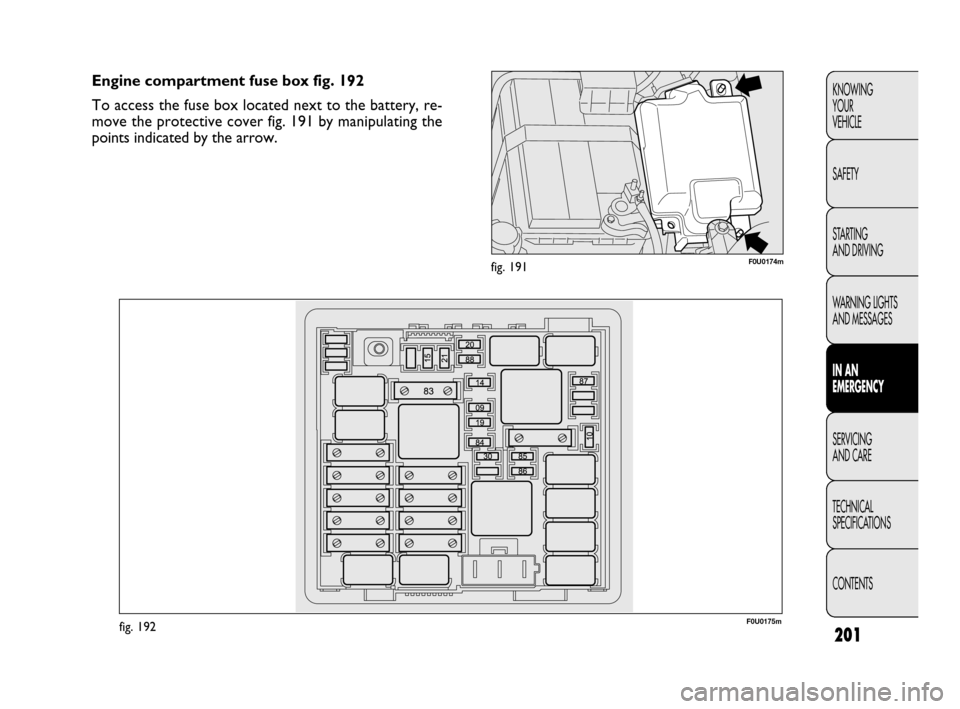
Engine compartment fuse box fig. 192
To access the fuse box located next to the battery, re-
move the protective cover fig. 191 by manipulating the
points indicated by the arrow.
F0U0175mfig. 192
175-210 PUNTO FL EN 4ed 2-02-2010 14:05 Pagina 201
Page 204 of 270
203
KNOWING
YOUR
VEHICLE
SAFETY
STARTING
AND DRIVING
WARNING LIGHTS
AND MESSAGES
IN AN
EMERGENCY
SERVICING
AND CARE
TECHNICAL
SPECIFICATIONS
CONTENTS
7.5
7.5
5
5
10
5
20
20
20
20
5
5
7.5 1
8
13
2
5
11
4
6
14
7
12
3
10
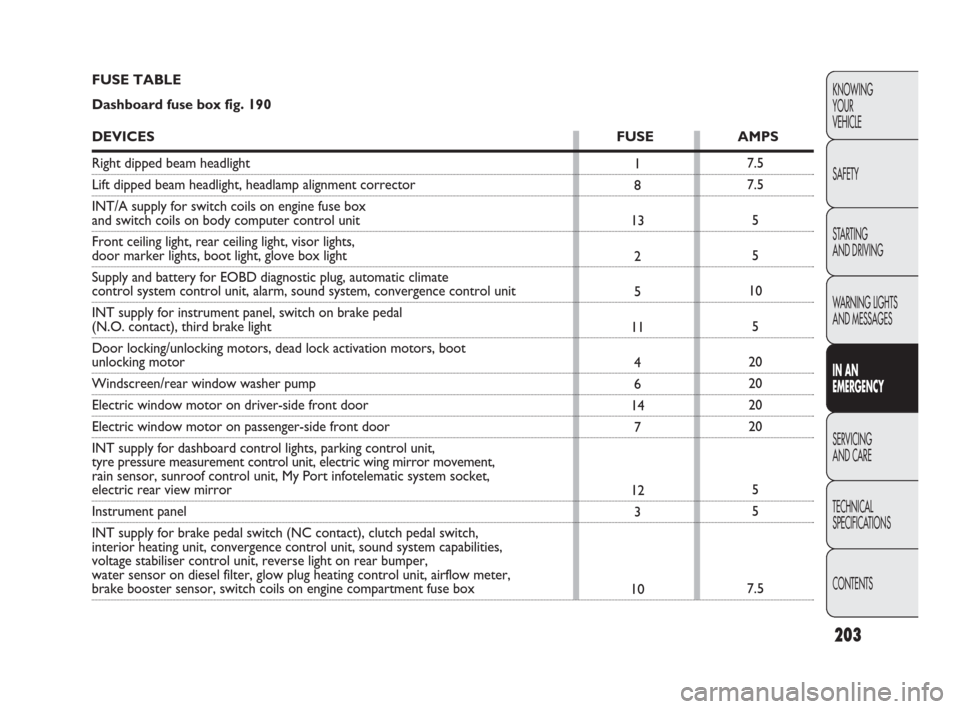
FUSE TABLE
Dashboard fuse box fig. 190
DEVICESFUSE AMPS
Right dipped beam headlight
Lift dipped beam headlight, headlamp alignment corrector
INT/A supply for switch coils on engine fuse box
and switch coils on body computer control unit
Front ceiling light, rear ceiling light, visor lights,
door marker lights, boot light, glove box light
Supply and battery for EOBD diagnostic plug, automatic climate
control system control unit, alarm, sound system, convergence control unit
INT supply for instrument panel, switch on brake pedal
(N.O. contact), third brake light
Door locking/unlocking motors, dead lock activation motors, boot
unlocking motor
Windscreen/rear window washer pump
Electric window motor on driver-side front door
Electric window motor on passenger-side front door
INT supply for dashboard control lights, parking control unit,
tyre pressure measurement control unit, electric wing mirror movement,
rain sensor, sunroof control unit, My Port infotelematic system socket,
electric rear view mirror
Instrument panel
INT supply for brake pedal switch (NC contact), clutch pedal switch,
interior heating unit, convergence control unit, sound system capabilities,
voltage stabiliser control unit, reverse light on rear bumper,
water sensor on diesel filter, glow plug heating control unit, airflow meter,
brake booster sensor, switch coils on engine compartment fuse box
175-210 PUNTO FL EN 4ed 20-01-2010 15:09 Pagina 203
Page 205 of 270
09
10
14
15
19
20
21
30
84
85
86
87
8820
10
15
30
7.5
30
15
15
7.5
–
15
5
7.5
204
KNOWING
YOUR
VEHICLE
SAFETY
STARTING
AND DRIVING
WARNING LIGHTS
AND MESSAGES
IN AN
EMERGENCY
SERVICING
AND CARE
TECHNICAL
SPECIFICATIONS
CONTENTS
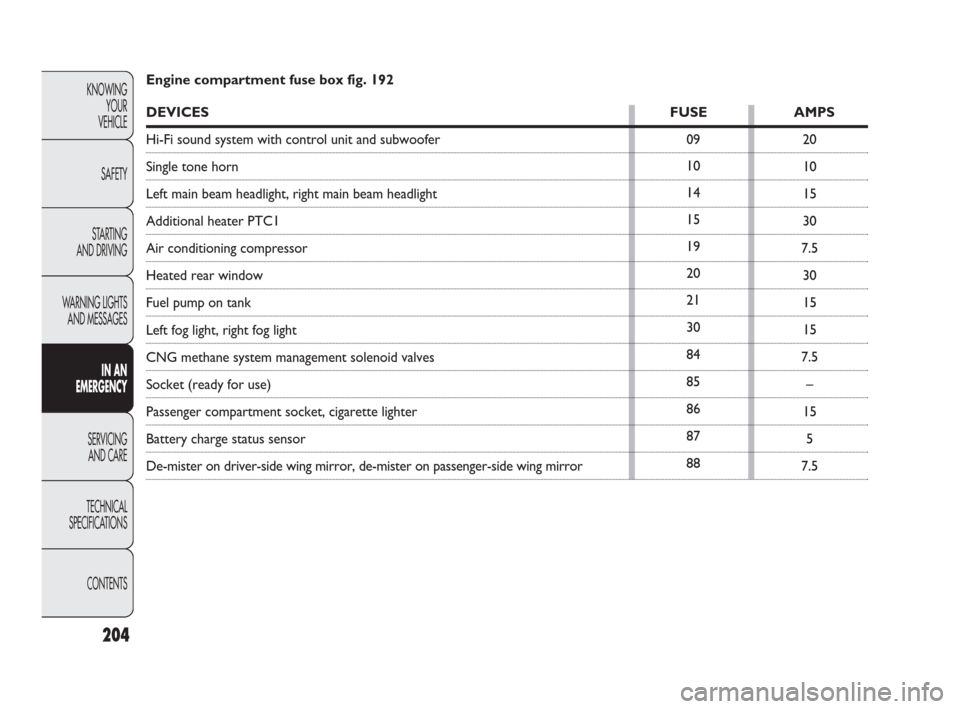
Engine compartment fuse box fig. 192
DEVICESFUSE AMPS
Hi-Fi sound system with control unit and subwoofer
Single tone horn
Left main beam headlight, right main beam headlight
Additional heater PTC1
Air conditioning compressor
Heated rear window
Fuel pump on tank
Left fog light, right fog light
CNG methane system management solenoid valves
Socket (ready for use)
Passenger compartment socket, cigarette lighter
Battery charge status sensor
De-mister on driver-side wing mirror, de-mister on passenger-side wing mirror
175-210 PUNTO FL EN 4ed 20-01-2010 15:09 Pagina 204
Page 207 of 270
206
KNOWING
YOUR
VEHICLE
SAFETY
STARTING
AND DRIVING
WARNING LIGHTS
AND MESSAGES
IN AN
EMERGENCY
SERVICING
AND CARE
TECHNICAL
SPECIFICATIONS
CONTENTS
RECHARGING THE BATTERY
IMPORTANT The battery recharging procedure is pro-
vided for information purposes only. You are recom-
mended to go to a Fiat Dealership to have this operation
performed.
We recommend recharging the battery slowly for ap-
proximately 24 hours at low amperage. Rapid charging with
high currents could damage the battery.
VERSIONS WITHOUT Start&Stop SYSTEM
(for versions/markets, where provided)
Charge the battery as follows:
❒disconnect the battery negative terminal;
❒connect the charger leads to the battery terminals, ob-
serving the polarity;
❒turn on the charger;
❒when you have finished, turn the charger off before dis-
connecting the battery;
❒reconnect battery negative terminal.
VERSIONS WITH Start&Stop SYSTEM
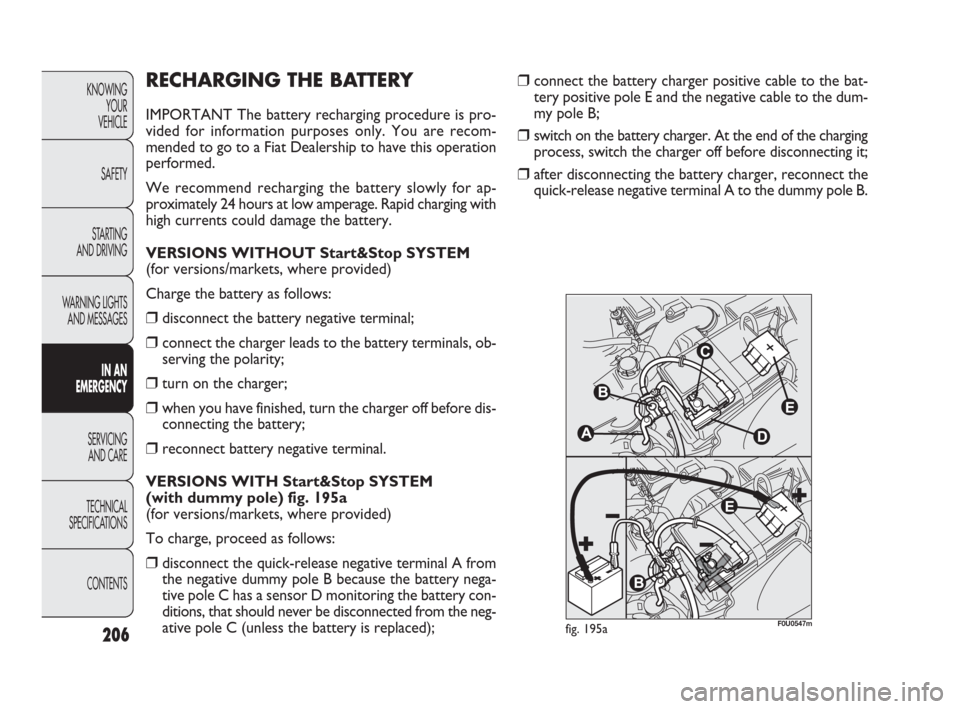
(with dummy pole) fig. 195a
(for versions/markets, where provided)
To charge, proceed as follows:
❒disconnect the quick-release negative terminal A from
the negative dummy pole B because the battery nega-
tive pole C has a sensor D monitoring the battery con-
ditions, that should never be disconnected from the neg-
ative pole C (unless the battery is replaced);
❒connect the battery charger positive cable to the bat-
tery positive pole E and the negative cable to the dum-
my pole B;
❒switch on the battery charger. At the end of the charging
process, switch the charger off before disconnecting it;
❒after disconnecting the battery charger, reconnect the
quick-release negative terminal A to the dummy pole B.
fig. 195aF0U0547m
175-210 PUNTO FL EN 4ed 20-01-2010 15:10 Pagina 206
Page 208 of 270
207
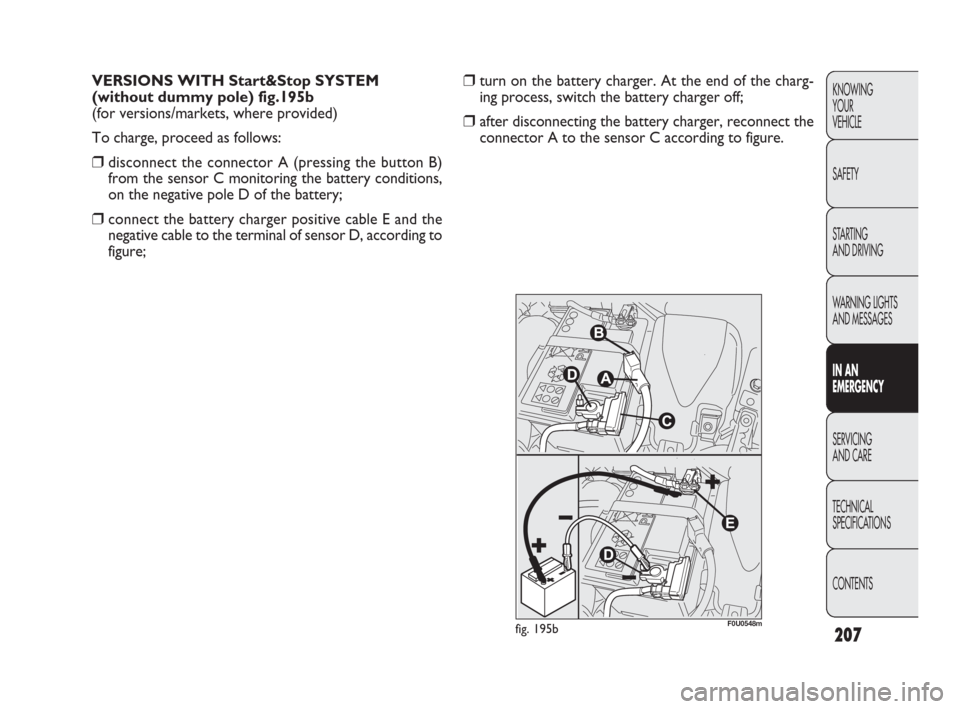
❒turn on the battery charger. At the end of the charg-
ing process, switch the battery charger off;
❒after disconnecting the battery charger, reconnect the
connector A to the sensor C according to figure. VERSIONS WITH Start&Stop SYSTEM
(without dummy pole) fig.195b
(for versions/markets, where provided)
To charge, proceed as follows:
❒disconnect the connector A (pressing the button B)
from the sensor C monitoring the battery conditions,
on the negative pole D of the battery;
❒connect the battery charger positive cable E and the
negative cable to the terminal of sensor D, according to
figure;
KNOWING
YOUR
VEHICLE
SAFETY
STARTING
AND DRIVING
WARNING LIGHTS
AND MESSAGES
IN AN
EMERGENCY
SERVICING
AND CARE
TECHNICAL
SPECIFICATIONS
CONTENTS
fig. 195bF0U0548m
175-210 PUNTO FL EN 4ed 20-01-2010 15:10 Pagina 207
Page 209 of 270
208
KNOWING
YOUR
VEHICLE
SAFETY
STARTING
AND DRIVING
WARNING LIGHTS
AND MESSAGES
IN AN
EMERGENCY
SERVICING
AND CARE
TECHNICAL
SPECIFICATIONS
CONTENTS
Battery fluid is poisonous and corrosive:
avoid contact with your skin and eyes. The
battery recharging operation must be performed
in a ventilated place, away from naked flames or
possible sources of sparks to avoid the risk of ex-
plosion and fire.
WARNING
Don’t try to recharge a frozen battery: de-
frost it first or it might explode. If the bat-
tery was frozen, have it inspected by specialised
personnel before recharging to check that the in-
ternal elements are not damaged and that the cas-
ing is not cracked, which could cause poisonous,
corrosive acid to leak.
WARNING
RAISING THE CAR
If the car needs to be lifted, go to a Fiat Dealership which
is equipped with the arm hoist or workshop lift.
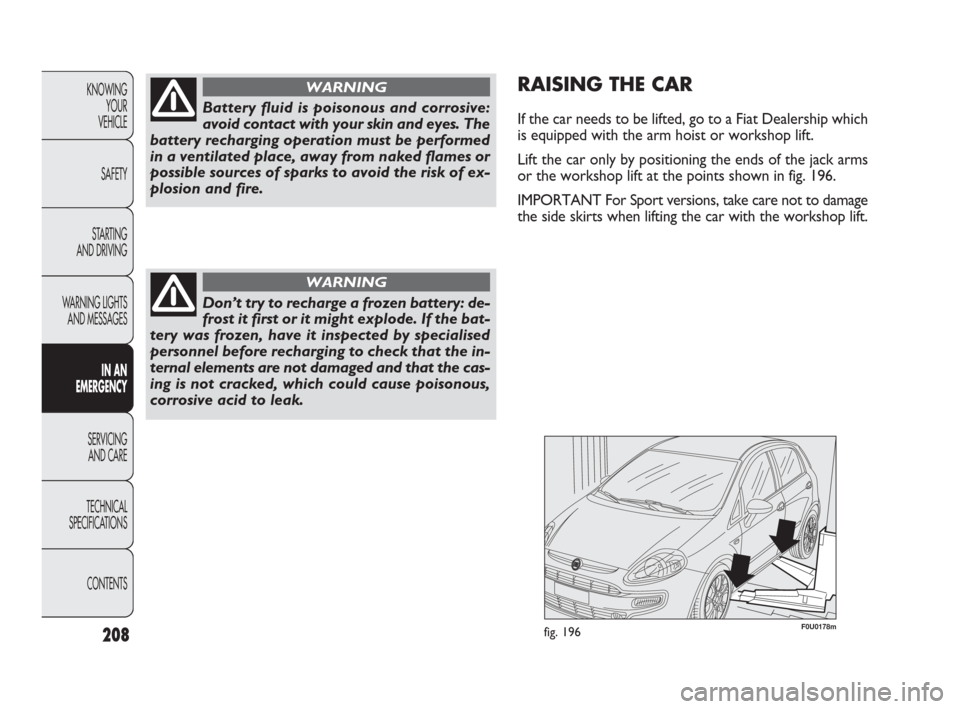
Lift the car only by positioning the ends of the jack arms
or the workshop lift at the points shown in fig. 196.
IMPORTANT For Sport versions, take care not to damage
the side skirts when lifting the car with the workshop lift.
fig. 196F0U0178m
175-210 PUNTO FL EN 4ed 20-01-2010 15:10 Pagina 208
Page 213 of 270
●● ●● ● ●
●● ●● ● ●
●● ●● ● ●
●● ●● ● ●
●● ●● ● ●
●● ●
●● ●● ● ●
●● ●● ● ●
●● ●● ● ●
●● ●● ● ●
●●
●●
●●
●● ●
●● ●● ● ●
212
KNOWING
YOUR
VEHICLE
SAFETY
STARTING
AND DRIVING
WARNING LIGHTS
AND MESSAGES
IN AN
EMERGENCY
SERVICING
AND CARE
TECHNICAL
SPECIFICATIONS
CONTENTS
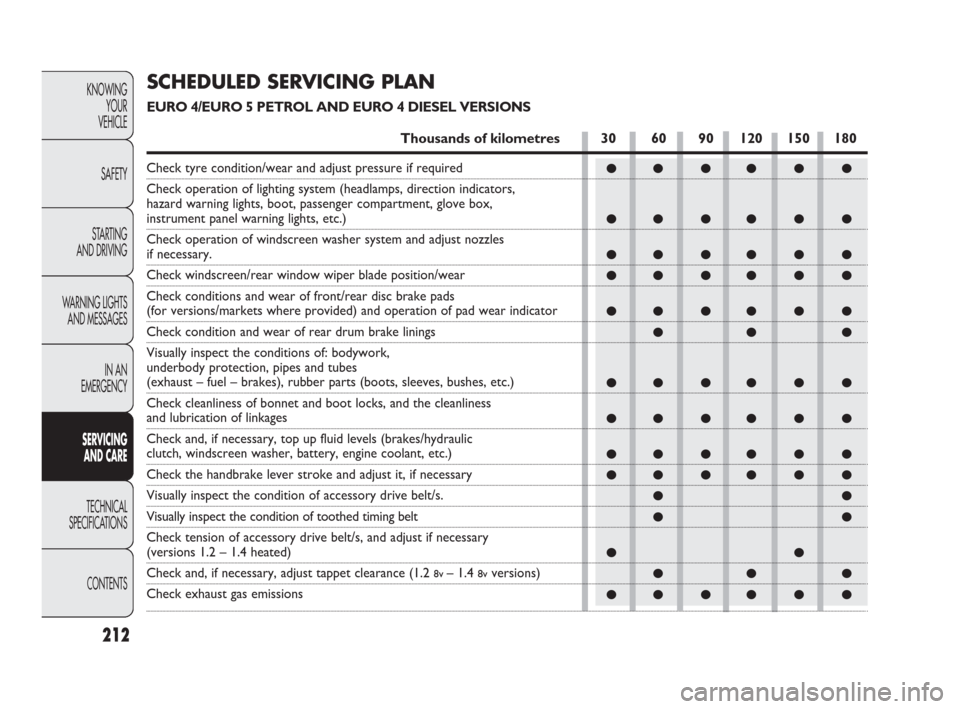
SCHEDULED SERVICING PLAN
EURO 4/EURO 5 PETROL AND EURO 4 DIESEL VERSIONS
Thousands of kilometres 30 60 90 120 150 180
Check tyre condition/wear and adjust pressure if required
Check operation of lighting system (headlamps, direction indicators,
hazard warning lights, boot, passenger compartment, glove box,
instrument panel warning lights, etc.)
Check operation of windscreen washer system and adjust nozzles
if necessary.
Check windscreen/rear window wiper blade position/wear
Check conditions and wear of front/rear disc brake pads
(for versions/markets where provided) and operation of pad wear indicator
Check condition and wear of rear drum brake linings
Visually inspect the conditions of: bodywork,
underbody protection, pipes and tubes
(exhaust – fuel – brakes), rubber parts (boots, sleeves, bushes, etc.)
Check cleanliness of bonnet and boot locks, and the cleanliness
and lubrication of linkages
Check and, if necessary, top up fluid levels (brakes/hydraulic
clutch, windscreen washer, battery, engine coolant, etc.)
Check the handbrake lever stroke and adjust it, if necessary
Visually inspect the condition of accessory drive belt/s.
Visually inspect the condition of toothed timing belt
Check tension of accessory drive belt/s, and adjust if necessary
(versions 1.2 – 1.4 heated)
Check and, if necessary, adjust tappet clearance (1.2 8v – 1.4 8vversions)
Check exhaust gas emissions
211-234 PUNTO FL EN 4ed 18-01-2010 12:27 Pagina 212
Page 215 of 270
214
KNOWING
YOUR
VEHICLE
SAFETY
STARTING
AND DRIVING
WARNING LIGHTS
AND MESSAGES
IN AN
EMERGENCY
SERVICING
AND CARE
TECHNICAL
SPECIFICATIONS
CONTENTS
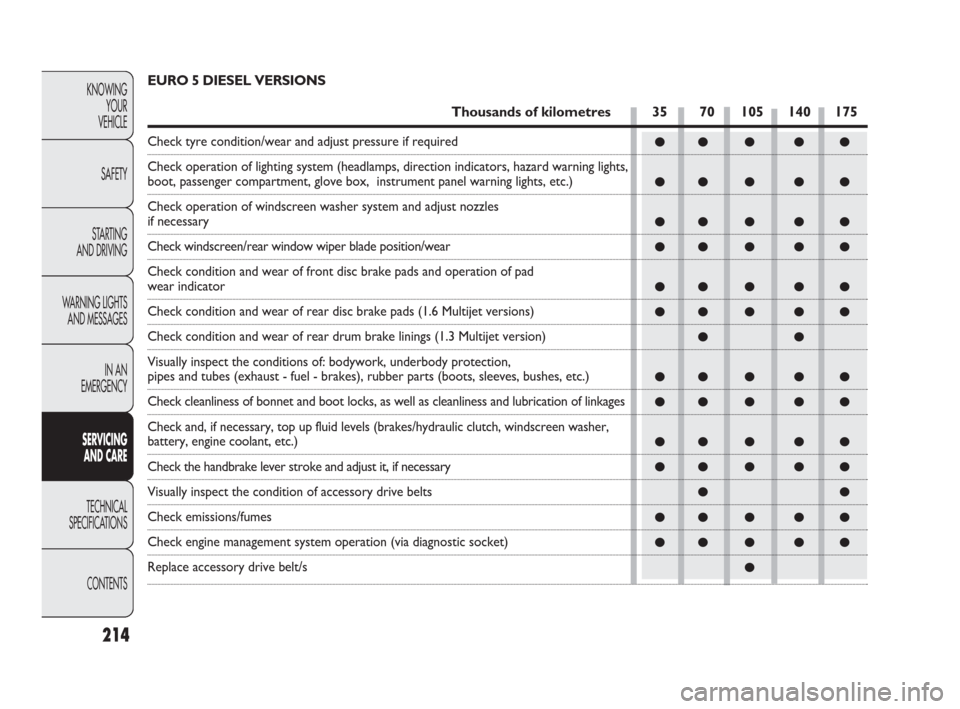
●● ● ● ●
●● ● ● ●
●● ● ● ●
●● ● ● ●
●● ● ● ●
●● ● ● ●
●●
●● ● ● ●
●● ● ● ●
●● ● ● ●
●● ● ● ●
●●
●● ● ● ●
●● ● ● ●
●
EURO 5 DIESEL VERSIONS
Thousands of kilometres 35 70 105 140 175
Check tyre condition/wear and adjust pressure if required
Check operation of lighting system (headlamps, direction indicators, hazard warning lights,
boot, passenger compartment, glove box, instrument panel warning lights, etc.)
Check operation of windscreen washer system and adjust nozzles
if necessary
Check windscreen/rear window wiper blade position/wear
Check condition and wear of front disc brake pads and operation of pad
wear indicator
Check condition and wear of rear disc brake pads (1.6 Multijet versions)
Check condition and wear of rear drum brake linings (1.3 Multijet version)
Visually inspect the conditions of: bodywork, underbody protection,
pipes and tubes (exhaust - fuel - brakes), rubber parts (boots, sleeves, bushes, etc.)
Check cleanliness of bonnet and boot locks, as well as cleanliness and lubrication of linkages
Check and, if necessary, top up fluid levels (brakes/hydraulic clutch, windscreen washer,
battery, engine coolant, etc.)
Check the handbrake lever stroke and adjust it, if necessary
Visually inspect the condition of accessory drive belts
Check emissions/fumes
Check engine management system operation (via diagnostic socket)
Replace accessory drive belt/s
211-234 PUNTO FL EN 4ed 18-01-2010 12:27 Pagina 214
Page 217 of 270
216
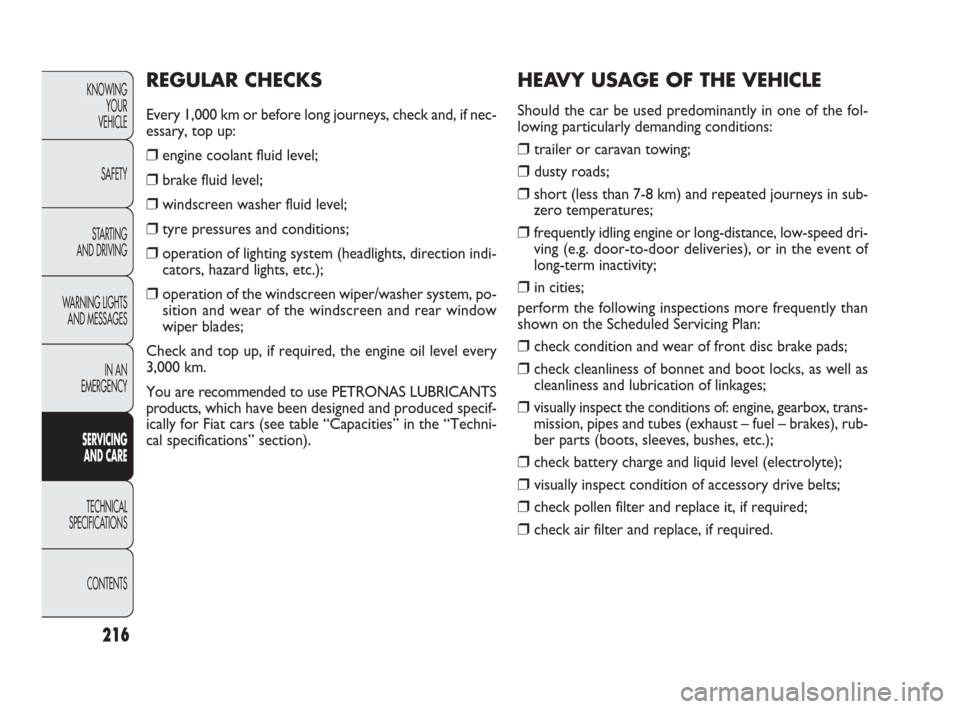
HEAVY USAGE OF THE VEHICLE
Should the car be used predominantly in one of the fol-
lowing particularly demanding conditions:
❒ trailer or caravan towing;
❒ dusty roads;
❒short (less than 7-8 km) and repeated journeys in sub-
zero temperatures;
❒frequently idling engine or long-distance, low-speed dri-
ving (e.g. door-to-door deliveries), or in the event of
long-term inactivity;
❒ in cities;
perform the following inspections more frequently than
shown on the Scheduled Servicing Plan:
❒ check condition and wear of front disc brake pads;
❒check cleanliness of bonnet and boot locks, as well as
cleanliness and lubrication of linkages;
❒visually inspect the conditions of: engine, gearbox, trans-
mission, pipes and tubes (exhaust – fuel – brakes), rub-
ber parts (boots, sleeves, bushes, etc.);
❒check battery charge and liquid level (electrolyte);
❒ visually inspect condition of accessory drive belts;
❒ check pollen filter and replace it, if required;
❒ check air filter and replace, if required.
REGULAR CHECKS
Every 1,000 km or before long journeys, check and, if nec-
essary, top up:
❒engine coolant fluid level;
❒brake fluid level;
❒windscreen washer fluid level;
❒tyre pressures and conditions;
❒operation of lighting system (headlights, direction indi-
cators, hazard lights, etc.);
❒operation of the windscreen wiper/washer system, po-
sition and wear of the windscreen and rear window
wiper blades;
Check and top up, if required, the engine oil level every
3,000 km.
You are recommended to use PETRONAS LUBRICANTS
products, which have been designed and produced specif-
ically for Fiat cars (see table “Capacities” in the “Techni-
cal specifications” section).
KNOWING
YOUR
VEHICLE
SAFETY
STARTING
AND DRIVING
WARNING LIGHTS
AND MESSAGES
IN AN
EMERGENCY
SERVICING
AND CARE
TECHNICAL
SPECIFICATIONS
CONTENTS
211-234 PUNTO FL EN 4ed 18-01-2010 12:27 Pagina 216