instrument panel FIAT QUBO 2008 1.G User Guide
[x] Cancel search | Manufacturer: FIAT, Model Year: 2008, Model line: QUBO, Model: FIAT QUBO 2008 1.GPages: 202, PDF Size: 3.43 MB
Page 74 of 202
73
SAFETY
STARTING
AND DRIVING
WARNING
LIGHTS AND
MESSAGES
IN AN
EMERGENCY
MAINTENANCE
AND CARE
TECHNICAL
SPECIFICATIONS
INDEX
DASHBOARD
AND CONTROLS
ESP SYSTEM ACTIVATION
The ESP system is automatically activat-
ed when the car is started and cannot be
de-activated.
FAILURE INDICATIONS
In the event of failure, the ESP system is
automatically disconnected, the warning
light
á, comes on with fixed light on the
instrument panel, together with the mes-
sage on the multifunction display (where
provided) (see section “Warning lights and
messages”) and with the button led ASR
OFF. In this case contact a Fiat Dealership
as soon as possible.
Performance of the ESP sys-
tem, in terms of active safe-
ty should not induce the driver to take
pointless and unnecessary risks. The
style of driving must in any case al-
ways be adapted to the conditions of
the road surface, visibility and traffic.
Road safety is always the driver’s re-
sponsibility.
WARNING
HILL HOLDER SYSTEM
This system is an integral part of the ESP
system and it is provided to facilitate start-
ing on slopes.
It will activate automatically with the fol-
lowing conditions:
❒uphill: vehicle stationary on a road with
a gradient of more than 5%, engine run-
ning, brake pressed and gearbox in neu-
tral or gear other than reverse engaged;
❒downhill: vehicle stationary on a road
with a gradient of more than 5%, engine
running, brake pressed and reverse gear
engaged.
At pickup the ESP system control unit will
keep brake force on wheels until reaching
the torque suitable for starting, or in any
case for max. 2 seconds in order to pass
easily from the brake pedal to the accel-
erator pedal.
After two seconds without starting, the
system will deactivate automatically by re-
leasing gradually the brake force.
At releasing, the typical brake disengage-
ment noise indicating that the car is go-
ing to move will be heard.FAILURE INDICATIONS
System failure is indicated by the turning
on of warning light *on the instrument
panel with digital display and warning light
áon the instrument panel with multi-
function display (where provided) (see
section “Warning lights and messages”).
IMPORANT The Hill Holder system is not
a parking brake therefore, never leave the
car without having engaged the handbrake,
turned the engine off and engaged the first
speed.
For correct operation of the
ESP and ASR systems, the
tyres must absolutely be of the same
brand and type on all wheels, in per-
fect conditions and, above all, of
type, brand and size specified.
WARNING
036-082 Fiorino GB 1ed 21-10-2008 14:59 Pagina 73
Page 76 of 202
75
SAFETY
STARTING
AND DRIVING
WARNING
LIGHTS AND
MESSAGES
IN AN
EMERGENCY
MAINTENANCE
AND CARE
TECHNICAL
SPECIFICATIONS
INDEX
DASHBOARD
AND CONTROLS
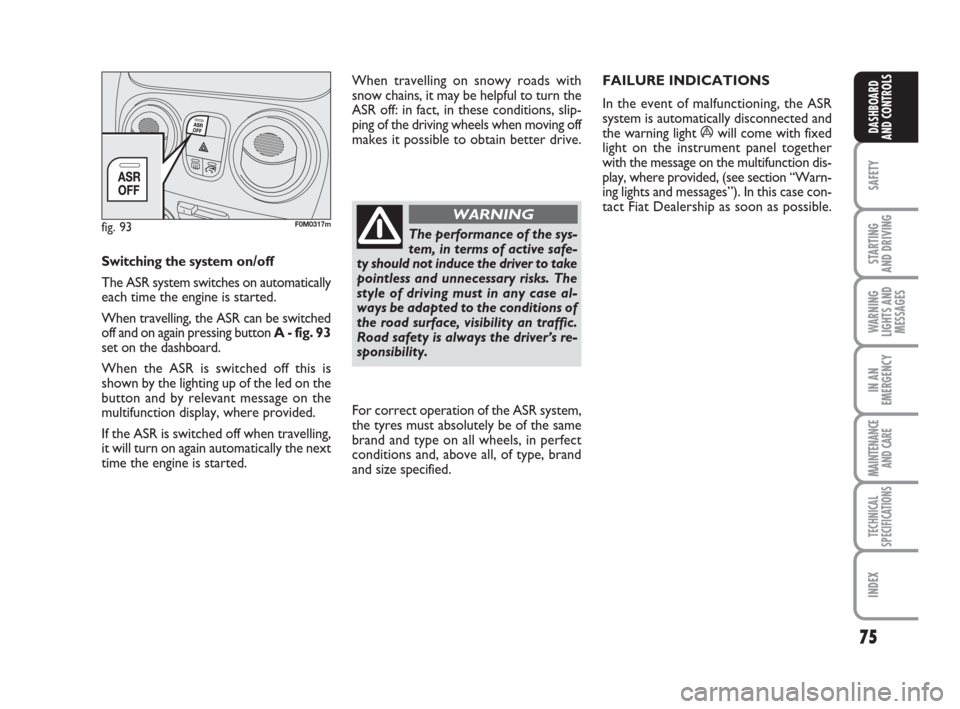
Switching the systemon/off
The ASR system switches on automatically
each time the engine is started.
When travelling, the ASR can be switched
off and on again pressing button A - fig. 93
set on the dashboard.
When the ASR is switched off this is
shown by the lighting up of the led on the
button and by relevant message on the
multifunction display, where provided.
If the ASR is switched off when travelling,
it will turn on again automatically the next
time the engine is started.
fig. 93F0M0317mThe performance of the sys-
tem, in terms of active safe-
ty should not induce the driver to take
pointless and unnecessary risks. The
style of driving must in any case al-
ways be adapted to the conditions of
the road surface, visibility an traffic.
Road safety is always the driver’s re-
sponsibility.
WARNING
For correct operation of the ASR system,
the tyres must absolutely be of the same
brand and type on all wheels, in perfect
conditions and, above all, of type, brand
and size specified. When travelling on snowy roads with
snow chains, it may be helpful to turn the
ASR off: in fact, in these conditions, slip-
ping of the driving wheels when moving off
makes it possible to obtain better drive.FAILURE INDICATIONS
In the event of malfunctioning, the ASR
system is automatically disconnected and
the warning light
áwill come with fixed
light on the instrument panel together
with the message on the multifunction dis-
play, where provided, (see section “Warn-
ing lights and messages”). In this case con-
tact Fiat Dealership as soon as possible.
036-082 Fiorino GB 1ed 21-10-2008 14:59 Pagina 75
Page 94 of 202
93
STARTING
AND DRIVING
WARNING
LIGHTS AND
MESSAGES
IN AN
EMERGENCY
MAINTENANCE
AND CARE
TECHNICAL
SPECIFICATIONS
INDEX
DASHBOARDAND CONTROLS
SAFETY
Below is a summary of the safety ru-
les to be followed for carrying chil-
dren.
❒Install the child seats on the rear seat,
which is the most protected position in
the event of an accident.
❒If the passenger’s airbag is deactivated,
always check the warning light
“on the
instrument panel to make sure that it
has actually been deactivated.
❒Carefully follow the instructions sup-
plied with the child restraint system
which are mandatory by law. Keep the
instructions in the vehicle along with
the other papers and this handbook. Do
not use child seats without instructions.❒Always check the seat belt is well fa-
stened by pulling the belt.
❒Only one child is to be strapped to ea-
ch retaining system.
❒Always check the seat belts do not fit
around the child’s throat.
❒While travelling, do not let the child sit
incorrectly or release the belts.
❒Never carry children on your lap, even
newborns. No-one can hold a child in
the event of an accident.
❒In the event of an accident, replace the
child’s seat with a new one.
Do not arrange child seats on
the front seat in vehicles fit-
ted with a passenger’s airbag. Chil-
dren must never travel on the front
seat.
WARNING
ISOFIX CHILD
RESTRAINT
ASSEMBLY SETUP
(where provided)
Provision has been made on the vehicle
for mounting a Universal Isofix child re-
straint system, a new European standar-
dised system for carrying children safely.
Isofix systems can be mounted simulta-
neously with a traditional restraint system.
An example of child seat is shown in
fig. 11. The Universal Isofix child seat co-
vers weight group: 1.
The other weight groups are covered by
specific Isofix child seats, which can be
used only if specifically designed, tested
and type-approved for this vehicle (see
vehicle list provided with the child seat).
083-100 Fiorino GB 1ed 21-10-2008 14:59 Pagina 93
Page 104 of 202
103
SAFETY
WARNING
LIGHTS AND
MESSAGES
IN AN
EMERGENCY
MAINTENANCE
AND CARE
TECHNICAL
SPECIFICATIONS
INDEX
DASHBOARDAND CONTROLS
STARTING
AND DRIVING
ENGINE START-UP
PROCEDURE FOR
DIESEL VERSIONS
Proceed as follows:
❒ensure that the handbrake is up;
❒put the gear lever into neutral;
❒turn the ignition key to MAR: warning
lights Yand
mwill light up on the
instrument panel;
❒wait until the warning lights Yand
mturn off. The hotter the engine, the
quicker this will happen;
❒press the clutch pedal all the way down
without touching the accelerator;
❒turn the ignition key to AVVas soon
as the warning light
mturns off. Wait-
ing too long will waste the work done
by the glow plugs.
Release the key as soon as the engine
starts.
IMPORTANT When the engine is cold,
rotate the ignition key to AVVto com-
pletely release the accelerator pedal.If the engine does not start at the first at-
tempt, return the ignition key to STOP
before repeating starting.
If with the ignition key on MAR, the in-
strument panel warning light Yremains
on, turn the key to STOPand then back
to MAR; if the warning light remains on,
try with the other keys provided with the
vehicle.
Contact the Fiat Dealership if the engine
still will not start.
The warning light
mblinks
for 60 seconds after starting
or during prolonged cranking
to indicate a fault to the glow
plug heating system. Use the vehicle
normally if the engine starts, but con-
tact the Fiat Dealership as soon as pos-
sible.
WARMING THE
ENGINE IMMEDIATELY AFTER
START-UP
Proceed as follows:
❒drive off slowly, letting the engine turn
at medium speed. Do not accelerate
abruptly;
❒do not demand maximum performance
for the first few kilometres. Wait until
the engine coolant gauge starts moving.
EMERGENCY START
If the warning light Ystays on steadily on
the instrument panel, you can perform an
emergency start using the code on the
CODE card (see section “In an emer-
gency”).
Never jump start the engine
by pushing, towing or driving
downhill. This could cause a
flow of fuel into the catalyt-
ic converter and damage it beyond re-
pair.
101-108 Fiorino GB 1ed 21-10-2008 15:00 Pagina 103
Page 111 of 202
110
SAFETY
IN AN
EMERGENCY
MAINTENANCE
AND CARE
TECHNICAL
SPECIFICATIONS
INDEX
DASHBOARDAND CONTROLS
STARTING
AND DRIVING
WARNING
LIGHTS AND
MESSAGES
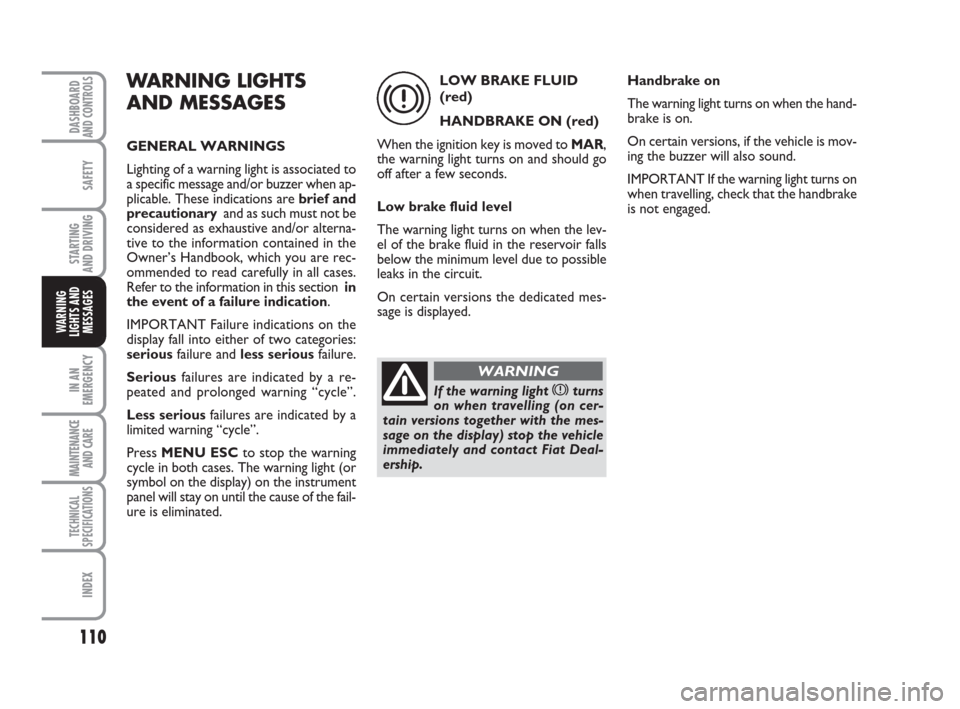
WARNING LIGHTS
AND MESSAGES
GENERAL WARNINGS
Lighting of a warning light is associated to
a specific message and/or buzzer when ap-
plicable. These indications are brief and
precautionary and as such must not be
considered as exhaustive and/or alterna-
tive to the information contained in the
Owner’s Handbook, which you are rec-
ommended to read carefully in all cases.
Refer to the information in this section in
the event of a failure indication.
IMPORTANT Failure indications on the
display fall into either of two categories:
seriousfailure and less seriousfailure.
Seriousfailures are indicated by a re-
peated and prolonged warning “cycle”.
Less seriousfailures are indicated by a
limited warning “cycle”.
Press MENU ESCto stop the warning
cycle in both cases. The warning light (or
symbol on the display) on the instrument
panel will stay on until the cause of the fail-
ure is eliminated.LOW BRAKE FLUID
(red)
HANDBRAKE ON (red)
When the ignition key is moved to MAR,
the warning light turns on and should go
off after a few seconds.
Low brake fluid level
The warning light turns on when the lev-
el of the brake fluid in the reservoir falls
below the minimum level due to possible
leaks in the circuit.
On certain versions the dedicated mes-
sage is displayed.Handbrake on
The warning light turns on when the hand-
brake is on.
On certain versions, if the vehicle is mov-
ing the buzzer will also sound.
IMPORTANT If the warning light turns on
when travelling, check that the handbrake
is not engaged.
x
If the warning light xturns
on when travelling (on cer-
tain versions together with the mes-
sage on the display) stop the vehicle
immediately and contact Fiat Deal-
ership.
WARNING
109-118 Fiorino GB 1ed 21-10-2008 15:00 Pagina 110
Page 121 of 202
120
SAFETY
MAINTENANCE
AND CARE
TECHNICAL
SPECIFICATIONS
INDEX
DASHBOARDAND CONTROLS
STARTING
AND DRIVING
WARNING
LIGHTS AND
MESSAGES
IN AN
EMERGENCY
STARTING
THE ENGINE
EMERGENCY START
Go to a Fiat Dealership immediately if
warning light Ycomes on steady on the
instrument panel.
STARTING THE ENGINE
WITH THE AUXILIARY
BATTERY
If the battery is down, the engine can be
started using an auxiliary battery having
the same capacity, or higher.
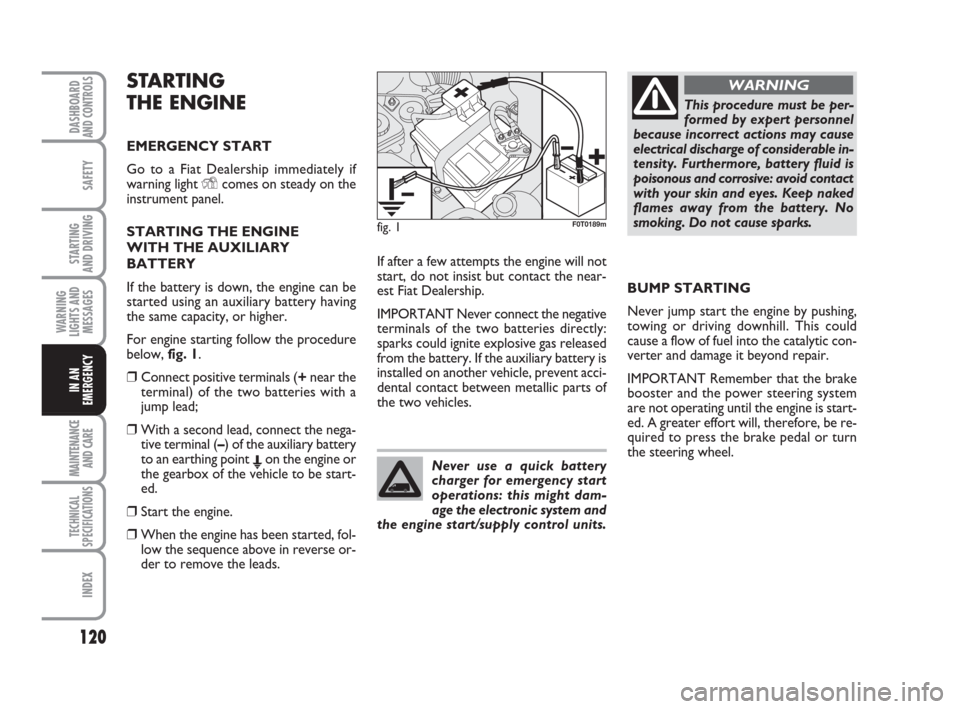
For engine starting follow the procedure
below, fig. 1.
❒Connect positive terminals (+near the
terminal) of the two batteries with a
jump lead;
❒With a second lead, connect the nega-
tive terminal (–) of the auxiliary battery
to an earthing point Eon the engine or
the gearbox of the vehicle to be start-
ed.
❒Start the engine.
❒When the engine has been started, fol-
low the sequence above in reverse or-
der to remove the leads.If after a few attempts the engine will not
start, do not insist but contact the near-
est Fiat Dealership.
IMPORTANT Never connect the negative
terminals of the two batteries directly:
sparks could ignite explosive gas released
from the battery. If the auxiliary battery is
installed on another vehicle, prevent acci-
dental contact between metallic parts of
the two vehicles.BUMP STARTING
Never jump start the engine by pushing,
towing or driving downhill. This could
cause a flow of fuel into the catalytic con-
verter and damage it beyond repair.
IMPORTANT Remember that the brake
booster and the power steering system
are not operating until the engine is start-
ed. A greater effort will, therefore, be re-
quired to press the brake pedal or turn
the steering wheel.
Never use a quick battery
charger for emergency start
operations: this might dam-
age the electronic system and
the engine start/supply control units.
This procedure must be per-
formed by expert personnel
because incorrect actions may cause
electrical discharge of considerable in-
tensity. Furthermore, battery fluid is
poisonous and corrosive: avoid contact
with your skin and eyes. Keep naked
flames away from the battery. No
smoking. Do not cause sparks.
WARNING
fig. 1F0T0189m
119-150 Fiorino GB 1ed 21-10-2008 15:05 Pagina 120
Page 148 of 202
147
SAFETY
MAINTENANCE
AND CARE
TECHNICAL
SPECIFICATIONS
INDEX
DASHBOARDAND CONTROLS
STARTING
AND DRIVING
WARNING
LIGHTS AND
MESSAGES
IN AN
EMERGENCY
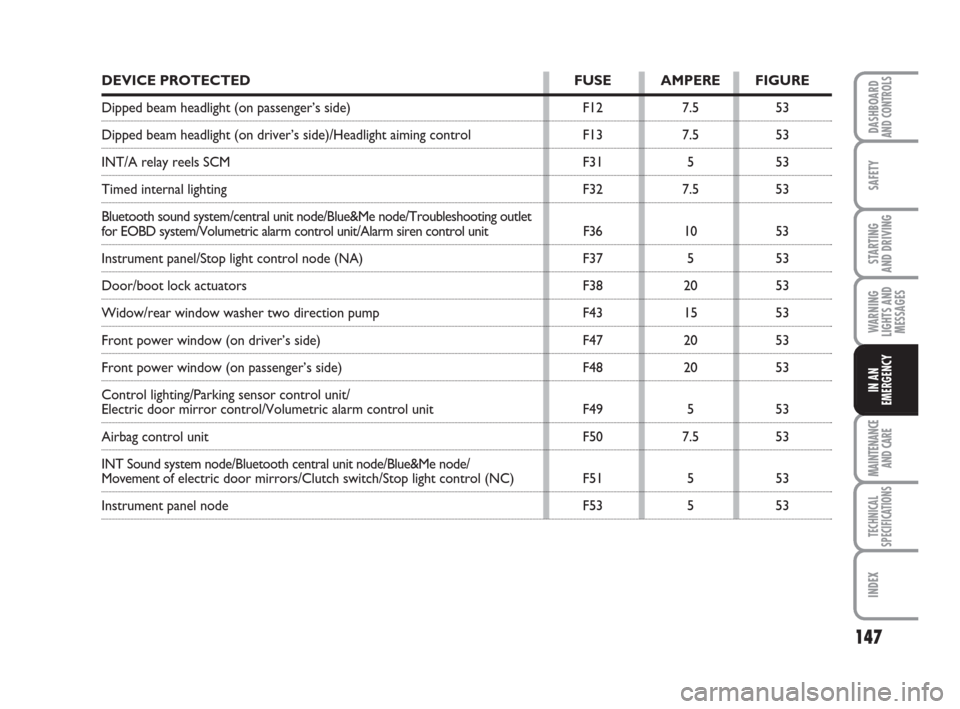
DEVICE PROTECTED FUSE AMPERE FIGURE
Dipped beam headlight (on passenger’s side) F12 7.5 53
Dipped beam headlight (on driver’s side)/Headlight aiming control F13 7.5 53
INT/A relay reels SCM F31 5 53
Timed internal lighting F32 7.5 53
Bluetooth sound system/central unit node/Blue&Me node/Troubleshooting outlet
for EOBD system/Volumetric alarm control unit/Alarm siren control unit F36 10 53
Instrument panel/Stop light control node (NA) F37 5 53
Door/boot lock actuators F38 20 53
Widow/rear window washer two direction pump F43 15 53
Front power window (on driver’s side) F47 20 53
Front power window (on passenger’s side) F48 20 53
Control lighting/Parking sensor control unit/
Electric door mirror control/Volumetric alarm control unit F49 5 53
Airbag control unit F50 7.5 53
INT Sound system node/Bluetooth central unit node/Blue&Me node/
Movement of electric door mirrors/Clutch switch/Stop light control (NC) F51 5 53
Instrument panel node F53 5 53
119-150 Fiorino GB 1ed 21-10-2008 15:06 Pagina 147
Page 154 of 202
153
SAFETY
TECHNICAL
SPECIFICATIONS
INDEX
DASHBOARDAND CONTROLS
STARTING
AND DRIVING
WARNING
LIGHTS AND
MESSAGES
IN AN
EMERGENCY
MAINTENANCE
AND CARE
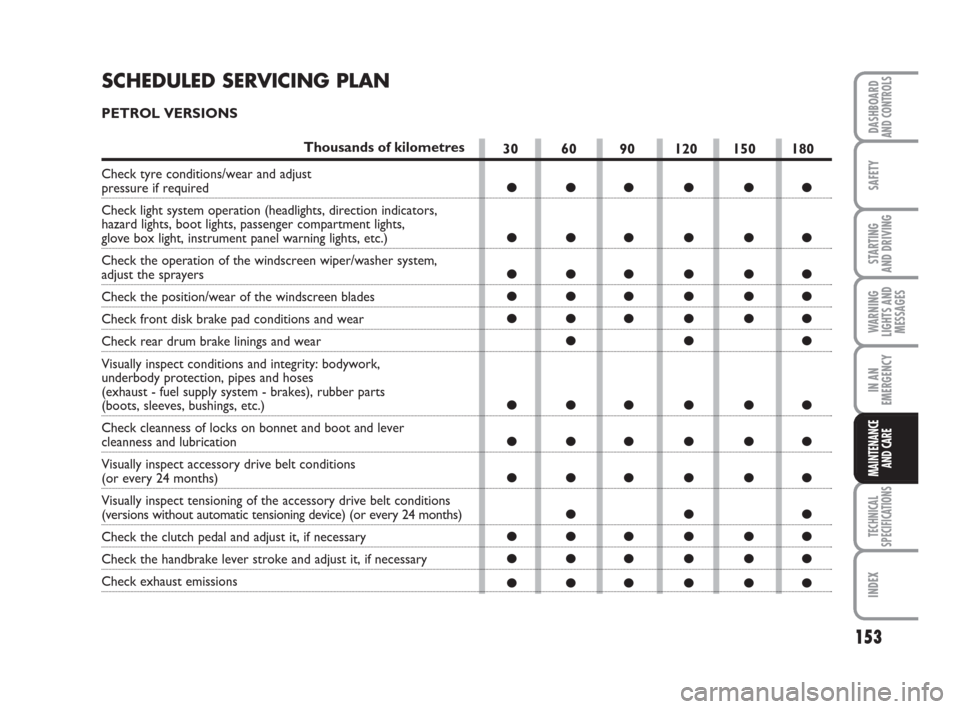
30 60 90 120 150 180
●●●●●●
●●●●●●
●●●●●●
●●●●●●
●●●●●●
●●●
●●●●●●
●●●●●●
●●●●●●
●●●
●●●●●●
●●●●●●
●●●●●●
SCHEDULED SERVICING PLAN
PETROL VERSIONS
Thousands of kilometres
Check tyre conditions/wear and adjust pressure if required
Check light system operation (headlights, direction indicators,
hazard lights, boot lights, passenger compartment lights,
glove box light, instrument panel warning lights, etc.)
Check the operation of the windscreen wiper/washer system,
adjust the sprayers
Check the position/wear of the windscreen blades
Check front disk brake pad conditions and wear
Check rear drum brake linings and wear
Visually inspect conditions and integrity: bodywork,
underbody protection, pipes and hoses
(exhaust - fuel supply system - brakes), rubber parts
(boots, sleeves, bushings, etc.)
Check cleanness of locks on bonnet and boot and lever
cleanness and lubrication
Visually inspect accessory drive belt conditions
(or every 24 months)
Visually inspect tensioning of the accessory drive belt conditions
(versions without automatic tensioning device) (or every 24 months)
Check the clutch pedal and adjust it, if necessary
Check the handbrake lever stroke and adjust it, if necessary
Check exhaust emissions
151-172 Fiorino GB 1ed 21-10-2008 15:01 Pagina 153
Page 156 of 202

155
SAFETY
TECHNICAL
SPECIFICATIONS
INDEX
DASHBOARDAND CONTROLS
STARTING
AND DRIVING
WARNING
LIGHTS AND
MESSAGES
IN AN
EMERGENCY
MAINTENANCE
AND CARE
30 60 90 120 150 180
●●●●●●
●●●●●●
●●●●●●
●●●●●●
●●●●●●
●●●
●●●●●●
●●●●●●
●●
●●
●●●●●●
●●●●●●
DIESEL VERSIONS
Thousands of kilometres
Check tyre conditions/wear and adjust pressure, if required
Check light system operation (headlights, direction indicators,
emergency lights, boot lights, passenger compartment lights,
glove box light, instrument panel warning lights, etc.)
Check the operation of the windscreen wiper/washer system,
adjust the sprayers
Check the position/wear of the windscreen blades
Check front disk brake pad conditions and wear
Check rear drum brake linings and wear
Visually inspect conditions and integrity: bodywork,
underbody protection, pipes and hoses
(exhaust - fuel supply system - brakes), rubber parts
(boots, sleeves, bushings, etc.)
Check cleanness of locks on bonnet and boot and lever
cleanness and lubrication
Visually inspect accessory drive belt conditions
Visually inspect tensioning of the accessory drive belt conditions
(versions without automatic tensioning device)
Check the handbrake lever stroke and adjust it, if necessary
Check exhaust emissions/smokiness
151-172 Fiorino GB 1ed 21-10-2008 15:01 Pagina 155
Page 173 of 202
172
SAFETY
TECHNICAL
SPECIFICATIONS
INDEX
DASHBOARDAND CONTROLS
STARTING
AND DRIVING
WARNING
LIGHTS AND
MESSAGES
IN AN
EMERGENCY
MAINTENANCE
AND CARE
CLEANING SEATS
AND FABRIC PARTS
Remove dust with a soft brush or a vacu-
um cleaner. It is advisable to use a moist
brush on velvet upholstery.
Rub the seats with a sponge moistened
with a solution of water and neutral de-
tergent.
CLEANING PLASTIC PARTS
It is advisable to clean interior plastic parts
with a moist cloth and a solution of wa-
ter and mild soap. Remove grease and
tough stains using specific solvent-free
products for cleaning plastic parts specif-
ically designed to prevent damage to the
appearance and colour of the treated
parts.
IMPORTANT Never use spirit or petro-
leum to clean the instrument panel.STEERING WHEEL/GEARBOX
LEVER KNOB/HANDBRAKE
COATED WITH REAL LEATHER
(where provided)
These components must be cleaned with
mild soap and water only. Never use spir-
it and/or alcohol based products.
Before using specific products for clean-
ing the interiors, carefully read the in-
structions on the product label and ensure
that it does not contain alcohol and/or al-
cohol-based substances.
If drops of the specific product for clean-
ing windows accidentally falls onto the
leather of the steering wheel / gear lever
knob during windscreen window washing,
immediately wipe the drops away and then
wash the area with mild soap and water.
IMPORTANT If a lock device is installed
on the steering wheel, maximum care
must be taken during installation in order
to prevent abrasions of the leather up-
holstery.INTERIORS
Periodically check that water is not
trapped under the mats (due to water
dripping off shoes, umbrellas, etc.) which
could cause oxidisation of the sheet met-
al.
Never use flammable prod-
ucts, such as petrol, ether or
rectified petrol, to clean the vehicle
interior. The electrostatic charges
which are generated by rubbing dur-
ing cleaning operations may cause a
fire.
WARNING
Do not keep aerosol cans in
the vehicle: risk of explosion.
Aerosol cans must not be exposed to
a temperature exceeding 50°C. When
the vehicle is exposed to sunlight, in-
ner temperature can greatly exceed
this value.
WARNING
151-172 Fiorino GB 1ed 21-10-2008 15:02 Pagina 172