wheel FIAT QUBO 2008 1.G Owner's Manual
[x] Cancel search | Manufacturer: FIAT, Model Year: 2008, Model line: QUBO, Model: FIAT QUBO 2008 1.GPages: 202, PDF Size: 3.43 MB
Page 123 of 202
122
SAFETY
MAINTENANCE
AND CARE
TECHNICAL
SPECIFICATIONS
INDEX
DASHBOARDAND CONTROLS
STARTING
AND DRIVING
WARNING
LIGHTS AND
MESSAGES
IN AN
EMERGENCY
fig. 3F0T0281m
Important notes:
❒the jack weight is 1.76 kg;
❒the jack requires no adjustment;
❒the jack cannot be repaired. If it breaks
it must be replaced with a new jack;
❒no tool other than the cranking device
has to be fitted on the jack.
To replace a tyre proceed as follows:
❒stop the vehicle in a position so that it
is not a danger for on-coming traffic in
a location where you can replace the
wheel safely. The ground must be flat
and compact.
❒Turn the engine off and pull up the
handbrake.
❒Engage first gear or reverse.
❒open the rear swing doors the luggage
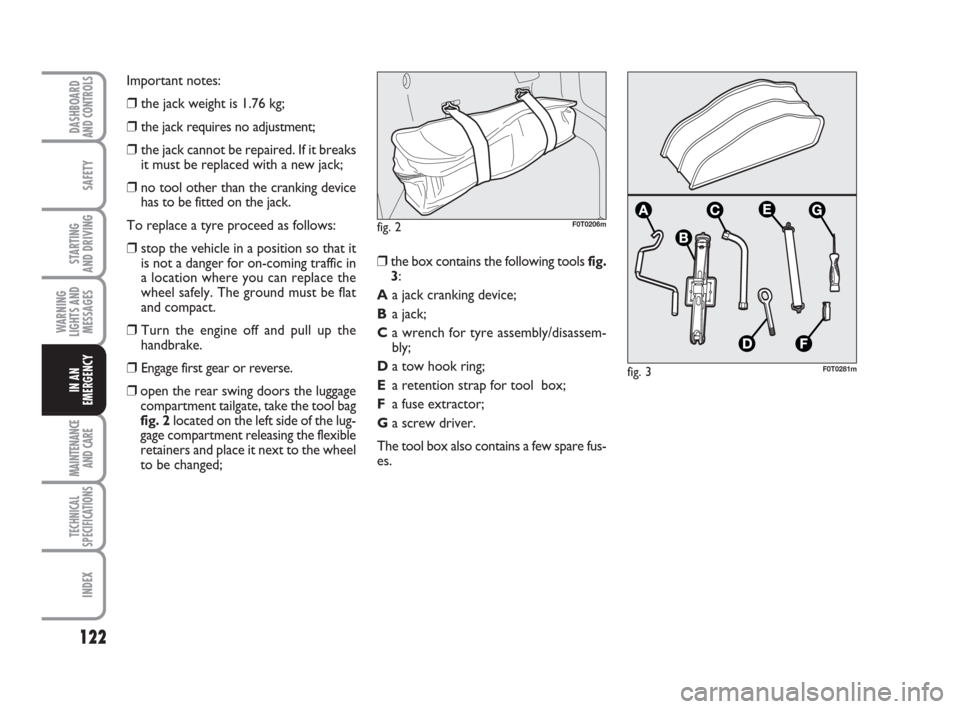
compartment tailgate, take the tool bag
fig. 2located on the left side of the lug-
gage compartment releasing the flexible
retainers and place it next to the wheel
to be changed;❒the box contains the following tools fig.
3:
Aa jack cranking device;
Ba jack;
Ca wrench for tyre assembly/disassem-
bly;
Da tow hook ring;
Ea retention strap for tool box;
Fa fuse extractor;
Ga screw driver.
The tool box also contains a few spare fus-
es.
fig. 2F0T0206m
119-150 Fiorino GB 1ed 21-10-2008 15:05 Pagina 122
Page 124 of 202
123
SAFETY
MAINTENANCE
AND CARE
TECHNICAL
SPECIFICATIONS
INDEX
DASHBOARDAND CONTROLS
STARTING
AND DRIVING
WARNING
LIGHTS AND
MESSAGES
IN AN
EMERGENCY
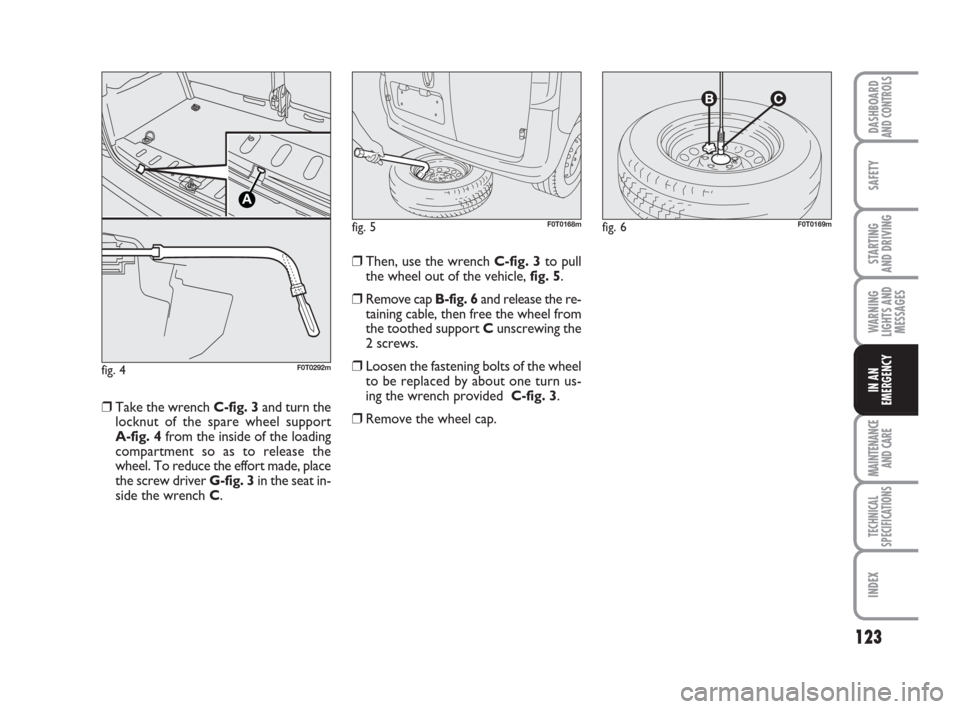
❒Then, use the wrench C-fig. 3to pull
the wheel out of the vehicle, fig. 5.
❒Remove cap B-fig. 6and release the re-
taining cable, then free the wheel from
the toothed support Cunscrewing the
2 screws.
❒Loosen the fastening bolts of the wheel
to be replaced by about one turn us-
ing the wrench provided C-fig. 3.
❒Remove the wheel cap. ❒Take the wrench C-fig. 3and turn the
locknut of the spare wheel support
A-fig. 4from the inside of the loading
compartment so as to release the
wheel. To reduce the effort made, place
the screw driver G-fig. 3in the seat in-
side the wrench C.
fig. 5F0T0168m
fig. 4
A
F0T0292m
fig. 6F0T0169m
119-150 Fiorino GB 1ed 21-10-2008 15:05 Pagina 123
Page 125 of 202
124
SAFETY
MAINTENANCE
AND CARE
TECHNICAL
SPECIFICATIONS
INDEX
DASHBOARDAND CONTROLS
STARTING
AND DRIVING
WARNING
LIGHTS AND
MESSAGES
IN AN
EMERGENCY
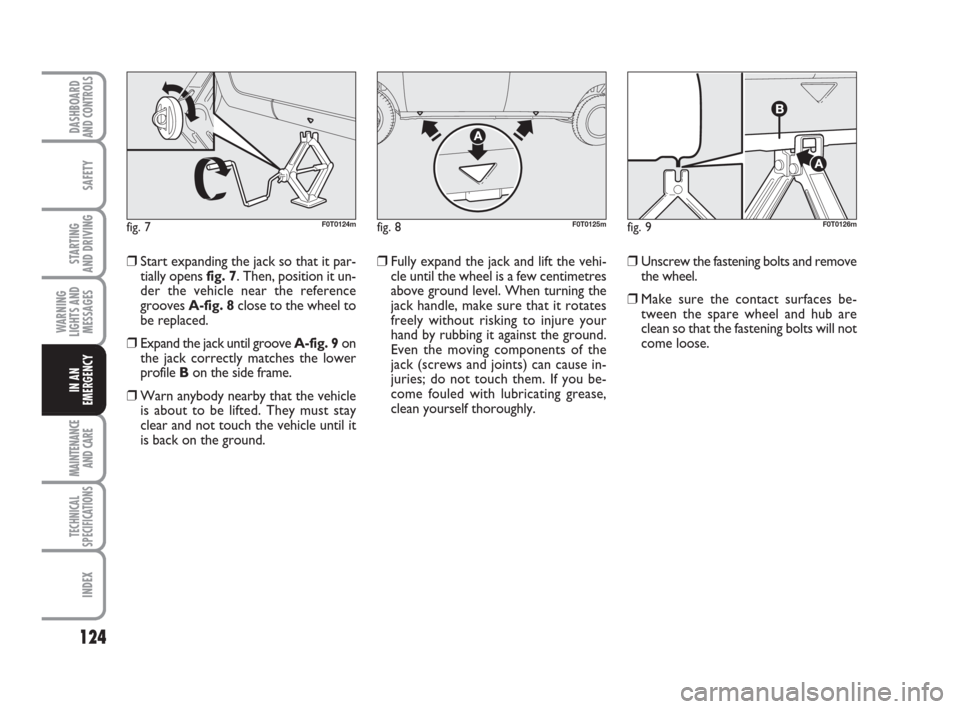
❒Fully expand the jack and lift the vehi-
cle until the wheel is a few centimetres
above ground level. When turning the
jack handle, make sure that it rotates
freely without risking to injure your
hand by rubbing it against the ground.
Even the moving components of the
jack (screws and joints) can cause in-
juries; do not touch them. If you be-
come fouled with lubricating grease,
clean yourself thoroughly.❒Unscrew the fastening bolts and remove
the wheel.
❒Make sure the contact surfaces be-
tween the spare wheel and hub are
clean so that the fastening bolts will not
come loose.
fig. 7F0T0124mfig. 9F0T0126mfig. 8F0T0125m
❒Start expanding the jack so that it par-
tially opens fig. 7. Then, position it un-
der the vehicle near the reference
grooves A-fig. 8close to the wheel to
be replaced.
❒Expand the jack until groove A-fig. 9on
the jack correctly matches the lower
profile Bon the side frame.
❒Warn anybody nearby that the vehicle
is about to be lifted. They must stay
clear and not touch the vehicle until it
is back on the ground.
119-150 Fiorino GB 1ed 21-10-2008 15:05 Pagina 124
Page 126 of 202
125
SAFETY
MAINTENANCE
AND CARE
TECHNICAL
SPECIFICATIONS
INDEX
DASHBOARDAND CONTROLS
STARTING
AND DRIVING
WARNING
LIGHTS AND
MESSAGES
IN AN
EMERGENCY
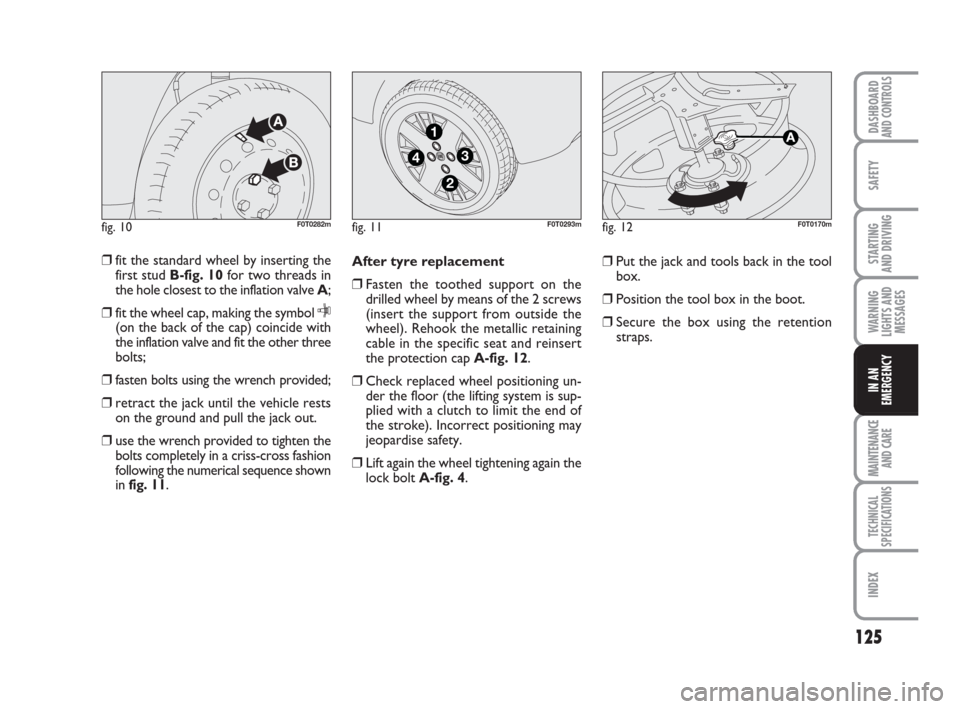
❒fit the standard wheel by inserting the
first stud B-fig. 10for two threads in
the hole closest to the inflation valve A;
❒fit the wheel cap, making the symbol
C(on the back of the cap) coincide with
the inflation valve and fit the other three
bolts;
❒fasten bolts using the wrench provided;
❒retract the jack until the vehicle rests
on the ground and pull the jack out.
❒use the wrench provided to tighten the
bolts completely in a criss-cross fashion
following the numerical sequence shown
in fig. 11.After tyre replacement
❒Fasten the toothed support on the
drilled wheel by means of the 2 screws
(insert the support from outside the
wheel). Rehook the metallic retaining
cable in the specific seat and reinsert
the protection cap A-fig. 12.
❒Check replaced wheel positioning un-
der the floor (the lifting system is sup-
plied with a clutch to limit the end of
the stroke). Incorrect positioning may
jeopardise safety.
❒Lift again the wheel tightening again the
lock boltA-fig. 4.❒Put the jack and tools back in the tool
box.
❒Position the tool box in the boot.
❒Secure the box using the retention
straps.
fig. 10F0T0282mfig. 11
4
1
3
2
F0T0293mfig. 12F0T0170m
119-150 Fiorino GB 1ed 21-10-2008 15:05 Pagina 125
Page 127 of 202
126
SAFETY
MAINTENANCE
AND CARE
TECHNICAL
SPECIFICATIONS
INDEX
DASHBOARDAND CONTROLS
STARTING
AND DRIVING
WARNING
LIGHTS AND
MESSAGES
IN AN
EMERGENCY
QUICK TYRE REPAIR
KIT AUTOMATIC
FIX & GO
The automatic fast tyre repair kit Fix & Go
is placed in a container in the boot.
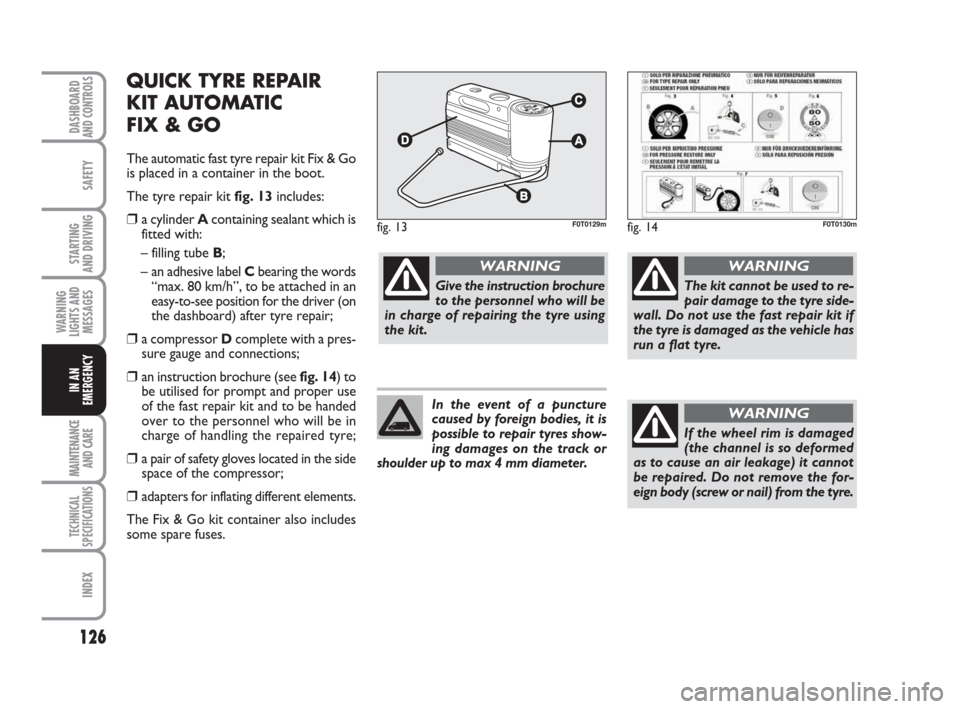
The tyre repair kit fig. 13includes:
❒a cylinder A containing sealant which is
fitted with:
– filling tube B;
– an adhesive label Cbearing the words
“max. 80 km/h”, to be attached in an
easy-to-see position for the driver (on
the dashboard) after tyre repair;
❒a compressor Dcomplete with a pres-
sure gauge and connections;
❒an instruction brochure (see fig. 14) to
be utilised for prompt and proper use
of the fast repair kit and to be handed
over to the personnel who will be in
charge of handling the repaired tyre;
❒a pair of safety gloves located in the side
space of the compressor;
❒adapters for inflating different elements.
The Fix & Go kit container also includes
some spare fuses.
fig. 13F0T0129mfig. 14F0T0130m
Give the instruction brochure
to the personnel who will be
in charge of repairing the tyre using
the kit.
WARNING
The kit cannot be used to re-
pair damage to the tyre side-
wall. Do not use the fast repair kit if
the tyre is damaged as the vehicle has
run a flat tyre.
WARNING
If the wheel rim is damaged
(the channel is so deformed
as to cause an air leakage) it cannot
be repaired. Do not remove the for-
eign body (screw or nail) from the tyre.
WARNINGIn the event of a puncture
caused by foreign bodies, it is
possible to repair tyres show-
ing damages on the track or
shoulder up to max 4 mm diameter.
119-150 Fiorino GB 1ed 21-10-2008 15:05 Pagina 126
Page 151 of 202
150
SAFETY
MAINTENANCE
AND CARE
TECHNICAL
SPECIFICATIONS
INDEX
DASHBOARDAND CONTROLS
STARTING
AND DRIVING
WARNING
LIGHTS AND
MESSAGES
IN AN
EMERGENCY
IF THE VEHICLE NEEDS
TO BE TOWED
The tow ring supplied with the vehicle is
positioned in the tool in the boot.
HOOKING THE TOW
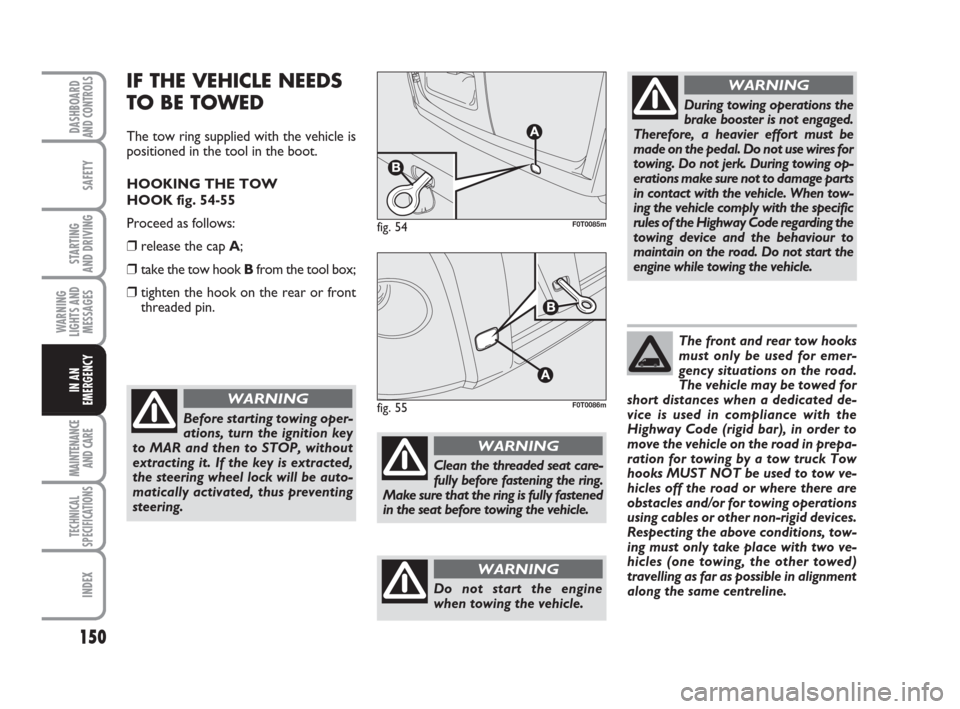
HOOK fig. 54-55
Proceed as follows:
❒release the cap A;
❒take the tow hook Bfrom the tool box;
❒tighten the hook on the rear or front
threaded pin.
fig. 54F0T0085m
fig. 55F0T0086m
Before starting towing oper-
ations, turn the ignition key
to MAR and then to STOP, without
extracting it. If the key is extracted,
the steering wheel lock will be auto-
matically activated, thus preventing
steering.
WARNING
During towing operations the
brake booster is not engaged.
Therefore, a heavier effort must be
made on the pedal. Do not use wires for
towing. Do not jerk. During towing op-
erations make sure not to damage parts
in contact with the vehicle. When tow-
ing the vehicle comply with the specific
rules of the Highway Code regarding the
towing device and the behaviour to
maintain on the road. Do not start the
engine while towing the vehicle.
WARNING
Clean the threaded seat care-
fully before fastening the ring.
Make sure that the ring is fully fastened
in the seat before towing the vehicle.
WARNING
Do not start the engine
when towing the vehicle.
WARNING
The front and rear tow hooks
must only be used for emer-
gency situations on the road.
The vehicle may be towed for
short distances when a dedicated de-
vice is used in compliance with the
Highway Code (rigid bar), in order to
move the vehicle on the road in prepa-
ration for towing by a tow truck Tow
hooks MUST NOT be used to tow ve-
hicles off the road or where there are
obstacles and/or for towing operations
using cables or other non-rigid devices.
Respecting the above conditions, tow-
ing must only take place with two ve-
hicles (one towing, the other towed)
travelling as far as possible in alignment
along the same centreline.
119-150 Fiorino GB 1ed 21-10-2008 15:06 Pagina 150
Page 152 of 202
151
SAFETY
TECHNICAL
SPECIFICATIONS
INDEX
DASHBOARDAND CONTROLS
STARTING
AND DRIVING
WARNING
LIGHTS AND
MESSAGES
IN AN
EMERGENCY
MAINTENANCE
AND CARE
SCHEDULED SERVICING................................................. 152
SCHEDULED SERVICING PLAN..................................... 153
PERIODIC CHECKING...................................................... 157
DEMANDING VEHICLE USE........................................... 157
CHECKING FLUID LEVELS.............................................. 158
AIR CLEANER/POLLEN FILTER...................................... 158
BATTERY............................................................................... 163
WHEELS AND TYRES........................................................ 165
RUBBER HOSES................................................................... 166
WINDSCREEN/REAR WINDOW WIPER.................... 167
BODYWORK....................................................................... 169
INTERIORS ............................................................................ 172
M M
A A
I I
N N
T T
E E
N N
A A
N N
C C
E E
A A
N N
D D
C C
A A
R R
E E
151-172 Fiorino GB 1ed 21-10-2008 15:01 Pagina 151
Page 166 of 202
165
SAFETY
TECHNICAL
SPECIFICATIONS
INDEX
DASHBOARDAND CONTROLS
STARTING
AND DRIVING
WARNING
LIGHTS AND
MESSAGES
IN AN
EMERGENCY
MAINTENANCE
AND CARE
WHEELS AND TYRES
Check the pressure of each tyre, includ-
ing the spare wheel, approximately once
every two weeks and before starting a
long journey: this check must be per-
formed with the tyre rested and cold.
It is normal for pressure to increase when
the vehicle is used. For the correct tyre
inflation pressure, see “Wheels” in “Tech-
nical specifications” section.
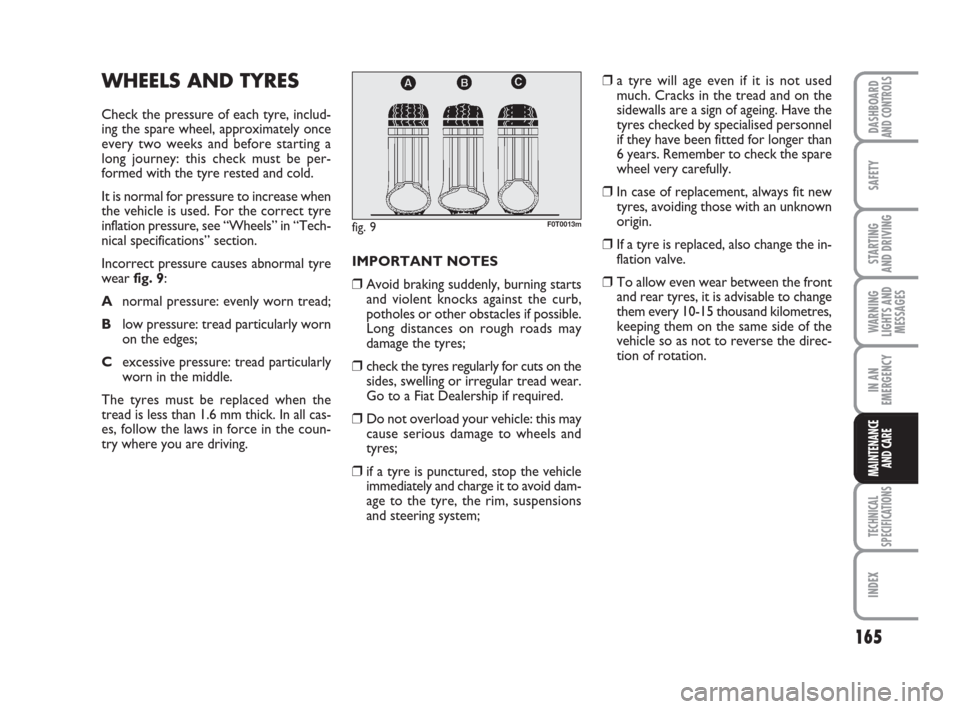
Incorrect pressure causes abnormal tyre
wearfig. 9:
Anormal pressure: evenly worn tread;
Blow pressure: tread particularly worn
on the edges;
Cexcessive pressure: tread particularly
worn in the middle.
The tyres must be replaced when the
tread is less than 1.6 mm thick. In all cas-
es, follow the laws in force in the coun-
try where you are driving.IMPORTANT NOTES
❒Avoid braking suddenly, burning starts
and violent knocks against the curb,
potholes or other obstacles if possible.
Long distances on rough roads may
damage the tyres;
❒check the tyres regularly for cuts on the
sides, swelling or irregular tread wear.
Go to a Fiat Dealership if required.
❒Do not overload your vehicle: this may
cause serious damage to wheels and
tyres;
❒if a tyre is punctured, stop the vehicle
immediately and charge it to avoid dam-
age to the tyre, the rim, suspensions
and steering system;❒a tyre will age even if it is not used
much. Cracks in the tread and on the
sidewalls are a sign of ageing. Have the
tyres checked by specialised personnel
if they have been fitted for longer than
6 years. Remember to check the spare
wheel very carefully.
❒In case of replacement, always fit new
tyres, avoiding those with an unknown
origin.
❒If a tyre is replaced, also change the in-
flation valve.
❒To allow even wear between the front
and rear tyres, it is advisable to change
them every 10-15 thousand kilometres,
keeping them on the same side of the
vehicle so as not to reverse the direc-
tion of rotation.
fig. 9F0T0013m
151-172 Fiorino GB 1ed 21-10-2008 15:02 Pagina 165
Page 167 of 202
166
SAFETY
TECHNICAL
SPECIFICATIONS
INDEX
DASHBOARDAND CONTROLS
STARTING
AND DRIVING
WARNING
LIGHTS AND
MESSAGES
IN AN
EMERGENCY
MAINTENANCE
AND CARE
RUBBER HOSES
As far as the brake system and fuel rubber
hoses are concerned, carefully follow the
instructionsprovided in the “Scheduled
servicing plan” in this section.
Ozone, high temperatures and prolonged
lack of fluid in the system may cause hard-
ening and cracking of the hoses, with pos-
sible leaks. Careful inspections are there-
fore necessary.Remember that road holding
also depends on the correct
tyre inflation pressure.
WARNING
If the pressure is too low the
tyre overheats and this can
cause serious damage.
WARNING
Do not cross switch the
tyres, moving them from the
right of the vehicle to the left and
vice versa.
WARNING
Never submit alloy rims to
repainting treatments re-
quiring the use of temperatures ex-
ceeding 150°C. The mechanical prop-
erties of the wheels could be im-
paired.
WARNING
151-172 Fiorino GB 1ed 21-10-2008 15:02 Pagina 166
Page 170 of 202
169
SAFETY
TECHNICAL
SPECIFICATIONS
INDEX
DASHBOARDAND CONTROLS
STARTING
AND DRIVING
WARNING
LIGHTS AND
MESSAGES
IN AN
EMERGENCY
MAINTENANCE
AND CARE
BODYWORK
PROTECTION FROM
WEATHER CONDITIONS
The main causes of corrosion are the fol-
lowing:
❒atmospheric pollution;
❒salty air and humidity (coastal areas or
hot humid climates);
❒seasonal environment conditions.
Equal importance must be attributed to
the abrasive action of wind-borne atmos-
pheric dust as well as sand and mud and
gravel raised by other vehicles.
On your vehicle Fiat has adopted the best
manufacturing technologies to effectively
protect the bodywork against corrosion.These are the most important technolo-
gies:
❒painting products and systems which
give the vehicle particular resistance to
corrosion and abrasion;
❒use of galvanised (or pre-treated) steel
sheets with high resistance to corro-
sion;
❒spraying the underbody, engine com-
partment, wheelhouse internal parts
and other parts with highly protective
wax products;
❒spraying of plastic parts with a protec-
tive function in the more exposed
points: underdoor, inner fender parts,
edges, etc.;
❒use of “open” boxed sections to pre-
vent condensation and pockets of mois-
ture from triggering rust inside.VEHICLE BODY
AND UNDERBODY WARRANTY
Your vehicle is covered by warranty
against perforation due to rust of any orig-
inal element of the structure or body.
For the general terms of this warranty, re-
fer to the Fiat Warranty Booklet.
151-172 Fiorino GB 1ed 21-10-2008 15:02 Pagina 169