warning lights FIAT QUBO 2010 1.G Owners Manual
[x] Cancel search | Manufacturer: FIAT, Model Year: 2010, Model line: QUBO, Model: FIAT QUBO 2010 1.GPages: 230, PDF Size: 4.38 MB
Page 108 of 230
MANUAL DEACTIVATION OF
PASSENGER'S FRONT AIRBAG AND SIDE
BAG
(for versions/markets, where provided)
Whenever a child needs to be carried on the front
seat, the passenger's front airbag and side bags
(for versions/markets where provided) can be
deactivated.
The warning light
on the instrument panel stays
on until the passenger's front airbag and side bags
(for versions/markets where provided) are
reactivated.
IMPORTANT Refer to "Digital display" and
“Multifunction display” in the “Know your vehicle”
section to manually deactivate the passenger's front
airbag and side bags (for versions/markets, where
provided).
SIDE BAGS
(for versions/markets, where provided)
On some versions, the vehicle may be fitted with
driver and passenger's front side bags.
Side bags protect occupants from side-on crashes of
medium/high severity by placing the bag between
the occupant and the internal parts of the side
structure of the vehicle.
Non-activation of side bags in other types of
collisions (head-on collisions, rear shunts, roll-overs,
etc...) is not an indication of system malfunction.
An electronic control unit causes the bags to inflate
in the event of a side-on collision. The bags inflate
instantaneously, placing themselves between the
occupant's body and the structures which could
cause injury. They deflate immediately afterwards.
Side bags are not a replacement of, but rather a
complement to, seat belts, which you are
recommended to wear at all times, as specified by
law in Europe and most non-European countries.
For this reason, the seat belt must be worn at all
times. In the case of side-on collisions, the seat belts
hold occupants in the correct position and prevent
them from being thrown out of the car by a very
violent collision.
107
KNOW YOUR
VEHICLE
SAFETY
STARTING AND
DRIVING
W
ARNING LIGHTS
AND MESSAGES
IN AN EMERGENCY
SERVICING AND
MAINTENANCE
TECHNICAL
SPECIFICATIONS
INDEX
Page 109 of 230
SIDE BAGS
(for versions/markets, where provided)
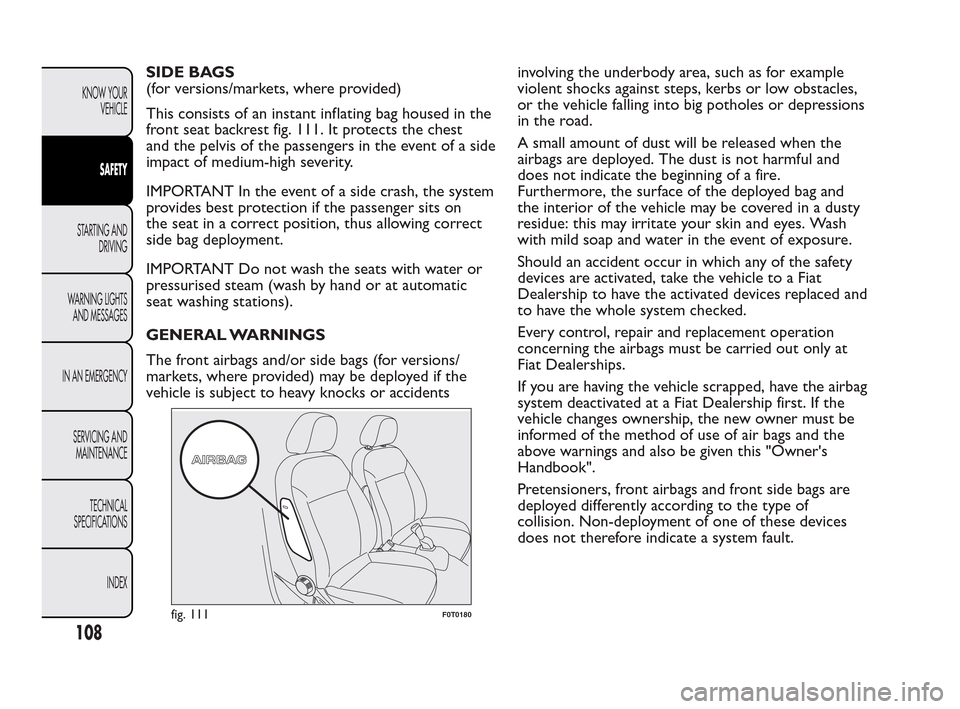
This consists of an instant inflating bag housed in the
front seat backrest fig. 111. It protects the chest
and the pelvis of the passengers in the event of a side
impact of medium-high severity.
IMPORTANT In the event of a side crash, the system
provides best protection if the passenger sits on
the seat in a correct position, thus allowing correct
side bag deployment.
IMPORTANT Do not wash the seats with water or
pressurised steam (wash by hand or at automatic
seat washing stations).
GENERAL WARNINGS
The front airbags and/or side bags (for versions/
markets, where provided) may be deployed if the
vehicle is subject to heavy knocks or accidentsinvolving the underbody area, such as for example
violent shocks against steps, kerbs or low obstacles,
or the vehicle falling into big potholes or depressions
in the road.
A small amount of dust will be released when the
airbags are deployed. The dust is not harmful and
does not indicate the beginning of a fire.
Furthermore, the surface of the deployed bag and
the interior of the vehicle may be covered in a dusty
residue: this may irritate your skin and eyes. Wash
with mild soap and water in the event of exposure.
Should an accident occur in which any of the safety
devices are activated, take the vehicle to a Fiat
Dealership to have the activated devices replaced and
to have the whole system checked.
Every control, repair and replacement operation
concerning the airbags must be carried out only at
Fiat Dealerships.
If you are having the vehicle scrapped, have the airbag
system deactivated at a Fiat Dealership first. If the
vehicle changes ownership, the new owner must be
informed of the method of use of air bags and the
above warnings and also be given this "Owner's
Handbook".
Pretensioners, front airbags and front side bags are
deployed differently according to the type of
collision. Non-deployment of one of these devices
does not therefore indicate a system fault.
fig. 111F0T0180
108
KNOW YOUR
VEHICLE
SAFETY
STARTING AND
DRIVING
W
ARNING LIGHTS
AND MESSAGES
IN AN EMERGENCY
SERVICING AND
MAINTENANCE
TECHNICAL
SPECIFICATIONS
INDEX
Page 110 of 230
WARNING
There may be a fault in the retaining
sys
tems if the warning light
does not
light up when the key is turn on or remains on
while travelling (on some versions with a
message on the display). In this case, the airbags
or the pretensioners may not be activated in
the case of an accident or (more seldom) they
may be activated incorrectly. Contact a Fiat
Dealership immediately to have the system
checked.
WARNING
The expiration dates of the explosive
ch
arge and the clock wire are shown on
a label contained in the glove box. Go to a Fiat
Dealership to have the devices replaced when
the expiration date approaches.
WARNING
Do not travel carrying objects in your
lap,
in front of your chest or between
your lips (pipe, pencils, etc .): they could cause
severe injury if the airbag is deployed.
WARNING
Airbags may be deployed if another
v
ehicle crashes into yours if the key is
inserted and on, even if the engine is not
running and your vehicle is standing. For this
reason, children must never sit on the front
seat , even if when standing. On the other hand,
if the key is inserted and at STOP, none of the
safety devices (airbag or pretensioners) will
be deployed in a collision. Non-deployment of
the devices in this case does not indicate a
system fault .
WARNING
Have the airbag system checked by a
Fiat
Dealership if the car was stolen, if
theft was attempted, or if the car was subjected
to vandalism or flooding.
WARNING
When the ignition key is turned to MAR,
t
he warning light
(with passenger's
front airbag activated) comes on and flashes for
a few seconds to remind you that the
passenger's airbag will be deployed in a crash,
after which it should go off.
109
KNOW YOUR
VEHICLE
SAFETY
STARTING AND
DRIVING
W
ARNING LIGHTS
AND MESSAGES
IN AN EMERGENCY
SERVICING AND
MAINTENANCE
TECHNICAL
SPECIFICATIONS
INDEX
Page 111 of 230
WARNING
The airbag deployment threshold is
high
er than that of the pretensioners.
For collisions in the range between the two
thresholds, it is normal for only the
pretensioners to be activated.
WARNING
Airbags do not replace seat belts, but
in
crease their efficiency. Furthermore,
since front airbags are not deployed in
low-speed head-on collisions, side-on impacts,
rear-end shunts or roll-overs, the passengers are
protected only by the seat belts which must
therefore be fastened at all times.
110
KNOW YOUR
VEHICLE
SAFETY
STARTING AND
DRIVING
W
ARNING LIGHTS
AND MESSAGES
IN AN EMERGENCY
SERVICING AND
MAINTENANCE
TECHNICAL
SPECIFICATIONS
INDEX
Page 112 of 230
STARTING AND DRIVING
STARTING THE ENGINE
The vehicle is fitted with an immobiliser: if the engine
fails to start, see the paragraph on “The Fiat CODE
system” in the “Knowing your vehicle” section.
The engine may be noisier during the first few
seconds of operation, particularly after a long period
of inactivity. This is due to the hydraulic tappets,
the timing system chosen for petrol engine versions
to reduce the number of servicing interventions,
and affects neither functionality nor reliability.
It is advisable not to demand maximum
performance from your vehicle (e.g.
excessive acceleration, long distances at
high speeds, excessive intense braking, etc .) during
the initial period of use.
When the engine is switched off never
leave the key on (at MAR) to prevent
unnecessary consumption and draining
the battery.
WARNING
It is dangerous to have the engine
runnin
g indoors.The engine takes in
oxygen and discharges carbon dioxide, carbon
monoxide and other toxic gases.
WARNING
Remember that the brake booster and
elect
ric power steering are not
operational until the engine has been started,
so you need to apply much more force than
usual to the brake pedal and steering wheel.
STARTING PROCEDURE FOR DIESEL
VERSIONS
Proceed as follows:
❒apply the handbrake;
❒put the gear lever into neutral;
❒turn the key on (MAR position): instrument panel
warning light
will light up;
❒wait for the warning lights
andto go out.
The hotter the engine is, the quicker this will
happen;
❒press the clutch pedal down to the floor without
touching the accelerator;
❒turn the ignition key to AVV as soon as the
warning light goes out. Waiting too long will
waste the heating work carried out by the glow
plugs.
Release the key as soon as the engine starts.
111
KNOW YOUR
VEHICLE
SAFETY
STARTING AND
DRIVING
WARNING LIGHTS
AND
MESSAGES
IN AN EMERGENCY
SERVICING AND
MAINTENANCE
TECHNICAL
SPECIFICATIONS
INDEX
Page 113 of 230
IMPORTANT With the engine cold, the accelerator
pedal must be fully released when you turn the
ignition key to AVV.
If the engine does not start at the first attempt,
return the ignition key to STOP before repeating the
procedure.
If the
warning light stays on when the ignition key
is at MAR, turn the key to STOP and then back to
MAR; if the warning light remains on, try with the
other keys provided with the car.
Contact a Fiat Dealership if the engine still does not
start.
Warning lightwill blink for 60
seconds after starting or during prolonged
cranking to indicate a fault to the glow
plug heating system. Use the vehicle normally if
the engine starts, but go to a Fiat Dealership
as soon as possible.
HOW TO WARM UP THE ENGINE AFTER IT
HAS JUST STARTED
Proceed as follows:
❒drive off slowly, letting the engine turn at medium
revs. Do not accelerate abruptly;
❒do not demand to performance for the first few
kilometres. Wait until the engine coolant gauge
starts moving.EMERGENCY STARTING
Go to a Fiat Dealership immediately if warning light
comes on steady on the instrument panel.
Never jump start the engine by pushing,
towing or driving downhill.This could
cause fuel to flow into the catalytic
converter and damage it beyond repair.
STOPPING THE ENGINE
Turn the ignition key to STOP while the engine is
idling.
IMPORTANT After a long drive, you should allow
the engine to “catch its breath” before turning it off
by letting it idle to allow the temperature in the
engine compartment to fall.
A quick burst on the accelerator before
turning off the engine serves absolutely no
practical purpose; it wastes fuel and is
especially damaging to turbocharged engines.
112
KNOW YOUR
VEHICLE
SAFETY
STARTING AND
DRIVING
WARNING LIGHTS
AND
MESSAGES
IN AN EMERGENCY
SERVICING AND
MAINTENANCE
TECHNICAL
SPECIFICATIONS
INDEX
Page 114 of 230
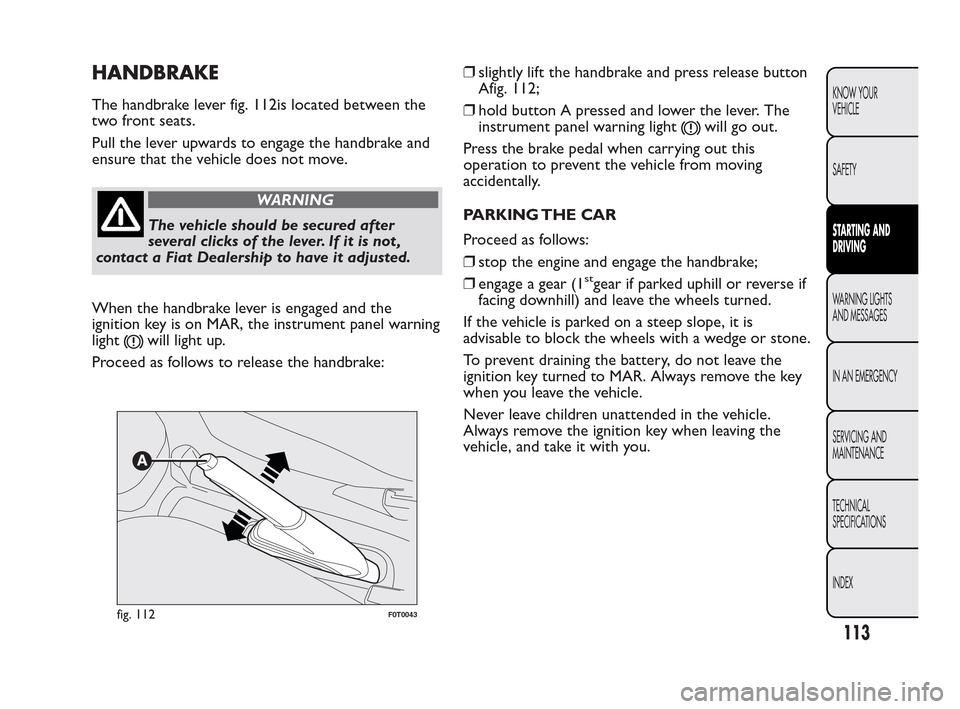
HANDBRAKE
The handbrake lever fig. 112is located between the
two front seats.
Pull the lever upwards to engage the handbrake and
ensure that the vehicle does not move.
WARNING
The vehicle should be secured after
se
veral clicks of the lever. If it is not ,
contact a Fiat Dealership to have it adjusted.
When the handbrake lever is engaged and the
ignition key is on MAR, the instrument panel warning
light
will light up.
Proceed as follows to release the handbrake:❒slightly lift the handbrake and press release button
Afig. 112;
❒hold button A pressed and lower the lever. The
instrument panel warning light
will go out.
Press the brake pedal when carrying out this
operation to prevent the vehicle from moving
accidentally.
PARKING THE CAR
Proceed as follows:
❒stop the engine and engage the handbrake;
❒engage a gear (1
stgear if parked uphill or reverse if
facing downhill) and leave the wheels turned.
If the vehicle is parked on a steep slope, it is
advisable to block the wheels with a wedge or stone.
To prevent draining the battery, do not leave the
ignition key turned to MAR. Always remove the key
when you leave the vehicle.
Never leave children unattended in the vehicle.
Always remove the ignition key when leaving the
vehicle, and take it with you.
fig. 112F0T0043
113
KNOW YOUR
VEHICLE
SAFETY
STARTING AND
DRIVING
WARNING LIGHTS
AND
MESSAGES
IN AN EMERGENCY
SERVICING AND
MAINTENANCE
TECHNICAL
SPECIFICATIONS
INDEX
Page 115 of 230
SNOW TYRES
A Fiat Dealership will be happy to provide advice
concerning the most suitable type of tyre for your
requirements.
For the type, pressures and specifications of the
snow tyre to be used, follow carefully the
instructions given in the “Wheels” paragraph of the
“Technical specifications” section.
The winter performance of these tyres is
considerably reduced when the tread thickness is less
than 4 mm. If this is the case, replace them.
Due to their specific features, the performance of
snow tyres is much lower than that of standard tyres
in normal conditions or on long motorway stretches.
You should therefore use them only in the
conditions for which they were designed.
IMPORTANT When using snow tyres with a
maximum speed index below the one that can be
reached by the vehicle (increased by 5%), place
a notice in the passenger compartment, plainly in
view, which states the maximum speed allowed
by the snow tyres (as per EC Directive).
All four tyres should be the same (brand and profile)
to ensure greater safety when driving and braking
as well as making the car more responsive.
Remember that you should not change the rotation
direction of the tyres.
WARNING
You must not exceed 160 km/h on snow
t
yres with a “Q” mark; in any case, make
sure you stick to the rules of the highway code.
114
KNOW YOUR
VEHICLE
SAFETY
STARTING AND
DRIVING
WARNING LIGHTS
AND
MESSAGES
IN AN EMERGENCY
SERVICING AND
MAINTENANCE
TECHNICAL
SPECIFICATIONS
INDEX
Page 116 of 230
USING THE GEARBOX
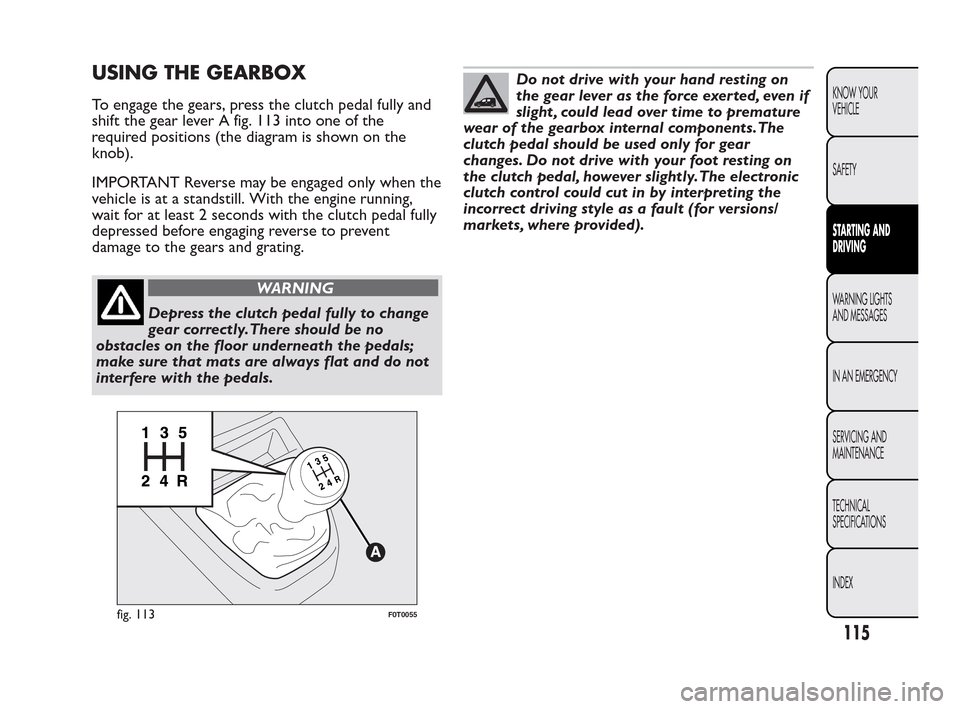
To engage the gears, press the clutch pedal fully and
shift the gear lever A fig. 113 into one of the
required positions (the diagram is shown on the
knob).
IMPORTANT Reverse may be engaged only when the
vehicle is at a standstill. With the engine running,
wait for at least 2 seconds with the clutch pedal fully
depressed before engaging reverse to prevent
damage to the gears and grating.
WARNING
Depress the clutch pedal fully to change
gear
correctly.There should be no
obstacles on the floor underneath the pedals;
make sure that mats are always flat and do not
interfere with the pedals.
Do not drive with your hand resting on
the gear lever as the force exerted, even if
slight , could lead over time to premature
wear of the gearbox internal components.The
clutch pedal should be used only for gear
changes. Do not drive with your foot resting on
the clutch pedal, however slightly.The electronic
clutch control could cut in by interpreting the
incorrect driving style as a fault (for versions/
markets, where provided).
fig. 113F0T0055
115
KNOW YOUR
VEHICLE
SAFETY
STARTING AND
DRIVING
WARNING LIGHTS
AND
MESSAGES
IN AN EMERGENCY
SERVICING AND
MAINTENANCE
TECHNICAL
SPECIFICATIONS
INDEX
Page 117 of 230
SAVING FUEL
Here are some useful tips to save fuel and minimise
harmful emissions of CO2 and other pollutants
(nitric oxides, unburnt hydrocarbons, fine dusts etc.).
GENERAL CONSIDERATIONS
General conditions which influence fuel consumption
are shown below.
Vehicle maintenance
Have checks and adjustments carried out in
accordance with the “Scheduled Servicing Plan”.
Ty r e s
Check the tyre pressure at least once every four
weeks: if the pressure is too low, consumption levels
increase as resistance to rolling is higher.
Unnecessary loads
Do not travel with an overloaded boot. The weight
of the vehicle (especially when driving in town)
and its trim greatly affect fuel consumption
and stability.
Roof rack/ski rack
Remove the roof rack or the ski rack from the roof
after use. These accessories reduce the aerodynamic
coefficient of the vehicle and have a negative effect
on fuel consumption. It is better to use a trailer
to transport particularly bulky objects.Electric devices
Use electrical devices only for the amount of time
needed. The heated rear window, auxiliary
headlights, windscreen wipers and fan heater use up
a considerable amount of current, causing increased
fuel consumption (up to +25% in the urban cycle).
Climate control system
The air conditioner leads to higher fuel consumption
(on average up to +20%). If the temperature outside
is not too extreme, try and use the air vents.
Spoilers
The use of non-certified spoilers may adversely affect
aerodynamics and fuel consumption.
DRIVING STYLE
The main driving styles affecting fuel consumption
are shown below.
Starting
Do not warm up the engine at low or high revs when
the vehicle is stationary; this causes the engine to
warm up more slowly, thereby increasing fuel
consumption and emissions. It is advisable to set off
immediately and slowly, avoiding high revs: this allows
the engine to warm up more quickly.
116
KNOW YOUR
VEHICLE
SAFETY
STARTING AND
DRIVING
WARNING LIGHTS
AND
MESSAGES
IN AN EMERGENCY
SERVICING AND
MAINTENANCE
TECHNICAL
SPECIFICATIONS
INDEX