Rear seats FIAT QUBO 2010 1.G User Guide
[x] Cancel search | Manufacturer: FIAT, Model Year: 2010, Model line: QUBO, Model: FIAT QUBO 2010 1.GPages: 230, PDF Size: 4.38 MB
Page 102 of 230
Below is a summary of the rules of safety to
be followed when carrying children:
❒Install the child seats on the rear seat, which is the
most protected position in the event of an
accident.
❒If the passenger's air bag is deactivated, always
check the amber warning light
on the
instrument panel to make sure that it has actually
been deactivated.
❒Carefully follow the instructions that came with
the child seat, which the manufacturer must supply
by law. Keep the instructions in the vehicle along
with the other papers and this handbook. Do
not use child seats without instructions.
❒Always check the seat belt is well fastened by
pulling on it.
❒Only one child is to be strapped into each seat;
never carry two children using one child seat.
❒Always check the seat belts do not rest on the
child's neck.
❒While travelling, do not let the child sit incorrectly
or release the belts.
❒Never carry children on your lap, even newborns.
No-one can hold a child in the event of an
accident.
❒In the event of an accident, replace the child seat
with a new one.
WARNING
Do not arrange child seats on the front
seat
in cars fitted with passenger's air
bag. Children must never travel on the front
seat .
101
KNOW YOUR
VEHICLE
SAFETY
STARTING AND
DRIVING
W
ARNING LIGHTS
AND MESSAGES
IN AN EMERGENCY
SERVICING AND
MAINTENANCE
TECHNICAL
SPECIFICATIONS
INDEX
Page 103 of 230
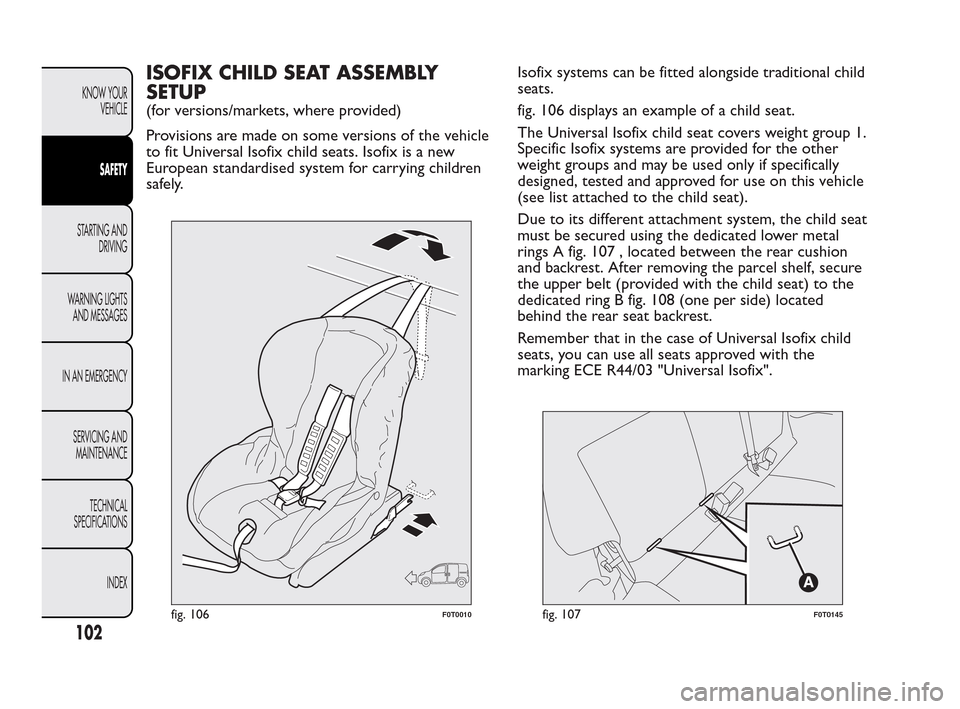
ISOFIX CHILD SEAT ASSEMBLY
SETUP
(for versions/markets, where provided)
Provisions are made on some versions of the vehicle
to fit Universal Isofix child seats. Isofix is a new
European standardised system for carrying children
safely.Isofix systems can be fitted alongside traditional child
seats.
fig. 106 displays an example of a child seat.
The Universal Isofix child seat covers weight group 1.
Specific Isofix systems are provided for the other
weight groups and may be used only if specifically
designed, tested and approved for use on this vehicle
(see list attached to the child seat).
Due to its different attachment system, the child seat
must be secured using the dedicated lower metal
rings A fig. 107 , located between the rear cushion
and backrest. After removing the parcel shelf, secure
the upper belt (provided with the child seat) to the
dedicated ring B fig. 108 (one per side) located
behind the rear seat backrest.
Remember that in the case of Universal Isofix child
seats, you can use all seats approved with the
marking ECE R44/03 "Universal Isofix".
fig. 106F0T0010fig. 107F0T0145
102
KNOW YOUR
VEHICLE
SAFETY
STARTING AND
DRIVING
W
ARNING LIGHTS
AND MESSAGES
IN AN EMERGENCY
SERVICING AND
MAINTENANCE
TECHNICAL
SPECIFICATIONS
INDEX
Page 105 of 230
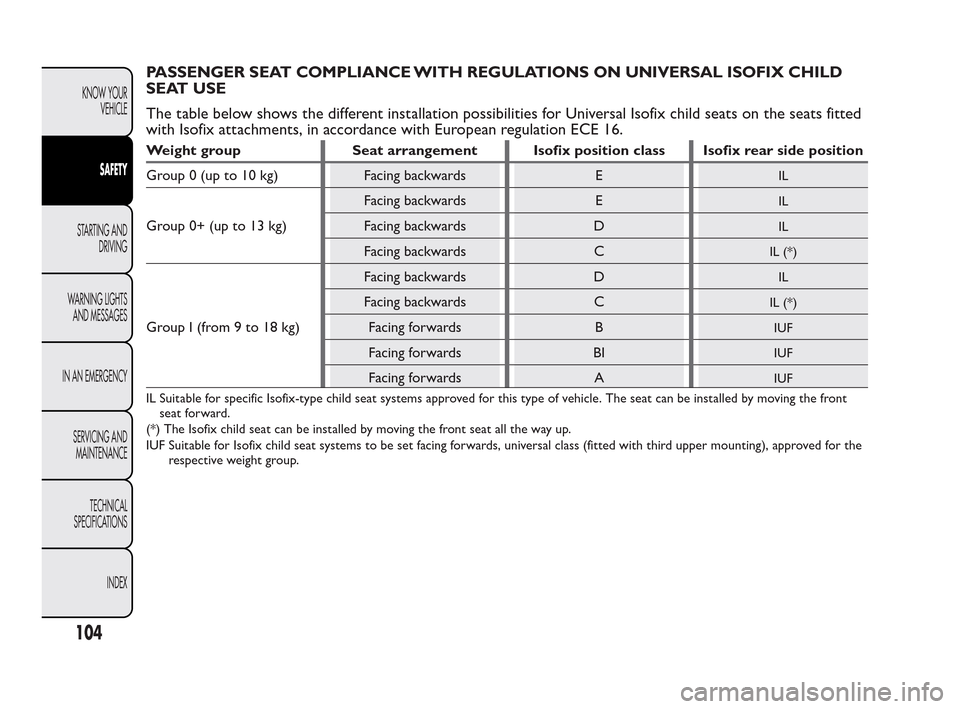
PASSENGER SEAT COMPLIANCE WITH REGULATIONS ON UNIVERSAL ISOFIX CHILD
SEAT USE
The table below shows the different installation possibilities for Universal Isofix child seats on the seats fitted
with Isofix attachments, in accordance with European regulation ECE 16.
Weight group Seat arrangement Isofix position class Isofix rear side position
Group 0 (up to 10 kg) Facing backwards E
IL
Group 0+ (up to 13 kg)Facing backwards E
IL
Facing backwards DIL
Facing backwards CIL (*)
GroupI(from9to18kg)Facing backwards D
IL
Facing backwards CIL (*)
Facing forwards BIUF
Facing forwards BIIUF
Facing forwards AIUF
IL Suitable for specific Isofix-type child seat systems approved for this type of vehicle. The seat can be installed by moving the front
seat forward.
(*) The Isofix child seat can be installed by moving the front seat all the way up.
IUF Suitable for Isofix child seat systems to be set facing forwards, universal class (fitted with third upper mounting), approved for the
respective weight group.
104
KNOW YOUR
VEHICLE
SAFETY
STARTING AND
DRIVING
W
ARNING LIGHTS
AND MESSAGES
IN AN EMERGENCY
SERVICING AND
MAINTENANCE
TECHNICAL
SPECIFICATIONS
INDEX
Page 106 of 230
FRONT AIRBAGS
The vehicle is fitted with front airbags for driver and
passenger (for versions/markets where provided).
The front driver/passenger airbags (for versions/
markets, where provided) are designed to protect
the front-seat occupants in the event of head-on
crashes of medium-high severity, by placing the bag
between the occupant and the steering wheel or
dashboard.
Non-activation in other types of crash (side-on
collisions, rear shunts, roll-overs, etc.) is therefore
not a sign of system malfunction.
An electronic control unit causes the bag to inflate, if
necessary, in the event of a head-on crash.
The bag will inflate instantaneously, placing itself
between the front occupant's body and the
structures which could cause injury. It will deflate
immediately afterwards.
Front driver/passenger airbags (for versions/markets,
where provided) are not a replacement for, but
rather a complement to, the seat belts, which should
be worn at all times as specified by law in Europe
and most non-European countries.
In the event of an impact, someone not wearing a
seat belt will move forward and come into contact
with the bag which is still opening. The protection
offered by the bag is reduced in such a case.
Front airbags may not be activated in the following
situations:❒head-on impacts against highly deformable objects
that do not affect the front surface of the vehicle
(e.g. front wing hitting a guard rail);
❒vehicle getting wedged under other vehicles or
protective barriers (e.g. trucks or guard rails);
they could not provide any additional protection
compared with seat belts, so their activation would
not be worthwhile. In these cases, non-deployment
of the airbag does not necessarily indicate a system
malfunction.
WARNING
Do not apply stickers or other objects to
t
he steering wheel, the dashboard in
the passenger side airbag area and the seats.
Do not place objects (e.g. mobile phones) on the
passenger side dashboard because these could
interfere with the correct opening of the airbag
and cause severe injur y to occupants.
The front driver and passenger airbags are designed
and calibrated to best protect front-seat passengers
wearing seat belts. The volume of the front airbags at
maximum inflation fills most of the space between
the steering wheel and the driver and between
the dashboard and the passenger.
The airbags are not deployed in the event of small
head-on collisions (for which the withholding action
of the seat belts is sufficient). Seat belts must always
105
KNOW YOUR
VEHICLE
SAFETY
STARTING AND
DRIVING
W
ARNING LIGHTS
AND MESSAGES
IN AN EMERGENCY
SERVICING AND
MAINTENANCE
TECHNICAL
SPECIFICATIONS
INDEX
Page 160 of 230
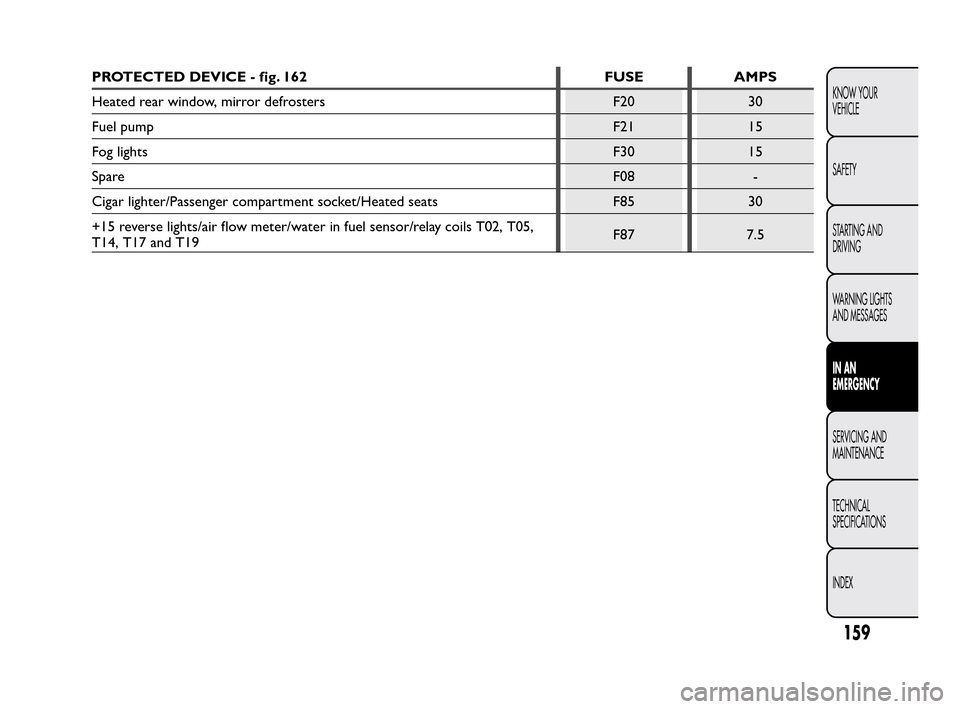
PROTECTED DEVICE - fig. 162 FUSE AMPS
Heated rear window, mirror defrosters F20 30
Fuel pump F21 15
Fog lights F30 15
SpareF08 -
Cigar lighter/Passenger compartment socket/Heated seats F85 30
+15 reverse lights/air flow meter/water in fuel sensor/relay coils T02, T05,
T14, T17 and T19F87 7.5
159
KNOW YOUR
VEHICLE
SAFETY
STARTING AND
DRIVING
WARNING LIGHTS
AND MESSAGES
IN AN
EMERGENCY
SERVICING AND
MAINTENANCE
TECHNICAL
SPECIFICA
TIONS
INDEX
Page 202 of 230
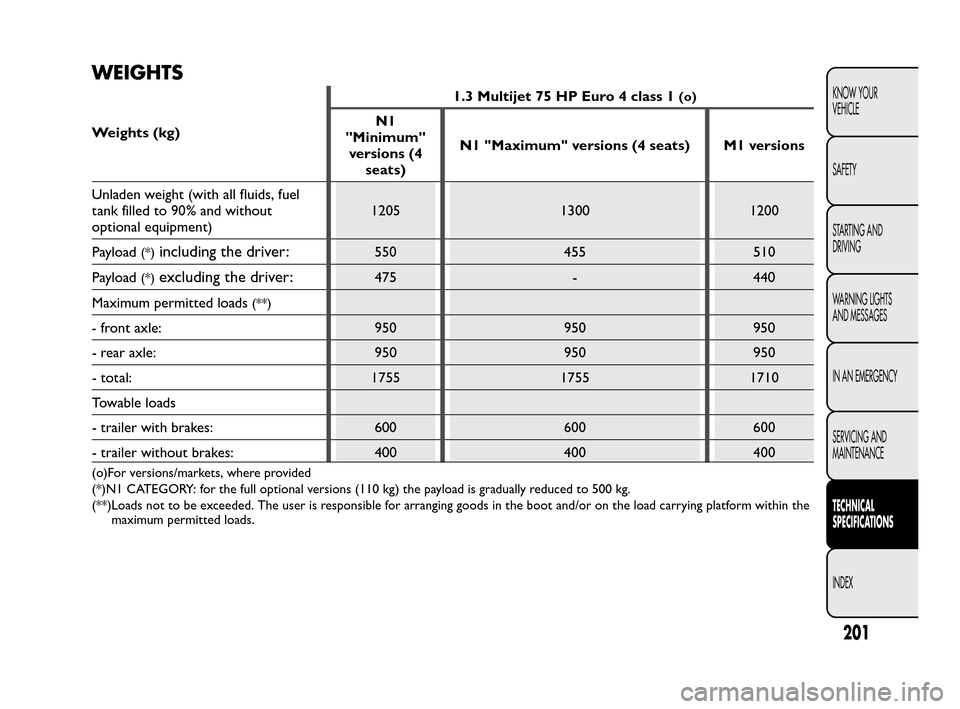
WEIGHTS
Weights (kg)1.3 Multijet 75 HP Euro 4 class 1
(o)
N1
"Minimum"
versions (4
seats)N1 "Maximum" versions (4 seats) M1 versions
Unladen weight (with all fluids, fuel
tank filled to 90% and without
optional equipment)1205 1300 1200
Payload
(*)including the driver:550 455 510
Payload
(*)excluding the driver:475 - 440
Maximum permitted loads
(**)
- front axle: 950 950 950
- rear axle: 950 950 950
- total: 1755 1755 1710
Towable loads
- trailer with brakes: 600 600 600
- trailer without brakes: 400 400 400
(o)For versions/markets, where provided
(*)N1 CATEGORY: for the full optional versions (110 kg) the payload is gradually reduced to 500 kg.
(**)Loads not to be exceeded. The user is responsible for arranging goods in the boot and/or on the load carrying platform within the
maximum permitted loads.
201
KNOW YOUR
VEHICLE
SAFETY
STARTING AND
DRIVING
WARNING LIGHTS
AND MESSAGES
IN AN EMERGENCY
SERVICING AND
MAINTENANCE
TECHNICAL
SPECIFICA
TIONS
INDEX
Page 204 of 230
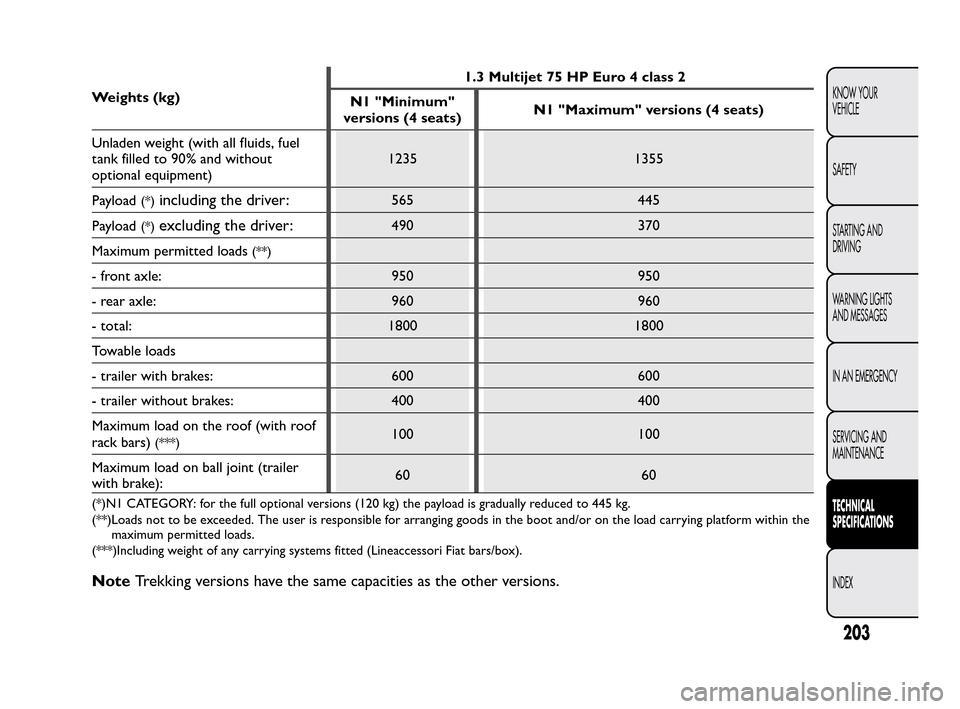
Weights (kg)1.3 Multijet 75 HP Euro 4 class 2
N1 "Minimum"
versions (4 seats)N1 "Maximum" versions (4 seats)
Unladen weight (with all fluids, fuel
tank filled to 90% and without
optional equipment)1235 1355
Payload
(*)including the driver:565 445
Payload
(*)excluding the driver:490 370
Maximum permitted loads
(**)
- front axle: 950 950
- rear axle: 960 960
- total: 1800 1800
Towable loads
- trailer with brakes: 600 600
- trailer without brakes: 400 400
Maximum load on the roof (with roof
rack bars)
(***)100 100
Maximum load on ball joint (trailer
with brake):60 60
(*)N1 CATEGORY: for the full optional versions (120 kg) the payload is gradually reduced to 445 kg.
(**)Loads not to be exceeded. The user is responsible for arranging goods in the boot and/or on the load carrying platform within the
maximum permitted loads.
(***)Including weight of any carrying systems fitted (Lineaccessori Fiat bars/box).
NoteTrekking versions have the same capacities as the other versions.
203
KNOW YOUR
VEHICLE
SAFETY
STARTING AND
DRIVING
WARNING LIGHTS
AND MESSAGES
IN AN EMERGENCY
SERVICING AND
MAINTENANCE
TECHNICAL
SPECIFICA
TIONS
INDEX
Page 225 of 230
– Front airbag passenger's
side .......................................... 106
– Manual deactivation of
passenger front airbag
and side bag ........................... 107
Front ceiling light ....................... 151
Front ceiling light with map
reading lights (changing a
bulb) ............................................ 152
Front light clusters
(changing a bulb) ...................... 146
Front light clusters .................... 146
Front power socket ................... 55
Fuel cap ......................................... 88
Fuel consumption ...................... 208
Fuel cut-off system ..................... 89
Fuel filter (water in fuel
warning light) ............................ 127
Fuel level indicator ..................... 13
Fuel reserve warning light........ 126
Fuel (reserve warning light) ..... 126
Fuel system.................................. 192
Fuses (replacement) . 154-156-160
Gear lever................................... 115
Generic failure indication
warning light.............................. 128
Generic failure indication
(warning light)........................... 128Glove compartment................... 55
Glow plug preheating fault
warning light.............................. 126
Glow plugs (preheating/fault
warning light) ............................ 126
Glow plugs preheating
warning light.............................. 126
Handbrake ................................... 113
Handbrake lever ......................... 113
Handbrake (warning light) ....... 120
Hazard lights ................................ 53
Headlight alignment
corrector .................................... 73
Headlights
– Headlight alignment
corrector................................. 73
– Light beam direction ............ 73
Headrest
– Front ........................................ 32
– Rear .......................................... 33
Heating and ventilation ............. 38
Heating and ventilation
system; ........................................ 37
Heavy use of the vehicle .......... 170
Hill Holder (system) .................. 78
How to warm up the engine
after it has just started ........... 112
Identification data ..................... 188Ignition switch
– Ignition ..................................... 12
– Steering lock........................... 12
In an emergency ......................... 131
Inflation pressure ....................... 198
Inflation procedure .................... 140
Injection system/EOBD
engine control system fault
warning light.............................. 125
Injection system (warning
light) ............................................ 125
Installing
electrical/electronic devices ... 86
Instrument panel ......................... 4
Instruments .................................. 13
Interior fittings ............................ 54
Interiors ....................................... 186
Isofix child seat assembly
setup ........................................... 102
Isofix child seats (fitting
arrangement) ............................ 102
– Seat compliance with
child seat use......................... 104
Jack ............................................... 133
Jump starting............................... 131
224
KNOW YOUR
VEHICLE
SAFETY
STARTING AND
DRIVING
WARNING LIGHTS
AND MESSAGES
IN AN EMERGENCY
SERVICING AND
MAINTENANCE
TECHNICAL
SPECIFICATIONS
INDEX
Page 227 of 230
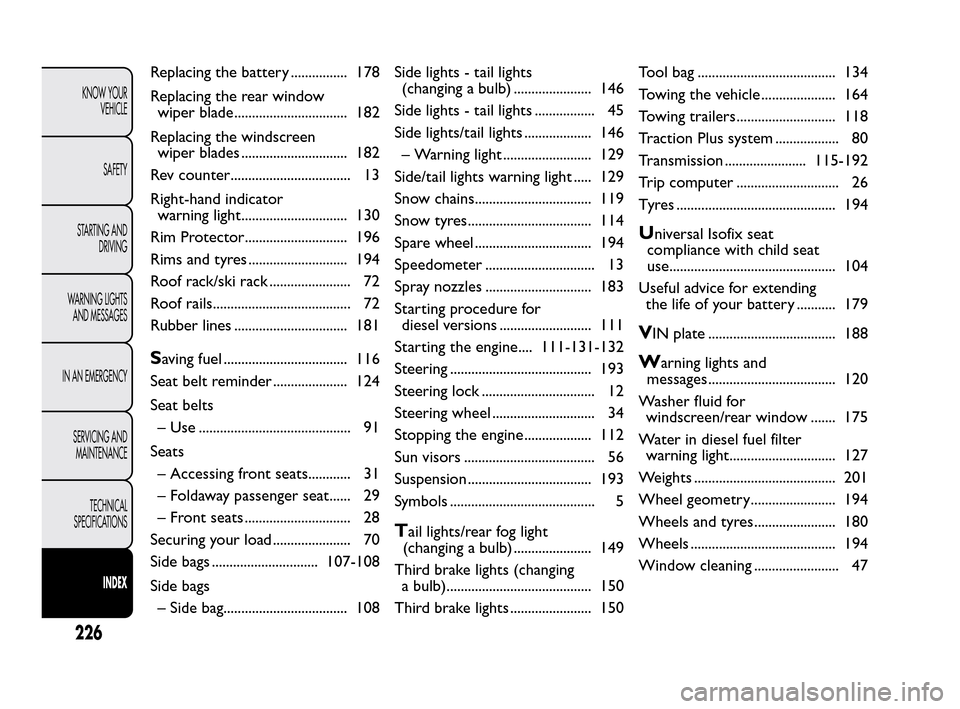
Replacing the battery ................ 178
Replacing the rear window
wiper blade................................ 182
Replacing the windscreen
wiper blades .............................. 182
Rev counter.................................. 13
Right-hand indicator
warning light.............................. 130
Rim Protector............................. 196
Rims and tyres ............................ 194
Roof rack/ski rack ....................... 72
Roof rails....................................... 72
Rubber lines ................................ 181
Saving fuel ................................... 116
Seat belt reminder ..................... 124
Seat belts
– Use ........................................... 91
Seats
– Accessing front seats............ 31
– Foldaway passenger seat...... 29
– Front seats .............................. 28
Securing your load ...................... 70
Side bags .............................. 107-108
Side bags
– Side bag................................... 108Side lights - tail lights
(changing a bulb) ...................... 146
Side lights - tail lights ................. 45
Side lights/tail lights ................... 146
– Warning light ......................... 129
Side/tail lights warning light ..... 129
Snow chains................................. 119
Snow tyres................................... 114
Spare wheel ................................. 194
Speedometer ............................... 13
Spray nozzles .............................. 183
Starting procedure for
diesel versions .......................... 111
Starting the engine.... 111-131-132
Steering ........................................ 193
Steering lock ................................ 12
Steering wheel ............................. 34
Stopping the engine ................... 112
Sun visors ..................................... 56
Suspension ................................... 193
Symbols ......................................... 5
Tail lights/rear fog light
(changing a bulb) ...................... 149
Third brake lights (changing
a bulb)......................................... 150
Third brake lights ....................... 150Tool bag ....................................... 134
Towing the vehicle ..................... 164
Towing trailers ............................ 118
Traction Plus system .................. 80
Transmission ....................... 115-192
Trip computer ............................. 26
Tyres ............................................. 194
Universal Isofix seat
compliance with child seat
use............................................... 104
Useful advice for extending
the life of your battery ........... 179
VIN plate .................................... 188
Warning lights and
messages .................................... 120
Washer fluid for
windscreen/rear window ....... 175
Water in diesel fuel filter
warning light.............................. 127
Weights ........................................ 201
Wheel geometry........................ 194
Wheels and tyres ....................... 180
Wheels ......................................... 194
Window cleaning ........................ 47
226
KNOW YOUR
VEHICLE
SAFETY
STARTING AND
DRIVING
WARNING LIGHTS
AND MESSAGES
IN AN EMERGENCY
SERVICING AND
MAINTENANCE
TECHNICAL
SPECIFICATIONS
INDEX