tow FIAT QUBO 2010 1.G User Guide
[x] Cancel search | Manufacturer: FIAT, Model Year: 2010, Model line: QUBO, Model: FIAT QUBO 2010 1.GPages: 230, PDF Size: 4.38 MB
Page 72 of 230
WARNING
Before opening the bonnet , check that
win
dscreen wiper arm is not lifted from
the windscreen.CLOSING
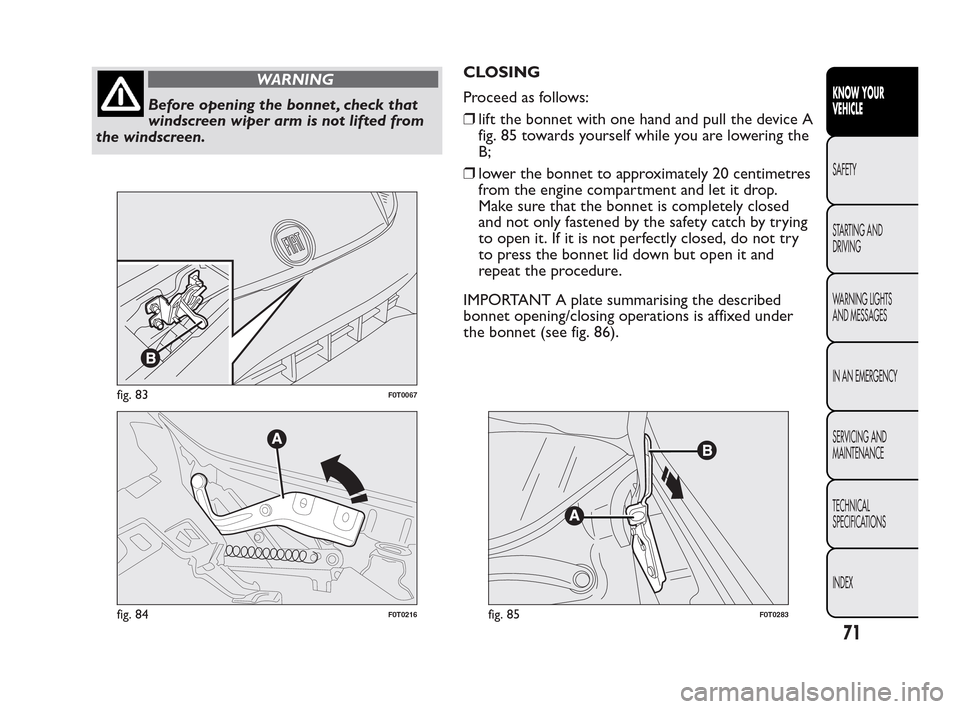
Proceed as follows:
❒lift the bonnet with one hand and pull the device A
fig. 85 towards yourself while you are lowering the
B;
❒lower the bonnet to approximately 20 centimetres
from the engine compartment and let it drop.
Make sure that the bonnet is completely closed
and not only fastened by the safety catch by trying
to open it. If it is not perfectly closed, do not try
to press the bonnet lid down but open it and
repeat the procedure.
IMPORTANT A plate summarising the described
bonnet opening/closing operations is affixed under
the bonnet (see fig. 86).
fig. 83F0T0067
fig. 84F0T0216fig. 85F0T0283
71
KNOW YOUR
VEHICLE
SAFETY
ST
ARTING AND
DRIVING
WARNING LIGHTS
AND MESSAGES
IN AN EMERGENCY
SERVICING AND
MAINTENANCE
TECHNICAL
SPECIFICATIONS
INDEX
Page 75 of 230
Adjusting headlight alignment
Press
oron the control panel fig. 89.
The instrument panel display shows the position in
relation to the adjustment set.
Position 0 - one or two people in the front seats.
Position1-fivepeople.
Position2-fivepeople + load in the boot.
Position 3 - driver + maximum permitted load
stowed in the boot.
IMPORTANT Check the alignment of the light beams
each time the weight of the load transported
changes.
FOG LIGHT DIRECTION
(for versions/markets, where provided)
Contact a Fiat Dealership to have the direction
checked and, if necessary, adjusted.ADJUSTING THE HEADLIGHTS WHEN
ABROAD
The dipped headlights are adjusted to work in the
country where the vehicle was originally purchased.
When in countries where you drive on the other
side of the road, you need to alter the beam
direction by affixing a specially designed self-adhesive
film in order not to dazzle the vehicles travelling in
the opposite direction. Such film is provided by
Lineaccessori Fiat and is available at Fiat Dealerships.
74
KNOW YOUR
VEHICLE
SAFETY
ST
ARTING AND
DRIVING
WARNING LIGHTS
AND MESSAGES
IN AN EMERGENCY
SERVICING AND
MAINTENANCE
TECHNICAL
SPECIFICATIONS
INDEX
Page 84 of 230
WARNING BUZZER
Activating the reverse gear, an intermittent buzzer
automatically turns on (a short beep to indicate the
activation of the system).
The beeps:
❒increase as the distance between the vehicle and
the obstacle decreases;
❒become continuous when the distance between
the vehicle and the obstacle is less than 30 cm
and stop immediately if the distance increases;
❒remains constant if the distance between the
vehicle and the obstacle remains unchanged.
Detection distances
Centre operating range 120 cm
Side operating radius 60 cm
If several obstacles are detected by the sensors, only
the nearest one is considered.
FAILURE INDICATIONS
Parking sensor failures are indicated, when engaging
reverse gear, by a three-second beep.The sensor must be free of mud, dirt , snow
or ice in order for the system to work. Be
careful not to scratch or damage the
sensors while cleaning them. Avoid using dry,
rough or hard cloths.The sensors should be
washed using clean water with the addition of car
shampoo if necessary.When using special
washing equipment such as high pressure jets or
steam cleaning, clean the sensors very quickly
keeping the jet more than 10 cm away.
OPERATION WITH TRAILER
The operation of the sensors is automatically
deactivated when the plug for the electric cable for
the trailer is inserted in the vehicle tow hook socket.
The sensors are automatically enabled again when
the trailer cable plug is removed.
GENERAL WARNINGS
❒During parking manoeuvres, pay the utmost
attention to any obstacles that could be located
above or below the sensors.
❒Sometimes, objects located very near the rear of
the vehicle are not detected and could therefore
damage the vehicle or be damaged themselves.
83
KNOW YOUR
VEHICLE
SAFETY
ST
ARTING AND
DRIVING
WARNING LIGHTS
AND MESSAGES
IN AN EMERGENCY
SERVICING AND
MAINTENANCE
TECHNICAL
SPECIFICATIONS
INDEX
Page 113 of 230
IMPORTANT With the engine cold, the accelerator
pedal must be fully released when you turn the
ignition key to AVV.
If the engine does not start at the first attempt,
return the ignition key to STOP before repeating the
procedure.
If the
warning light stays on when the ignition key
is at MAR, turn the key to STOP and then back to
MAR; if the warning light remains on, try with the
other keys provided with the car.
Contact a Fiat Dealership if the engine still does not
start.
Warning lightwill blink for 60
seconds after starting or during prolonged
cranking to indicate a fault to the glow
plug heating system. Use the vehicle normally if
the engine starts, but go to a Fiat Dealership
as soon as possible.
HOW TO WARM UP THE ENGINE AFTER IT
HAS JUST STARTED
Proceed as follows:
❒drive off slowly, letting the engine turn at medium
revs. Do not accelerate abruptly;
❒do not demand to performance for the first few
kilometres. Wait until the engine coolant gauge
starts moving.EMERGENCY STARTING
Go to a Fiat Dealership immediately if warning light
comes on steady on the instrument panel.
Never jump start the engine by pushing,
towing or driving downhill.This could
cause fuel to flow into the catalytic
converter and damage it beyond repair.
STOPPING THE ENGINE
Turn the ignition key to STOP while the engine is
idling.
IMPORTANT After a long drive, you should allow
the engine to “catch its breath” before turning it off
by letting it idle to allow the temperature in the
engine compartment to fall.
A quick burst on the accelerator before
turning off the engine serves absolutely no
practical purpose; it wastes fuel and is
especially damaging to turbocharged engines.
112
KNOW YOUR
VEHICLE
SAFETY
STARTING AND
DRIVING
WARNING LIGHTS
AND
MESSAGES
IN AN EMERGENCY
SERVICING AND
MAINTENANCE
TECHNICAL
SPECIFICATIONS
INDEX
Page 117 of 230
SAVING FUEL
Here are some useful tips to save fuel and minimise
harmful emissions of CO2 and other pollutants
(nitric oxides, unburnt hydrocarbons, fine dusts etc.).
GENERAL CONSIDERATIONS
General conditions which influence fuel consumption
are shown below.
Vehicle maintenance
Have checks and adjustments carried out in
accordance with the “Scheduled Servicing Plan”.
Ty r e s
Check the tyre pressure at least once every four
weeks: if the pressure is too low, consumption levels
increase as resistance to rolling is higher.
Unnecessary loads
Do not travel with an overloaded boot. The weight
of the vehicle (especially when driving in town)
and its trim greatly affect fuel consumption
and stability.
Roof rack/ski rack
Remove the roof rack or the ski rack from the roof
after use. These accessories reduce the aerodynamic
coefficient of the vehicle and have a negative effect
on fuel consumption. It is better to use a trailer
to transport particularly bulky objects.Electric devices
Use electrical devices only for the amount of time
needed. The heated rear window, auxiliary
headlights, windscreen wipers and fan heater use up
a considerable amount of current, causing increased
fuel consumption (up to +25% in the urban cycle).
Climate control system
The air conditioner leads to higher fuel consumption
(on average up to +20%). If the temperature outside
is not too extreme, try and use the air vents.
Spoilers
The use of non-certified spoilers may adversely affect
aerodynamics and fuel consumption.
DRIVING STYLE
The main driving styles affecting fuel consumption
are shown below.
Starting
Do not warm up the engine at low or high revs when
the vehicle is stationary; this causes the engine to
warm up more slowly, thereby increasing fuel
consumption and emissions. It is advisable to set off
immediately and slowly, avoiding high revs: this allows
the engine to warm up more quickly.
116
KNOW YOUR
VEHICLE
SAFETY
STARTING AND
DRIVING
WARNING LIGHTS
AND
MESSAGES
IN AN EMERGENCY
SERVICING AND
MAINTENANCE
TECHNICAL
SPECIFICATIONS
INDEX
Page 119 of 230
TOWING TRAILERS
IMPORTANT
The vehicle must be provided with a type-approved
tow hitch and adequate electrical system to tow
trailers. Installation must be performed by specialised
personnel who will issue the required papers for
travelling on roads.
Install any specific and/or additional rear-view mirrors
in accordance with the highway code of the country
in which you are travelling.
Remember that when towing a trailer, steep hills are
harder to climb, braking distances increase and
overtaking takes longer depending on the overall
weight of the trailer.
Engage a low gear when driving downhill, rather than
constantly using the brake.
The weight of the trailer on the vehicle tow hitch
will reduce the loading capacity of the vehicle by the
same amount.
Consider the weight at full load, including accessories
and luggage, to make sure you do not exceed the
maximum towable weight (shown in the log book).
Respect each country's speed limits for vehicles
towing trailers. In all cases, the top speed must not
exceed 80 km/h.
WARNING
The ABS with which the vehicle may be
equipped
will not control the braking
system of the trailer. Particular caution is
therefore required on slippery roads.
WARNING
Never modify the braking system of the
v
ehicle to control the trailer brake.
The trailer braking system must be fully
independent from the hydraulic system of the
vehicle.
118
KNOW YOUR
VEHICLE
SAFETY
STARTING AND
DRIVING
WARNING LIGHTS
AND
MESSAGES
IN AN EMERGENCY
SERVICING AND
MAINTENANCE
TECHNICAL
SPECIFICATIONS
INDEX
Page 123 of 230
WARNING
Failure of the warning lightis
indicated by warning light
.In
addition, the air bag system automatically
disables the passenger air bags (both front and
side air bags, for versions/markets, where
provided). Contact a Fiat Dealership
immediately to have the system checked.
OVERHEATED ENGINE COOLANT
(red)
When the ignition key is turned to MAR, the warning
light turns on but should go off after a few seconds.
The warning light turns on when the engine is
overheated.
If the warning light comes on, proceed as follows:
❒When travelling normally: stop the vehicle, stop
the engine and check that the coolant level in
the vessel is not under the MIN line. If it is, wait
for a few minutes to allow the engine to cool
down, then slowly and carefully open the vessel
cap. Top up with coolant fluid making sure that the
liquid level is included between the MIN and
MAX lines on the vessel. Also check for leaks. Go
to a Fiat Dealership if the warning light comeson again when the engine is next started.
❒If the vehicle is used under demanding conditions
(e.g. towing trailers uphill or fully loaded): slow
down and, if the light stays on, stop the vehicle.
Stop for two or three minutes with the engine
running and slightly accelerated to assist better
coolant circulation. Then switch the engine off.
Check correct fluid level in the vessel as described
above.
IMPORTANT On particularly demanding journeys, it
is advisable to keep the engine on and slightly
accelerated for a few minutes before switching it off.
A specific message is displayed on certain versions.
LOW BATTERY CHARGE (red)
The warning light comes on when the ignition key is
turned to MAR, but it should go out as soon as
the engine has started (with the engine running at
idle speed a brief delay before going out is
acceptable).
If the warning light stays on, contact a Fiat
Dealership immediately.
A specific message is displayed on certain versions.
122
KNOW YOUR
VEHICLE
SAFETY
STARTING AND
DRIVING
WARNING LIGHTS
AND
MESSAGES
IN AN EMERGENCY
SERVICING
AND
MAINTENANCE
TECHNICAL
SPECIFICATIONS
INDEX
Page 133 of 230
WARNING
This procedure must be performed by
e
xperts because incorrect actions may
cause considerable electrical discharge.
Furthermore, battery fluid is poisonous and
corrosive: avoid contact with skin and eyes.
Keep naked flames and lit cigarettes away from
the battery. Do not create sparks.
BUMP STARTING
Never bump start the engine by pushing, towing or
driving downhill. This could cause fuel to flow into
the catalytic converter and damage it beyond repair.
IMPORTANT Remember that the brake booster
and the power steering system are not active until
the engine is started, so you will need to apply much
more force to the brake pedal or steering wheel.
CHANGING A TYRE
The vehicle is originally equipped with the Fix&Go
automatic quick tyre repair kit (see instructions
in the next chapter). As an alternative, the vehicle
may have a normal-sized spare wheel.
Changing the wheel and correct use of the jack and
spare wheel require some precautions, which are
listed below.
WARNING
The spare wheel (for versions/markets,
w
here provided) is specific for your
vehicle.Therefore, it must not be used on other
models. Do not use spare wheels of other
models on your vehicle.The spare wheel must
be used only in an emergency. Use of the spare
wheel must kept to the minimum necessary.
132
KNOW YOUR
VEHICLE
SAFETY
STARTING AND
DRIVING
WARNING LIGHTS
AND MESSAGES
IN AN
EMERGENCY
SERVICING AND
MAINTENANCE
TECHNICAL
SPECIFICA
TIONS
INDEX
Page 135 of 230
❒indicate that the vehicle is parked up by using the
devices required by law in the country in which
you are travelling (e.g. warning triangle, hazard
lights etc.);
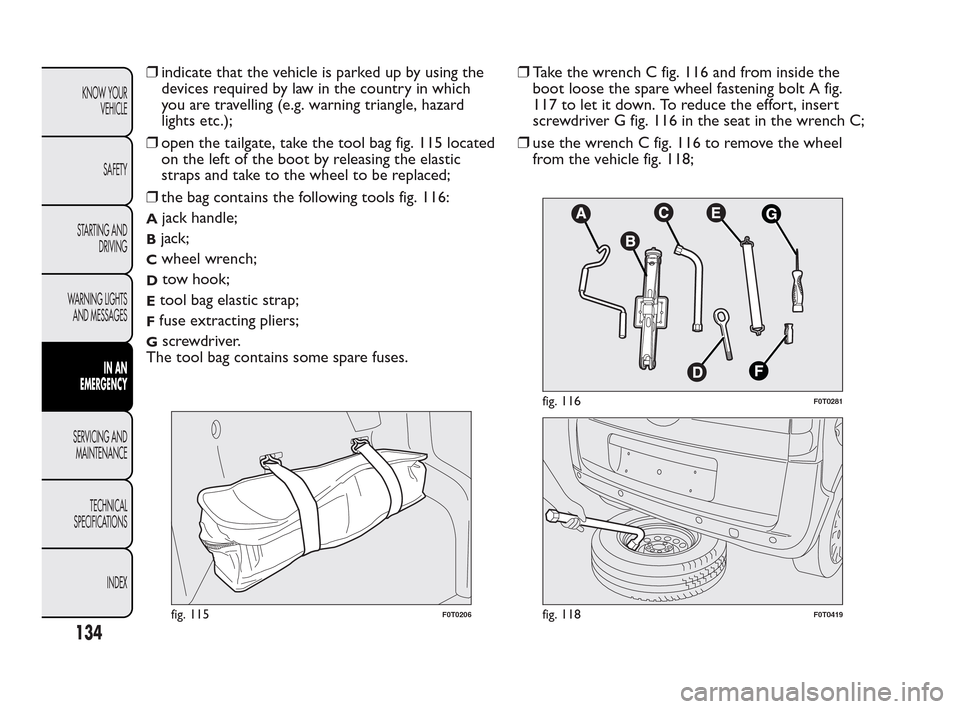
❒open the tailgate, take the tool bag fig. 115 located
on the left of the boot by releasing the elastic
straps and take to the wheel to be replaced;
❒the bag contains the following tools fig. 116:
Ajack handle;
Bjack;
Cwheel wrench;
Dtow hook;
Etool bag elastic strap;
Ffuse extracting pliers;
Gscrewdriver.
The tool bag contains some spare fuses.❒Take the wrench C fig. 116 and from inside the
boot loose the spare wheel fastening bolt A fig.
117 to let it down. To reduce the effort, insert
screwdriver G fig. 116 in the seat in the wrench C;
❒use the wrench C fig. 116 to remove the wheel
from the vehicle fig. 118;
fig. 115F0T0206
fig. 116F0T0281
fig. 118F0T0419
134
KNOW YOUR
VEHICLE
SAFETY
STARTING AND
DRIVING
WARNING LIGHTS
AND MESSAGES
IN AN
EMERGENCY
SERVICING AND
MAINTENANCE
TECHNICAL
SPECIFICA
TIONS
INDEX
Page 157 of 230
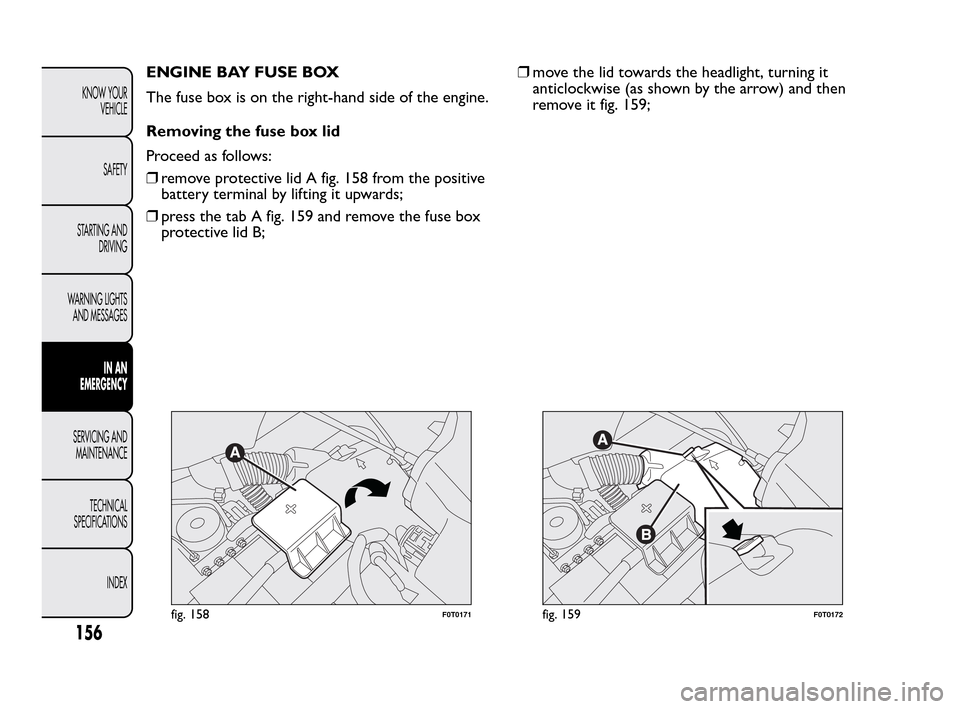
ENGINE BAY FUSE BOX
The fuse box is on the right-hand side of the engine.
Removing the fuse box lid
Proceed as follows:
❒remove protective lid A fig. 158 from the positive
battery terminal by lifting it upwards;
❒press the tab A fig. 159 and remove the fuse box
protective lid B;❒move the lid towards the headlight, turning it
anticlockwise (as shown by the arrow) and then
remove it fig. 159;
fig. 158F0T0171fig. 159F0T0172
156
KNOW YOUR
VEHICLE
SAFETY
STARTING AND
DRIVING
WARNING LIGHTS
AND MESSAGES
IN AN
EMERGENCY
SERVICING AND
MAINTENANCE
TECHNICAL
SPECIFICA
TIONS
INDEX